
UNIT 3 RELATIONS AND FUNCTIONS 5 1 Representing


- Slides: 40
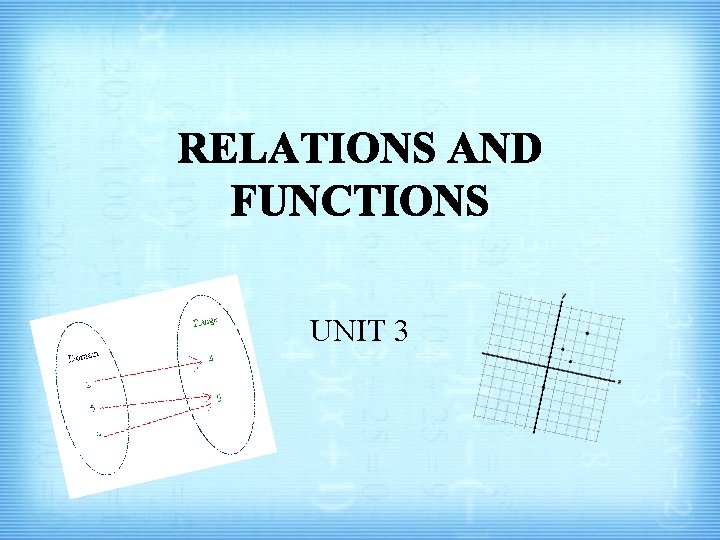
UNIT 3
RELATIONS AND FUNCTIONS • • 5. 1 – Representing Relations 5. 2 – Properties of Functions 5. 3 – Interpreting and Sketching Graphs 5. 4 – Graphing Data 5. 5 – Graphs of Relations and Functions 5. 6 – Properties of Linear Equations 5. 7 – Interpreting Graphs of Linear Functions
5. 1
Students are expected to: • Graph, with or without technology, a set of data, and determine the restrictions on the domain and range. • Explain why data points should or should not be connected on the graph for a situation. • Describe a possible situation for a given graph. • Sketch a possible graph for a given situation. • Determine, and express in a variety of ways, the domain and range of a graph, a set of ordered pairs, or a table of values.
Key Terms • • • arrow diagram relation function set element
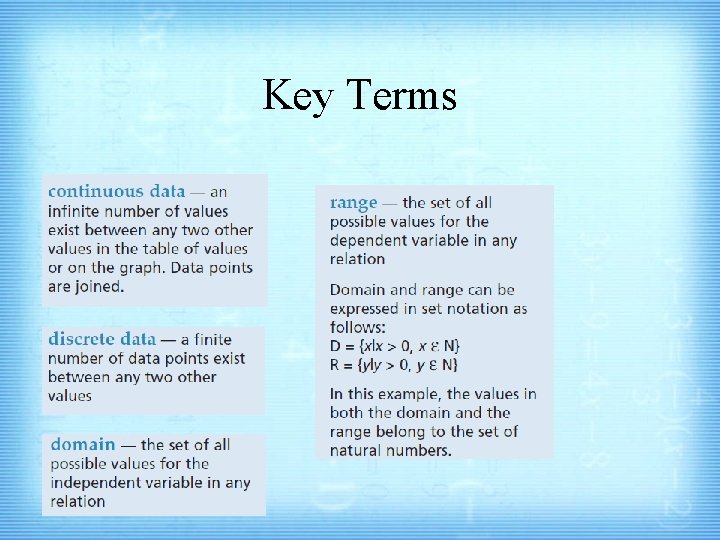
Key Terms
Vocabulary • Write 30 -40 vocabulary from Chapter 5.
Homework • Explore our website. Check out Unit 3 webpage, especially on the Media Resources.
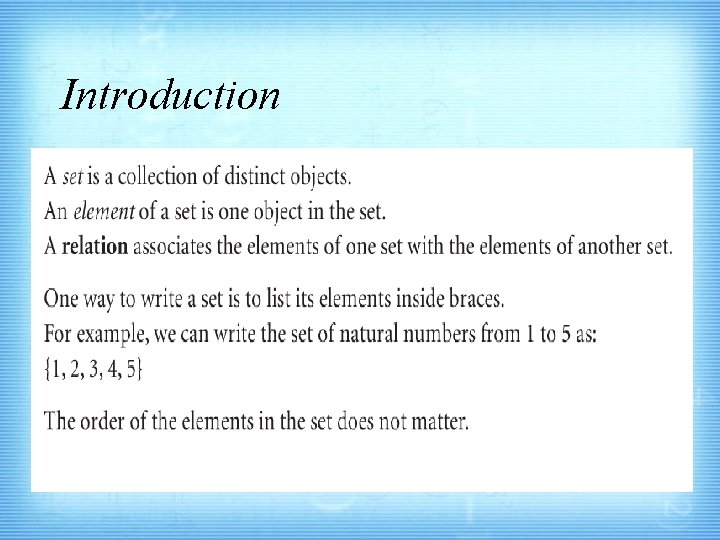
Introduction
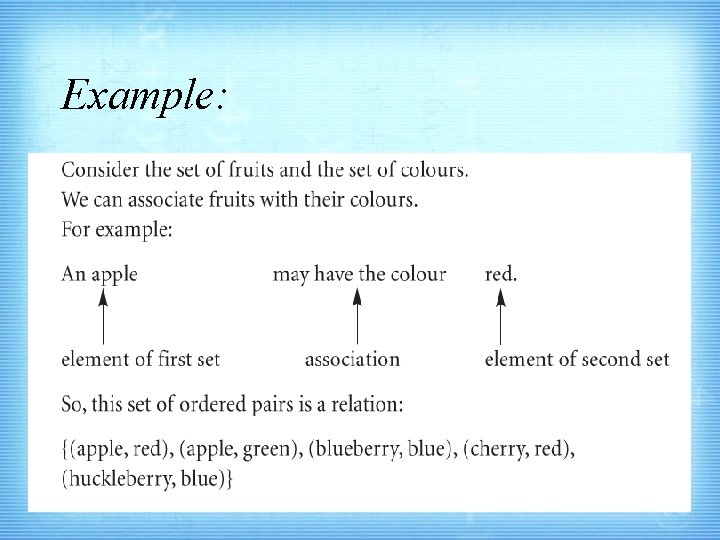
Example:
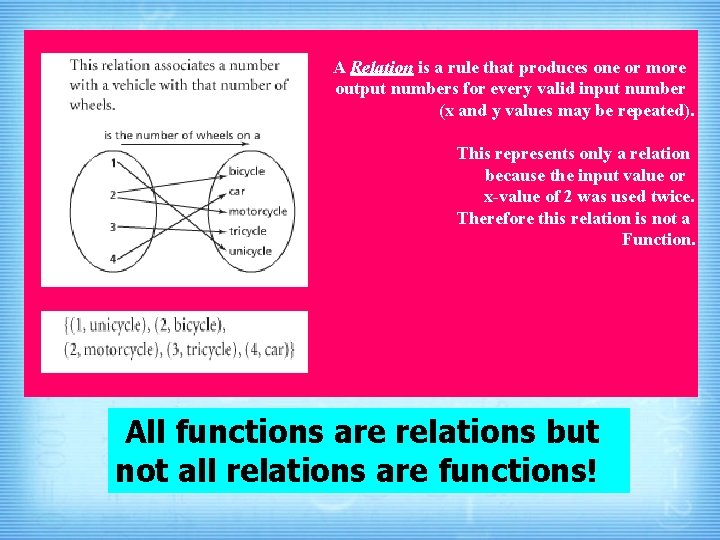
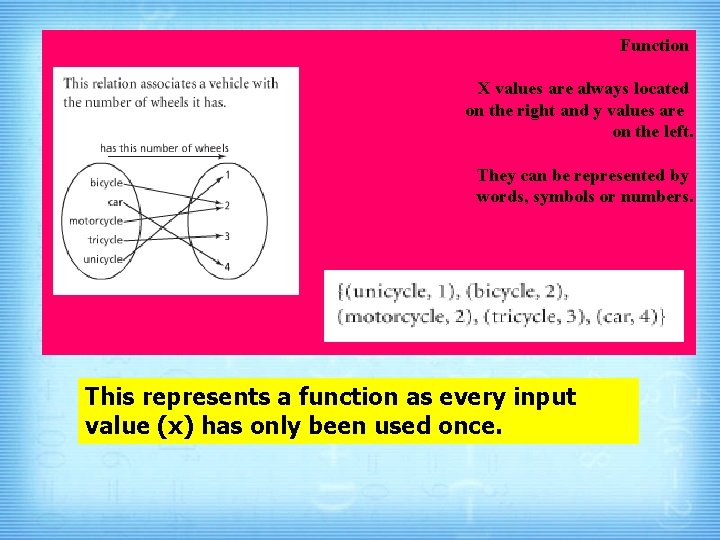
A Relation is a rule that produces one or more output numbers for every valid input number (x and y values may be repeated). This represents only a relation because the input value or x-value of 2 was used twice. Therefore this relation is not a Function. All functions are relations but not all relations are functions!
Function X values are always located on the right and y values are on the left. They can be represented by words, symbols or numbers. This represents a function as every input value (x) has only been used once.
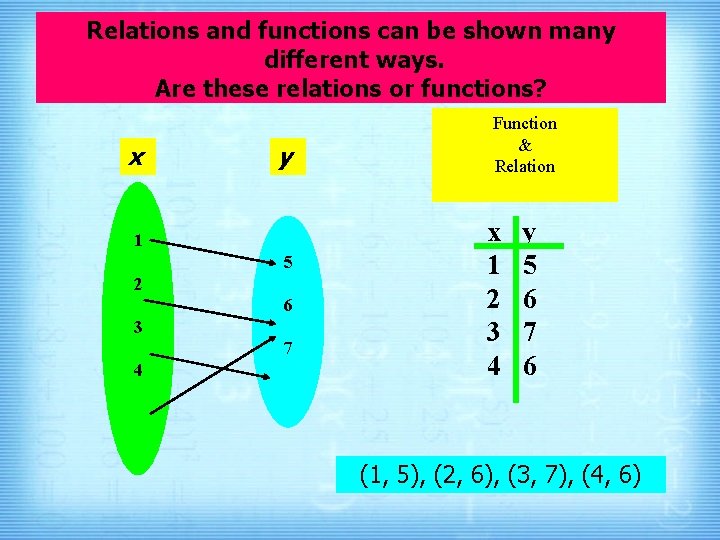
Relations and functions can be shown many different ways. Are these relations or functions? x y 1 5 2 6 3 7 4 Function & Relation x 1 2 3 4 y 5 6 7 6 (1, 5), (2, 6), (3, 7), (4, 6)
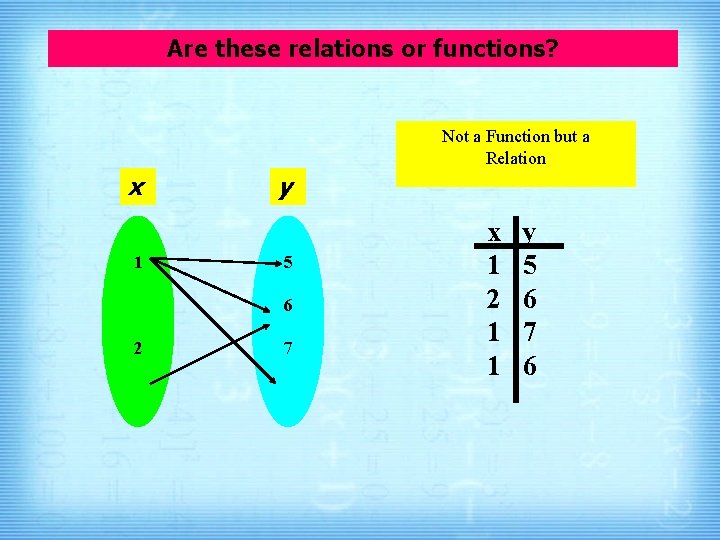
Are these relations or functions? Not a Function but a Relation x 1 y 5 6 2 7 x 1 2 1 1 y 5 6 7 6
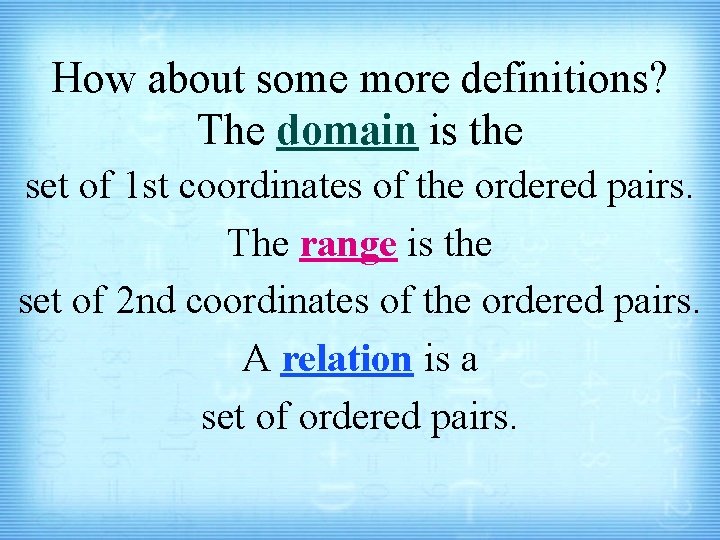
How about some more definitions? The domain is the set of 1 st coordinates of the ordered pairs. The range is the set of 2 nd coordinates of the ordered pairs. A relation is a set of ordered pairs.
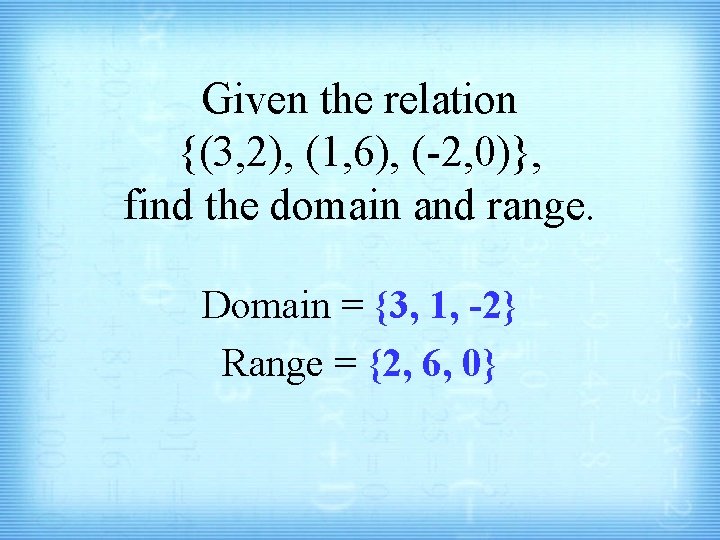
Given the relation {(3, 2), (1, 6), (-2, 0)}, find the domain and range. Domain = {3, 1, -2} Range = {2, 6, 0}
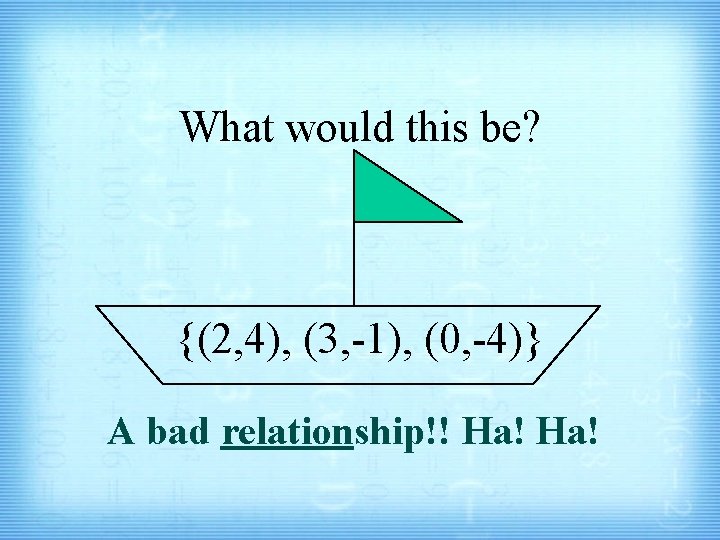
What would this be? {(2, 4), (3, -1), (0, -4)} A bad relationship!! Ha!
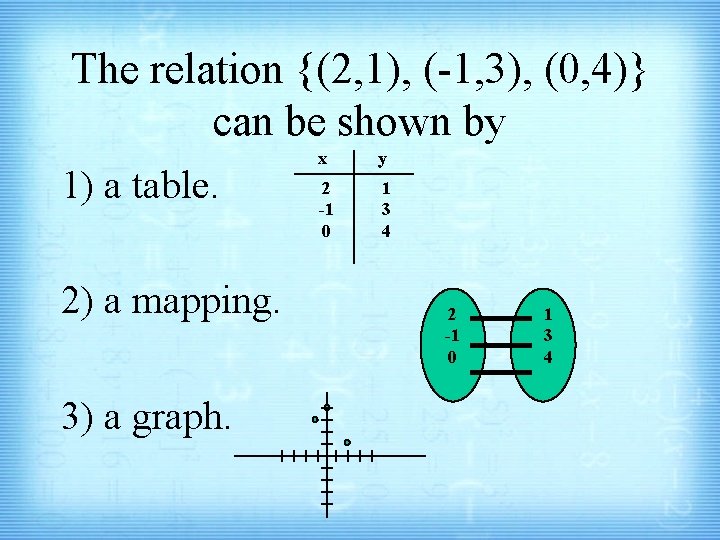
The relation {(2, 1), (-1, 3), (0, 4)} can be shown by 1) a table. 2) a mapping. 3) a graph. x y 2 -1 0 1 3 4
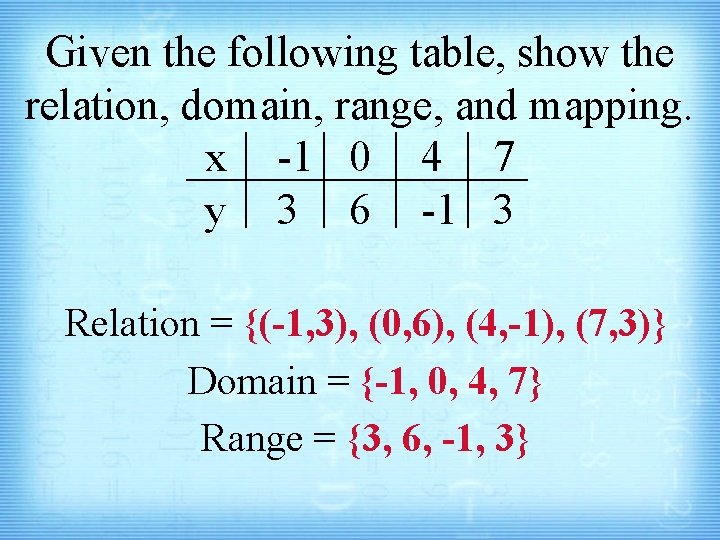
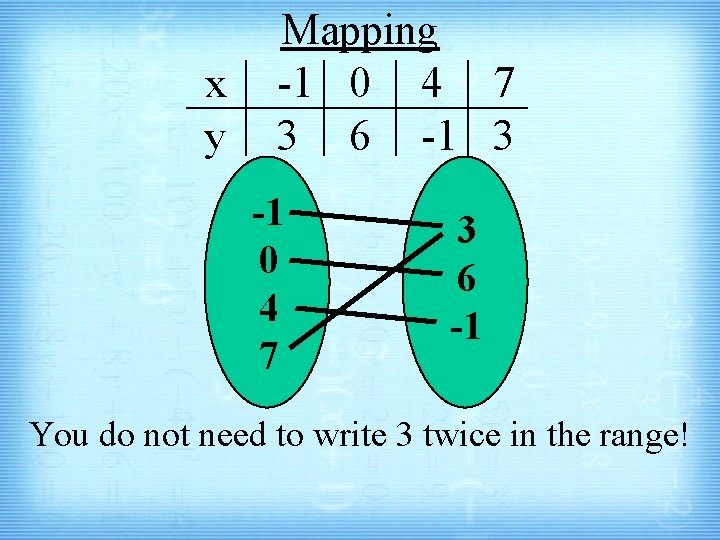
Given the following table, show the relation, domain, range, and mapping. x -1 0 4 7 y 3 6 -1 3 Relation = {(-1, 3), (0, 6), (4, -1), (7, 3)} Domain = {-1, 0, 4, 7} Range = {3, 6, -1, 3}
x y Mapping -1 0 4 7 3 6 -1 3 -1 0 4 7 3 6 -1 You do not need to write 3 twice in the range!
Example 1 - 3 • Refer to the textbook. Page 259 -262
Class Exercises • Refer Sample problems from the textbook on page 259 -260 • Refer Check Your Understanding, # 3 -14 on pages 262 -263
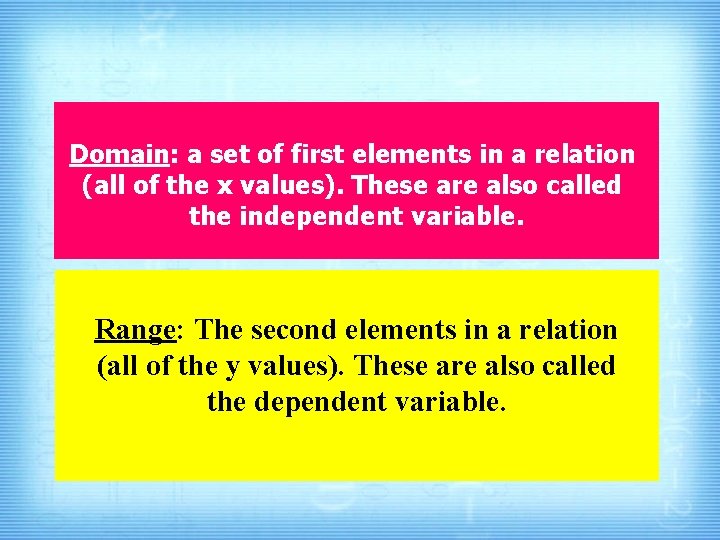
Domain: a set of first elements in a relation (all of the x values). These are also called the independent variable. Range: The second elements in a relation (all of the y values). These are also called the dependent variable.
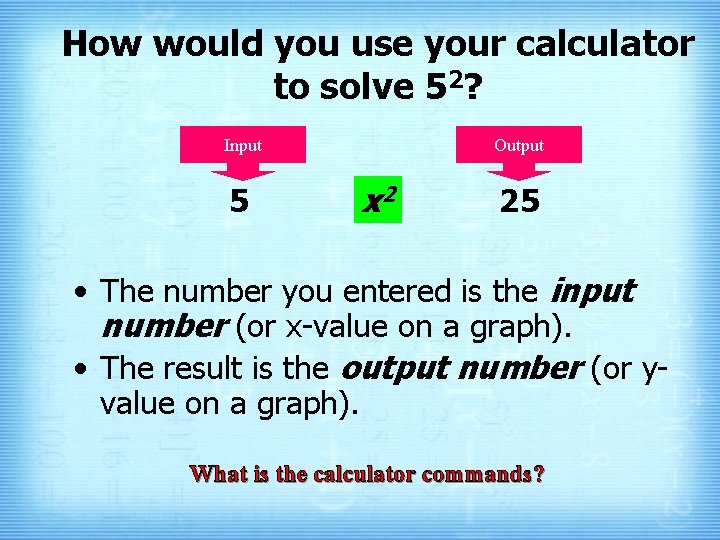
How would you use your calculator to solve 52? Input 5 Output x 2 25 • The number you entered is the input number (or x-value on a graph). • The result is the output number (or yvalue on a graph). What is the calculator commands?
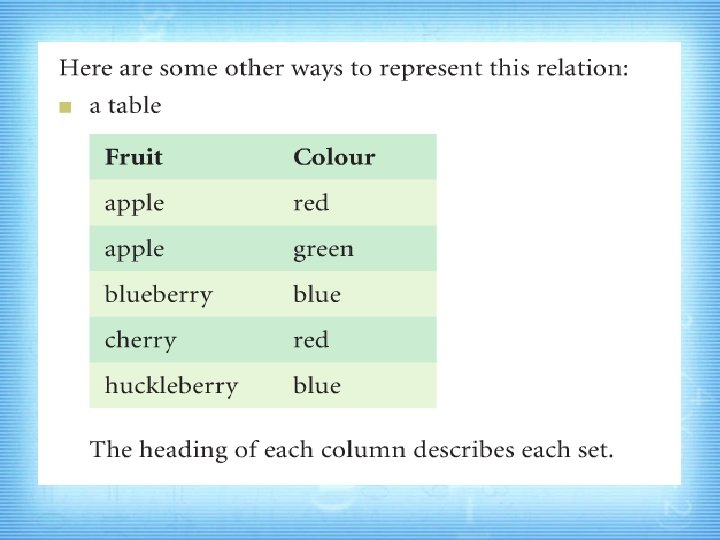
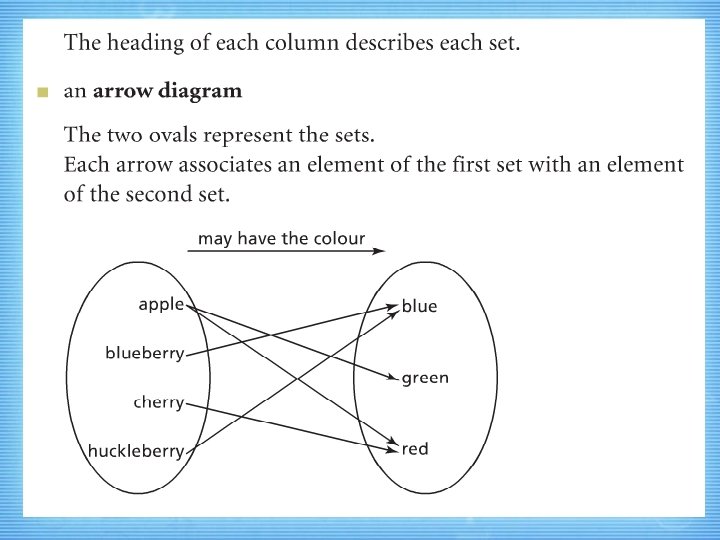
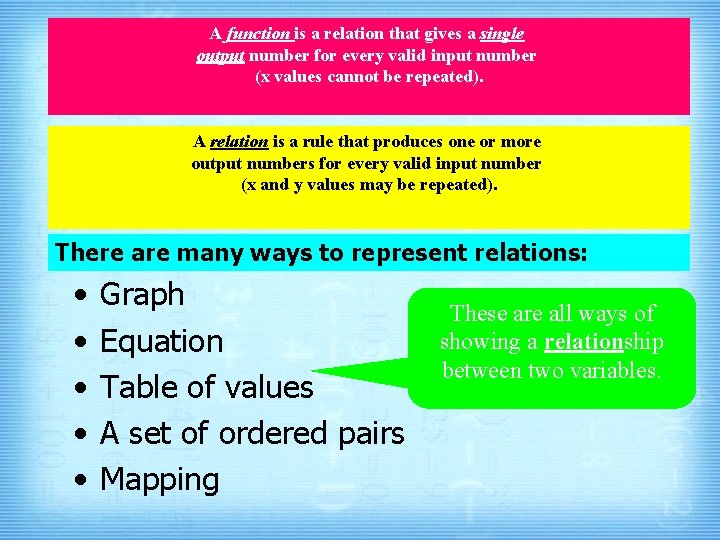
A function is a relation that gives a single output number for every valid input number (x values cannot be repeated). A relation is a rule that produces one or more output numbers for every valid input number (x and y values may be repeated). There are many ways to represent relations: • • • Graph Equation Table of values A set of ordered pairs Mapping These are all ways of showing a relationship between two variables.
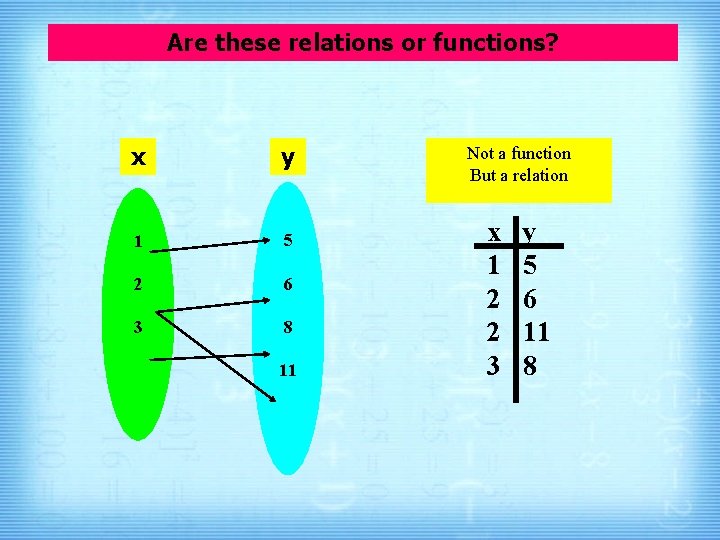
Are these relations or functions? x y 1 5 2 6 3 8 11 Not a function But a relation x 1 2 2 3 y 5 6 11 8
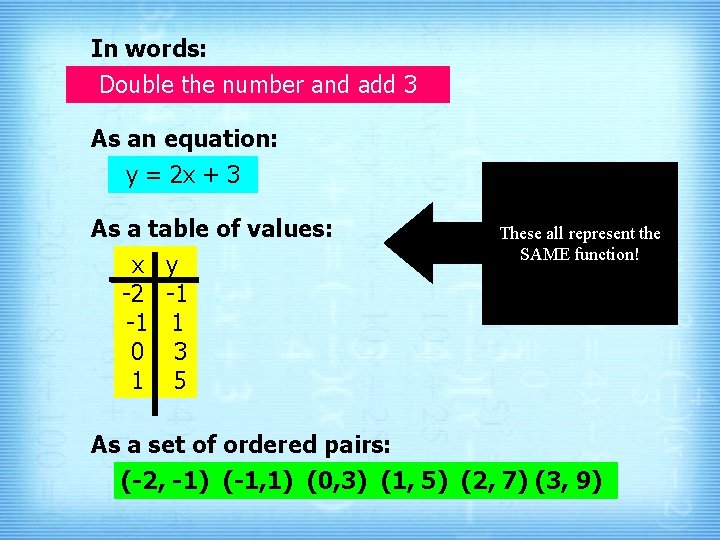
In words: Double the number and add 3 As an equation: y = 2 x + 3 As a table of values: x y -2 -1 -1 1 0 3 1 5 These all represent the SAME function! As a set of ordered pairs: (-2, -1) (-1, 1) (0, 3) (1, 5) (2, 7) (3, 9)
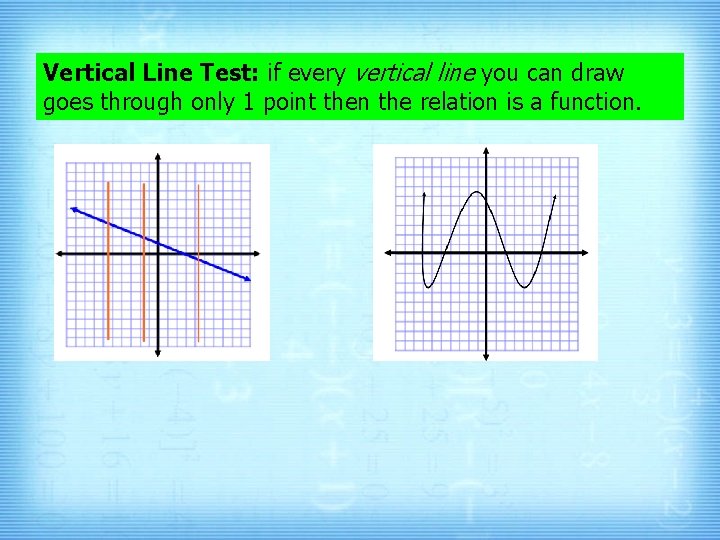
Vertical Line Test: if every vertical line you can draw goes through only 1 point then the relation is a function.
Check Your Understanding
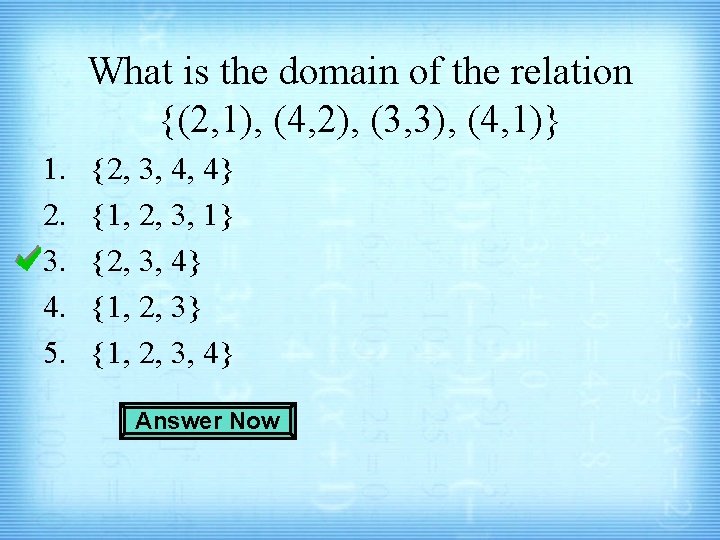
What is the domain of the relation {(2, 1), (4, 2), (3, 3), (4, 1)} 1. 2. 3. 4. 5. {2, 3, 4, 4} {1, 2, 3, 1} {2, 3, 4} {1, 2, 3, 4} Answer Now
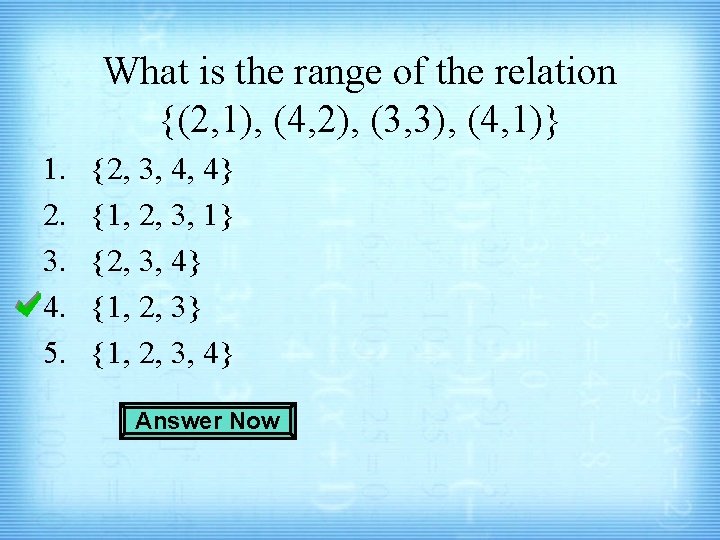
What is the range of the relation {(2, 1), (4, 2), (3, 3), (4, 1)} 1. 2. 3. 4. 5. {2, 3, 4, 4} {1, 2, 3, 1} {2, 3, 4} {1, 2, 3, 4} Answer Now
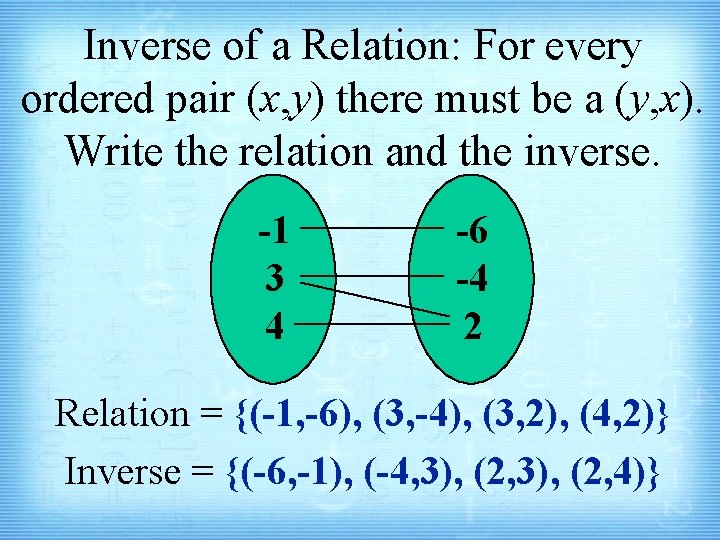
Inverse of a Relation: For every ordered pair (x, y) there must be a (y, x). Write the relation and the inverse. -1 3 4 -6 -4 2 Relation = {(-1, -6), (3, -4), (3, 2), (4, 2)} Inverse = {(-6, -1), (-4, 3), (2, 4)}
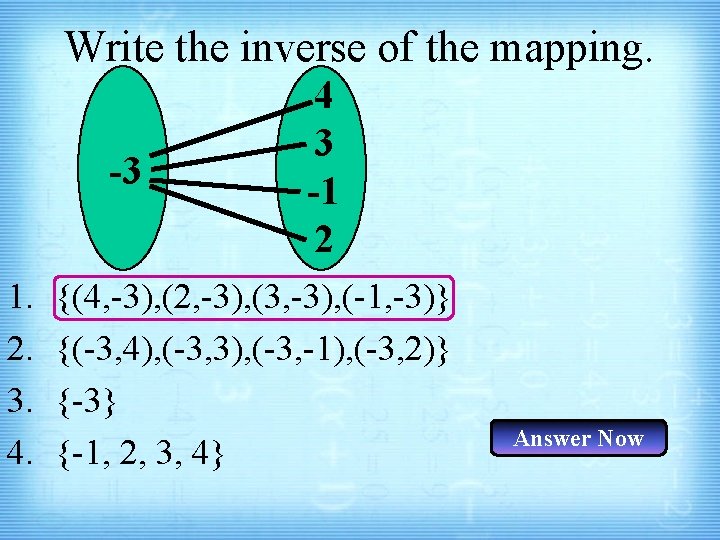
Write the inverse of the mapping. -3 1. 2. 3. 4. 4 3 -1 2 {(4, -3), (2, -3), (3, -3), (-1, -3)} {(-3, 4), (-3, 3), (-3, -1), (-3, 2)} {-3} {-1, 2, 3, 4} Answer Now
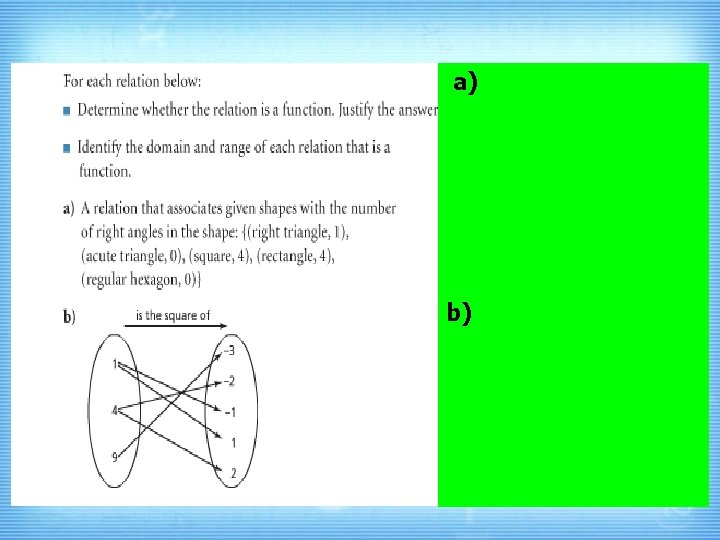
a) b)
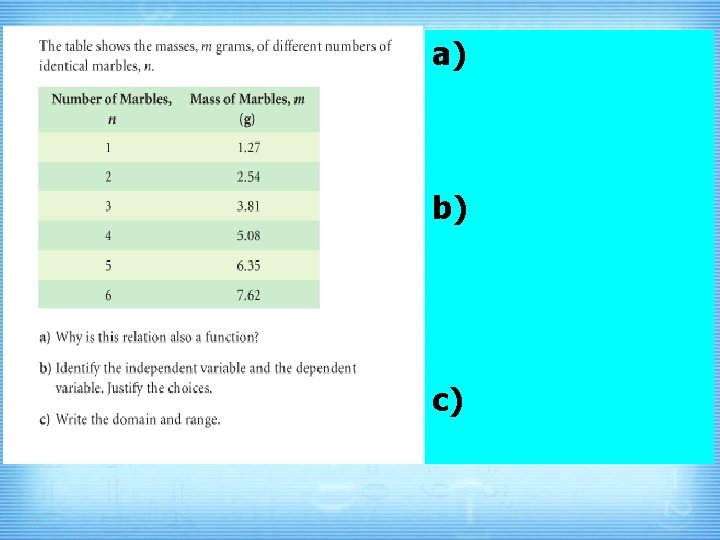
a) b) c)
Class work: Answer CYU # 4 -9 on pages 270 -271.
Homework • Answer CYU # 14 -16, 19 -23 on pages 272273.
References • teachers. henrico. k 12. va. us/ • sms 8 thmath. weebly. com/