
Unit 3 Power Amplifiers Outline 3 1 Concept
- Slides: 36
Unit 3 Power Amplifiers
Outline 3. 1 Concept of power amplifiers 3. 2 Difference between voltage and power amplifiers 3. 3 Classification of power amplifiers 3. 4 Transformer coupled Class A power amplifiers 3. 5 Push pull amplifiers 3. 6 Class A push pull power amplifiers 3. 7 Class B push pull power amplifiers 3. 8 Cross over distortion 3. 9 Class AB push pull power amplifiers 3. 10 Phase Inverter 3. 11 complimentary symmetry Push Pull Amplifier 3. 12 Comparison of Power Amplifiers
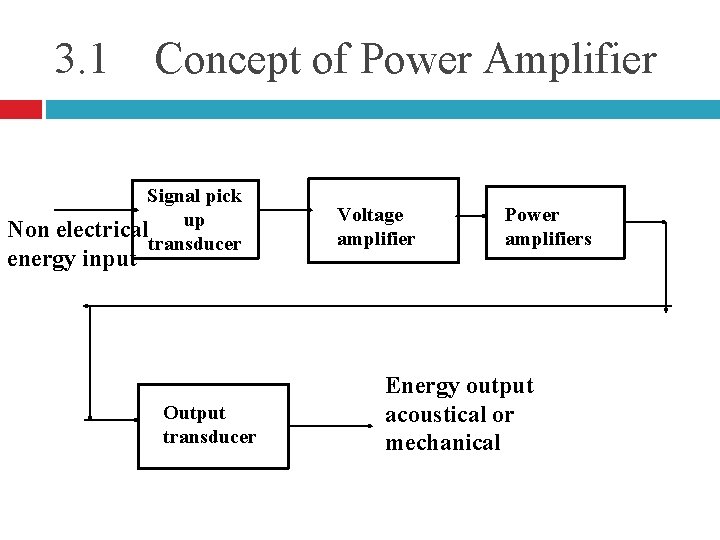
3. 1 Concept of Power Amplifier Signal pick Non electrical up transducer energy input Output transducer Voltage amplifier Power amplifiers Energy output acoustical or mechanical
Continue… Transducer: it is used to convert one form of energy into another type. Voltage amplifier: to amplify the signal. Power amplifier: it is used to raise the power level of the input signal.
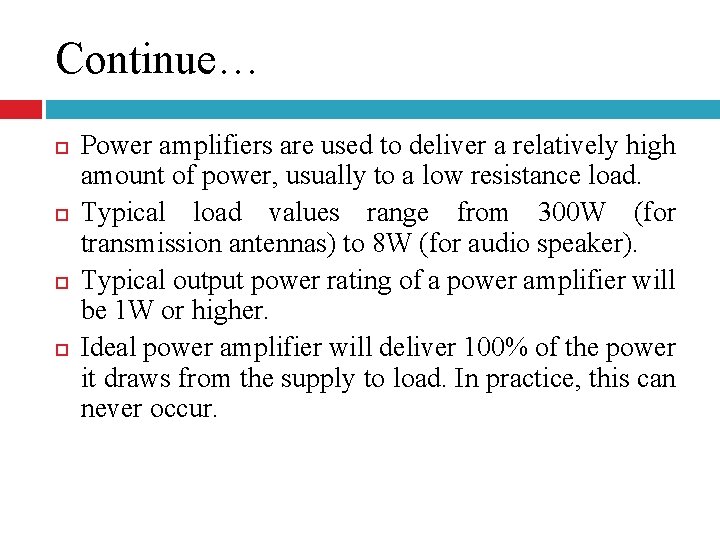
Continue… Power amplifiers are used to deliver a relatively high amount of power, usually to a low resistance load. Typical load values range from 300 W (for transmission antennas) to 8 W (for audio speaker). Typical output power rating of a power amplifier will be 1 W or higher. Ideal power amplifier will deliver 100% of the power it draws from the supply to load. In practice, this can never occur.
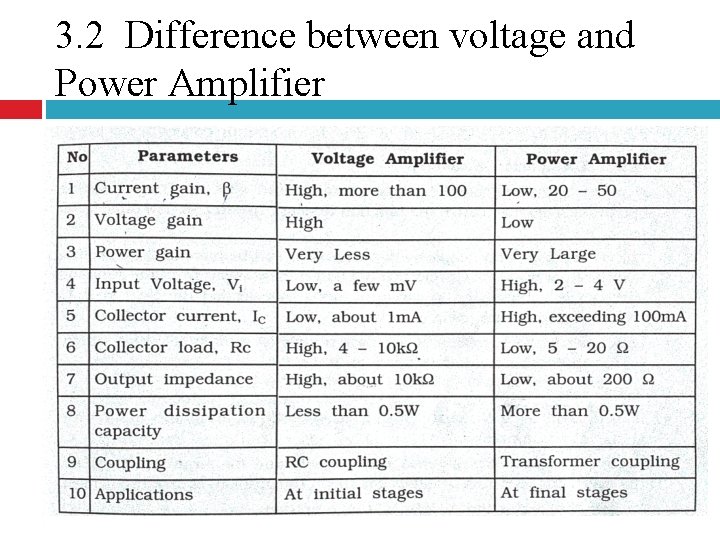
3. 2 Difference between voltage and Power Amplifier
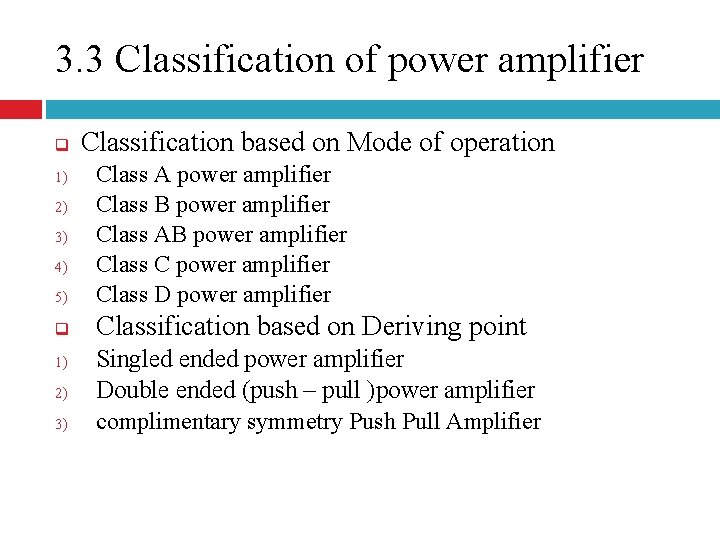
3. 3 Classification of power amplifier q Classification based on Mode of operation 5) Class A power amplifier Class B power amplifier Class AB power amplifier Class C power amplifier Class D power amplifier q Classification based on Deriving point 1) 2) 3) 4) 1) 2) 3) Singled ended power amplifier Double ended (push – pull )power amplifier complimentary symmetry Push Pull Amplifier
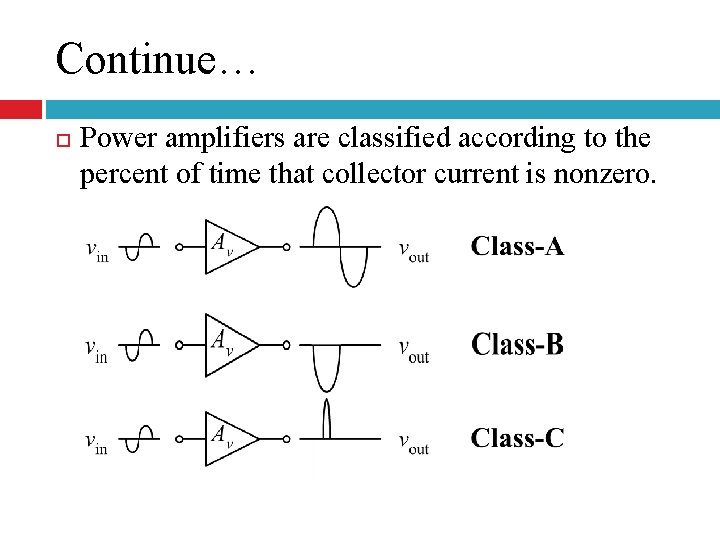
Continue… Power amplifiers are classified according to the percent of time that collector current is nonzero.
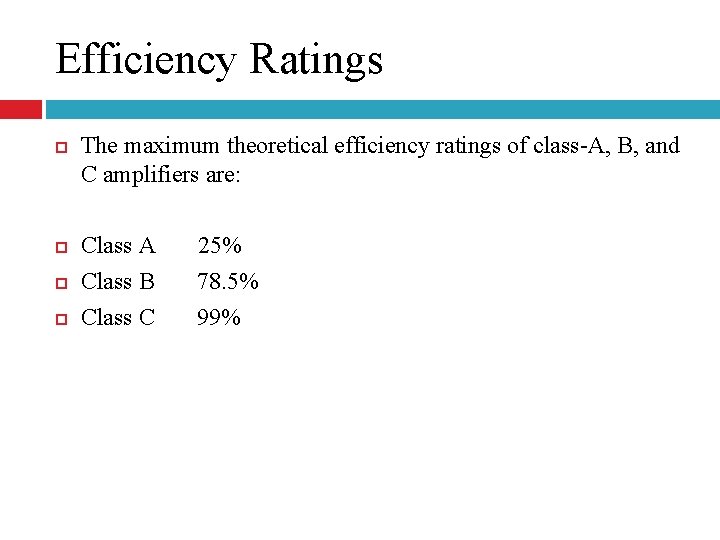
Efficiency Ratings The maximum theoretical efficiency ratings of class-A, B, and C amplifiers are: Class A Class B Class C 25% 78. 5% 99%
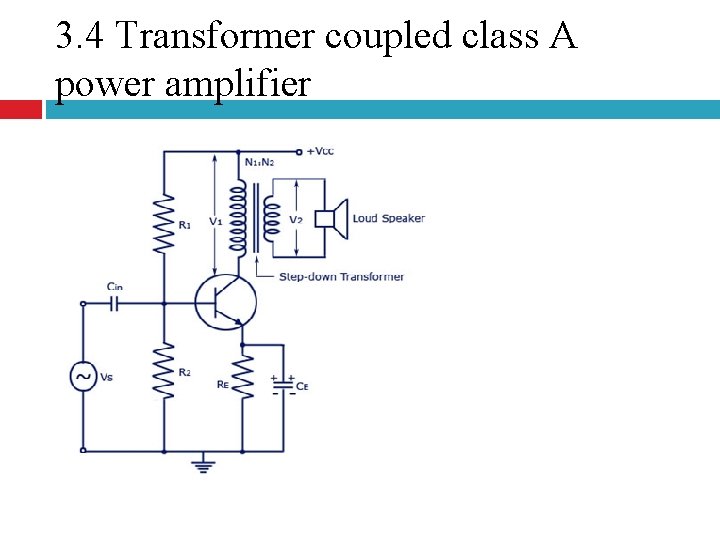
3. 4 Transformer coupled class A power amplifier
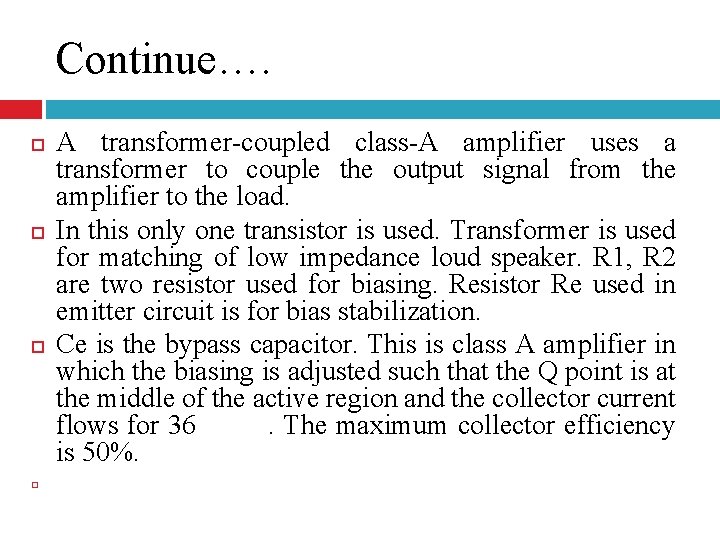
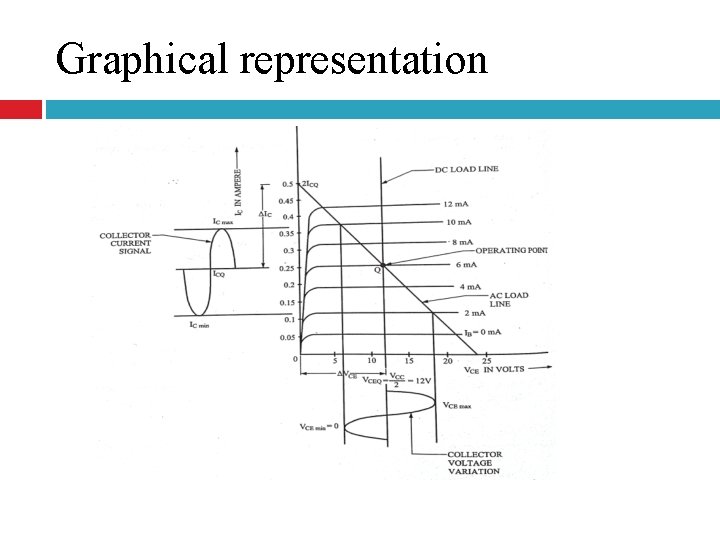
Continue…. A transformer-coupled class-A amplifier uses a transformer to couple the output signal from the amplifier to the load. In this only one transistor is used. Transformer is used for matching of low impedance loud speaker. R 1, R 2 are two resistor used for biasing. Resistor Re used in emitter circuit is for bias stabilization. Ce is the bypass capacitor. This is class A amplifier in which the biasing is adjusted such that the Q point is at the middle of the active region and the collector current flows for 36. The maximum collector efficiency is 50%.
Graphical representation
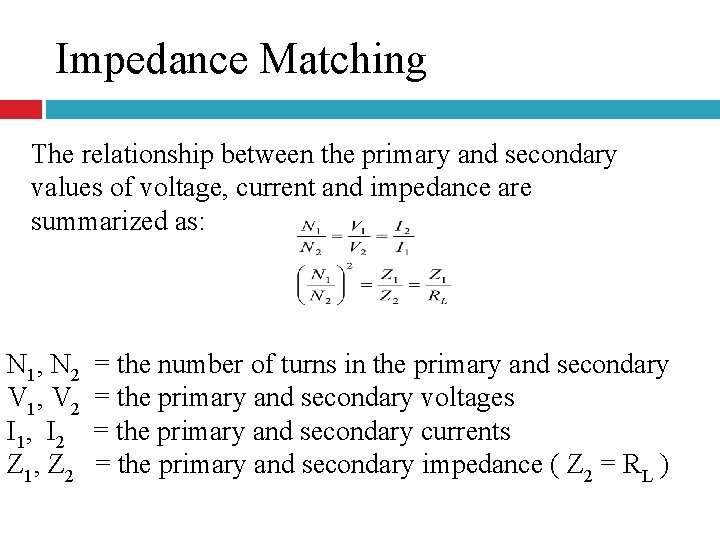
Impedance Matching The relationship between the primary and secondary values of voltage, current and impedance are summarized as: N 1, N 2 V 1, V 2 I 1, I 2 Z 1, Z 2 = the number of turns in the primary and secondary = the primary and secondary voltages = the primary and secondary currents = the primary and secondary impedance ( Z 2 = RL )
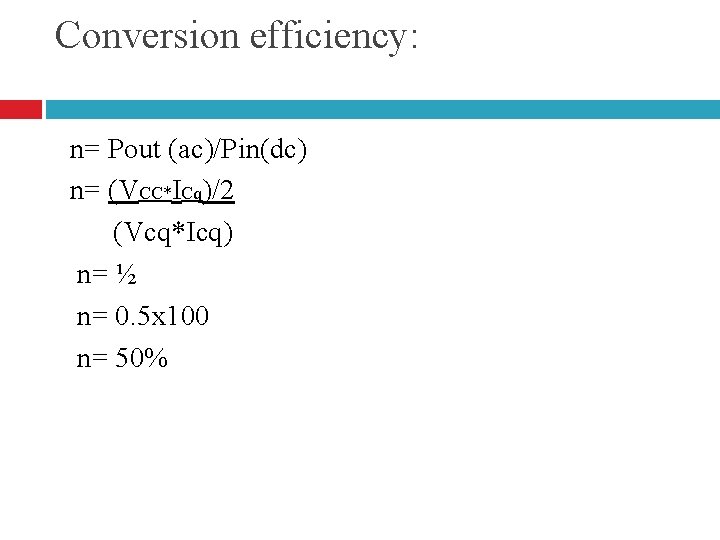
Conversion efficiency: n= Pout (ac)/Pin(dc) n= (VCC*ICq)/2 (Vcq*Icq) n= ½ n= 0. 5 x 100 n= 50%
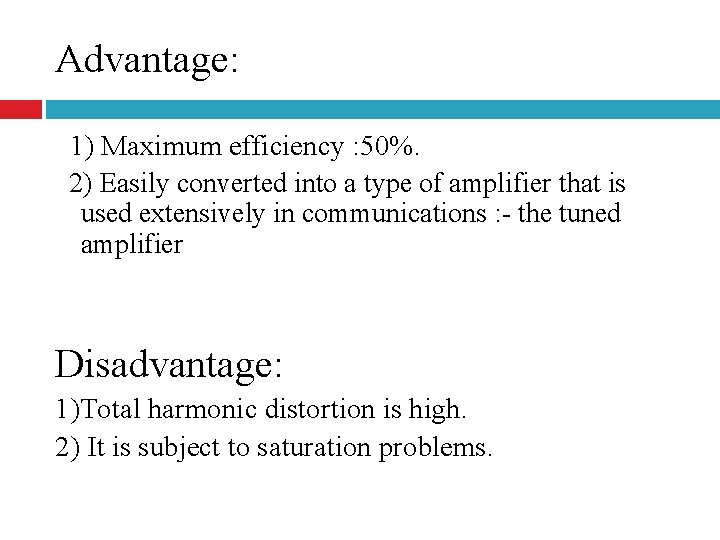
Advantage: 1) Maximum efficiency : 50%. 2) Easily converted into a type of amplifier that is used extensively in communications : - the tuned amplifier Disadvantage: 1)Total harmonic distortion is high. 2) It is subject to saturation problems.
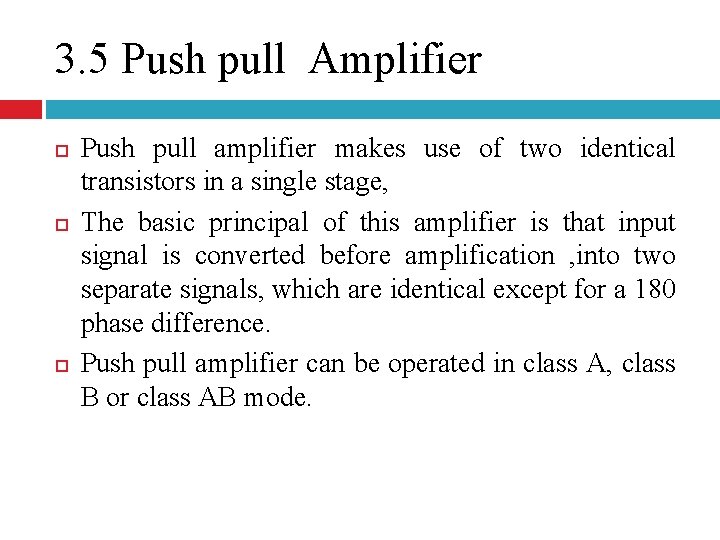
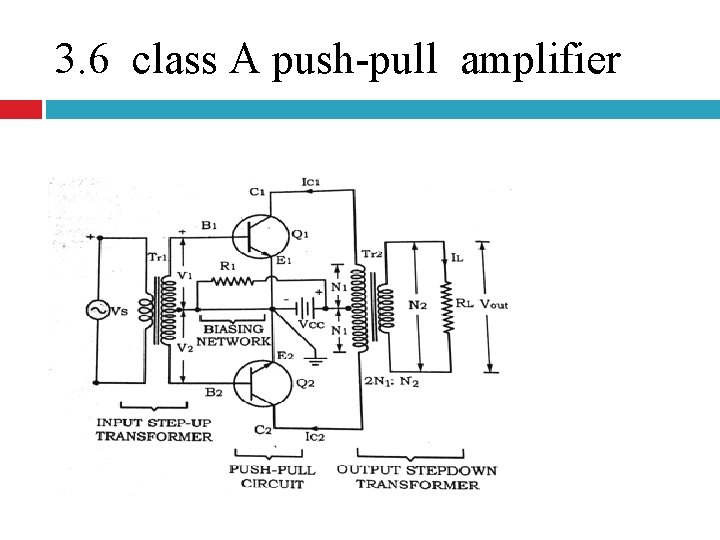
3. 5 Push pull Amplifier Push pull amplifier makes use of two identical transistors in a single stage, The basic principal of this amplifier is that input signal is converted before amplification , into two separate signals, which are identical except for a 180 phase difference. Push pull amplifier can be operated in class A, class B or class AB mode.
3. 6 class A push-pull amplifier
Continue…. When the base current of one transistor is driven positive with respect to the quiescent point Q, the collector current increases. q At the same time reverse action take place in the base circuit of second transistor ; base current decreases causing a drop in the collector current. q So ac current flowing through the transformer primary winding is in the same direction. q As Ic 1 increases (pulls) the Ic 2 decreases (pushes) Hence the name push-pull amplifier. q
Advantage: 1) Eliminate non linear distortion. 2) Gives more output per active device. Disadvantage: 1)It require of two identical or matched pair transistors. 2) It need of bulky and expensive transformer.
3. 7 class B push-pull amplifier
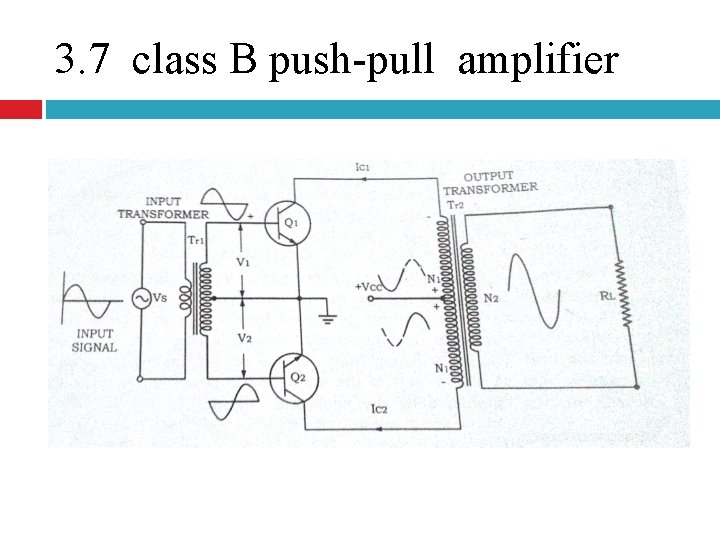
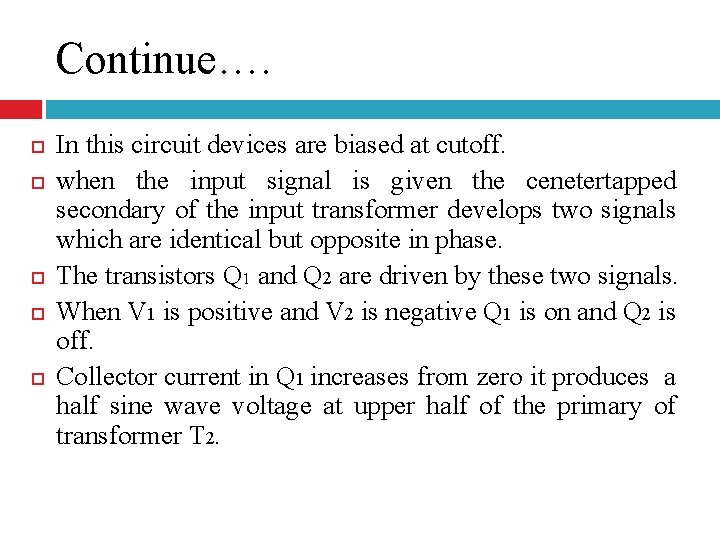
Continue…. In this circuit devices are biased at cutoff. when the input signal is given the cenetertapped secondary of the input transformer develops two signals which are identical but opposite in phase. The transistors Q 1 and Q 2 are driven by these two signals. When V 1 is positive and V 2 is negative Q 1 is on and Q 2 is off. Collector current in Q 1 increases from zero it produces a half sine wave voltage at upper half of the primary of transformer T 2.
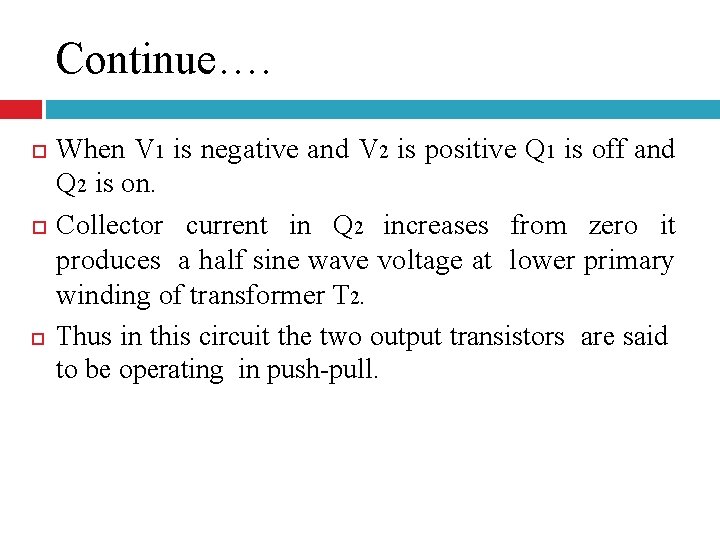
Continue…. When V 1 is negative and V 2 is positive Q 1 is off and Q 2 is on. Collector current in Q 2 increases from zero it produces a half sine wave voltage at lower primary winding of transformer T 2. Thus in this circuit the two output transistors are said to be operating in push-pull.
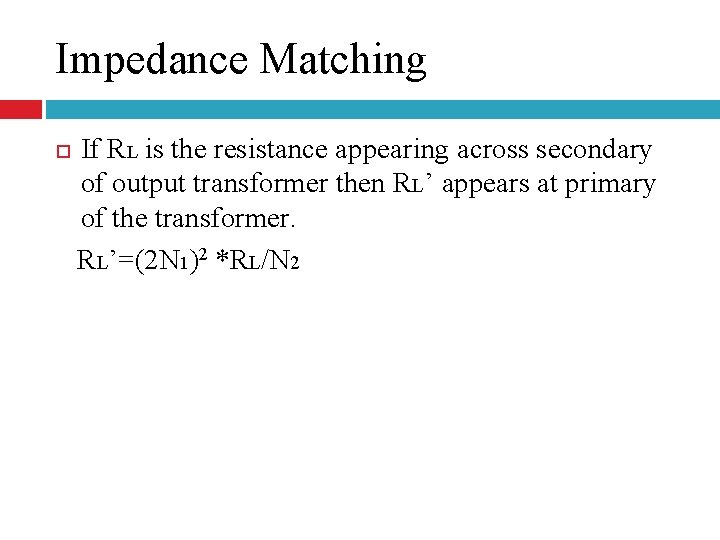
Impedance Matching If RL is the resistance appearing across secondary of output transformer then RL’ appears at primary of the transformer. RL’=(2 N 1)2 *RL/N 2
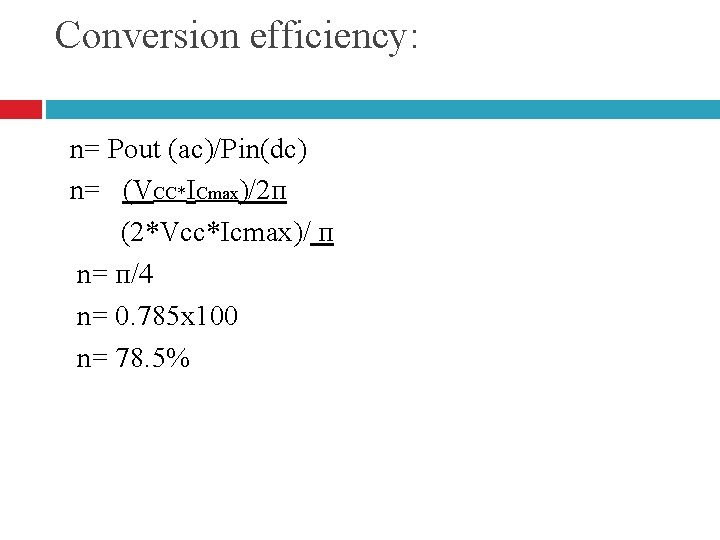
Conversion efficiency: n= Pout (ac)/Pin(dc) n= (VCC*ICmax)/2 п (2*Vcc*Icmax)/ п n= п/4 n= 0. 785 x 100 n= 78. 5%
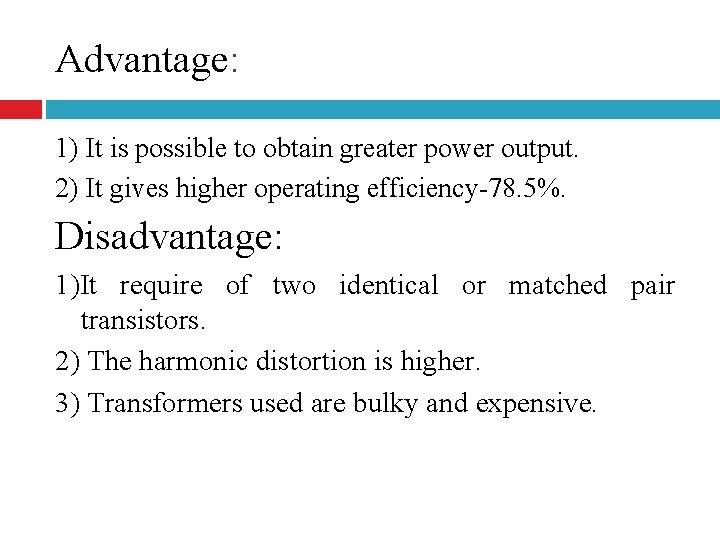
Advantage: 1) It is possible to obtain greater power output. 2) It gives higher operating efficiency-78. 5%. Disadvantage: 1)It require of two identical or matched pair transistors. 2) The harmonic distortion is higher. 3) Transformers used are bulky and expensive.
3. 8 Cross over distortion
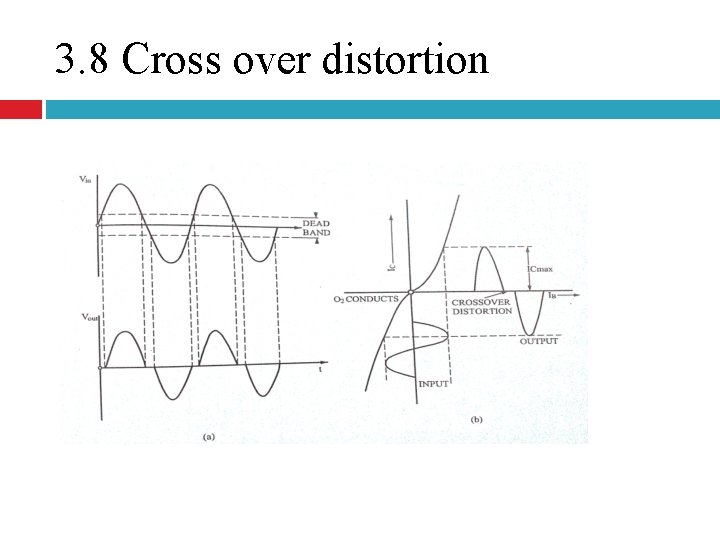
Continue…. In class B push pull amplifiers the forward bias is produced by the input signal. When the input signal is approximately +0. 5 V, both of the transistors will be non-conducting. This forms a “dead band” in the input and produces crossover distortion tin the output. It occurs during the time operation cross over from one transistor to the other in the push pull amplifier.
3. 9 Class AB push-pull amplifier
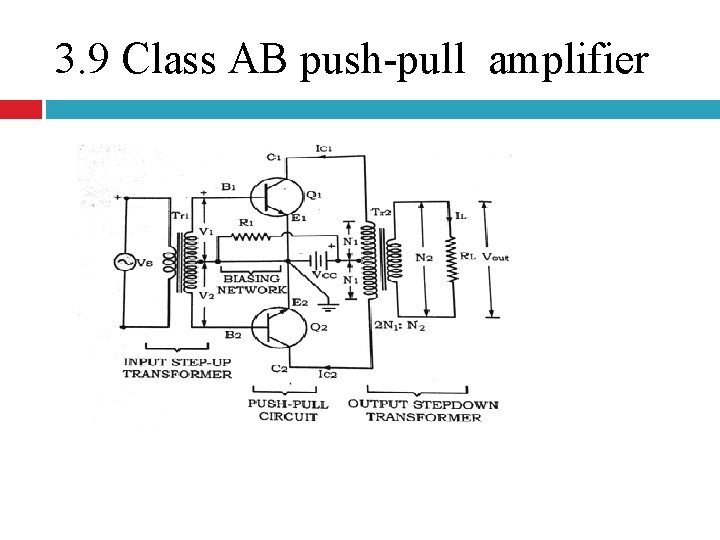
Continue…. The basic circuit of class AB push pull amplifier is the same as that of class A push pull amplifier except that the voltage drop across resistor R 2 is so adjusted that it is approximately equal to cut in voltage. When the base current of one transistor is being driven positive with respect top the quiescent point Q, the collector current increases thus causing a decrease in collector potential relative to ground. As Ic 1 increases the current Ic 2 decreases hence the name is push pull.
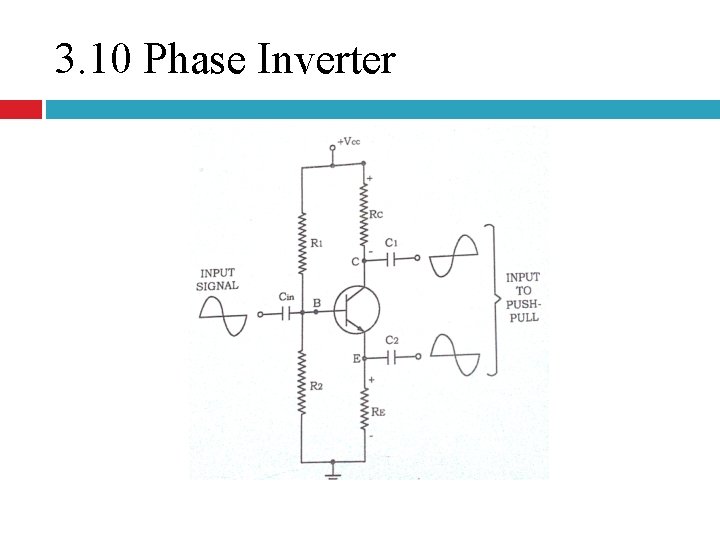
3. 10 Phase Inverter
Continue…. It is used to provide the polarity inversion between the two input signals to the push pull circuit. During the positive half cycle Ib increases so Ic also increases resulting increase in Ic. Rc voltage drop. This result decrease in Vc. E and so the phase of the signal at the collector of the transistor is reversed. So we get negative half cycle of Vc. E. During negative half cycle the output from the emitter is of the same polarity as the input. So the two output signals obtained from this circuit are of opposite polarity.
Disadvantage : This circuit is emitter follower type so there is no voltage gain. Output voltages have some imbalance.
3. 11 Complementary Symmetry pushpull amplifier
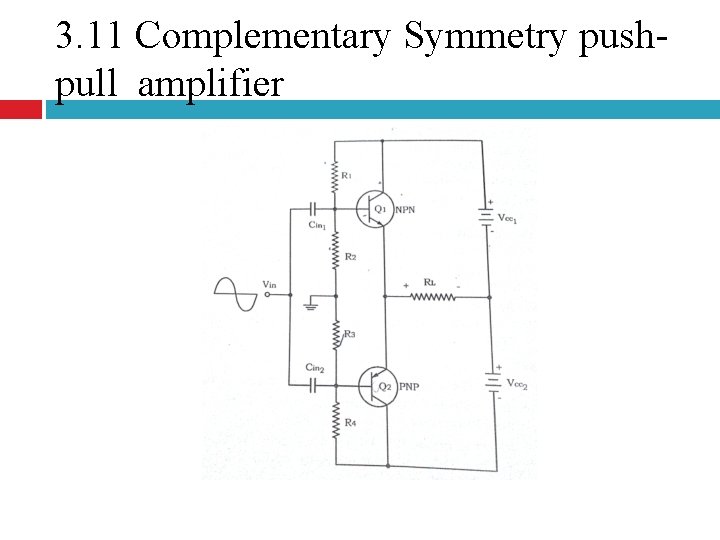
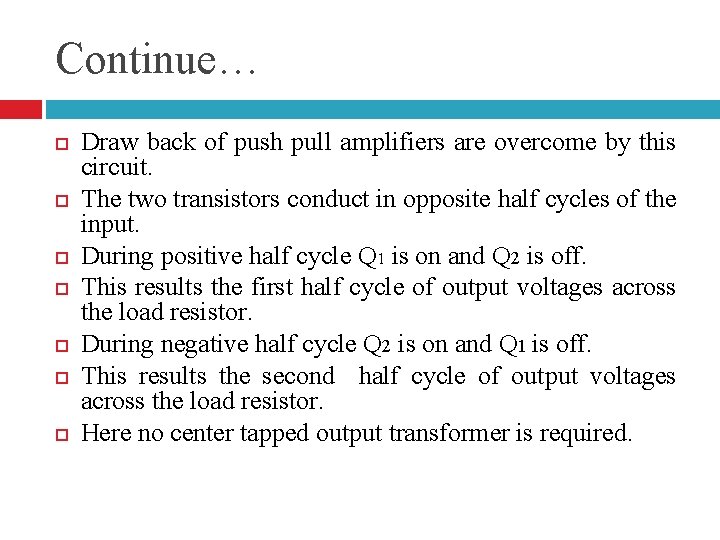
Continue… Draw back of push pull amplifiers are overcome by this circuit. The two transistors conduct in opposite half cycles of the input. During positive half cycle Q 1 is on and Q 2 is off. This results the first half cycle of output voltages across the load resistor. During negative half cycle Q 2 is on and Q 1 is off. This results the second half cycle of output voltages across the load resistor. Here no center tapped output transformer is required.
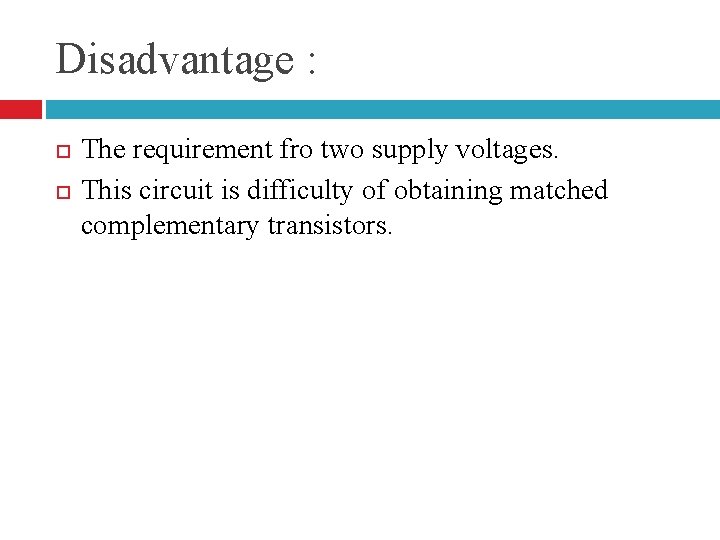
Disadvantage : The requirement fro two supply voltages. This circuit is difficulty of obtaining matched complementary transistors.
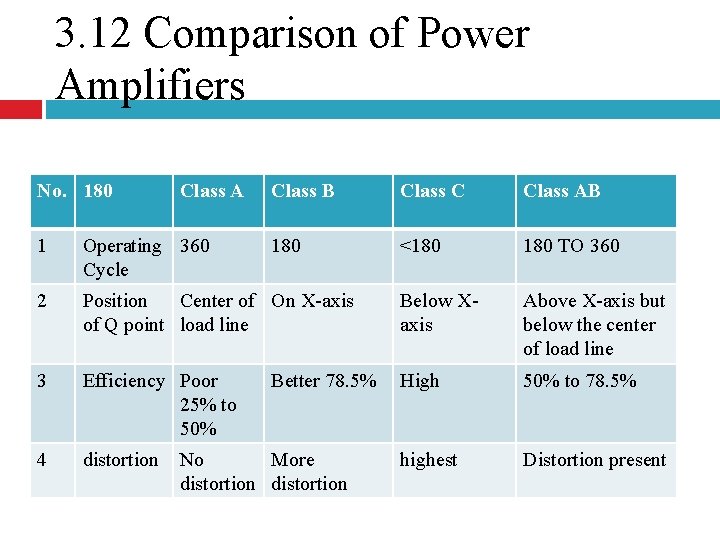
3. 12 Comparison of Power Amplifiers No. 180 Class A Class B Class C Class AB 180 <180 TO 360 1 Operating 360 Cycle 2 Position Center of On X-axis of Q point load line Below Xaxis Above X-axis but below the center of load line 3 Efficiency Poor 25% to 50% High 50% to 78. 5% 4 distortion highest Distortion present Better 78. 5% No More distortion