
Unit 3 Personal Business Finance Mr Barry Year
Unit 3 Personal & Business Finance Mr. Barry Year 12 Business BTEC
Types of expenditure • Expenditure is money spent by a business and can be split into two categories: capital expenditure and revenue expenditure. • You are going to start by looking at capital expenditure. This is used to buy capital items, which are assets that will stay in the business for a long period of time. Capital items are non -current assets and intangible assets Mr. Barry Year 12 Business BTEC
Non-current assets • Non-current assets are items owned by a business that will remain in the business for a reasonable period of time. • These are shown on a business’s statement of financial position (or balance sheet) and include land premises, machinery and equipment, vehicles, and fixtures and fittings. These are sometimes referred to as ‘tangible assets’ because they can be touched Mr. Barry Year 12 Business BTEC
Non-current assets • Non-current assets lose value over their useful economic life • This is known as depreciation • This means that each year their value on the balance sheet is reduced in order to give a fair value of the asset. Mr. Barry Year 12 Business BTEC
Intangibles • An intangible asset is something owned by the business that cannot be touched but adds value to the business. • Can you find four common intangible assets found in business and explain briefly what they are? 10 minutes Mr. Barry Year 12 Business BTEC
Goodwill • When you buy an existing business, its name and reputation will already be known, and it may already have an established customer base or set of clients. • This increases the value of the business and therefore increases the selling price of the business. • A sum of money is added to the value of the business to reflect the value of this goodwill. However, goodwill is difficult to place a figure on – how much would you pay for a recognised brand business name? Mr. Barry Year 12 Business BTEC
Patents • A patent is the legal protection of an invention, such as a unique feature of a product or a new process. • An entrepreneur or business may patent their idea to stop others from copying the idea. • Having a patent allows the business to exploit this in the future by launching an innovative product at a premium (more expensive) selling price. • The patent itself must, therefore, be worth something, but again it is difficult to know exactly how much value to place on it. Mr. Barry Year 12 Business BTEC
Trademarks • A trademark is a symbol, logo, brand name, words or even colour that sets apart one business’s goods or services from those of its competitors. • Trademarks can be a key influence on consumer choice and build a strong brand loyalty. • A trademark, therefore, is of value to a business and consequently recorded as an intangible asset. Mr. Barry Year 12 Business BTEC
Brand name • A feature of a business that is recognised by customers and distinguishes the business from competitors. • Customers will link the brand name to expectations based on previous experiences with the brand. It is sometimes said that a brand name is a promise of what to expect. Mr. Barry Year 12 Business BTEC
Knowledge check • Can you explain what an intangible asset is? • Explain briefly some examples? 3 minutes End Mr. Barry Year 12 Business BTEC
Revenue expenditure • Revenue expenditure is spending on items on a day-to-day or regular basis. • These are the expenses incurred by a business that are shown on the profit and loss account (also known as a statement of comprehensive income). • The types of costs incurred vary from business to business. Mr. Barry Year 12 Business BTEC
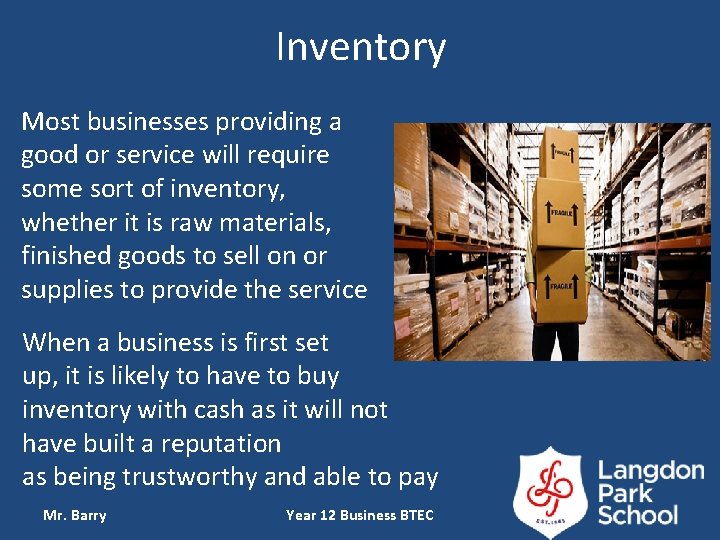
Inventory Most businesses providing a good or service will require some sort of inventory, whether it is raw materials, finished goods to sell on or supplies to provide the service When a business is first set up, it is likely to have to buy inventory with cash as it will not have built a reputation as being trustworthy and able to pay Mr. Barry Year 12 Business BTEC
Inventory • As a business becomes more established, it may be able to buy inventory on credit (such as receiving the inventory and paying 30 days later) • Bigger and more established businesses may also be able to drive the cost of inventory down as they will buy in larger quantities. There are other costs related to inventory, such as insurance and storage costs Mr. Barry Year 12 Business BTEC
Rent • This is the cost of using premises not owned by the business. These are regular payments, usually monthly, for the use of premises. Mr. Barry Year 12 Business BTEC
Rates • In the same way as private residents pay council tax to the local authority, businesses pay non-domestic rates. • This is a sum of money paid to the local council to go towards services such as street lights and refuse collection. • This is not a set amount, but is calculated by the council based on the size and location of the premises and the nature of the business Mr. Barry Year 12 Business BTEC
Heating and lighting • This covers payments for services such as gas and electricity. • The business will receive regular bills, often quarterly (every three months) for the provision and use of these services Mr. Barry Year 12 Business BTEC
Water • This involves payment for the supply of water to premises and use of water • This can be a fixed rate or based upon usage if a water meter is fitted Mr. Barry Year 12 Business BTEC
Insurance • A business is legally required to take out a number of types of insurance. Can you name and explain them? 5 minutes End Mr. Barry Year 12 Business BTEC
Administration • Administration refers to the paperwork that goes on within a business either internally between employees or externally with suppliers and customers • Administrative costs include items such as postage, printing and stationery, which might include items such as business cards, headed paper and order books Mr. Barry Year 12 Business BTEC
Administration • Telephone charges are also classed as an administrative cost and are slightly unusual from an accounting point of view • For a landline, these costs are split into two: there is the line rental cost, which is paid quarterly in advance and then the call charges, which are paid quarterly after use. Mr. Barry Year 12 Business BTEC
Salaries • A salary is an annual figure paid to an employee divided into equal monthly payments. Mr. Barry Year 12 Business BTEC
• A trainee accountant may have a salary of £ 18, 000 per year, meaning their gross pay is £ 1500 per month. • The employee will then have to pay National Insurance, tax and maybe pension contributions on this figure, so the amount they actually take home will be quite a bit less • For the business, however, the actual amount they have to pay (the real cost to the business) is higher • On a salary of £ 18, 000 the business also has to pay employers’ National Insurance of 12. 8 per cent, (an additional £ 2304) plus any pension and other benefits Mr. Barry Year 12 Business BTEC
Wages • A wage is an hourly rate paid to an employee, meaning there is a direct link between the number of hours worked and the amount of money paid • Paying a wage rather than a salary allows greater flexibility for both the employer and the employee, but also creates greater uncertainty Mr. Barry Year 12 Business BTEC
Research • Employers in the UK, by law, have to pay a minimum wage to all employees over 16. • From April 2016 a National Living Wage will be introduced for workers over 25 1. What is the current minimum wage in the UK? 2. Should business pay a National living wage? Debate the arguments for and against introducing the living wage Mr. Barry Year 12 Business BTEC
Marketing • This covers a whole range of costs associated with attracting the customer and convincing them to make a purchase • Possible marketing costs might include advertisements, promotional literature, promotional events, point of sale material Mr. Barry Year 12 Business BTEC
Bank charges • Unlike personal banking, which is generally free, banks charge businesses for each transaction that takes place, for example, every time a cheque is paid in or written, whenever cash is deposited, and so on • Banks might offer free banking to businesses for the first year as a marketing technique, but, once the first year is over, bank charges can soon start to add up to quite a large amount of money. Mr. Barry Year 12 Business BTEC
Interest paid • If the business has a bank loan or a mortgage, then interest will be charged on this • Banks may offer big businesses preferential rates if they are confident that the money will be paid back and if they want to keep that particular business as a loyal customer • Big businesses will carry out a lot of transactions and pay high bank charges, so, for the bank, it may be worth offering lower interest rates to keep them happy Mr. Barry Year 12 Business BTEC
Depreciation • Can you research what depreciation mean? • In particular, please focus on the two methods of calculating depreciation and the purpose of it in terms of revenue expenditure 5 minutes Mr. Barry Year 12 Business BTEC
Discount allowed • Reductions offered to customers are an expense to a business as it reduces the amount of cash flowing into the business • Discounts may be allowed to attract customers, for bulk purchases or to gain a competitive advantage Mr. Barry Year 12 Business BTEC
Pause Point • Can you explain, with the use of examples, the difference between capital expenditure and revenue expenditure? • Close the book and draw a concept map about the classifications of expenditure. 1: 00 1: 01 1: 02 1: 03 1: 04 1: 05 1: 06 1: 07 1: 08 1: 09 1: 10 1: 11 1: 12 1: 13 1: 14 1: 15 1: 16 1: 17 1: 18 1: 19 1: 20 1: 21 1: 22 1: 23 1: 24 1: 25 1: 26 1: 27 1: 28 1: 29 1: 30 1: 31 1: 32 1: 33 1: 34 1: 35 1: 36 1: 37 1: 38 1: 39 1: 40 1: 41 1: 42 1: 43 1: 44 1: 45 1: 46 1: 47 1: 48 1: 49 1: 50 1: 51 1: 52 1: 53 1: 54 1: 55 1: 56 1: 57 1: 58 1: 59 2: 00 0: 01 0: 02 0: 03 0: 04 0: 05 0: 06 0: 07 0: 08 0: 09 0: 10 0: 11 0: 12 0: 13 0: 14 0: 15 0: 16 0: 17 0: 18 0: 19 0: 20 0: 21 0: 22 0: 23 0: 24 0: 25 0: 26 0: 27 0: 28 0: 29 0: 30 0: 31 0: 32 0: 33 0: 34 0: 35 0: 36 0: 37 0: 38 0: 39 0: 40 0: 41 0: 42 0: 43 0: 44 0: 45 0: 46 0: 47 0: 48 0: 49 0: 50 0: 51 0: 52 0: 53 0: 54 0: 55 0: 56 0: 57 0: 58 0: 59 End Mr. Barry Year 12 Business BTEC
Assessment practice 3. 3 1 Identify one intangible asset. (1 mark) 2 Identify two sources of revenue income. (2 marks) 3 Outline what is meant by ‘depreciation’. (2 mark) Mr. Barry Year 12 Business BTEC
- Slides: 31