
Unit 3 past simple and past continuous We

- Slides: 9
Unit 3 – past simple and past continuous
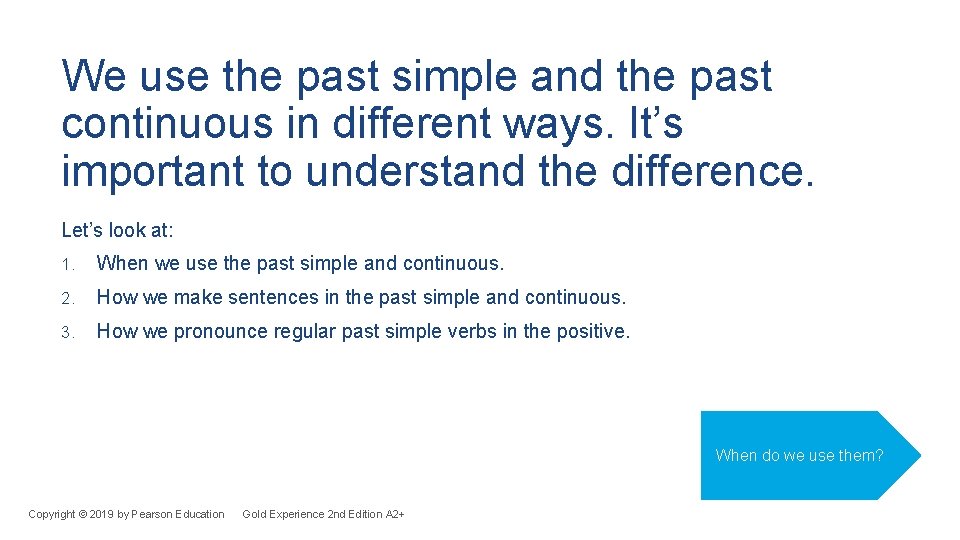
We use the past simple and the past continuous in different ways. It’s important to understand the difference. Let’s look at: 1. When we use the past simple and continuous. 2. How we make sentences in the past simple and continuous. 3. How we pronounce regular past simple verbs in the positive. When do we use them? Copyright © 2019 by Pearson Education Gold Experience 2 nd Edition A 2+
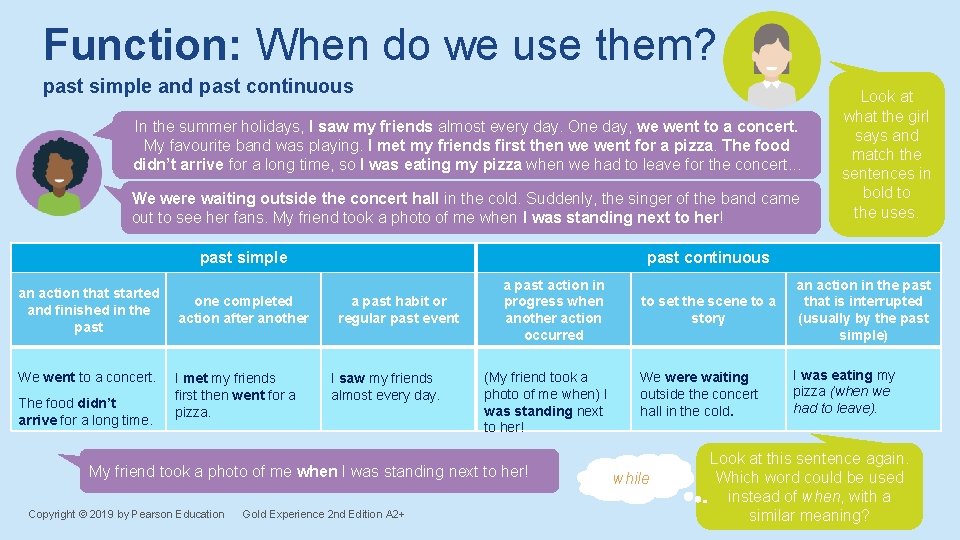
Function: When do we use them? past simple and past continuous In the summer holidays, I saw my friends almost every day. One day, we went to a concert. My favourite band was playing. I met my friends first then we went for a pizza. The food didn’t arrive for a long time, so I was eating my pizza when we had to leave for the concert. . . We were waiting outside the concert hall in the cold. Suddenly, the singer of the band came out to see her fans. My friend took a photo of me when I was standing next to her! past simple an action that started and finished in the past We went to a concert. The food didn’t arrive for a long time. one completed action after another I met my friends first then went for a pizza. Look at what the girl says and match the sentences in bold to the uses. past continuous a past habit or regular past event I saw my friends almost every day. a past action in progress when another action occurred (My friend took a photo of me when) I was standing next to her! My friend took a photo of me when I was standing next to her! Copyright © 2019 by Pearson Education Gold Experience 2 nd Edition A 2+ to set the scene to a story an action in the past that is interrupted (usually by the past simple) We were waiting outside the concert hall in the cold. I was eating my pizza (when we had to leave). while Look at this sentence again. Which word could be used instead of when, with a similar meaning?
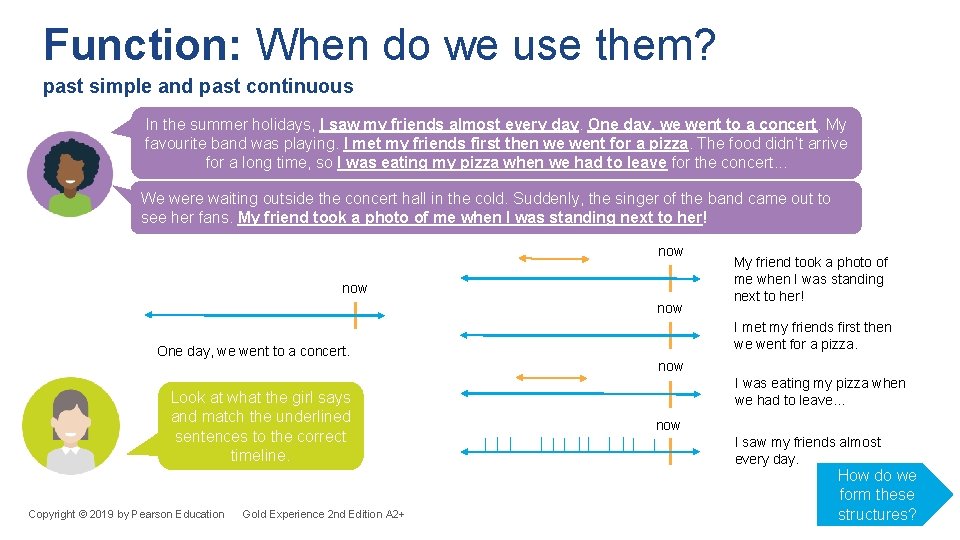
Function: When do we use them? past simple and past continuous In the summer holidays, I saw my friends almost every day. One day, we went to a concert. My favourite band was playing. I met my friends first then we went for a pizza. The food didn’t arrive for a long time, so I was eating my pizza when we had to leave for the concert. . . We were waiting outside the concert hall in the cold. Suddenly, the singer of the band came out to see her fans. My friend took a photo of me when I was standing next to her! now now One day, we went to a concert. Look at what the girl says and match the underlined sentences to the correct timeline. Copyright © 2019 by Pearson Education Gold Experience 2 nd Edition A 2+ My friend took a photo of me when I was standing next to her! I met my friends first then we went for a pizza. now I was eating my pizza when we had to leave. . . now I saw my friends almost every day. How do we form these structures?
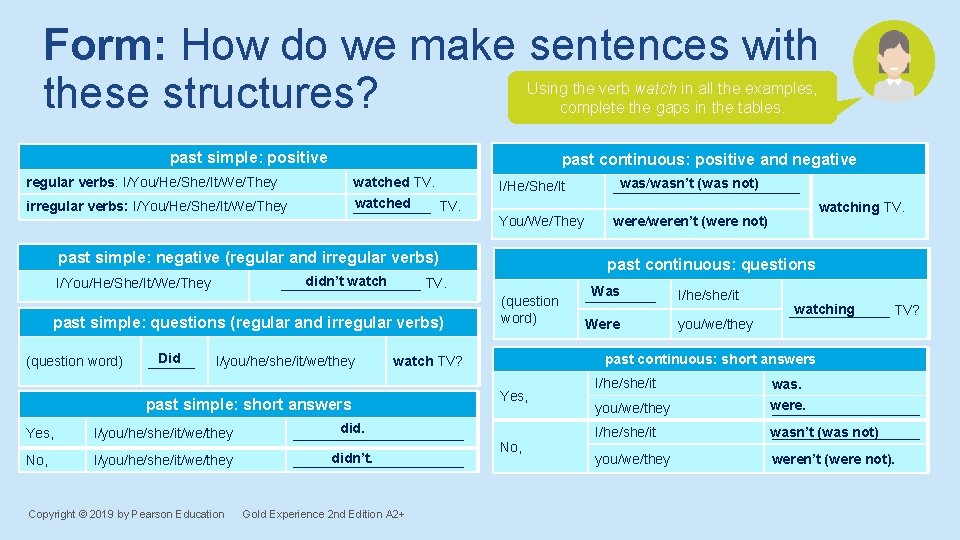
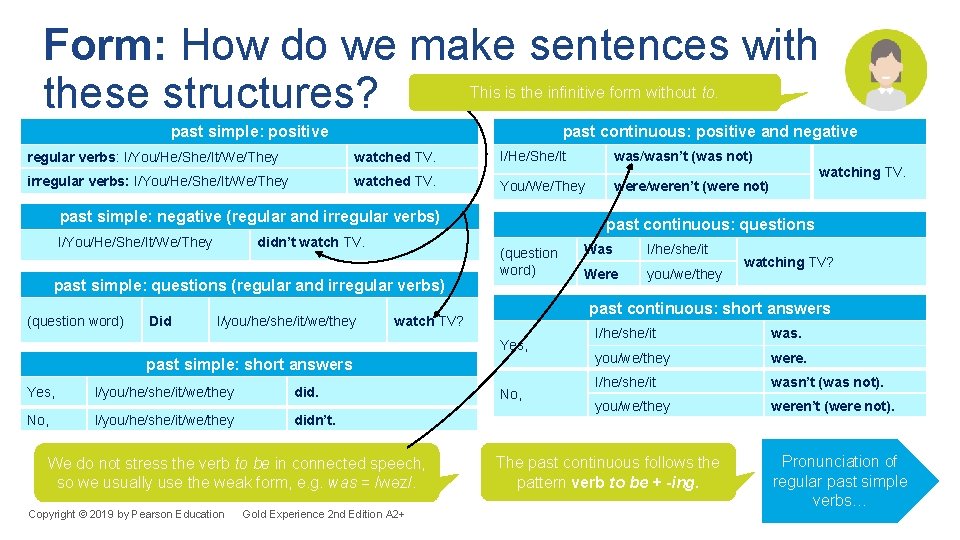
Form: How do we make sentences with these structures? Using the verb watch in all the examples, complete the gaps in the tables. past simple: positive regular verbs: I/You/He/She/It/We/They past continuous: positive and negative watched TV. watched _____ TV. irregular verbs: I/You/He/She/It/We/They I/He/She/It You/We/They past simple: negative (regular and irregular verbs) past simple: questions (regular and irregular verbs) (question word) Did ______ I/you/he/she/it/we/they (question word) Yes, I/you/he/she/it/we/they did. ___________ No, I/you/he/she/it/we/they didn’t. ___________ Copyright © 2019 by Pearson Education Gold Experience 2 nd Edition A 2+ were/weren’t (were not) Was _____ I/he/she/it Were you/we/they watching _______ TV? past continuous: short answers watch TV? past simple: short answers watching TV. past continuous: questions didn’t watch _________ TV. I/You/He/She/It/We/They was/wasn’t (was not) ____________ Yes, No, I/he/she/it was. you/we/they were. __________ I/he/she/it wasn’t (was not) __________ you/we/they weren’t (were not).
Form: How do we make sentences with these structures? This is the infinitive form without to. past continuous: positive and negative past simple: positive regular verbs: I/You/He/She/It/We/They watched TV. I/He/She/It was/wasn’t (was not) irregular verbs: I/You/He/She/It/We/They watched TV. You/We/They were/weren’t (were not) past simple: negative (regular and irregular verbs) I/You/He/She/It/We/They didn’t watch TV. past simple: questions (regular and irregular verbs) (question word) Did I/you/he/she/it/we/they past continuous: questions (question word) past simple: short answers I/you/he/she/it/we/they did. No, I/you/he/she/it/we/they didn’t. We do not stress the verb to be in connected speech, so we usually use the weak form, e. g. was = /wəz/. Copyright © 2019 by Pearson Education Gold Experience 2 nd Edition A 2+ Was I/he/she/it Were you/we/they watching TV? past continuous: short answers watch TV? Yes, watching TV. No, I/he/she/it was. you/we/they were. I/he/she/it wasn’t (was not). you/we/they weren’t (were not). The past continuous follows the pattern verb to be + -ing. Pronunciation of regular past simple verbs…
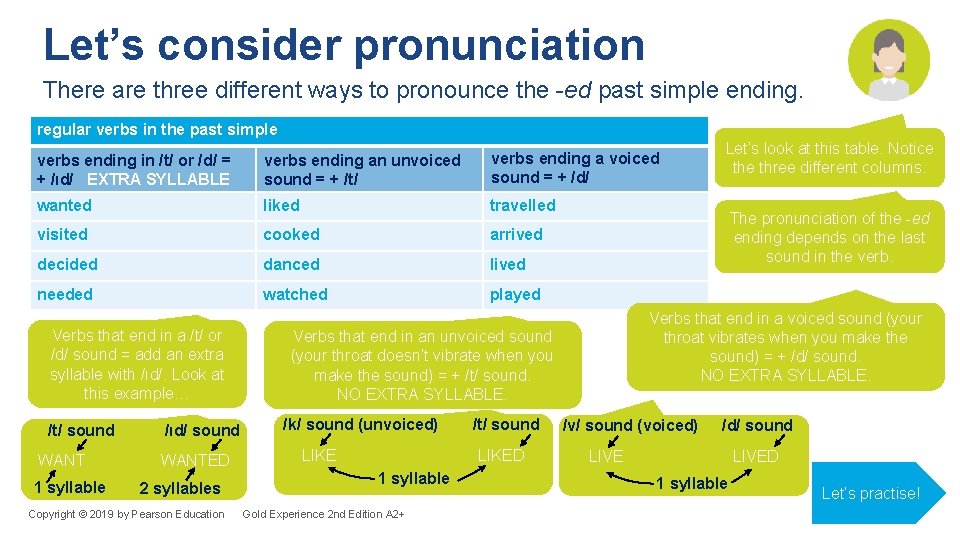
Let’s consider pronunciation There are three different ways to pronounce the -ed past simple ending. regular verbs in the past simple verbs ending in /t/ or /d/ = + /ıd/ EXTRA SYLLABLE verbs ending an unvoiced sound = + /t/ verbs ending a voiced sound = + /d/ wanted liked travelled visited cooked arrived decided danced lived needed watched played Verbs that end in a /t/ or /d/ sound = add an extra syllable with /ıd/. Look at this example… /t/ sound /ıd/ sound WANT WANTED 1 syllable 2 syllables The pronunciation of the -ed ending depends on the last sound in the verb. Verbs that end in a voiced sound (your throat vibrates when you make the sound) = + /d/ sound. NO EXTRA SYLLABLE. Verbs that end in an unvoiced sound (your throat doesn’t vibrate when you make the sound) = + /t/ sound. NO EXTRA SYLLABLE. /k/ sound (unvoiced) /t/ sound LIKE LIKED 1 syllable Copyright © 2019 by Pearson Education Gold Experience 2 nd Edition A 2+ Let’s look at this table. Notice three different columns. /v/ sound (voiced) /d/ sound LIVED 1 syllable Let’s practise!
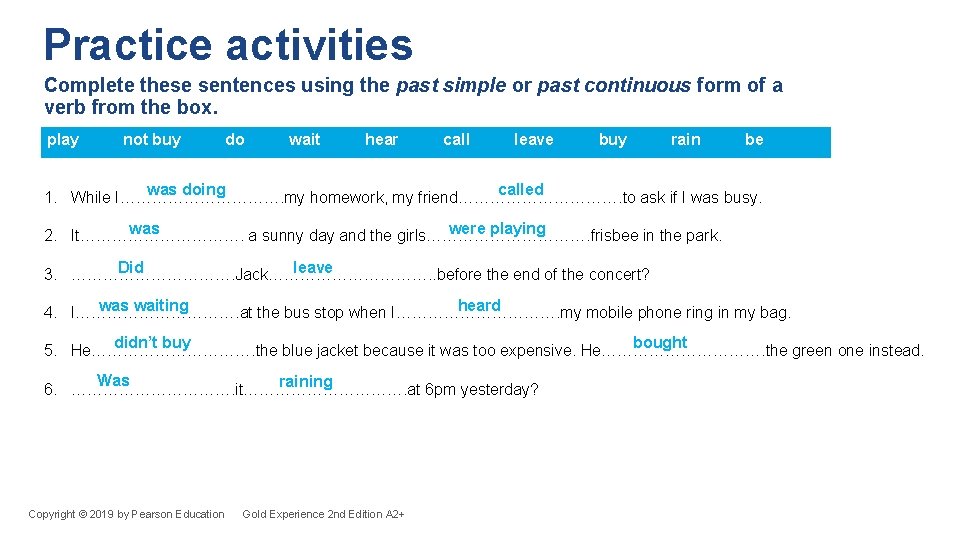
Practice activities Complete these sentences using the past simple or past continuous form of a verb from the box. play not buy do wait hear call leave buy rain be called was doing 1. While I……………. my homework, my friend……………. to ask if I was busy. were playing was 2. It……………. a sunny day and the girls……………. frisbee in the park. leave Did 3. ……………. Jack……………. . before the end of the concert? was waiting heard 4. I……………. at the bus stop when I……………. my mobile phone ring in my bag. didn’t buy bought 5. He……………. the blue jacket because it was too expensive. He……………. the green one instead. Was raining 6. ……………. it……………. at 6 pm yesterday? Copyright © 2019 by Pearson Education Gold Experience 2 nd Edition A 2+
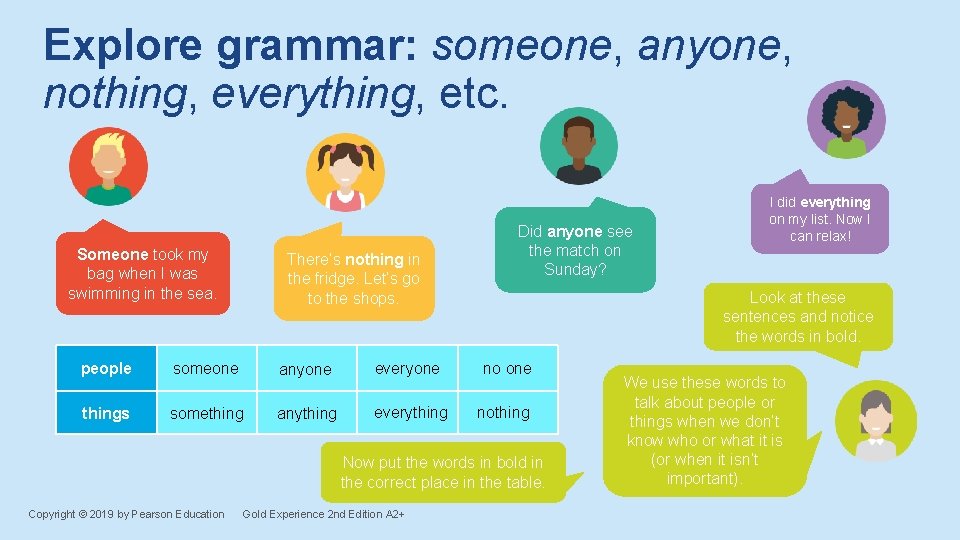
Explore grammar: someone, anyone, nothing, everything, etc. Someone took my bag when I was swimming in the sea. There’s nothing in the fridge. Let’s go to the shops. Did anyone see the match on Sunday? Look at these sentences and notice the words in bold. people someone anyone everyone no one things something anything everything nothing Now put the words in bold in the correct place in the table. Copyright © 2019 by Pearson Education Gold Experience 2 nd Edition A 2+ I did everything on my list. Now I can relax! We use these words to talk about people or things when we don’t know who or what it is (or when it isn’t important).