
Unit 3 Motion Objectives 3 01 3 02
Unit 3: Motion
Objectives 3. 01, 3. 02 Define speed, mass, velocity, and acceleration Calculate speed, velocity, and acceleration PA Anchor: S 8. C. 3. 1
What is motion? Motion – occurs when the distance between two objects changes Ex: Driving down the road Running around the field Jumping up and down
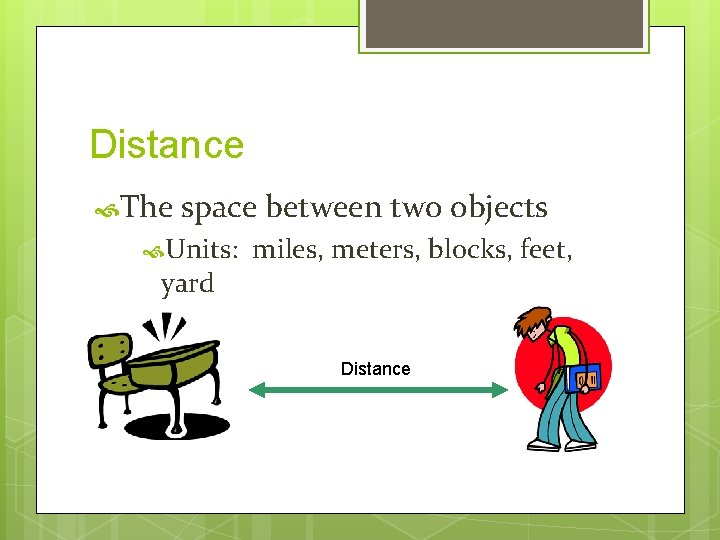
Distance The space between two objects Units: yard miles, meters, blocks, feet, Distance
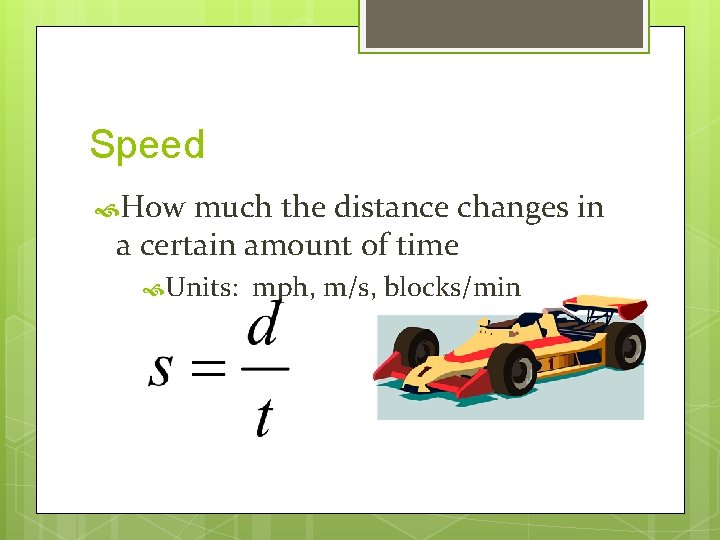
Speed How much the distance changes in a certain amount of time Units: mph, m/s, blocks/min
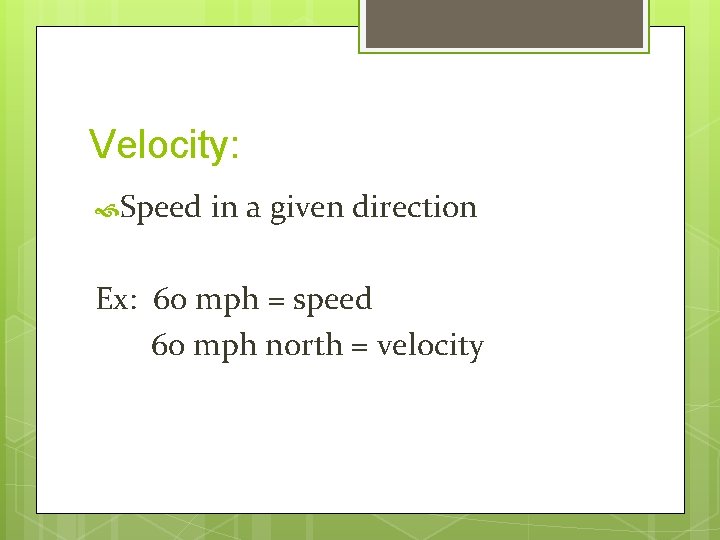
Velocity: Speed in a given direction Ex: 60 mph = speed 60 mph north = velocity
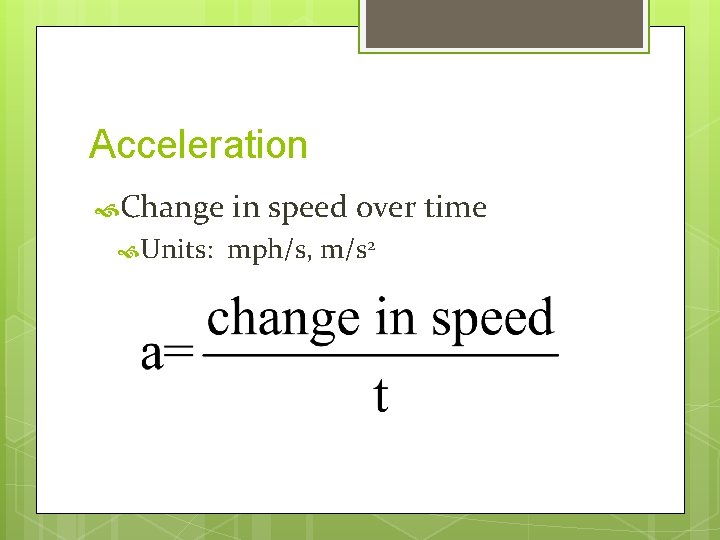
Acceleration Change Units: in speed over time mph/s, m/s 2
Sample Problem #1 It takes you 2 hours to travel 120 miles on the Interstate. What is your speed?
Sample Problem # 2 If you’re driving down the road at 35 mph for 3 hours, how much distance will you cover?
Sample Problem #3 You need to speed up from 10 mph to 50 mph in 5 seconds. What acceleration is necessary to accomplish this?
Objectives 3. 03, 3. 04 Differentiate between mass, inertia, weight, force, and momentum Apply the Law of Conservation of Momentum PA Anchor: S 8. C. 3. 1
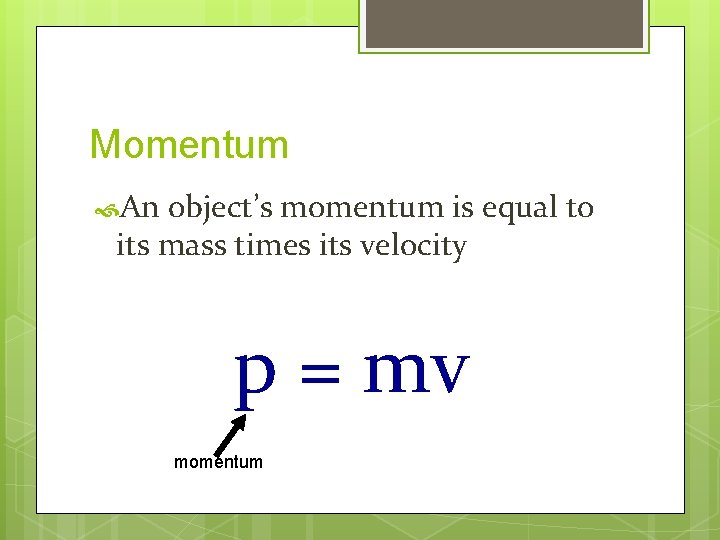
Momentum An object’s momentum is equal to its mass times its velocity p = mv momentum
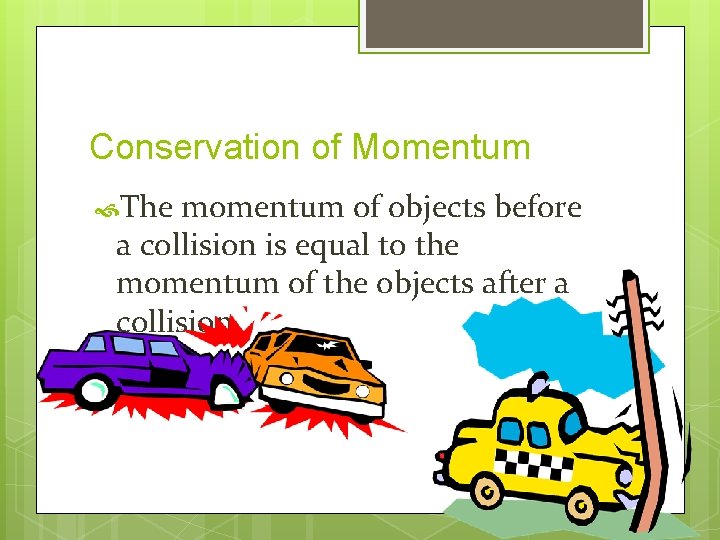
Conservation of Momentum The momentum of objects before a collision is equal to the momentum of the objects after a collision.
Sample Problem #4 If an object has a mass of 10 kg and a velocity of 5 m/s North, what is the momentum of that object?
Objective 3. 05 Use a displacement vs. time graph to determine distance, speed, and velocity PA Anchor: S 8. C. 3. 1
Moving on to Graphs… Why do we use graphs? To represent information more easily than writing it all out
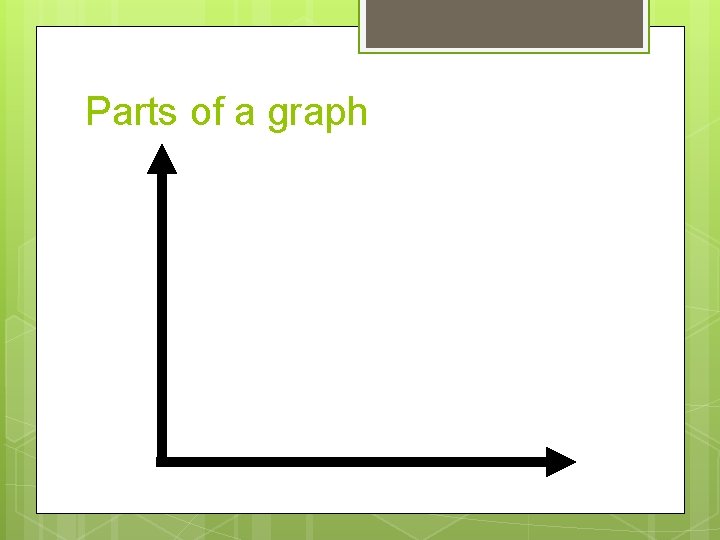
Parts of a graph
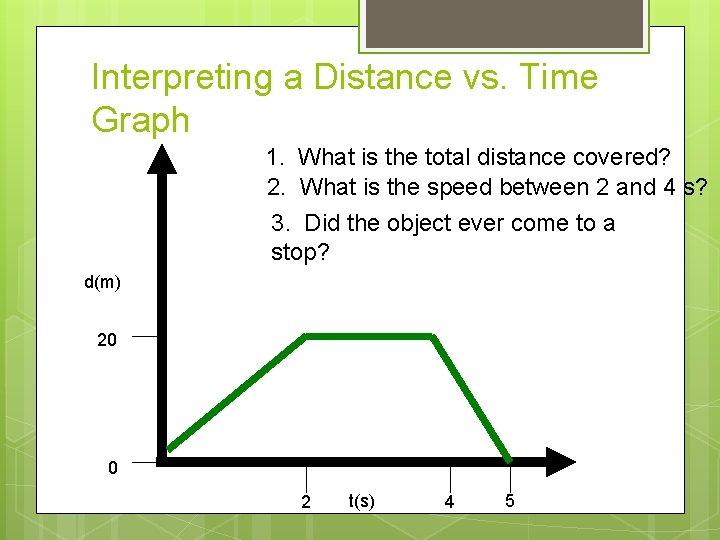
Interpreting a Distance vs. Time Graph 1. What is the total distance covered? 2. What is the speed between 2 and 4 s? 3. Did the object ever come to a stop? d(m) 20 0 2 t(s) 4 5
Objective 3. 06 Identify the types of forces in everyday life PA Anchor: S 8. C. 3. 1
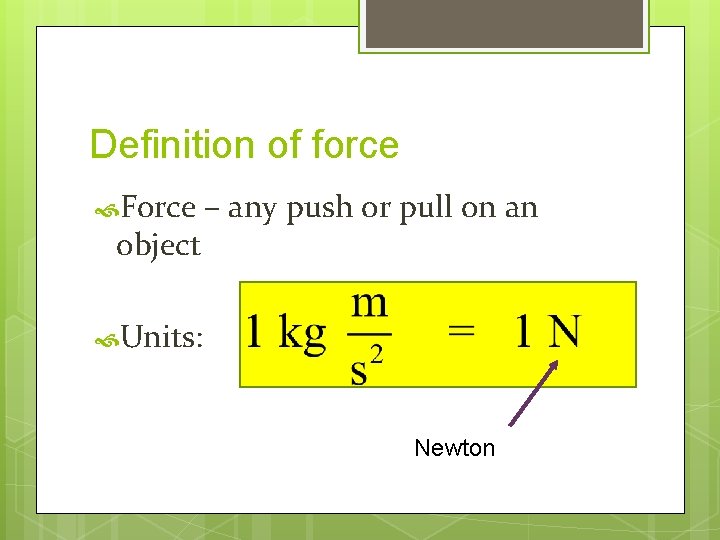
Definition of force Force object – any push or pull on an Units: Newton
Examples of Forces Gravity – pulls objects toward center of Earth Friction – slows objects down Spring – car suspensions, slinky Applied – any push or pull that you give to the object
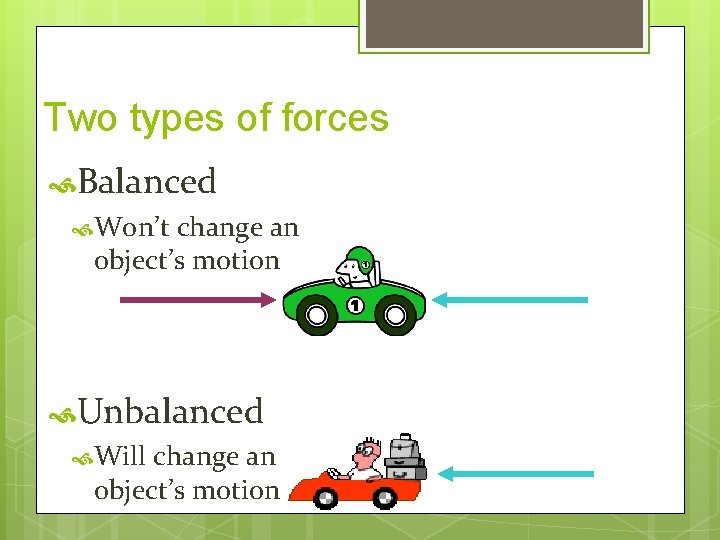
Two types of forces Balanced Won’t change an object’s motion Unbalanced Will change an object’s motion
Objective 3. 07 Apply Newton’s three laws of motion PA Anchor: S 8. C. 3. 1
Newton’s 1 st Law of Motion An object in motion will stay in motion and an object at rest will stay at rest; unless acted on by an unbalanced force Explanation: To change the motion of an object, you need to apply an unbalanced force.
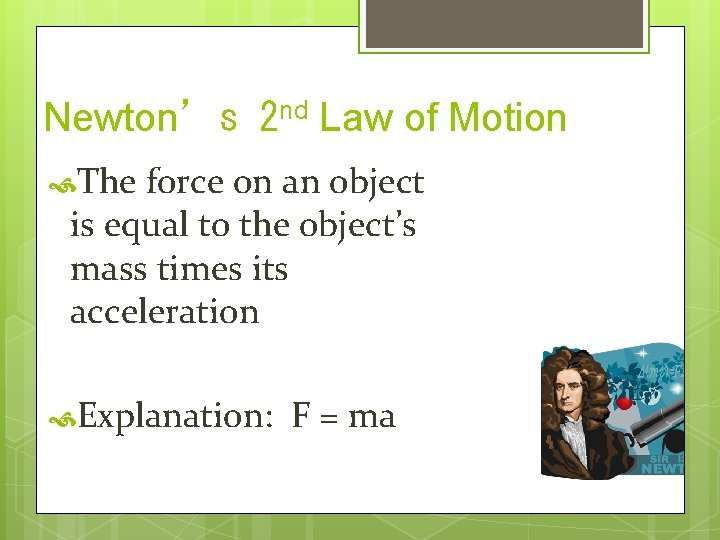
Newton’s 2 nd Law of Motion The force on an object is equal to the object’s mass times its acceleration Explanation: F = ma
Newton’s 3 rd Law of Motion For every action force, there is an equal and opposite reaction force. Explanation: If I push on an object, that object pushes back on me with the same amount of force.

Objective 3. 08 Define work and identify situations where work occurs PA Anchor: S 8. C. 3. 1
The “Scientific” Definition… Work – when a force is exerted on an object that moves the object some distance Units: Newton – meter (Nm)
In other words… (Three requirements for work) To do “work”, you need to: 1. Apply a force AND 2. Move the object some distance AND 3. Some of the force needs to be in the direction of the motion
In equation form…
Sample Problem #1 If it takes 3 N to move an object a distance of 4 m, how much work is done?
Sample Problem #2 You apply a force of 20 N to an object, but it does not move. How much work is done on the object?
Objective 3. 09 Explain the mechanical advantage of simple machines PA Anchor: S 8. C. 3. 1
Why do we use machines? 1. 2. 3. Change amount of force necessary Change distance you apply force Change direction you apply force
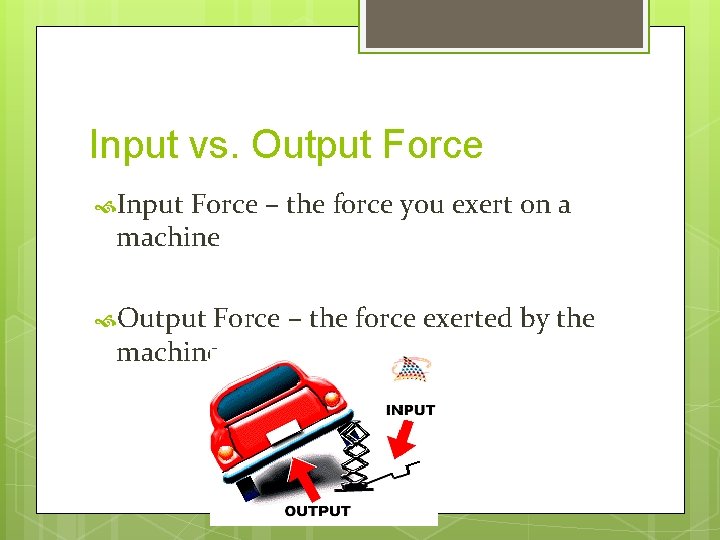
Input vs. Output Force Input Force – the force you exert on a machine Output Force – the force exerted by the machine
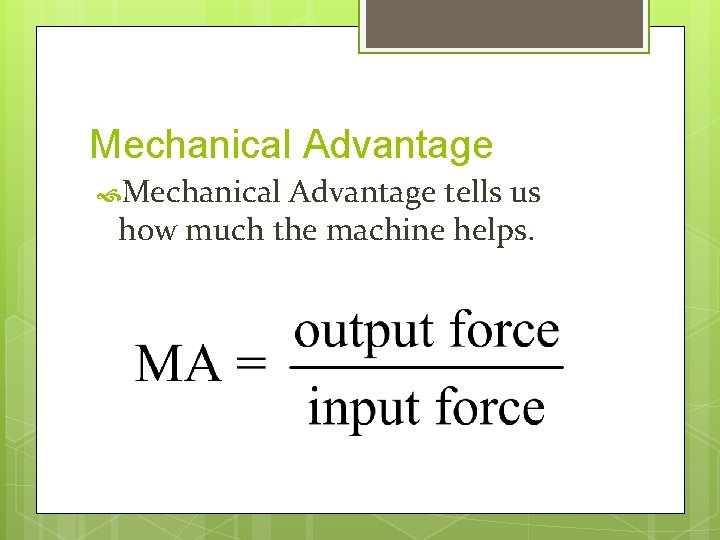
Mechanical Advantage tells us how much the machine helps.
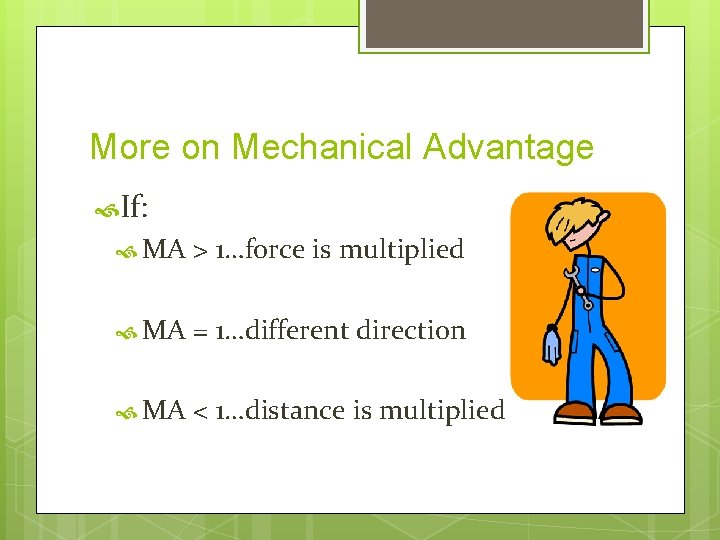
More on Mechanical Advantage If: MA > 1…force is multiplied MA = 1…different direction MA < 1…distance is multiplied
Sample Problem Find the mechanical advantage of a machine that delivers an output force of 12 N when an input force of 3 N is applied.
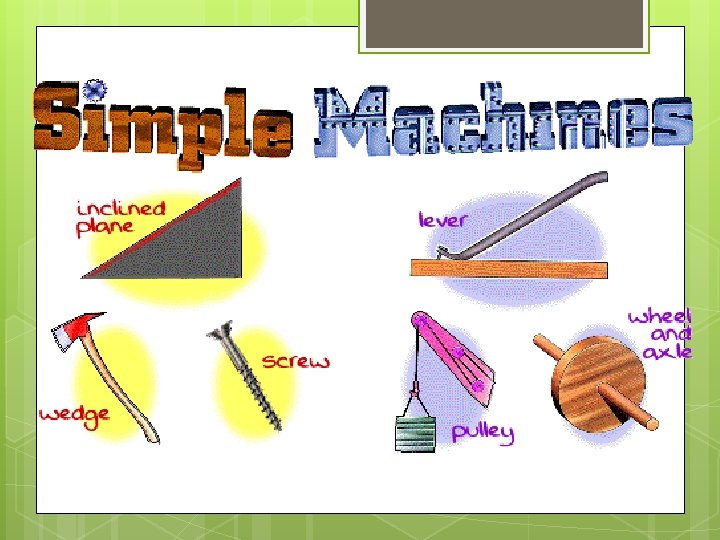
Objectives 3. 10, 3. 11 Identify simple machines in everyday life Determine the class of levers PA Anchor: S 8. C. 3. 1
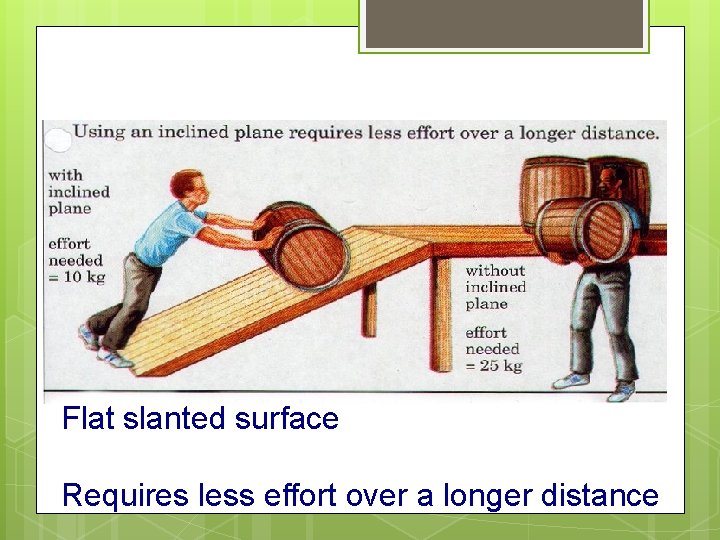
Inclined Plane Flat slanted surface Requires less effort over a longer distance
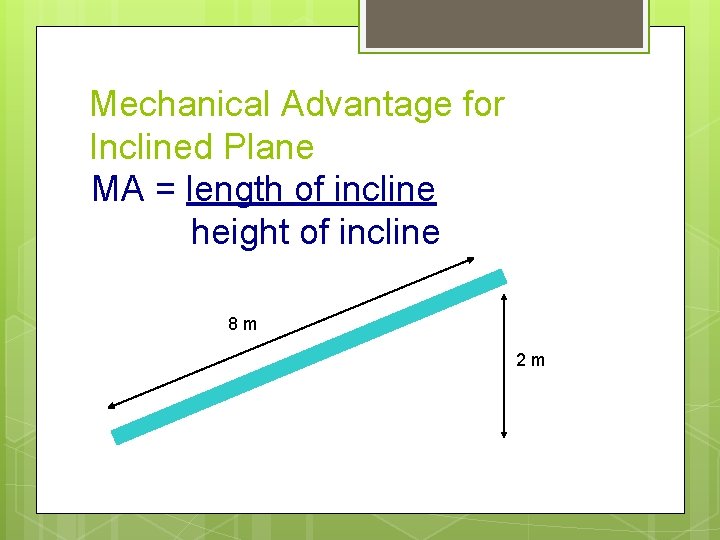
Mechanical Advantage for Inclined Plane MA = length of incline height of incline 8 m 2 m
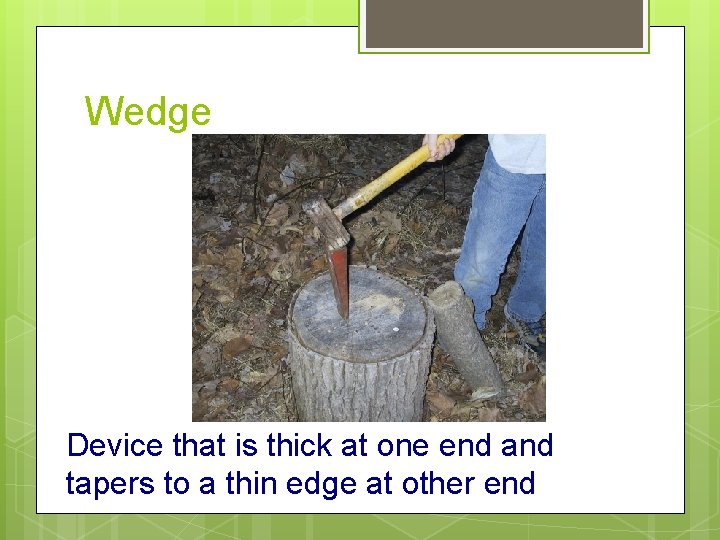
Wedge Device that is thick at one end and tapers to a thin edge at other end
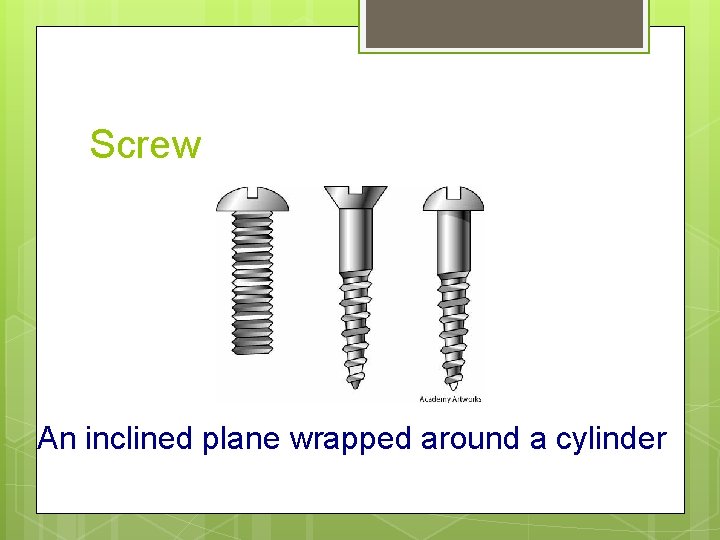
Screw An inclined plane wrapped around a cylinder
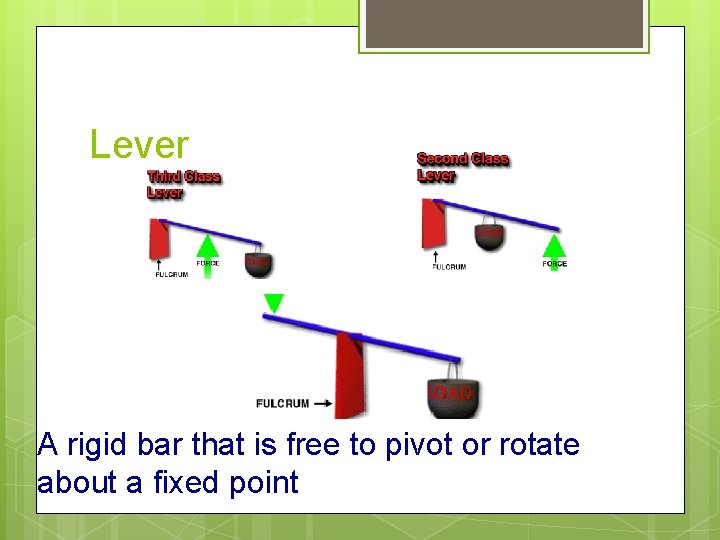
Lever A rigid bar that is free to pivot or rotate about a fixed point
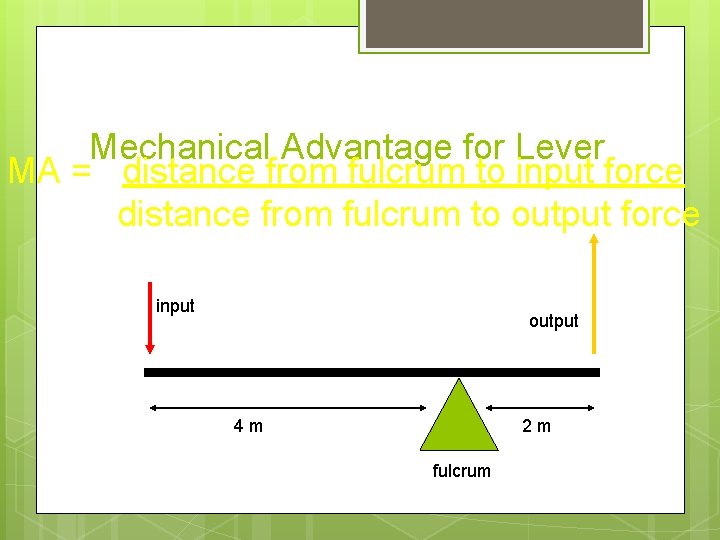
Mechanical Advantage for Lever MA = distance from fulcrum to input force distance from fulcrum to output force input output 4 m 2 m fulcrum
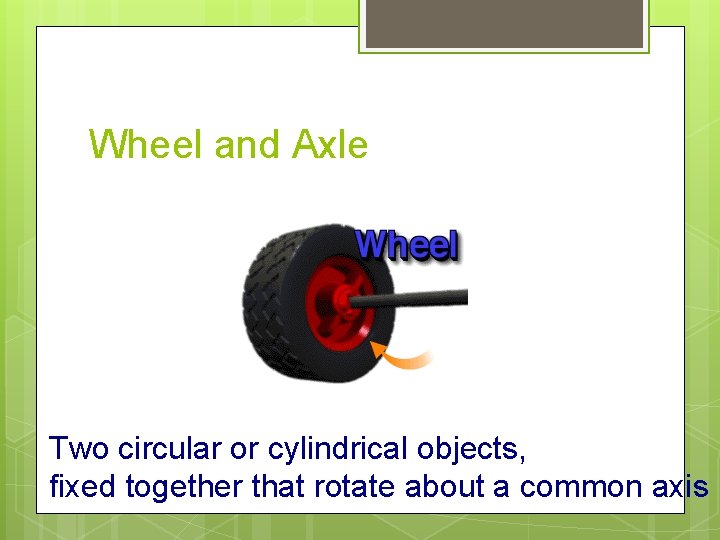
Wheel and Axle Two circular or cylindrical objects, fixed together that rotate about a common axis
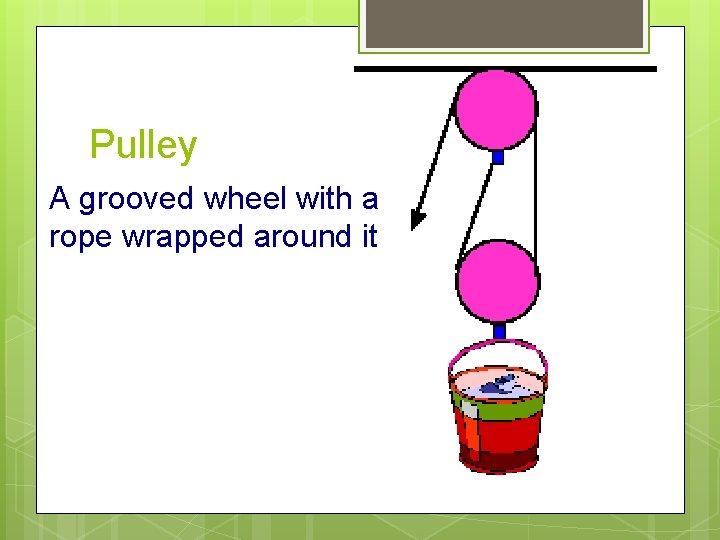
Pulley A grooved wheel with a rope wrapped around it
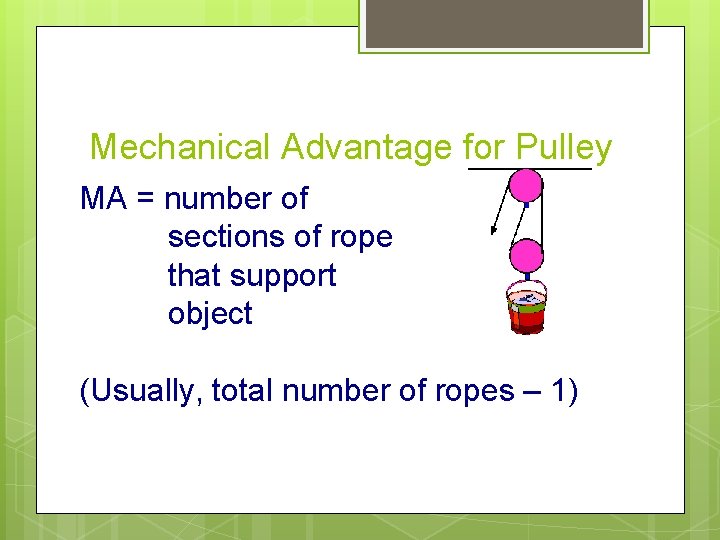
Mechanical Advantage for Pulley MA = number of sections of rope that support object (Usually, total number of ropes – 1)
- Slides: 49