
UNIT 3 MANAGEMENT DEPARTMENTATION Meaning of Departmentalisation Departmentation
- Slides: 49
UNIT 3 – MANAGEMENT DEPARTMENTATION
Meaning of Departmentalisation: • ‘Departmentation’ or ‘Departmentalisation’ is the process of grouping the activi ties of an enterprise into several units for the purpose of administration at all levels. • The administrative units so created may be designated as departments, divisions, units, branches, sections, etc. • The process of organising consists of dividing and grouping of the works to be done in an enterprise and assigning different duties and responsibilities to different people.
Need for and Importance of Departmentation: • The basic need for departmentation is to make the size of each departmental unit man ageable and secure the advantages of specialisation. • Grouping of activities and, consequently, of personnel, into departments makes it possible to expand an enterprise to any extent.
• 1. Advantages of Specialisation: • Departmentation enables an enterprise to avail of the benefits of specialisation. When every department looks after one major function, the enterprise is developed and efficiency of operations is increased. • 2. Feeling of Autonomy: • Normally departments are created in the enterprise with cer tain degree of autonomy and freedom. The manager in charge of a department can take inde pendent decisions within the overall framework of the organisation. The feeling of autonomy provides job satisfaction and motivation which lead to higher efficiency of operations.
• 3. Expansion: • One manager can supervise and direct only a few subordinates. Group ing of activities and personnel into departmentation makes it possible for the enterprise to expand grow. • 4. Fixation of Responsibility: Departmentation enables each person to know the spe cific role he is to play in the total organisation. The responsibility for results can be defined more clearly, precisely and accurately and an individual can be held accountable for the per formance of his responsibility.
• 5. Upliftment of Managerial Skills • Departmentation helps in the development of managerial skill. Development is possible due to two factors. • Firstly, the managers focus their attention on some specific problems which provide them effective on the job training. • Sec ondly, managerial need for further training can be identified easily because the managers’ role is prescribed and training can provide them opportunity to work better in their area of spe cialisation.
• 6. Facility in Appraisal: • Appraisal of managerial performance becomes easier when specific tasks are assigned to departmental personnel. Managerial performance can be meas ured when the areas of activities are specified and the standards of performance are fixed. Departmentation provides help in both these areas.
• 7. Administrative Control: • Departmentation is a means of dividing the large and com plex organisation into small administrative units. Grouping of activities and personnel into manageable units facilitates administrative control. Standards of performance for each and every department can be precisely determined.
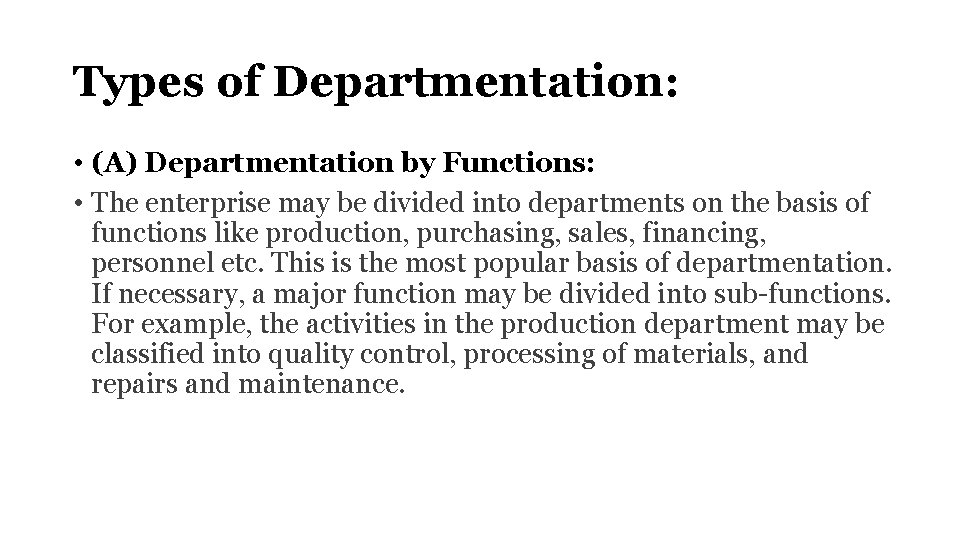
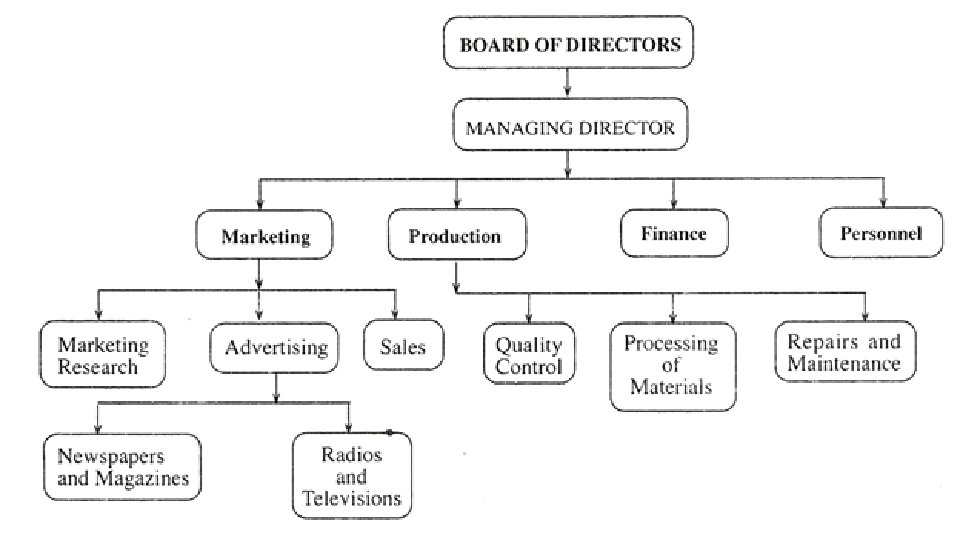
Types of Departmentation: • (A) Departmentation by Functions: • The enterprise may be divided into departments on the basis of functions like production, purchasing, sales, financing, personnel etc. This is the most popular basis of departmentation. If necessary, a major function may be divided into sub functions. For example, the activities in the production department may be classified into quality control, processing of materials, and repairs and maintenance.
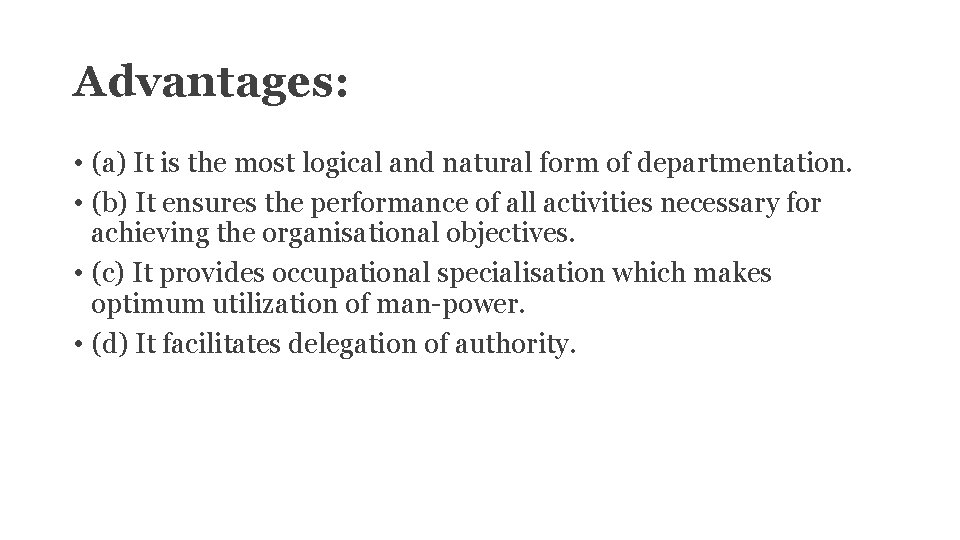
Advantages: • (a) It is the most logical and natural form of departmentation. • (b) It ensures the performance of all activities necessary for achieving the organisational objectives. • (c) It provides occupational specialisation which makes optimum utilization of man power. • (d) It facilitates delegation of authority.
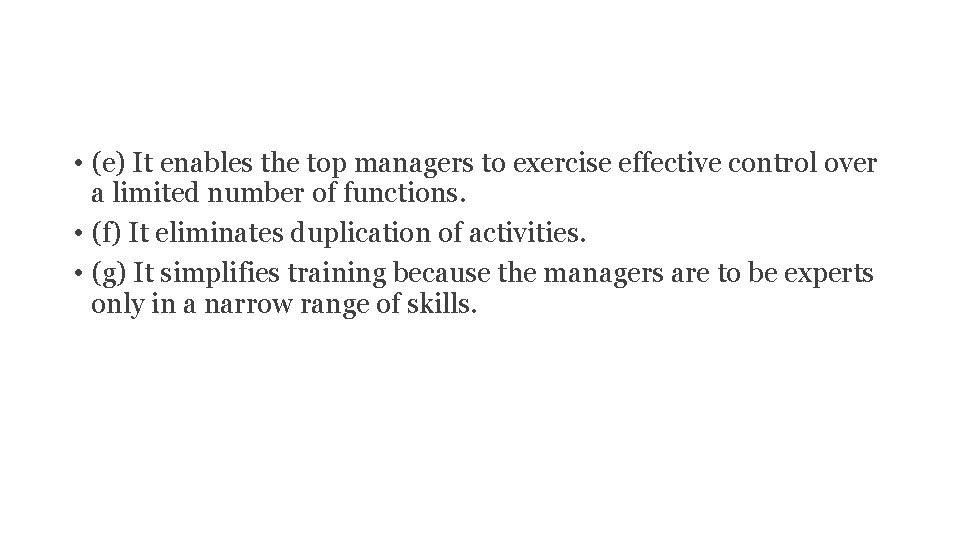
• (e) It enables the top managers to exercise effective control over a limited number of functions. • (f) It eliminates duplication of activities. • (g) It simplifies training because the managers are to be experts only in a narrow range of skills.
Disadvantages • (a) There may be conflicts between departments. • (b) The scope for management development is limited. Functional managers do not get training for top management positions. The responsibility for results cannot be fixed on any one functional head. • (c) There is too much emphasis on specialisation. • (d) There may be difficulties in coordinating the activities of different departments. • (e) There may be inflexibility and complexity of operations.
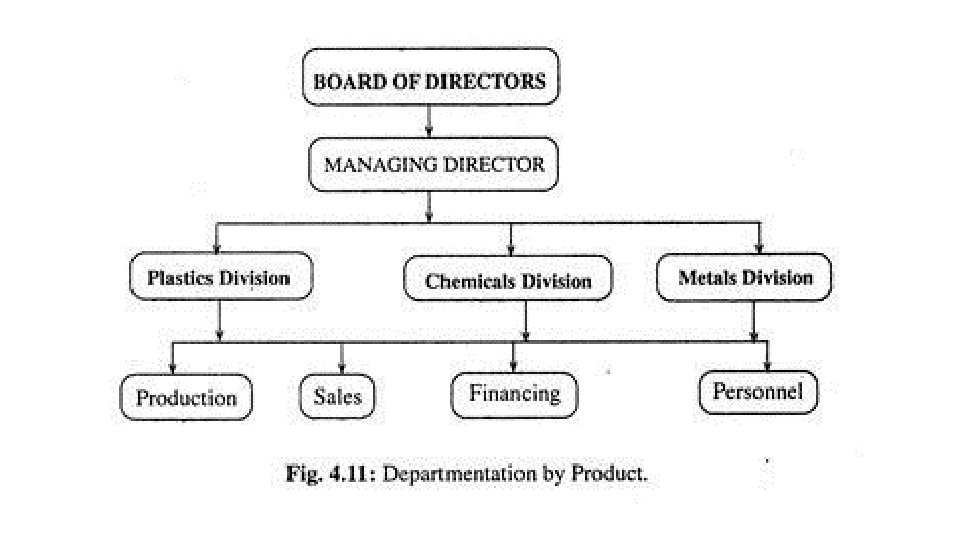
(B) Departmentation by Products: • In product departmentation, every major product is organised as a separate department. Each department looks after the production, sales and financing of one product. Product departmentation is useful when the expansion, diversifica tion, manufacturing and marketing characteristics of each product are primarily significant. • It is generally used when the production line is complex and diverse requiring specialised knowl edge and huge capital is required for plant, equipment and other facilities such as in automo bile and electronic industries.
• In fact, many large companies are diversifying in different fields and they prefer product departmentation. • For example, a big company with a diversified product line may have three product divisions, one each for plastics, chemicals, and metals. • Each division may be sub divided into production, sales, financing, and personnel activities.
Advantages: • (a) Product departmentation focuses individual attention to each product line which fa cilitates the expansion and diversification of the products. • (b) It ensures full use of specialised production facilities. Personal skill and specialised knowledge of the production managers can be fully utilised. • (c) The production managers can be held accountable for the profitability of each prod uct. Each product division is semi autonomous and contains different functions. So, product departmentation provides an excellent training facility for the top managers. • (d) It is more flexible and adaptable to change.
Disadvantages: • (a) It creates the problem of effective control over the product divisions by the top managers. • (b) Each production manager asserts his autonomy disregarding the interests of the organisation. • (c) The advantages of centralisation of certain activities like financing, and accounting are not available. • (d) There is duplication of physical facilities and functions. Each product division main tains its own specialised personnel due to which operating costs may be high. • (e) There may be under utilisation of plant capacity when the demand for a particular product is not adequate.
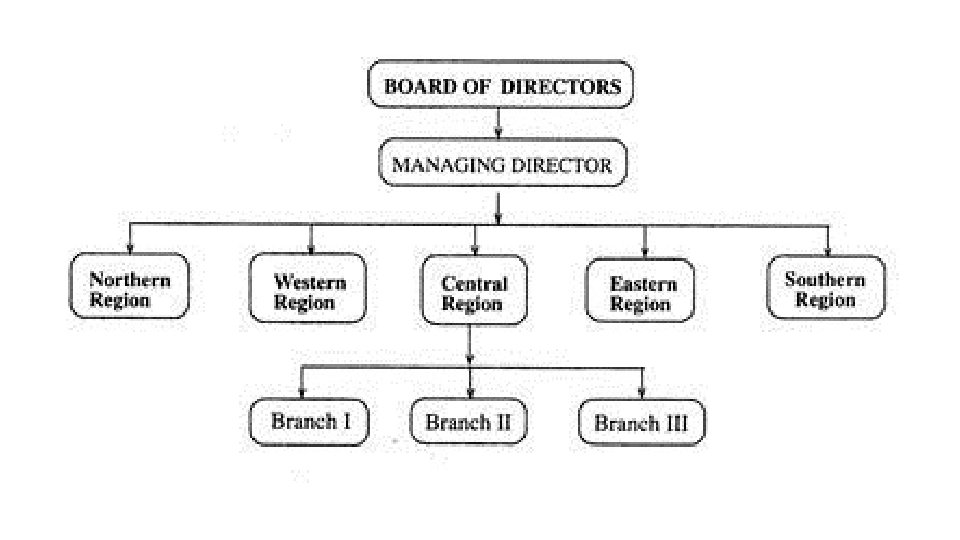
(C) Departmentation by Territory: • Territorial or geographical departmentation is spe cially useful to large scale enterprises whose activities are widely dispersed. Banks, insu rance companies, transport companies, distribution agencies etc. are some examples of such enterprises, where all the activities of a given area of operations are grouped into zones, branches, divisions etc. • It is obviously not possible for one functional manager to manage efficiently such widely spread activities. This makes it necessary to appoint regional manag ers for different regions.
Advantages: • (a) Every regional manager can specialise himself in the peculiar problems of his region. • (b) It facilitates the expansion of business to various regions. • (c) It helps in achieving the benefits of local operations. The local managers are more familiar with the local customs, preferences, styles, fashion, etc. The enterprise can gain inti mate knowledge of the conditions in the local markets. • (d) It results in savings in freight, rents, and labour costs. It also saves time. • (e) There is better co ordination of activities in a locality through setting up regional divisions. • (f) It provides adequate autonomy to each regional manager and opportunity to train him as he looks after the entire operation of a unit.
Disadvantages: • (a) There is the problem of communication. • (b) It requires more managers with general managerial abilities. Such managers may not be always available. • (c) There may be conflict between the regional managers. • (d) Co ordination and control of different branches from the head office become less effective. • (e) Owing to duplication of physical facilities, costs of operation are usually high. • (f) There is multiplication of personnel, accounting and other services at the regional level.
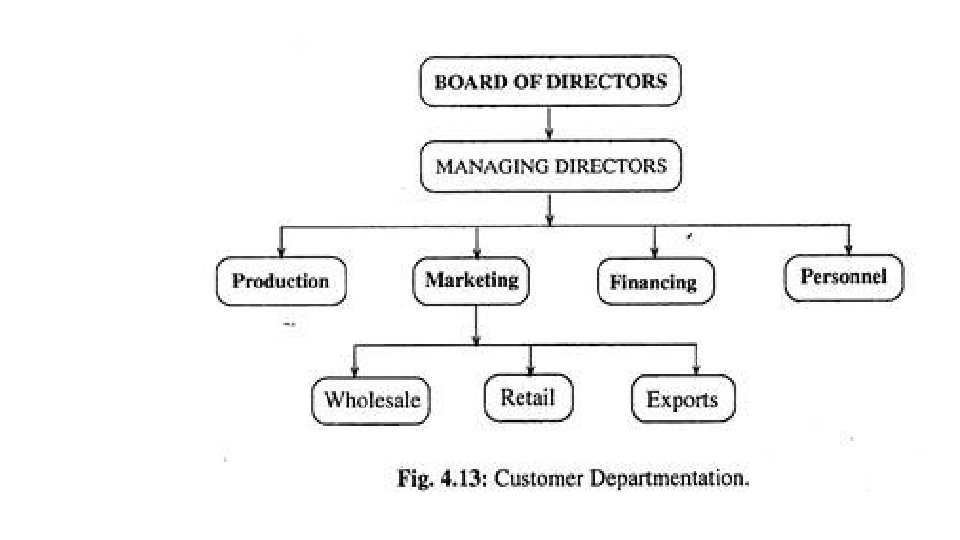
(D) Departmentation by Customers: • In such method of departmentation, the activities are grouped according to the type of customers. For example, a large cloth store may be divided into wholesale, retail, and export divisions. • This type of departmentation is useful for the enterprises which sell a product or service to a number of clearly defined customer groups. For instance, a large readymade garment store may have a separate department each for men, women, and children. • A bank may have separate loan departments for large scale and small scale businessmen.
Advantages: • (a) Special attention can be given to the particular tastes and preferences of each type of customer. • (b) Different types of customers can be satisfied, easily through specialised staff. Cus tomers’ satisfaction enhances the goodwill and sale of the enterprise. • (c) The benefits of specialisation can be gained. • (d) The enterprise may acquire intimate knowledge of the needs of each category of customers.
Disadvantages: • (a) Co ordination between sales and other functions becomes difficult because this method can be followed only in marketing division. • (b) There may be under utilisation of facilities and manpower in some departments, particularly during the period of low demand. • (c) It may lead to duplication of activities and heavy overheads, • (d) The managers of customer departments may put pressures for special benefits and facilities.
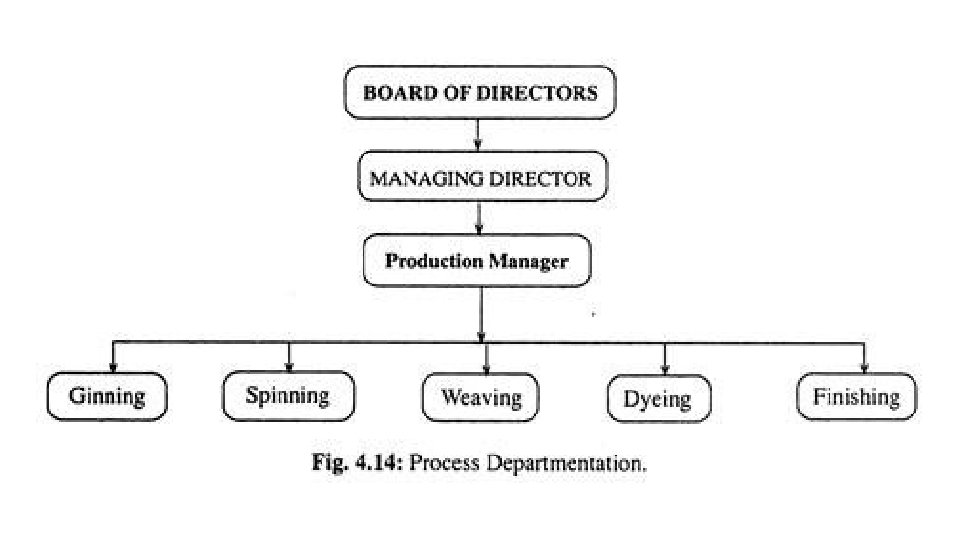
(E) Departmentation by Process or Equipment: • In such type or departmentation the activities are grouped on the basis of production processes involved or equipment used. • This is generally used in manufacturing and distribution enterprises and at lower levels of organi sation. • For instance, a textile mill may be organised into ginning, spinning, weaving, dyeing and finishing departments. Similarly, a printing press may have composing, proof reading, printing and binding departments. • Such departmentation may also be employed in enginee ring and oil industries.
Advantages: • The basic object of such departmentation is to achieve efficiency and economy of operations. • The processes are set in such a way that a series of operations is feasible making operations economic. • Efficiency can be achieved if departments are created for each process as each one has its peculiarities. • It provides the advantages of specialisation required at each level of the total processes. • The maintenance of plant can be done in better way and manpower can be utilised effectively.
Disadvantages: • In such departmentation, there may be difficulty in coordinating the different process departments, because the work of each process depends fully on the prece ding process. • So, there are chances of conflicts among the managers looking after the differ ent processes. • It cannot be used where manufacturing activity does not involve distinct proc esses.
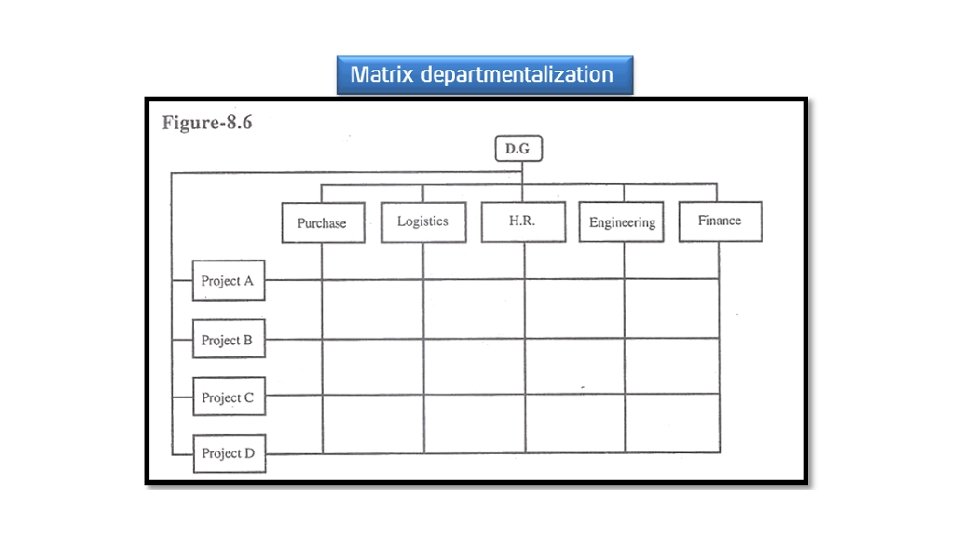
Departmentation by Matrix • Matrix Organisational Structure is a combination of functional organisation and project organisation (i. e. Matrix Organisation = Functional Structure + Project Structure). • It consists of groups of persons, drawn from various functional departments and deputed to work on a project under the guidance and direction of a Project Manager appointed by the top management.
• According to Stanley Davis and Paul Lawrence, matrix organisation is, “Any organisation that employs a multiple command structure but also related support mechanisms and an associated organisational culture and behaviour pattern”. • The matrix organisation may be followed where a large number of small projects have to be managed.
• This is also called project organisation. It is a combination of all relationships in the organisation – vertical, horizontal and diagonal. It is mostly used in complex projects. • It provides a high degree of operational freedom, flexibility and adaptability for both the line and the staff managers in performing their respective roles. • The main objective of matrix organisation is to secure a higher degree of coordination than what is possible from the conventional organisational structures such as – the line and staff.
• The matrix organisation is increasingly used in high technology enterprises but there are cases of many failures also. • Matrix organisations have one striking advantage – flexibility and optimisation of resources. • Work groups, along with its resources, can be shifted from one project to the other, depending upon the exigency. • When the project is completed, they return to their functional departments. • The process of monitoring and controlling the work groups is easier since the workers are under the charge of one project manager from the beginning to the end.
• One of the shortcomings of matrix organisation is that it does not observe the principle of ‘one employee, one superior’. • However, as long as the managers are aware of their roles, things go well. • In other words, the authority and responsibility relationships, in case of matrix organisation, need precise definition.
• Otherwise, the workers suffer from the overlapping and conflicting authority and responsibility. • Working with two taskmasters may, at times, result in suffocating, disgusting, and frustrating experience. • This may lead to inertia and lack of motivation also. • Much before this happens, it is advisable that the top management appoints a general manager (Projects) for coordinating the project managers and the functional managers to settle the differences, if any.
• Benefits and Limitations of Matrix Structure: • (a) More cooperation across functions. • (b) Improved Decision making. • (c) Greater flexibility in adding / deleting or changing activities or changing demands. • (d) Better customer service due to presence of project manager. • (e) Better performance accountability.
• (f) Improved strategic management, better motivation and commitment to organisation or people (as teams can be created, redefined and dissolved as needed). • (g) Opportunities of learning new skills. • (h) A useful vehicle for decentralisation. • (i) Two boss means power struggles, buck passing, and dual reporting channels.
• (j) Team meeting time consuming. • (k) Two bosses mean creating confusion. • (l) More time required for coordinating task related activities. • (m) Propensity to foster power struggles because of confusion and ambiguity. • Higher over heads because more management positions are created. • (o) Dual source of reward and punishment.
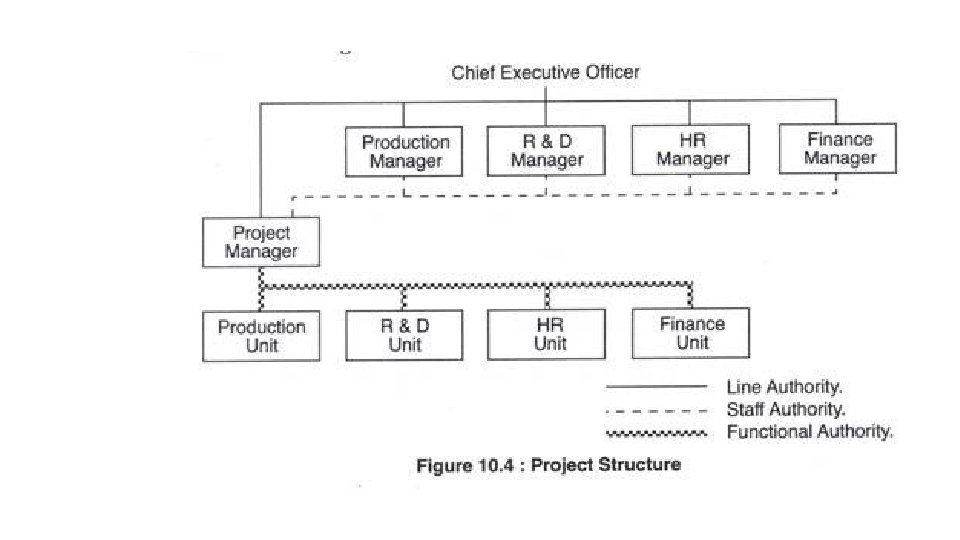
Project Structure: • A project structure is an advanced type of matrix structure. A project structure has no formal departments where employees can go back at the completion of a project. • Rather, employee takes their skills, abilities and experiences to other projects, one after the other. In project structures all work is performed by teams. • The advantages of a project structure are that since there is no departmentation or employee job titles, decision making is not slowed. • Secondly, herein managers work as facilitators, coaches and mentors. However project structure remains to be ‘fluid and flexible” organisational designs.
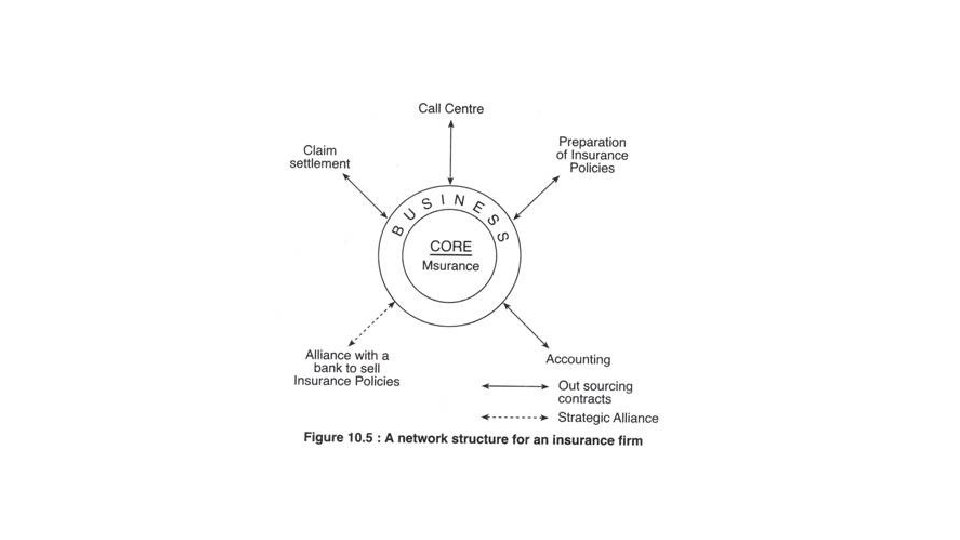
Network Structure: • Network structures are relatively a new phenomenon whereby organizations have started making alliances and collaborations with their vendors, which extend beyond the conventional supplier manufacturer relationships. The trust and confidence exhibited by organizations in treating their vendors as close partners has been the hallmark of recent times. Outsourcing is just one brick of this radical phenomenon. • Outsourcing means contracting business functions to outside contractors or suppliers. An airline may outsource food, engineering services and airport handling. • An all India examination body outsources receipt of examination forms, preparation of list of cheques, filling deposit slips of the bank, despatch of admission tickets, checking of marks etc.
• The firm itself is very small, comprises a few full time core employees working from head quarters. The insurance company has outsourced preparation of insurance policies, call centre, claim settlement and the accounting function; and has entered into an alliance with a bank, who would be selling the insurance policies through its all India network. • The availability of information technology has made the job of outsourcing very easy. Network structure enables firms to remain Cost Competitive, very learn and streamlined. The job of the core people is merely to coordinate with the outside related firms.
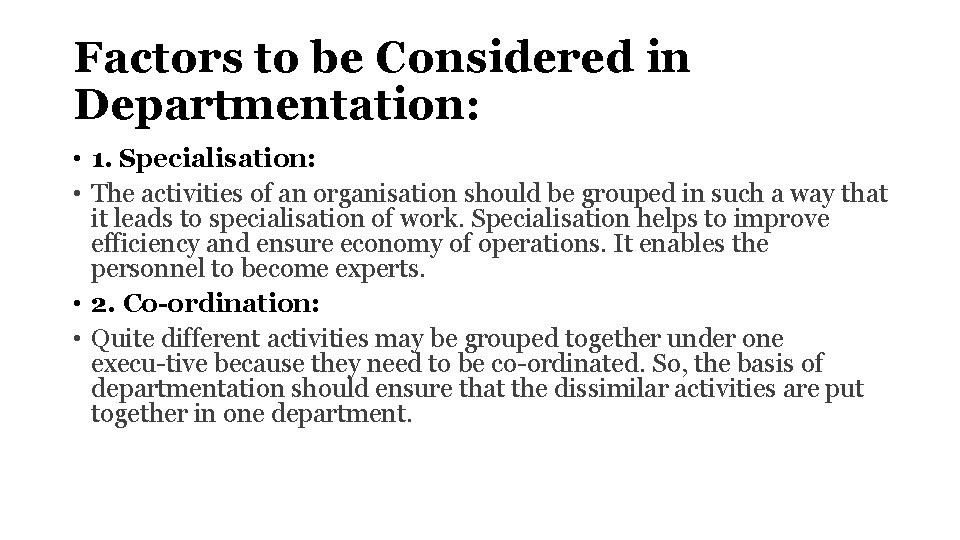
Factors to be Considered in Departmentation: • 1. Specialisation: • The activities of an organisation should be grouped in such a way that it leads to specialisation of work. Specialisation helps to improve efficiency and ensure economy of operations. It enables the personnel to become experts. • 2. Co-ordination: • Quite different activities may be grouped together under one execu tive because they need to be co ordinated. So, the basis of departmentation should ensure that the dissimilar activities are put together in one department.
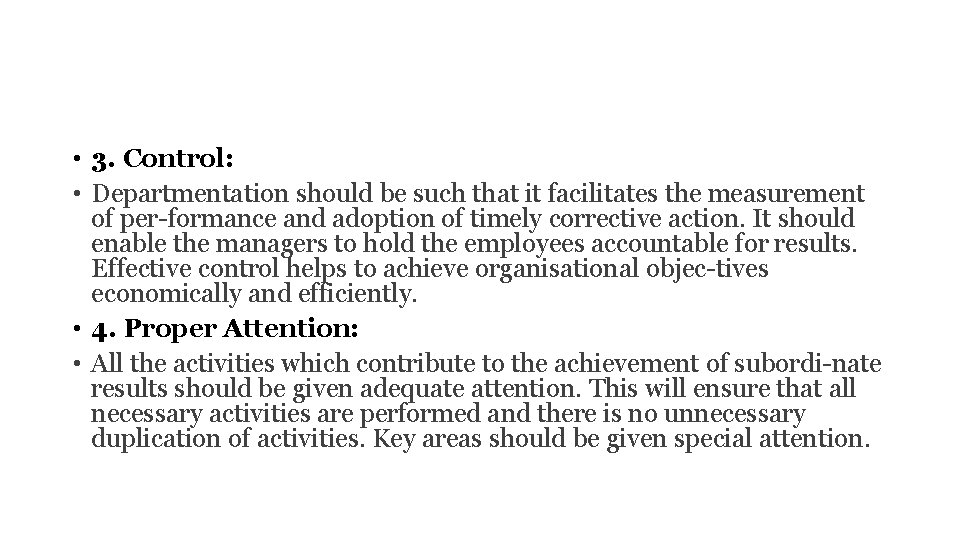
• 3. Control: • Departmentation should be such that it facilitates the measurement of per formance and adoption of timely corrective action. It should enable the managers to hold the employees accountable for results. Effective control helps to achieve organisational objec tives economically and efficiently. • 4. Proper Attention: • All the activities which contribute to the achievement of subordi nate results should be given adequate attention. This will ensure that all necessary activities are performed and there is no unnecessary duplication of activities. Key areas should be given special attention.
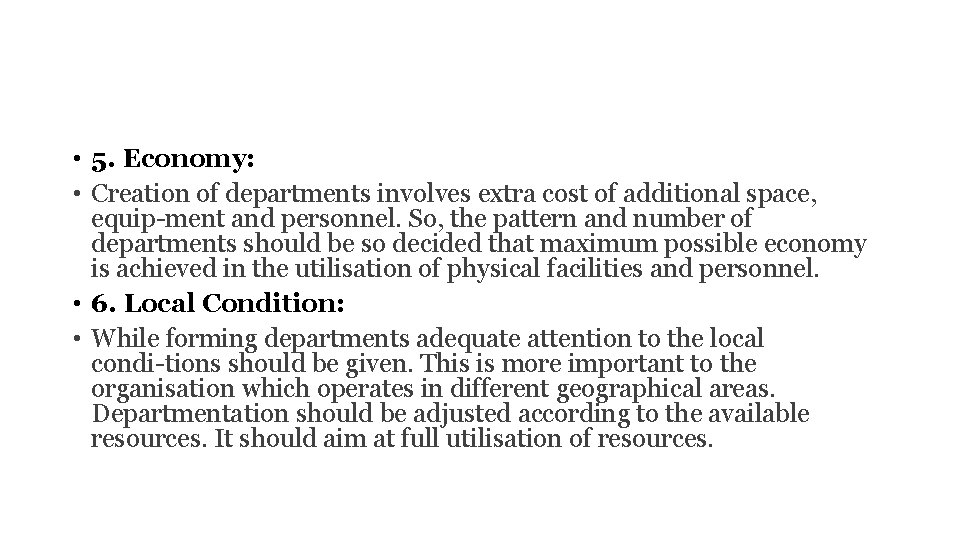
• 5. Economy: • Creation of departments involves extra cost of additional space, equip ment and personnel. So, the pattern and number of departments should be so decided that maximum possible economy is achieved in the utilisation of physical facilities and personnel. • 6. Local Condition: • While forming departments adequate attention to the local condi tions should be given. This is more important to the organisation which operates in different geographical areas. Departmentation should be adjusted according to the available resources. It should aim at full utilisation of resources.
• 7. Human Consideration: • Departmentation should also consider the human aspect in the organisation. So, along with the technical factors discussed above, departments should be created on the basis of availability of personnel, their attitude, aspiration and value systems, informal work groups, cultural patterns, etc. Due attention to the human factors will make departmentation more effective and more efficient.