
Unit 3 Macroeconomics Institutions Ch 8 Employment Labor
Unit 3 Macroeconomics: Institutions Ch 8 – Employment, Labor, and Wages Ch 9 – Sources of Gov. ’t Revenue Ch 10 – Gov. ’t Spending Ch 11 – Money and Banking Ch 12 – Financial Markets SKIP
Ch 8 and 9 Quiz
• Macroeconomics • The area of economics that deals w/ the economy as a whole, including inflation, employment, economic growth, gross domestic product, + the distribution of income. • Macro = Large
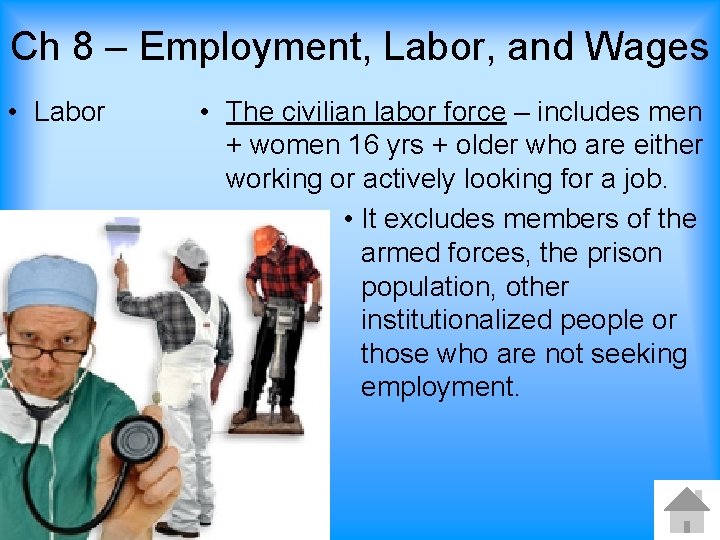
Ch 8 – Employment, Labor, and Wages • Labor • The civilian labor force – includes men + women 16 yrs + older who are either working or actively looking for a job. • It excludes members of the armed forces, the prison population, other institutionalized people or those who are not seeking employment.
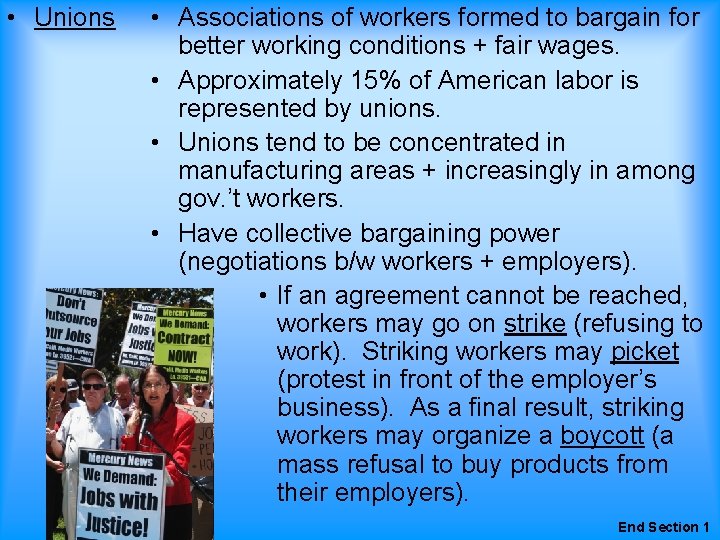
• Unions • Associations of workers formed to bargain for better working conditions + fair wages. • Approximately 15% of American labor is represented by unions. • Unions tend to be concentrated in manufacturing areas + increasingly in among gov. ’t workers. • Have collective bargaining power (negotiations b/w workers + employers). • If an agreement cannot be reached, workers may go on strike (refusing to work). Striking workers may picket (protest in front of the employer’s business). As a final result, striking workers may organize a boycott (a mass refusal to buy products from their employers). End Section 1
• Collective bargaining • Occurs when representatives from both labor + management meet. Labor is represented by a group of elected union officials. • Requires compromise from both sides. If a compromise cannot be reached b/w the 2 sides, other methods of negotiation are available: • Mediation – involves bringing in a neutral 3 rd party whose job it is to find a solution acceptable to both sides. The mediator’s solution is NOT BINDING. • Arbitration – involves bringing in a 3 rd party whose decision is BINDING. • Fact-finding – involves bringing in a neutral 3 rd party to collect facts about a dispute + present a solution which is NOT BINDING. • Beneficial if both sides have presented distorted facts or if one side doesn’t trust the other. • Injunction (court order not to act) or seizure (temporary gov. ’t take over). • Presidential intervention – may involve a simple public appeal or firing federal workers. End Section 2
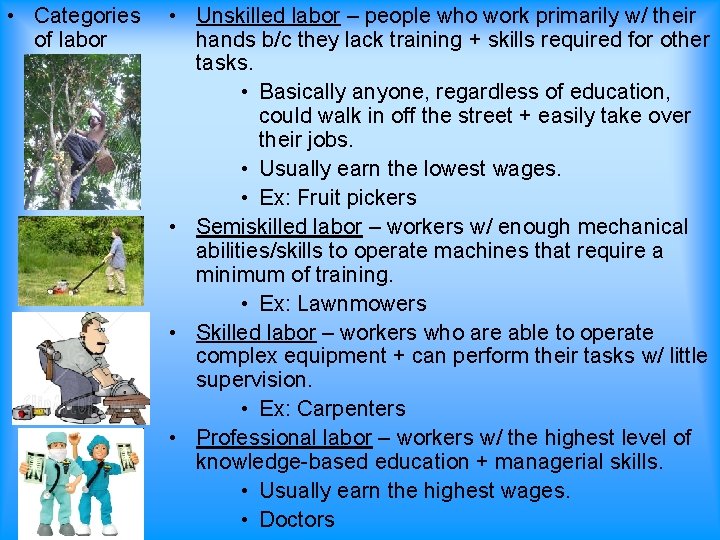
• Categories of labor • Unskilled labor – people who work primarily w/ their hands b/c they lack training + skills required for other tasks. • Basically anyone, regardless of education, could walk in off the street + easily take over their jobs. • Usually earn the lowest wages. • Ex: Fruit pickers • Semiskilled labor – workers w/ enough mechanical abilities/skills to operate machines that require a minimum of training. • Ex: Lawnmowers • Skilled labor – workers who are able to operate complex equipment + can perform their tasks w/ little supervision. • Ex: Carpenters • Professional labor – workers w/ the highest level of knowledge-based education + managerial skills. • Usually earn the highest wages. • Doctors
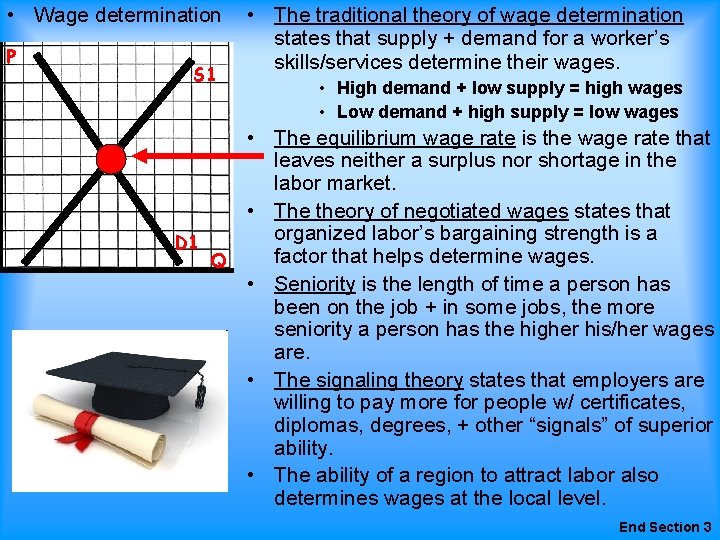
• Wage determination P S 1 • The traditional theory of wage determination states that supply + demand for a worker’s skills/services determine their wages. • High demand + low supply = high wages • Low demand + high supply = low wages • The equilibrium wage rate is the wage rate that leaves neither a surplus nor shortage in the labor market. • The theory of negotiated wages states that organized labor’s bargaining strength is a D 1 factor that helps determine wages. Q • Seniority is the length of time a person has been on the job + in some jobs, the more seniority a person has the higher his/her wages are. • The signaling theory states that employers are willing to pay more for people w/ certificates, diplomas, degrees, + other “signals” of superior ability. • The ability of a region to attract labor also determines wages at the local level. End Section 3
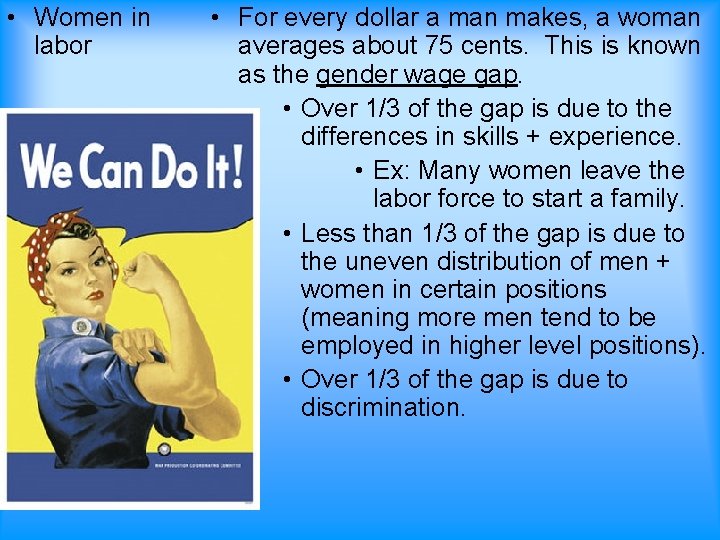
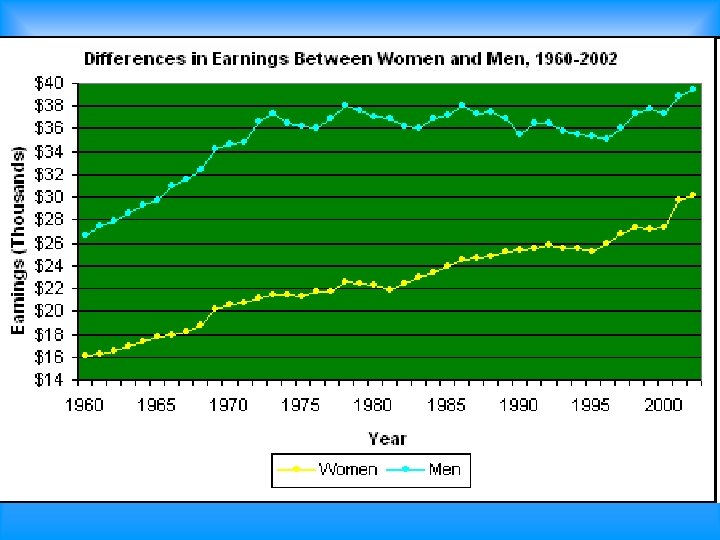
• Women in labor • For every dollar a man makes, a woman averages about 75 cents. This is known as the gender wage gap. • Over 1/3 of the gap is due to the differences in skills + experience. • Ex: Many women leave the labor force to start a family. • Less than 1/3 of the gap is due to the uneven distribution of men + women in certain positions (meaning more men tend to be employed in higher level positions). • Over 1/3 of the gap is due to discrimination.
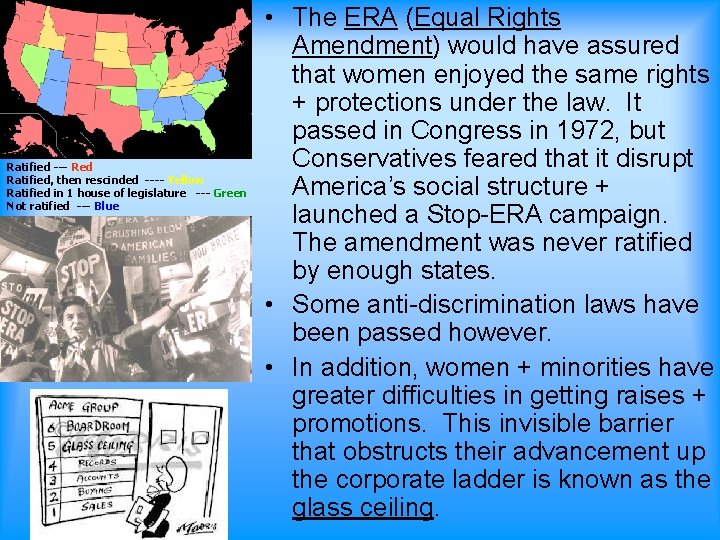
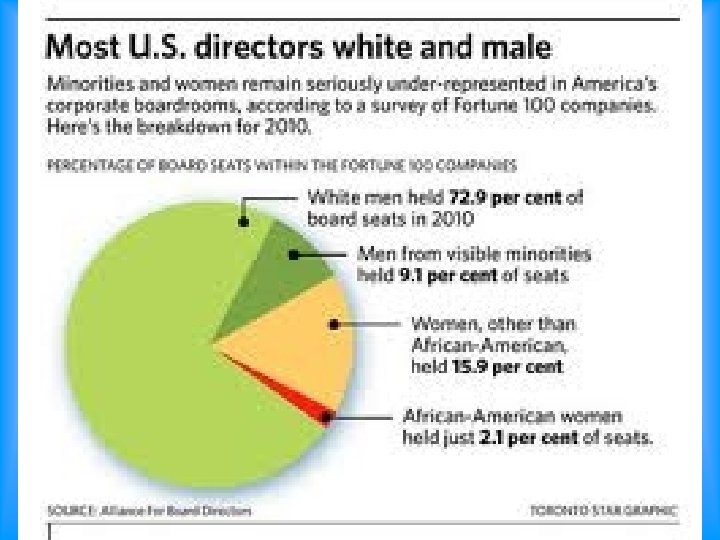
Ratified --- Red Ratified, then rescinded ---- Yellow Ratified in 1 house of legislature --- Green Not ratified --- Blue • The ERA (Equal Rights Amendment) would have assured that women enjoyed the same rights + protections under the law. It passed in Congress in 1972, but Conservatives feared that it disrupt America’s social structure + launched a Stop-ERA campaign. The amendment was never ratified by enough states. • Some anti-discrimination laws have been passed however. • In addition, women + minorities have greater difficulties in getting raises + promotions. This invisible barrier that obstructs their advancement up the corporate ladder is known as the glass ceiling.
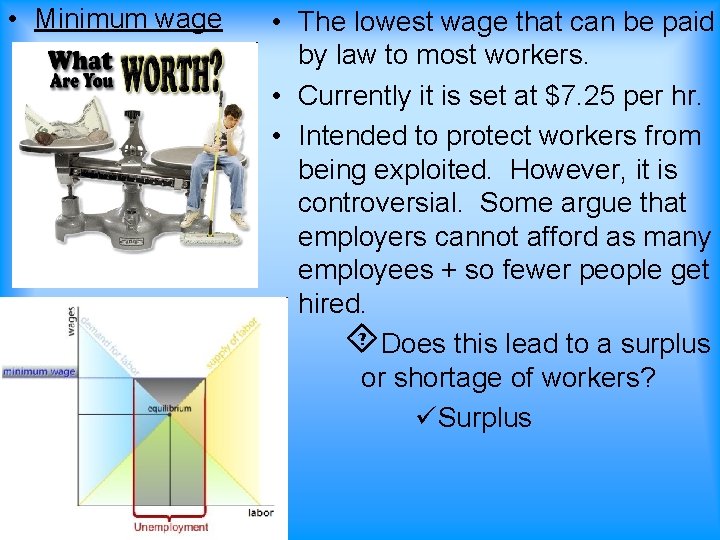
• Minimum wage • The lowest wage that can be paid by law to most workers. • Currently it is set at $7. 25 per hr. • Intended to protect workers from being exploited. However, it is controversial. Some argue that employers cannot afford as many employees + so fewer people get hired. ´Does this lead to a surplus or shortage of workers? üSurplus
End Section 4
Ch 9 – Sources of Gov. ’t Revenue • Taxes impact the economy in by affecting: • Resource allocation – the higher the taxes on resources, the fewer people can afford them + it can unemployment. • Consumer behavior – can discourage consumers from buying certain products. • Ex: The sin tax (a relatively high tax designed to raise revenue + consumption) on items such as tobacco + alcohol. • The nation’s productivity + growth • Also, the burden of taxes is sometimes transferred onto another party besides the one being taxed. • If a company is charged a higher tax it may the cost of its goods (passing cost onto consumers), take it out of profits (passing cost onto owners), or lay off workers (passing cost onto employees).
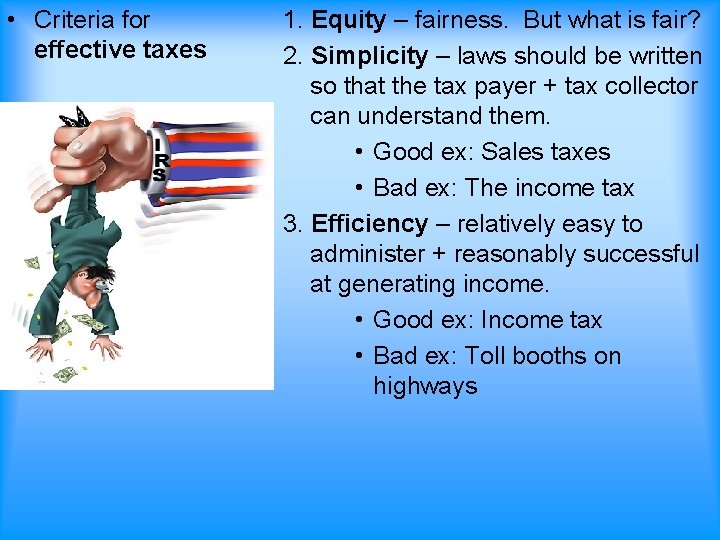
• Criteria for effective taxes 1. Equity – fairness. But what is fair? 2. Simplicity – laws should be written so that the tax payer + tax collector can understand them. • Good ex: Sales taxes • Bad ex: The income tax 3. Efficiency – relatively easy to administer + reasonably successful at generating income. • Good ex: Income tax • Bad ex: Toll booths on highways
• Principles of taxation • The benefit principle of taxation says that those who benefit from gov. ’t goods/services should pay in proportion to the benefits they receive. • Ex: toll booth taxes, gas taxes, etc… • 2 disadvantages: 1. Those who can least afford to pay taxes are usually the ones who benefit most from gov. ’t services. 2. Benefits are often hard to measure. • The ability to pay principle of taxation says that people should be taxed according to their ability to pay regardless of the benefits received. • Ex: income tax • 2 bases for: 1. Benefits are often hard to measure. 2. Assumes that people w/ higher incomes suffer less discomfort paying taxes than people w/ lower incomes.
• Types of taxes • Proportional tax or “flat tax” – everyone pays the same percentage rate (not the same amount) regardless of income. • Ex: If flat tax was applied to income taxes everyone would have to pay 20%. So someone who made $20, 000 would pay $4, 000 + someone who made $200, 000 would pay $40, 000. • Progressive tax – people who make more pay a higher percentage rate of their income. • Ex: Current income tax • Regressive tax – people who make less pay a higher percentage rate of their income. • Ex: Sales tax End Section 1
• Federal taxes • The most important taxes the national gov. ’t collects are the income tax (over 35% of its revenue), social security taxes (about 33%), + corporate income taxes (about 7. 5%). • P. 232 • Excise tax – taxes on the manufacture or sale of selected items like gas, alcohol, coal, etc… • Property tax – taxes levied on either real property (land, buildings, etc) or on personal property (cars, stocks, bank accounts, etc). • Estate tax – (or “death tax”) taxes the gov. ’t levies on the transfer of property when a person dies. • Gift tax – taxes on donations of $ or wealth PAID BY THE PERSON GIVING THE GIFT. This is to prevent people from giving away their wealth shortly before dying. • Customs duties or tariffs – taxes on imports. • User fees – charges on the use of goods/service such as gov. ’t land. End Section 2
• Sources of revenue for state gov. ’ts • $ from the federal gov. ’t (over 22%). • Sales tax (20% - except for the states w/ no sales tax). • State employee retirement + insurance (18%). • State income tax (15% - except for the states w/o an income tax). • Sources of revenue for local gov. ’ts • $ from the federal + state gov. ’ts (35%). • Property taxes such as real estate, cars, bank accounts, buildings, etc… (24%). • Utilities + state-owned liquor stores (8%). • Sales tax (6%). End Section 3
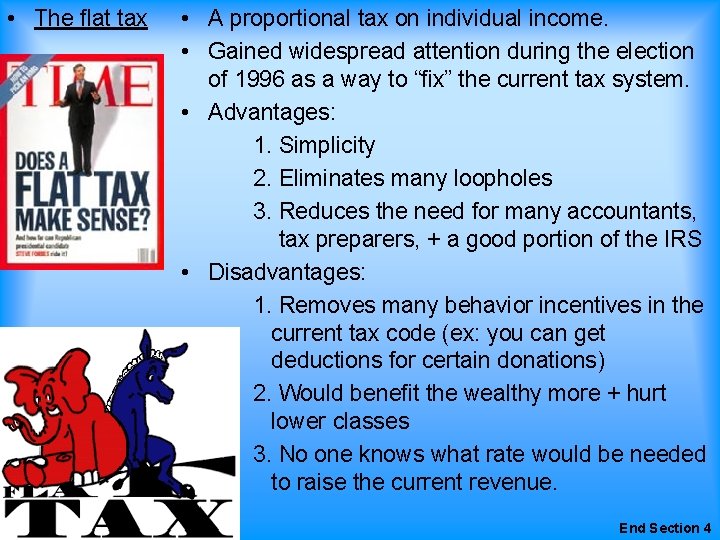
• The flat tax • A proportional tax on individual income. • Gained widespread attention during the election of 1996 as a way to “fix” the current tax system. • Advantages: 1. Simplicity 2. Eliminates many loopholes 3. Reduces the need for many accountants, tax preparers, + a good portion of the IRS • Disadvantages: 1. Removes many behavior incentives in the current tax code (ex: you can get deductions for certain donations) 2. Would benefit the wealthy more + hurt lower classes 3. No one knows what rate would be needed to raise the current revenue. End Section 4
Ch 10 and 11 Quiz
Ch 10 – Gov. ’t Spending • Spending • In 2003, federal, state, + local gov. ’ts collected nearly $2 TRILLION. That averaged out to about $10, 300 per capita (per person). • The public sector refers to the part of the economy made up of federal, state, + local gov. ’ts. • The private sector refers to the part of the economy made up of private individuals + privately-owned businesses.
Are they part of the public or private sector? _______ 1. Employees at TL Hanna High School _______ 2. Employees at Microsoft _______ 3. The President of the United States _______ 4. Police _______ 5. The veterinarian at Pet-Smart _______ 6. Bankers _______ 7. A soldier _______ 8. Your family physician
• Types of gov. ’t spending • Purchase of goods/services: • Tanks, ships, weapons, space shuttles, land, roads, offices, schools, prisons, employees, etc… • Transfer payments (a payment for which the gov. ’t receives neither goods nor services): • Social security, welfare, unemployment, Medicare, grants -in-aid (transfer payment from one level of gov. ’t to another), etc…
• Impact of gov. ’t spending • Due to its sheer size, the public sector has a huge impact on people’s lives: 1. Affecting resource allocation – military spending encourages private industries that make weapons, agricultural price supports encourage more people to stay on farms, etc… 2. Redistributing income – the amount of $ received by lower income families through programs such as Medicare, the closing of a military base causes the surrounding community to lose $, etc… 3. Competing w/ the private sector – public education vs. private education, military vs. private hospitals, etc… End Section 1
• Federal gov. ’t • The federal budget is an annual plan outlining spending proposed $ that will be raised + spent. • About 2/3 of the federal budget is mandatory spending (spending authorized by law that doesn’t have to be approved by Congress every year – ex: Social Security, Medicare, etc…). • About 1/3 of the federal budget is discretionary spending (programs that must receive Congressional authorization every year – ex: the military, welfare, stimulus $, etc…). • The fiscal year is a 12 month financial planning period. • The federal gov. ’t’s fiscal year is from Oct. 1 st – Sept. 30 th. • A budget deficit is when the gov. ’t spends more $ than it takes in. • A budget surplus is when the gov. ’t takes in more $ than it spends.
• Major • Social Security (over 20%) spending by • National defense (18%) the federal • Income security (15%) – includes gov. ’t retirement benefits for federal + military employees, food programs for low income families, subsidized housing, Medicare, etc… • Interest on the national debt (varies) End Section 2
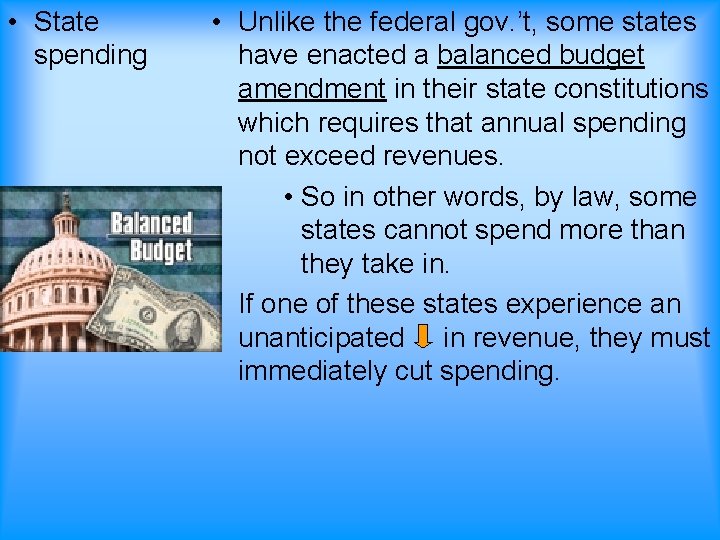
• State spending • Unlike the federal gov. ’t, some states have enacted a balanced budget amendment in their state constitutions which requires that annual spending not exceed revenues. • So in other words, by law, some states cannot spend more than they take in. • If one of these states experience an unanticipated in revenue, they must immediately cut spending.
• Major spending • $ to local gov. ’ts (30%) by state • Public Welfare (18%) gov. ’ts • Higher education (10%) • Highways (6%) • Major spending • K-12 Education (36%) by local gov. ’ts • Utilities (10%) • Police (5%) • Gov. ’t administration (5%) End Section 3
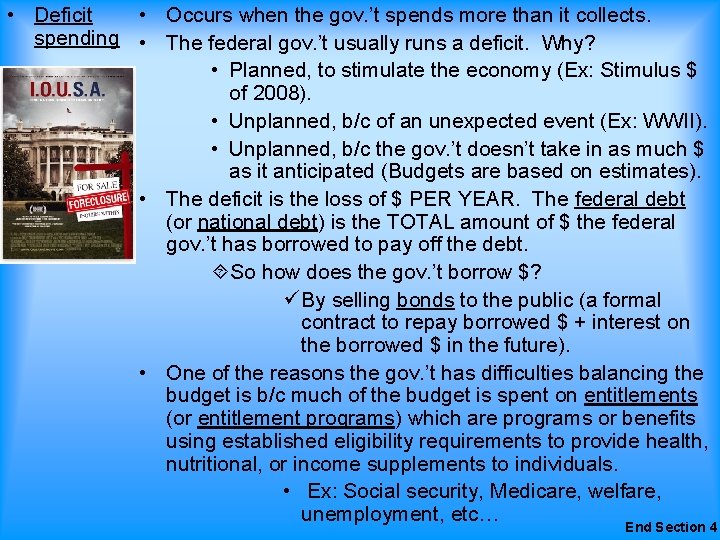
• Deficit • Occurs when the gov. ’t spends more than it collects. spending • The federal gov. ’t usually runs a deficit. Why? • Planned, to stimulate the economy (Ex: Stimulus $ of 2008). • Unplanned, b/c of an unexpected event (Ex: WWII). • Unplanned, b/c the gov. ’t doesn’t take in as much $ as it anticipated (Budgets are based on estimates). • The deficit is the loss of $ PER YEAR. The federal debt (or national debt) is the TOTAL amount of $ the federal gov. ’t has borrowed to pay off the debt. ´So how does the gov. ’t borrow $? ü By selling bonds to the public (a formal contract to repay borrowed $ + interest on the borrowed $ in the future). • One of the reasons the gov. ’t has difficulties balancing the budget is b/c much of the budget is spent on entitlements (or entitlement programs) which are programs or benefits using established eligibility requirements to provide health, nutritional, or income supplements to individuals. • Ex: Social security, Medicare, welfare, unemployment, etc… End Section 4
Ch 11 – Money and Banking • Functions of $ • Money is any substance that serves as a medium of exchange, a measure of value, + a store of value. 1. Medium of exchange – something accepted by all parties as payment for goods/services (Ex: gold, silver, salt, seashells, etc…). 2. Measure of value – a common denominator that can be used to express worth in terms that most individuals understand (Ex: price tags, to base the value of something by the weight of something else, etc…). 3. Store of value – the property that allows purchasing power to be saved until needed (putting $ in the bank, stockpiling gold etc…).
• Characteristics • Portable – easy to move from one place to of $ another. • Durable – won’t disintegrate or fall apart after a short period of time. • Divisible – can be divided into smaller units. • Limited availability – if too much exists or can be made, it loses its value. End Section 1
• The gold standard • • • A monetary standard under which the basic currency unit is equal to, + can be exchanged for, a specific amount of gold. In 1900, the US went on the gold standard w/ an ounce of gold being worth $20. 67. Although people continued to use paper $, they could at any time exchange the $ for a set amount of gold at the Treasury. Many other countries were also on the gold standard. Advantages: • People feel more secure if they can convert their $ into gold. • It is supposed to prevent the gov. ’t from printing too much $ (thus, preventing inflation). In reality, countries that go on the gold standard never have enough gold. Disadvantages: • The gold stock may not grow fast enough to keep pace w/ a growing economy + thereby preventing economic growth. • If too many people demand gold all at once, there can be a gold shortage. • The price of gold can change dramatically over time. • A gov. ’t looks inept if it isn’t able to accurately manage the gold/$ supply. The US went off the gold standard in 1934 during the Great Depression, when people didn’t trust in the value of paper $ + began stockpiling gold. Fearing there would be a severe shortage of gold, the gov. ’t ended the gold standard. End Section 2
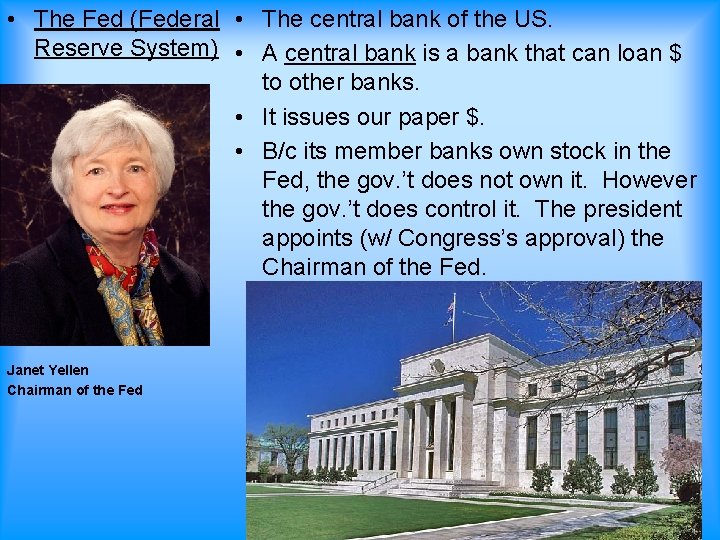
• The Fed (Federal • The central bank of the US. Reserve System) • A central bank is a bank that can loan $ to other banks. • It issues our paper $. • B/c its member banks own stock in the Fed, the gov. ’t does not own it. However the gov. ’t does control it. The president appoints (w/ Congress’s approval) the Chairman of the Fed. Janet Yellen Chairman of the Fed
• The FDIC • When the stock market crashed in 1929, many people lost their fortunes + immediately ran to the banks to withdraw their $. Many banks ran out of $ + closed permanently. Countless people lost everything. • To re-establish people’s confidence in the banking system, Congress passes The Banking Act of 1933 which created the Federal Deposit Insurance Corporation (FDIC) which protects customer deposits in the event of a bank closure (up to $250, 000 per individual per bank) • Bank failures still happen occasionally. If a bank appears to be in danger of collapsing, the FDIC can seize the bank + either sell it to a bigger bank or liquidate it + pay off the depositors. This is all done in secrecy to prevent panic withdrawals. The primary reason for bank closures is poor management. End Section 3
- Slides: 36