
Unit 3 Lesson 5 How Are Living Things
- Slides: 44
Unit 3 Lesson 5 How Are Living Things Adapted to Their Environment? Copyright © Houghton Mifflin Harcourt Publishing Company
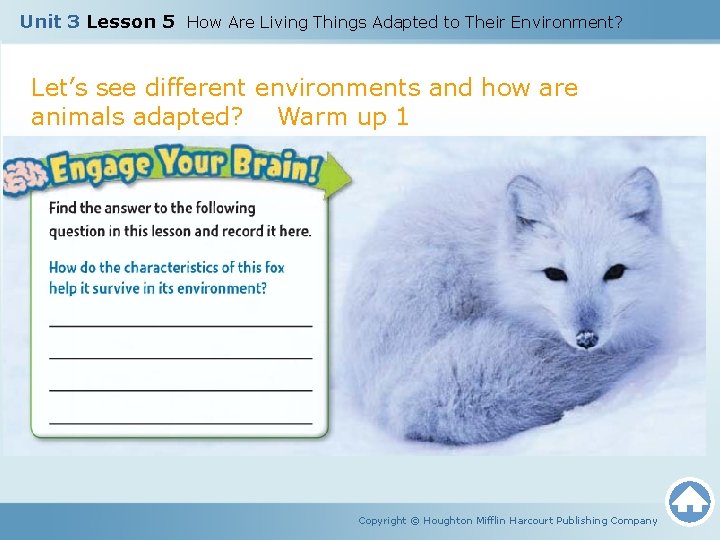
Unit 3 Lesson 5 How Are Living Things Adapted to Their Environment? Let’s see different environments and how are animals adapted? Warm up 1 Copyright © Houghton Mifflin Harcourt Publishing Company
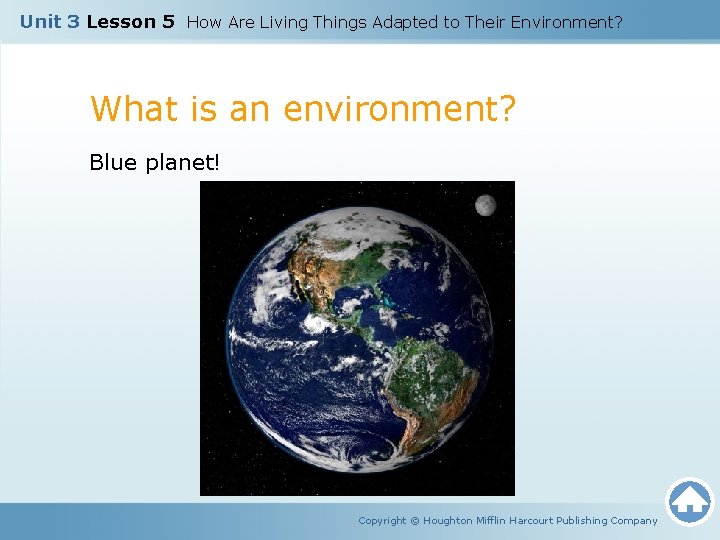
Unit 3 Lesson 5 How Are Living Things Adapted to Their Environment? What is an environment? Blue planet! Copyright © Houghton Mifflin Harcourt Publishing Company
Unit 3 Lesson 5 How Are Living Things Adapted to Their Environment? What is an environment? • The environment is all of the living and nonliving things in an area. • Earth has many types of environments. Because there are so many types of environments on Earth, there also many types of living things. • Each living thing, or organism, is able to survive in its own environment. • Plants and animals depend on their environment to meet their needs. • What do animals need to survive? Copyright © Houghton Mifflin Harcourt Publishing Company
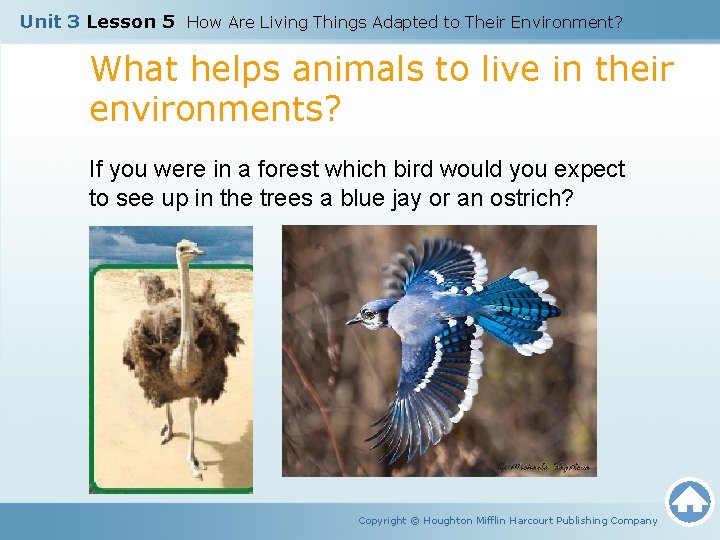
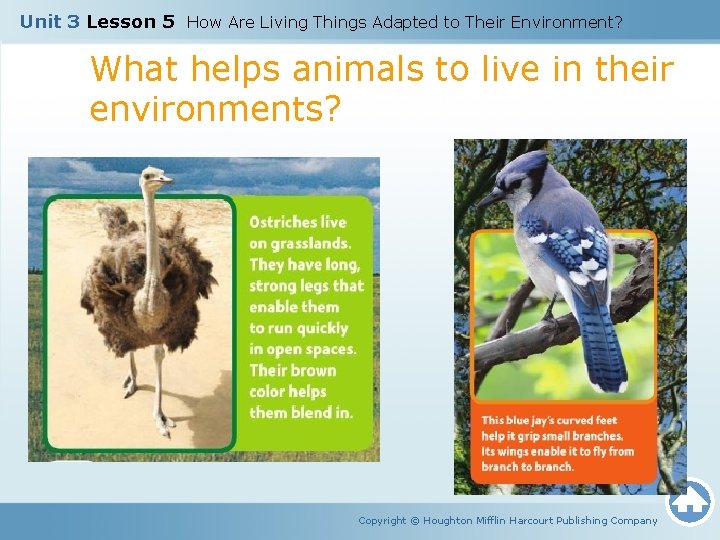
Unit 3 Lesson 5 How Are Living Things Adapted to Their Environment? What helps animals to live in their environments? If you were in a forest which bird would you expect to see up in the trees a blue jay or an ostrich? Copyright © Houghton Mifflin Harcourt Publishing Company
Unit 3 Lesson 5 How Are Living Things Adapted to Their Environment? What helps animals to live in their environments? Copyright © Houghton Mifflin Harcourt Publishing Company
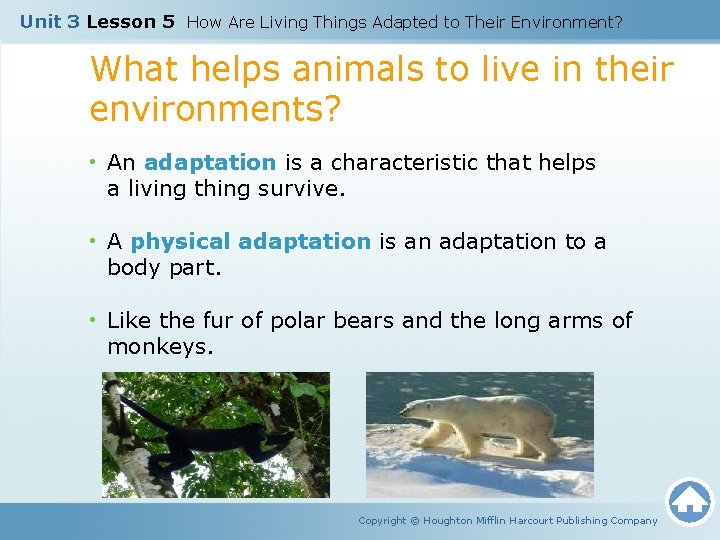
Unit 3 Lesson 5 How Are Living Things Adapted to Their Environment? What helps animals to live in their environments? • An adaptation is a characteristic that helps a living thing survive. • A physical adaptation is an adaptation to a body part. • Like the fur of polar bears and the long arms of monkeys. Copyright © Houghton Mifflin Harcourt Publishing Company
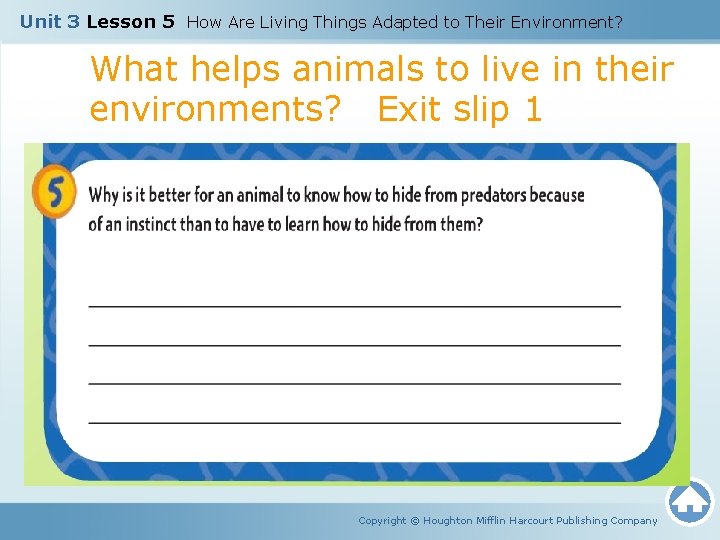
Unit 3 Lesson 5 How Are Living Things Adapted to Their Environment? What helps animals to live in their environments? Exit slip 1 Copyright © Houghton Mifflin Harcourt Publishing Company
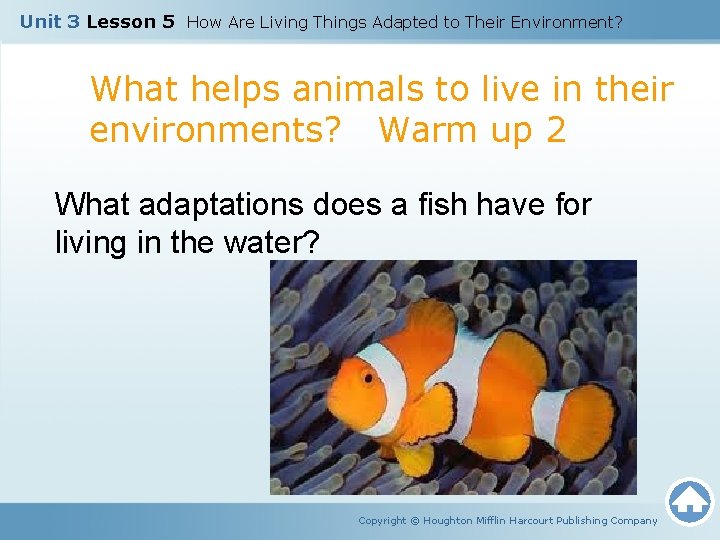
Unit 3 Lesson 5 How Are Living Things Adapted to Their Environment? What helps animals to live in their environments? Warm up 2 What adaptations does a fish have for living in the water? Copyright © Houghton Mifflin Harcourt Publishing Company
Unit 3 Lesson 5 How Are Living Things Adapted to Their Environment? Let’s see different environments and how are animals adapted? Copyright © Houghton Mifflin Harcourt Publishing Company
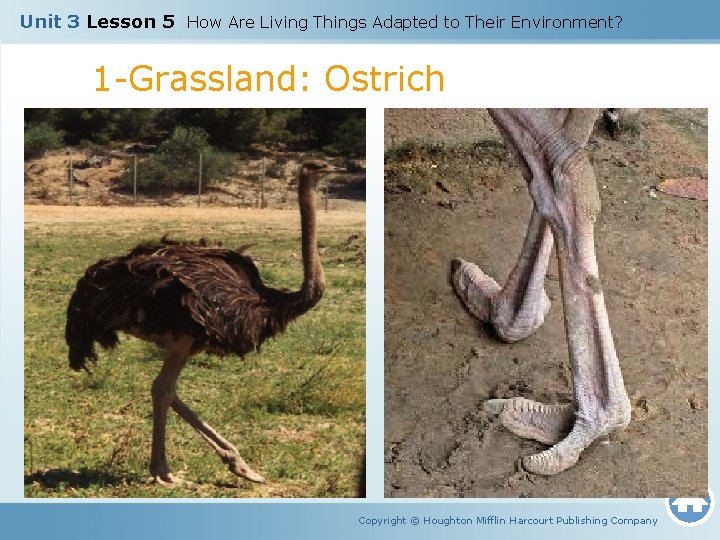
Unit 3 Lesson 5 How Are Living Things Adapted to Their Environment? 1 -Grassland: Ostrich Copyright © Houghton Mifflin Harcourt Publishing Company
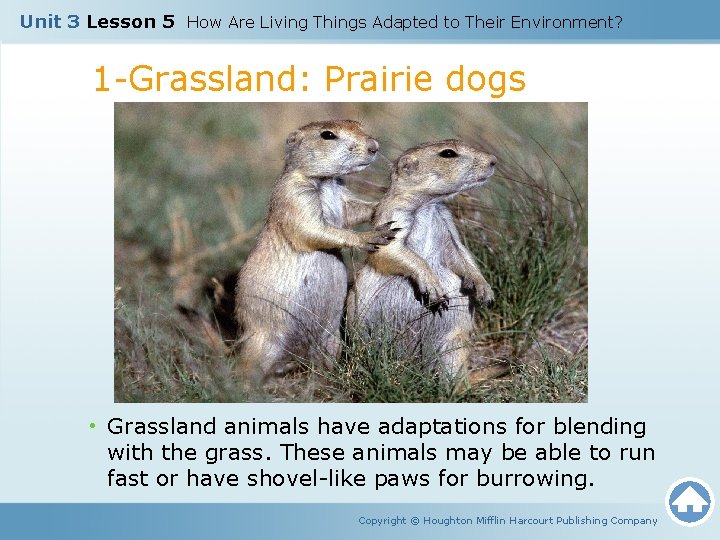
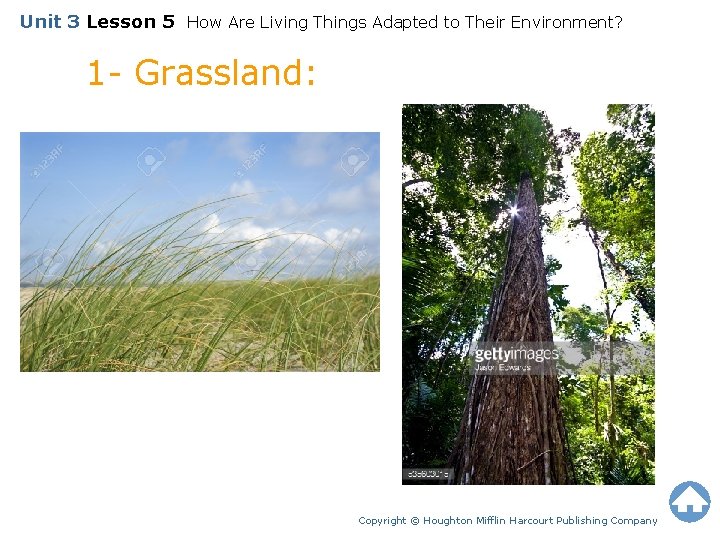
Unit 3 Lesson 5 How Are Living Things Adapted to Their Environment? 1 -Grassland: Prairie dogs • Grassland animals have adaptations for blending with the grass. These animals may be able to run fast or have shovel-like paws for burrowing. Copyright © Houghton Mifflin Harcourt Publishing Company
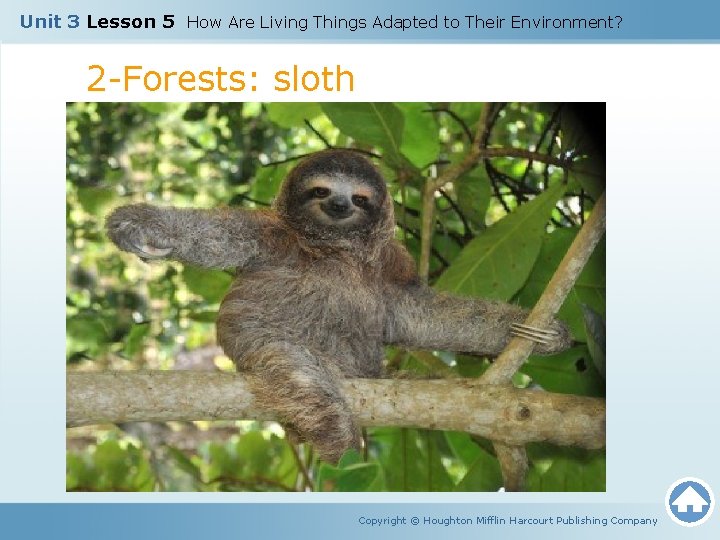
Unit 3 Lesson 5 How Are Living Things Adapted to Their Environment? 2 -Forests: sloth Copyright © Houghton Mifflin Harcourt Publishing Company
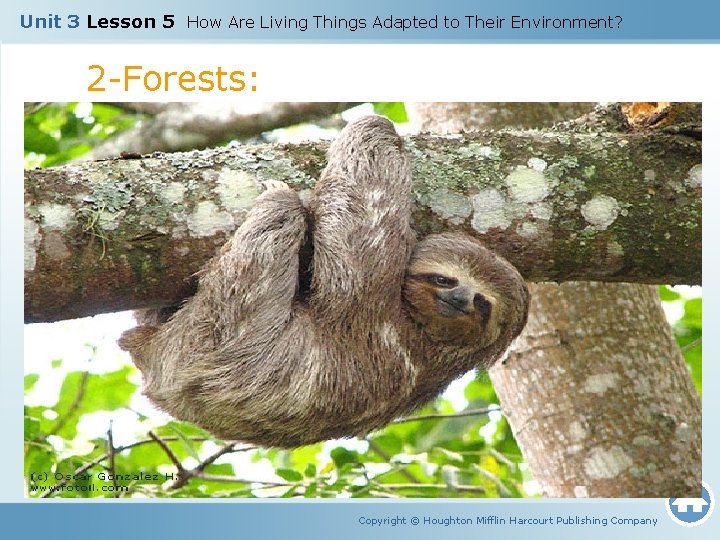
Unit 3 Lesson 5 How Are Living Things Adapted to Their Environment? 2 -Forests: Copyright © Houghton Mifflin Harcourt Publishing Company
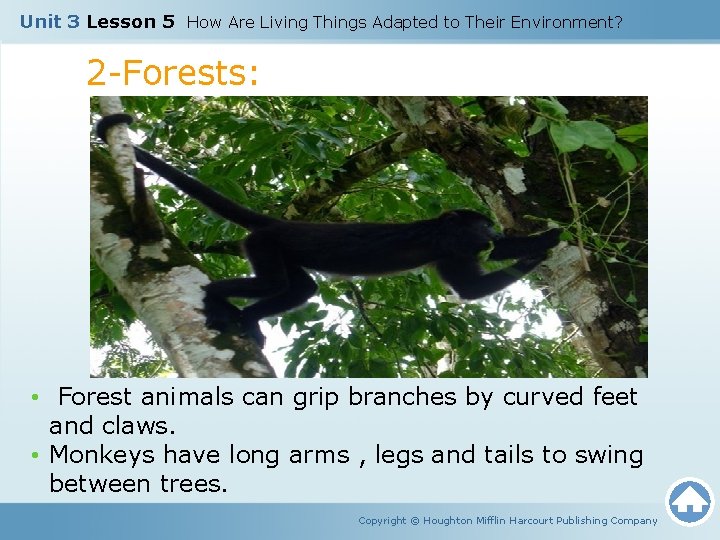
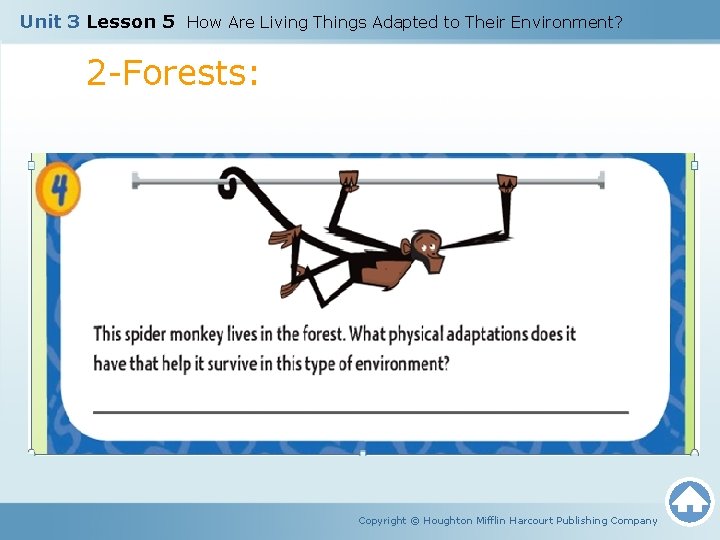
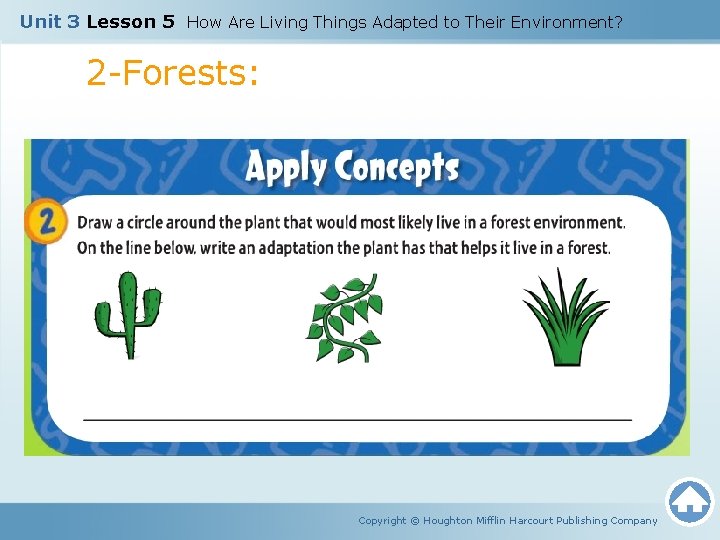
Unit 3 Lesson 5 How Are Living Things Adapted to Their Environment? 2 -Forests: • Forest animals can grip branches by curved feet and claws. • Monkeys have long arms , legs and tails to swing between trees. Copyright © Houghton Mifflin Harcourt Publishing Company
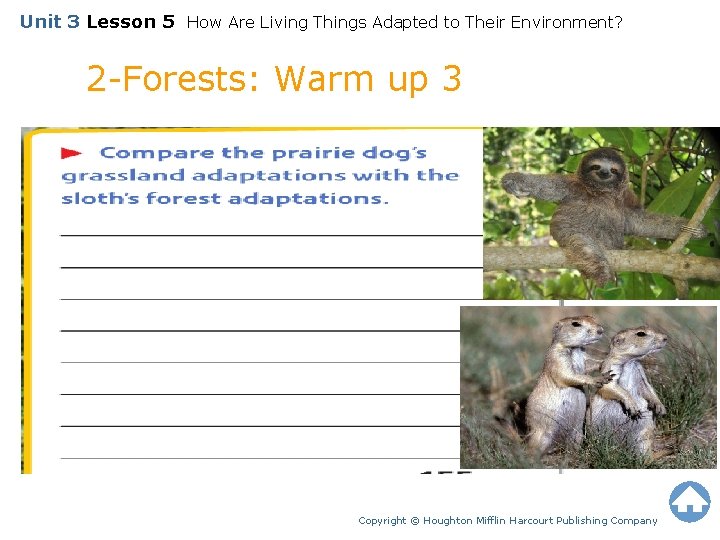
Unit 3 Lesson 5 How Are Living Things Adapted to Their Environment? 2 -Forests: Warm up 3 Copyright © Houghton Mifflin Harcourt Publishing Company
Unit 3 Lesson 5 How Are Living Things Adapted to Their Environment? 2 -Forests: • Copyright © Houghton Mifflin Harcourt Publishing Company
Unit 3 Lesson 5 How Are Living Things Adapted to Their Environment? 1 - Grassland: Copyright © Houghton Mifflin Harcourt Publishing Company
Unit 3 Lesson 5 How Are Living Things Adapted to Their Environment? 2 -Forests: Copyright © Houghton Mifflin Harcourt Publishing Company
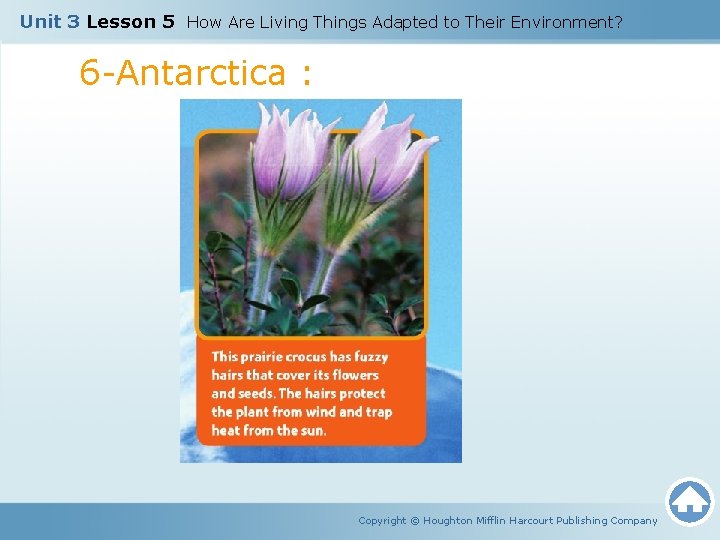
Unit 3 Lesson 5 How Are Living Things Adapted to Their Environment? 6 -Antarctica : Copyright © Houghton Mifflin Harcourt Publishing Company
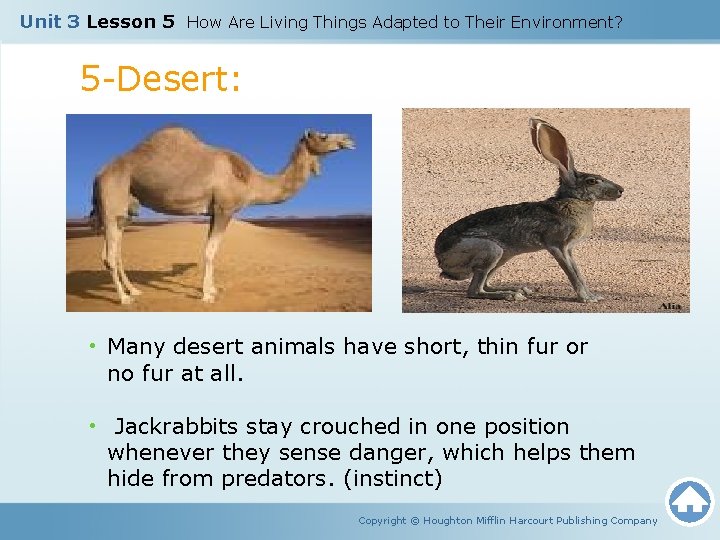
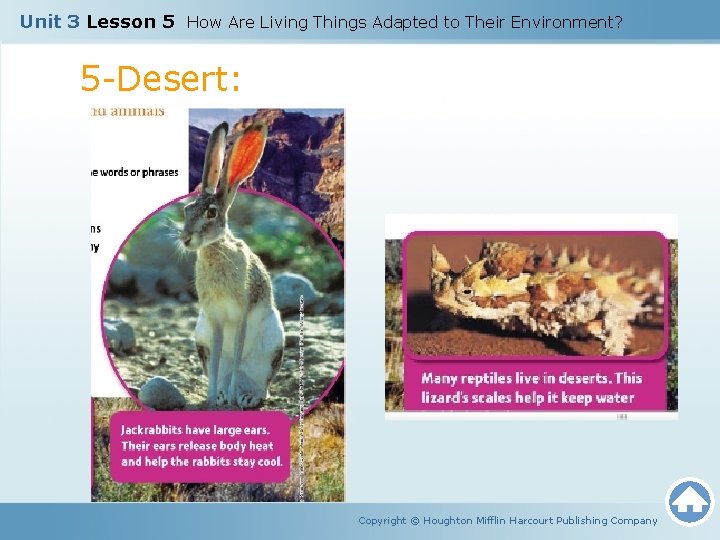
Unit 3 Lesson 5 How Are Living Things Adapted to Their Environment? 5 -Desert: • Many desert animals have short, thin fur or no fur at all. • Jackrabbits stay crouched in one position whenever they sense danger, which helps them hide from predators. (instinct) Copyright © Houghton Mifflin Harcourt Publishing Company
Unit 3 Lesson 5 How Are Living Things Adapted to Their Environment? 5 -Desert: Copyright © Houghton Mifflin Harcourt Publishing Company
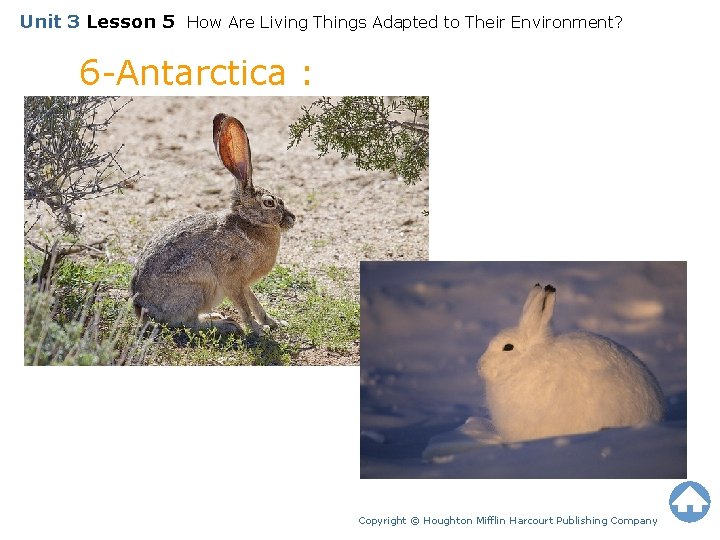
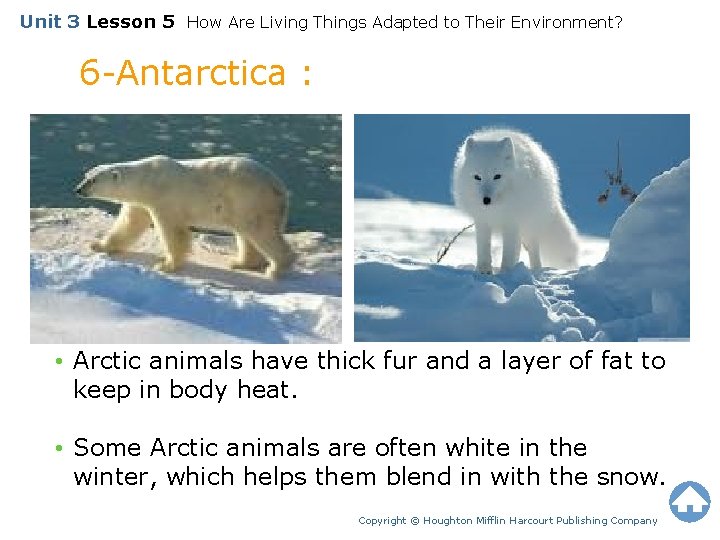
Unit 3 Lesson 5 How Are Living Things Adapted to Their Environment? 6 -Antarctica : • Arctic animals have thick fur and a layer of fat to keep in body heat. • Some Arctic animals are often white in the winter, which helps them blend in with the snow. Copyright © Houghton Mifflin Harcourt Publishing Company
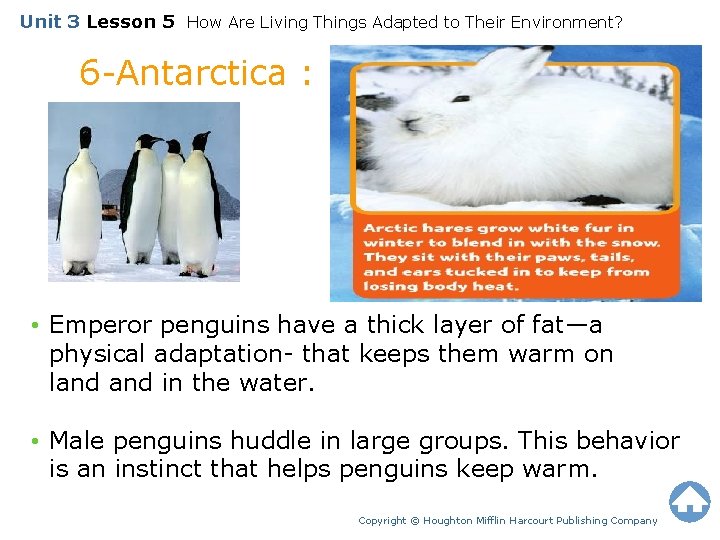
Unit 3 Lesson 5 How Are Living Things Adapted to Their Environment? 6 -Antarctica : • Emperor penguins have a thick layer of fat—a physical adaptation- that keeps them warm on land in the water. • Male penguins huddle in large groups. This behavior is an instinct that helps penguins keep warm. Copyright © Houghton Mifflin Harcourt Publishing Company
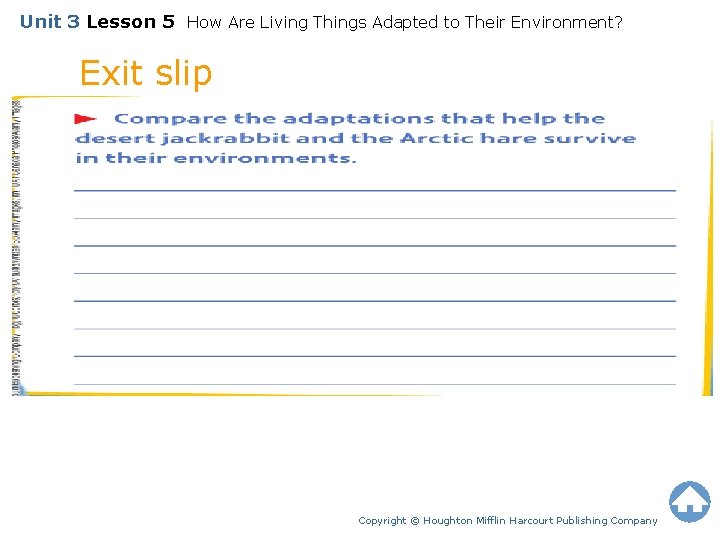
Unit 3 Lesson 5 How Are Living Things Adapted to Their Environment? Exit slip Copyright © Houghton Mifflin Harcourt Publishing Company
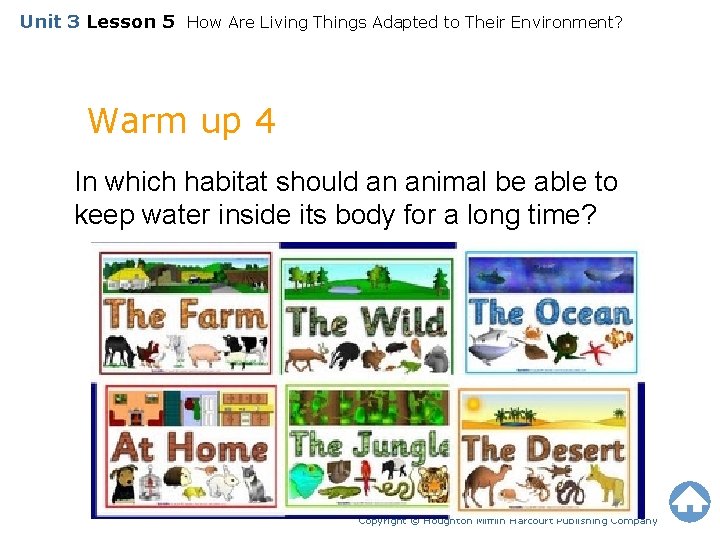
Unit 3 Lesson 5 How Are Living Things Adapted to Their Environment? Warm up 4 In which habitat should an animal be able to keep water inside its body for a long time? Copyright © Houghton Mifflin Harcourt Publishing Company
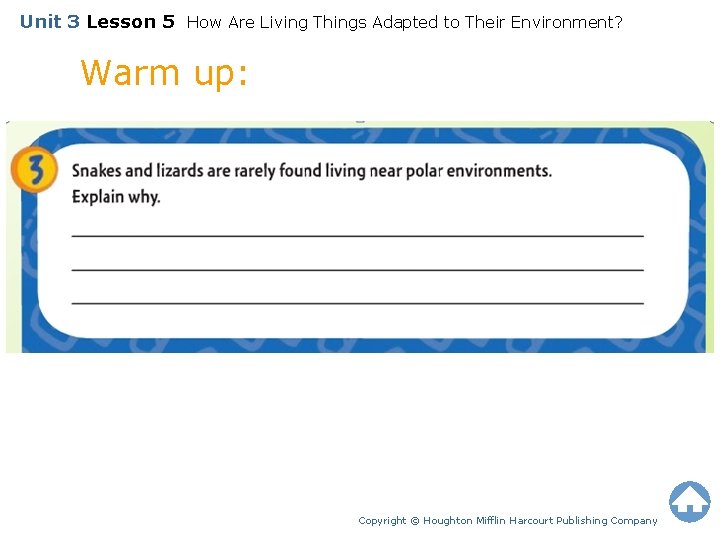
Unit 3 Lesson 5 How Are Living Things Adapted to Their Environment? Warm up: Copyright © Houghton Mifflin Harcourt Publishing Company
Unit 3 Lesson 5 How Are Living Things Adapted to Their Environment? What helps animals to live in their environments? • A behavioral adaptation is something an animal does to help it survive. • For example, most desert animals are active at night to avoid the heat of the day. • An instinct is an inherited behavior an animal knows how to do without having to learn it. Copyright © Houghton Mifflin Harcourt Publishing Company
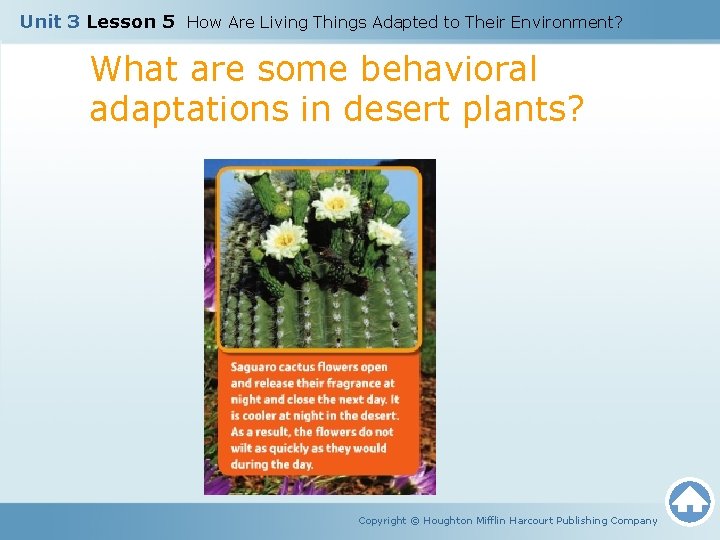
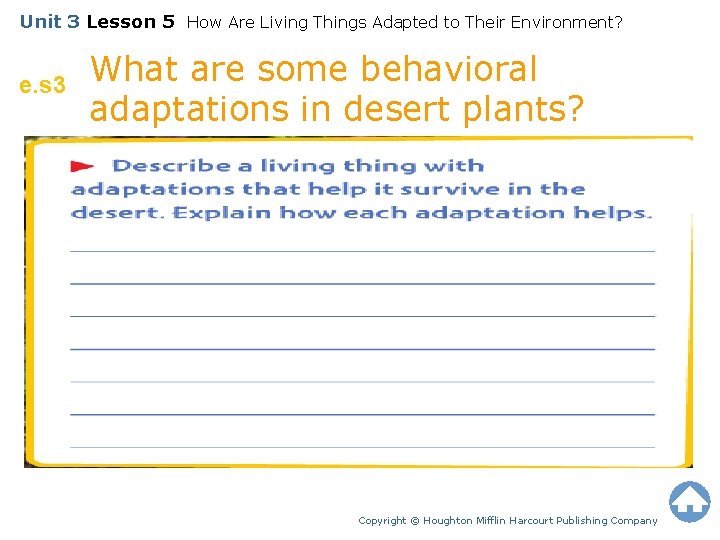
Unit 3 Lesson 5 How Are Living Things Adapted to Their Environment? What are some behavioral adaptations in desert plants? • Some seeds of desert plants stay dormant, or inactive, until it rains. • When it rains enough, the seeds grow quickly into plants that flower and make more seeds. • Cactus flowers open and release their fragrance at night and close during daytime. (WHY? ) Copyright © Houghton Mifflin Harcourt Publishing Company
Unit 3 Lesson 5 How Are Living Things Adapted to Their Environment? What are some behavioral adaptations in desert plants? Copyright © Houghton Mifflin Harcourt Publishing Company
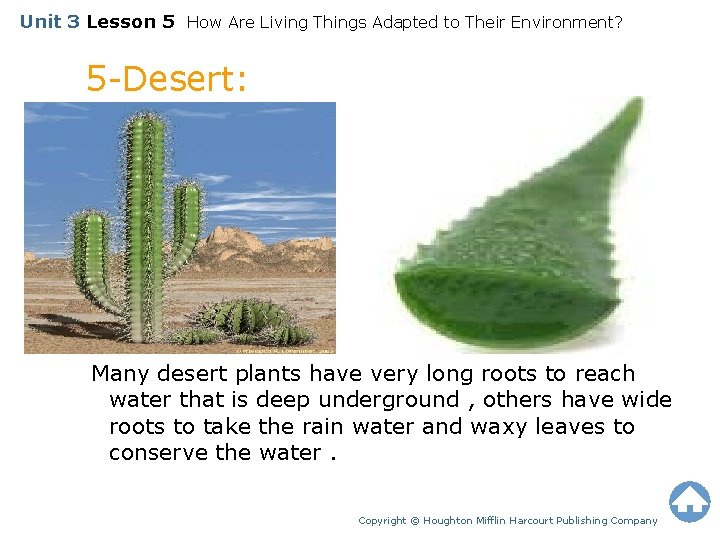
Unit 3 Lesson 5 How Are Living Things Adapted to Their Environment? 5 -Desert: Many desert plants have very long roots to reach water that is deep underground , others have wide roots to take the rain water and waxy leaves to conserve the water. Copyright © Houghton Mifflin Harcourt Publishing Company
Unit 3 Lesson 5 How Are Living Things Adapted to Their Environment? 6 -Antarctica : • Most Arctic plants have short roots, because the ground is frozen the majority of the year. • Most Arctic plants grow close to the ground, which helps protect them from strong, cold Arctic winds. Copyright © Houghton Mifflin Harcourt Publishing Company
Unit 3 Lesson 5 How Are Living Things Adapted to Their Environment? 6 -Antarctica : Copyright © Houghton Mifflin Harcourt Publishing Company
Unit 3 Lesson 5 How Are Living Things Adapted to Their Environment? e. s 3 What are some behavioral adaptations in desert plants? Copyright © Houghton Mifflin Harcourt Publishing Company
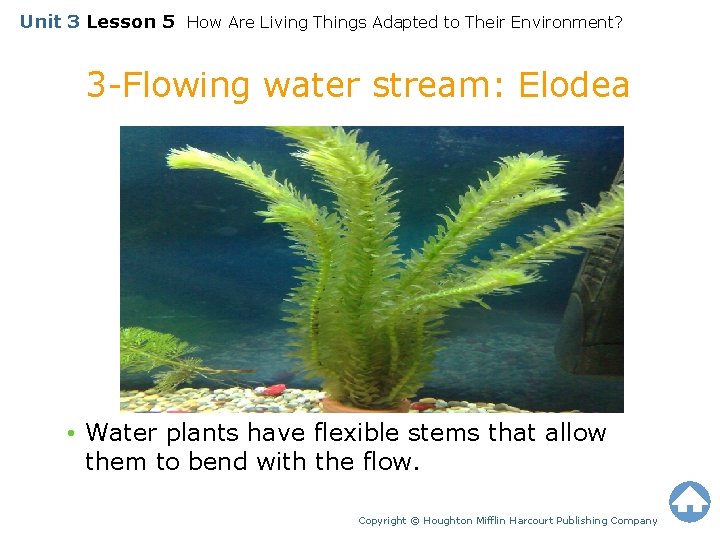
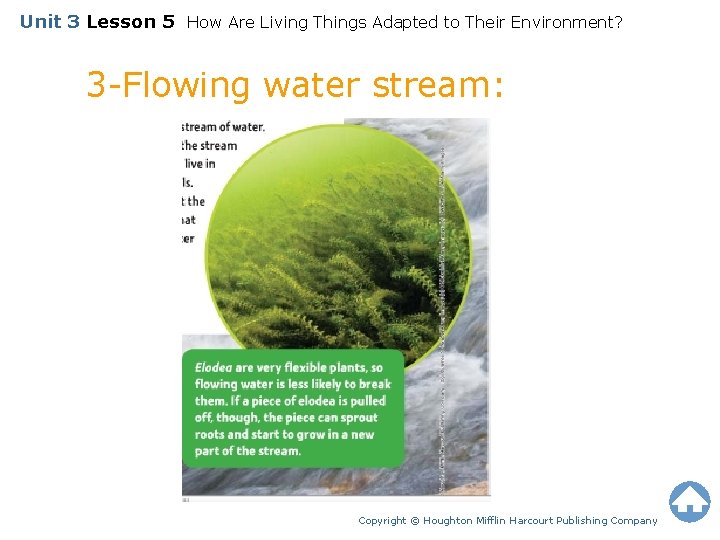
Unit 3 Lesson 5 How Are Living Things Adapted to Their Environment? 3 -Flowing water stream: Elodea • Water plants have flexible stems that allow them to bend with the flow. Copyright © Houghton Mifflin Harcourt Publishing Company
Unit 3 Lesson 5 How Are Living Things Adapted to Their Environment? 3 -Flowing water stream: Copyright © Houghton Mifflin Harcourt Publishing Company
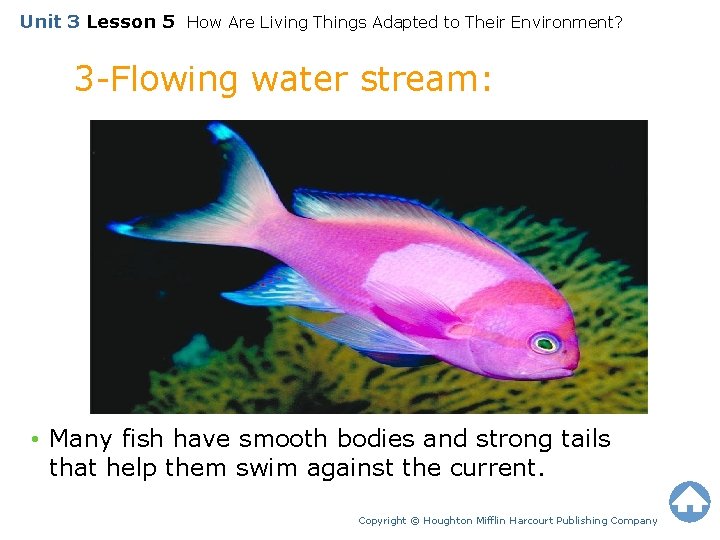
Unit 3 Lesson 5 How Are Living Things Adapted to Their Environment? 3 -Flowing water stream: • Many fish have smooth bodies and strong tails that help them swim against the current. Copyright © Houghton Mifflin Harcourt Publishing Company
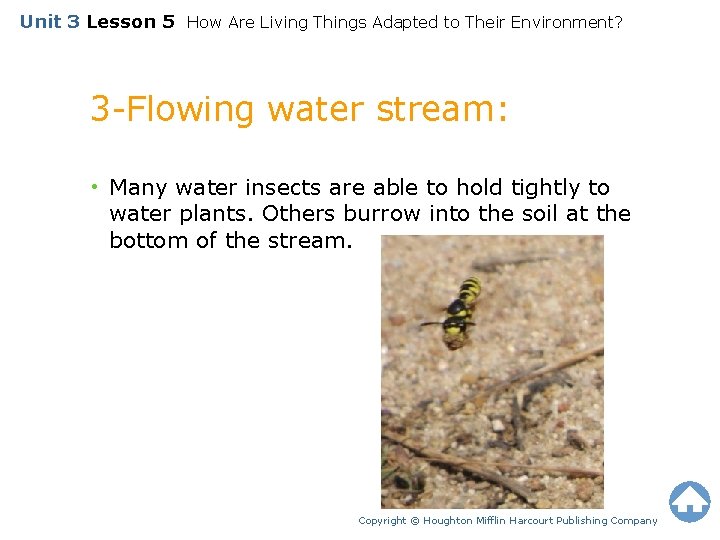
Unit 3 Lesson 5 How Are Living Things Adapted to Their Environment? 3 -Flowing water stream: • Many water insects are able to hold tightly to water plants. Others burrow into the soil at the bottom of the stream. Copyright © Houghton Mifflin Harcourt Publishing Company
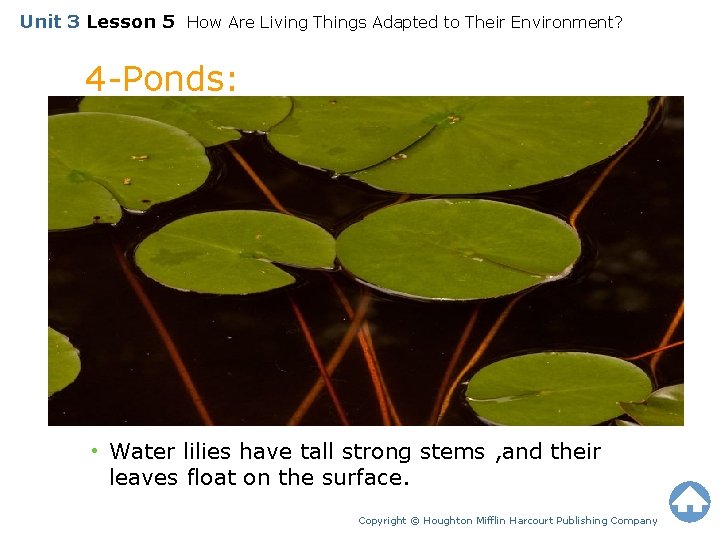
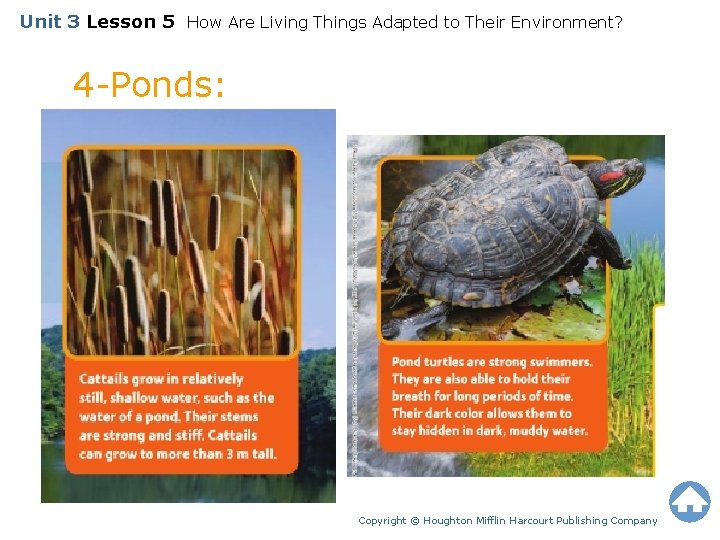
Unit 3 Lesson 5 How Are Living Things Adapted to Their Environment? 4 -Ponds: • Water lilies have tall strong stems , and their leaves float on the surface. Copyright © Houghton Mifflin Harcourt Publishing Company
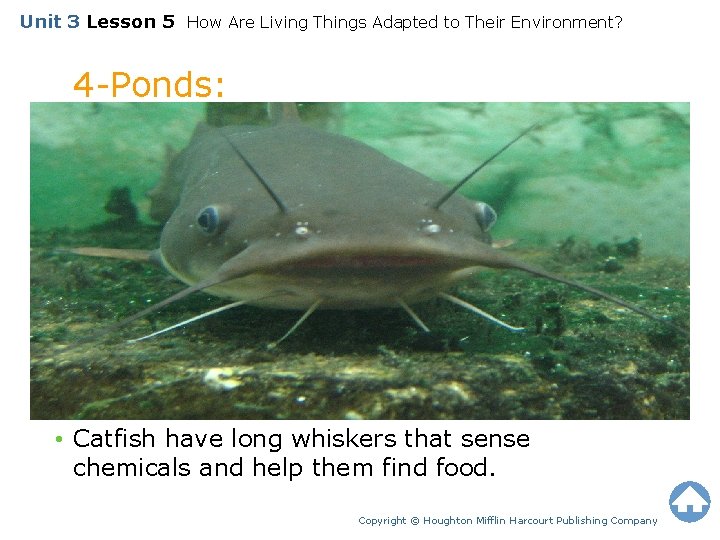
Unit 3 Lesson 5 How Are Living Things Adapted to Their Environment? 4 -Ponds: • Catfish have long whiskers that sense chemicals and help them find food. Copyright © Houghton Mifflin Harcourt Publishing Company
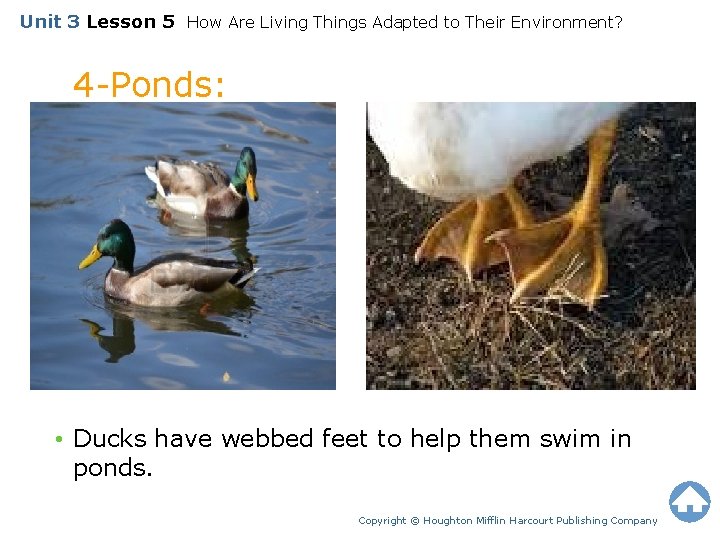
Unit 3 Lesson 5 How Are Living Things Adapted to Their Environment? 4 -Ponds: • Ducks have webbed feet to help them swim in ponds. Copyright © Houghton Mifflin Harcourt Publishing Company
Unit 3 Lesson 5 How Are Living Things Adapted to Their Environment? 4 -Ponds: Copyright © Houghton Mifflin Harcourt Publishing Company
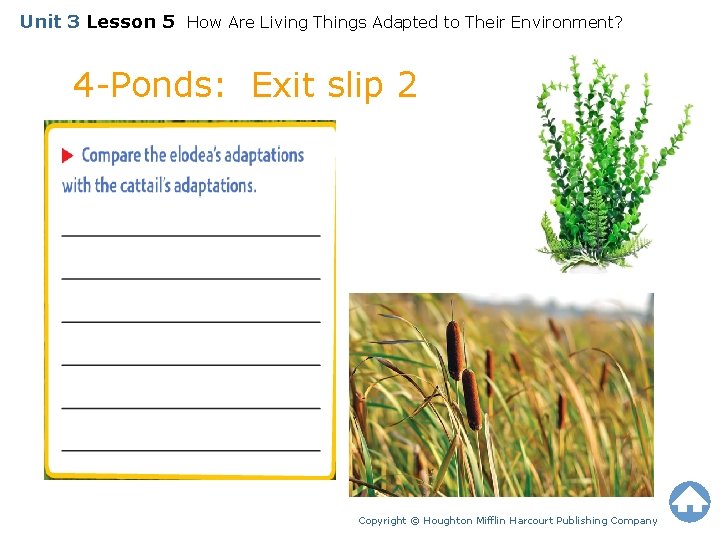
Unit 3 Lesson 5 How Are Living Things Adapted to Their Environment? 4 -Ponds: Exit slip 2 Copyright © Houghton Mifflin Harcourt Publishing Company
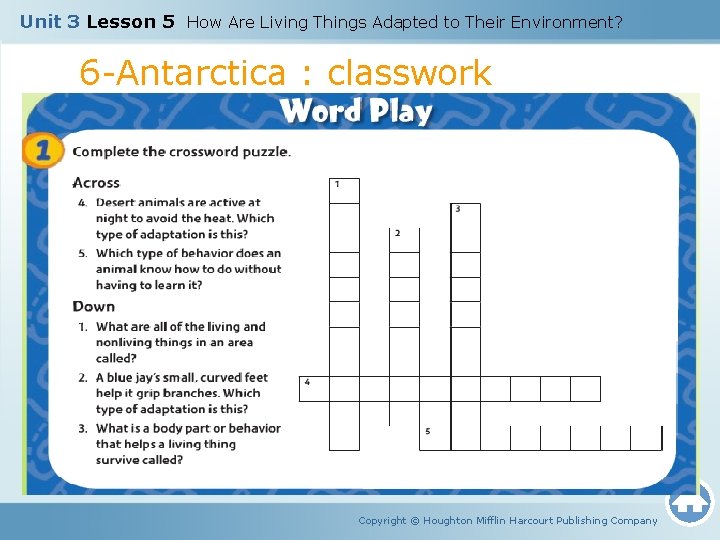
Unit 3 Lesson 5 How Are Living Things Adapted to Their Environment? 6 -Antarctica : classwork Copyright © Houghton Mifflin Harcourt Publishing Company