
Unit 3 Lesson 4 Renewable Energy Resources Copyright
Unit 3 Lesson 4 Renewable Energy Resources Copyright © Houghton Mifflin Harcourt Publishing Company
Unit 3 Lesson 4 Renewable Energy Resources Energy Déjà Vu What are the two main sources of renewable energy? • An energy resource is a natural resource used to generate electricity and other forms of energy. • Most of the energy used by humans comes from nonrenewable resources. These resources are used more quickly than they can be replaced. • But renewable resources can be replaced almost as quickly as they are used. Most of them come from the sun and some from Earth itself. Copyright © Houghton Mifflin Harcourt Publishing Company
Unit 3 Lesson 4 Renewable Energy Resources What are the two main sources of renewable energy? • The sun’s energy is a result of nuclear fusion, a process by which two or more nuclei fuse together to form a larger nucleus. • Solar energy warms Earth and moves air masses and some ocean currents. It also fuels plant growth. Animals get energy by eating plants. • Humans can harness energy from wind, moving water, plant and animal materials, and directly from the light and heat coming from the sun. Copyright © Houghton Mifflin Harcourt Publishing Company
Unit 3 Lesson 4 Renewable Energy Resources What are the two main sources of renewable energy? • One source of energy from within Earth is the decay of radioactive elements in Earth’s mantle and crust, caused by nuclear fission. • The second source of energy within Earth is energy stored during Earth’s formation. • The heat produced from these sources radiates outward toward Earth’s surface. Humans can harness this heat to use as an energy source. Copyright © Houghton Mifflin Harcourt Publishing Company
Unit 3 Lesson 4 Renewable Energy Resources How might a renewable energy resource become nonrenewable? • Trees are a renewable resource. • However, some forests are being cut down but are not being replanted in a timely manner. Others are being cut down and replaced with buildings. • If this process continues, eventually these forests will no longer be considered renewable resources. Copyright © Houghton Mifflin Harcourt Publishing Company

Unit 3 Lesson 4 Renewable Energy Resources Turn, Turn How do humans use wind energy? • Wind energy uses the force of moving air to drive an electric generator or do other work. • Wind energy is renewable because the wind will blow as long as the sun warms Earth. • Wind energy is harnessed by machines called wind turbines. Clusters of wind turbines, called wind farms, generate large amounts of electricity. Copyright © Houghton Mifflin Harcourt Publishing Company
Unit 3 Lesson 4 Renewable Energy Resources How do humans use wind energy? • Wind energy has several disadvantages. Wind farms can be placed only in areas that receive large amounts of wind. • Production and maintenance of the equipment is expensive and produces some pollution. • The turbine blades can be hazardous to birds. Copyright © Houghton Mifflin Harcourt Publishing Company

Unit 3 Lesson 4 Renewable Energy Resources How do humans get energy from moving water? • Moving water has kinetic energy. • Electrical energy produced by moving water is called hydroelectric energy. It is renewable because the water cycle is driven by the sun. • The energy in flowing water is converted to electrical energy when it spins turbines connected to electric generators inside a dam. Copyright © Houghton Mifflin Harcourt Publishing Company

Unit 3 Lesson 4 Renewable Energy Resources How do humans get energy from moving water? • Hydroelectric energy is a good source of energy only in locations where there are large, reliable amounts of flowing water. • Another disadvantage is that hydroelectric dams and their technology are expensive to build. • Dams can block the movement of fish between the sea and their spawning grounds, and special ladders must be built to allow fish to swim around the dam. Copyright © Houghton Mifflin Harcourt Publishing Company

Unit 3 Lesson 4 Renewable Energy Resources How do humans get energy from moving water? • How does a hydroelectric plant generate electricity? Copyright © Houghton Mifflin Harcourt Publishing Company
Unit 3 Lesson 4 Renewable Energy Resources Let the Sunshine In How do humans use solar energy? • Solar energy is the energy received by Earth from the sun in the form of radiation. • Solar energy can be used to warm buildings directly. • It can also be converted into electricity by solar cells. Copyright © Houghton Mifflin Harcourt Publishing Company

Unit 3 Lesson 4 Renewable Energy Resources How do humans use solar energy? • We can use liquids warmed by the sun to warm water and buildings. • When heat is absorbed by liquid in a solar collector, it can be transferred to water that can be used to warm the building or for various household purposes. • The only pollution generated by solar heating systems comes from the manufacture and maintenance of the equipment. Copyright © Houghton Mifflin Harcourt Publishing Company

Unit 3 Lesson 4 Renewable Energy Resources How do humans use solar energy? • Solar collector absorbs solar energy and heats water in a house. Copyright © Houghton Mifflin Harcourt Publishing Company
Unit 3 Lesson 4 Renewable Energy Resources How do humans use solar energy? • Solar collectors can be used to heat fluid and produce steam. The steam then turns a turbine connected to a generator that produces electricity. • Electricity can also be generated when sunlight is absorbed by a photovoltaic cell. Many cells must be joined together to form a solar panel. • Solar power plants must be built in places with adequate space and abundant sunshine yearround. Copyright © Houghton Mifflin Harcourt Publishing Company
Unit 3 Lesson 4 Renewable Energy Resources How do humans get energy from living things? • Biomass is organic matter from plants and from animal waste that contains chemical energy. It can be burned to release energy. • Biomass is inexpensive and can usually be replaced relatively quickly, so it is considered to be a renewable resource. • Like fossil fuels, biomass produces pollutants when burned. Copyright © Houghton Mifflin Harcourt Publishing Company
Unit 3 Lesson 4 Renewable Energy Resources How do humans get energy from living things? • Biomass material can be used to produce an alcohol called ethanol. • The sugars or cellulose in plants are eaten by microbes, which give off carbon dioxide and ethanol. • The ethanol is collected and burned as a fuel, or it can be mixed with gasoline to make a fuel called gasohol. Copyright © Houghton Mifflin Harcourt Publishing Company
Unit 3 Lesson 4 Renewable Energy Resources How do humans use geothermal energy? • Geothermal energy is produced by heat from Earth’s interior. This energy heats rock formations deep within the ground. • Groundwater absorbs this heat and forms hot springs and geysers where the water reaches Earth’s surface. • Geothermal energy is used to produce energy as heat and electricity. Copyright © Houghton Mifflin Harcourt Publishing Company
Unit 3 Lesson 4 Renewable Energy Resources How do humans use geothermal energy? • Geothermal energy is used to warm and cool buildings. • Water is pumped through a closed loop of pipes that runs from underground into a building’s heating system. The water absorbs heat from the ground and warms the building. • In warmer months, the ground is cooler than the air, so this system can also be used for cooling. Copyright © Houghton Mifflin Harcourt Publishing Company
Unit 3 Lesson 4 Renewable Energy Resources How do humans use geothermal energy? • Geothermal energy is also used to produce electricity. • Wells are drilled into areas of superheated groundwater. Geothermal power plants use the escaping steam or hot water to spin turbines and generate electricity. • However, production of the equipment generates pollution, and the technology is expensive to make and maintain. Copyright © Houghton Mifflin Harcourt Publishing Company
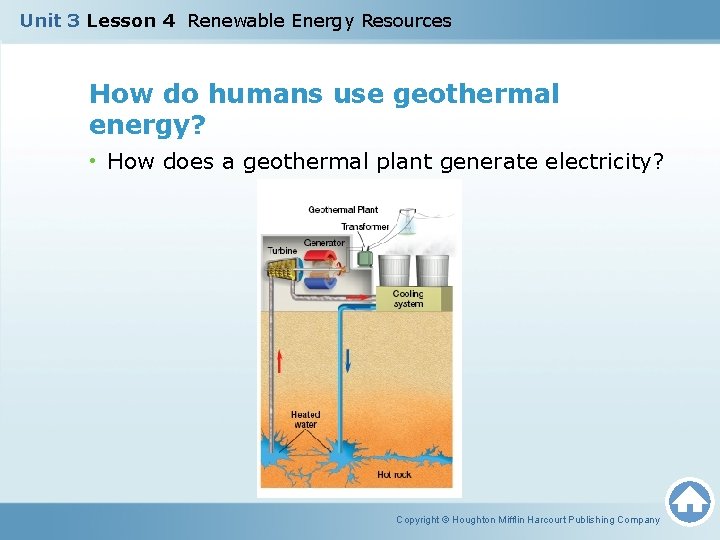
Unit 3 Lesson 4 Renewable Energy Resources How do humans use geothermal energy? • How does a geothermal plant generate electricity? Copyright © Houghton Mifflin Harcourt Publishing Company
- Slides: 20