
Unit 3 Lesson 3 How Do Cells Work


- Slides: 17
Unit 3 Lesson 3 How Do Cells Work Together? Copyright © Houghton Mifflin Harcourt Publishing Company
Unit 3 Lesson 3 How Do Cells Work Together? How Cells Are Organized • Cells are organized to work together so the body functions smoothly. • Tissue is made up of cells of the same type that work together to do a certain job. • The body has four different types of tissues: muscle, connective, nerve, and epithelial. Copyright © Houghton Mifflin Harcourt Publishing Company
Unit 3 Lesson 3 How Do Cells Work Together? How Cells Are Organized • An organ is made up of several tissues that work together to do a certain job. • Organs that work together to do a job for the body make up an organ system. Copyright © Houghton Mifflin Harcourt Publishing Company
Unit 3 Lesson 3 How Do Cells Work Together? How Cells Are Organized • Nerve tissue makes up your brain and spine, which are organs that are part of your nervous system. • Epithelial tissue makes up the outer layer of skin, the largest organ of your body. Skin is made of all four tissues. • Connective tissue holds tissues and organs together. These tissues connect muscles to bone. • Muscle tissue makes up a large part of the body and is responsible for movement. Copyright © Houghton Mifflin Harcourt Publishing Company
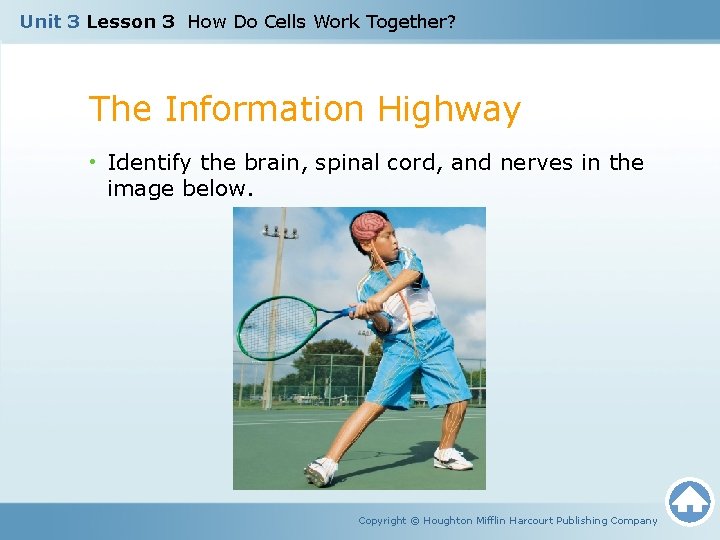
Unit 3 Lesson 3 How Do Cells Work Together? The Information Highway • Sensing your surroundings and communicating information are the jobs of your nervous system. • The nervous system is made of tiny structures called nerve cells. Chains of long nerve cells make up nerves. Copyright © Houghton Mifflin Harcourt Publishing Company
Unit 3 Lesson 3 How Do Cells Work Together? The Information Highway • Nerves carry information to and from the brain, which processes information. • The spinal cord, a rope-like bundle of nerve tissue, is the main pathway for information traveling to and from the brain. Copyright © Houghton Mifflin Harcourt Publishing Company
Unit 3 Lesson 3 How Do Cells Work Together? The Information Highway • Identify the brain, spinal cord, and nerves in the image below. Copyright © Houghton Mifflin Harcourt Publishing Company
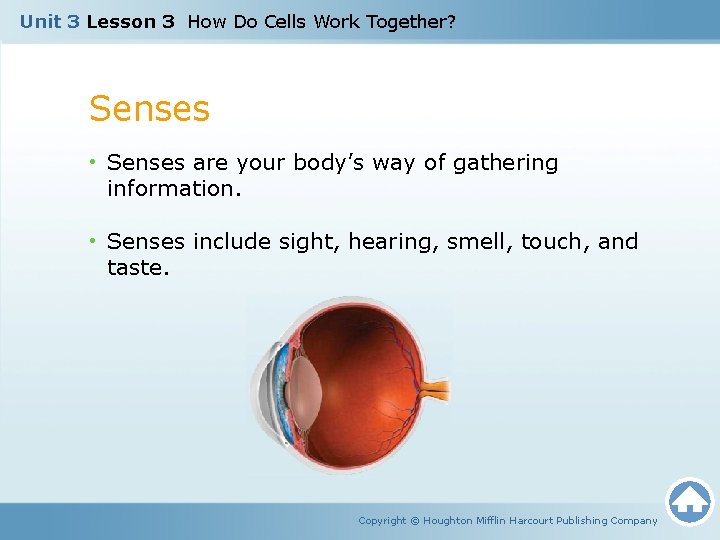
Unit 3 Lesson 3 How Do Cells Work Together? Senses • Senses are your body’s way of gathering information. • Senses include sight, hearing, smell, touch, and taste. Copyright © Houghton Mifflin Harcourt Publishing Company
Unit 3 Lesson 3 How Do Cells Work Together? Sight and Smell Sight • The iris is the part of the eye that gives your eye color. Light enters the eye through the pupil. • The retina at the back of the eye contains nerve cells that detect light. These nerve cells send signals to the brain. Copyright © Houghton Mifflin Harcourt Publishing Company
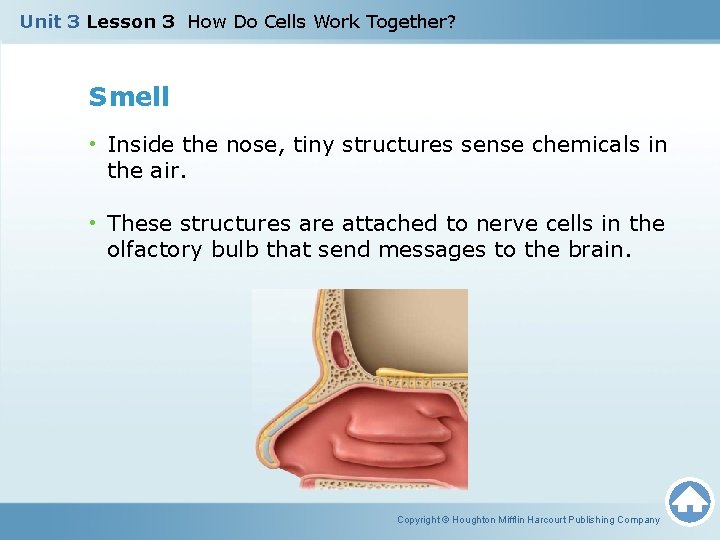
Unit 3 Lesson 3 How Do Cells Work Together? Smell • Inside the nose, tiny structures sense chemicals in the air. • These structures are attached to nerve cells in the olfactory bulb that send messages to the brain. Copyright © Houghton Mifflin Harcourt Publishing Company
Unit 3 Lesson 3 How Do Cells Work Together? Hearing and Taste Hearing • The outer ear funnels sound into the middle ear causing the eardrum to vibrate. • These bones pass vibrations to the inner ear where a fluid-filled structure called the cochlea passes vibrations to tiny hairs on the nerves. • These nerves send messages about vibrations to the brain and you hear. Copyright © Houghton Mifflin Harcourt Publishing Company
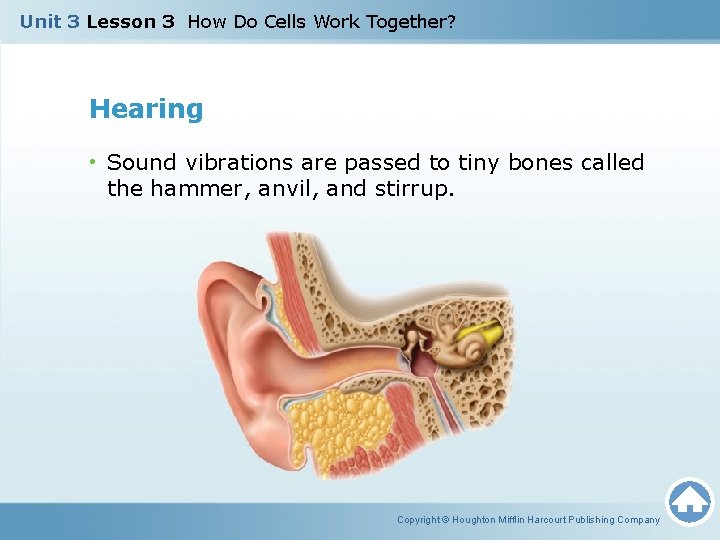
Unit 3 Lesson 3 How Do Cells Work Together? Hearing • Sound vibrations are passed to tiny bones called the hammer, anvil, and stirrup. Copyright © Houghton Mifflin Harcourt Publishing Company
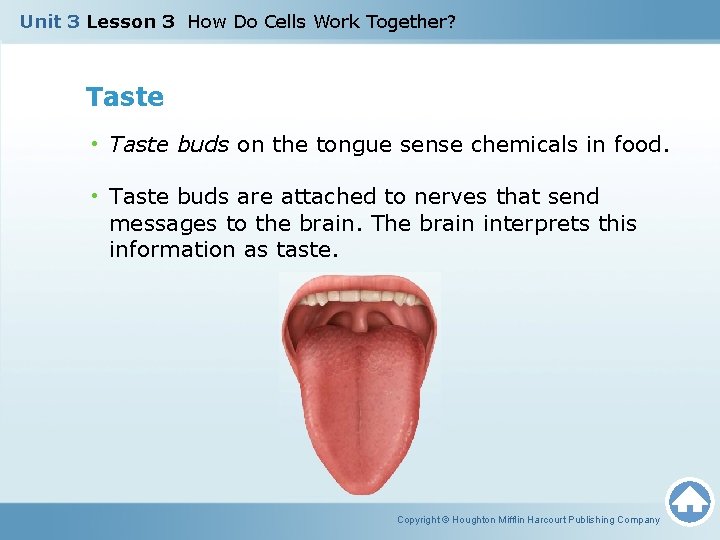
Unit 3 Lesson 3 How Do Cells Work Together? Taste • Taste buds on the tongue sense chemicals in food. • Taste buds are attached to nerves that send messages to the brain. The brain interprets this information as taste. Copyright © Houghton Mifflin Harcourt Publishing Company
Unit 3 Lesson 3 How Do Cells Work Together? The Skin You’re In • Skin is a protective layer that covers the body. • Skin, fingernails, toenails, and hair are part of the integumentary system. The integumentary system protects the inside of the body. Copyright © Houghton Mifflin Harcourt Publishing Company
Unit 3 Lesson 3 How Do Cells Work Together? The Skin You’re In • Skin keeps germs out of the body and water in the body. • When you get too hot, sweat on the skin cools the body. When you get too cold, hair keeps your head warm. • Hair also protects your skin. Copyright © Houghton Mifflin Harcourt Publishing Company
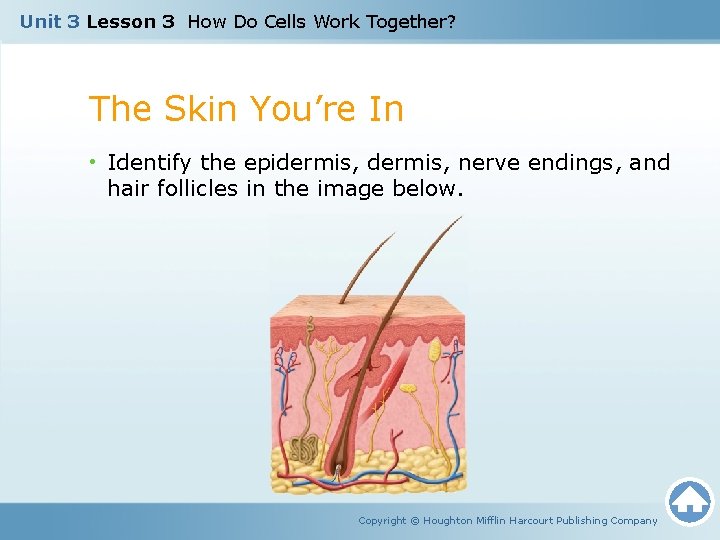
Unit 3 Lesson 3 How Do Cells Work Together? The Skin You’re In • The epidermis is your outer layer of skin. • The dermis is the inner layer of skin. It contains hair follicles, sweat glands, blood vessels, and nerve endings. • Nerve endings are special structures that sense touch, heat, cold, pain, pressure, and vibration. Copyright © Houghton Mifflin Harcourt Publishing Company
Unit 3 Lesson 3 How Do Cells Work Together? The Skin You’re In • Identify the epidermis, nerve endings, and hair follicles in the image below. Copyright © Houghton Mifflin Harcourt Publishing Company