
Unit 3 Lesson 2 Communication for Healthy Lifestyles


- Slides: 19
Unit 3: Lesson 2
Communication for Healthy Lifestyles & Health Behaviour Change Lesson 2: Skills for Brief Intervention
Making Every Contact Count Play your part in changing lifestyle behaviours and help prevent chronic disease
RECAP UNIT 3 Lesson 1 • “Talking about Health” • Person-Centred Approach • Active Listening Skills • Different types of questions- open/closed …
Brief Interventions (BI) Brief interventions involve opportunistic advice, discussion, negotiation or encouragement and can be delivered by a range of health care professionals, typically within 3 -10 minutes. A Brief Intervention may include: – – Motivational Interviewing techniques An assessment of the individual’s commitment to change Offer pharmacotherapy and/or behavioural support Self-help material and referral to more intensive support
Do Brief Interventions work? Brief Intervention from health professionals increases the percentage of smokers who quit and remain abstinent for 6 months or more (Health Education Authority, 2000). One in eight people will lower their alcohol consumption following a brief intervention (Raistrick, Heather, & Godfrey, 2006). The evidence shows that a Brief Intervention doubles a patient’s chances of making a successful quit attempt (West et al. , 2015).
Effective communication skills are a necessity when it comes to providing a Brief Intervention.
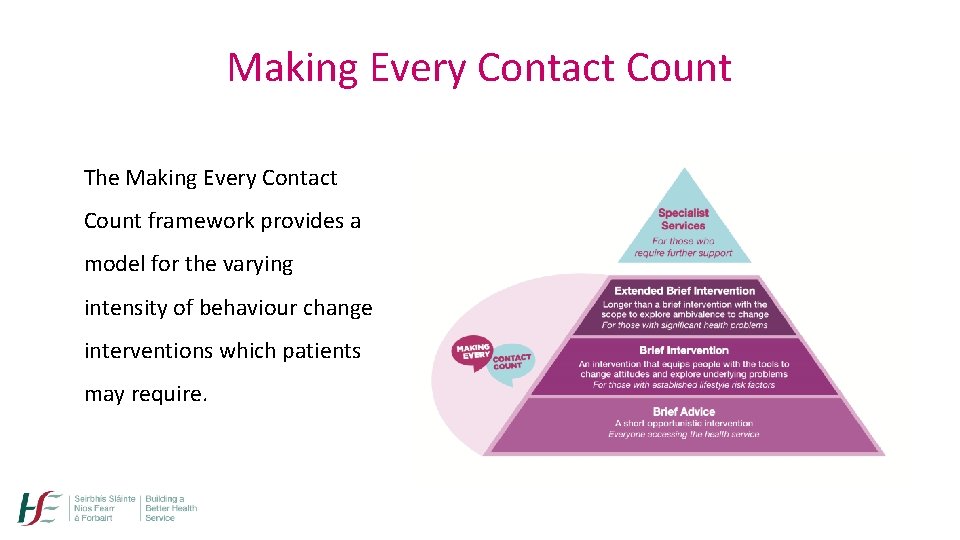
Making Every Contact Count The Making Every Contact Count framework provides a model for the varying intensity of behaviour change interventions which patients may require.
Motivational Interviewing “A collaborative, person-centred form of guiding to elicit and strengthen motivation for change” (Millner & Rollnick, 2010).
Motivational interviewing OARS • Open ended questions • Affirmations • Reflective listening • Summarising Other Tools • Scaling questions (0 -10) • Decisional balance
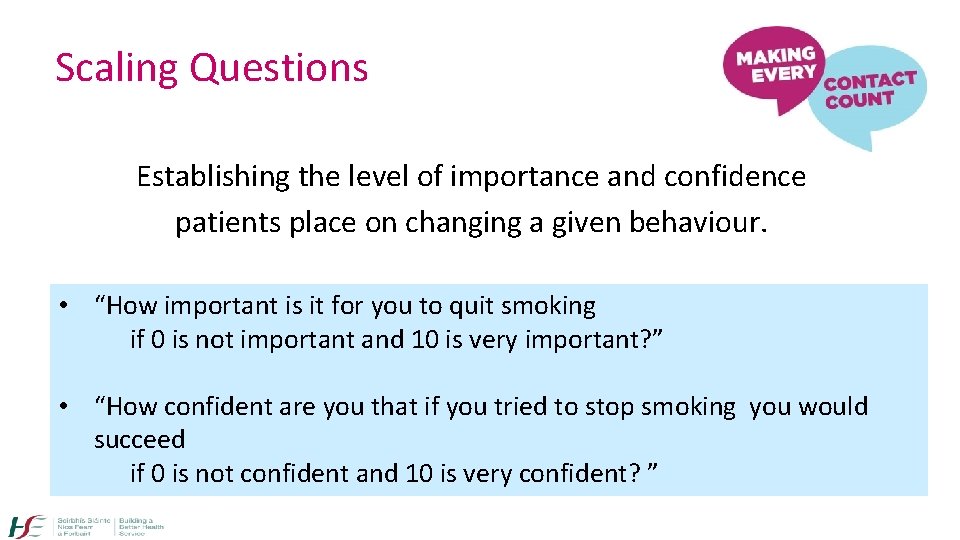
Scaling Questions Establishing the level of importance and confidence patients place on changing a given behaviour. • “How important is it for you to quit smoking if 0 is not important and 10 is very important? ” • “How confident are you that if you tried to stop smoking you would succeed if 0 is not confident and 10 is very confident? ”
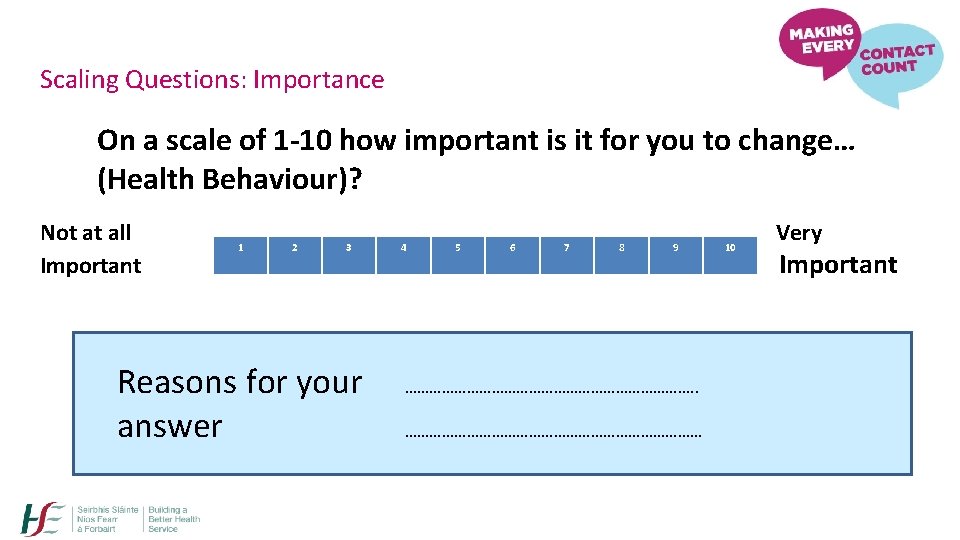
Scaling Questions: Importance On a scale of 1 -10 how important is it for you to change… (Health Behaviour)? Not at all Important 1 2 3 Reasons for your answer 4 5 6 7 8 9 ………………………………. . ……………………………… 10 Very Important
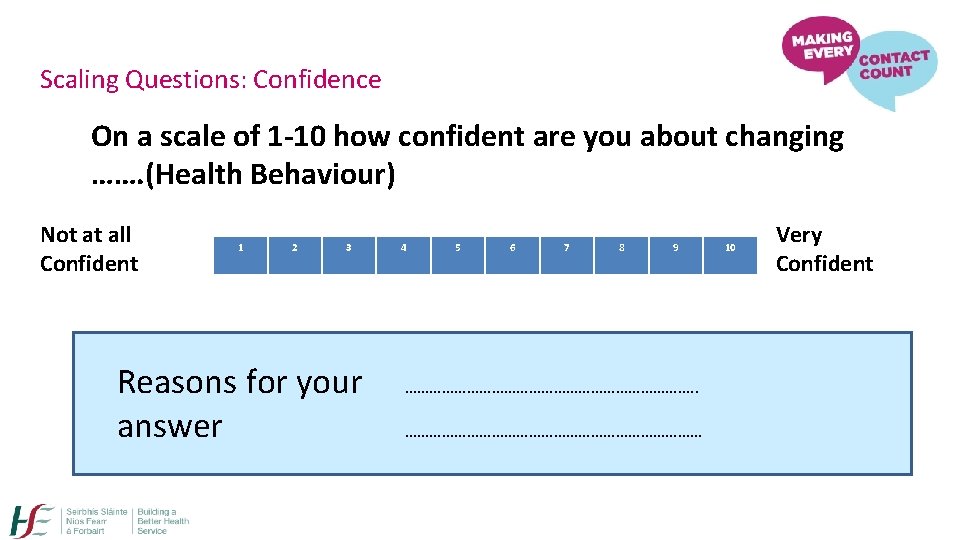
Scaling Questions: Confidence On a scale of 1 -10 how confident are you about changing ……. (Health Behaviour) Not at all Confident 1 2 3 Reasons for your answer 4 5 6 7 8 9 ………………………………. . ……………………………… 10 Very Confident
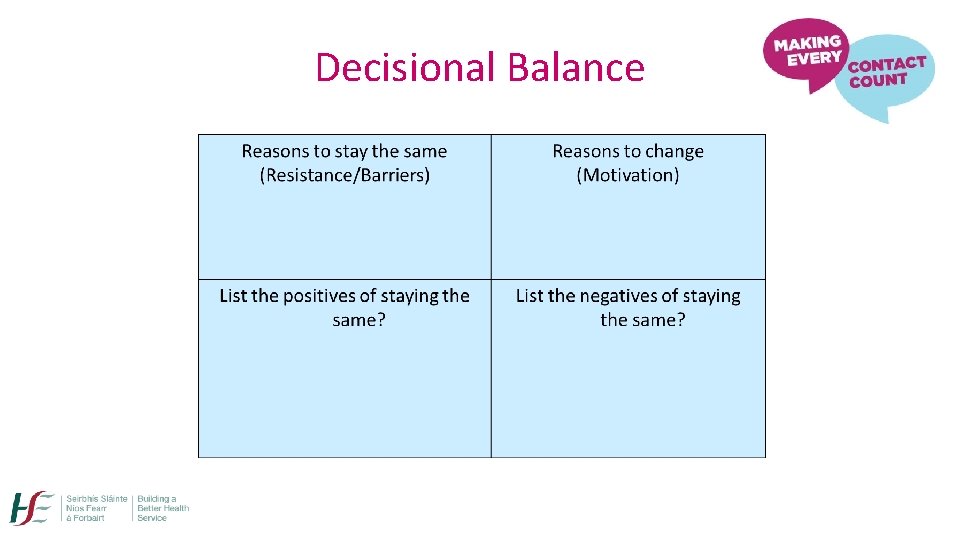
Decisional Balance
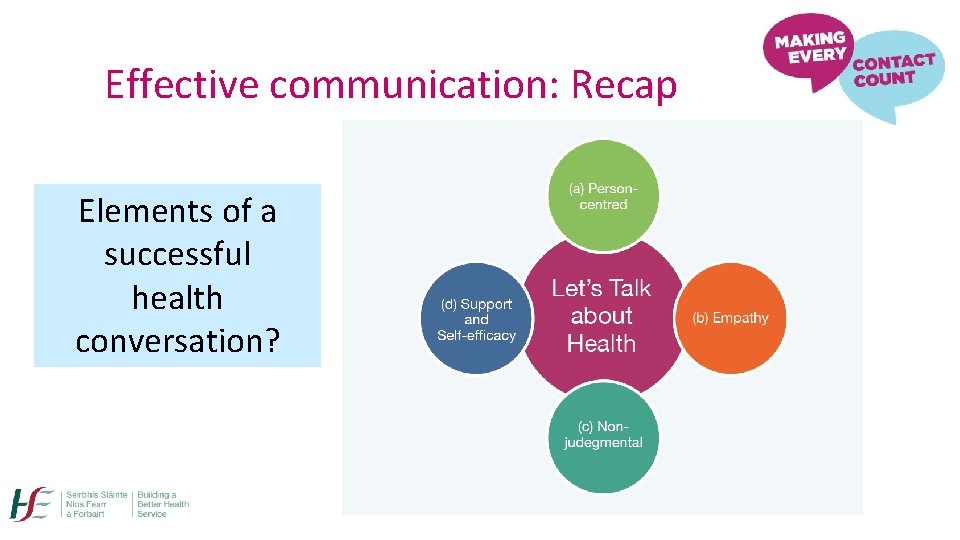
Effective communication: Recap Elements of a successful health conversation?
Activity 3. 3 Scenario 1 (A nurse and a patient are talking while the nurse is changing the patient’s dressing, in a ward in an acute hospital setting) Patient: I loved walking before, a few years ago. But I was a lot slimmer and fitter than I am now. Nurse: Walking is a good way to get exercise. Do you walk anytime now? Patient: Not really, but I loved the outdoors. What do you think the nurse should say or ask next to use this opportunity to provide a Brief Intervention?
Activity 3. 3 Scenario 2 (a) (Patient is attending a follow-up appointment with his GP after suffering a heart attack 10 days ago) GP: How have you been feeling since your discharge from the hospital? Patient: Not too bad I suppose no pain or anything. I think worry is the biggest problem at the moment, that I might have another heart attack. GP: That’s understandable, but the fact that you have no pain is a very positive sign and is what we would be hoping for at this stage. Is there anything else that is worrying you? Patient: Well, I know in the hospital they told me that I shouldn’t be smoking… I am trying, really hard and I was doing very well. But I slipped up and I smoked 2 cigarettes last Sunday night.
Activity 3. 3 Scenario 2 (continued) GP: Well it is very hard, and it sounds like you were doing quite well, stopping smoking is one of the most important things you can do for your heart at the moment because it is such a big risk factor for heart attacks. Patient: I know…I’m very disappointed in myself. GP: I know you are but a slip up isn’t unusual at this early stage. Have you smoked again since? Patient: No GP: Well that’s good anyway. Let’s look at what we can do to make sure that you don’t have another slip. Patient: Thanks doctor, that sounds good.
Reflect on the interaction in Scenario 2 • • Do you think that this was a positive conversation? Give reasons for your response?