
Unit 3 Lesson 1 Sociological Theorists Theory A









- Slides: 29
Unit 3 Lesson 1: Sociological Theorists & Theory A Breakdown of Functionalism, Conflict Theory and Symbolic Interactionism
Warm up 3 - write and discuss • What is a sport? – Is fishing a sport? – Is bull fighting a sport? – Is Dancing a sport? • Do we need sports in our society? Why or why not?
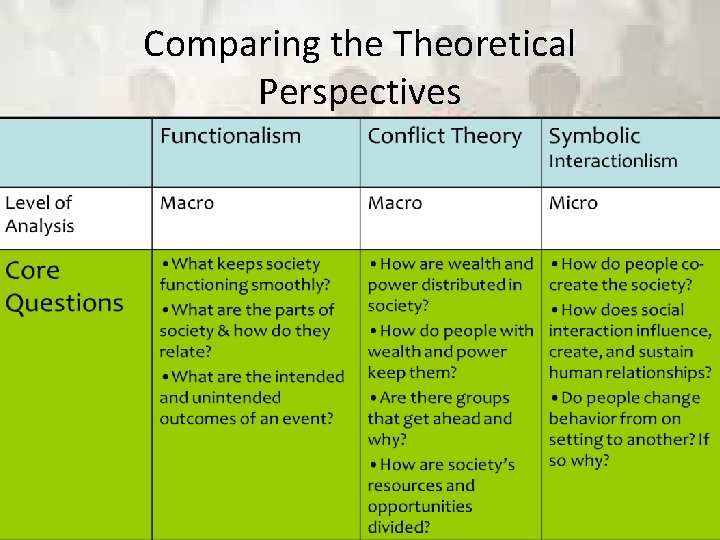
Comparing the Theoretical Perspectives
Theory #1: Functionalism • Functionalism: Deals with how society has different social institutions but focuses on how the different institutions serve an important role in the stability of society. – What is an example we can use for class? ? ? • It is a macro (large scale) orientation because it studies how social institutions affect how a society works
Question 1 • Is Society relatively stable? Explain. – Discuss in groups for 1 minute – Share with class
Functionalism • Society is relatively stable, which means that things occur in society for a specific function and those functions help maintain stability. • Social institutions such as the family, economy, educational system, and political system are critical for society to function properly. – Why do we need family for society to function properly? – Why do we need educational system for society to function to properly? – Why do we need the political system for society to function to properly?
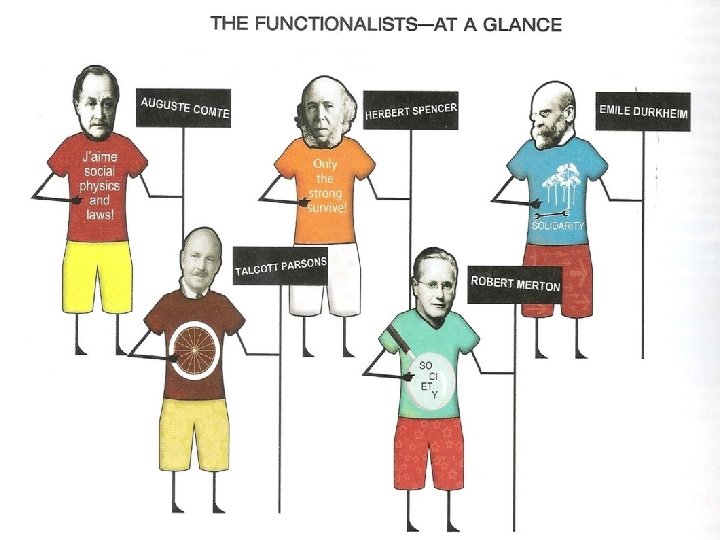
Functionalist Theorists • • Auguste Comte Herbert Spencer Emile Durkheim Robert Merton
Auguste Comte • ****Comte coined the term sociology**** • Felt that sociology should strive to discover social laws – values and norms provide the foundation for the rules and laws that it creates. • (used as ground rules for studying society). – What are a few social values or norms in American society? ? ? – These norms regulate the relationships between social institutions.
Comte & Functionalism • Comte suggested in order to know social laws (Values and Norms) of a society one must study social statics and social dynamics • Social statics: concerned with the ways in which the parts of a social institution interact with one another – EX: how does family institution fit/deal with the economic institution • Social dynamics: Focused on social change in society – Civil Rights movement, Woman’s suffrage, etc…
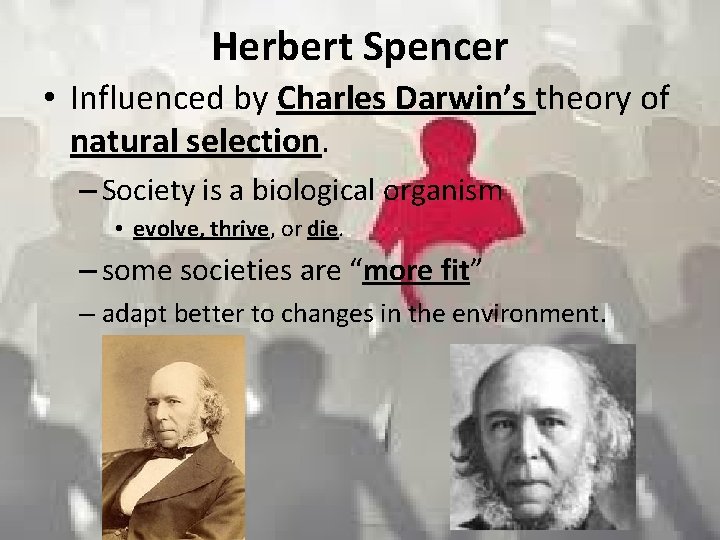
Herbert Spencer • Influenced by Charles Darwin’s theory of natural selection. – Society is a biological organism • evolve, thrive, or die. – some societies are “more fit” – adapt better to changes in the environment.
Emile Durkheim • Durkheim was one of the first true sociologists in that he used data to test theories. • Durkheim’s work suggested that solidarity is a vital component that holds society together. – Solidarity is the level of connectedness a person feels towards others in their environment – Social control refers to the social mechanisms that regulate a person’s actions
Durkheim & Solidarity • Mechanical solidarity: state/society in which people share beliefs and values that lead to common activities. – Patriotism • Organic solidarity: state/society with diverse division of labor, this forces people to depend on one another for survival. – Government control to keep deviance down
Durkheim & Suicide • Come up with 1 reason why a person might seriously consider suicide • Place reasons why on board • Step 2: Put reason why into “If a person experienced _____ what feelings would a person experience that would lead him or her to consider suicide? ”
Durkheim & Suicide • “Unhappiness Theory”: People commit suicide because they are seriously, chronically, and profoundly unhappy. – individualistic (or non-sociological) explanation • As sociologist we do not focus on this aspect • Sociologist focus on how does society affect suicide
Warm up 4 - CNN write up • Watch CNN student news and create a summary of: – Write a summary of what is happening in the world today. – What would Herbert Spencer or Auguste Comte say about 1 of the issues in today’s news. • http: //www. cnn. com/2017/04/11/cnn 10/tencontent-weds/index. html
Durkheim & Suicide • He uses the suicide statistics from several European countries – Durkheim regarded statistics as ‘social facts’. • He would establish connections & reveal the casual relationships which led to suicide.
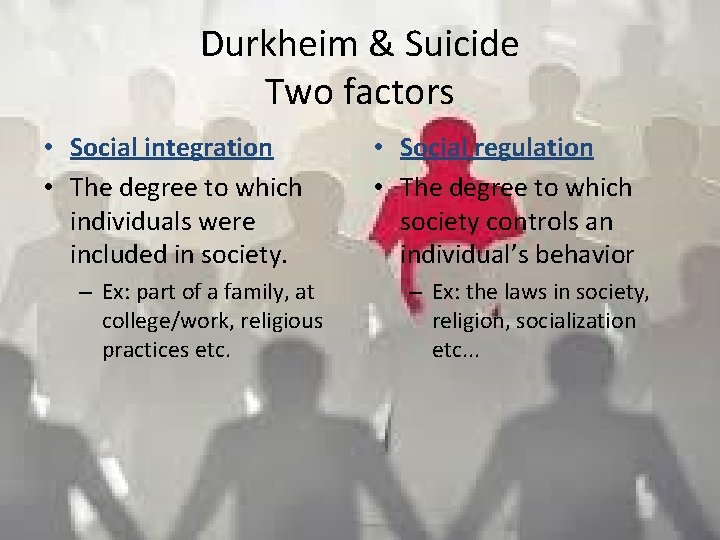
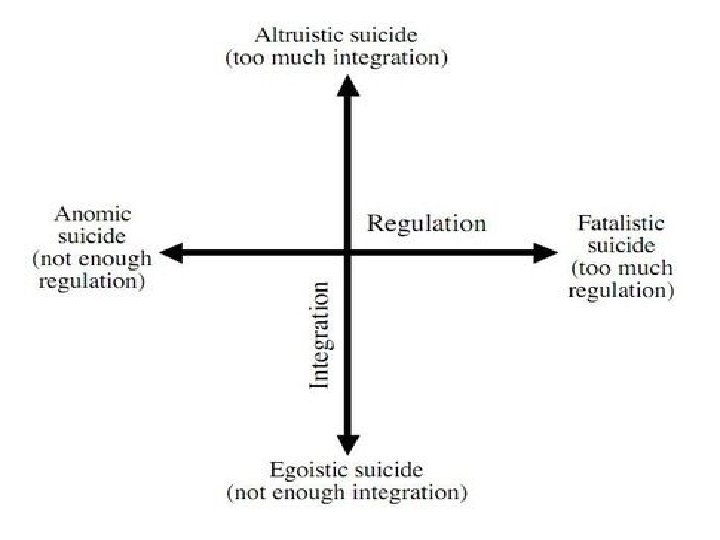
Durkheim & Suicide Two factors • Social integration • The degree to which individuals were included in society. – Ex: part of a family, at college/work, religious practices etc. • Social regulation • The degree to which society controls an individual’s behavior – Ex: the laws in society, religion, socialization etc. . .
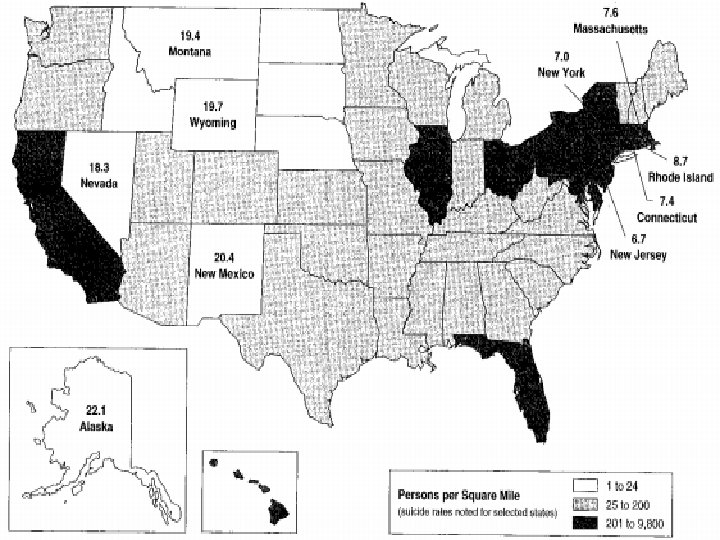
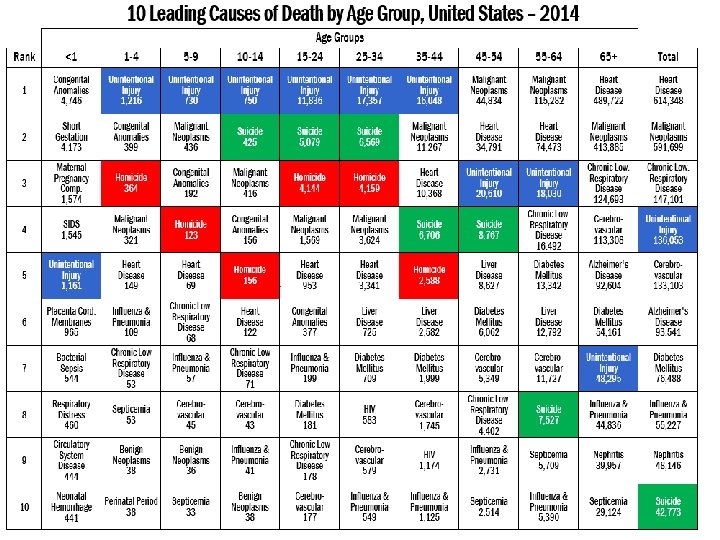
Durkheim & Suicide • Why is the rate of suicide higher in some states than it is in others? – Find 3 reasons
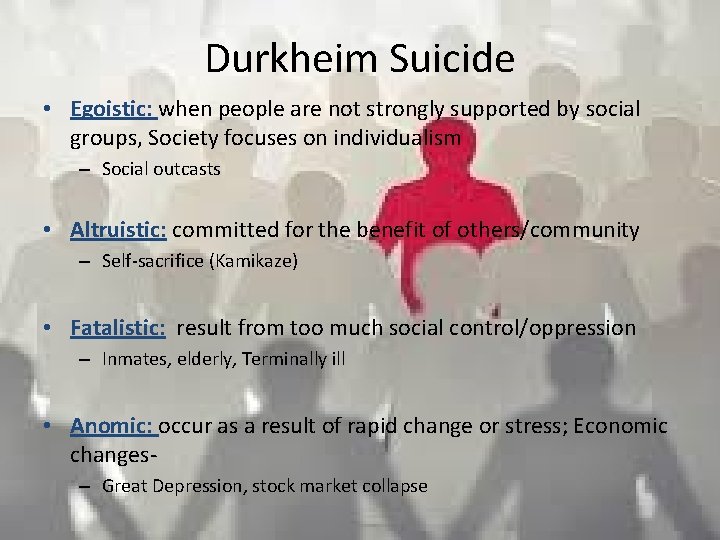
Durkheim Suicide • Egoistic: when people are not strongly supported by social groups, Society focuses on individualism – Social outcasts • Altruistic: committed for the benefit of others/community – Self-sacrifice (Kamikaze) • Fatalistic: result from too much social control/oppression – Inmates, elderly, Terminally ill • Anomic: occur as a result of rapid change or stress; Economic changes– Great Depression, stock market collapse
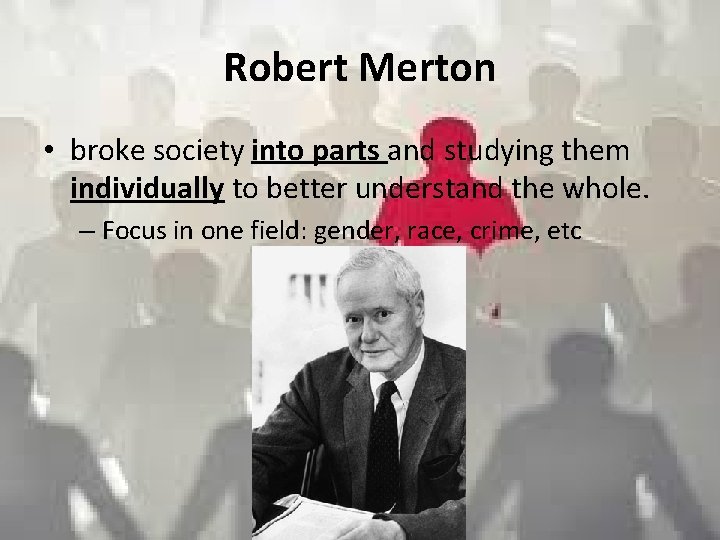
Robert Merton • broke society into parts and studying them individually to better understand the whole. – Focus in one field: gender, race, crime, etc
Manifest & Latent • Merton identified two types of functions: • Manifest functions: are factors that lead to an excepted consequence or outcome. – Cars get us to places faster – Dishwasher washes dishes • Latent functions: are factors that lead to an unforeseen or unexpected consequence. – Using cars causes environmental pollution – Using Headache medication may cause side effects
Criticisms of Functionalism 1. Does not focus on influence of wealth and power on the formation of society. 2. Fallow to closely to the status quo (what is popular at the moment) 1. Focus on majority rules 3. Only big changes can bring society to evolve 4. Minorities are left out
Functionalist Assignment Located on the class website, go to unit 3 Look for the file that says Functionalism Application Complete the chart and answer the question that goes with the assignment. Submit to Schoology Day A: 4/20/17 Day B: 4/19/17