
Unit 3 Ionic and Metallic Substances Review Honors
Unit 3: Ionic and Metallic Substances Review Honors Chemistry
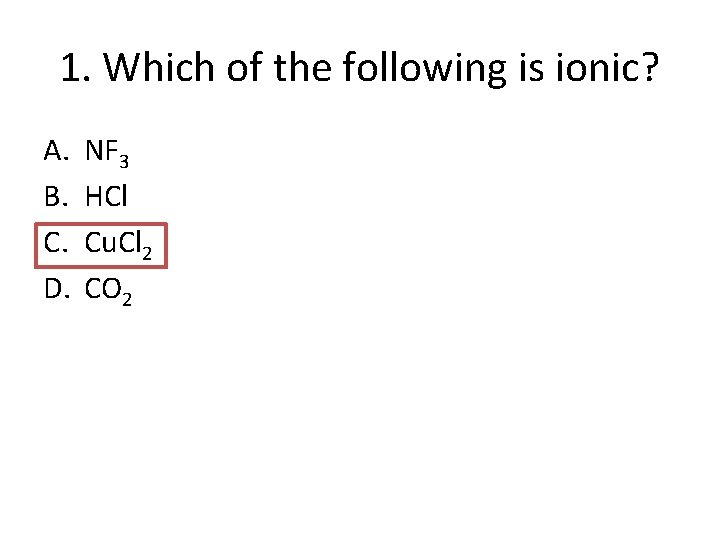
1. Which of the following is ionic? A. B. C. D. NF 3 HCl Cu. Cl 2 CO 2

2. Which of the following is covalent? A. B. C. D. Mg. O H 3 N Fe. O Zn. Cl

3. To form an ion Nitrogen will A. B. C. D. Lose 3 electrons to become N 3+ Gain 3 electrons to become N 3+
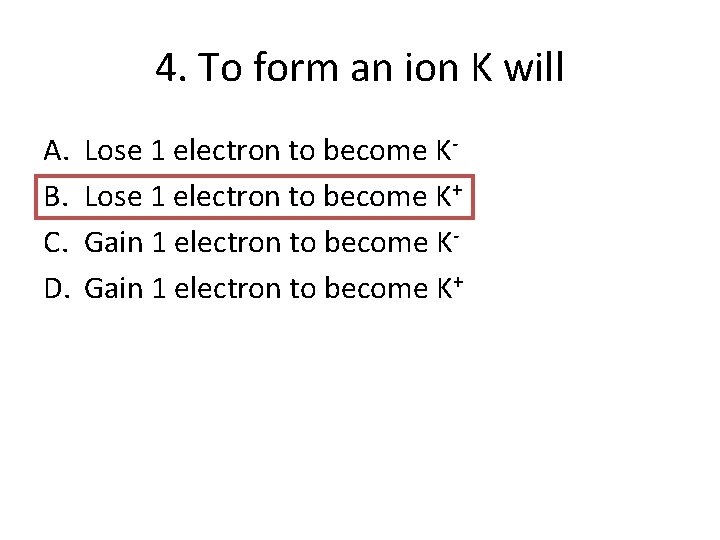
4. To form an ion K will A. B. C. D. Lose 1 electron to become K+ Gain 1 electron to become K+
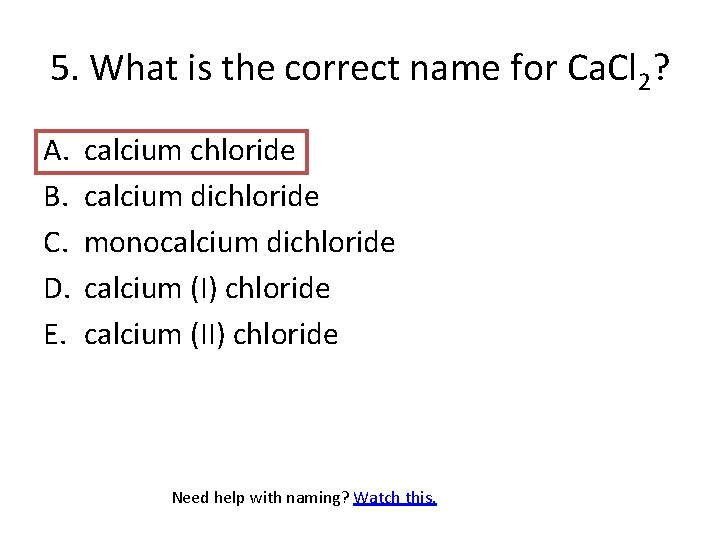
5. What is the correct name for Ca. Cl 2? A. B. C. D. E. calcium chloride calcium dichloride monocalcium dichloride calcium (I) chloride calcium (II) chloride Need help with naming? Watch this.
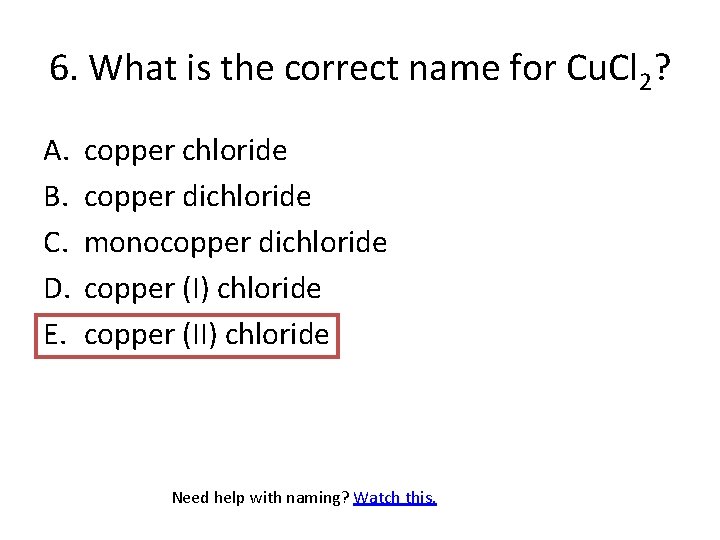
6. What is the correct name for Cu. Cl 2? A. B. C. D. E. copper chloride copper dichloride monocopper dichloride copper (I) chloride copper (II) chloride Need help with naming? Watch this.
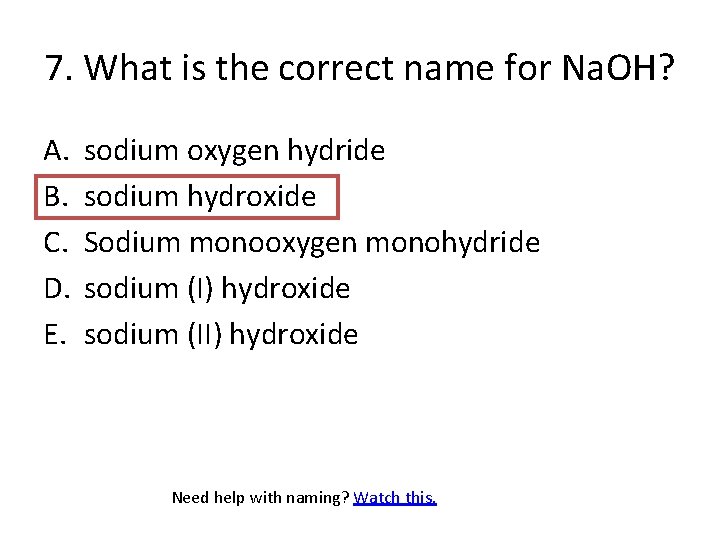
7. What is the correct name for Na. OH? A. B. C. D. E. sodium oxygen hydride sodium hydroxide Sodium monooxygen monohydride sodium (I) hydroxide sodium (II) hydroxide Need help with naming? Watch this.
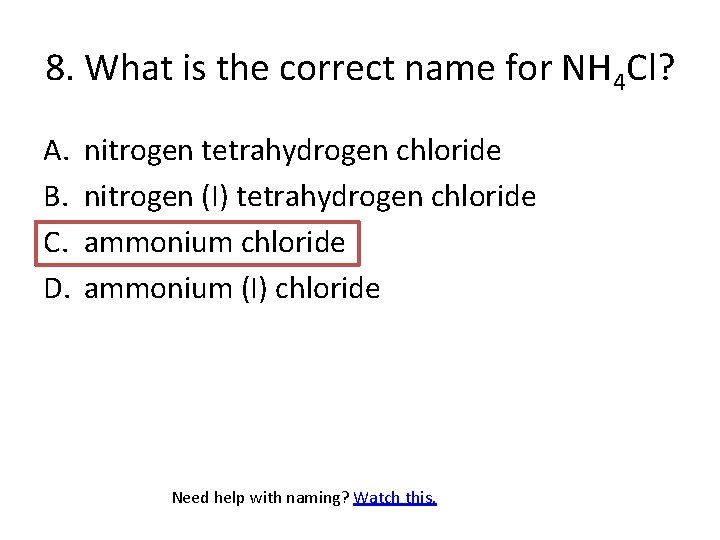
8. What is the correct name for NH 4 Cl? A. B. C. D. nitrogen tetrahydrogen chloride nitrogen (I) tetrahydrogen chloride ammonium (I) chloride Need help with naming? Watch this.
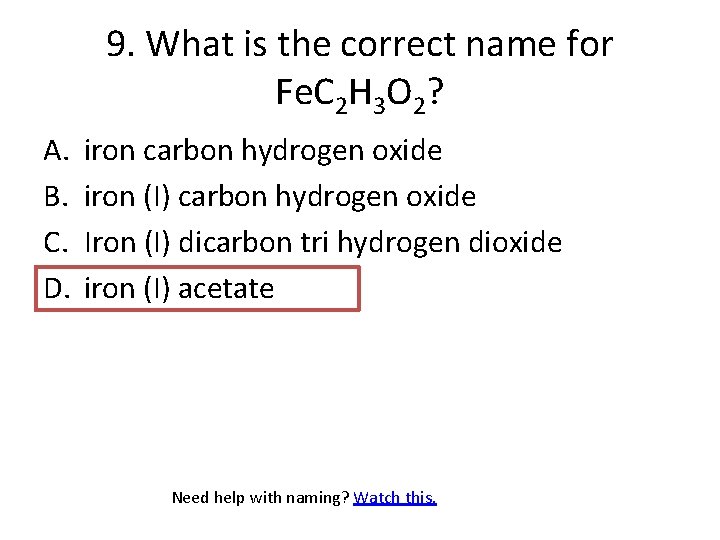
9. What is the correct name for Fe. C 2 H 3 O 2? A. B. C. D. iron carbon hydrogen oxide iron (I) carbon hydrogen oxide Iron (I) dicarbon tri hydrogen dioxide iron (I) acetate Need help with naming? Watch this.
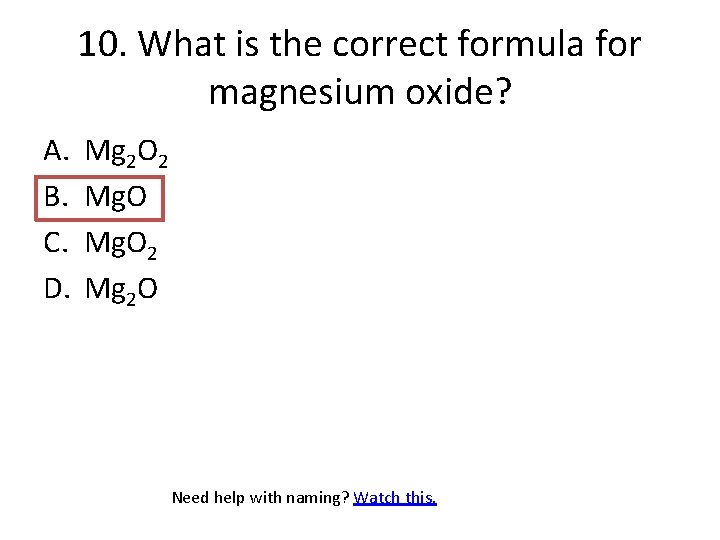
10. What is the correct formula for magnesium oxide? A. B. C. D. Mg 2 O 2 Mg 2 O Need help with naming? Watch this.
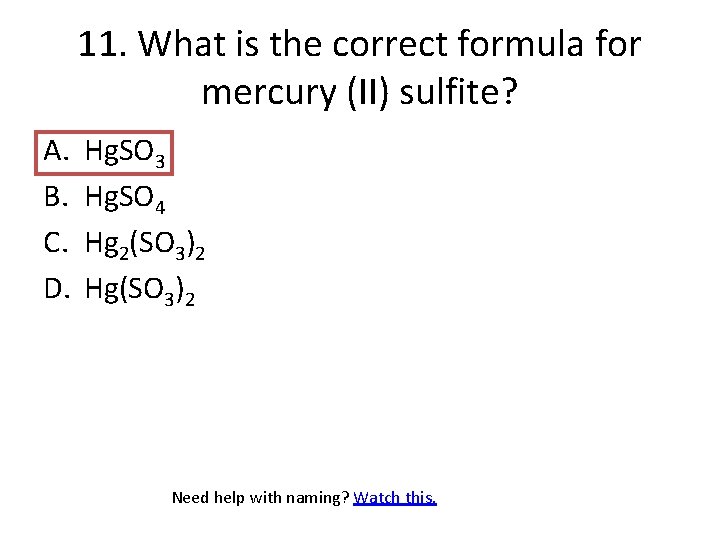
11. What is the correct formula for mercury (II) sulfite? A. B. C. D. Hg. SO 3 Hg. SO 4 Hg 2(SO 3)2 Hg(SO 3)2 Need help with naming? Watch this.
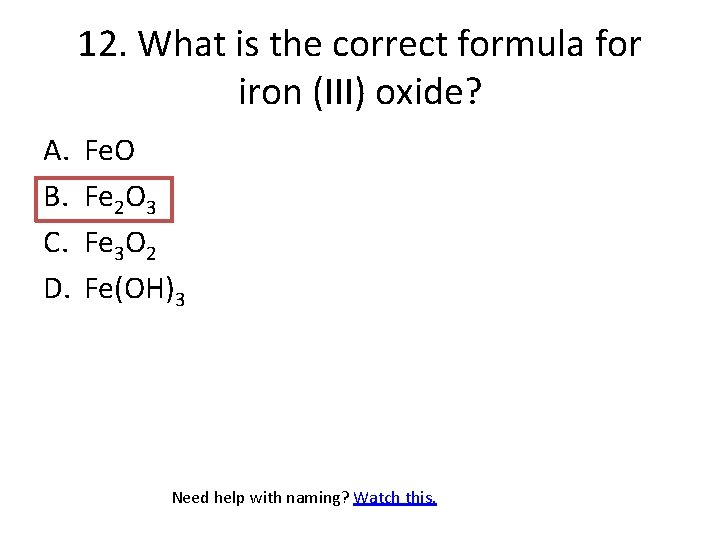
12. What is the correct formula for iron (III) oxide? A. B. C. D. Fe. O Fe 2 O 3 Fe 3 O 2 Fe(OH)3 Need help with naming? Watch this.
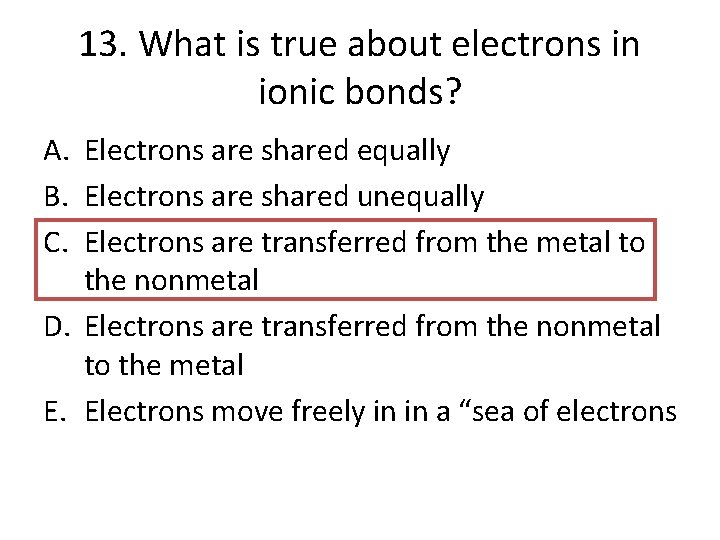
13. What is true about electrons in ionic bonds? A. Electrons are shared equally B. Electrons are shared unequally C. Electrons are transferred from the metal to the nonmetal D. Electrons are transferred from the nonmetal to the metal E. Electrons move freely in in a “sea of electrons
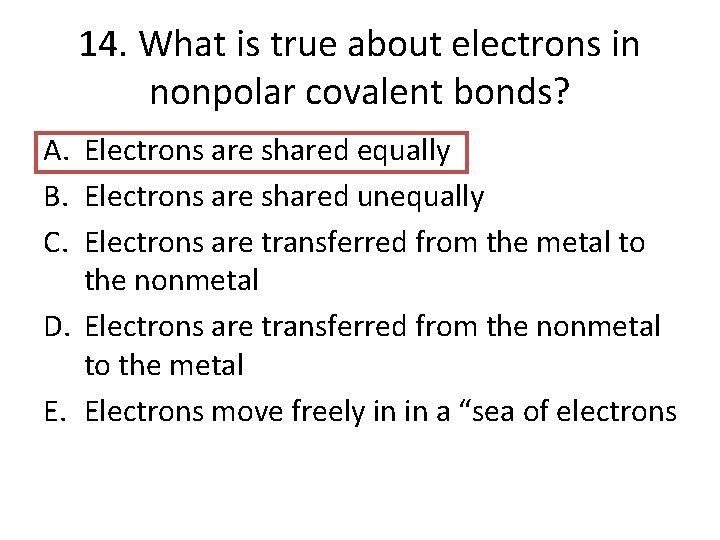
14. What is true about electrons in nonpolar covalent bonds? A. Electrons are shared equally B. Electrons are shared unequally C. Electrons are transferred from the metal to the nonmetal D. Electrons are transferred from the nonmetal to the metal E. Electrons move freely in in a “sea of electrons
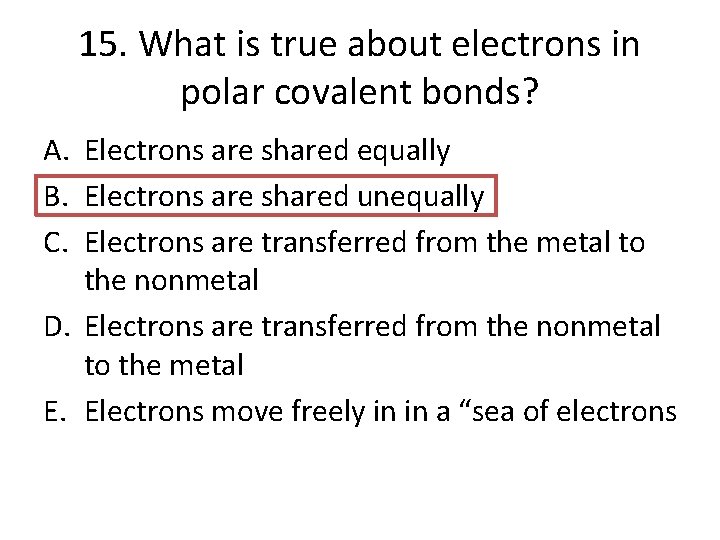
15. What is true about electrons in polar covalent bonds? A. Electrons are shared equally B. Electrons are shared unequally C. Electrons are transferred from the metal to the nonmetal D. Electrons are transferred from the nonmetal to the metal E. Electrons move freely in in a “sea of electrons
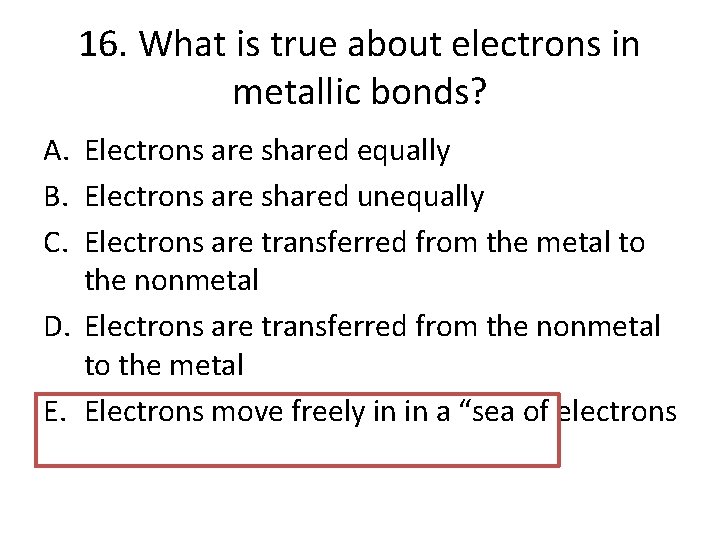
16. What is true about electrons in metallic bonds? A. Electrons are shared equally B. Electrons are shared unequally C. Electrons are transferred from the metal to the nonmetal D. Electrons are transferred from the nonmetal to the metal E. Electrons move freely in in a “sea of electrons
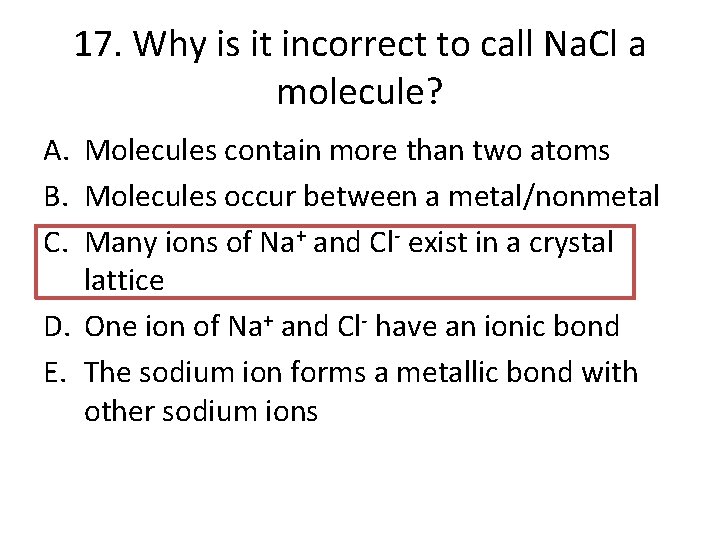
17. Why is it incorrect to call Na. Cl a molecule? A. Molecules contain more than two atoms B. Molecules occur between a metal/nonmetal C. Many ions of Na+ and Cl- exist in a crystal lattice D. One ion of Na+ and Cl- have an ionic bond E. The sodium ion forms a metallic bond with other sodium ions
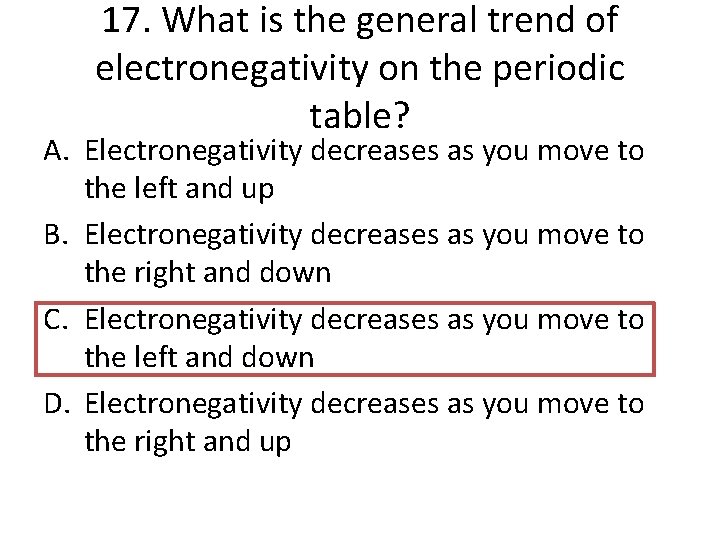
17. What is the general trend of electronegativity on the periodic table? A. Electronegativity decreases as you move to the left and up B. Electronegativity decreases as you move to the right and down C. Electronegativity decreases as you move to the left and down D. Electronegativity decreases as you move to the right and up
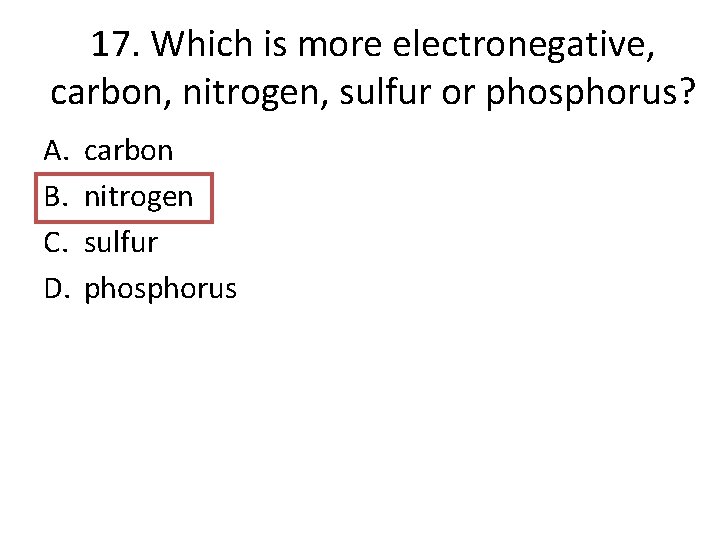
17. Which is more electronegative, carbon, nitrogen, sulfur or phosphorus? A. B. C. D. carbon nitrogen sulfur phosphorus
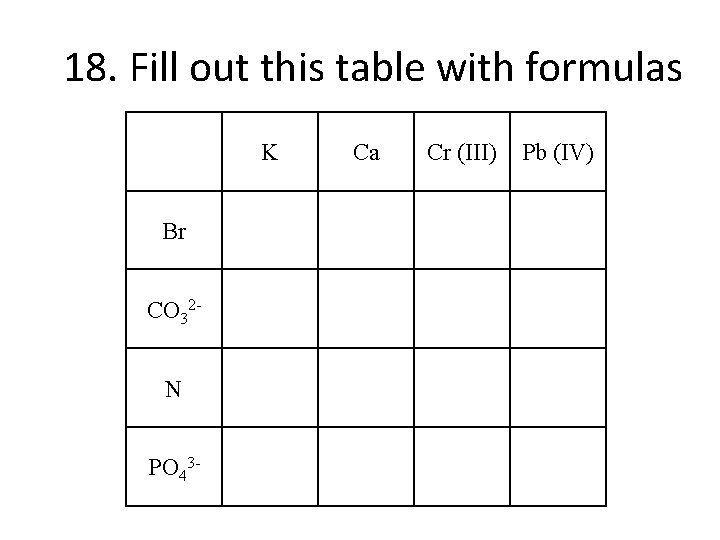
18. Fill out this table with formulas K Br CO 32 N PO 43 - Ca Cr (III) Pb (IV)
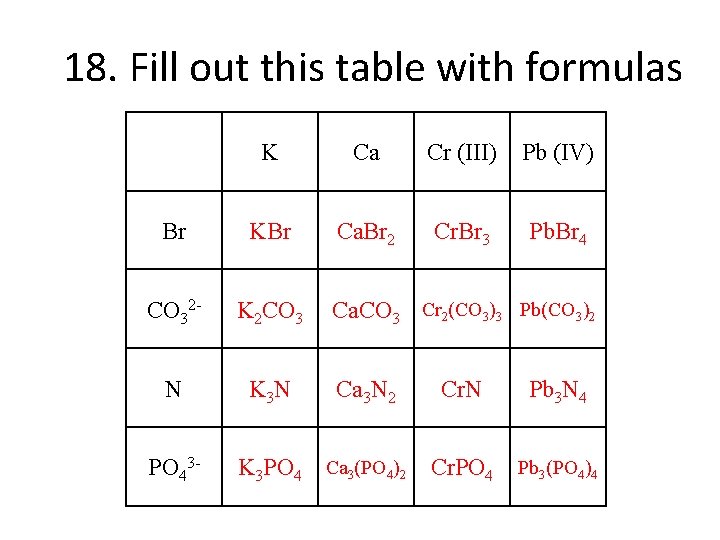
18. Fill out this table with formulas K Ca Cr (III) Pb (IV) Br KBr Ca. Br 2 Cr. Br 3 Pb. Br 4 CO 32 - K 2 CO 3 N K 3 N PO 43 - Ca. CO 3 Cr 2(CO 3)3 Pb(CO 3)2 Ca 3 N 2 K 3 PO 4 Ca 3(PO 4)2 Cr. N Pb 3 N 4 Cr. PO 4 Pb 3(PO 4)4
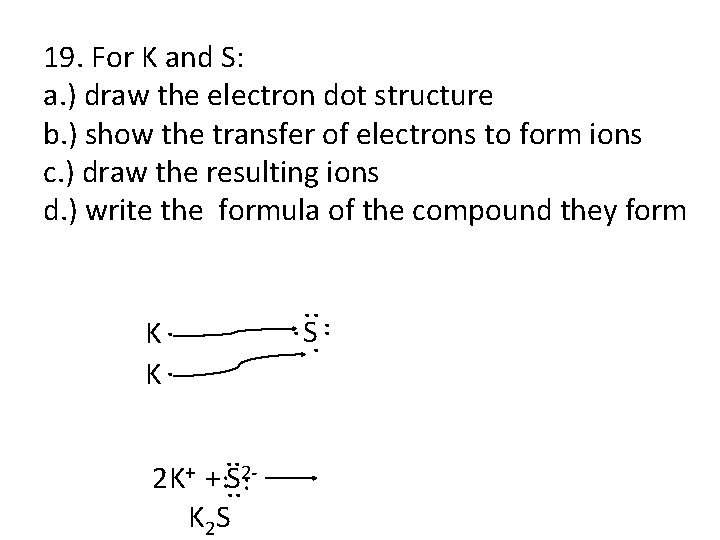
19. For K and S: a. ) draw the electron dot structure b. ) show the transfer of electrons to form ions c. ) draw the resulting ions d. ) write the formula of the compound they form. . S. . K. K. . . . 2+. . S K 2 S 2 K+
- Slides: 23