
Unit 3 How do children learn language Objectives
Unit 3: How do children learn language? Objectives: Understand how children acquire language Identify the different stages of linguistic development • Understand how phonemes link to linguistic development • •
Activity 1 – Introduction 1 • Earlier units have shown how one of the things that make us human is our capacity to learn and use language • But how exactly do we do this? • In pairs, discuss how you think humans acquire language and when this happens • Make notes of your main ideas to share with the group
Activity 2 Watch the video and answer the questions on your worksheet The Human Body: How Children Acquire and Produce Language (BBC extract) www. youtube. com/watch? v=2 i 1 z 37 n. YMr. M 2
LAD 3 • Unless we have something physically wrong with us, we all learn to speak a language as babies and young children • We have an innate ‘blueprint’ for language which provides us with the ability to acquire grammatical structures quickly and effortlessly • When we are born, we have the capacity to speak any language, not just the one our parents or carers speak. We each have within us something called a Language Acquisition Device (LAD) • Thus, even though each language has its own particular characteristics, we learn them in generally the same way and in the same order or stages
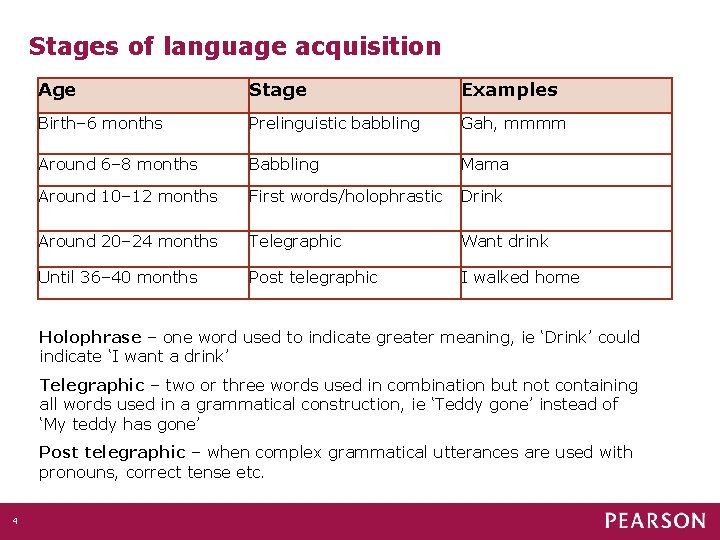
Stages of language acquisition Age Stage Examples Birth– 6 months Prelinguistic babbling Gah, mmmm Around 6– 8 months Babbling Mama Around 10– 12 months First words/holophrastic Drink Around 20– 24 months Telegraphic Want drink Until 36– 40 months Post telegraphic I walked home Holophrase – one word used to indicate greater meaning, ie ‘Drink’ could indicate ‘I want a drink’ Telegraphic – two or three words used in combination but not containing all words used in a grammatical construction, ie ‘Teddy gone’ instead of ‘My teddy has gone’ Post telegraphic – when complex grammatical utterances are used with pronouns, correct tense etc. 4
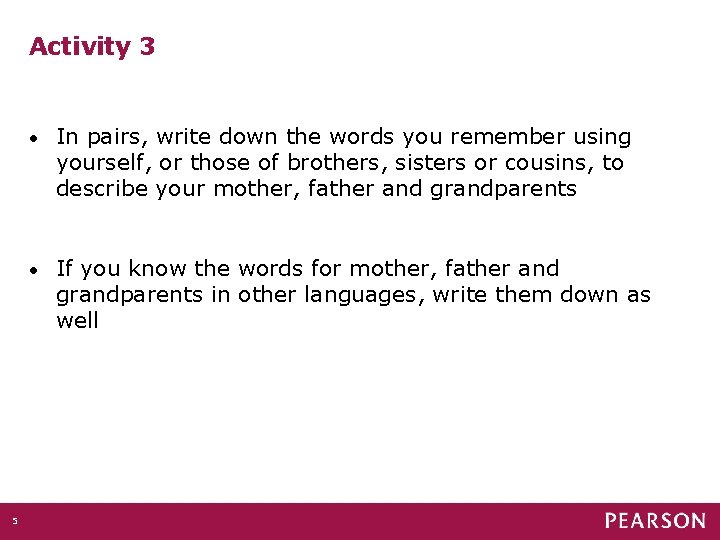
Activity 3 5 • In pairs, write down the words you remember using yourself, or those of brothers, sisters or cousins, to describe your mother, father and grandparents • If you know the words for mother, father and grandparents in other languages, write them down as well
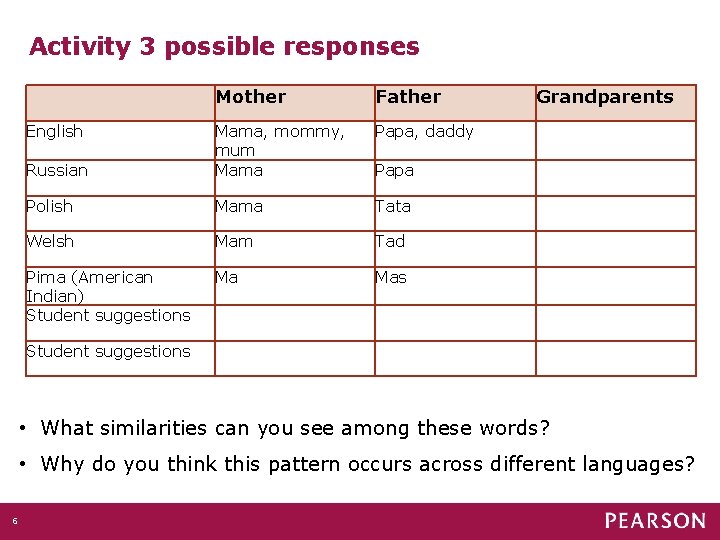
Activity 3 possible responses Mother Father Papa, daddy Russian Mama, mommy, mum Mama Polish Mama Tata Welsh Mam Tad Pima (American Indian) Student suggestions Ma Mas English Grandparents Papa Student suggestions • What similarities can you see among these words? • Why do you think this pattern occurs across different languages? 6
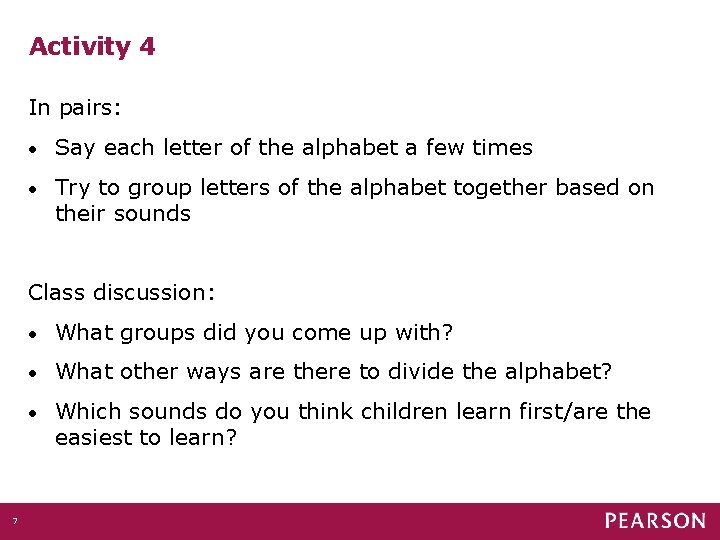
Activity 4 In pairs: • Say each letter of the alphabet a few times • Try to group letters of the alphabet together based on their sounds Class discussion: 7 • What groups did you come up with? • What other ways are there to divide the alphabet? • Which sounds do you think children learn first/are the easiest to learn?
Sounds of English The simplest sounds children produce are: • those produced with the lips: p, b, m • those produced by putting the tip of the tongue against or slightly behind the back of the upper teeth: t, d, n These sounds form a group called consonants. The other group of sounds are called vowels. Vowels are represented alphabetically as a, e, i, o, u and are formed without using the lips or the tongue. All other letters of the alphabet represent consonants. 8
Activity 5 In pairs: 9 • Write down a random set of 10 words which all start with a consonant • Can you see a pattern of how the words are structured based on their sounds?
Sounds of English – syllables 10 • Consonants and vowels combine together to produce syllables • The first syllables children learn to speak usually consist of one consonant followed by one vowel (a ‘CV’ combination): ma. The easiest way for a child to make a word longer is by repeating the syllable: mama • All languages have syllables consisting of a consonant followed by a vowel (CV). In many languages, such as English, syllables can have up to three consonants before the vowel, as in the word spring, and up to four afterwards, as in the word sixths.
Structure of languages All world languages share the same principles, such as sound systems (phonology), systems of meaning (semantics), rules of word formation (morphology), rules of sentence formation (syntax or grammar) and vocabulary of words (lexicon) These areas help us discuss the processes through which children acquire language The sounds that we make when producing speech to speak a specific language are called phonemes As we have learned, parts of words, or how words are structured, help us to identify what is being said or, later in life, written The parts of language that make up words are called morphemes. For example, the morpheme s is used to turn singular nouns into plural: cat/s, dog/s, house/s, boy/s 11
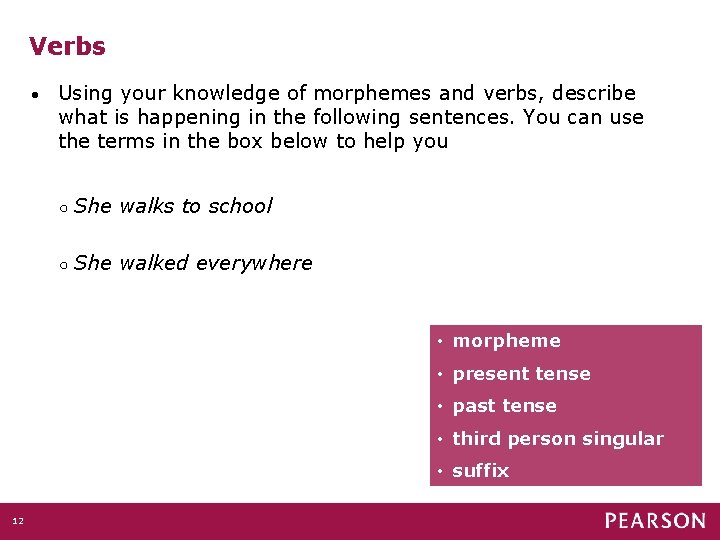
Verbs • Using your knowledge of morphemes and verbs, describe what is happening in the following sentences. You can use the terms in the box below to help you ○ She walks to school ○ She walked everywhere • morpheme • present tense • past tense • third person singular • suffix 12
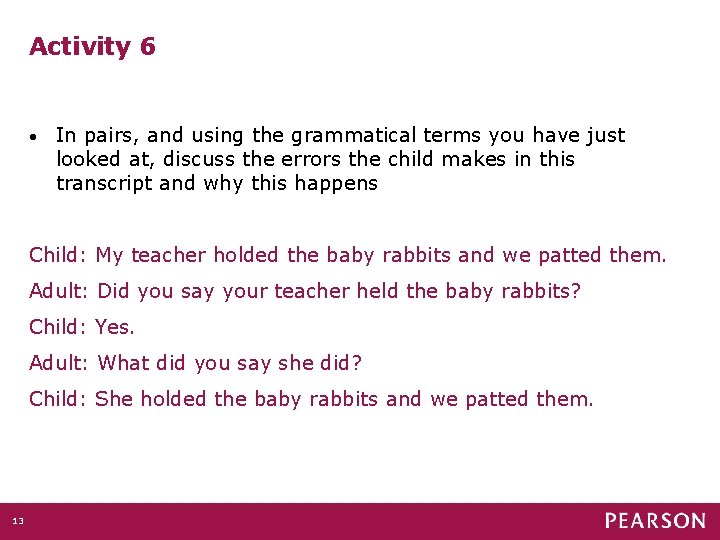
Activity 6 • In pairs, and using the grammatical terms you have just looked at, discuss the errors the child makes in this transcript and why this happens Child: My teacher holded the baby rabbits and we patted them. Adult: Did you say your teacher held the baby rabbits? Child: Yes. Adult: What did you say she did? Child: She holded the baby rabbits and we patted them. 13
Innate processes 14 • We refer to the error the child made as overgeneralisation • This is when a child follows a logical process to infer a pattern with language which then leads to them making an error – in this case adding –ed to form a past tense verb • Does the use of overgeneralisation indicate that the acquisition of language is an innate process?
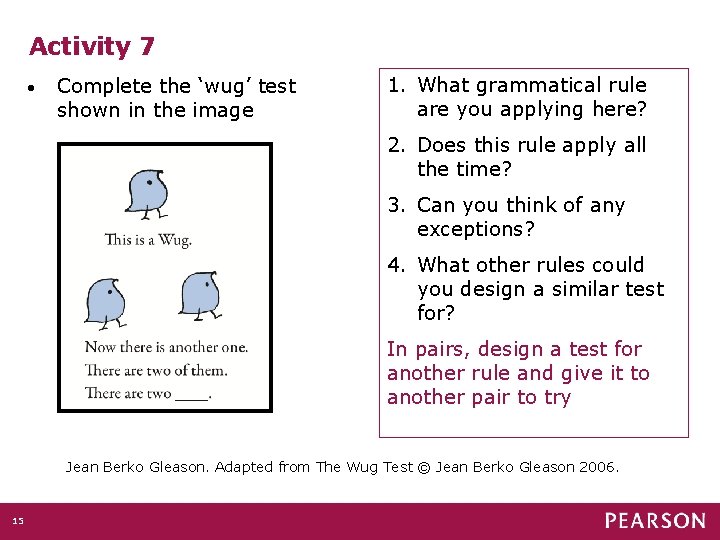
Activity 7 • Complete the ‘wug’ test shown in the image 1. What grammatical rule are you applying here? 2. Does this rule apply all the time? 3. Can you think of any exceptions? 4. What other rules could you design a similar test for? In pairs, design a test for another rule and give it to another pair to try Jean Berko Gleason. Adapted from The Wug Test © Jean Berko Gleason 2006. 15
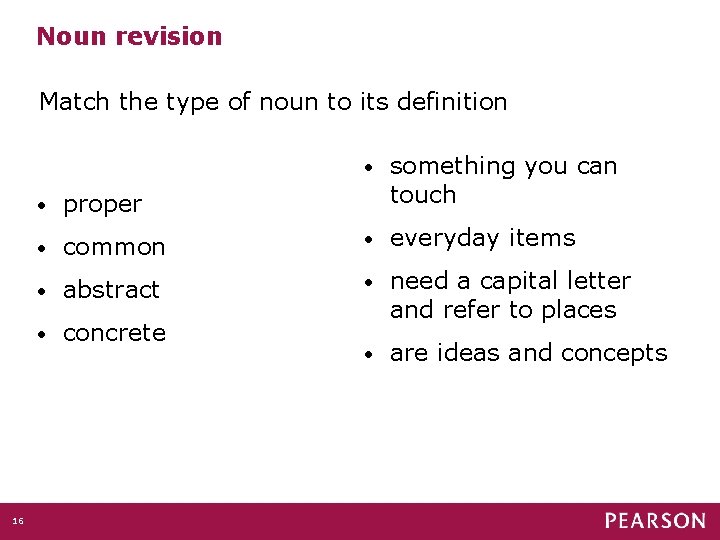
Noun revision Match the type of noun to its definition 16 • something you can touch • proper • common • everyday items • abstract • • concrete need a capital letter and refer to places • are ideas and concepts
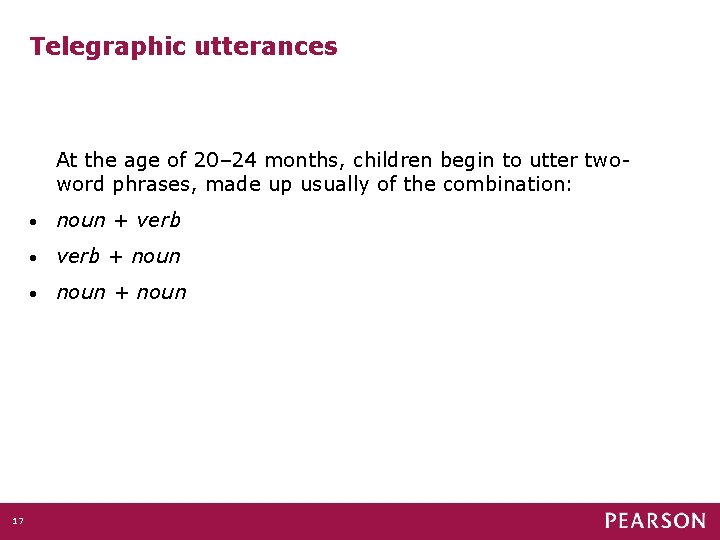
Telegraphic utterances At the age of 20– 24 months, children begin to utter twoword phrases, made up usually of the combination: 17 • noun + verb • verb + noun • noun + noun
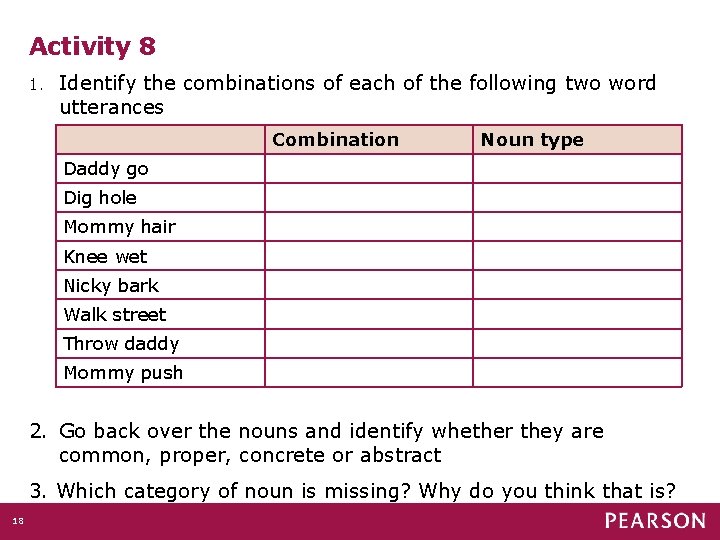
Activity 8 1. Identify the combinations of each of the following two word utterances Combination Noun type Daddy go Dig hole Mommy hair Knee wet Nicky bark Walk street Throw daddy Mommy push 2. Go back over the nouns and identify whether they are common, proper, concrete or abstract 3. Which category of noun is missing? Why do you think that is? 18
- Slides: 19