
Unit 3 GETTING THE WORK DONE Skills focus


- Slides: 47
Unit 3 GETTING THE WORK DONE
Skills focus Listening • preparing for a lecture • predicting lecture content • making lecture notes • using different information sources Speaking • reporting research findings • formulating questions Vocabulary focus • stress patterns in multisyllable words • prefixes
3. 1 Vocabulary 3. 2 Listening 3. 3 Extending Skills 3. 4 Extending Skills
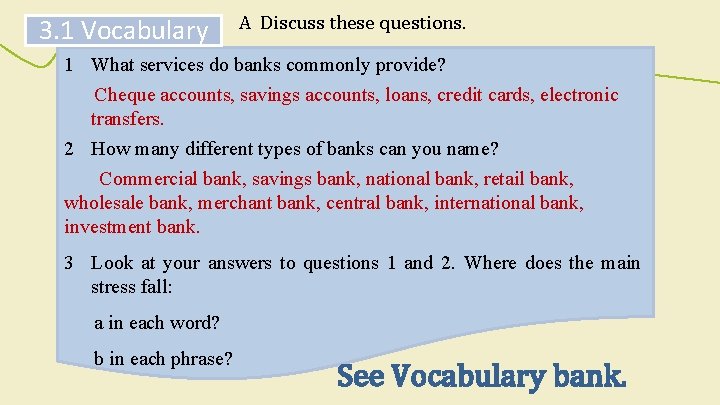
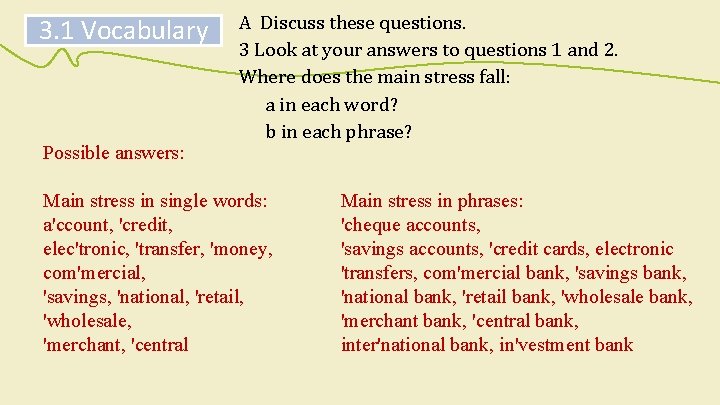
3. 1 Vocabulary A Discuss these questions. 1 What services do banks commonly provide? Cheque accounts, savings accounts, loans, credit cards, electronic transfers. 2 How many different types of banks can you name? Commercial bank, savings bank, national bank, retail bank, wholesale bank, merchant bank, central bank, international bank, investment bank. 3 Look at your answers to questions 1 and 2. Where does the main stress fall: a in each word? b in each phrase? See Vocabulary bank.
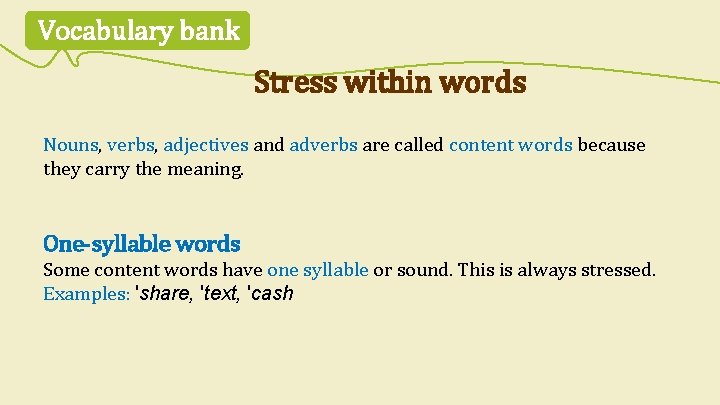
Vocabulary bank Stress within words Nouns, verbs, adjectives and adverbs are called content words because they carry the meaning. One-syllable words Some content words have one syllable or sound. This is always stressed. Examples: 'share, 'text, 'cash
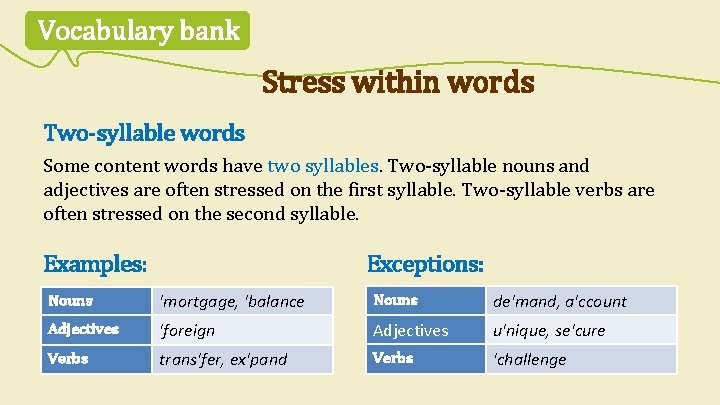
Vocabulary bank Stress within words Two-syllable words Some content words have two syllables. Two-syllable nouns and adjectives are often stressed on the first syllable. Two-syllable verbs are often stressed on the second syllable. Examples: Exceptions: Nouns 'mortgage, 'balance Nouns de'mand, a'ccount Adjectives 'foreign Adjectives u'nique, se'cure Verbs trans'fer, ex'pand Verbs 'challenge
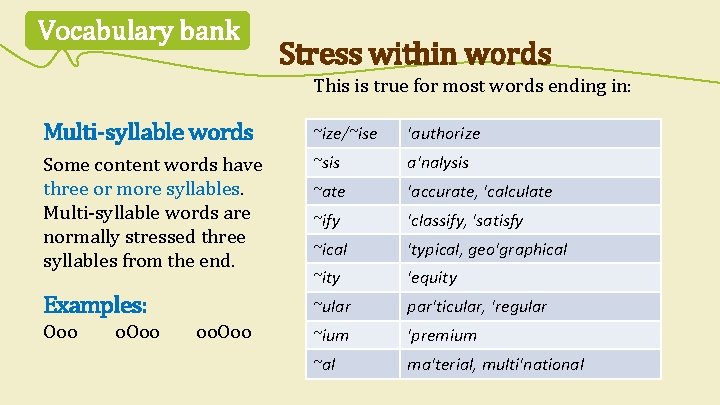
Vocabulary bank Stress within words This is true for most words ending in: Multi-syllable words ~ize/~ise 'authorize Some content words have three or more syllables. Multi-syllable words are normally stressed three syllables from the end. ~sis a'nalysis ~ate 'accurate, 'calculate ~ify 'classify, 'satisfy ~ical 'typical, geo'graphical ~ity 'equity Examples: ~ular par'ticular, 'regular ~ium 'premium ~al ma'terial, multi'national Ooo oo. Ooo
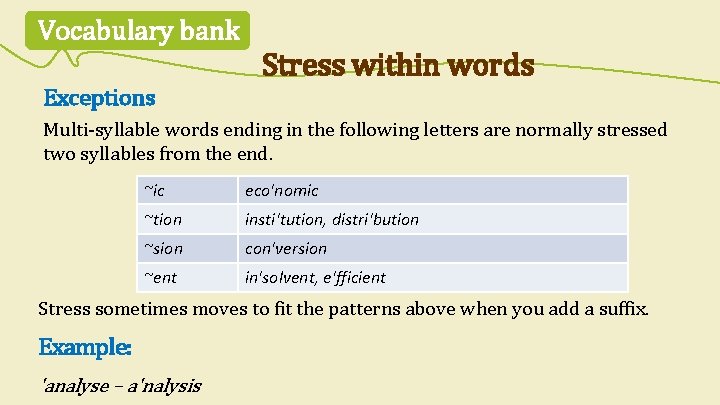
Vocabulary bank Stress within words Exceptions Multi-syllable words ending in the following letters are normally stressed two syllables from the end. ~ic eco'nomic ~tion insti'tution, distri'bution ~sion con'version ~ent in'solvent, e'fficient Stress sometimes moves to fit the patterns above when you add a suffix. Example: 'analyse – a'nalysis
3. 1 Vocabulary Possible answers: A Discuss these questions. 3 Look at your answers to questions 1 and 2. Where does the main stress fall: a in each word? b in each phrase? Main stress in single words: a'ccount, 'credit, elec'tronic, 'transfer, 'money, com'mercial, 'savings, 'national, 'retail, 'wholesale, 'merchant, 'central Main stress in phrases: 'cheque accounts, 'savings accounts, 'credit cards, electronic 'transfers, com'mercial bank, 'savings bank, 'national bank, 'retail bank, 'wholesale bank, 'merchant bank, 'central bank, inter'national bank, in'vestment bank
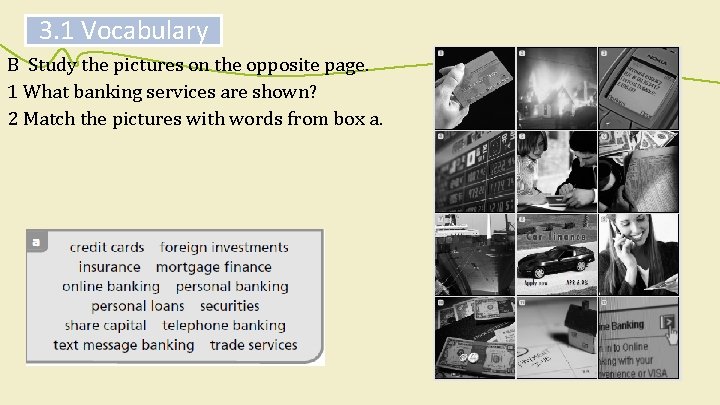
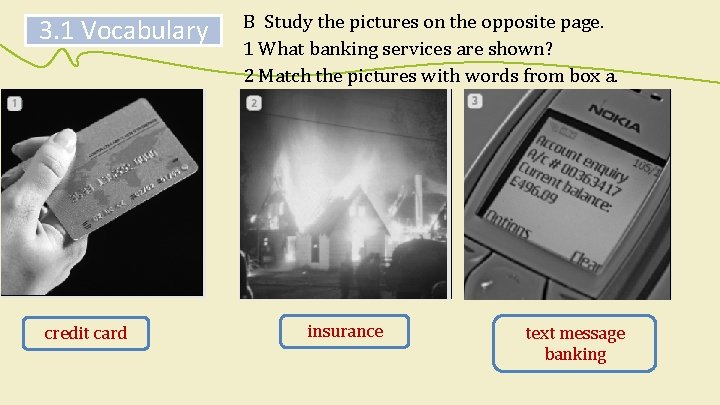
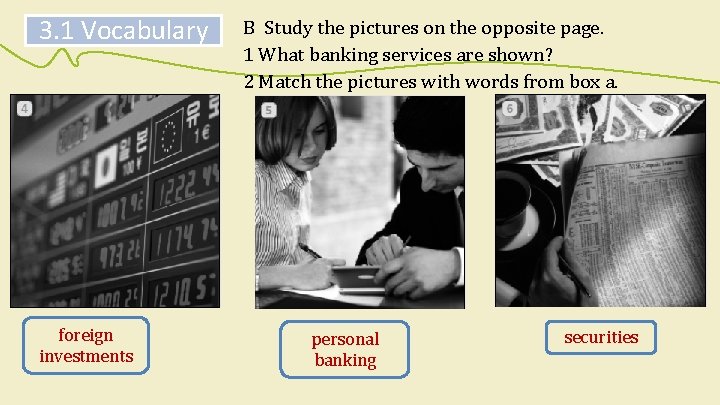
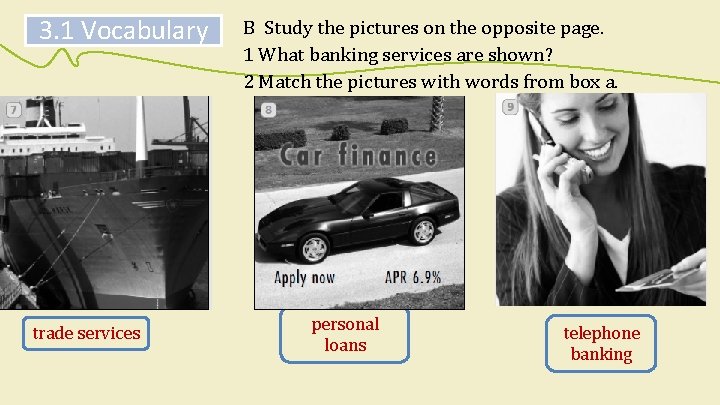
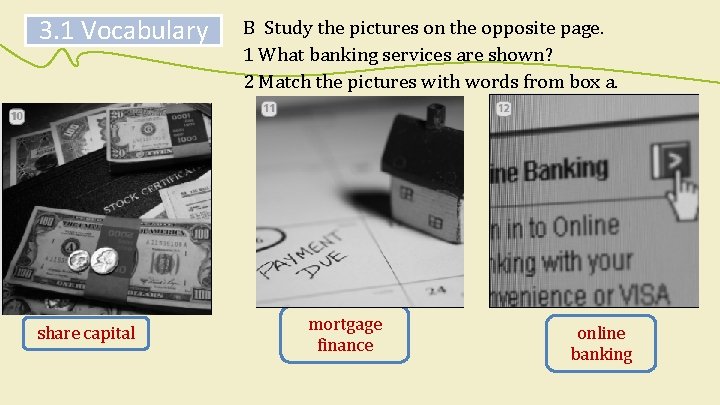
3. 1 Vocabulary B Study the pictures on the opposite page. 1 What banking services are shown? 2 Match the pictures with words from box a.
3. 1 Vocabulary credit card B Study the pictures on the opposite page. 1 What banking services are shown? 2 Match the pictures with words from box a. insurance text message banking
3. 1 Vocabulary foreign investments B Study the pictures on the opposite page. 1 What banking services are shown? 2 Match the pictures with words from box a. personal banking securities
3. 1 Vocabulary trade services B Study the pictures on the opposite page. 1 What banking services are shown? 2 Match the pictures with words from box a. personal loans telephone banking
3. 1 Vocabulary share capital B Study the pictures on the opposite page. 1 What banking services are shown? 2 Match the pictures with words from box a. mortgage finance online banking
3. 1 Vocabulary C Complete each sentence with words from box a. Change the form if necessary. securities refers to both investments in stocks and shares, 1 The term _____ and the ownership certificates. 2 The bank accepted the bill of exchange from the exporter’s overseas customer as part of its _______ trade services for its client. share capital 3 The value of a company’s assets held as shares is known as _____. text message banking so convenient. 4 If you have a cell phone, _________is 5 At the first sign of trouble in the domestic economy he moved his money foreign investments into ________. credit card the bank checked his credit 6 Before issuing him with a _____, history. insurance 7 When they went on holiday, they took out travel ____.
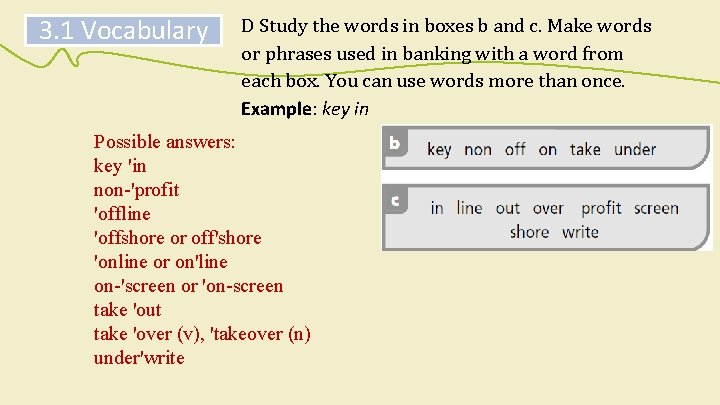
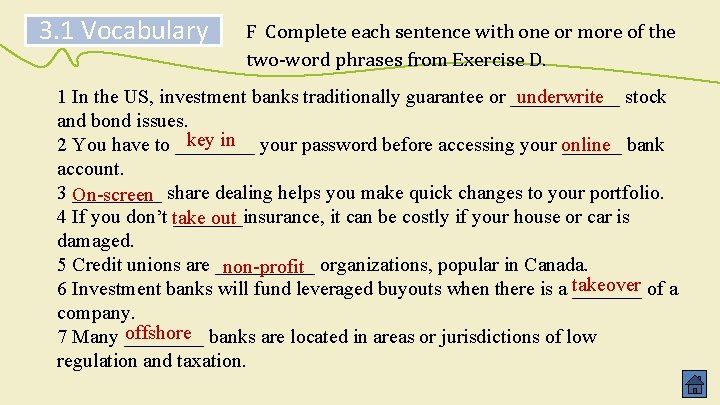
3. 1 Vocabulary D Study the words in boxes b and c. Make words or phrases used in banking with a word from each box. You can use words more than once. Example: key in Possible answers: key 'in non-'profit 'offline 'offshore or off'shore 'online or on'line on-'screen or 'on-screen take 'out take 'over (v), 'takeover (n) under'write
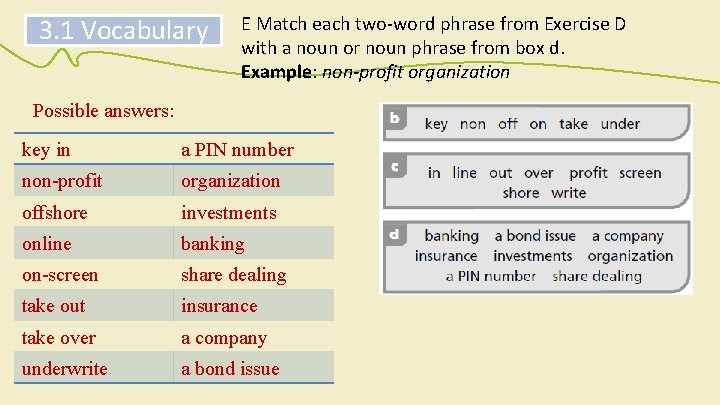
3. 1 Vocabulary E Match each two-word phrase from Exercise D with a noun or noun phrase from box d. Example: non-profit organization Possible answers: key in a PIN number non-profit organization offshore investments online banking on-screen share dealing take out insurance take over a company underwrite a bond issue
3. 1 Vocabulary F Complete each sentence with one or more of the two-word phrases from Exercise D. underwrite stock 1 In the US, investment banks traditionally guarantee or ______ and bond issues. key in your password before accessing your online 2 You have to ______ bank account. 3 On-screen _____ share dealing helps you make quick changes to your portfolio. 4 If you don’t take _______insurance, it can be costly if your house or car is out damaged. 5 Credit unions are _____ non-profit organizations, popular in Canada. takeover of a 6 Investment banks will fund leveraged buyouts when there is a _______ company. offshore banks are located in areas or jurisdictions of low 7 Many ____ regulation and taxation.
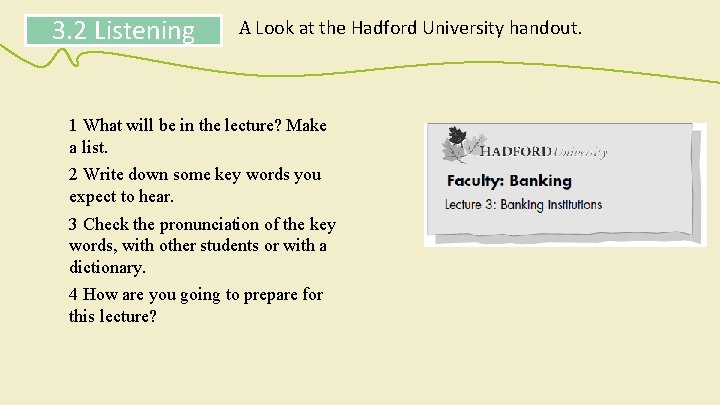
3. 2 Listening A Look at the Hadford University handout. 1 What will be in the lecture? Make a list. 2 Write down some key words you expect to hear. 3 Check the pronunciation of the key words, with other students or with a dictionary. 4 How are you going to prepare for this lecture?
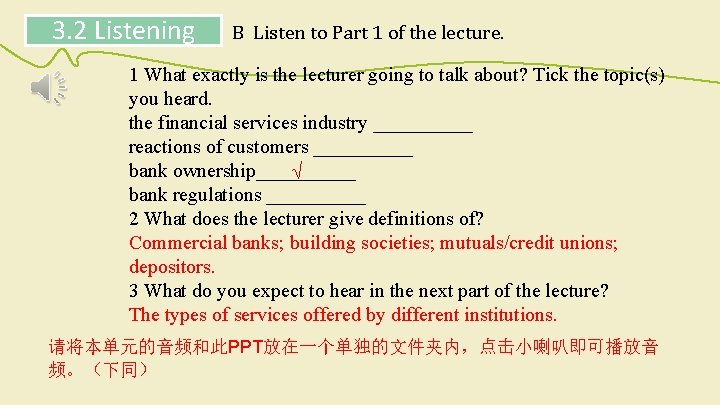
3. 2 Listening B Listen to Part 1 of the lecture. 1 What exactly is the lecturer going to talk about? Tick the topic(s) you heard. the financial services industry _____ reactions of customers _____ bank ownership_____ √ bank regulations _____ 2 What does the lecturer give definitions of? Commercial banks; building societies; mutuals/credit unions; depositors. 3 What do you expect to hear in the next part of the lecture? The types of services offered by different institutions. 请将本单元的音频和此PPT放在一个单独的文件夹内,点击小喇叭即可播放音 频。(下同)
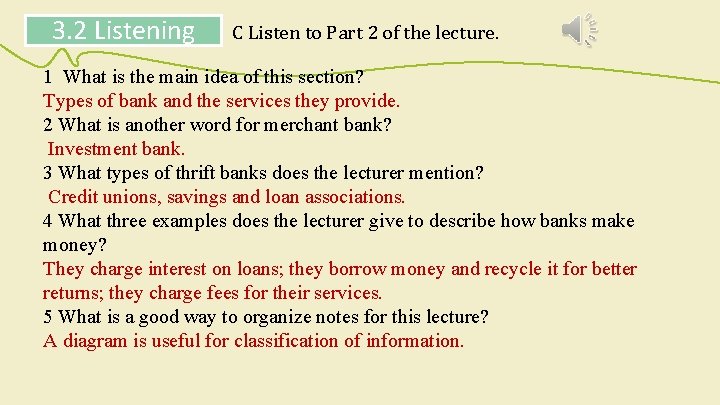
3. 2 Listening C Listen to Part 2 of the lecture. 1 What is the main idea of this section? Types of bank and the services they provide. 2 What is another word for merchant bank? Investment bank. 3 What types of thrift banks does the lecturer mention? Credit unions, savings and loan associations. 4 What three examples does the lecturer give to describe how banks make money? They charge interest on loans; they borrow money and recycle it for better returns; they charge fees for their services. 5 What is a good way to organize notes for this lecture? A diagram is useful for classification of information.
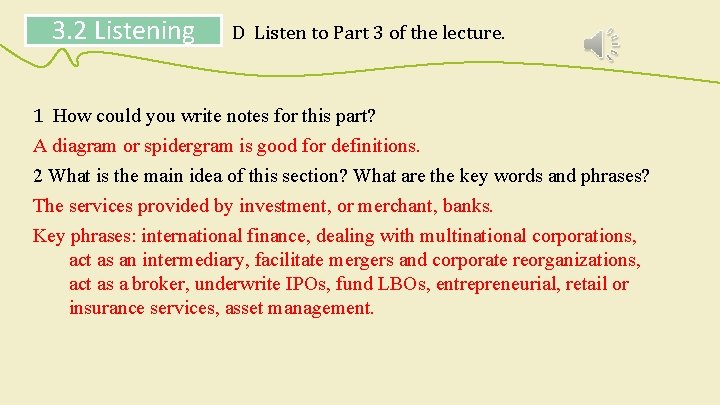
3. 2 Listening D Listen to Part 3 of the lecture. 1 How could you write notes for this part? A diagram or spidergram is good for definitions. 2 What is the main idea of this section? What are the key words and phrases? The services provided by investment, or merchant, banks. Key phrases: international finance, dealing with multinational corporations, act as an intermediary, facilitate mergers and corporate reorganizations, act as a broker, underwrite IPOs, fund LBOs, entrepreneurial, retail or insurance services, asset management.
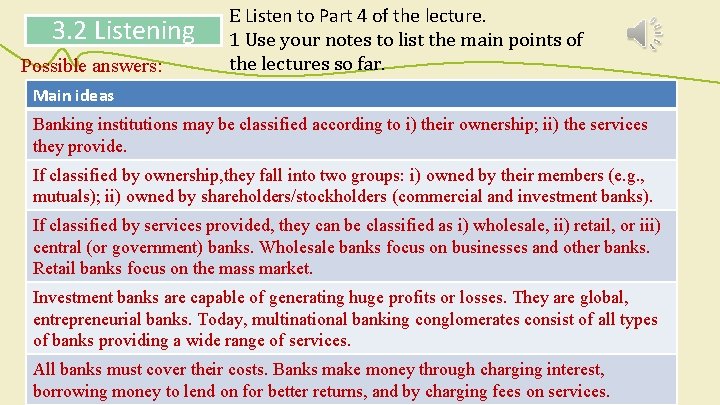
3. 2 Listening Possible answers: E Listen to Part 4 of the lecture. 1 Use your notes to list the main points of the lectures so far. Main ideas Banking institutions may be classified according to i) their ownership; ii) the services they provide. If classified by ownership, they fall into two groups: i) owned by their members (e. g. , mutuals); ii) owned by shareholders/stockholders (commercial and investment banks). If classified by services provided, they can be classified as i) wholesale, ii) retail, or iii) central (or government) banks. Wholesale banks focus on businesses and other banks. Retail banks focus on the mass market. Investment banks are capable of generating huge profits or losses. They are global, entrepreneurial banks. Today, multinational banking conglomerates consist of all types of banks providing a wide range of services. All banks must cover their costs. Banks make money through charging interest, borrowing money to lend on for better returns, and by charging fees on services.
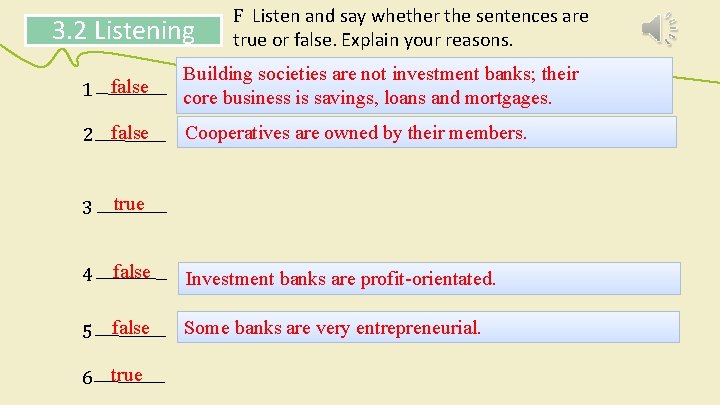
3. 2 Listening F Listen and say whether the sentences are true or false. Explain your reasons. 1 false Building societies are not investment banks; their core business is savings, loans and mortgages. 2 false Cooperatives are owned by their members. 3 true 4 false Investment banks are profit-orientated. 5 false Some banks are very entrepreneurial. 6 true
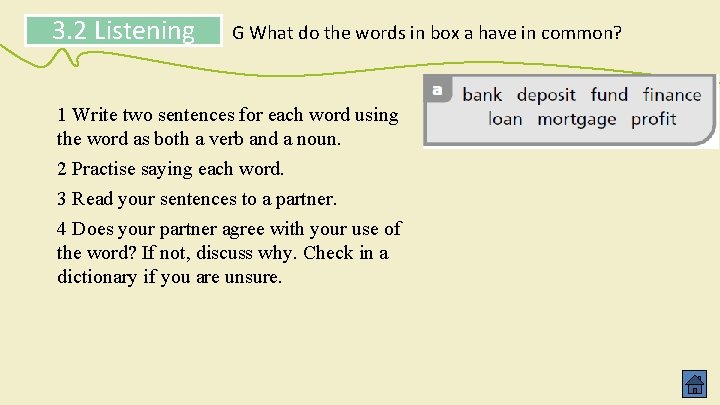
3. 2 Listening G What do the words in box a have in common? 1 Write two sentences for each word using the word as both a verb and a noun. 2 Practise saying each word. 3 Read your sentences to a partner. 4 Does your partner agree with your use of the word? If not, discuss why. Check in a dictionary if you are unsure.
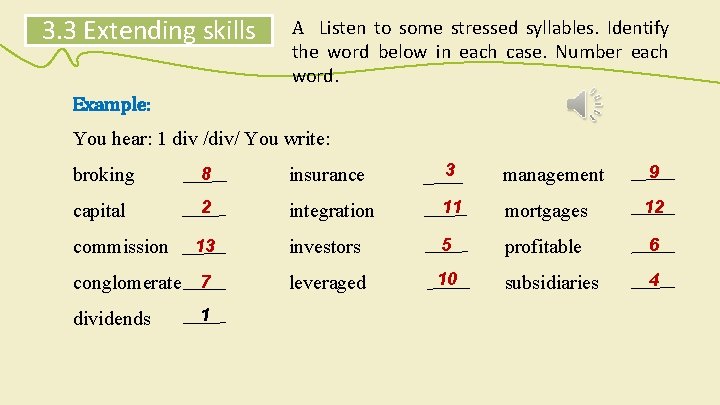
3. 3 Extending skills A Listen to some stressed syllables. Identify the word below in each case. Number each word. Example: You hear: 1 div /div/ You write: broking 8 insurance 3 management 9 capital 2 integration 11 mortgages 12 investors 5 profitable 6 leveraged 10 subsidiaries 4 commission 13 conglomerate 7 dividends 1
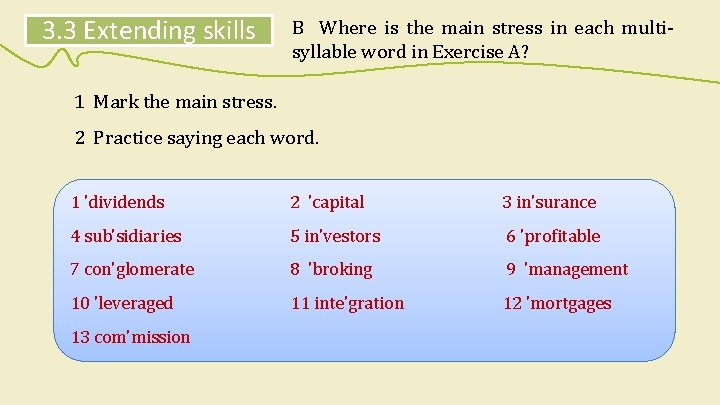
3. 3 Extending skills B Where is the main stress in each multisyllable word in Exercise A? 1 Mark the main stress. 2 Practice saying each word. 1 'dividends 2 'capital 3 in'surance 4 sub'sidiaries 5 in'vestors 6 'profitable 7 con'glomerate 8 'broking 9 'management 10 'leveraged 11 inte'gration 12 'mortgages 13 com'mission
3. 3 Extending skills C Work in pairs or groups. Define of the words in Exercise A. The other student(s) must find and say the correct word.
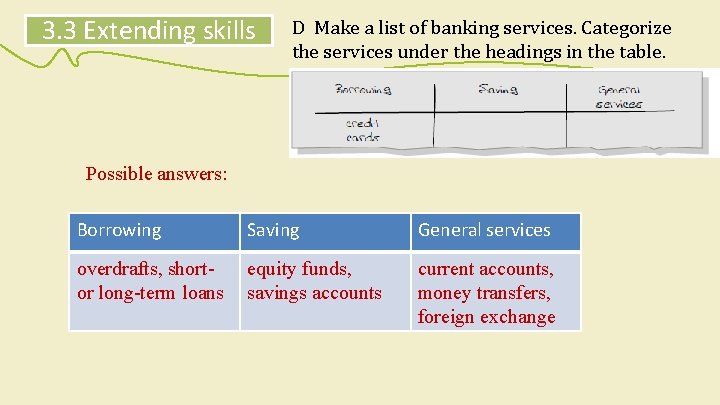
3. 3 Extending skills D Make a list of banking services. Categorize the services under the headings in the table. Possible answers: Borrowing Saving General services overdrafts, shortor long-term loans equity funds, savings accounts current accounts, money transfers, foreign exchange
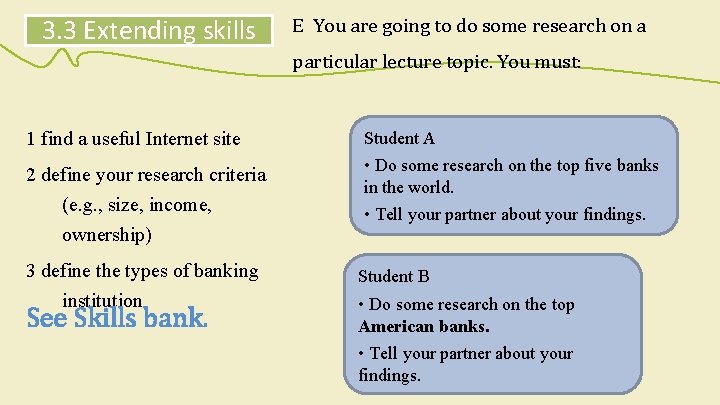
3. 3 Extending skills E You are going to do some research on a particular lecture topic. You must: 1 find a useful Internet site Student A 2 define your research criteria (e. g. , size, income, ownership) • Do some research on the top five banks in the world. • Tell your partner about your findings. 3 define the types of banking institution See Skills bank. Student B • Do some research on the top American banks. • Tell your partner about your findings.
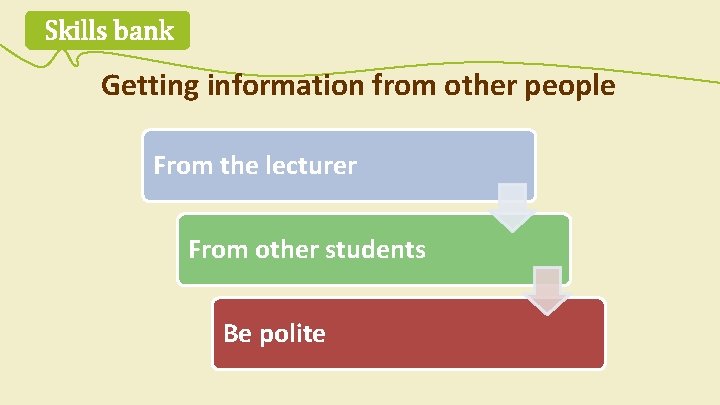
Skills bank Getting information from other people From the lecturer From other students Be polite
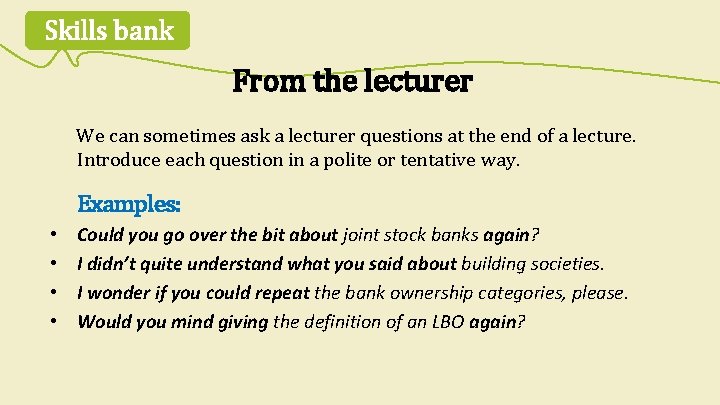
Skills bank From the lecturer We can sometimes ask a lecturer questions at the end of a lecture. Introduce each question in a polite or tentative way. Examples: • • Could you go over the bit about joint stock banks again? I didn’t quite understand what you said about building societies. I wonder if you could repeat the bank ownership categories, please. Would you mind giving the definition of an LBO again?
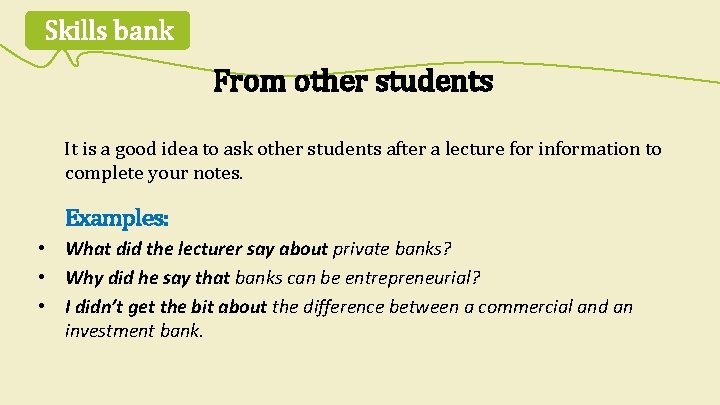
Skills bank From other students It is a good idea to ask other students after a lecture for information to complete your notes. Examples: • What did the lecturer say about private banks? • Why did he say that banks can be entrepreneurial? • I didn’t get the bit about the difference between a commercial and an investment bank.
Skills bank Be polite! In some situations, it can sound impolite to ask people a direct question. We may add a polite introduction. Examples: Do credit unions operate in the UK? → Do you know if credit unions operate in the UK? What does ‘underwrite’ mean? → Can you remember what ‘underwrite’ means?
Skills bank Reporting information to other people We often have to report research findings to a tutor or other students in a seminar. Make sure you can give: • sources—books, articles, writers, publication dates • quotes—in the writer’s own words • summary findings—in your own words
3. 4 Extending skills A You are going to listen to a continuation of the lecture in Lesson 2. 1 Make a list of points from that lecture. 2 What is the lecturer going to talk about today? (Clue: You researched it in Lesson 2. ) 3 Listen to the end of the last lecture again and check your ideas. The services offered by some banks operating in the UK.
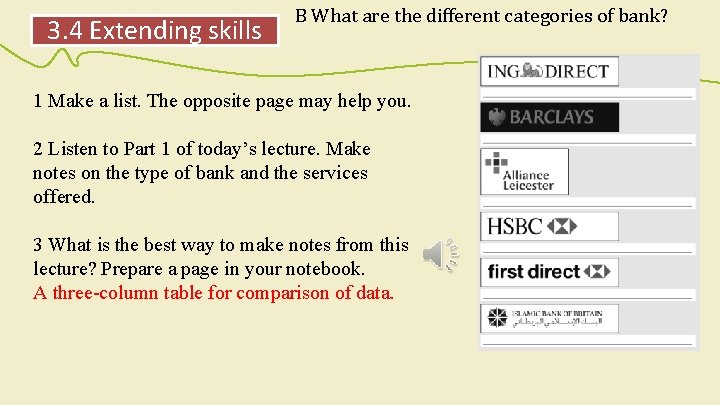
3. 4 Extending skills B What are the different categories of bank? 1 Make a list. The opposite page may help you. 2 Listen to Part 1 of today’s lecture. Make notes on the type of bank and the services offered. 3 What is the best way to make notes from this lecture? Prepare a page in your notebook. A three-column table for comparison of data.
3. 4 Extending skills C Listen to Part 2 of the lecture. Make notes.
3. 4 Extending skills D Listen to Part 3 of the lecture. Make notes.
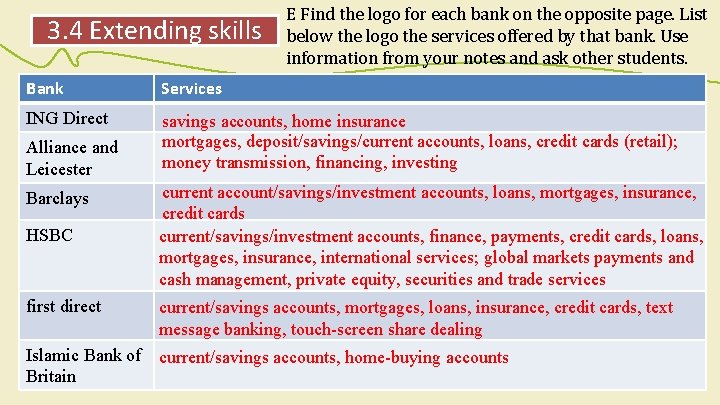
3. 4 Extending skills E Find the logo for each bank on the opposite page. List below the logo the services offered by that bank. Use information from your notes and ask other students. Bank Services ING Direct savings accounts, home insurance mortgages, deposit/savings/current accounts, loans, credit cards (retail); money transmission, financing, investing Alliance and Leicester Barclays HSBC first direct current account/savings/investment accounts, loans, mortgages, insurance, credit cards current/savings/investment accounts, finance, payments, credit cards, loans, mortgages, insurance, international services; global markets payments and cash management, private equity, securities and trade services current/savings accounts, mortgages, loans, insurance, credit cards, text message banking, touch-screen share dealing Islamic Bank of current/savings accounts, home-buying accounts Britain
3. 4 Extending skills F Listen to the final part of the lecture. 1 What is the lecturer’s conclusion? The lecturer concludes that banks tend to offer a range of services that cross category boundaries – and that this trend will continue. 2 Are different services common to different categories of bank? 3 Do you agree with the lecturer? Discuss your reasons for agreeing or disagreeing.
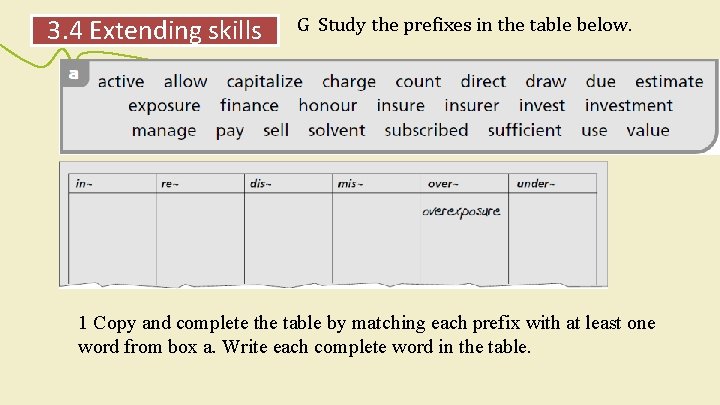
3. 4 Extending skills G Study the prefixes in the table below. 1 Copy and complete the table by matching each prefix with at least one word from box a. Write each complete word in the table.
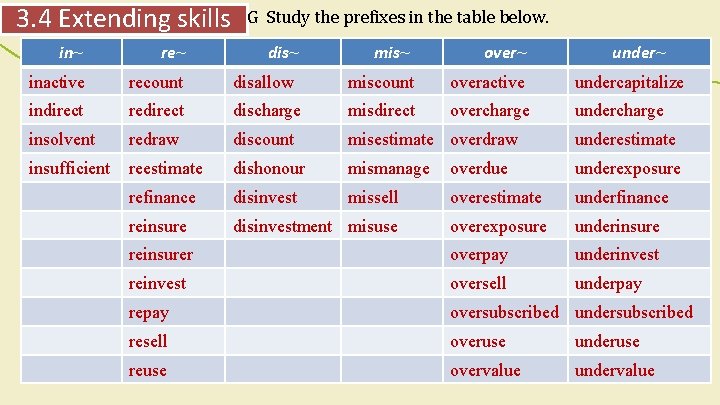
3. 4 Extending skills G Study the prefixes in the table below. in~ re~ dis~ mis~ over~ under~ inactive recount disallow miscount overactive undercapitalize indirect redirect discharge misdirect overcharge undercharge insolvent redraw discount misestimate overdraw underestimate insufficient reestimate dishonour mismanage overdue underexposure refinance disinvest missell overestimate underfinance reinsure disinvestment misuse overexposure underinsure reinsurer overpay underinvest reinvest oversell underpay repay oversubscribed undersubscribed resell overuse underuse reuse overvalue undervalue
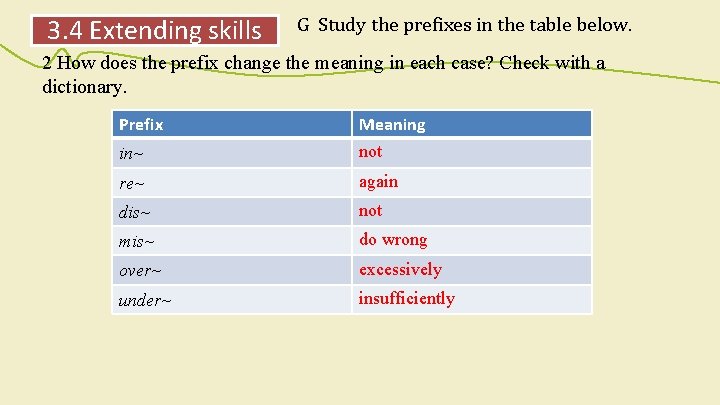
3. 4 Extending skills G Study the prefixes in the table below. 2 How does the prefix change the meaning in each case? Check with a dictionary. Prefix in~ Meaning not re~ again dis~ not mis~ do wrong over~ excessively under~ insufficiently
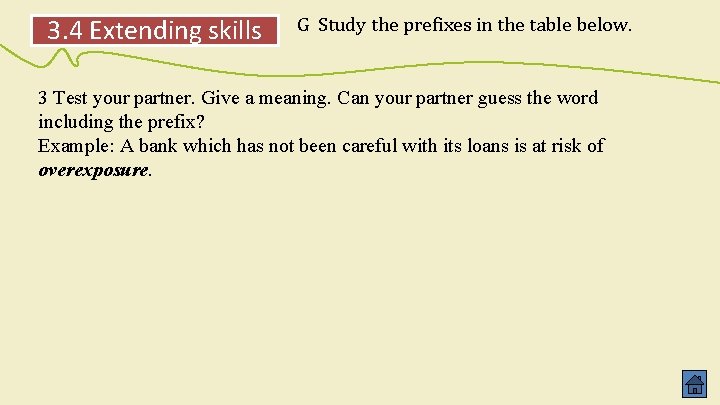
3. 4 Extending skills G Study the prefixes in the table below. 3 Test your partner. Give a meaning. Can your partner guess the word including the prefix? Example: A bank which has not been careful with its loans is at risk of overexposure.
Tips for Reference 3. 1 Vocabulary部分,学生课前完成练习B、C、E、F;课堂上讲解 vocabulary bank中的 “Stress within words”技能,并完成练习A、D。 3. 2 Listening部分,按次序听完,巩固第一单元中的 “Making perfect lecture notes”技能。 3. 3 Extending skills部分,课堂完成练习A、B、C,巩固 “Stress within words”技能;结合skills bank中 “Getting information from other people”技 能完成练习E。 3. 4 Extending skills部分,顺次完成练习A、B、C、D、E、F,巩固 “making lecture notes”技能。练习G可以让学生课后完成。