
Unit 3 Genetics Part 1 Genetic Information BOOK
Unit 3: Genetics Part 1: Genetic Information BOOK CHAPTERS 12 &13
Learning Goals Describe the scientists responsible for the discovery of DNA and the structure of DNA Describe the overall structure of the DNA molecule Summarize the events of DNA replication Relate the DNA molecule to chromosome structure Describe how RNA differs from DNA Name 3 main types of RNA Describe the events of transcription and translation Explain the relationship between genes and proteins Explain how genes are regulated Explain the 2 types of mutations Contrast gene mutations and chromosomal mutations Describe a typical gene
Griffith’s Experiment In 1928, Frederick Griffith tried to explain why people got sick He collected similar bacteria, in 2 different varieties, from mice and tested them
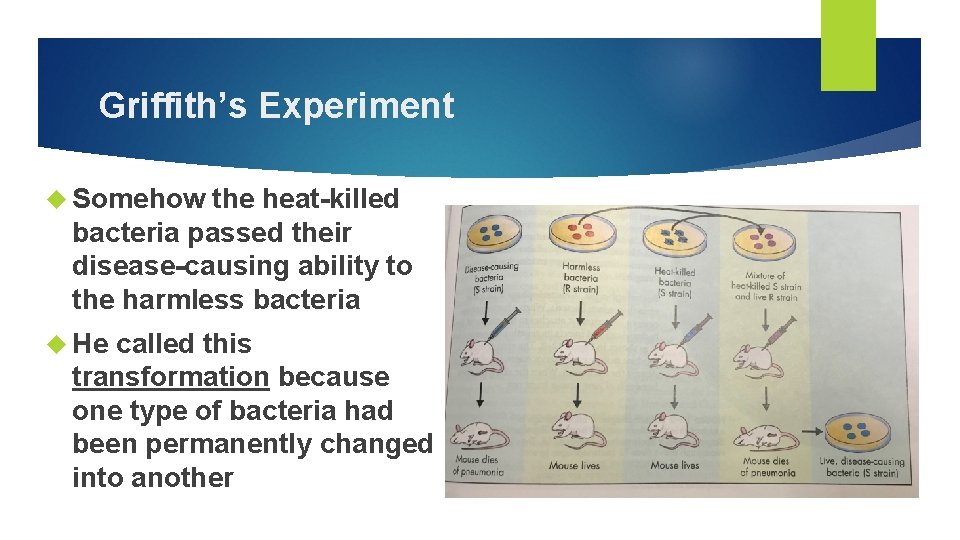
Griffith’s Experiment Somehow the heat-killed bacteria passed their disease-causing ability to the harmless bacteria He called this transformation because one type of bacteria had been permanently changed into another
Avery/Hershey & Chase Avery (1944) worked to figure out which molecule in the heatkilled bacteria was the most important to transformation He discovered that DNA stores and transmits genetic information from one generation of bacteria to the next Hershey and Chase worked to determine which part the virus entered the bacterial cell Their experiment confirmed Avery’s results and convinced many other scientists that DNA was the genetic material found in genes of all living cells
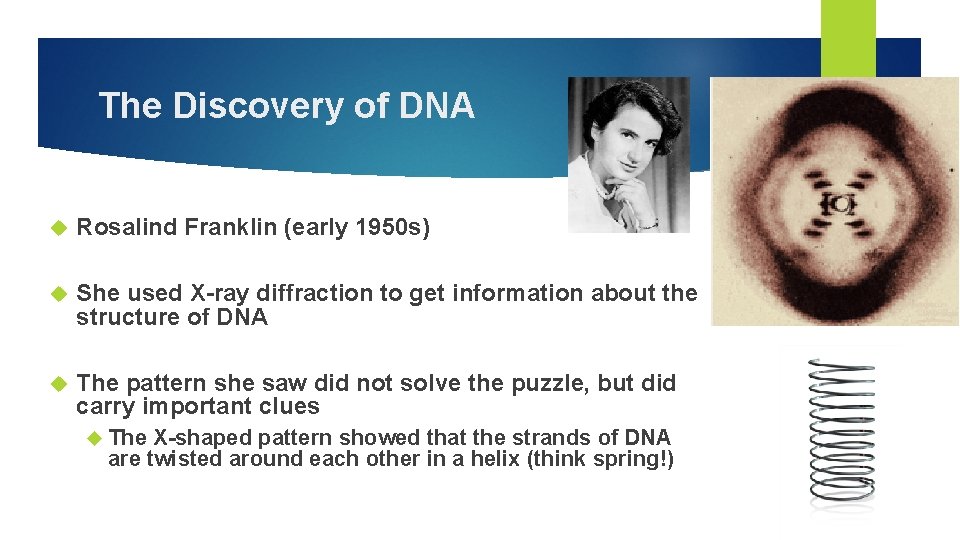
The Discovery of DNA Rosalind Franklin (early 1950 s) She used X-ray diffraction to get information about the structure of DNA The pattern she saw did not solve the puzzle, but did carry important clues The X-shaped pattern showed that the strands of DNA are twisted around each other in a helix (think spring!)
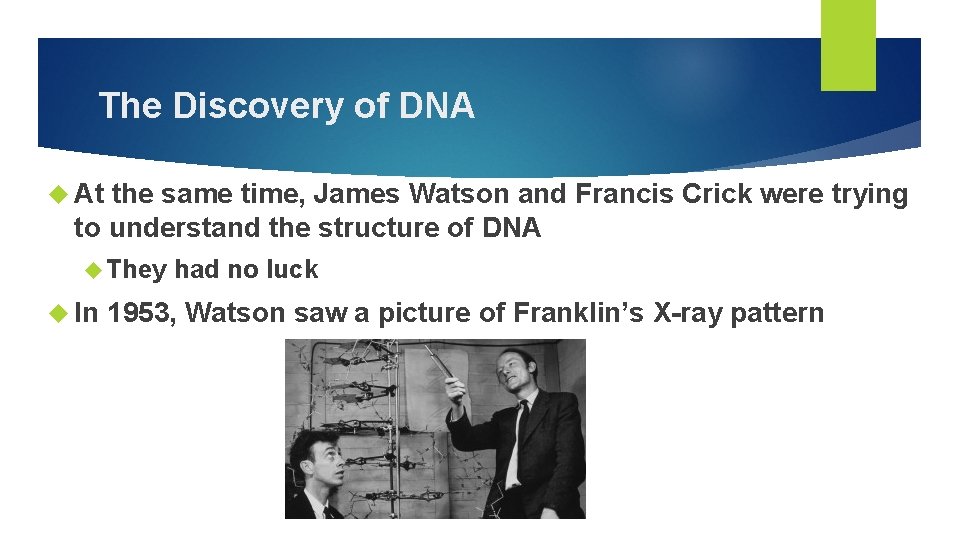
The Discovery of DNA At the same time, James Watson and Francis Crick were trying to understand the structure of DNA They In had no luck 1953, Watson saw a picture of Franklin’s X-ray pattern
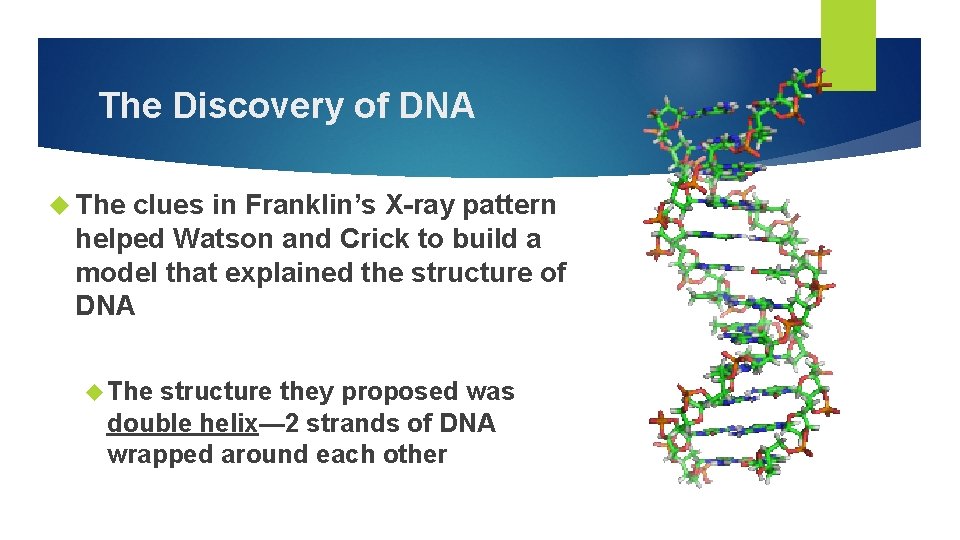
The Discovery of DNA The clues in Franklin’s X-ray pattern helped Watson and Crick to build a model that explained the structure of DNA The structure they proposed was double helix— 2 strands of DNA wrapped around each other
The Components of DNA = Deoxyribo. Nucleic Acid is a nucleic acid made up of nucleotides joined into long strands by covalent bonds
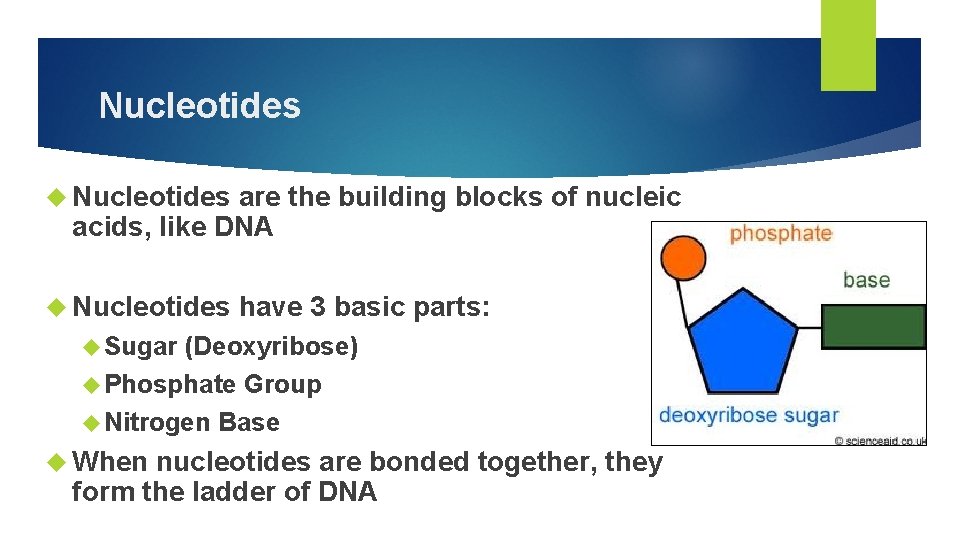
Nucleotides are the building blocks of nucleic acids, like DNA Nucleotides have 3 basic parts: Sugar (Deoxyribose) Phosphate Group Nitrogen Base When nucleotides are bonded together, they form the ladder of DNA

Nitrogen Bases There are 4 different nitrogen bases: Adenine Thymine Cytosine Guanine They are identified by the first letter: A, T, C, G The bases pair up in a strand of DNA: A & T, C & G—this is base pairing The number of A in a strand of DNA will equal the number of T, and the number of G will equal the number of C
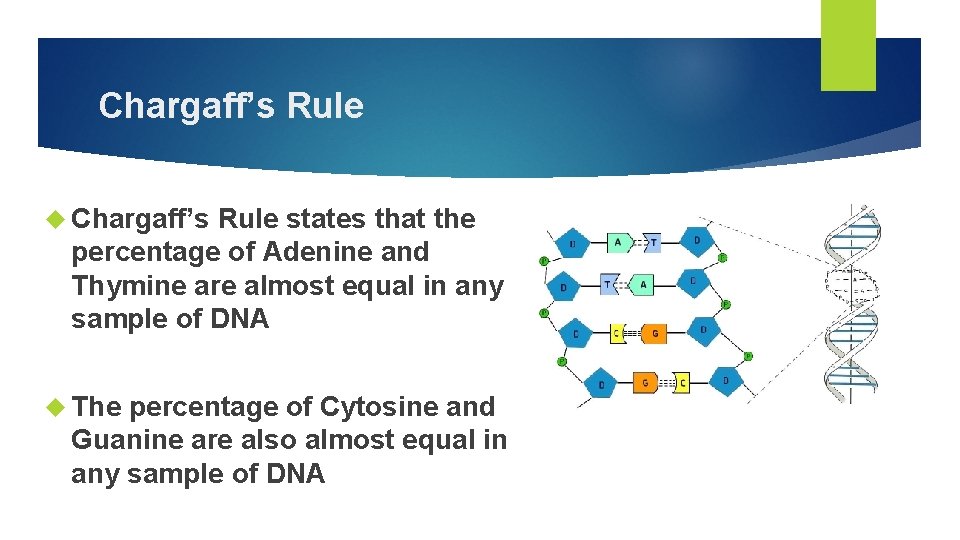
Chargaff’s Rule states that the percentage of Adenine and Thymine are almost equal in any sample of DNA The percentage of Cytosine and Guanine are also almost equal in any sample of DNA

DNA Replication Before a cell divides, the DNA must be copied exactly Replication Base is the process of copying DNA pairing makes this possible…but how?
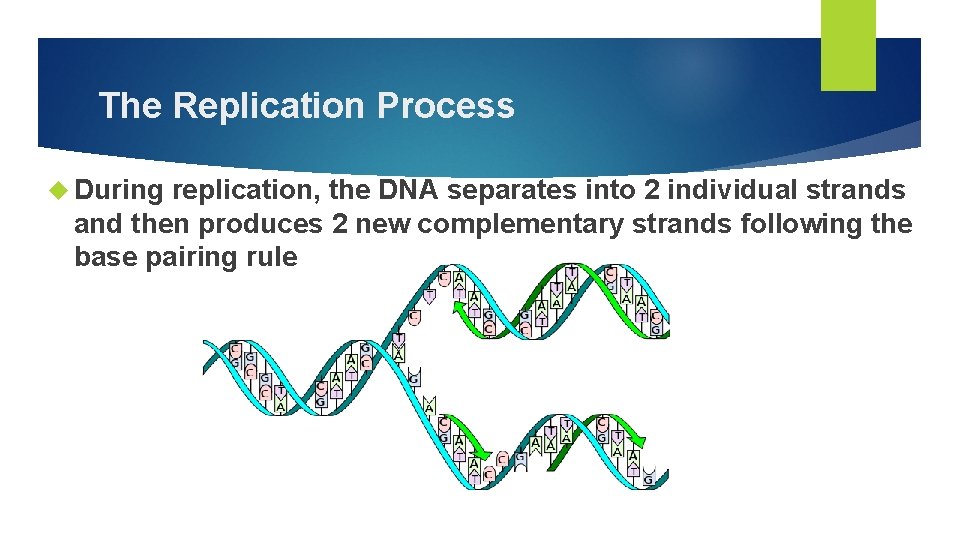
The Replication Process During replication, the DNA separates into 2 individual strands and then produces 2 new complementary strands following the base pairing rule
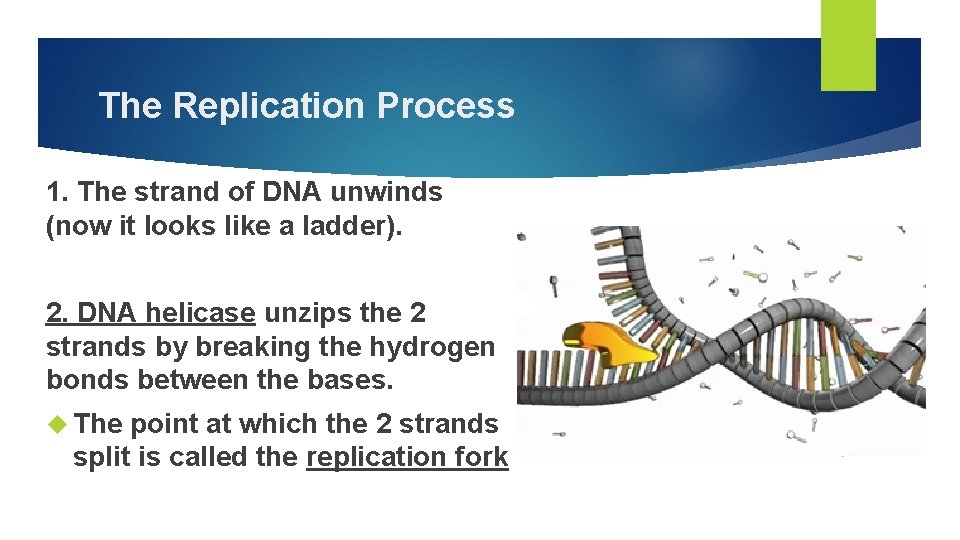
The Replication Process 1. The strand of DNA unwinds (now it looks like a ladder). 2. DNA helicase unzips the 2 strands by breaking the hydrogen bonds between the bases. The point at which the 2 strands split is called the replication fork

The Replication Process 3. DNA polymerase adds free floating nucleotides to the separated DNA strands. This creates the complementary strand Replication happens in 2 different directions (the strands are antiparallel) 4. Two new strands of DNA are produced.
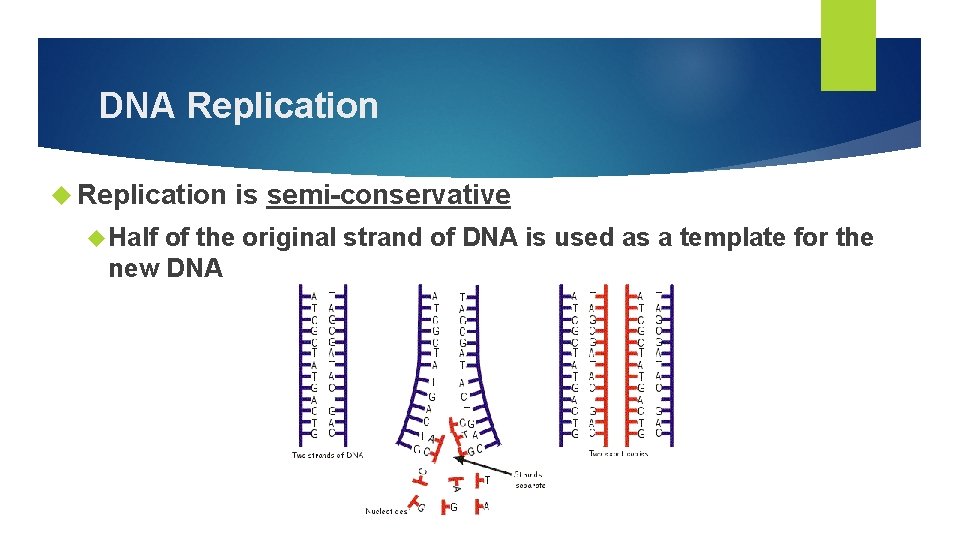
DNA Replication Half is semi-conservative of the original strand of DNA is used as a template for the new DNA
RNA The discovery of DNA was not enough to answer the question of how a gene works The answer cam from the discovery of RNA (ribonucleic acid) RNA is also a long chain of nucleotides bonded together
RNA There are 3 important differences between DNA and RNA: 1. The sugar in RNA is ribose instead of deoxyribose 2. RNA is generally single stranded not double stranded 3. RNA contains uracil instead of thymine
Types of RNA There are 3 kinds of RNA: 1. Messenger RNA (m. RNA) – carry copies of instructions for assembling amino acids into proteins 2. Ribosomal RNA (r. RNA) – assemble proteins in ribosomes 3. Transfer RNA (t. RNA) – transfers amino acids to the ribosome
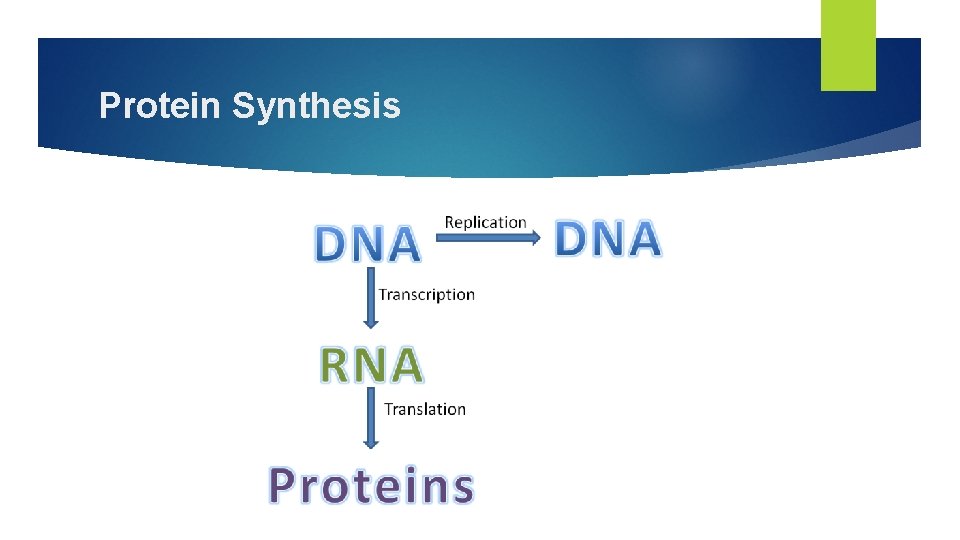
Transcription In transcription, segments of DNA serve as templates to produce complementary RNA molecules
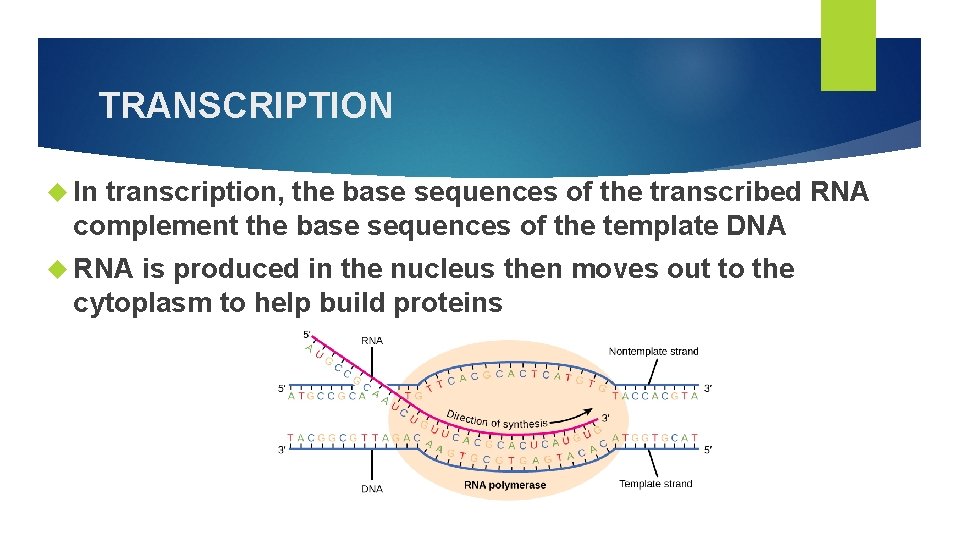
TRANSCRIPTION In transcription, the base sequences of the transcribed RNA complement the base sequences of the template DNA RNA is produced in the nucleus then moves out to the cytoplasm to help build proteins
RNA POLYMERASE & STEPS OF TRANSCRIPTION RNA polymerase is very similar to DNA polymerase 1. RNA polymerase binds to DNA and separates the strands. 2. RNA polymerase uses one strand of DNA as a template to create a complementary strand of RNA
PROMOTERS RNA polymerase doesn’t bind to DNA just anywhere It only binds to promoters, regions of DNA that have specific base sequences Promoters are signals in the DNA molecule that show RNA polymerase exactly where to begin making RNA Similar signal in DNA causes transcription to stop

RNA Editing The RNA that is made in transcription have nonessential pieces cut out before they can become m. RNA The pieces that get cut out are called introns The pieces of RNA that remain are called exons
Translation RNA contains 4 different bases: Adenine, We Uracil, Cytosine, Guanine call this language the genetic code The genetic code is read three “letters” at a time, so that each “word” is three bases long and corresponds to a single amino acid Each 3 letter “word” in m. RNA is known as a codon
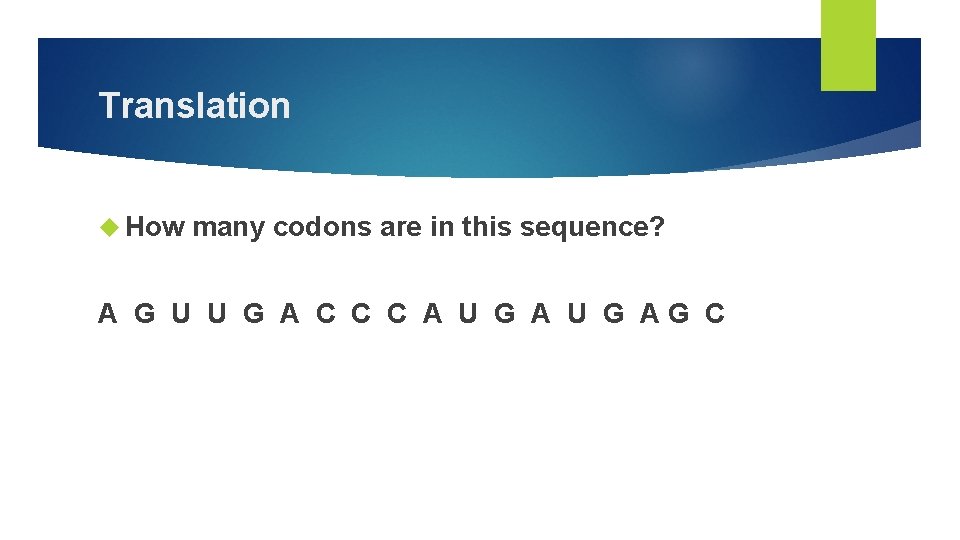
Translation How many codons are in this sequence? A G U U G A C C C A U G AG C
Translation Because codons Most there are 4 different bases, there are 64 possible 3 -base amino acids can be specified by more than one codon To use the chart start at the middle of the circle with the first letter of the codon, and move outward There are codons that signal both the start and stop of translation AUG is the only start codon
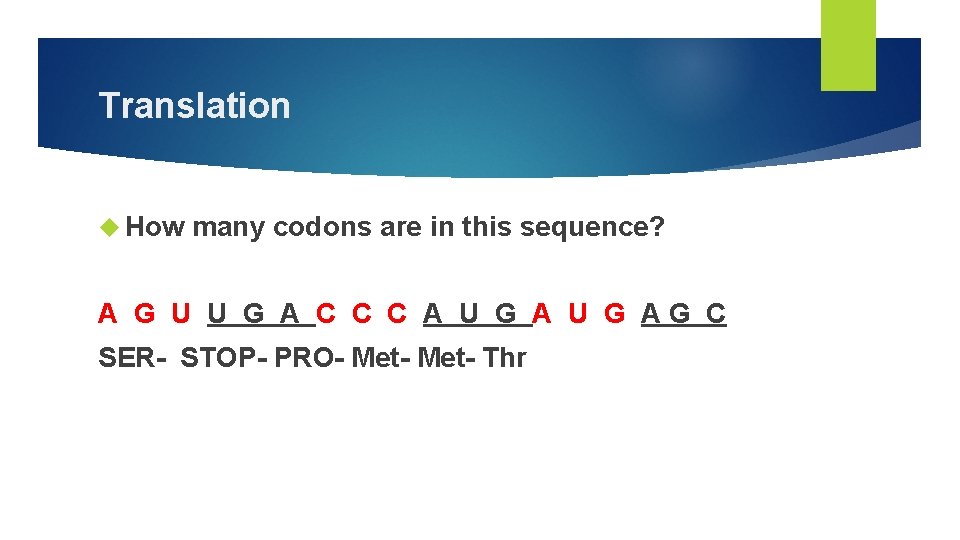
Translation How many codons are in this sequence? A G U U G A C C C A U G AG C SER- STOP- PRO- Met- Thr
Translation The decoding of an m. RNA message into a protein is known as translation After transcription, m. RNA leaves the nucleus to travel to the ribosome where translation occurs
Steps of Translation (1) Translation begins when a ribosome attaches to an m. RNA molecule in the cytoplasm As each codon passes through the ribosome, t. RNAs bring the correct amino acid to the ribosome One at a time, the ribosome attaches the amino acids to the growing chain
Steps of Translation (2) The ribosome helps to form a bond between the first and second amino acid At the same time the bond between the amino acid and the t. RNA is broken The t. RNA then moves out of the ribosome to bond to another amino acid in the cytoplasm
Steps of Translation (3) The chain of amino acids continues to grow until the ribosome reaches a “stop” codon on the m. RNA molecule When the ribosome reaches a stop codon, both the m. RNA and amino acid chain are released
Protein Synthesis
- Slides: 34