
Unit 3 Forces Forces l A force is

- Slides: 31
Unit 3 Forces
Forces l. A force is a push or a pull l A force affects how an object moves l Can make objects start or stop moving l Can make objects move faster or slower l Can make objects change direction
Push/Pull Activity l Move around the classroom and find at least 10 things that you push, pull, or push and pull (3 minutes) l Complete the Venn diagram by placing the items in the appropriate categories (2 minutes)
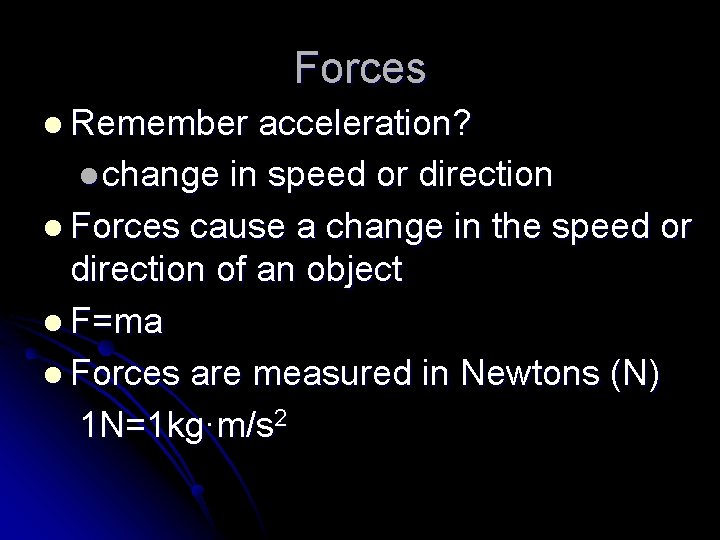
Forces l Remember acceleration? l change in speed or direction l Forces cause a change in the speed or direction of an object l F=ma l Forces are measured in Newtons (N) 1 N=1 kg·m/s 2
Combining Forces l Forces usually act in pairs l Forces act in a particular direction l Forces usually cannot be seen, but their effects can
Forces l More than one force can act on an object at a time l Forces can push or pull in any direction l What happens when more than one force acts on an object depends on: l How strong the forces are l The direction of the forces
Combining Forces l When more than one force acts on an object, the forces combine to form a net force l The net force is the combination of all forces acting on an object l Forces may work together or they may be opposite forces
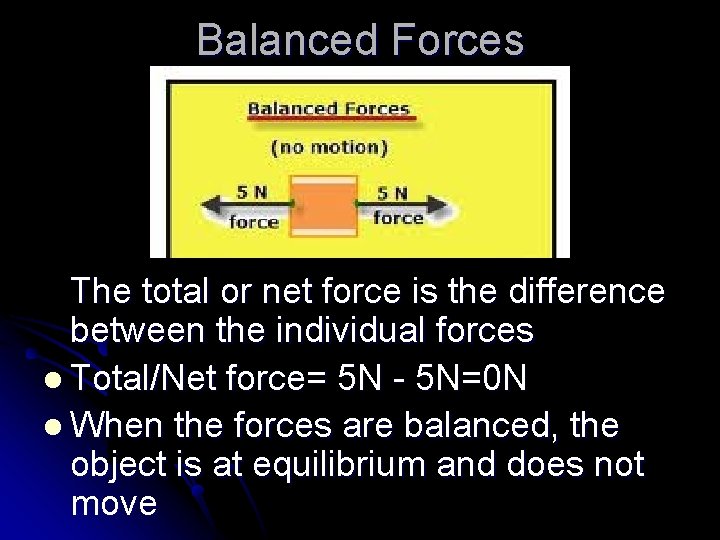
Balanced Forces The total or net force is the difference between the individual forces l Total/Net force= 5 N - 5 N=0 N l When the forces are balanced, the object is at equilibrium and does not move
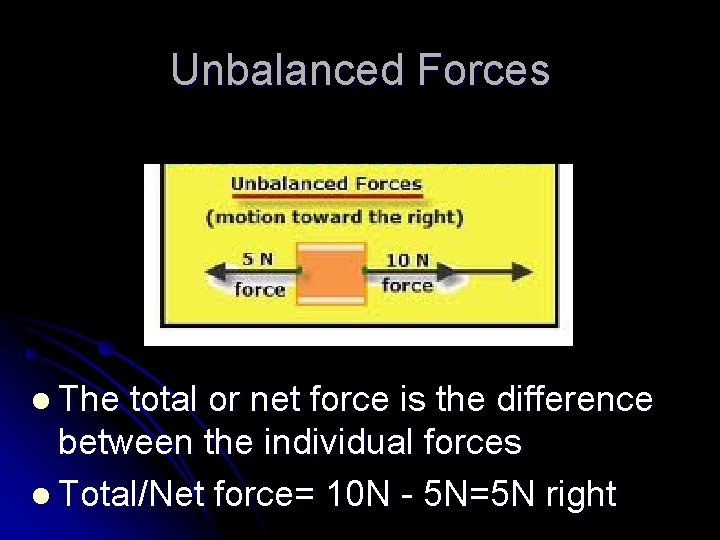
Unbalanced Forces l When 2 or more forces act in the opposite direction and are not equal in magnitude (number), the forces will be combined by subtracting to produce a net force l The total or net force is the difference between the individual forces l The object will move in the direction of the greater force
Unbalanced Forces l The total or net force is the difference between the individual forces l Total/Net force= 10 N - 5 N=5 N right
Practice l You are pulling a wagon with your niece in it up a hill with a force of 18 N. She is holding your dog’s leash, and the dog is pulling in the opposite direction with a force of 12 N. What is the force on the wagon? l Total/net Force = 18 N – 12 N = 6 N
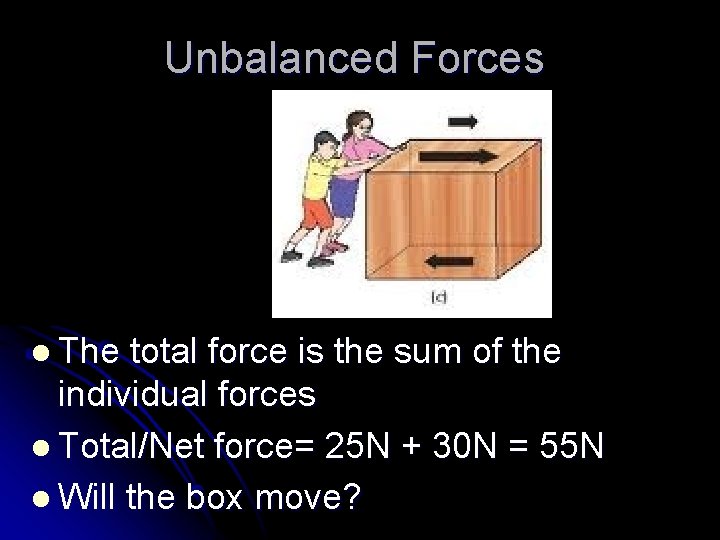
Unbalanced Forces l When 2 or more forces act in the same direction, the forces are added to produce the total force l Unbalanced forces result in motion
Unbalanced Forces l The total force is the sum of the individual forces l Total/Net force= 25 N + 30 N = 55 N l Will the box move?
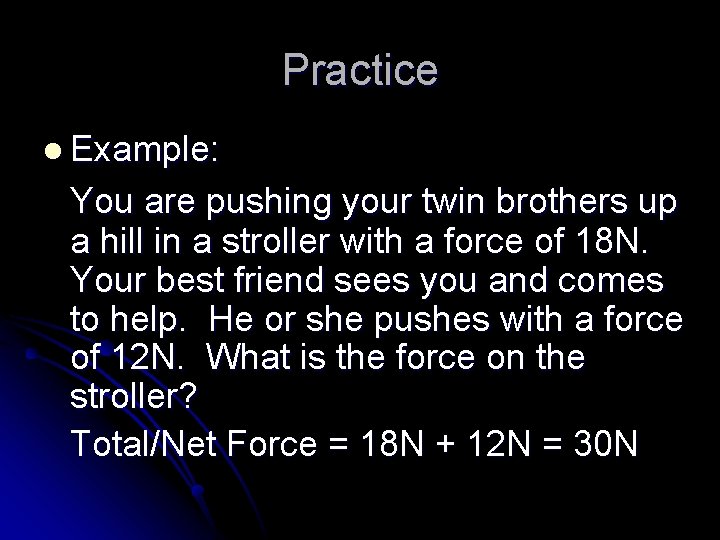
Practice l Example: You are pushing your twin brothers up a hill in a stroller with a force of 18 N. Your best friend sees you and comes to help. He or she pushes with a force of 12 N. What is the force on the stroller? Total/Net Force = 18 N + 12 N = 30 N
Friction l Dragon Racers Activity
Friction l Friction exists when two surfaces are touching and comes from the fact that no two surfaces are perfectly smooth l Friction acts in the opposite direction of motion and will cause a moving object to slow down and eventually stop
Friction l To make an object move, the force you exert on an object must be greater than the force opposing it l What did you observe about the friction of the surfaces that were rougher or softer in the Dragon Racer Activity?
Friction l Four types l Static friction – occurs between stationary objects l. Books on table, box on floor l Sliding friction – occurs when solid objects slide over each other l. Books or box being pushed
Friction l Four types l Rolling friction – occurs when a solid object rolls over another solid object l. Tires on a road l Fluid friction – occurs when an object moves through a fluid (liquid or gas) l. Fish swimming, airplane flying
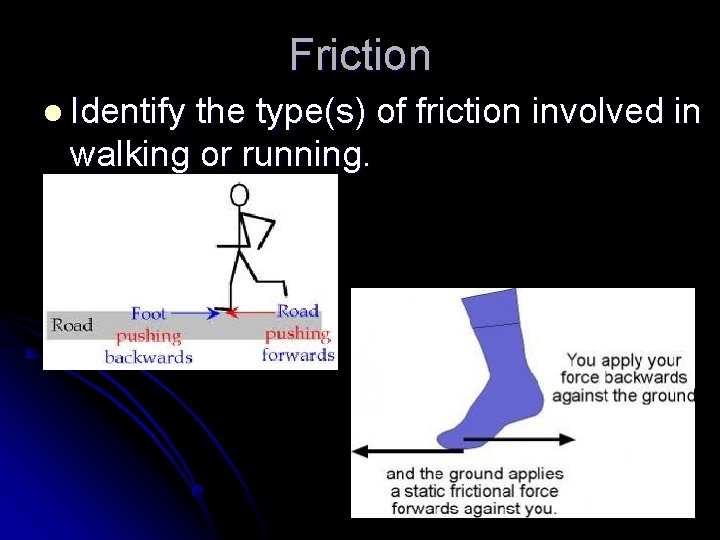
Friction l Identify the type(s) of friction involved in walking or running.
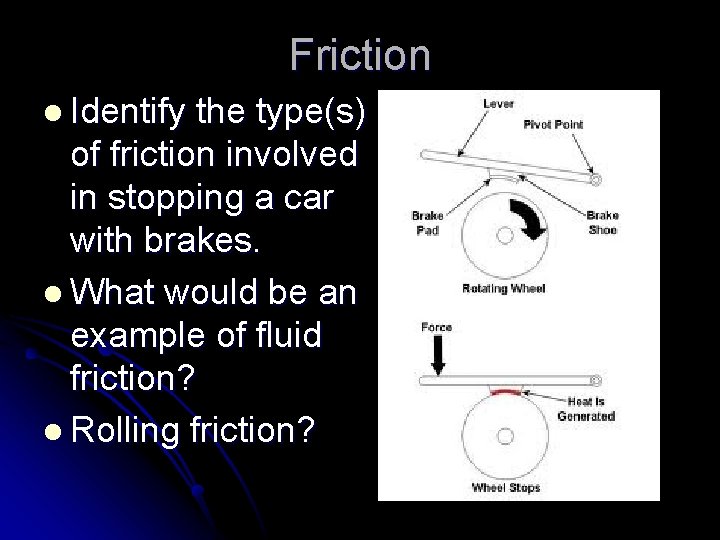
Friction l Identify the type(s) of friction involved in stopping a car with brakes. l What would be an example of fluid friction? l Rolling friction?
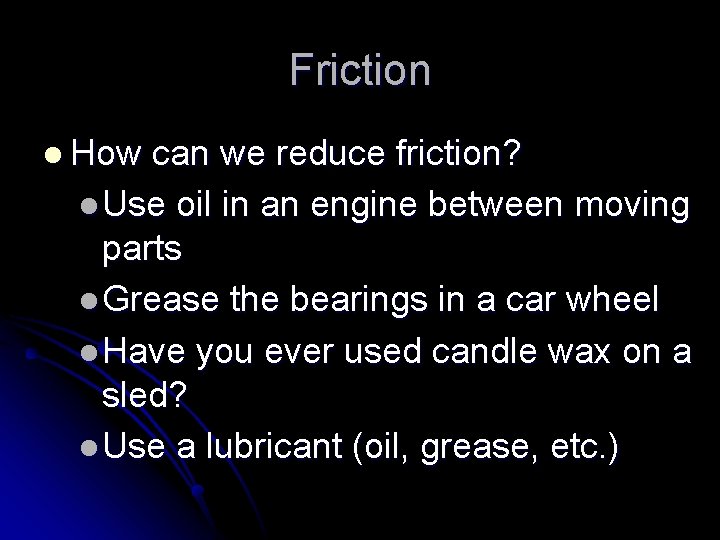
Friction l How can we reduce friction? l Use oil in an engine between moving parts l Grease the bearings in a car wheel l Have you ever used candle wax on a sled? l Use a lubricant (oil, grease, etc. )
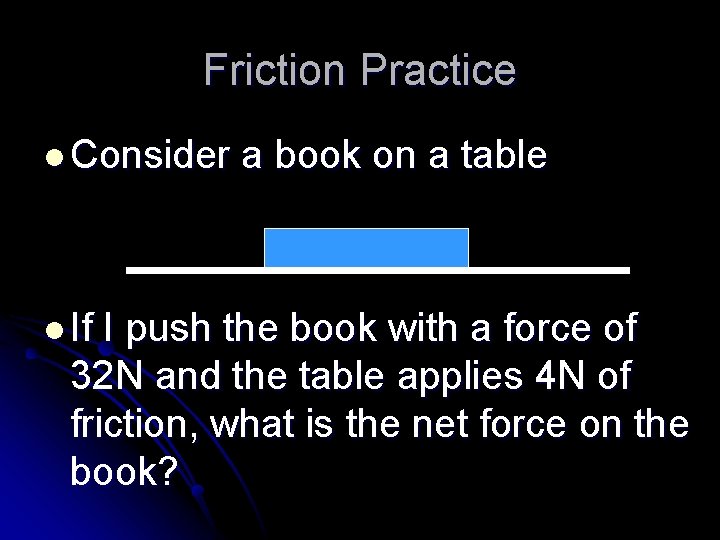
Friction Practice l Consider l If a book on a table I push the book with a force of 32 N and the table applies 4 N of friction, what is the net force on the book?
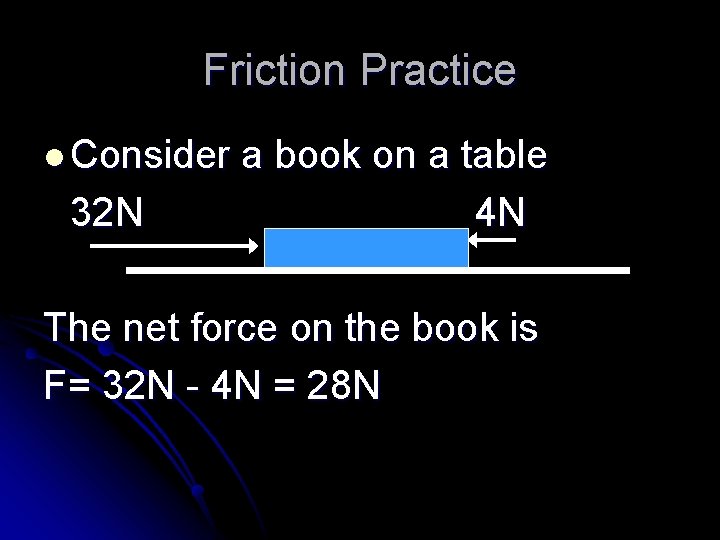
Friction Practice l Consider 32 N a book on a table 4 N The net force on the book is F= 32 N - 4 N = 28 N
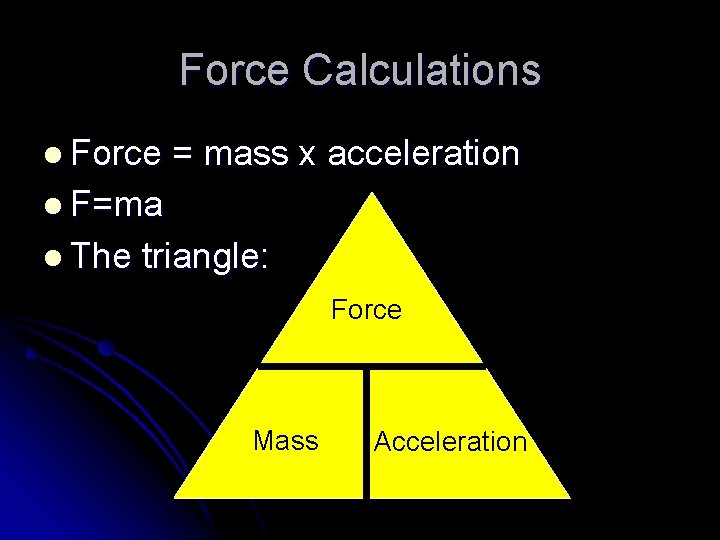
Force Calculations l Force = mass x acceleration l F=ma l The triangle: Force Mass Acceleration
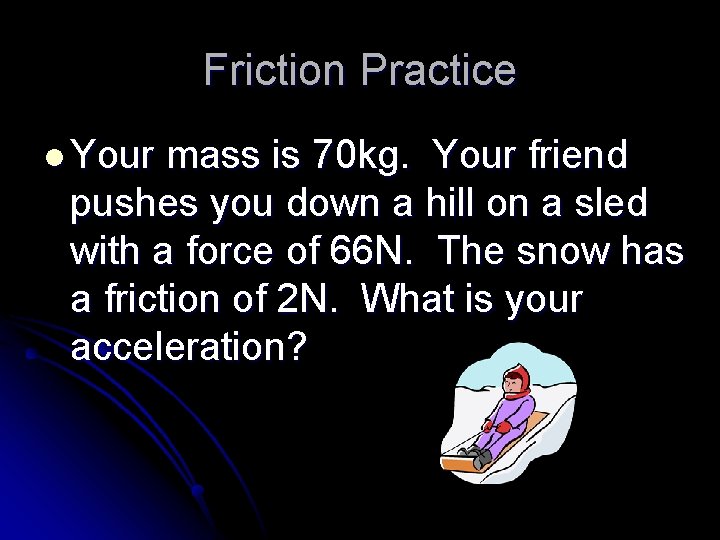
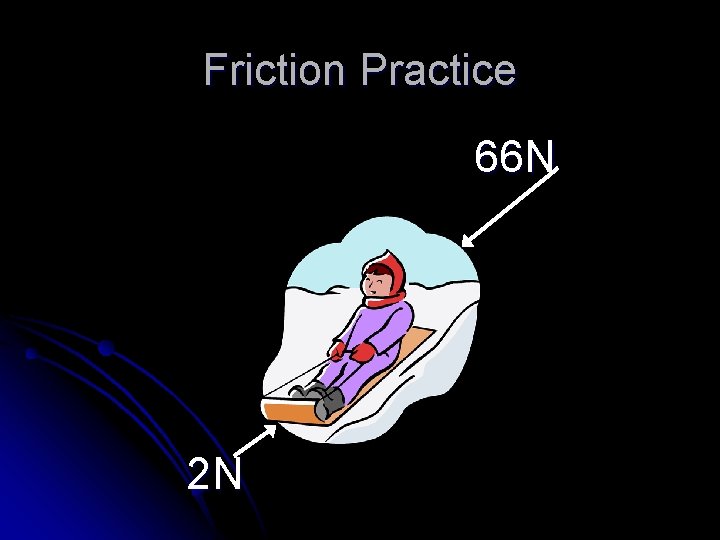
Friction Practice l Your mass is 70 kg. Your friend pushes you down a hill on a sled with a force of 66 N. The snow has a friction of 2 N. What is your acceleration?
Friction Practice 66 N 2 N
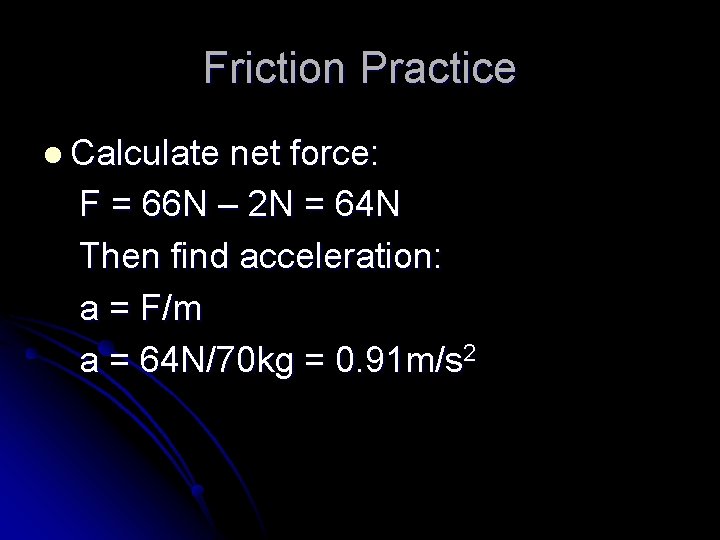
Friction Practice l Calculate net force: F = 66 N – 2 N = 64 N Then find acceleration: a = F/m a = 64 N/70 kg = 0. 91 m/s 2
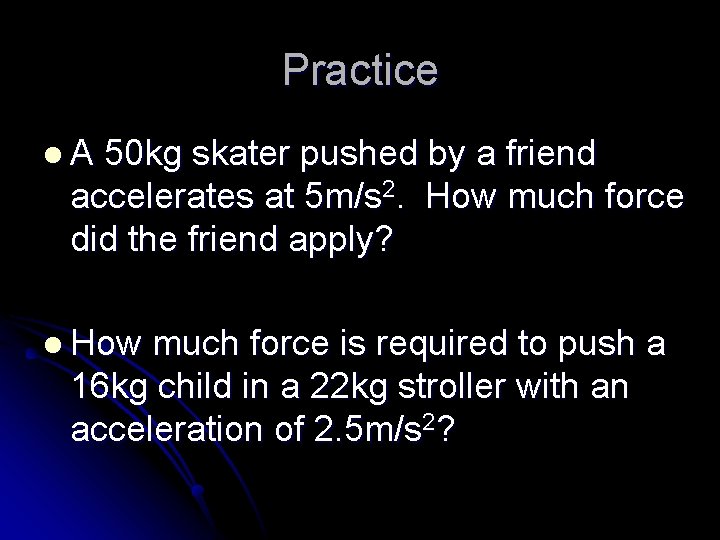
Practice l. A 50 kg skater pushed by a friend accelerates at 5 m/s 2. How much force did the friend apply? l How much force is required to push a 16 kg child in a 22 kg stroller with an acceleration of 2. 5 m/s 2?
Practice l If a 90 kg water skier is being pulled behind a boat with a force of 360 N, what is the skier’s acceleration? l If a 60 kg person on a 15 kg sled is pushed with a force of 300 N, what will be the person’s acceleration?
Practice l. A bowling ball rolled with a force of 15 N accelerates at a rate of 3 m/s 2. A second ball rolled with the same force accelerates at 4 m/s 2. What are the masses of the two bowling balls?