
Unit 3 Forces and Simple Machines Big Ideas
Unit 3 Forces and Simple Machines Big Ideas • there are different forces around you • machines affect forces on objects • simple machines have affected traditional lifestyles Mrs Preece Science 1
Introduction Use the picture on page 116 and 117 to fill in the following chart. Pulling Forces Pushing Forces Mrs Preece Science 2
Lesson 1 A Balancing Act Smart Board Lesson Mrs Preece Science 3
Lesson 2 Exploring Contact and Non-Contact Forces Read page 122 -123 to complete the following Contact Force: _____________________________ Example: _______________________________ Non-Contact Force: ___________________________ Example: _______________________________ What makes the Basket ball go forward? __________________________ Why doesn’t the basketball keep on going? __________________________ Mrs Preece Science 4
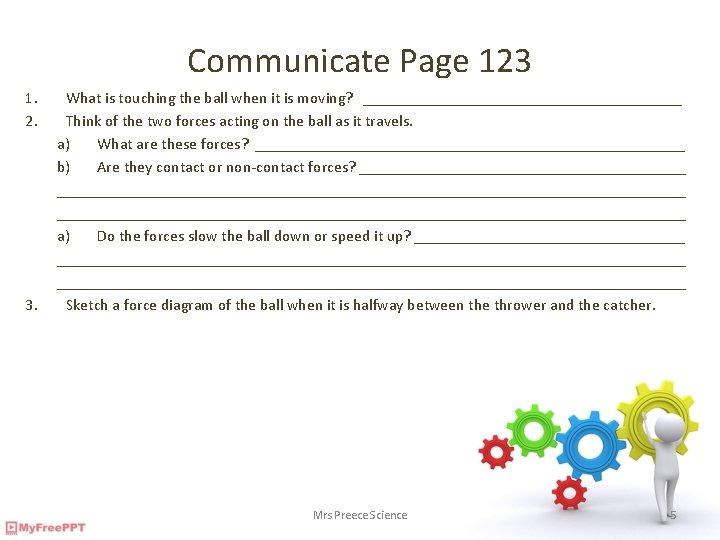
Communicate Page 123 1. 2. 3. What is touching the ball when it is moving? ____________________ Think of the two forces acting on the ball as it travels. a) What are these forces? ___________________________ b) Are they contact or non-contact forces? ____________________________________________________________ a) Do the forces slow the ball down or speed it up? _________________________________________________________ Sketch a force diagram of the ball when it is halfway between the thrower and the catcher. Mrs Preece Science 5
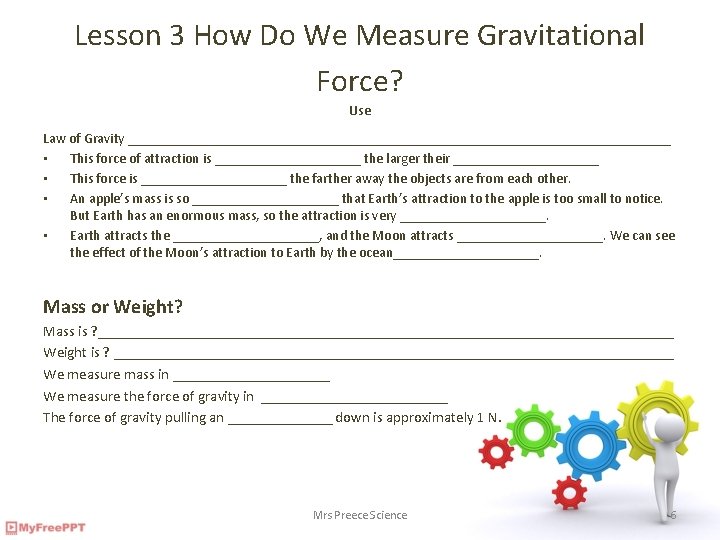
Lesson 3 How Do We Measure Gravitational Force? Use Law of Gravity _______________________________________ • This force of attraction is ___________ the larger their ___________ • This force is ___________ the farther away the objects are from each other. • An apple’s mass is so ___________ that Earth’s attraction to the apple is too small to notice. But Earth has an enormous mass, so the attraction is very ___________. • Earth attracts the ___________, and the Moon attracts ___________. We can see the effect of the Moon’s attraction to Earth by the ocean___________. Mass or Weight? Mass is ? _______________________________________ Weight is ? ______________________________________ We measure mass in ___________ We measure the force of gravity in _____________ The force of gravity pulling an _______ down is approximately 1 N. Mrs Preece Science 6
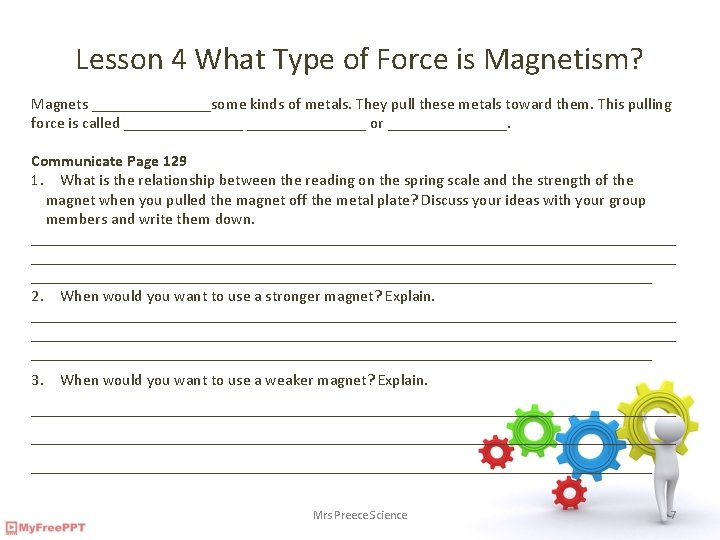
Lesson 4 What Type of Force is Magnetism? Magnets ________some kinds of metals. They pull these metals toward them. This pulling force is called _______________ or ________. Communicate Page 129 1. What is the relationship between the reading on the spring scale and the strength of the magnet when you pulled the magnet off the metal plate? Discuss your ideas with your group members and write them down. _________________________________________________________________________________ 2. When would you want to use a stronger magnet? Explain. _________________________________________________________________________________ 3. When would you want to use a weaker magnet? Explain. _________________________________________________________________________________ Mrs Preece Science 7

Lesson 5 What Type Of Force Is Friction Smart Board Lesson Mrs Preece Science 8
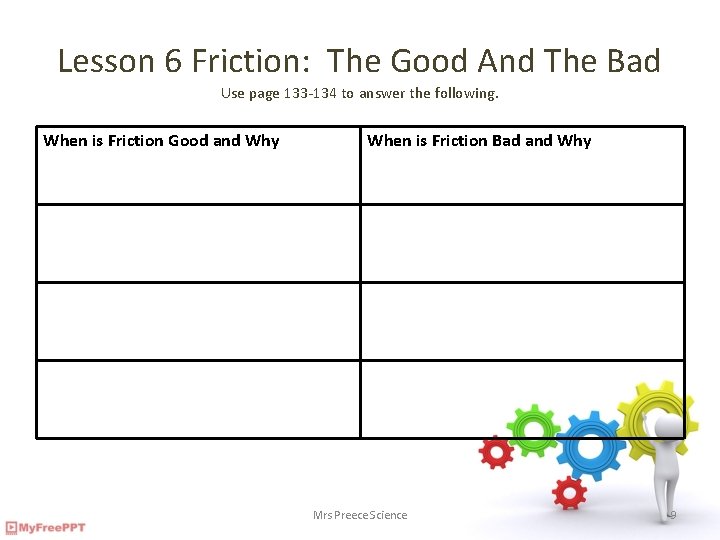
Lesson 6 Friction: The Good And The Bad Use page 133 -134 to answer the following. When is Friction Good and Why When is Friction Bad and Why Mrs Preece Science 9
Lesson 7 What Is A Simple Machine? Smart Board Lesson Mrs Preece Science 10

Lesson 8 How Do Simple Machines Lift Loads? Use page 138 -139 to complete the following. Simple machines help us apply _____. A Load is: ___________________________________ A Mechanical Advantage is: ____________________________ Mrs Preece Science 11
Lesson 9 How Do Levers Work? • Smartboard Lesson • Lever Song https: //www. youtube. com/watch? v=o. CP 2 kp. T R 4 Vc Mrs Preece Science 12
Lesson 11 How Do Wheels and Axles Work? Use page 148 -149 to complete Before the invention of the wheel and axle, people used _____to move heavy loads. The rollers helped reduce the force of _____ as objects were moved across them. 1. Which is bigger the wheel or the axle? ______________ 2. When you apply a force to the wheel and axle: a) which part move a greater distance? _____________ b) Which part moves a smaller distance? ____________ 3. Where is more force applied to the wheel or axle? _________ 4. An example of a wheel and axle is the ______. 5. Define what a gear is. __________________________________________________ Mrs Preece Science 14
Lesson 12 How Do Pulley Systems Work? • Smartboard Lesson Mrs Preece Science 15
Lesson 13 How Do Incline Planes Work? Use page 156 to complete 1. Does an incline plane move like a wheel or pulley? ___________ 2. Another name for an incline plane is _________________ 3. Where are two examples you can find incline planes? ______________________________ 4. What is the advantage to using an incline plane to move a heavy load? _______________________________________________________________ 5. What is the disadvantage to using an incline plane to move a heavy load? _______________________________________________________________ Mrs Preece Science 16
Lesson 14 How Do Wedges Work? Use page 158 to complete. • A wedge is really an _______________ turned on its side. • How do we use a wedge differently than an incline plane? _________________________________________ • Some examples of wedges are 1. 2. 3. 4. ________________________________ • What did First Nations and Metis people make their arrowheads from? ___________ • Explain what flint-knapping is. ________________________________ • What wedges do you use? __________________ • The narrower the wedge or sharper its point, the ______________you need to drive it into something. Mrs Preece Science 17
Lesson 15 Simple to Complex Use page 160 -161 • Simple machines are often _______ to make more complex mechanisms. • Most machines that we use every day are _______ machines. • Two examples of complex machines you might use every day are a ________ and a _________________. Both are a combination of a ________ and a ________. Mrs Preece Science 18
- Slides: 18