
Unit 3 Energy CHAPTER 4 What is energy
- Slides: 38
Unit 3: Energy CHAPTER 4
What is energy? Every change that occurs involves energy… Energy IS the ability to cause change.
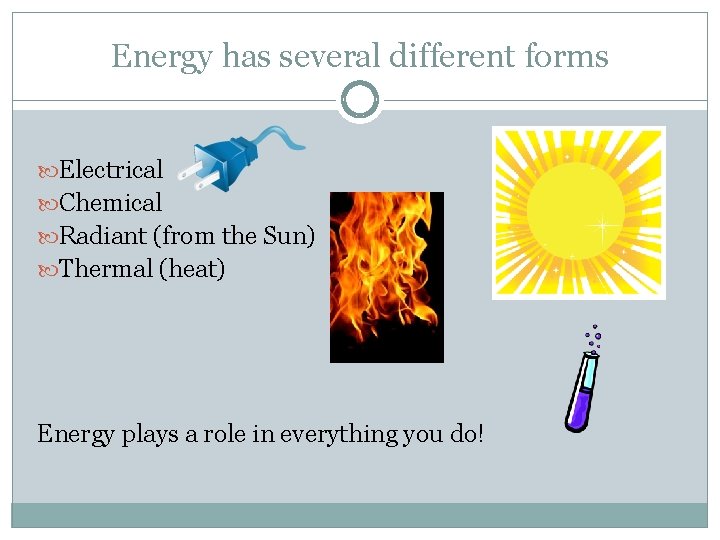
Energy has several different forms Electrical Chemical Radiant (from the Sun) Thermal (heat) Energy plays a role in everything you do!
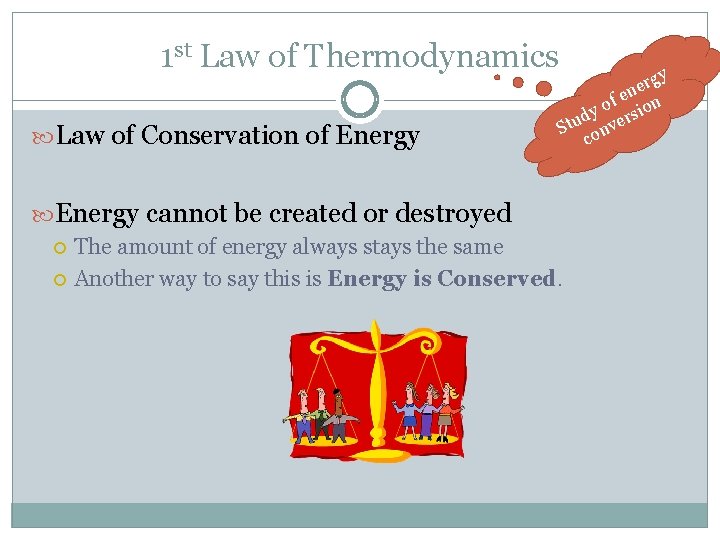
1 st Law of Thermodynamics Law of Conservation of Energy e f en on o dy ersi u t S onv c Energy cannot be created or destroyed The amount of energy always stays the same Another way to say this is Energy is Conserved.
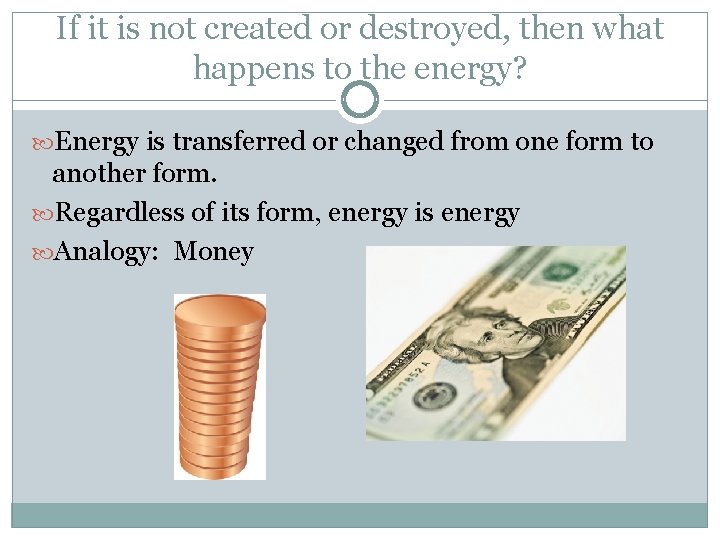
If it is not created or destroyed, then what happens to the energy? Energy is transferred or changed from one form to another form. Regardless of its form, energy is energy Analogy: Money
Transforming Energy Electrical Energy Ex: Lightbulb transforms electrical energy into light so we can see. Other examples?
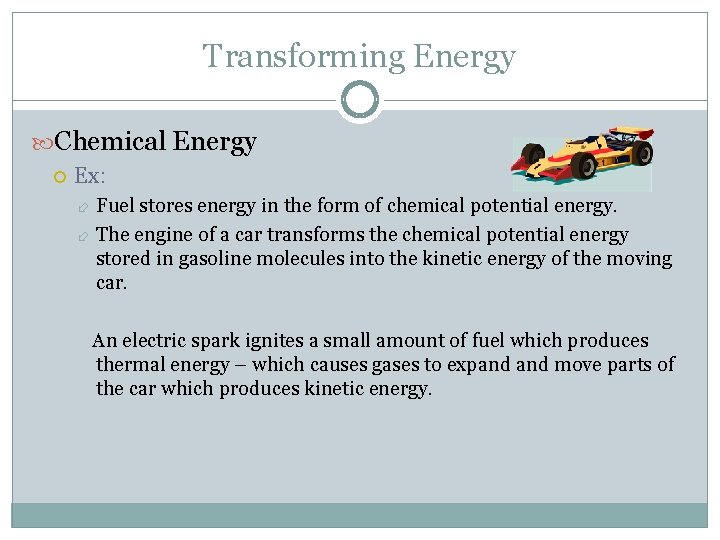
Transforming Energy Chemical Energy Ex: Fuel stores energy in the form of chemical potential energy. The engine of a car transforms the chemical potential energy stored in gasoline molecules into the kinetic energy of the moving car. An electric spark ignites a small amount of fuel which produces thermal energy – which causes gases to expand move parts of the car which produces kinetic energy.
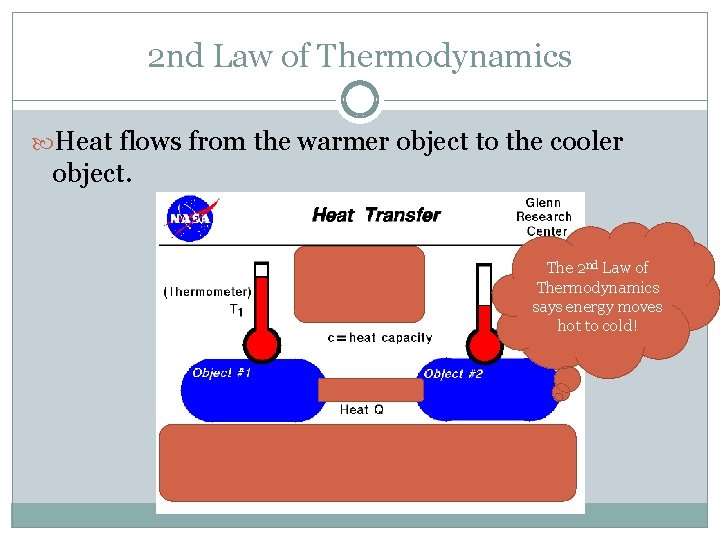
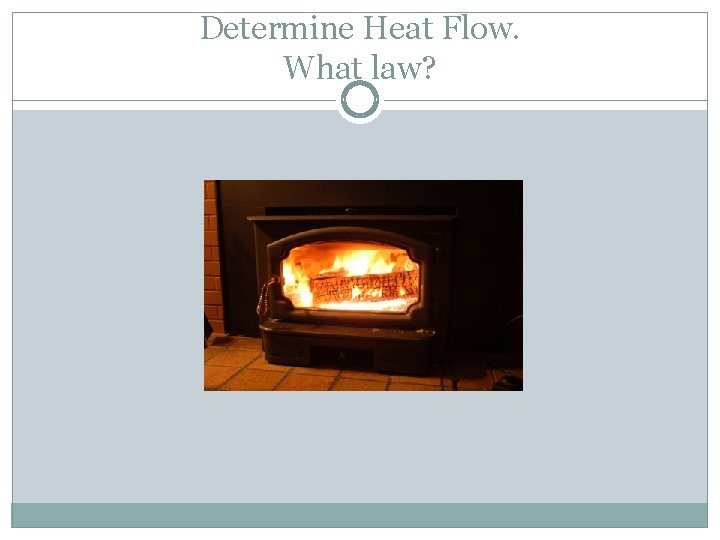
2 nd Law of Thermodynamics Heat flows from the warmer object to the cooler object. The 2 nd Law of Thermodynamics says energy moves hot to cold!
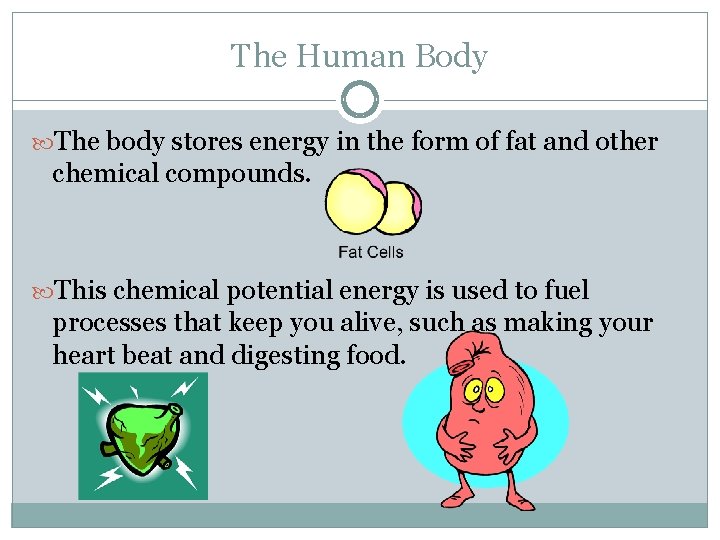
The Human Body The body stores energy in the form of fat and other chemical compounds. This chemical potential energy is used to fuel processes that keep you alive, such as making your heart beat and digesting food.
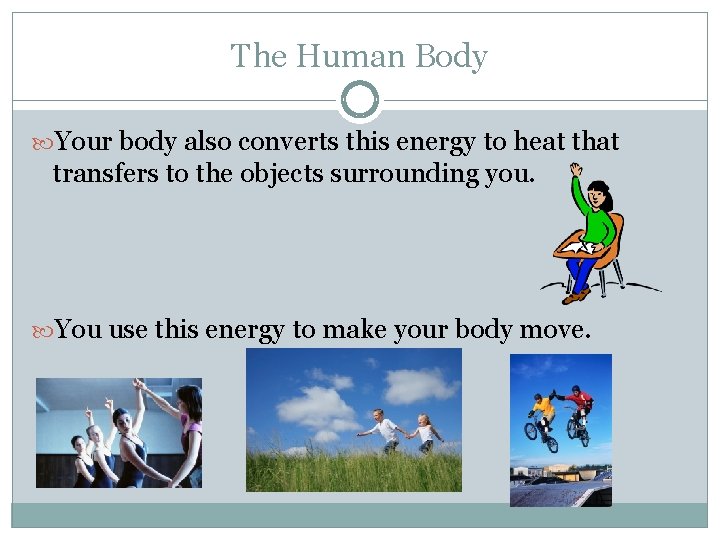
The Human Body Your body also converts this energy to heat that transfers to the objects surrounding you. You use this energy to make your body move.
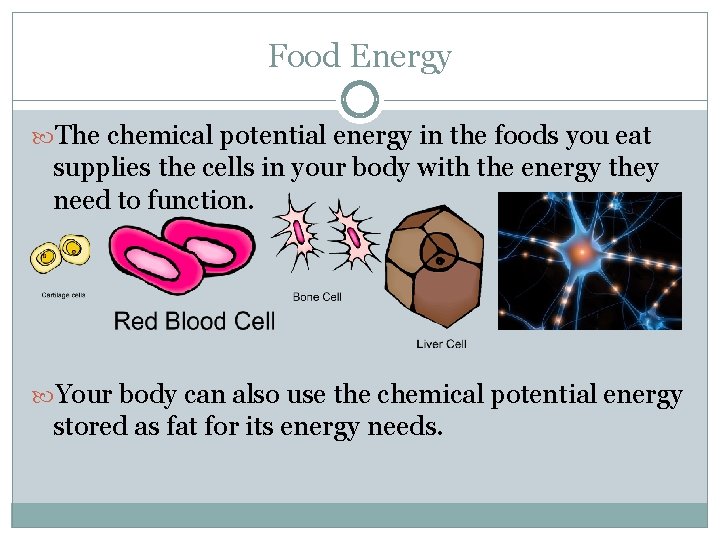
Food Energy The chemical potential energy in the foods you eat supplies the cells in your body with the energy they need to function. Your body can also use the chemical potential energy stored as fat for its energy needs.
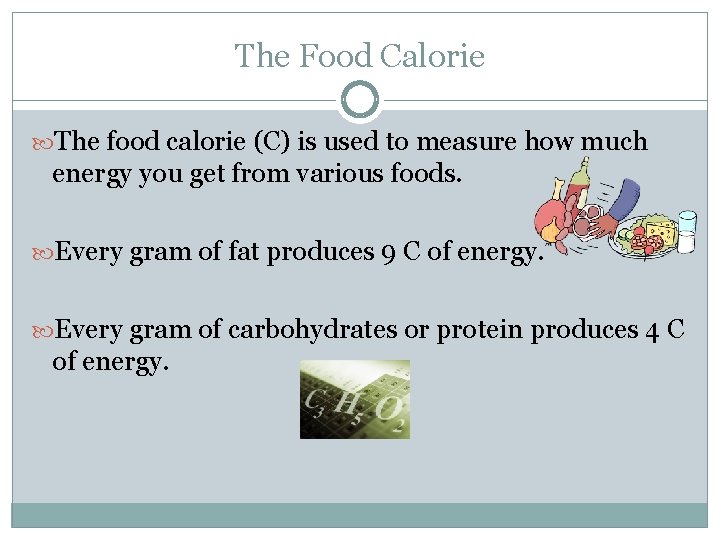
The Food Calorie The food calorie (C) is used to measure how much energy you get from various foods. Every gram of fat produces 9 C of energy. Every gram of carbohydrates or protein produces 4 C of energy.
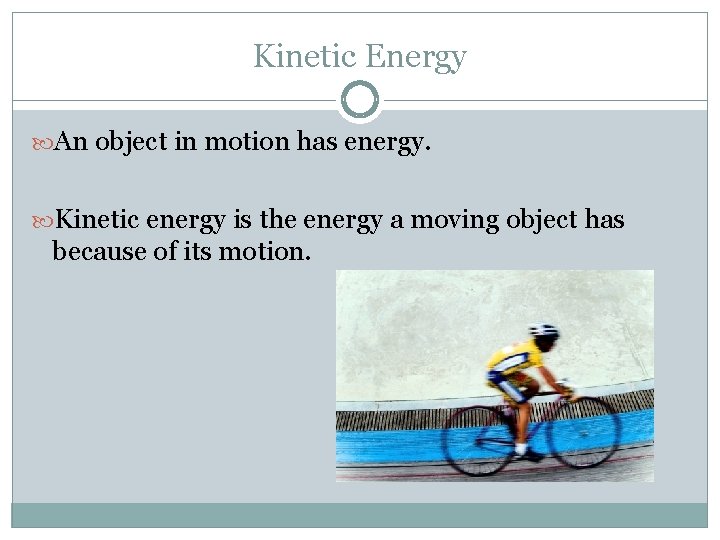
Kinetic Energy An object in motion has energy. Kinetic energy is the energy a moving object has because of its motion.
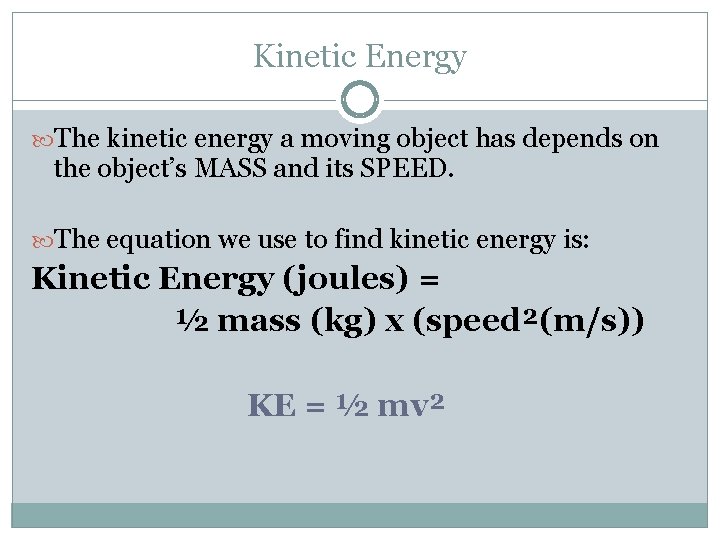
Kinetic Energy The kinetic energy a moving object has depends on the object’s MASS and its SPEED. The equation we use to find kinetic energy is: Kinetic Energy (joules) = ½ mass (kg) x (speed²(m/s)) KE = ½ mv²
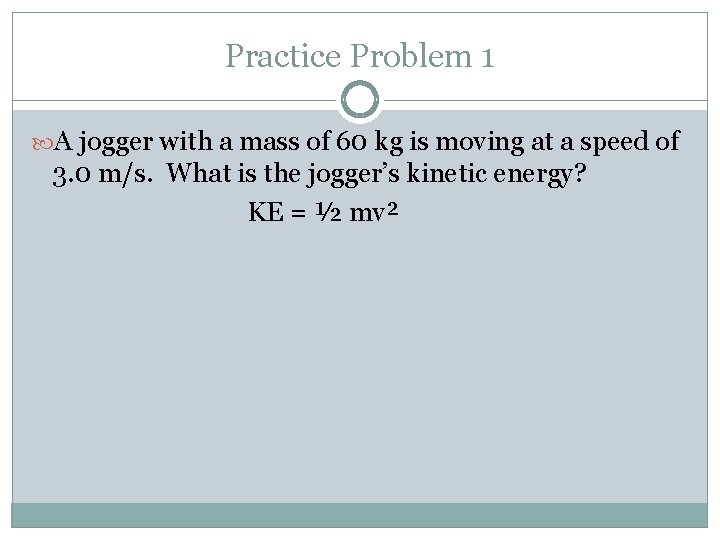
Practice Problem 1 A jogger with a mass of 60 kg is moving at a speed of 3. 0 m/s. What is the jogger’s kinetic energy? KE = ½ mv²
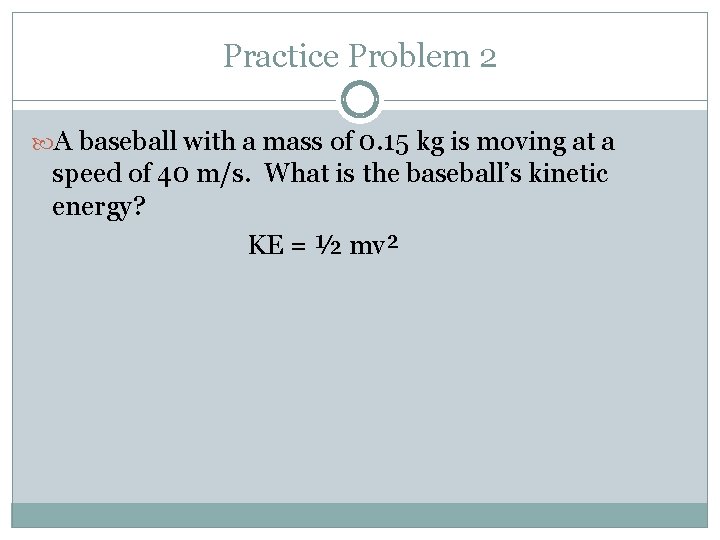
Practice Problem 2 A baseball with a mass of 0. 15 kg is moving at a speed of 40 m/s. What is the baseball’s kinetic energy? KE = ½ mv²
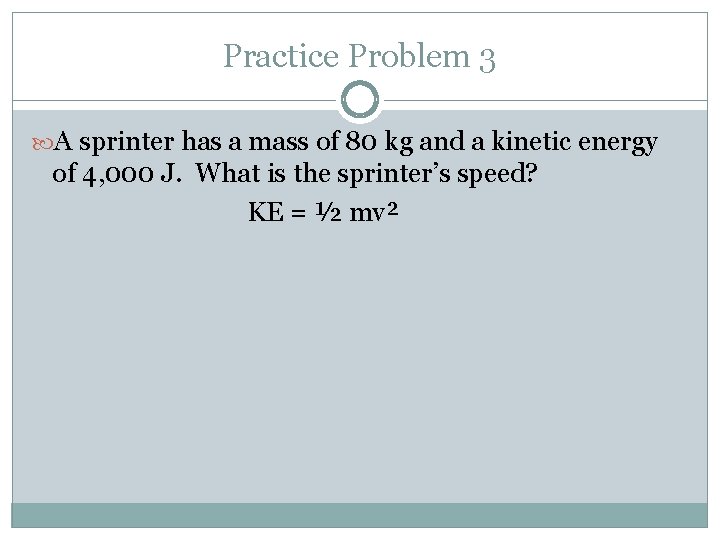
Practice Problem 3 A sprinter has a mass of 80 kg and a kinetic energy of 4, 000 J. What is the sprinter’s speed? KE = ½ mv²
Potential Energy Motionless objects can have energy. This energy is STORED in the object and is said to have the POTENTIAL to cause change = POTENTIAL ENERGY!!!
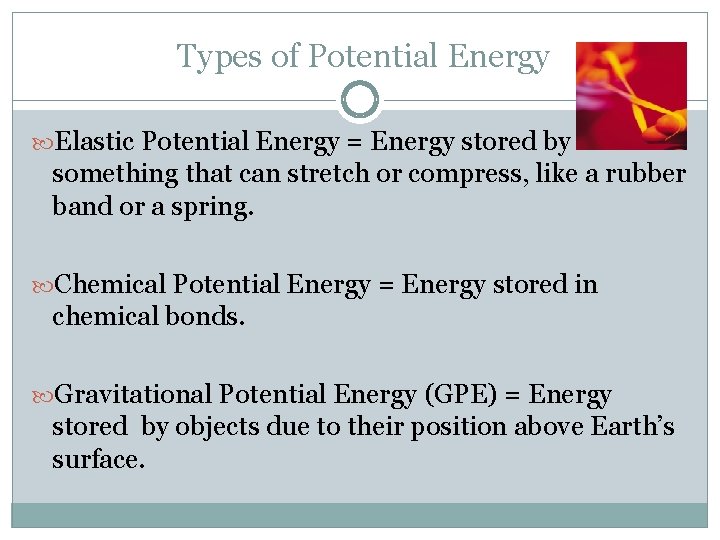
Types of Potential Energy Elastic Potential Energy = Energy stored by something that can stretch or compress, like a rubber band or a spring. Chemical Potential Energy = Energy stored in chemical bonds. Gravitational Potential Energy (GPE) = Energy stored by objects due to their position above Earth’s surface.
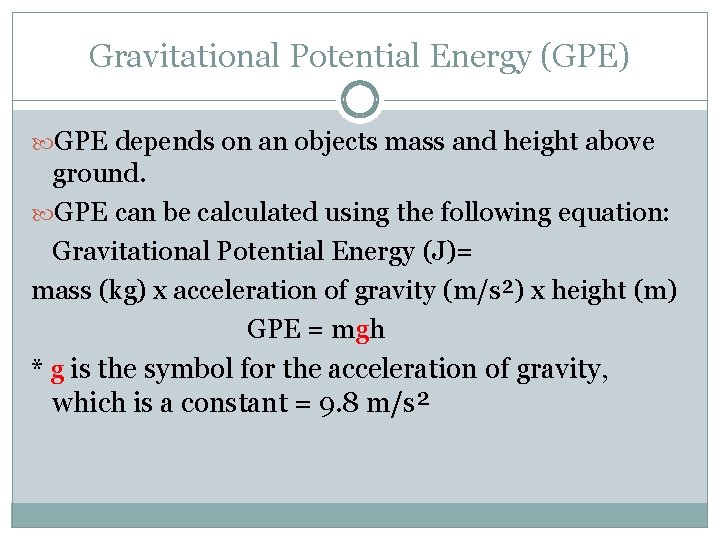
Gravitational Potential Energy (GPE) GPE depends on an objects mass and height above ground. GPE can be calculated using the following equation: Gravitational Potential Energy (J)= mass (kg) x acceleration of gravity (m/s²) x height (m) GPE = mgh * g is the symbol for the acceleration of gravity, which is a constant = 9. 8 m/s²
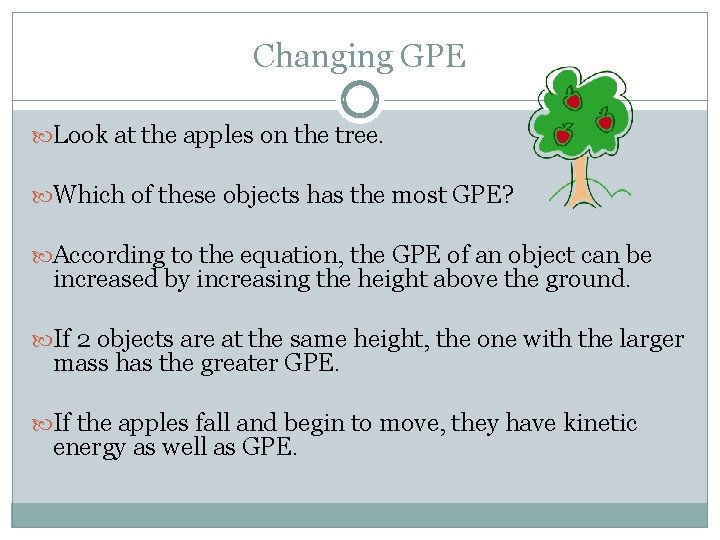
Changing GPE Look at the apples on the tree. Which of these objects has the most GPE? According to the equation, the GPE of an object can be increased by increasing the height above the ground. If 2 objects are at the same height, the one with the larger mass has the greater GPE. If the apples fall and begin to move, they have kinetic energy as well as GPE.
Practice Problem 1 What is the gravitational potential energy of a ceiling fan that has a mass of 7. 0 kg and is 4. 0 m above the ground?
Practice Problem 2 Find the GPE of a coffee mug with a mass of 0. 3 kg that is on a countertop 1. 0 m high above the ground.
Practice Problem 3 How high above the ground is a baseball with a mass of 0. 15 kg that has a GPE of 73. 5 J?
Conversions Between Kinetic and Potential Energy Many situations involve conversions between Kinetic and Potential Energy. Examples? To understand the energy conversions that occur, it is helpful to identify the mechanical energy of a system.
Mechanical Energy The total amount of potential and kinetic energy of a system. Due to the position and motion of an object Mechanical Energy = Potential Energy + Kinetic Energy
Falling Objects An apple hanging from the tree has GPE due to gravity. The instant the apple falls from the tree it accelerates due to gravity, causing it to lose height therefore losing GPE. The potential energy is converted into kinetic energy as the velocity increases. Since the potential energy is converted into kinetic energy, the mechanical energy of the apple stays the same.
Falling Objects THE FORM OF ENERGY CHANGES, BUT THE TOTAL AMOUNT OF ENERGY STAYS THE SAME!!!
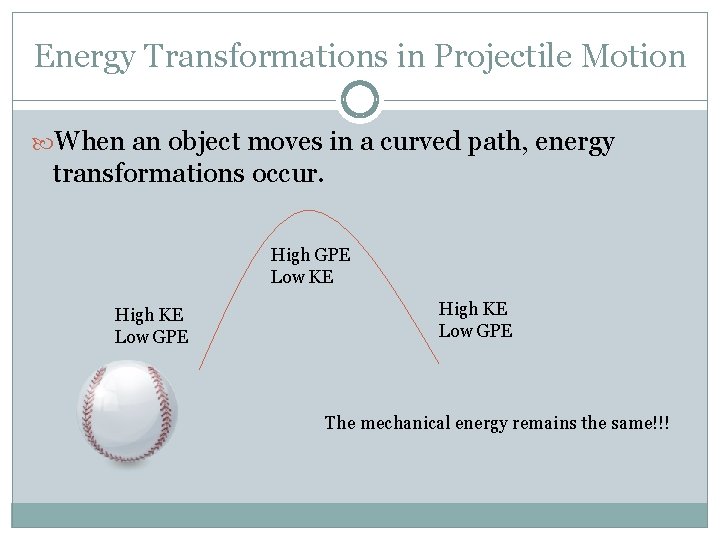
Energy Transformations in Projectile Motion When an object moves in a curved path, energy transformations occur. High GPE Low KE High KE Low GPE The mechanical energy remains the same!!!
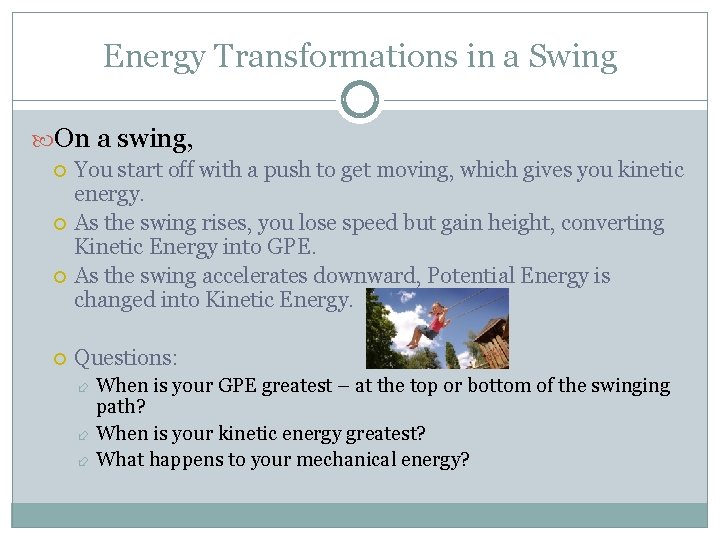
Energy Transformations in a Swing On a swing, You start off with a push to get moving, which gives you kinetic energy. As the swing rises, you lose speed but gain height, converting Kinetic Energy into GPE. As the swing accelerates downward, Potential Energy is changed into Kinetic Energy. Questions: When is your GPE greatest – at the top or bottom of the swinging path? When is your kinetic energy greatest? What happens to your mechanical energy?
The Effect of Friction and Air resistance cause some mechanical energy to change to thermal energy. Ex: Swing If you stop pumping your legs or being pushed, you will eventually come to a stop. What happened to the energy? Friction is produced between the chains and hooks Air effects the rider The temperature of the hooks and the air increases a little with each pass, converting the kinetic energy into thermal energy. Energy is not destroyed!
Converting Mass Into Energy Nuclear fusion Takes place in the Sun and other stars During this process a small amount of mass is converted into a tremendous amount of energy. This is how the Sun unleashes enough energy to light and warm the Earth.
Nuclear Fission Involves the nuclei of atoms Converts a small amount of mass into enormous quantities of energy In this process, nuclei of atoms are broken apart
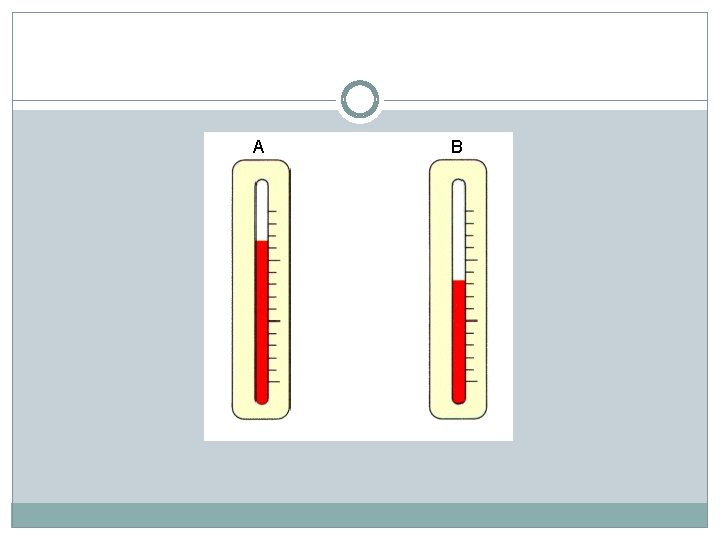
Determine Heat Flow. What law?
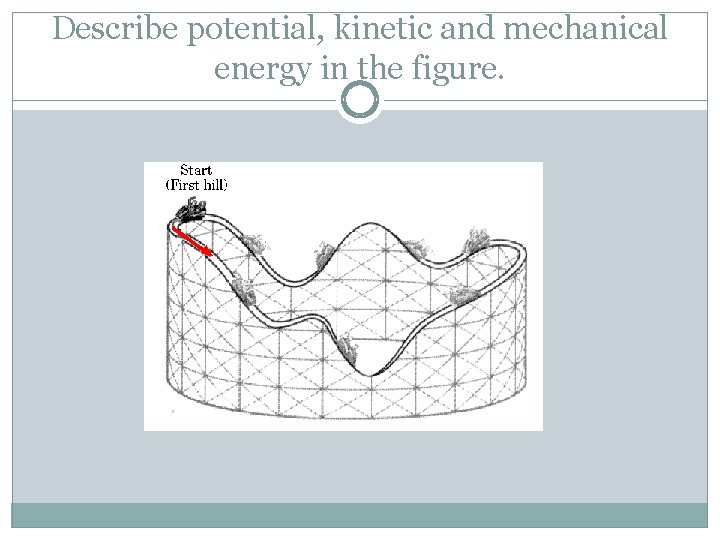
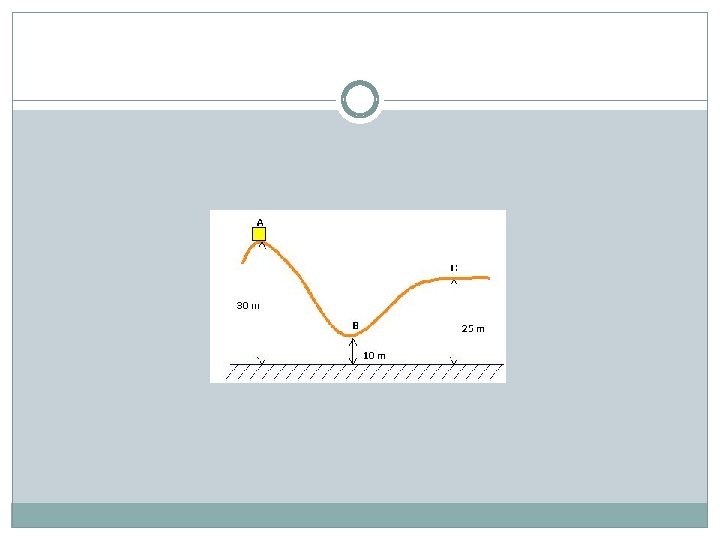
Describe potential, kinetic and mechanical energy in the figure.
A B