
UNIT 3 ELECTRICITY Unit 3 Electricity Ordinary matter


- Slides: 18
UNIT 3: ELECTRICITY
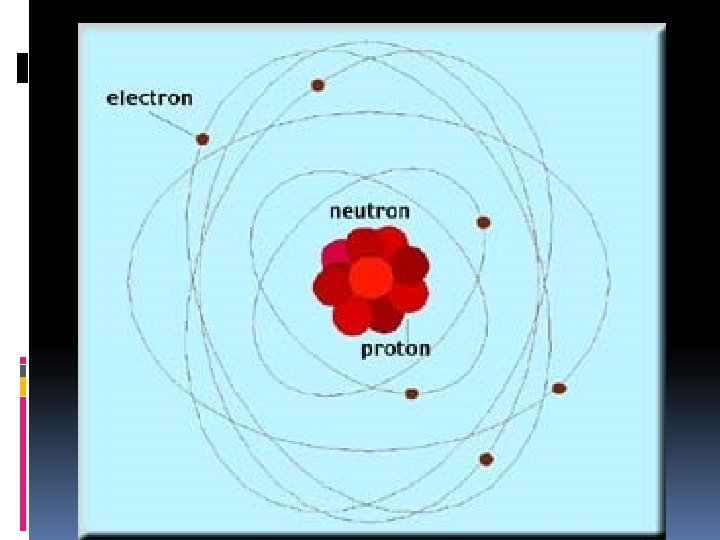
Unit 3 - Electricity Ordinary matter is made up of atoms which have protons and electrons. The magnitude of the charge on one proton or electron is called the elementary charge "e". Charge is quantized as a multiple of the electron or proton charge: e=1. 602 x 10 -19 Coulombs electron charge: e=-1. 602 x 10 -19 Coulombs
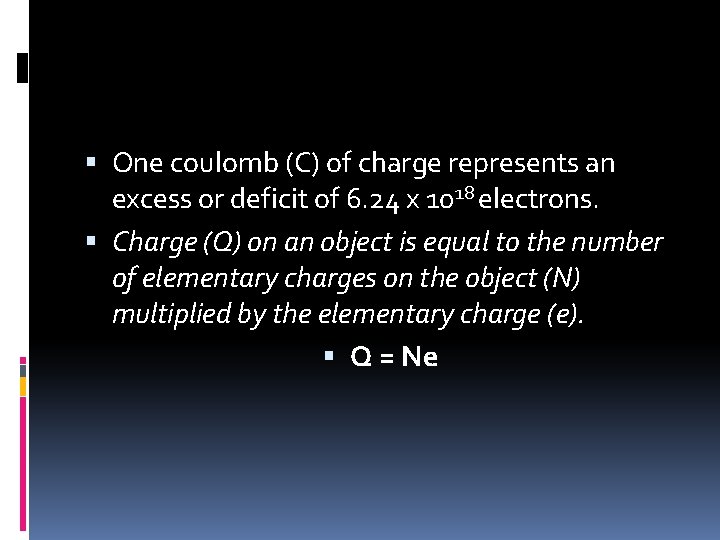
One coulomb (C) of charge represents an excess or deficit of 6. 24 x 1018 electrons. Charge (Q) on an object is equal to the number of elementary charges on the object (N) multiplied by the elementary charge (e). Q = Ne
Example 1: How much charge does the capacitor hold if it has 4. 5 billion elementary charges?
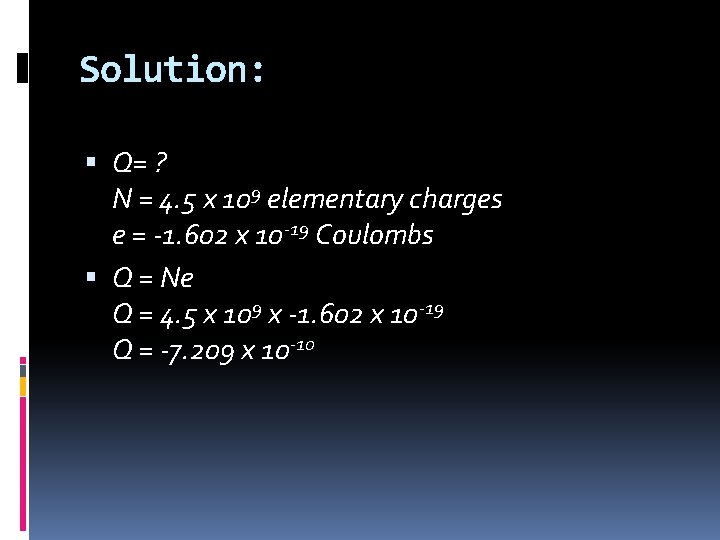
Solution: Q= ? N = 4. 5 x 10⁹ elementary charges e = -1. 602 x 10 -19 Coulombs Q = Ne Q = 4. 5 x 10⁹ x -1. 602 x 10 -19 Q = -7. 209 x 10 -10
Example 2: If an object has 4 coulombs of charge stored, how many elementary charges are present?
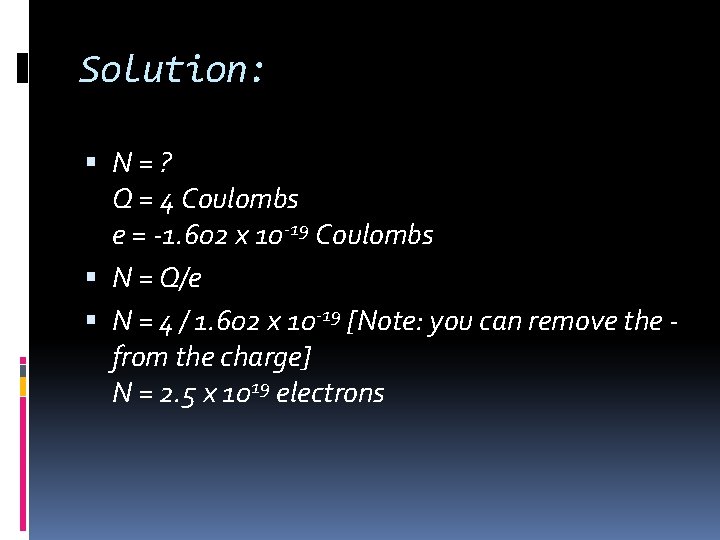
Solution: N=? Q = 4 Coulombs e = -1. 602 x 10 -19 Coulombs N = Q/e N = 4 / 1. 602 x 10 -19 [Note: you can remove the from the charge] N = 2. 5 x 10¹⁹ electrons
Example 3 How many electrons must be removed from an charged pair of wool socks with a -1µC charge to give it a charge of +2. 3 µC?
Solution: Qi= -1µC (Excess electrons) Qf= +2. 3µC (Deficit electrons) N=? e = -1. 602 x 10 -19 Coulombs Qt = Qf – Qi; Qt = +2. 3µC - (-1µC) Qt = +2. 3µC + 1µC Qt = +3. 3µC N = Q/e N = 3. 3 x 10 -4 / -1. 602 x 10 -19 N = 2. 05 x 1015 electrons
Fundamental Law of Electric Charge: 1. Opposite electric charges attract each other. 2. Similar electric charges repel each other. 3. Charged object attract some neutral object. Clip at http: //www. saskschools. ca/curr_content/ph ysics 30/elect/lessoniii_2_1. html
Current Electricity An electric charge in motion Consists of a swarm of moving electrons When electrons move from one location to another, they produce an electrical current Electricity flows through wires as water flows through pipes
Units for current I= Q/t (I= current(A), Q= charge(c), t=time(s) Measured in Amperes (A) 1 ampere of current flows when 1 coulomb of charge moves by a point in 1 second (about 6. 3 billion electrons per second) 1 A= 1 C/1 S
Types of currents Direct current (DC): involves the continous flow of electrons in the SAME direction Alternating current (AC): involves periodic reversal in the direction of electron flow
Reading current Current is read using an ammeter, it must be hooked directly into the current to make measurements
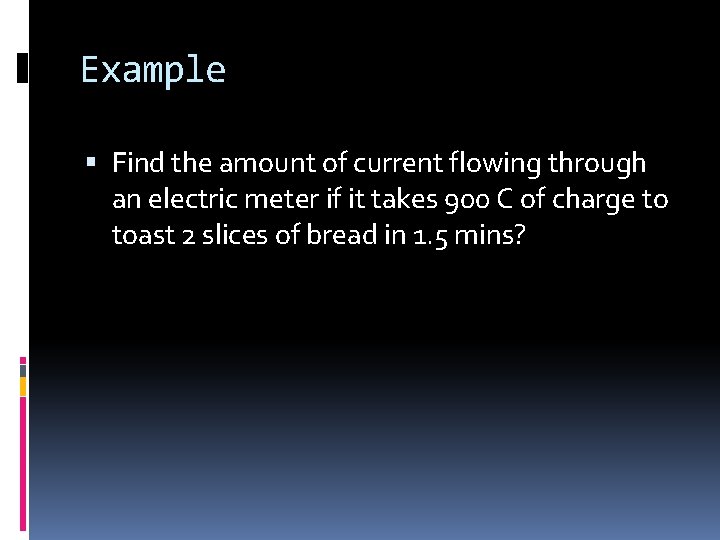
Example Find the amount of current flowing through an electric meter if it takes 900 C of charge to toast 2 slices of bread in 1. 5 mins?
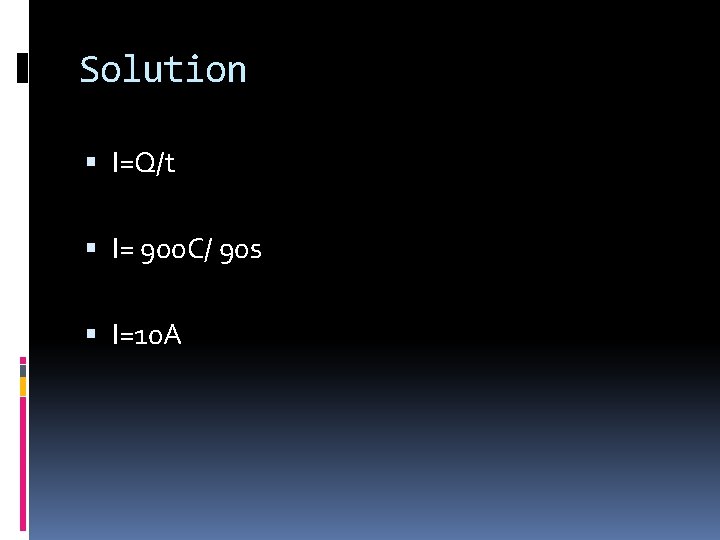
Solution I=Q/t I= 900 C/ 90 s I=10 A
Assignment: current and potential difference questions