
UNIT 3 Earth and its Resources As a
- Slides: 23
UNIT 3 Earth and its Resources
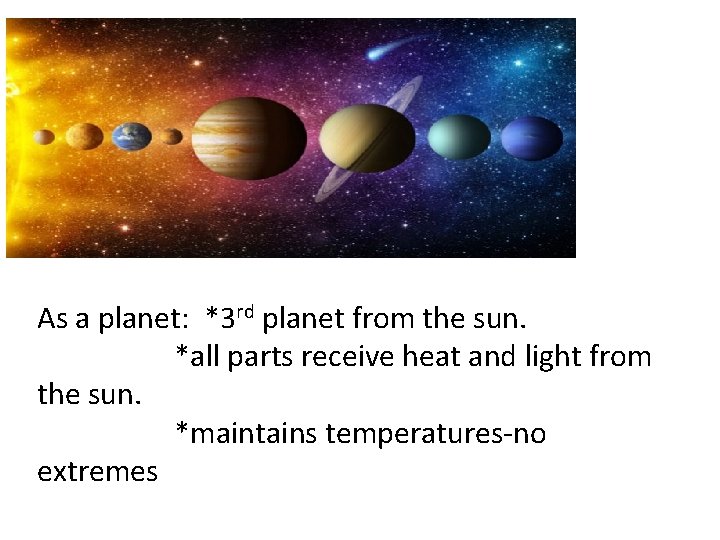
As a planet: *3 rd planet from the sun. *all parts receive heat and light from the sun. *maintains temperatures-no extremes
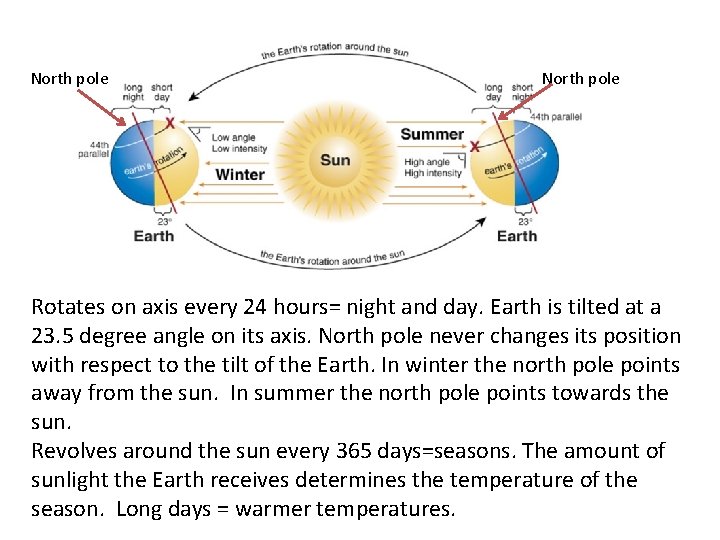
North pole Rotates on axis every 24 hours= night and day. Earth is tilted at a 23. 5 degree angle on its axis. North pole never changes its position with respect to the tilt of the Earth. In winter the north pole points away from the sun. In summer the north pole points towards the sun. Revolves around the sun every 365 days=seasons. The amount of sunlight the Earth receives determines the temperature of the season. Long days = warmer temperatures.
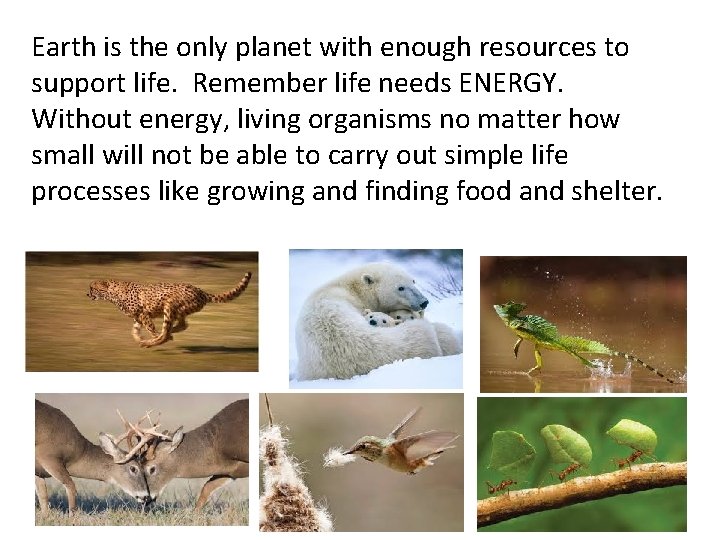
Earth is the only planet with enough resources to support life. Remember life needs ENERGY. Without energy, living organisms no matter how small will not be able to carry out simple life processes like growing and finding food and shelter.
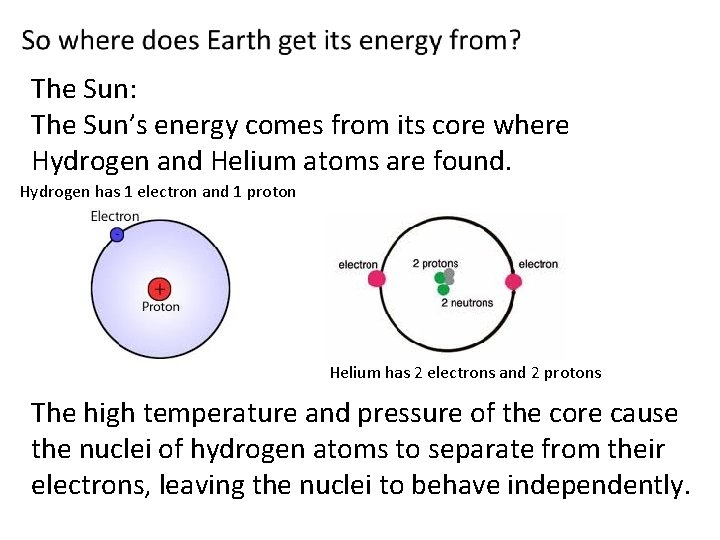
The Sun: The Sun’s energy comes from its core where Hydrogen and Helium atoms are found. Hydrogen has 1 electron and 1 proton Helium has 2 electrons and 2 protons The high temperature and pressure of the core cause the nuclei of hydrogen atoms to separate from their electrons, leaving the nuclei to behave independently.
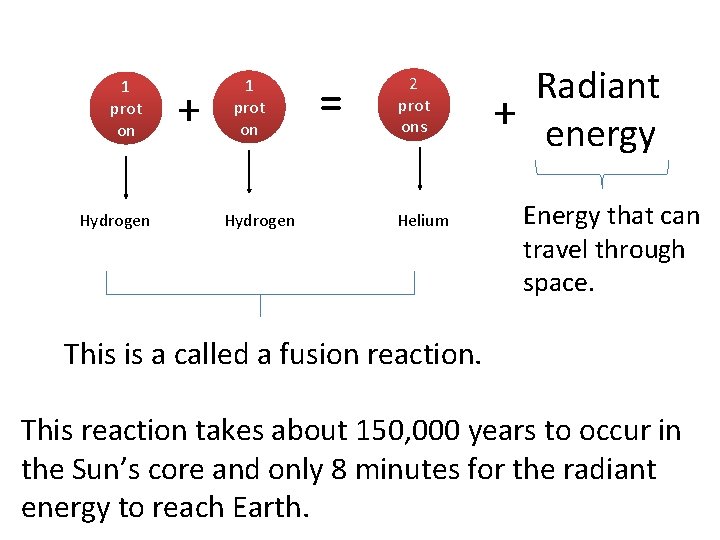
1 prot on Hydrogen + 1 prot on Hydrogen = 2 prot ons Helium + Radiant energy Energy that can travel through space. This is a called a fusion reaction. This reaction takes about 150, 000 years to occur in the Sun’s core and only 8 minutes for the radiant energy to reach Earth.
This radiant energy supplies a large amount of energy directly to the Earth. It warms our land oceans and maintains the Earth’s temperature. The sun is also the source for many different forms of energy. Solar energy powers the water cycle, allowing us to harness the energy of moving water. Solar energy drives wind formation, allowing us to use wind turbines to transform kinetic energy into electricity. Plants use solar energy in the process of photosynthesis. Even fossil fuels originally received their energy from the sun.
But the Sun’s energy is not enough. Living things also Need water and gases. Water – where did it come from? It came from 2 Sources: 1. When hot rock cooled steam was produced which produced precipitation. The rain fell and gathered in low lying areas to create the oceans. 2. When Comets and meteors made of ice hit the Earth and then melted, water was added to the Earth’s surface. Earth is the only planet known to have enough water to support life – 70% water. Oceans remain because of temperature and water cycle.
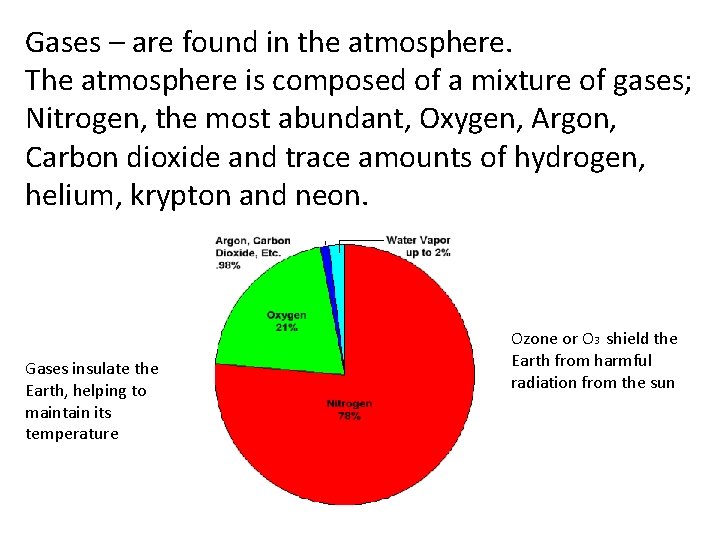
Gases – are found in the atmosphere. The atmosphere is composed of a mixture of gases; Nitrogen, the most abundant, Oxygen, Argon, Carbon dioxide and trace amounts of hydrogen, helium, krypton and neon. Gases insulate the Earth, helping to maintain its temperature Ozone or O 3 shield the Earth from harmful radiation from the sun
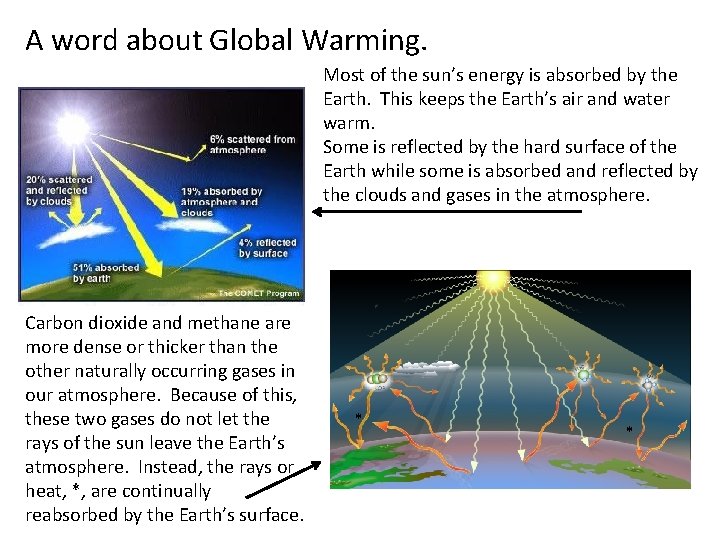
A word about Global Warming. Most of the sun’s energy is absorbed by the Earth. This keeps the Earth’s air and water warm. Some is reflected by the hard surface of the Earth while some is absorbed and reflected by the clouds and gases in the atmosphere. Carbon dioxide and methane are more dense or thicker than the other naturally occurring gases in our atmosphere. Because of this, these two gases do not let the rays of the sun leave the Earth’s atmosphere. Instead, the rays or heat, *, are continually reabsorbed by the Earth’s surface. * *
Natural resources are any materials made in nature that humans use for their life functions. Examples are: water, sun, wind, animals, minerals, stone, soil, plants, fossil fuels. Some are renewable, meaning when it is used its supply is replenished. The supply is replaced by natural processes, usually as quickly as they are used. Some are nonrenewable, meaning when it is used there isn’t anymore. These are not replaced and are used faster than they can be replaced.
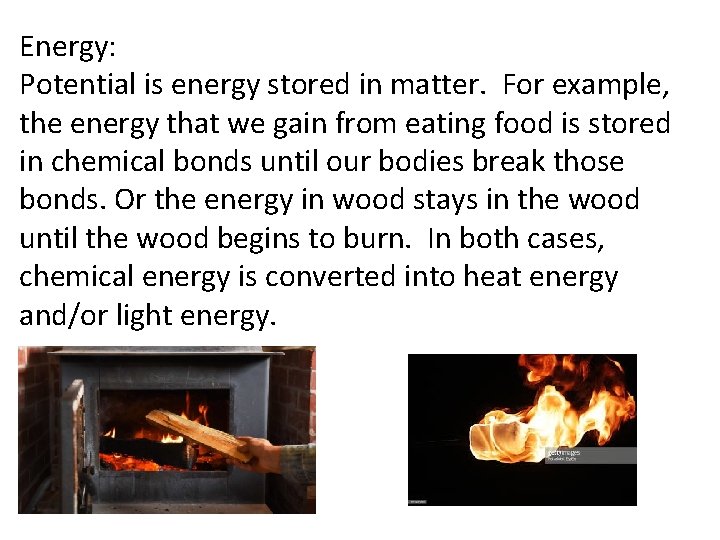
Energy: Potential is energy stored in matter. For example, the energy that we gain from eating food is stored in chemical bonds until our bodies break those bonds. Or the energy in wood stays in the wood until the wood begins to burn. In both cases, chemical energy is converted into heat energy and/or light energy.
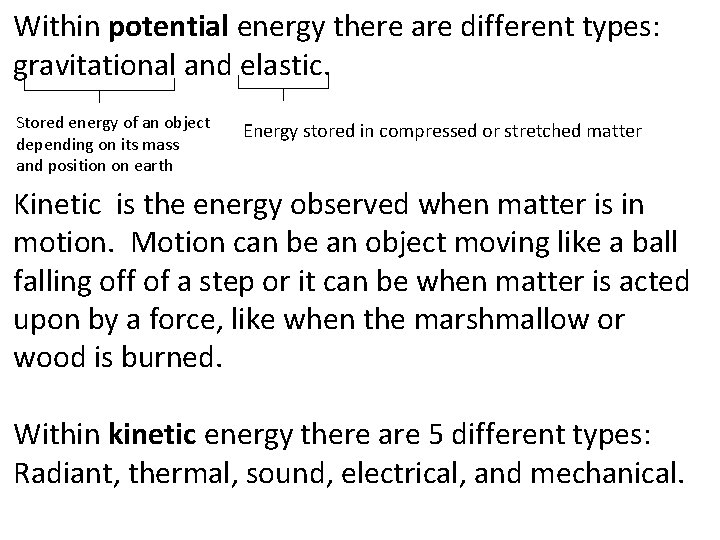
Within potential energy there are different types: gravitational and elastic. Stored energy of an object depending on its mass and position on earth Energy stored in compressed or stretched matter Kinetic is the energy observed when matter is in motion. Motion can be an object moving like a ball falling off of a step or it can be when matter is acted upon by a force, like when the marshmallow or wood is burned. Within kinetic energy there are 5 different types: Radiant, thermal, sound, electrical, and mechanical.
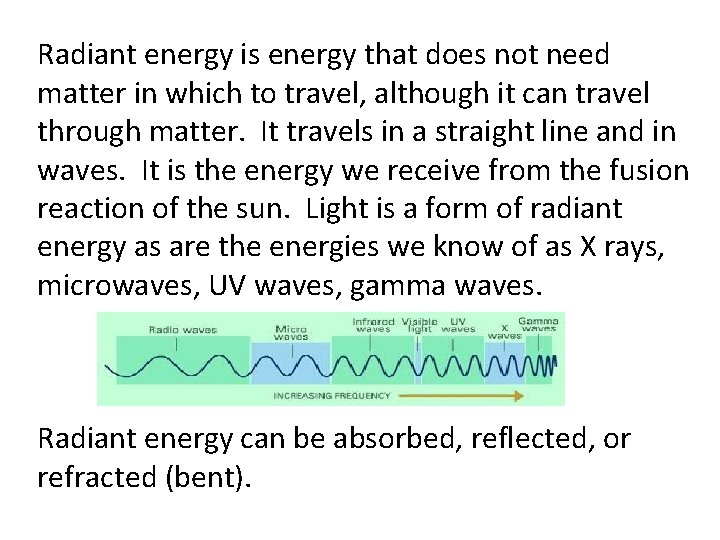
Radiant energy is energy that does not need matter in which to travel, although it can travel through matter. It travels in a straight line and in waves. It is the energy we receive from the fusion reaction of the sun. Light is a form of radiant energy as are the energies we know of as X rays, microwaves, UV waves, gamma waves. Radiant energy can be absorbed, reflected, or refracted (bent).
Thermal energy is energy that is observed as heat that is released. Sound energy is produced when matter vibrates. It has probably the lowest magnitude of energy of all. Electrical energy is the movement of electrons from one place to another. Mechanical energy is the energy observed when objects do work.
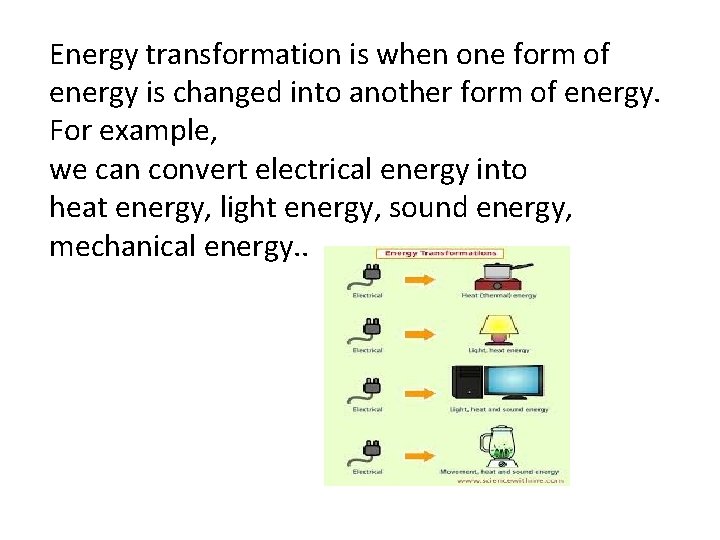
Energy transformation is when one form of energy is changed into another form of energy. For example, we can convert electrical energy into heat energy, light energy, sound energy, mechanical energy. .
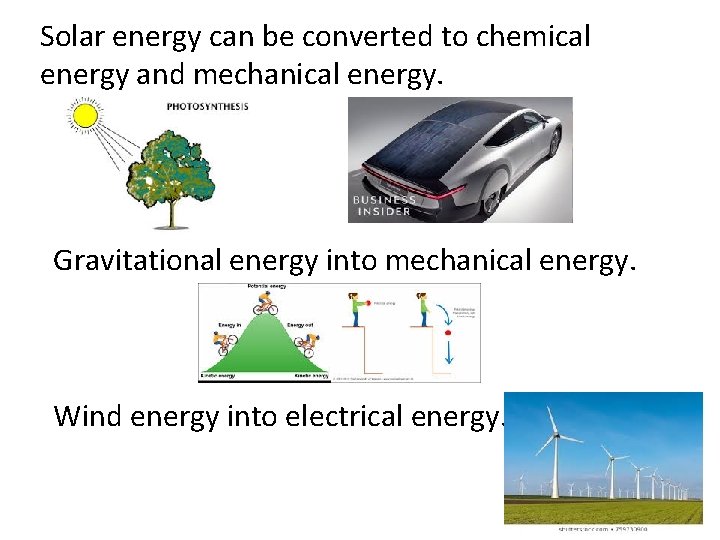
Solar energy can be converted to chemical energy and mechanical energy. Gravitational energy into mechanical energy. Wind energy into electrical energy.
https: //www. ck 12. org/earth-science/fossil-fuel-formation/lesson/Fossil-Fuel. Formation Non-renewable sources of energy: Fossil fuel: at one time fossil fuel was very abundant. As seen in the video, these fuels were made when plants, sometimes microscopic plants, died and decayed and got buried in the Earth’s layers, predominantly sedimentary rock and shale. High pressure and temperature changed the carbon and hydrogen in these organisms into fossil fuels. Decaying wood gave us coal and algae gave us oil and together they gave us natural gas.
Oil, natural gas and coal give us energy when they are burned. But they also give us plastics, foam, ink, and even bubble gum. Why are they good to use: it is a cheap source of energy it is extremely efficient But why are they bad to use: drilling for oil disrupts natural habitats water and air (smog) are polluted lowers the water table – ground water oil spills increases the level of carbon dioxide and methane in the atmosphere.
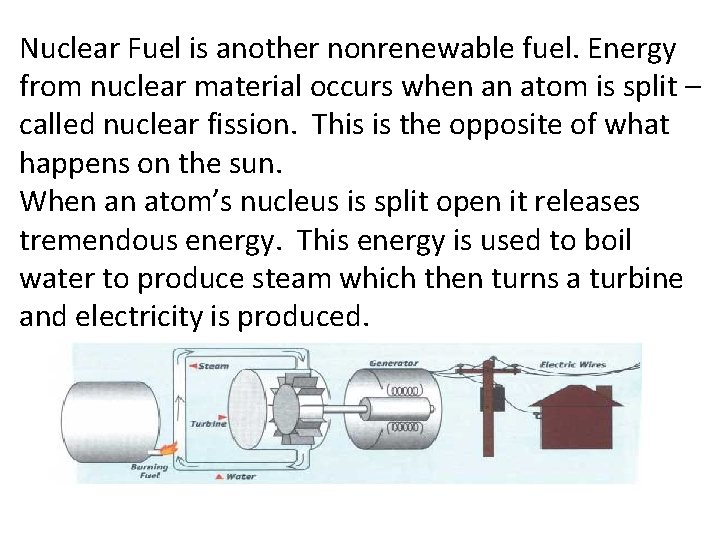
Nuclear Fuel is another nonrenewable fuel. Energy from nuclear material occurs when an atom is split – called nuclear fission. This is the opposite of what happens on the sun. When an atom’s nucleus is split open it releases tremendous energy. This energy is used to boil water to produce steam which then turns a turbine and electricity is produced.
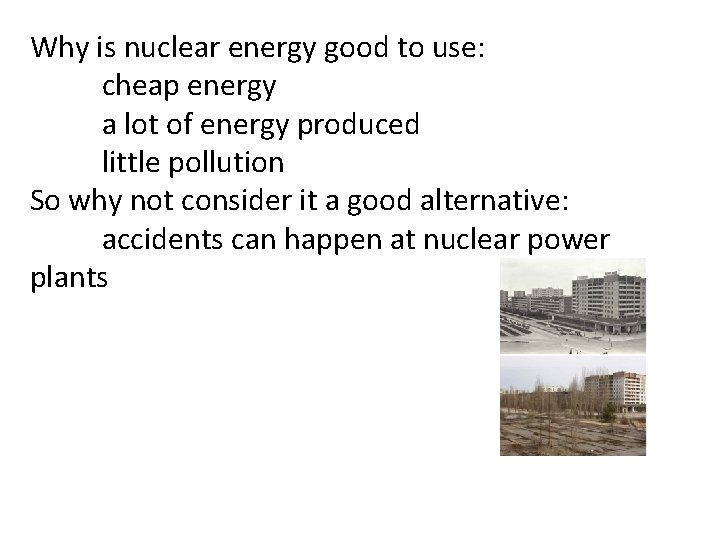
Why is nuclear energy good to use: cheap energy a lot of energy produced little pollution So why not consider it a good alternative: accidents can happen at nuclear power plants
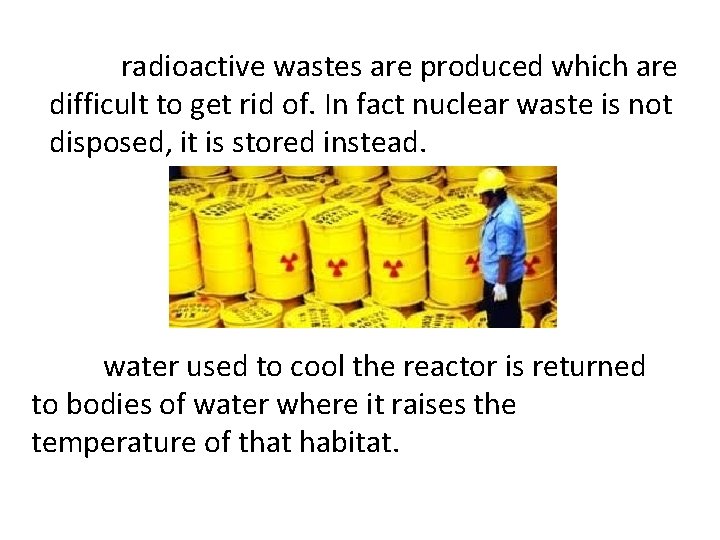
radioactive wastes are produced which are difficult to get rid of. In fact nuclear waste is not disposed, it is stored instead. water used to cool the reactor is returned to bodies of water where it raises the temperature of that habitat.
Renewable energy – energy from sources that are replaced as quickly as they are used. Solar, wind, hydroelectric, geothermal, hydrogen, and biomass. Why are these good sources of energy? they do not pollute they do not disrupt habitats they are renewable What are the limits to using these as energy? they are all expensive to use, initially.