
Unit 3 Developmental Psych Day 2 Piaget Vygotsky


- Slides: 27
Unit 3: Developmental Psych Day 2: Piaget & Vygotsky • Essential Question – How do humans develop physically, cognitively, and socially throughout the lifespan? • Objectives (write this down!): – I can: distinguish between and assess Piaget’s stages of cognitive development • ON YOUR DESKS: – Notes on Ratey from yesterday – RJ 3. 3 – Late MS essays? ? ? • DAILY COMMENTARY (in a spiral notebook!): – What is cognitive Development. Cite examples of different cognitive stages.
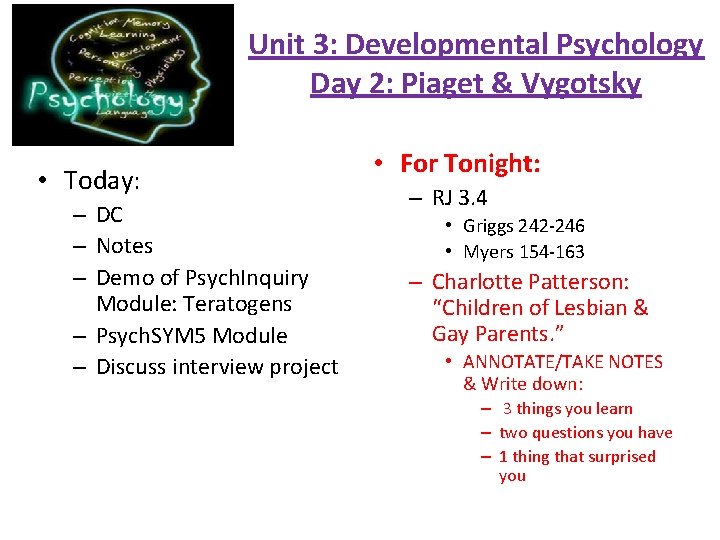
Unit 3: Developmental Psychology Day 2: Piaget & Vygotsky • Today: – DC – Notes – Demo of Psych. Inquiry Module: Teratogens – Psych. SYM 5 Module – Discuss interview project • For Tonight: – RJ 3. 4 • Griggs 242 -246 • Myers 154 -163 – Charlotte Patterson: “Children of Lesbian & Gay Parents. ” • ANNOTATE/TAKE NOTES & Write down: – 3 things you learn – two questions you have – 1 thing that surprised you
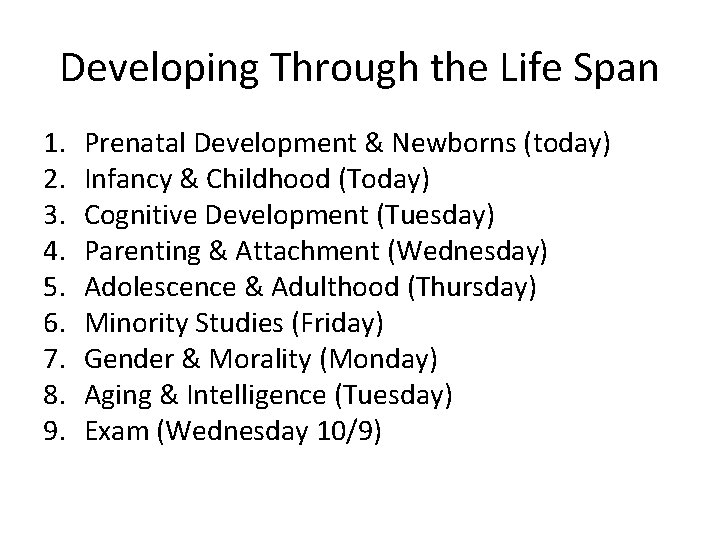
Developing Through the Life Span 1. 2. 3. 4. 5. 6. 7. 8. 9. Prenatal Development & Newborns (today) Infancy & Childhood (Today) Cognitive Development (Tuesday) Parenting & Attachment (Wednesday) Adolescence & Adulthood (Thursday) Minority Studies (Friday) Gender & Morality (Monday) Aging & Intelligence (Tuesday) Exam (Wednesday 10/9)
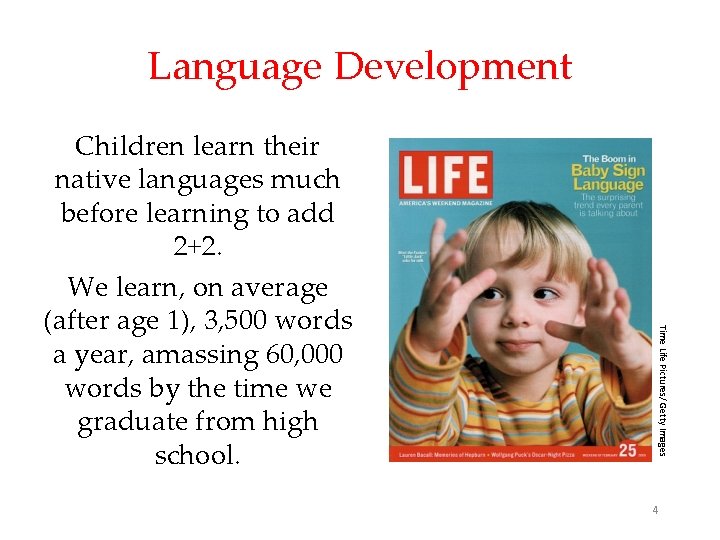
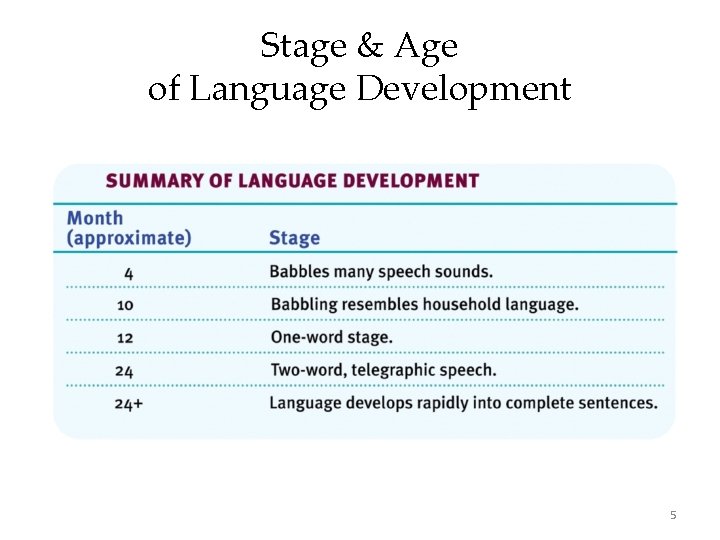
Language Development Time Life Pictures/ Getty Images Children learn their native languages much before learning to add 2+2. We learn, on average (after age 1), 3, 500 words a year, amassing 60, 000 words by the time we graduate from high school. 4
Stage & Age of Language Development 5
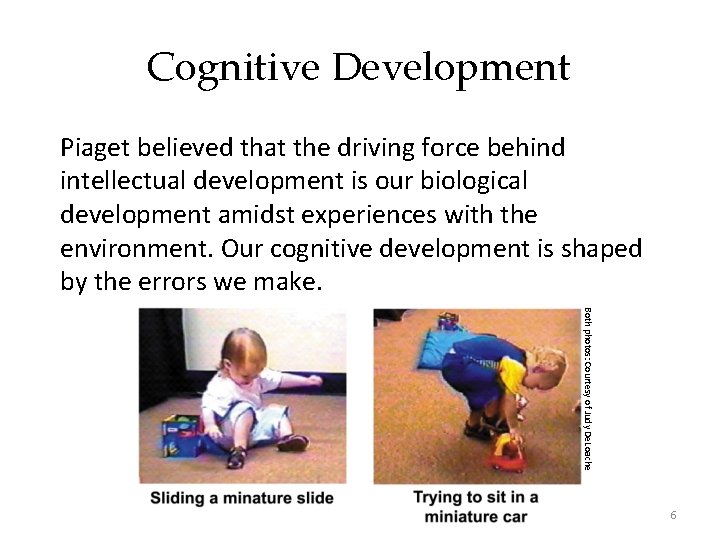
Cognitive Development Piaget believed that the driving force behind intellectual development is our biological development amidst experiences with the environment. Our cognitive development is shaped by the errors we make. Both photos: Courtesy of Judy De. Loache 6
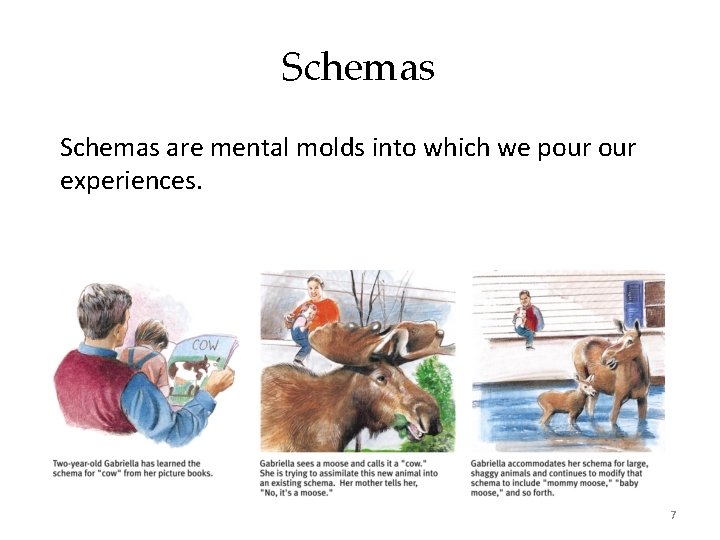
Schemas are mental molds into which we pour experiences. 7
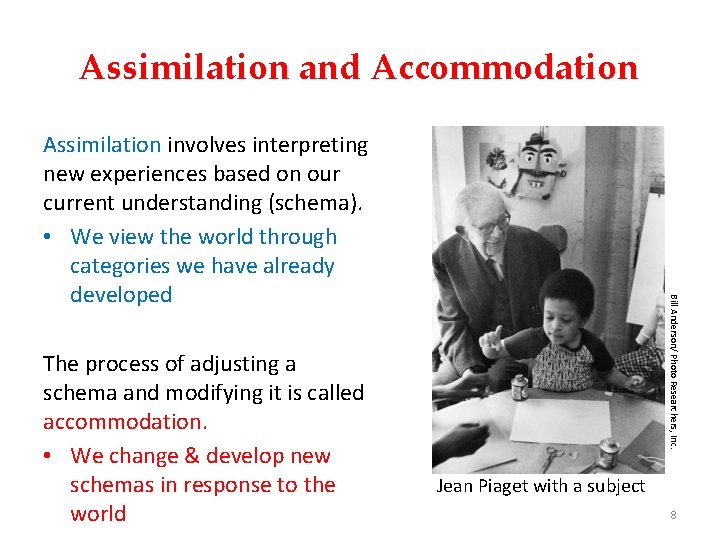
Assimilation and Accommodation The process of adjusting a schema and modifying it is called accommodation. • We change & develop new schemas in response to the world Bill Anderson/ Photo Researchers, Inc. Assimilation involves interpreting new experiences based on our current understanding (schema). • We view the world through categories we have already developed Jean Piaget with a subject 8
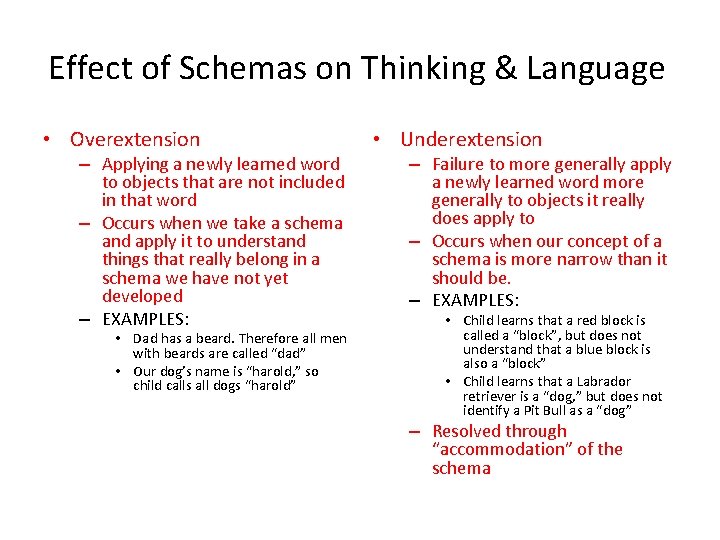
Effect of Schemas on Thinking & Language • Overextension – Applying a newly learned word to objects that are not included in that word – Occurs when we take a schema and apply it to understand things that really belong in a schema we have not yet developed – EXAMPLES: • Dad has a beard. Therefore all men with beards are called “dad” • Our dog’s name is “harold, ” so child calls all dogs “harold” • Underextension – Failure to more generally apply a newly learned word more generally to objects it really does apply to – Occurs when our concept of a schema is more narrow than it should be. – EXAMPLES: • Child learns that a red block is called a “block”, but does not understand that a blue block is also a “block” • Child learns that a Labrador retriever is a “dog, ” but does not identify a Pit Bull as a “dog” – Resolved through “accommodation” of the schema
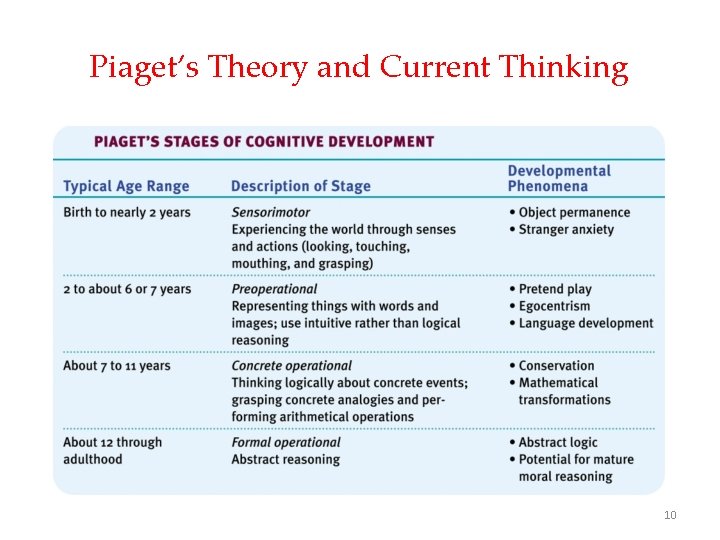
Piaget’s Theory and Current Thinking 10
Piaget Clips & Practice • Piaget Meets Santa
Unit 3: Developmental Psych Day 2: Piaget & Vygotsky (Continued) • Essential Question – How do humans develop physically, cognitively, and socially throughout the lifespan? • Objectives (write this down!): – I can: distinguish between and assess Piaget’s stages of cognitive development • ON YOUR DESKS: – Notes on Patterson Article – RJ 3. 3 (late) & 3. 4 (on time) – Late MS essays? ? ? • DAILY COMMENTARY (in a spiral notebook!): – Give examples demonstrating each of Piaget’s four stages of cognitive development.
Unit 3: Developmental Psychology Day 2: Piaget & Vygotsky • Today: – DC – Discussion of Pattreson Article – Psych. SYM 5 Module – Interview Project Planning • For Tonight: – RJ 3. 4 • Griggs 242 -246 • Myers 154 -163 – Charlotte Patterson: “Children of Lesbian & Gay Parents. ” • ANNOTATE/TAKE NOTES & Write down: – 3 things you learn – two questions you have – 1 thing that surprised you
Psych. Sym 5 Module 1. Complete “Cognitive Development” module – KNOW PIAGET!!!!! 2. As you work, complete the “How Knowing Changes” graphic organizer/practice sheet 3. Done early? Develop questions for interview project.
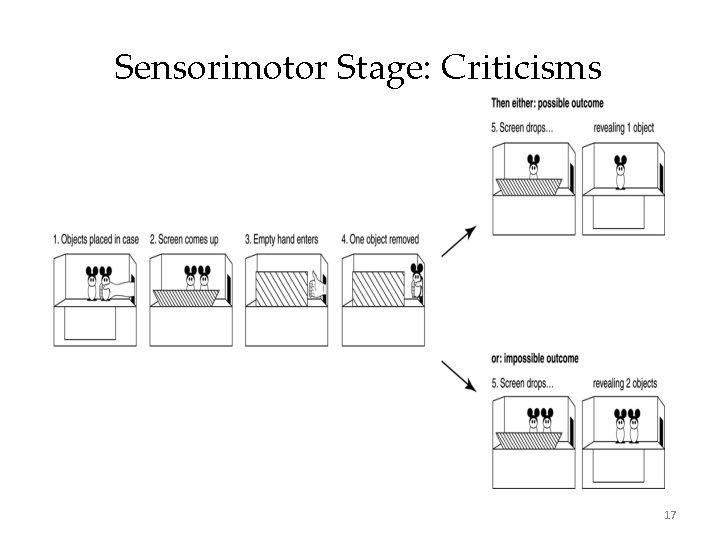
Sensorimotor Stage: Criticisms Piaget believed children in the sensorimotor stage could not think —they do not have any abstract concepts or ideas. However, recent research shows that children in the sensorimotor stage can think and count. 1. Children understand the basic laws of physics. They are amazed at how a ball can stop in midair or disappear. 16
Sensorimotor Stage: Criticisms 2. Children can also count. Wynn (1992, 2000) showed that children stared longer at the wrong number of objects than the right ones. 17
Preoperational Stage: Criticism De. Loache (1987) showed that children as young as 3 years of age are able to use mental operations. When shown a model of a dog’s hiding place behind the couch, a 2½year-old could not locate the stuffed dog in an actual room, but the 3 -year-old did. 18
Egocentrism Piaget concluded that preschool children are egocentric. They cannot perceive things from another’s point of view. When asked to show her picture to mommy, 2 -year-old Gabriella holds the picture facing her own eyes, believing that her mother can see it through her eyes. 19
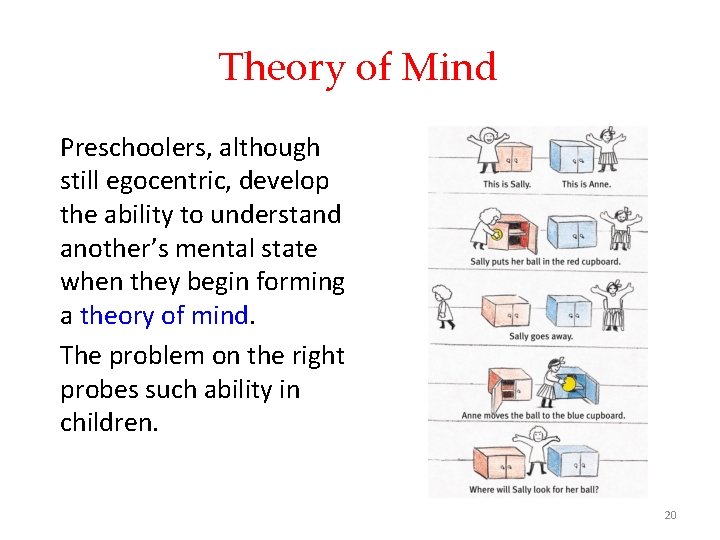
Theory of Mind Preschoolers, although still egocentric, develop the ability to understand another’s mental state when they begin forming a theory of mind. The problem on the right probes such ability in children. 20
Concrete Operational Stage In concrete operational stage, given concrete materials, 6 - to 7 -year-olds grasp conservation problems and mentally pour liquids back and forth into glasses of different shapes conserving their quantities. Children in this stage are also able to transform mathematical functions. So, if 4 + 8 = 12, then a transformation, 12 – 4 = 8, is also easily doable. 21
Formal Operational Stage Around age 12, our reasoning ability expands from concrete thinking to abstract thinking. We can now use symbols and imagined realities to systematically reason. Piaget called this formal operational thinking. 22
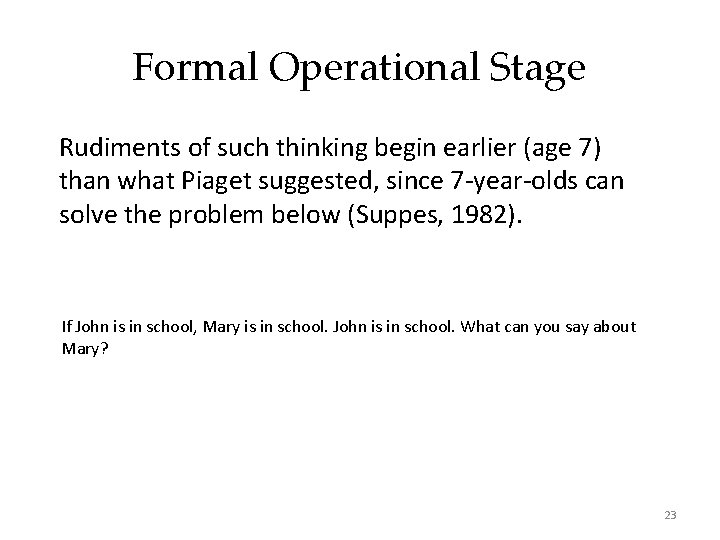
Formal Operational Stage Rudiments of such thinking begin earlier (age 7) than what Piaget suggested, since 7 -year-olds can solve the problem below (Suppes, 1982). If John is in school, Mary is in school. John is in school. What can you say about Mary? 23
Reflecting on Piaget’s Theory Piaget’s stage theory has been influential globally, validating a number of ideas regarding growth and development in many cultures and societies. However, today’s researchers believe the following: 1. Development is a continuous process. 2. Children express their mental abilities and operations at an earlier age. 3. Formal logic is a smaller part of cognition. 24
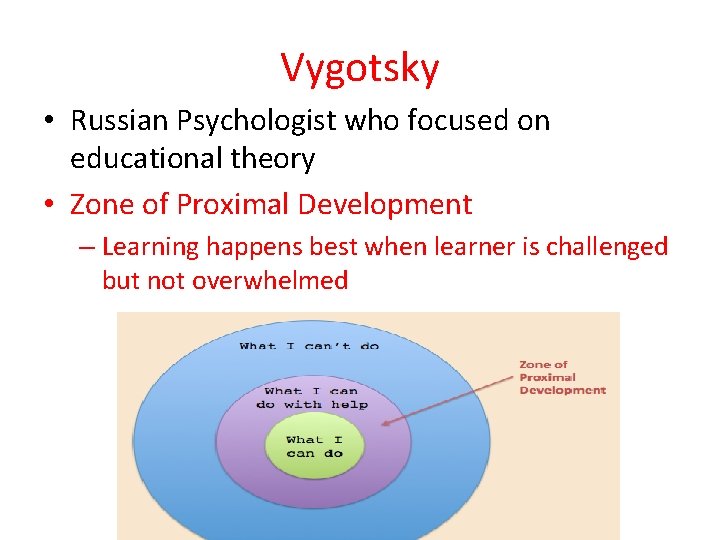
Vygotsky • Russian Psychologist who focused on educational theory • Zone of Proximal Development – Learning happens best when learner is challenged but not overwhelmed
Interview Project 1. Develop questions for interview project. – Make sure Mr. G-G has seen and approved them 2. Make a plan for who you will interview.
Unit 3: Developmental Psychology Day 2: Piaget & Vygotsky • Today: – DC – Notes – Demo of Psych. Inquiry Module: Teratogens – Psych. SYM 5 Module – Discuss interview project • For Tonight: – RJ 3. 4 • Griggs 242 -246 • Myers 154 -163 – Charlotte Patterson: “Children of Lesbian & Gay Parents. ” • ANNOTATE/TAKE NOTES & Write down: – 3 things you learn – two questions you have – 1 thing that surprised you