
Unit 3 Chapter 5 Cells The smallest functional

- Slides: 27
Unit 3: Chapter 5 - Cells The smallest functional unit of life.
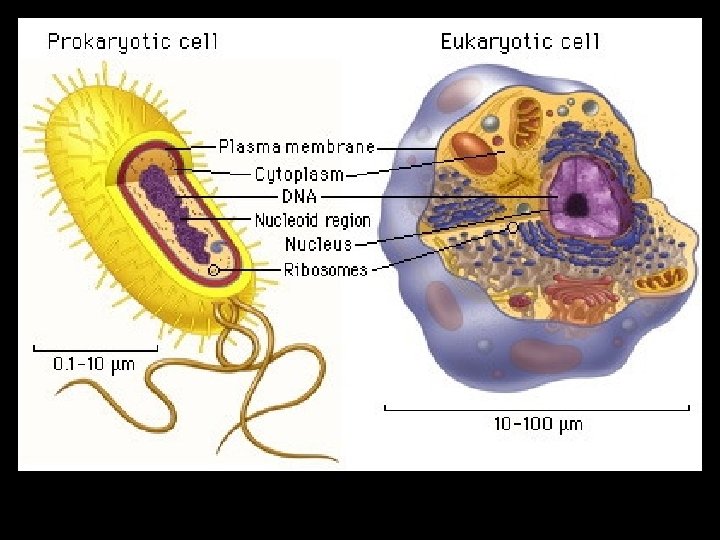
A. Types of Cells 1. __________ – Prokaryotes cells that ___________ surrounded by ____________________ no true ______, but they do have ______ smaller in size, less complex ex: bacteria 2. ___________ – Eukaryotes cells containing _______________ surrounded by _____________________ these are the cells you are familiar with because __________. have _________; specialized chemical reactions
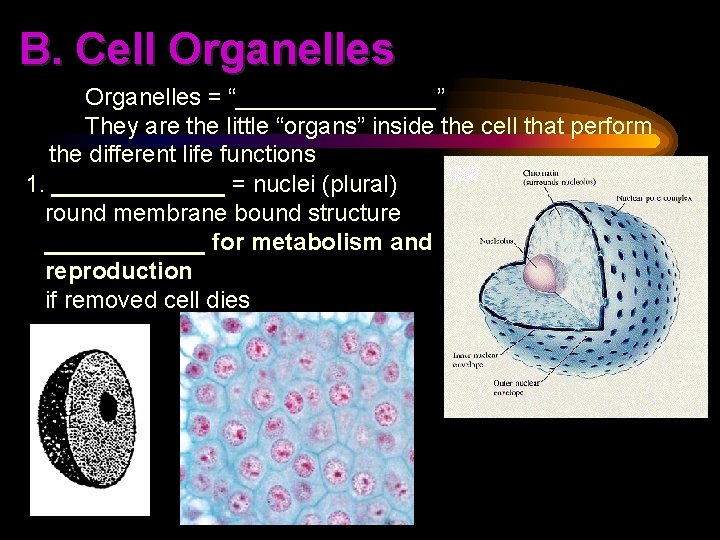
B. Cell Organelles = “________” They are the little “organs” inside the cell that perform the different life functions 1. _______ = nuclei (plural) round membrane bound structure ______ for metabolism and reproduction if removed cell dies
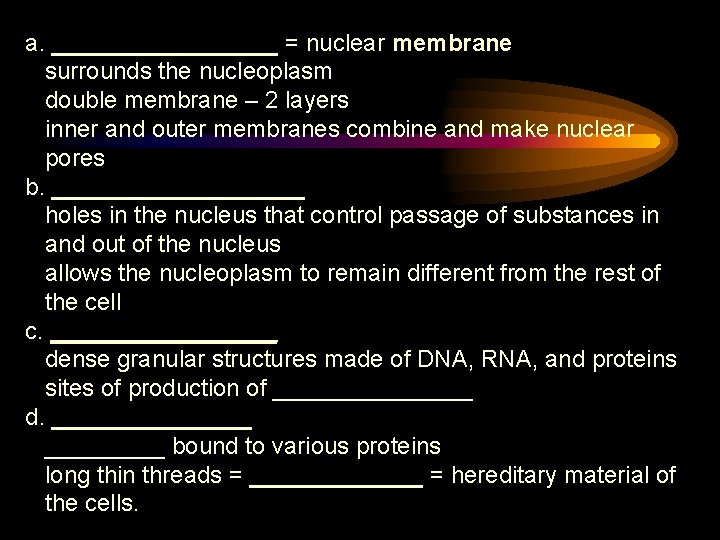
a. _________ = nuclear membrane surrounds the nucleoplasm double membrane – 2 layers inner and outer membranes combine and make nuclear pores b. __________ holes in the nucleus that control passage of substances in and out of the nucleus allows the nucleoplasm to remain different from the rest of the cell c. _________ dense granular structures made of DNA, RNA, and proteins sites of production of ________ d. ________ bound to various proteins long thin threads = _______ = hereditary material of the cells.
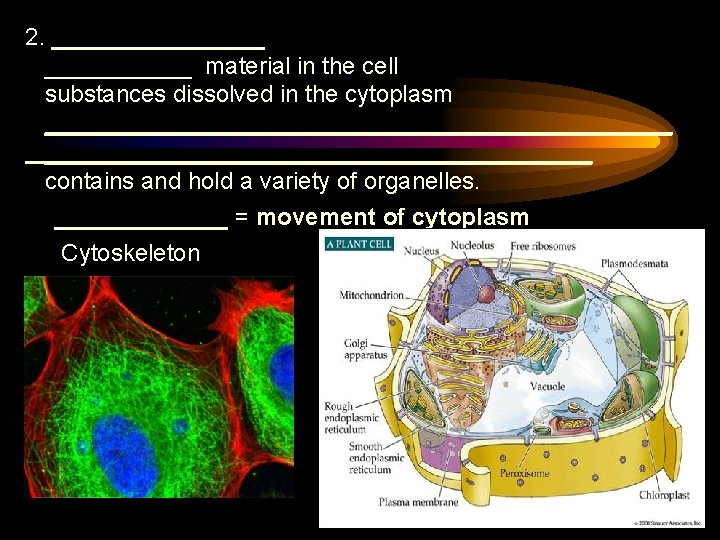
2. ________ material in the cell substances dissolved in the cytoplasm ________________________ contains and hold a variety of organelles. _______ = movement of cytoplasm Cytoskeleton
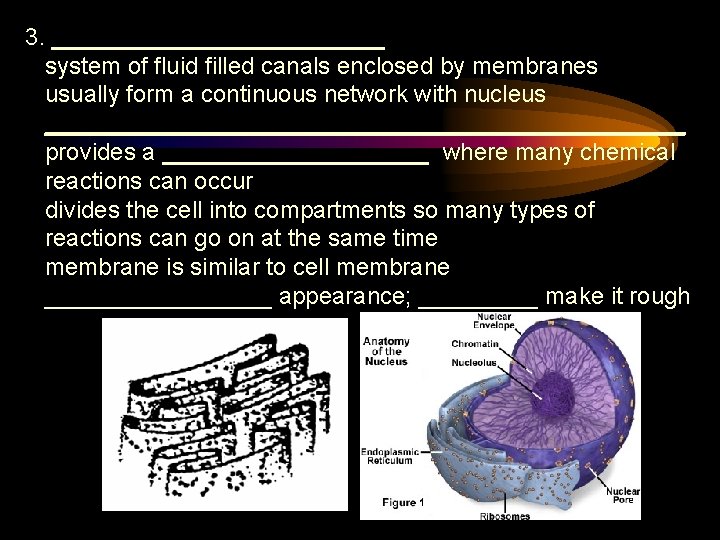
3. _____________ system of fluid filled canals enclosed by membranes usually form a continuous network with nucleus ________________________ provides a __________ where many chemical reactions can occur divides the cell into compartments so many types of reactions can go on at the same time membrane is similar to cell membrane _________ appearance; _____ make it rough
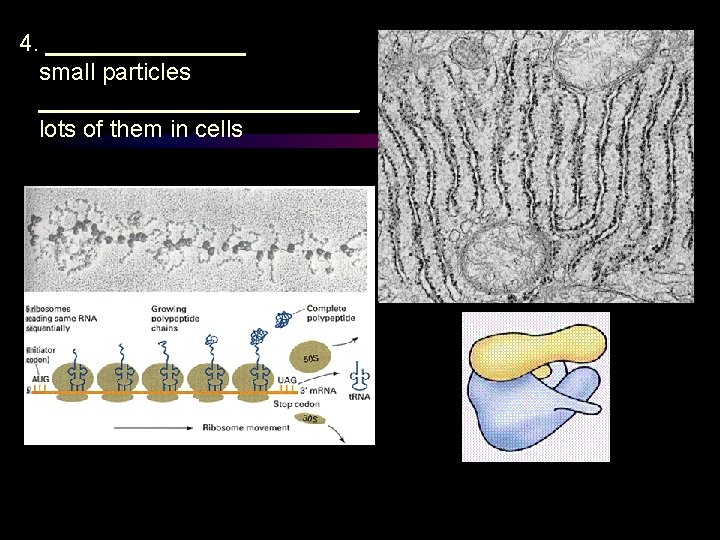
4. ________ small particles ____________ lots of them in cells
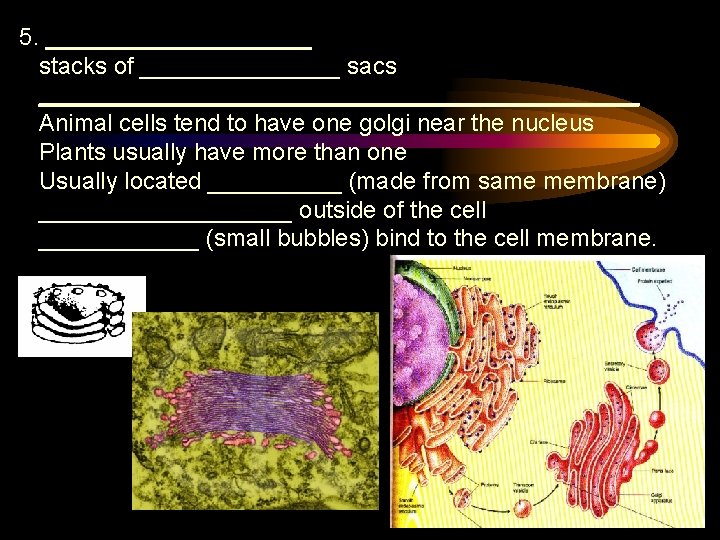
5. __________ stacks of ________ sacs _______________________ Animal cells tend to have one golgi near the nucleus Plants usually have more than one Usually located _____ (made from same membrane) __________ outside of the cell ______ (small bubbles) bind to the cell membrane.
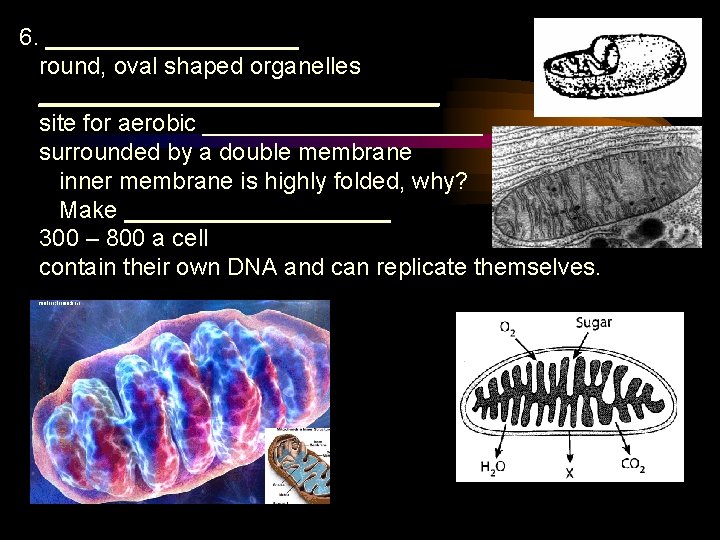
6. __________ round, oval shaped organelles _______________ site for aerobic ___________ surrounded by a double membrane inner membrane is highly folded, why? Make __________ 300 – 800 a cell contain their own DNA and can replicate themselves.
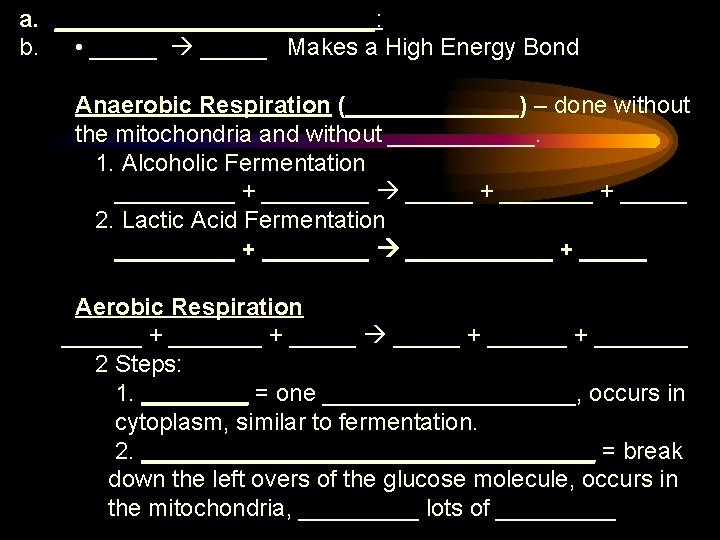
a. ____________: b. • _____ Makes a High Energy Bond Anaerobic Respiration (_______) – done without the mitochondria and without ______. 1. Alcoholic Fermentation _____ + _____ 2. Lactic Acid Fermentation _____ + ______ + _____ Aerobic Respiration ______ + _____ + _______ 2 Steps: 1. ____ = one __________, occurs in cytoplasm, similar to fermentation. 2. _________________ = break down the left overs of the glucose molecule, occurs in the mitochondria, _____ lots of _____
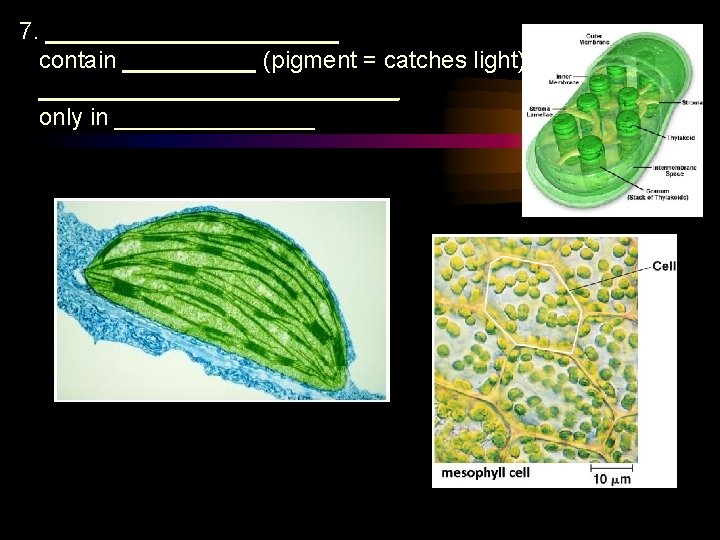
7. ___________ contain _____ (pigment = catches light) ______________ only in ________
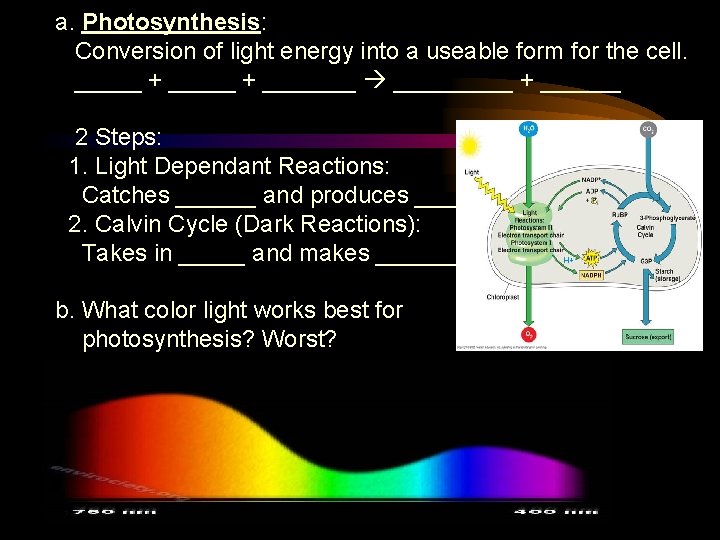
a. Photosynthesis: Conversion of light energy into a useable form for the cell. _____ + _______ + ______ 2 Steps: 1. Light Dependant Reactions: Catches ______ and produces ____ 2. Calvin Cycle (Dark Reactions): Takes in _____ and makes ______ b. What color light works best for photosynthesis? Worst?
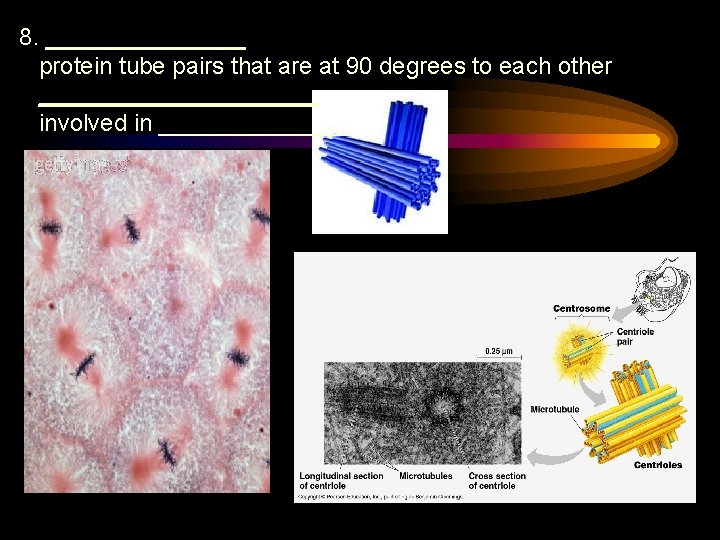
8. ________ protein tube pairs that are at 90 degrees to each other ___________ involved in _______
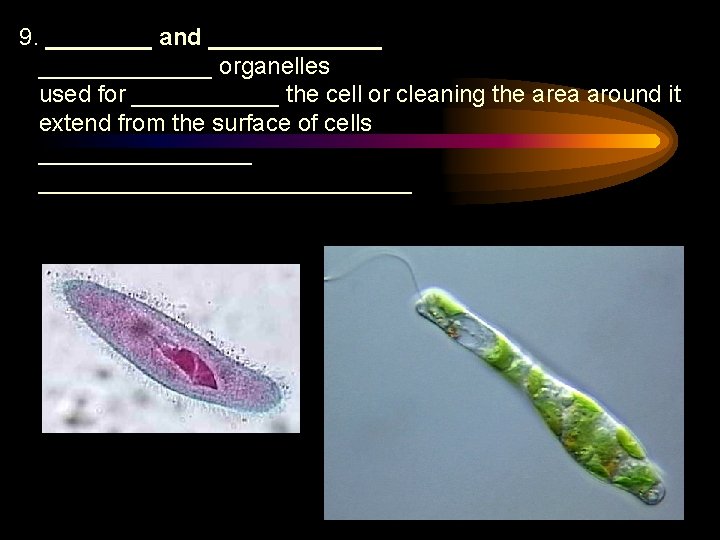
9. ____ and _____________ organelles used for ______ the cell or cleaning the area around it extend from the surface of cells ______________________
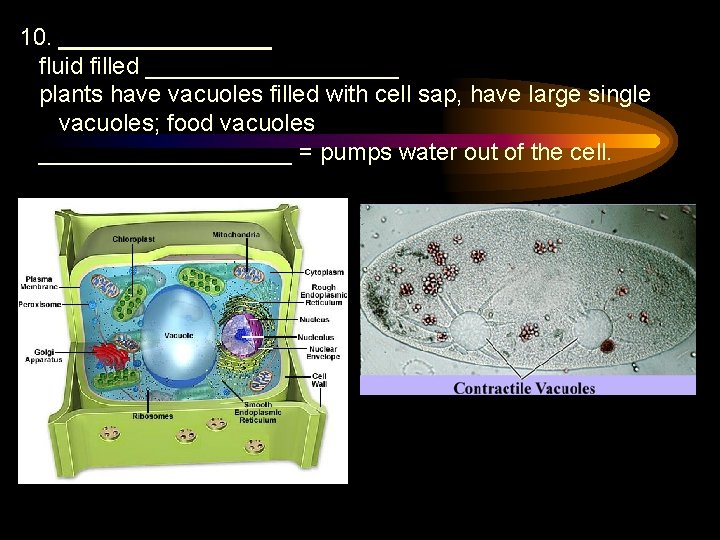
10. ________ fluid filled __________ plants have vacuoles filled with cell sap, have large single vacuoles; food vacuoles __________ = pumps water out of the cell.
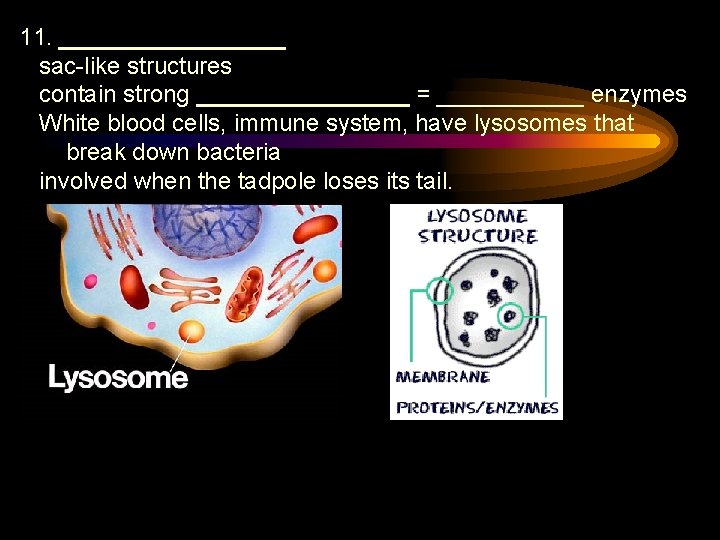
11. _________ sac-like structures contain strong ________ = ______ enzymes White blood cells, immune system, have lysosomes that break down bacteria involved when the tadpole loses its tail.
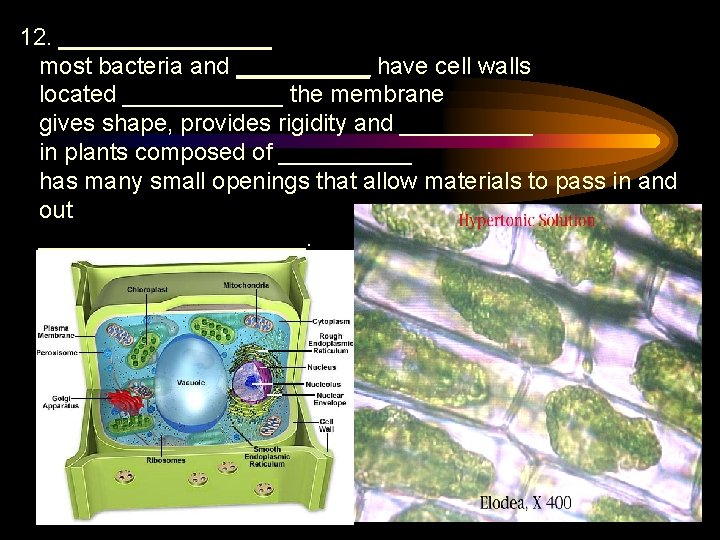
12. ________ most bacteria and _____ have cell walls located ______ the membrane gives shape, provides rigidity and _____ in plants composed of _____ has many small openings that allow materials to pass in and out __________.
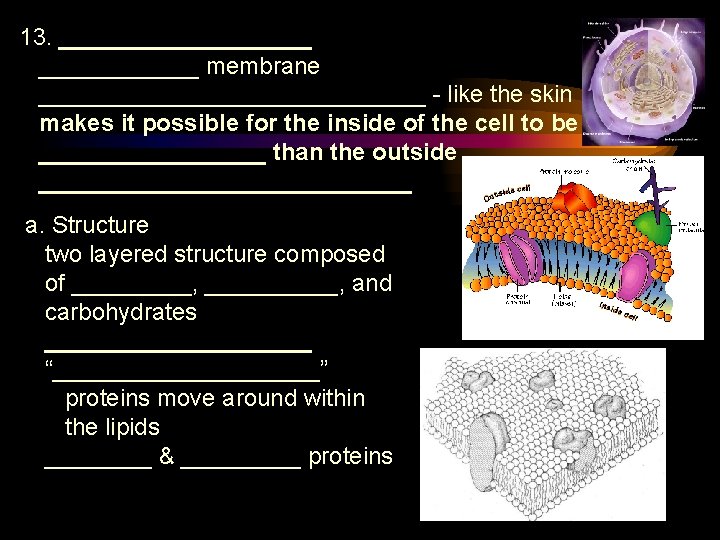
13. __________ membrane _______________ - like the skin makes it possible for the inside of the cell to be _________ than the outside ______________ a. Structure two layered structure composed of _____, and carbohydrates __________ “__________” proteins move around within the lipids ____ & _____ proteins
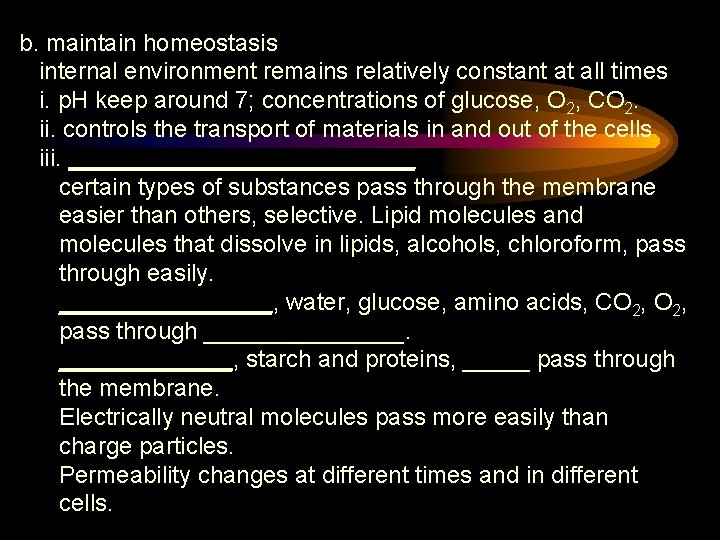
b. maintain homeostasis internal environment remains relatively constant at all times i. p. H keep around 7; concentrations of glucose, O 2, CO 2. ii. controls the transport of materials in and out of the cells iii. _____________ certain types of substances pass through the membrane easier than others, selective. Lipid molecules and molecules that dissolve in lipids, alcohols, chloroform, pass through easily. ________, water, glucose, amino acids, CO 2, pass through ________, starch and proteins, _____ pass through the membrane. Electrically neutral molecules pass more easily than charge particles. Permeability changes at different times and in different cells.
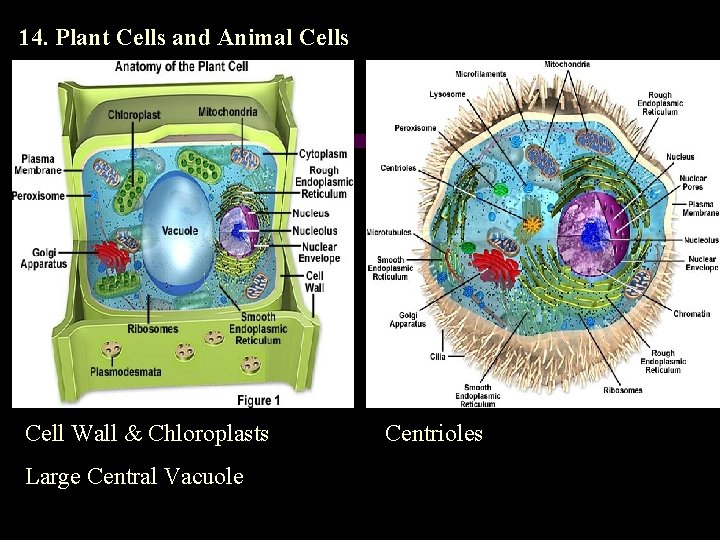
14. Plant Cells and Animal Cells Cell Wall & Chloroplasts Large Central Vacuole Centrioles
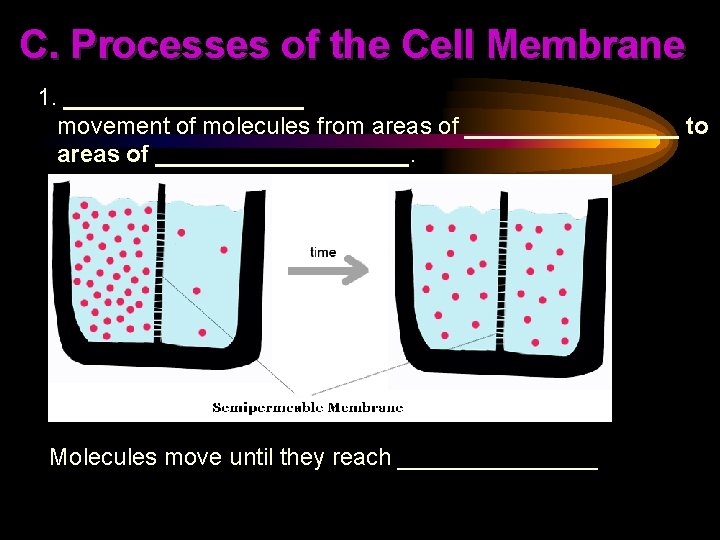
C. Processes of the Cell Membrane 1. _________ movement of molecules from areas of ________ to areas of __________. Molecules move until they reach ________
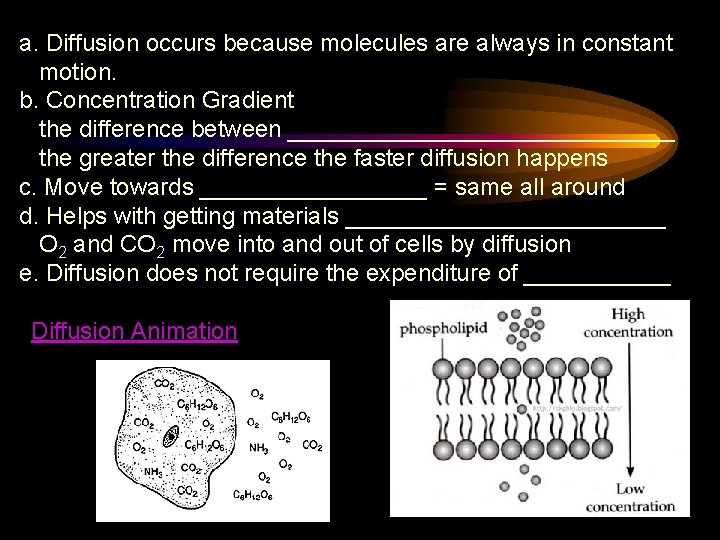
a. Diffusion occurs because molecules are always in constant motion. b. Concentration Gradient the difference between _______________ the greater the difference the faster diffusion happens c. Move towards _________ = same all around d. Helps with getting materials ____________ O 2 and CO 2 move into and out of cells by diffusion e. Diffusion does not require the expenditure of ______ Diffusion Animation
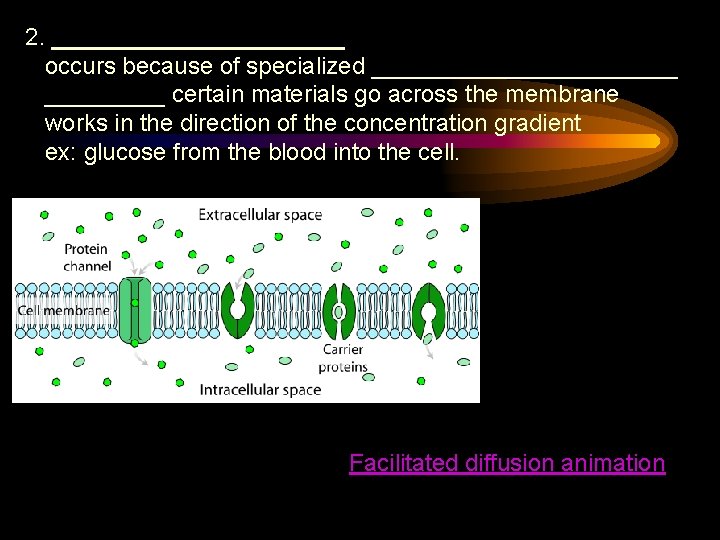
2. ___________ occurs because of specialized ____________ certain materials go across the membrane works in the direction of the concentration gradient ex: glucose from the blood into the cell. Facilitated diffusion animation
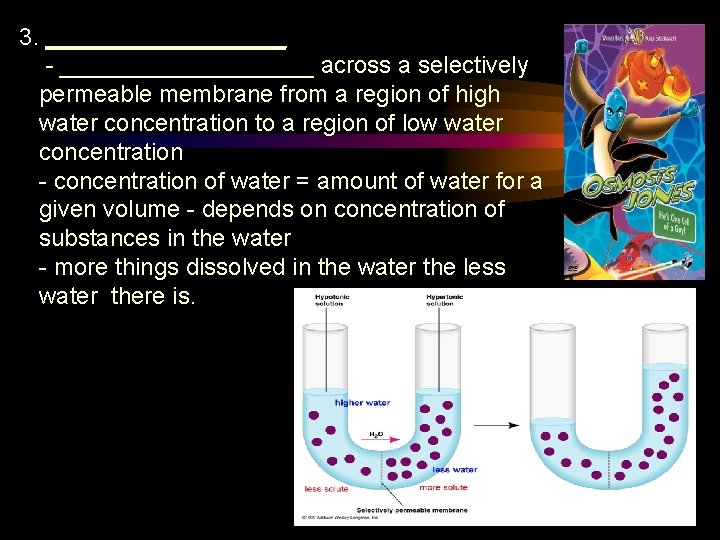
3. _________ - __________ across a selectively permeable membrane from a region of high water concentration to a region of low water concentration - concentration of water = amount of water for a given volume - depends on concentration of substances in the water - more things dissolved in the water the less water there is.
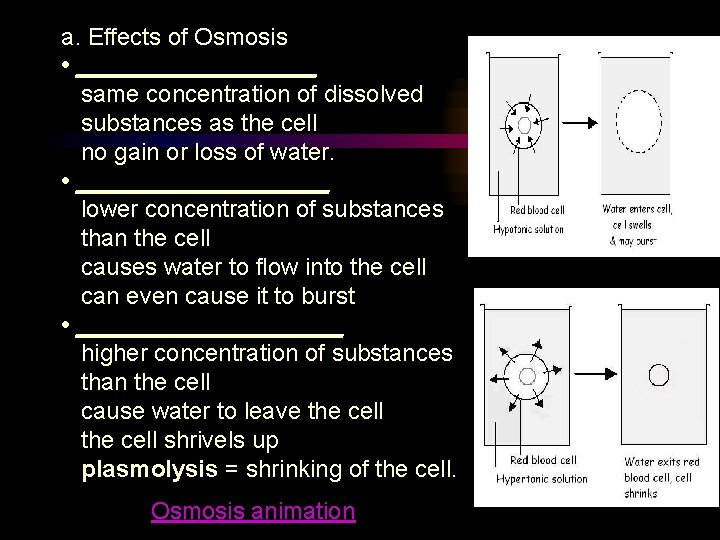
a. Effects of Osmosis • _________ same concentration of dissolved substances as the cell no gain or loss of water. • __________ lower concentration of substances than the cell causes water to flow into the cell can even cause it to burst • __________ higher concentration of substances than the cell cause water to leave the cell shrivels up plasmolysis = shrinking of the cell. Osmosis animation
4. ________ Active transport animation Phagocytosis animation a. _________ diffusion, osmosis, and facilitated diffusion are all examples of passive transport movement of materials across the cell membrane without the expenditure of energy. b. ________ movement of materials across the cell membrane with the __________ (ATP) make it possible to go ______ the concentration gradient ________ concentration endocytosis = transport of materials into the cell by a vacuole. pinocytosis = small amounts of liquid taken in ________ = small particles taken in ________ = movement of materials out of the cell by use of a vacuole.