
Unit 3 CH 7 Cell Structure Function The
- Slides: 18
Unit 3 CH 7 - Cell Structure/ Function “The Basic Unit of Life”
7. 1 – Cell Discovery and Theory l How is microscope technology related to discoveries of cells? l What are the similarities and differences between compound light microscopes and electron microscopes? l What are the principles of cell theory? l What are the differences between a prokaryote and eukaryote cell?
Discovery of the Cell l 1665 - Cells were discovered by Robert Hook in samples of cork. He named them “cells” after the small rooms monks lived in. l 1702 – Anton Von Leeuwenhoek learned how to make smaller lenses with great curvatures and his microscopes were able to magnify up to 270 X! l 1828 – Robert Brown discovered the nucleus.
Discovery of the Cell 1838 -39 - The Cell Theory was created by Schleiden (a botanist) and Schwann (a zoologist) in theory states: 1. 2. 3. The cell is the basic unit of life All plants and animals are made of cells All cells arise from pre-existing cells
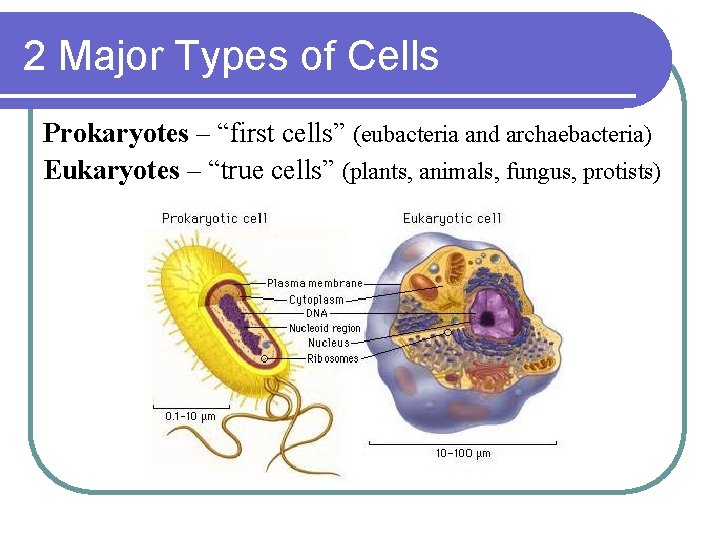
2 Major Types of Cells Prokaryotes – “first cells” (eubacteria and archaebacteria) Eukaryotes – “true cells” (plants, animals, fungus, protists)
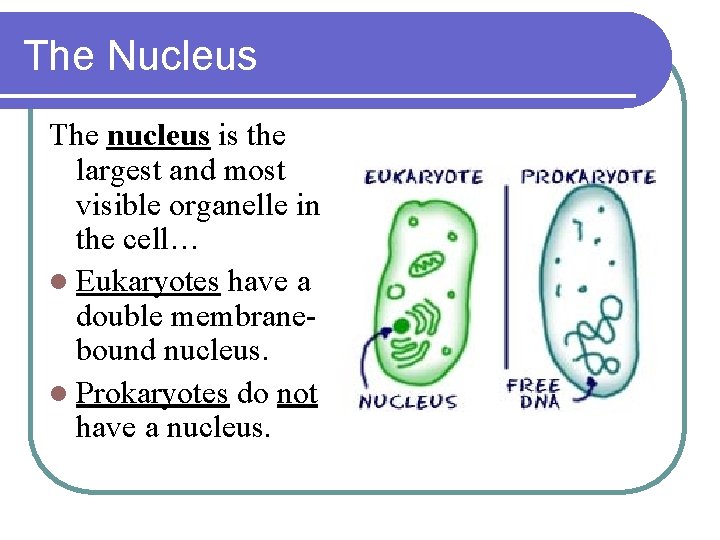
Prokaryotes How prokaryotes are different: l They do not have a nucleus or membranebound organelles. l Their DNA is a single strand floats around the cell. l They are smaller - 1/10 th the size. l Prokaryotes have a cell wall (like eukaryotic plant cells).
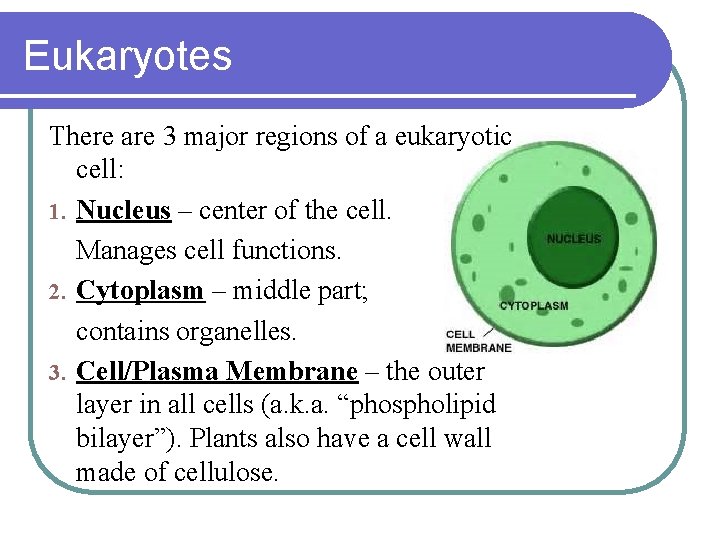
Eukaryotes There are 3 major regions of a eukaryotic cell: 1. Nucleus – center of the cell. Manages cell functions. 2. Cytoplasm – middle part; contains organelles. 3. Cell/Plasma Membrane – the outer layer in all cells (a. k. a. “phospholipid bilayer”). Plants also have a cell wall made of cellulose.
7. 3 – Structures and Organelles l What are the structures of a typical eukaryotic cell and what are their functions? l What are the similarities and differences between a plant and animal cell?
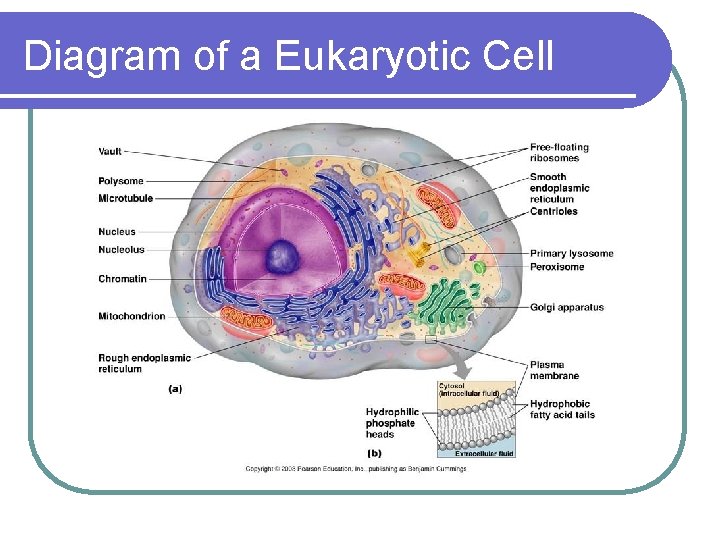
Diagram of a Eukaryotic Cell
The Nucleus The nucleus is the largest and most visible organelle in the cell… l Eukaryotes have a double membranebound nucleus. l Prokaryotes do not have a nucleus.
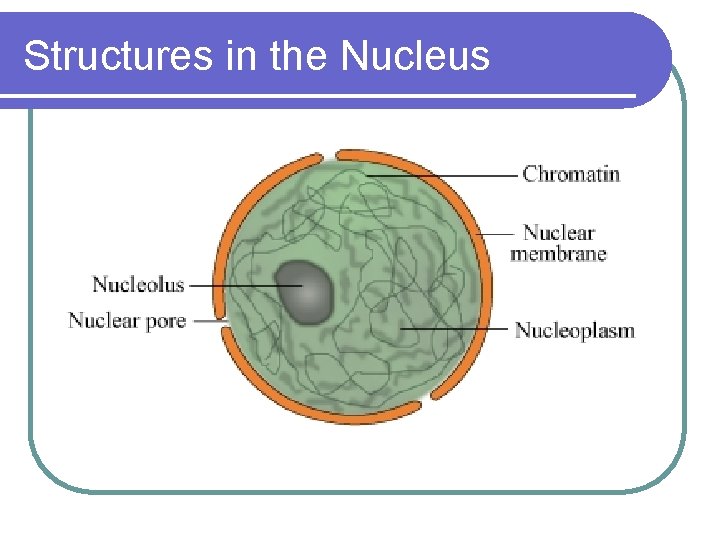
The Nucleus INSIDE the nucleus are: l Nucleolus (plural = nucleoli). (1) The site for synthesis (making) and storing of RNA. (2) Ribosomes are made here too. l Chromatin – fine threads of DNA that shorten and thicken to form chromosomes during mitosis. l Nucleoplasm – clear fluid of the nucleus. l Nuclear Membrane – a bi-layer membrane with pores allow transport.
Structures in the Nucleus
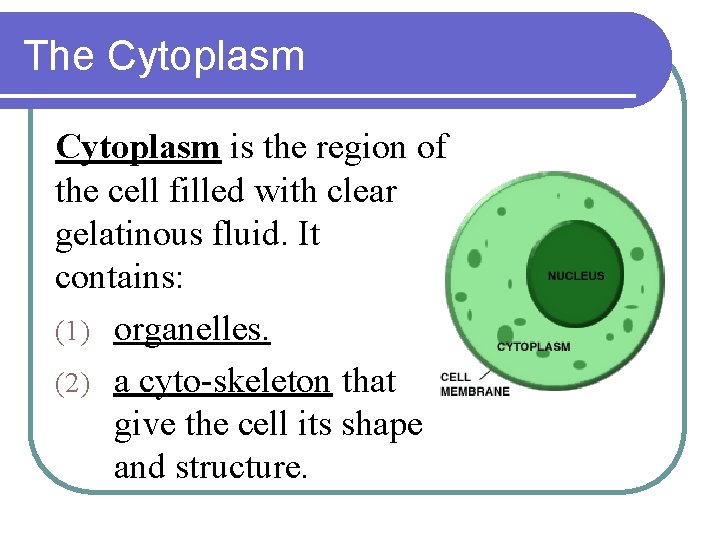
The Cytoplasm is the region of the cell filled with clear gelatinous fluid. It contains: (1) organelles. (2) a cyto-skeleton that give the cell its shape and structure.
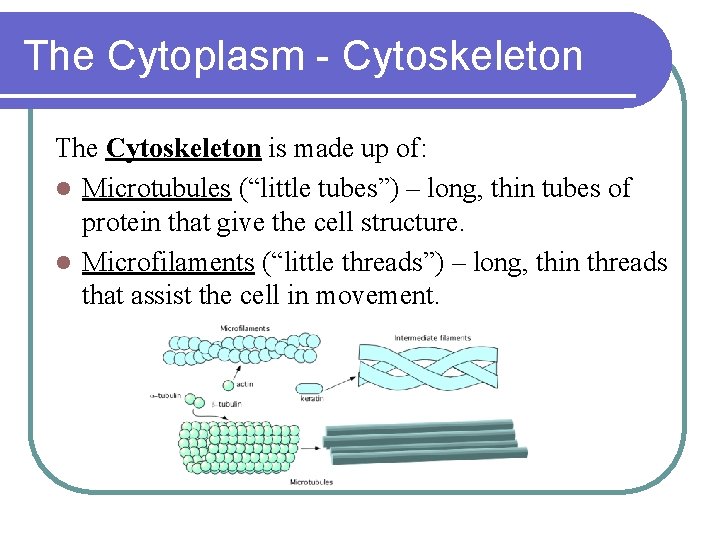
The Cytoplasm - Cytoskeleton The Cytoskeleton is made up of: l Microtubules (“little tubes”) – long, thin tubes of protein that give the cell structure. l Microfilaments (“little threads”) – long, thin threads that assist the cell in movement.
Cytoplasm - Organelles Centrioles are cylindrical structures that duplicate during mitosis and move to opposite ends of the cell. They are found in all animal cells and in some lower plants. They are also the base for cilia and flagella. l Chloroplasts capture light energy and produce food. They are found in green plants and some protists. l
Cytoplasm - Organelles Endoplasmic Reticulum is the site of chemical reactions in the cell. It is a network of highly folded membranes that form channels/paths to move particles through the cell. l Smooth ER – channel only l Rough ER – channel contains ribsomes
Cytoplasm - Organelles l l l Cilia (short and in large numbers) Cilia help tissues collect debris or other matter. (lungs, ears, etc. ) Golgi Apparatus modify, store, package and transport materials made by other parts of the cell. Lysosomes are vacuoles (sacs) filled with enzymes that can destroy the cell. They (1) digest food or worn out organelles and (2) engulf (surround) and digest viruses/bacteria.
Cytoplasm - Organelles l l Mitochondria are called the “Powerhouse of the cell. ” They are covered with enzymes that help release energy and assist in cellular respiration. Plastid are used for storage in plants. Some contain pigment (chlorophyll), starch, or lipids. Ribosomes make proteins and enzymes (“Protein Synthesis”). Some on rough ER; some free in the cytoplasm. Vacuoles store food, enzymes and waste. In plants, one large vacuole stores water.