
Unit 3 ATOMIC STRUCTURE Element the simplest form
- Slides: 27
Unit 3 ATOMIC STRUCTURE
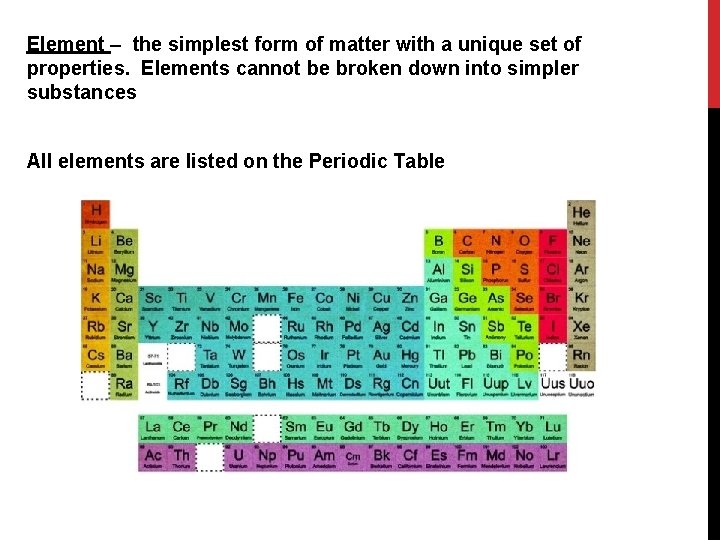
Element – the simplest form of matter with a unique set of properties. Elements cannot be broken down into simpler substances All elements are listed on the Periodic Table
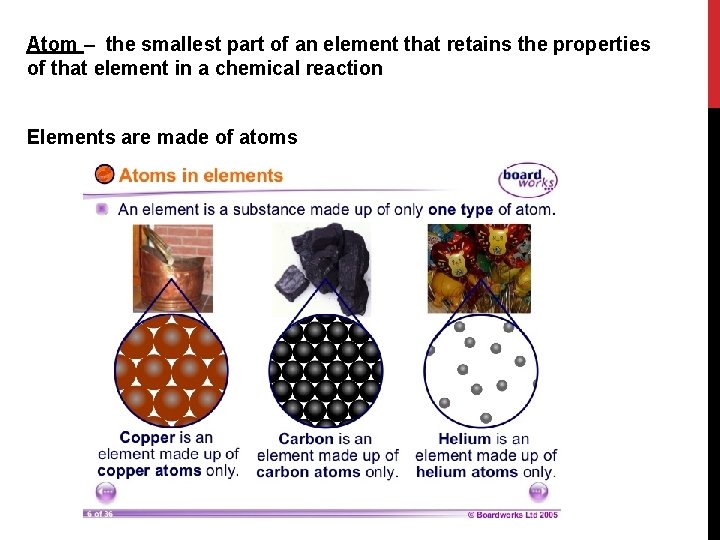
Atom – the smallest part of an element that retains the properties of that element in a chemical reaction Elements are made of atoms
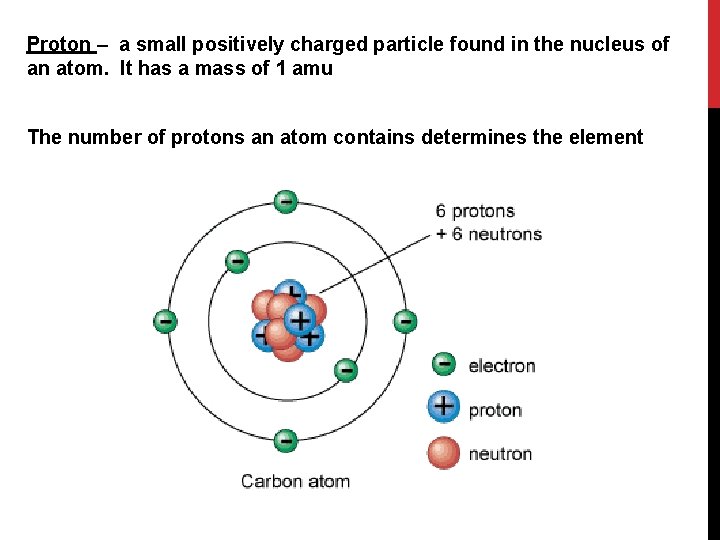
Proton – a small positively charged particle found in the nucleus of an atom. It has a mass of 1 amu The number of protons an atom contains determines the element
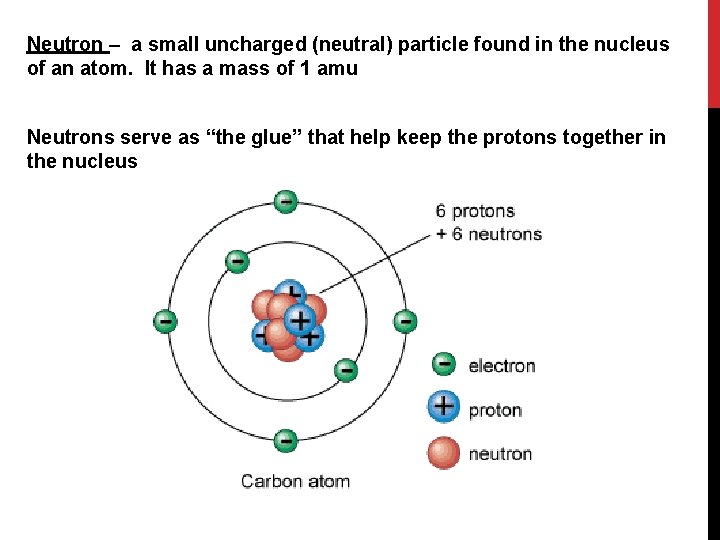
Neutron – a small uncharged (neutral) particle found in the nucleus of an atom. It has a mass of 1 amu Neutrons serve as “the glue” that help keep the protons together in the nucleus
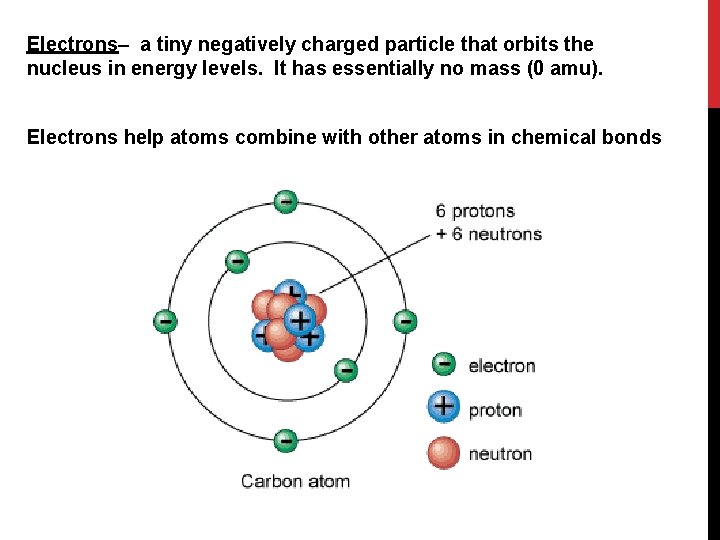
Electrons– a tiny negatively charged particle that orbits the nucleus in energy levels. It has essentially no mass (0 amu). Electrons help atoms combine with other atoms in chemical bonds
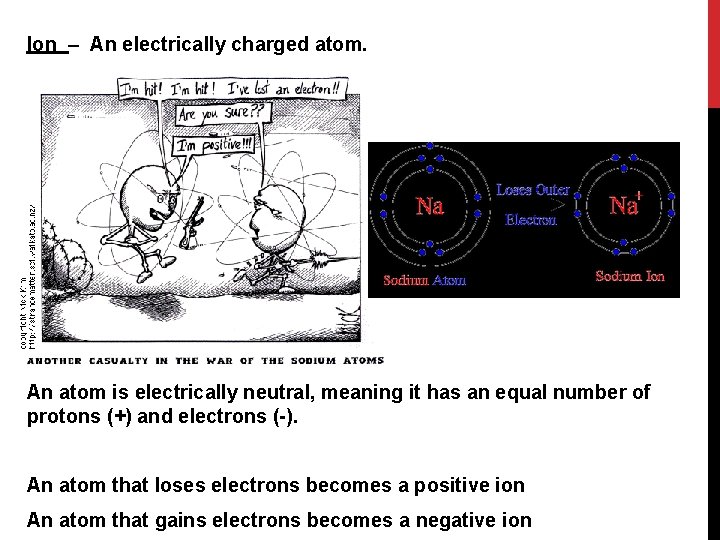
Ion – An electrically charged atom. An atom is electrically neutral, meaning it has an equal number of protons (+) and electrons (-). An atom that loses electrons becomes a positive ion An atom that gains electrons becomes a negative ion
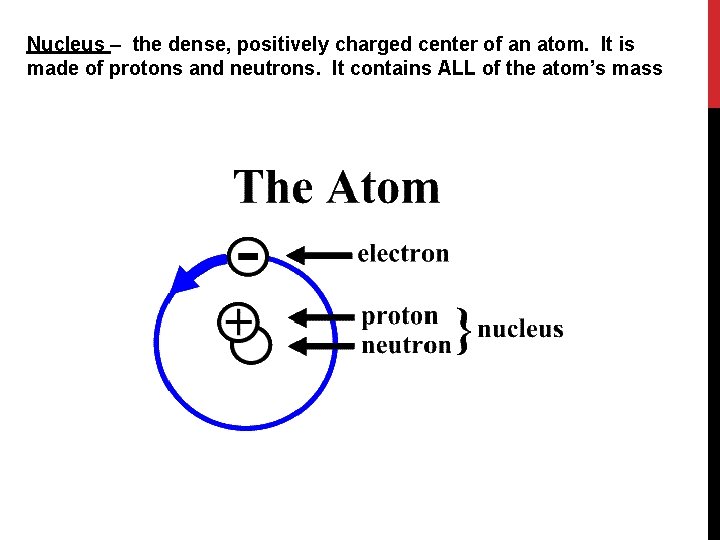
Nucleus – the dense, positively charged center of an atom. It is made of protons and neutrons. It contains ALL of the atom’s mass
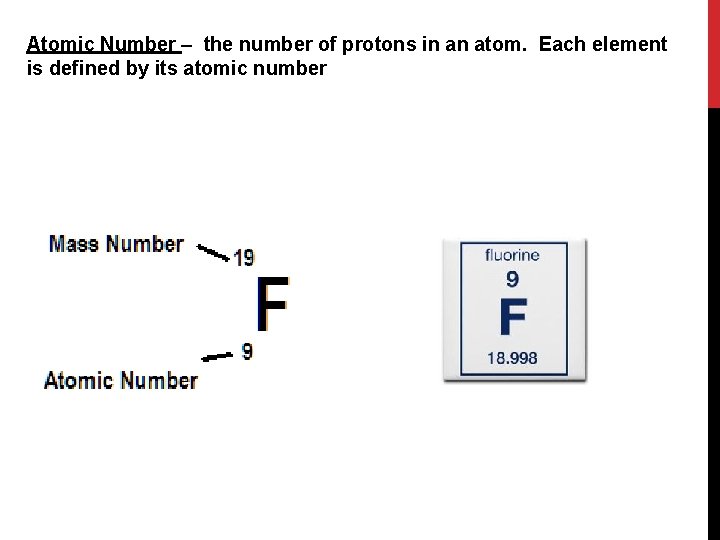
Atomic Number – the number of protons in an atom. Each element is defined by its atomic number
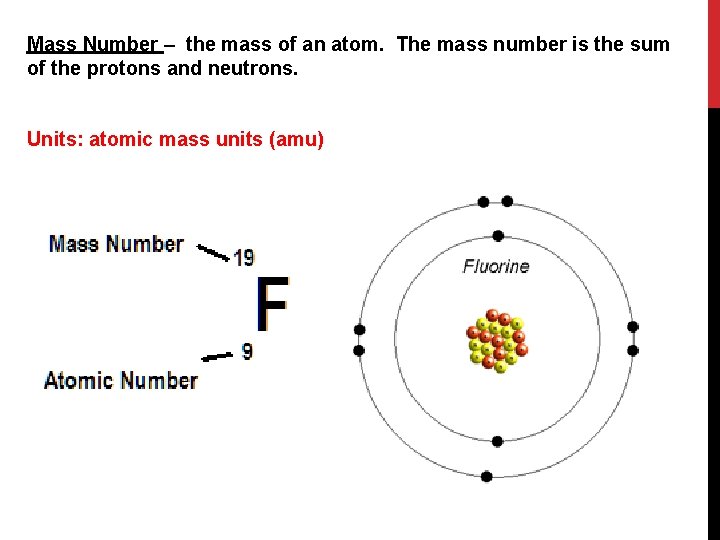
Mass Number – the mass of an atom. The mass number is the sum of the protons and neutrons. Units: atomic mass units (amu)
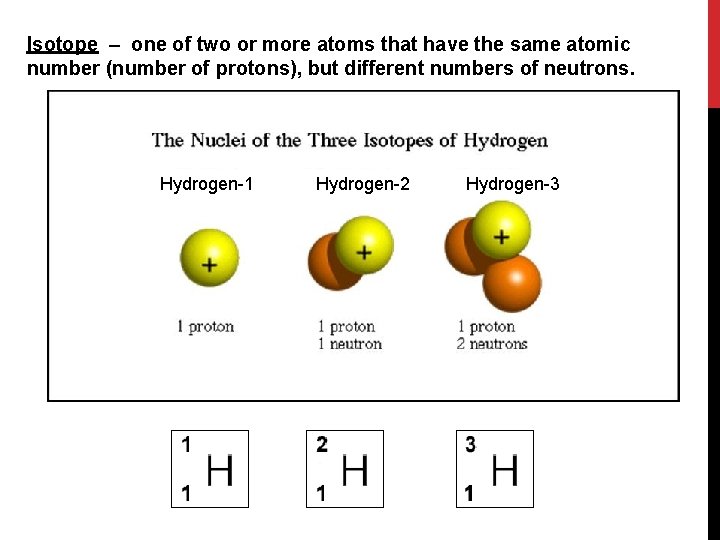
Isotope – one of two or more atoms that have the same atomic number (number of protons), but different numbers of neutrons. Hydrogen-1 Hydrogen-2 Hydrogen-3
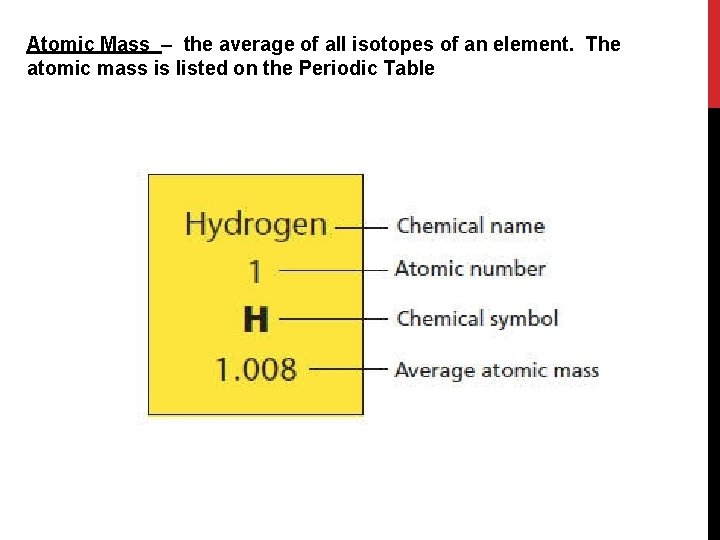
Atomic Mass – the average of all isotopes of an element. The atomic mass is listed on the Periodic Table
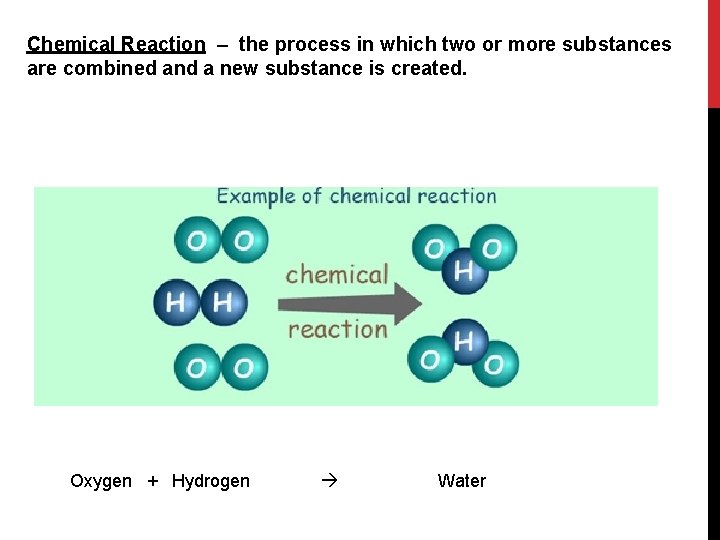
Chemical Reaction – the process in which two or more substances are combined and a new substance is created. Oxygen + Hydrogen Water
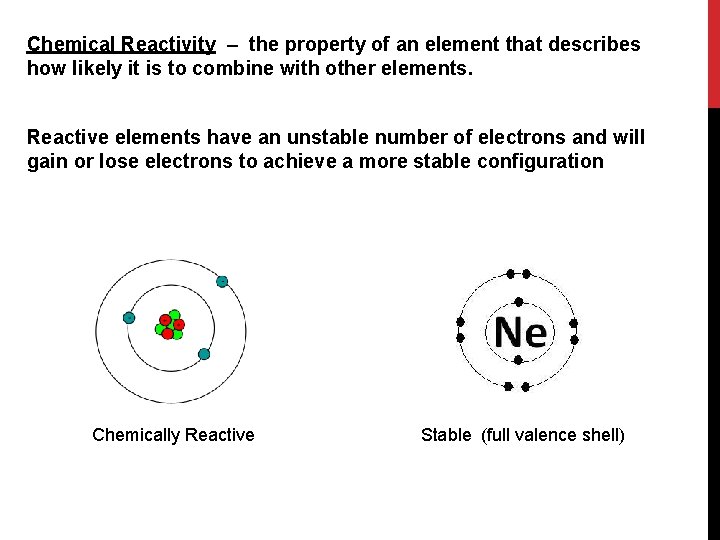
Chemical Reactivity – the property of an element that describes how likely it is to combine with other elements. Reactive elements have an unstable number of electrons and will gain or lose electrons to achieve a more stable configuration Chemically Reactive Stable (full valence shell)
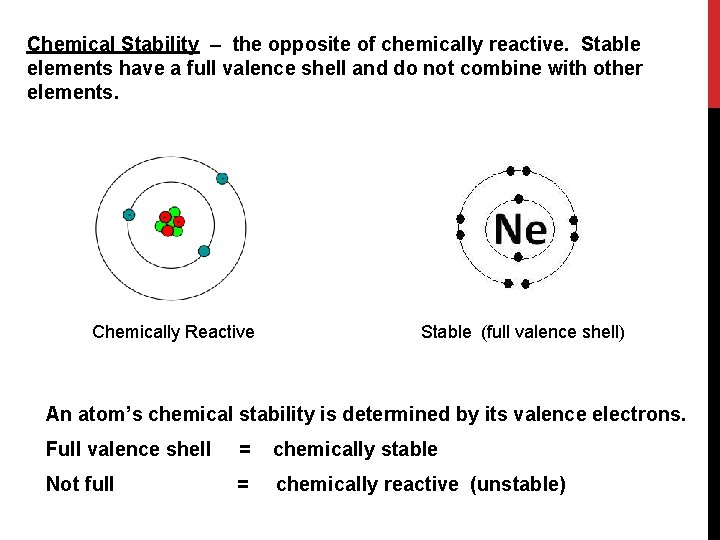
Chemical Stability – the opposite of chemically reactive. Stable elements have a full valence shell and do not combine with other elements. Chemically Reactive Stable (full valence shell) An atom’s chemical stability is determined by its valence electrons. Full valence shell = chemically stable Not full = chemically reactive (unstable)
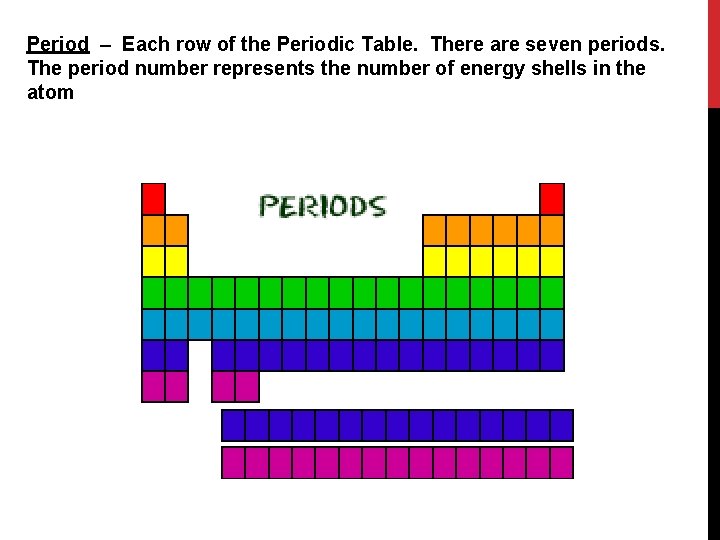
Period – Each row of the Periodic Table. There are seven periods. The period number represents the number of energy shells in the atom
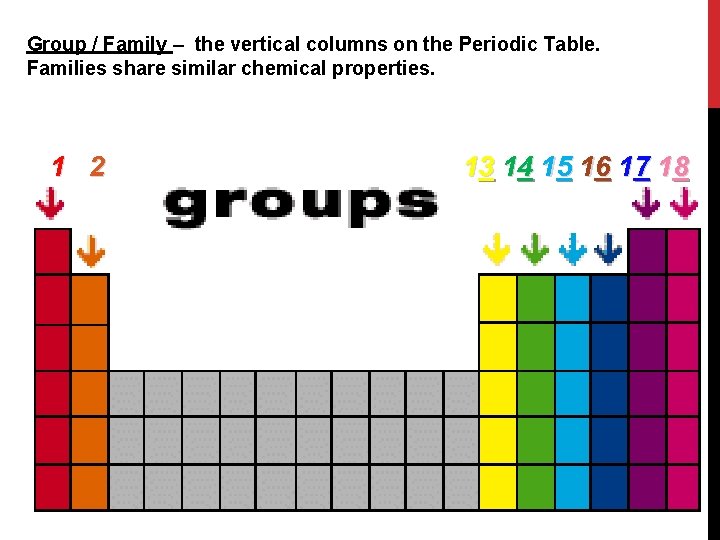
Group / Family – the vertical columns on the Periodic Table. Families share similar chemical properties. 1 2 13 14 15 16 17 18
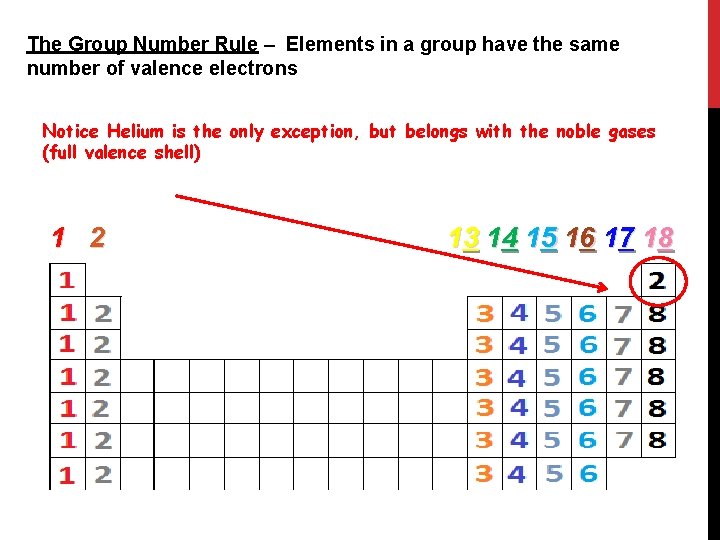
The Group Number Rule – Elements in a group have the same number of valence electrons Notice Helium is the only exception, but belongs with the noble gases (full valence shell) 1 2 13 14 15 16 17 18
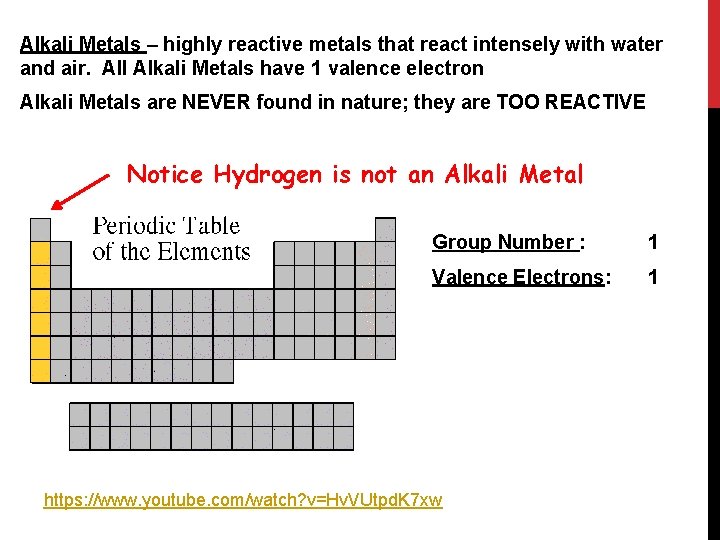
Alkali Metals – highly reactive metals that react intensely with water and air. All Alkali Metals have 1 valence electron Alkali Metals are NEVER found in nature; they are TOO REACTIVE Notice Hydrogen is not an Alkali Metal Group Number : 1 Valence Electrons: 1 https: //www. youtube. com/watch? v=Hv. VUtpd. K 7 xw
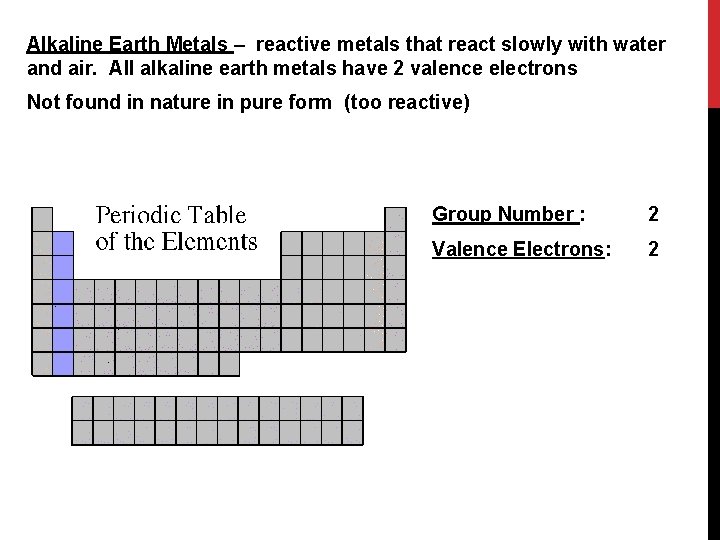
Alkaline Earth Metals – reactive metals that react slowly with water and air. All alkaline earth metals have 2 valence electrons Not found in nature in pure form (too reactive) Group Number : 2 Valence Electrons: 2
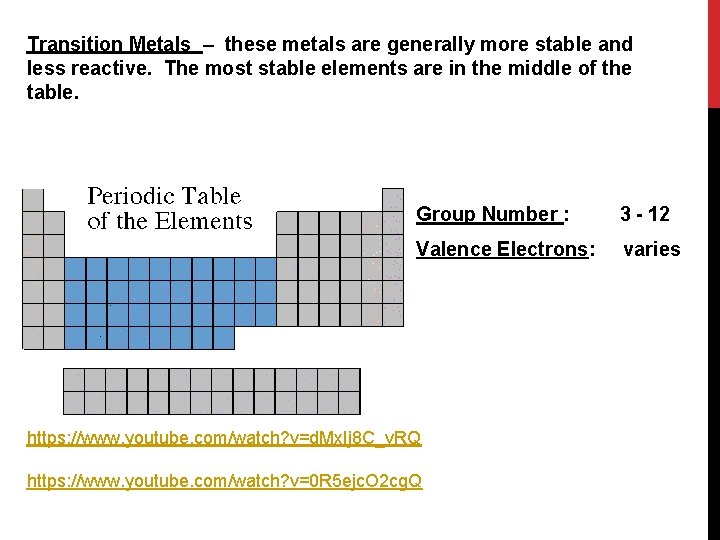
Transition Metals – these metals are generally more stable and less reactive. The most stable elements are in the middle of the table. Group Number : 3 - 12 Valence Electrons: varies https: //www. youtube. com/watch? v=d. Mx. Ij 8 C_v. RQ https: //www. youtube. com/watch? v=0 R 5 ejc. O 2 cg. Q
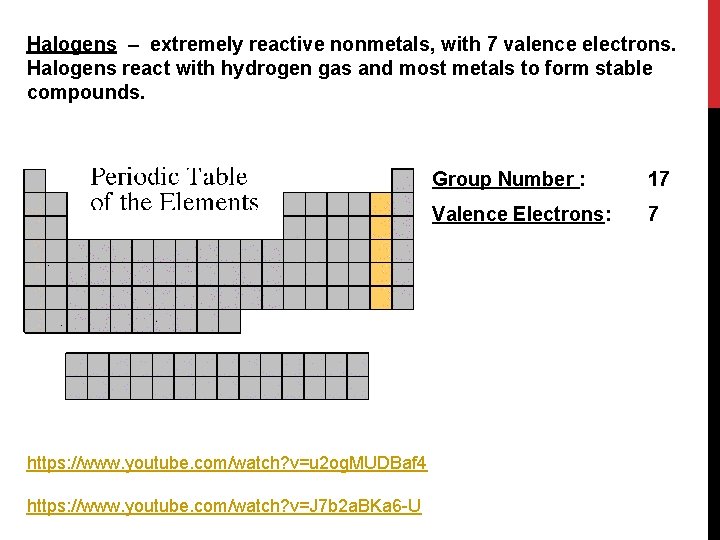
Halogens – extremely reactive nonmetals, with 7 valence electrons. Halogens react with hydrogen gas and most metals to form stable compounds. https: //www. youtube. com/watch? v=u 2 og. MUDBaf 4 https: //www. youtube. com/watch? v=J 7 b 2 a. BKa 6 -U Group Number : 17 Valence Electrons: 7
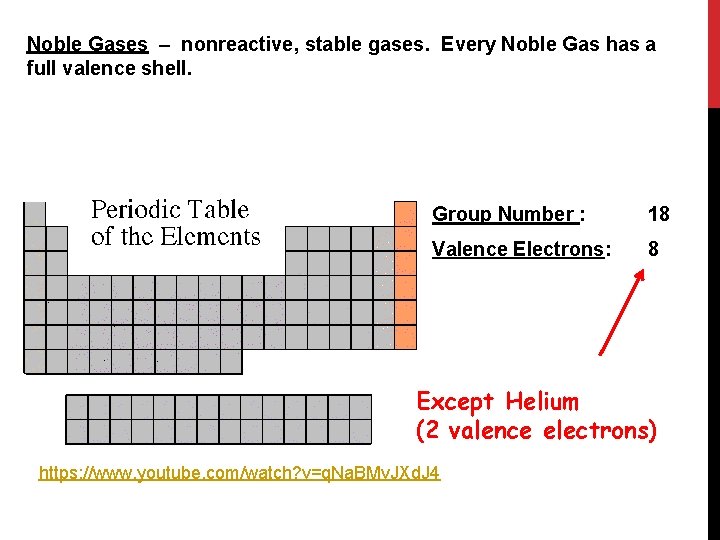
Noble Gases – nonreactive, stable gases. Every Noble Gas has a full valence shell. Group Number : 18 Valence Electrons: 8 Except Helium (2 valence electrons) https: //www. youtube. com/watch? v=q. Na. BMv. JXd. J 4
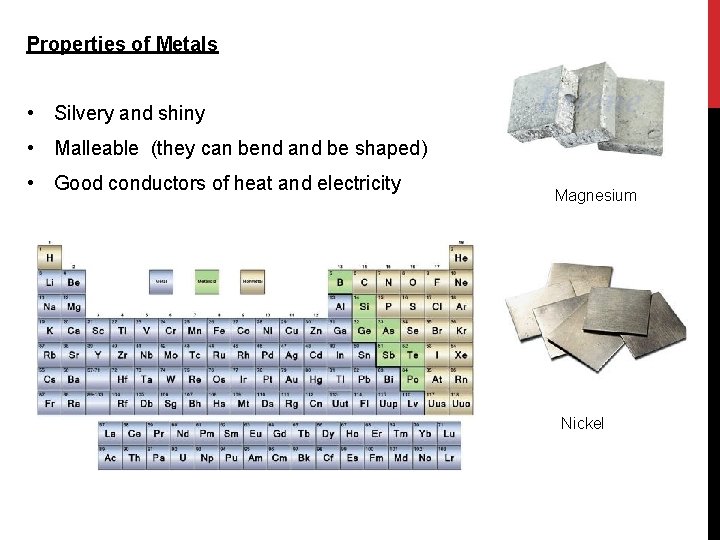
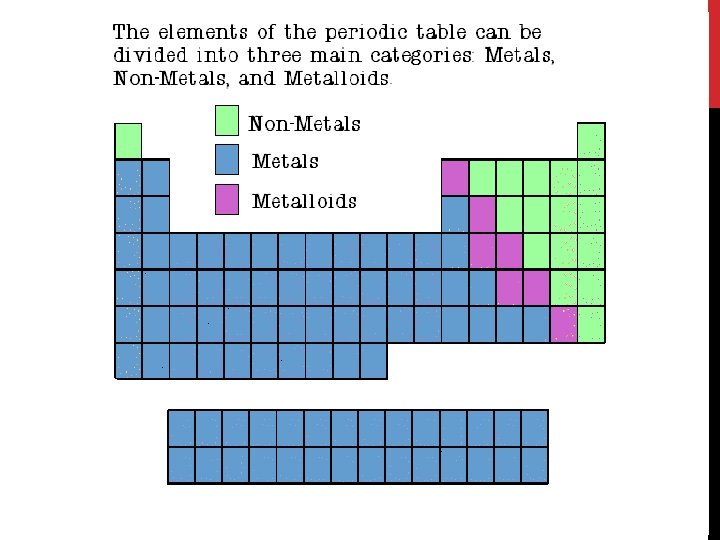
Properties of Metals • Silvery and shiny • Malleable (they can bend and be shaped) • Good conductors of heat and electricity Magnesium Nickel
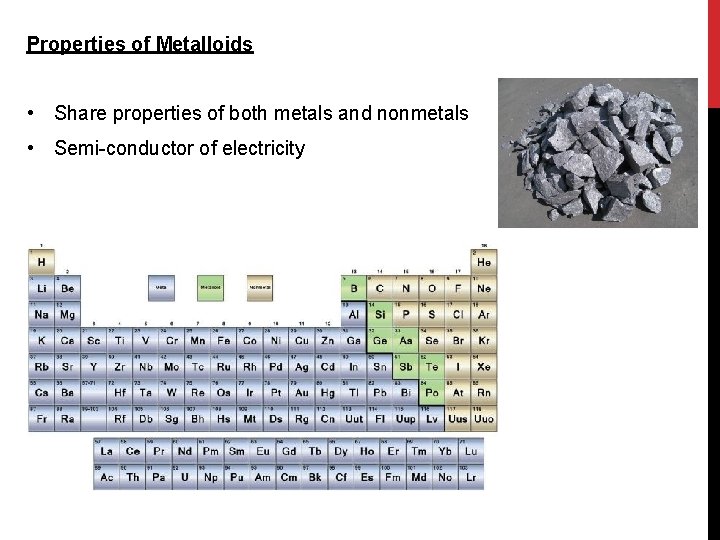
Properties of Metalloids • Share properties of both metals and nonmetals • Semi-conductor of electricity
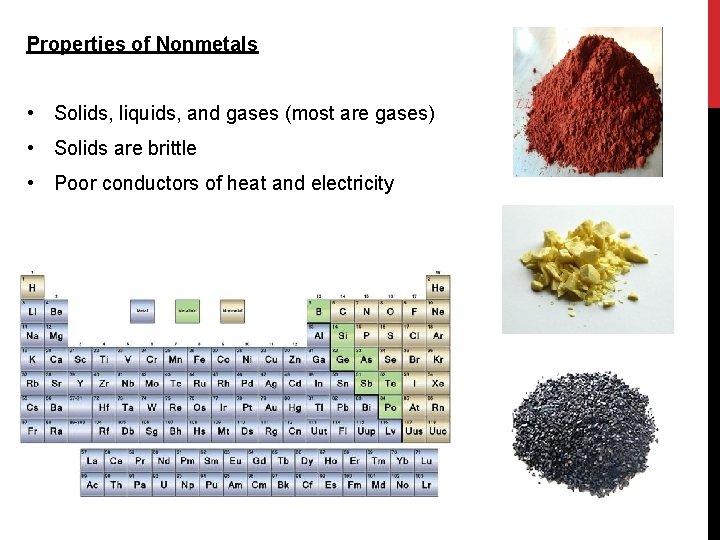
Properties of Nonmetals • Solids, liquids, and gases (most are gases) • Solids are brittle • Poor conductors of heat and electricity
HONORS SECTION