
Unit 3 1 Credit card borrowing People generally
Unit
3. 1 Credit card borrowing People generally borrow from banks , friends or. relatives Ways of borrowing from banks include: Personal loan Cheque account overdraft. Secured loan Buying or paying with a credit card.

The following are some descriptions of credit cards. Put a ‘ ’ in the box if you think the description is correct, or a ‘ ’ if it is incorrect.

3. 1 Credit card borrowing A. What is a credit card? Credit cards are issued by banks or other business organisations. Credit cardholders can purchase with their cards without paying instantly.
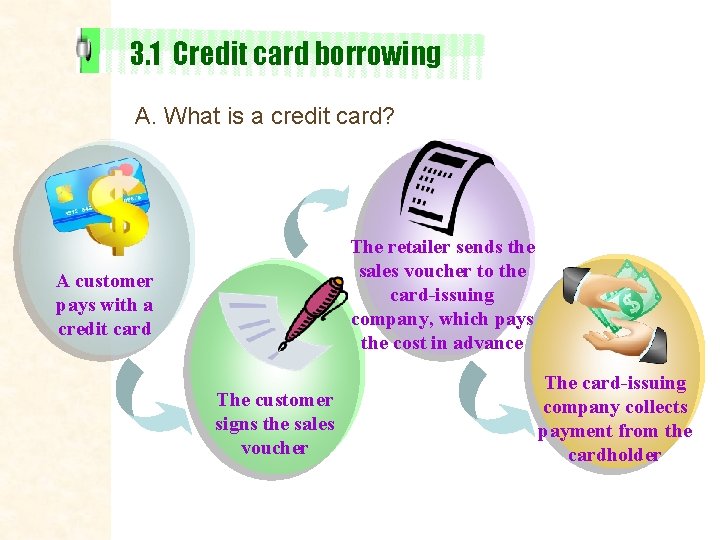
3. 1 Credit card borrowing A. What is a credit card? The retailer sends the sales voucher to the card-issuing company, which pays the cost in advance A customer pays with a credit card The customer signs the sales voucher The card-issuing company collects payment from the cardholder
3. 1 Credit card borrowing B. Points to note when using credit cards 1. Credit cards allow cardholders to purchase without money. Therefore, if the cardholders lack self-control , they are likely to form the bad habit _____________ of ‘spending their future money ’.
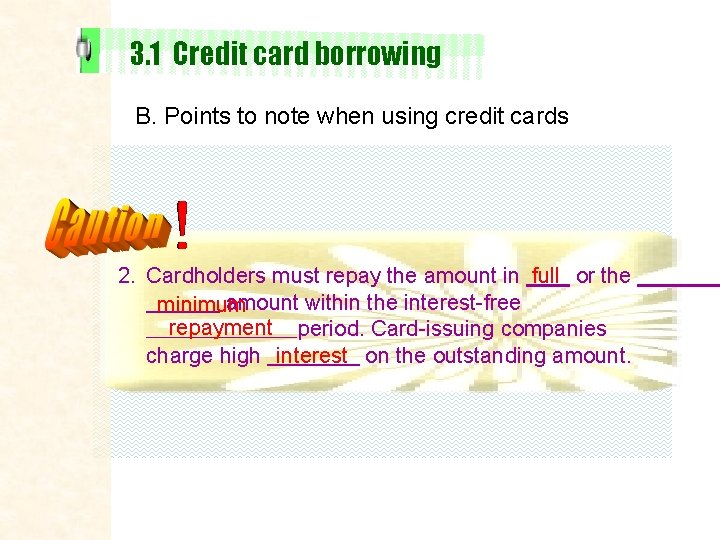
3. 1 Credit card borrowing B. Points to note when using credit cards Payment due date Minimum amount 2. Cardholders must repay the amount in full or the amount within the interest-free minimum repayment period. Card-issuing companies ______________ charge high interest on the outstanding amount.
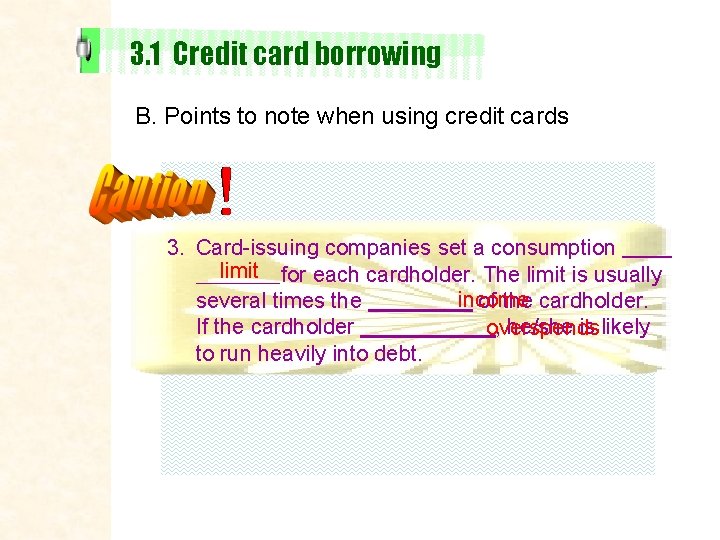
3. 1 Credit card borrowing B. Points to note when using credit cards Consumption limit: $50, 000 3. Card-issuing companies set a consumption limit for each cardholder. The limit is usually ________ income several times the of the cardholder. If the cardholder , he/she is likely overspends to run heavily into debt.
What are the advantages and disadvantages of using credit cards? Discuss with your classmates and find the answers. The advantages and disadvantages of using credit cards: Free answers. Suggested answer: Advantages 1. 2. 3. Disadvantages
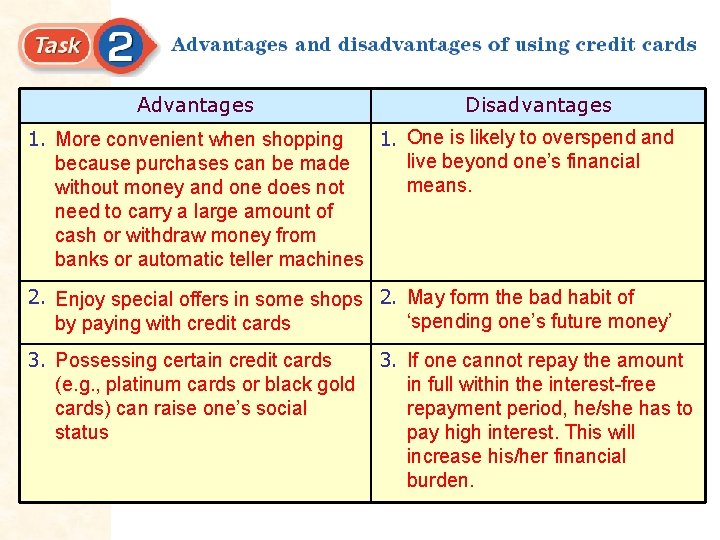
Advantages Disadvantages 1. One is likely to overspend and 1. More convenient when shopping live beyond one’s financial because purchases can be made means. without money and one does not need to carry a large amount of cash or withdraw money from banks or automatic teller machines 2. Enjoy special offers in some shops 2. May form the bad habit of ‘spending one’s future money’ by paying with credit cards 3. Possessing certain credit cards (e. g. , platinum cards or black gold cards) can raise one’s social status 3. If one cannot repay the amount in full within the interest-free repayment period, he/she has to pay high interest. This will increase his/her financial burden.
When you reach age 18, will you apply for a credit card? Why? Free answers.

3. 1 Credit card borrowing C. Purchasing with credit cards = Borrowing 1. Credit card consumption allows us to purchase without money. As a result, we are likely to overspend. We may even live beyond our financial means. 2. Paying bills with a credit card is actually borrowing from the card-issuing company. We have to pay interest. on the loan.
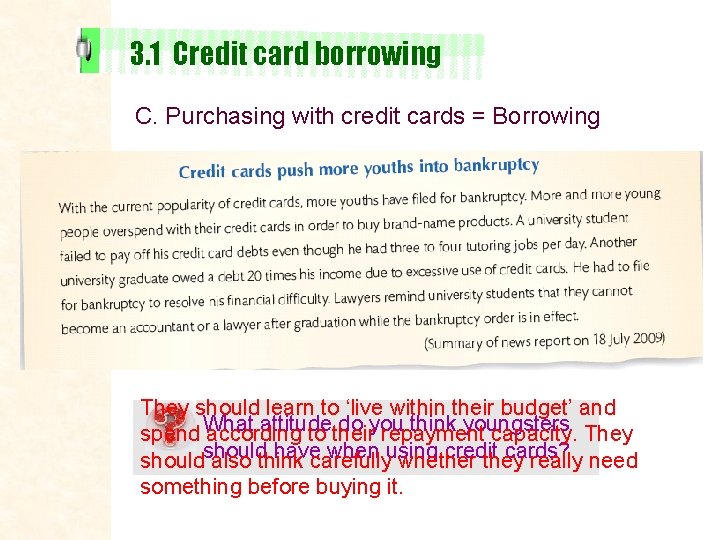
3. 1 Credit card borrowing C. Purchasing with credit cards = Borrowing They should learn to ‘live within their budget’ and attitude do you think youngsters spend What according to their repayment capacity. They havecarefully when using credit cards? should also think whether they really need something before buying it.
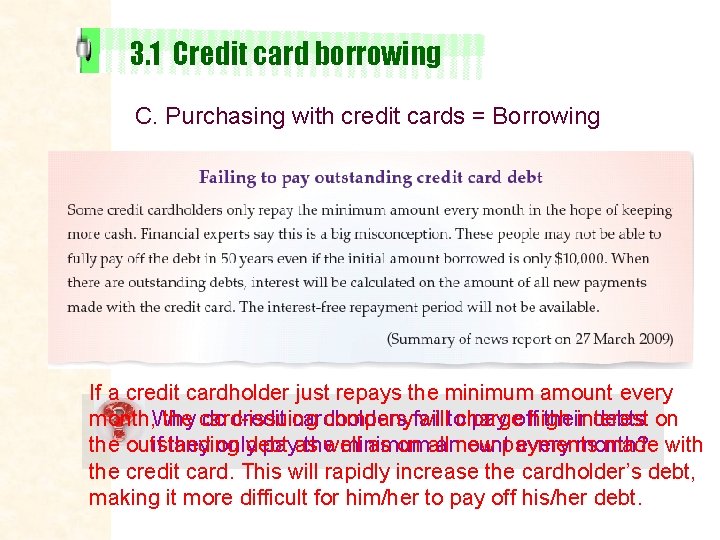
3. 1 Credit card borrowing C. Purchasing with credit cards = Borrowing If a credit cardholder just repays the minimum amount every do credit cardholders pay offhigh theirinterest debts on month, Why the card-issuing companyfail willtocharge if they only payas the minimum amount every month? the outstanding debt well as on all new payments made with the credit card. This will rapidly increase the cardholder’s debt, making it more difficult for him/her to pay off his/her debt.
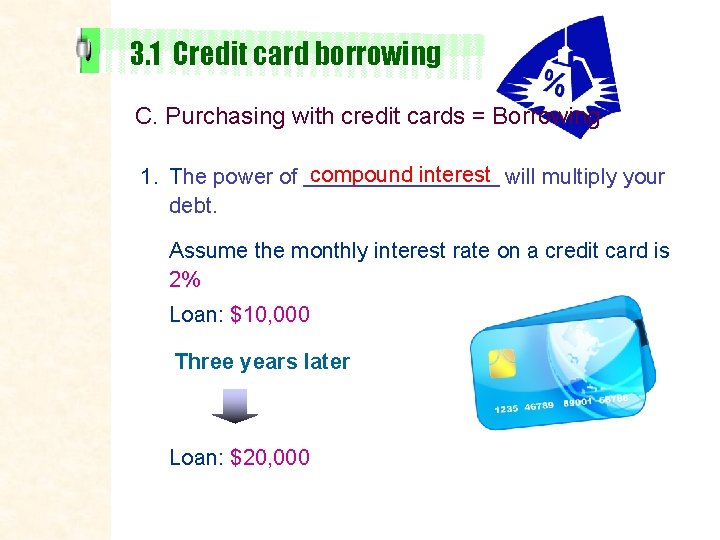
3. 1 Credit card borrowing C. Purchasing with credit cards = Borrowing 1. The power of compound interest will multiply your debt. Assume the monthly interest rate on a credit card is 2% Loan: $10, 000 Three years later Loan: $20, 000

3. 1 Credit card borrowing C. Purchasing with credit cards = Borrowing 2. When there are outstanding credit card debts, the amount of any new payment made with the credit card will be treated as an outstanding amount. Interest is calculated on a compound basis on this amount together with the old debts. You may have endless debts.

3. 1 Credit card borrowing D. How to make good use of credit cards? Before making a purchase, we should ask ourselves whether we really need the product. Do I really need the product? If we purchase by credit cards, we must make sure to pay off the outstanding balances within the interest-free repayment period, and never default on repayments.

3. 1 Credit card borrowing D. How to make good use of credit cards? If we find that we lack self-control in consumption, our credit cards, cutwe should cashpay in cancel our credit card accounts, and instead.
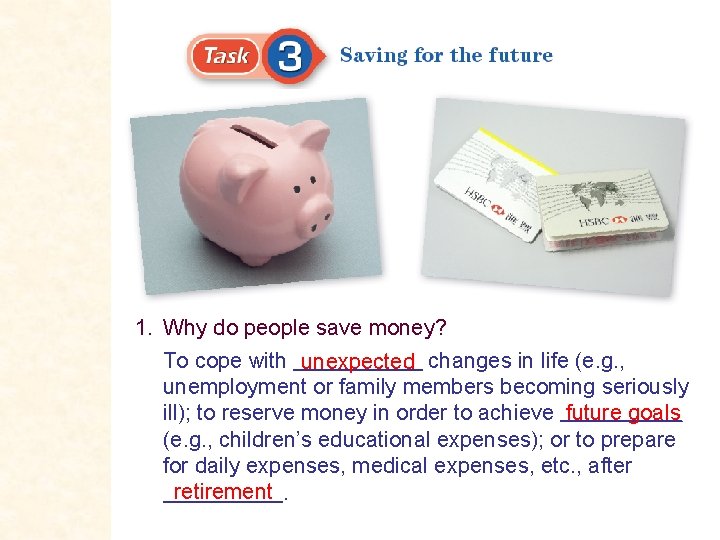
1. Why do people save money? To cope with unexpected changes in life (e. g. , unemployment or family members becoming seriously future goals ill); to reserve money in order to achieve ___________ (e. g. , children’s educational expenses); or to prepare for daily expenses, medical expenses, etc. , after retirement.
2. Do you have any savings plan now? If yes, how much do you plan to save? Free answers. 3. How will you use your savings? Free answers.
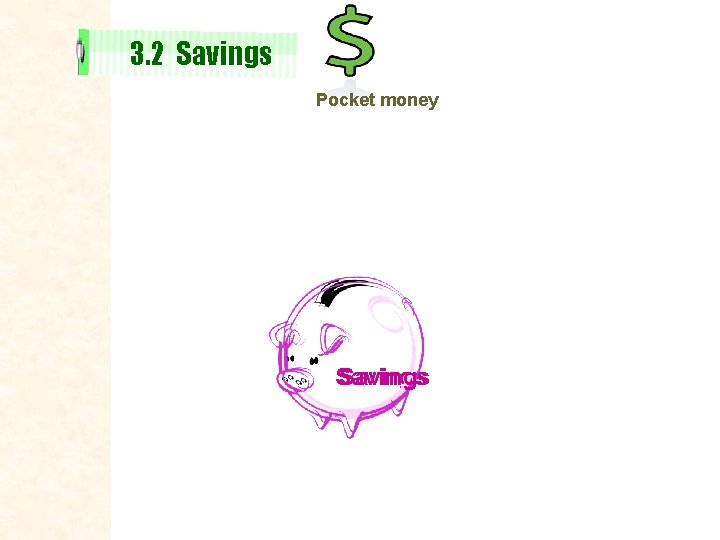
3. 2 Savings Pocket money Savings
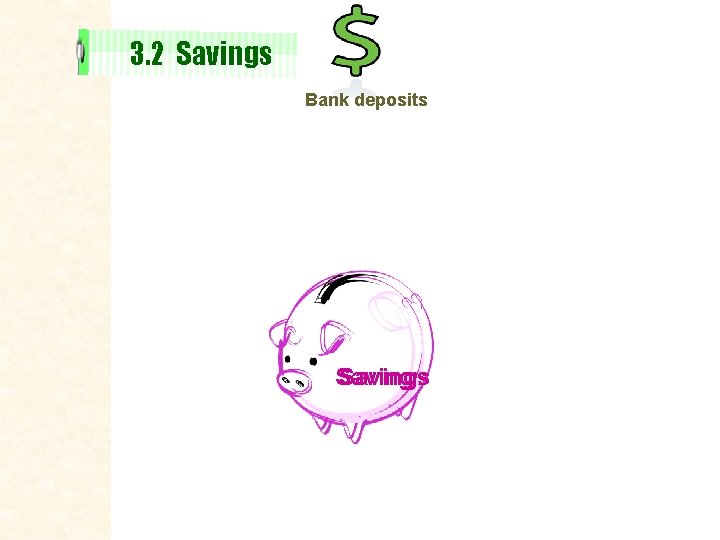
3. 2 Savings Bank deposits Savings
3. 2 Savings MPF contributions Savings
3. 2 Savings A. Why do we save? 1. Cope with unexpected changes We may exceed our budget due to unexpected changes in life. For example, we may become unemployed, or our family members may get seriously ill. When these occur, we need to use our savings to meet urgent needs. Can you list some expenses that you may incur suddenly? Free answers. Suggested answer: Cost of taking a taxi to school because one overslept; cost of buying a new lunch because one knocked over his/her lunchbox
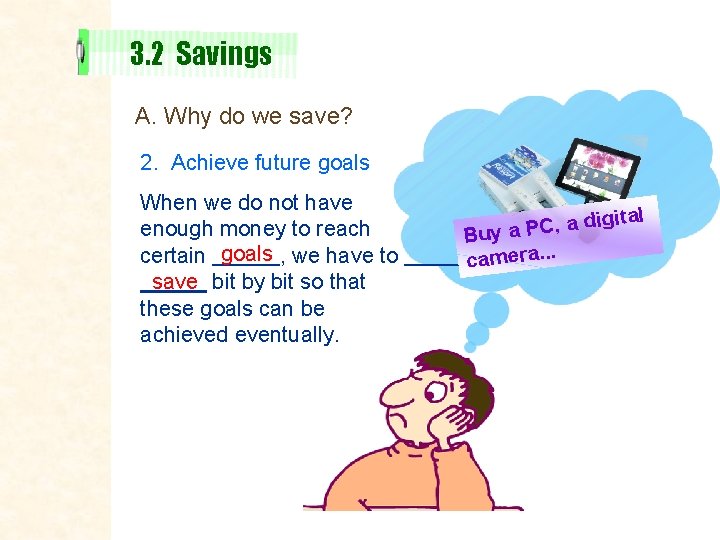
3. 2 Savings A. Why do we save? 2. Achieve future goals When we do not have enough money to reach certain goals , we have to save bit by bit so that these goals can be achieved eventually. a dig , C P a y Bu camera. . . ital
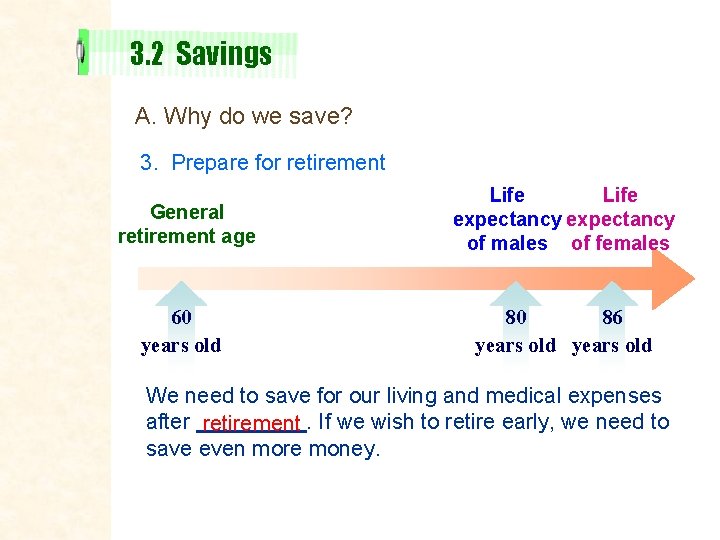
3. 2 Savings A. Why do we save? 3. Prepare for retirement General retirement age Life expectancy of males of females 60 years old 80 86 years old We need to save for our living and medical expenses after retirement. If we wish to retire early, we need to save even more money.
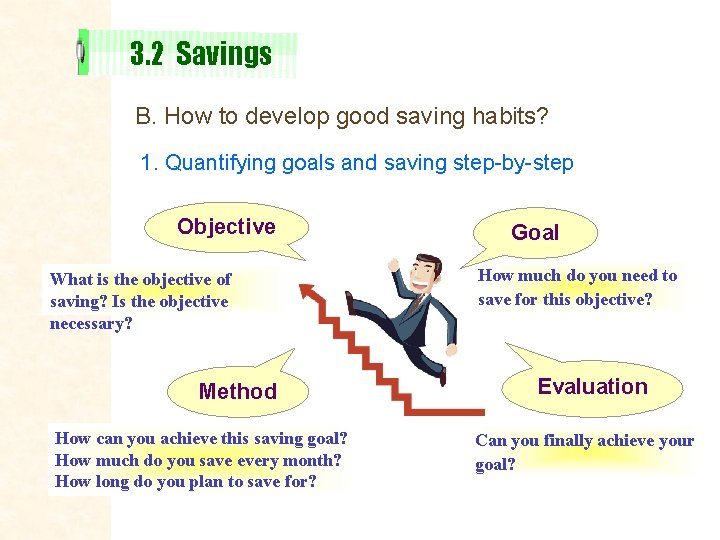
3. 2 Savings B. How to develop good saving habits? 1. Quantifying goals and saving step-by-step Objective What is the objective of saving? Is the objective necessary? Method How can you achieve this saving goal? How much do you save every month? How long do you plan to save for? Goal How much do you need to save for this objective? Evaluation Can you finally achieve your goal?
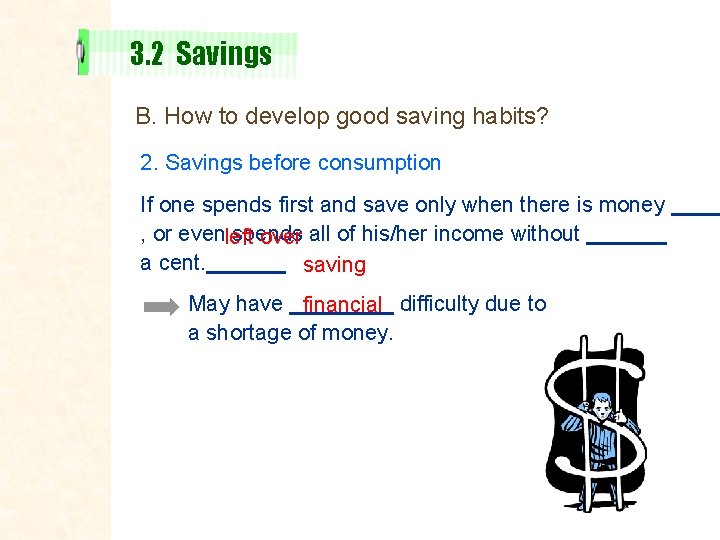
3. 2 Savings B. How to develop good saving habits? 2. Savings before consumption If one spends first and save only when there is money , or evenleft spends over all of his/her income without a cent. saving May have financial difficulty due to a shortage of money.
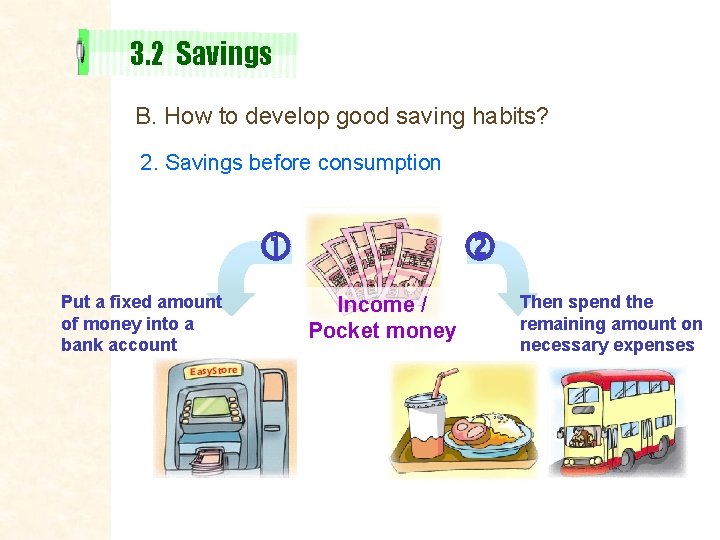
3. 2 Savings B. How to develop good saving habits? 2. Savings before consumption Put a fixed amount of money into a bank account Income / Pocket money Then spend the remaining amount on necessary expenses
3. 2 Savings B. How to develop good saving habits? 3. Start saving as early as possible We can earn interest on bank deposits.
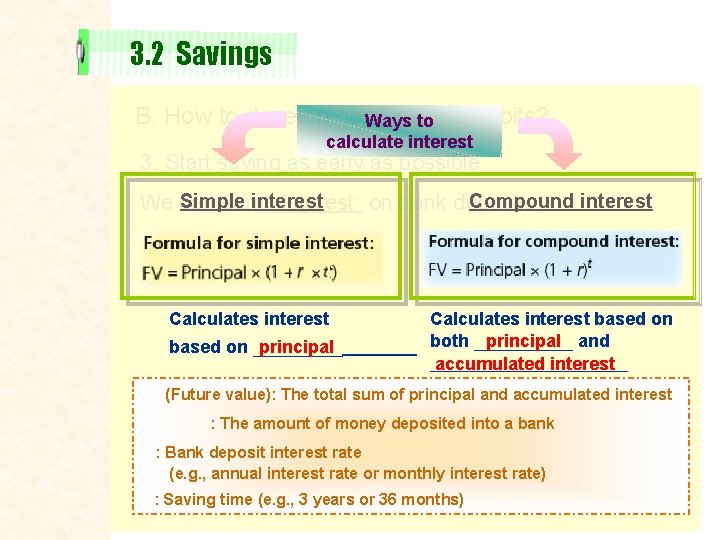
3. 2 Savings B. How to develop good saving habits? Ways to calculate interest 3. Start saving as early as possible Simple interest Compound interest We can earn interest on bank deposits. Calculates interest based on _____ principal Calculates interest based on both ______ principal and ___________ accumulated interest (Future value): The total sum of principal and accumulated interest : The amount of money deposited into a bank : Bank deposit interest rate (e. g. , annual interest rate or monthly interest rate) : Saving time (e. g. , 3 years or 36 months)
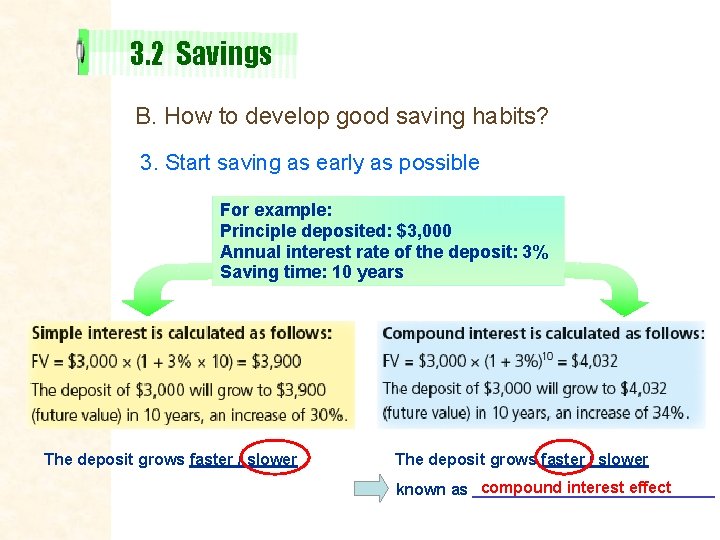
3. 2 Savings B. How to develop good saving habits? 3. Start saving as early as possible For example: Principle deposited: $3, 000 Annual interest rate of the deposit: 3% Saving time: 10 years The deposit grows faster / slower known as compound interest effect
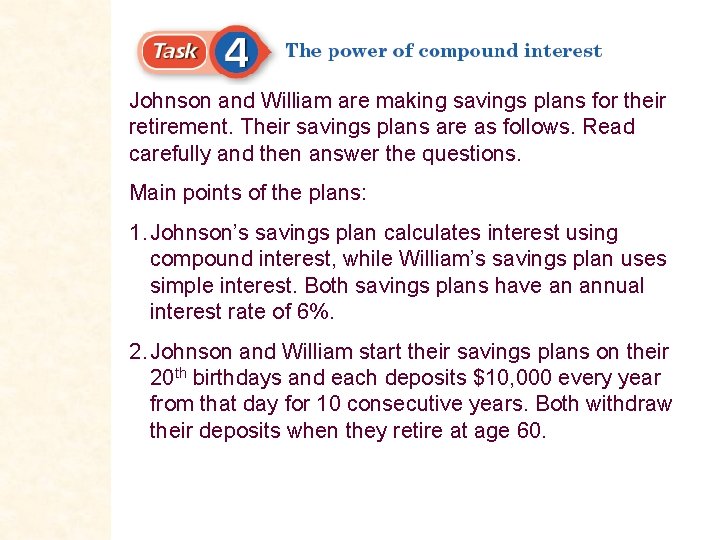
Johnson and William are making savings plans for their retirement. Their savings plans are as follows. Read carefully and then answer the questions. Main points of the plans: 1. Johnson’s savings plan calculates interest using compound interest, while William’s savings plan uses simple interest. Both savings plans have an annual interest rate of 6%. 2. Johnson and William start their savings plans on their 20 th birthdays and each deposits $10, 000 every year from that day for 10 consecutive years. Both withdraw their deposits when they retire at age 60.
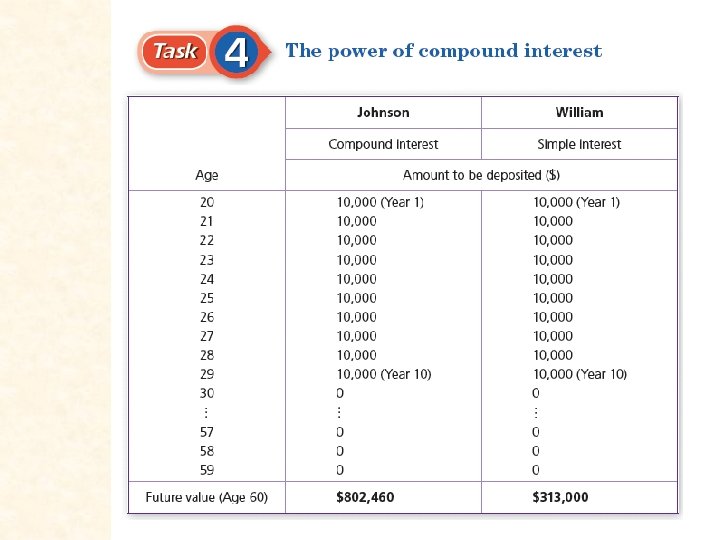
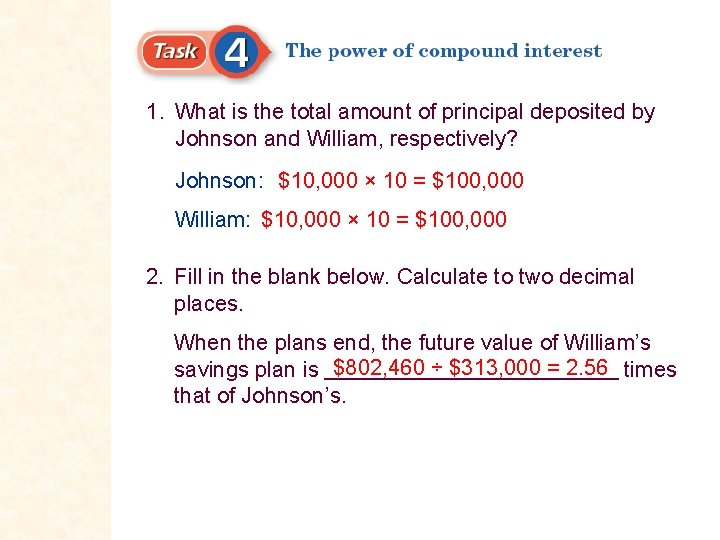
1. What is the total amount of principal deposited by Johnson and William, respectively? Johnson: $10, 000 × 10 = $100, 000 William: $10, 000 × 10 = $100, 000 2. Fill in the blank below. Calculate to two decimal places. When the plans end, the future value of William’s savings plan is $802, 460 ÷ $313, 000 = 2. 56 times that of Johnson’s.
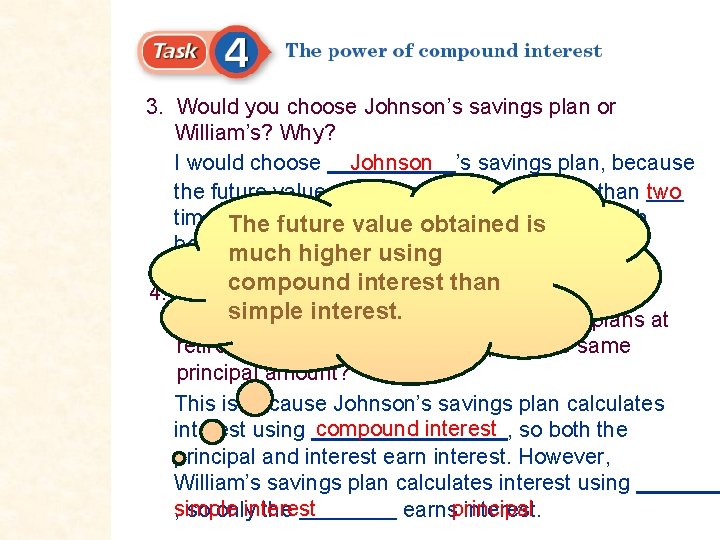
3. Would you choose Johnson’s savings plan or William’s? Why? I would choose Johnson ’s savings plan, because the future value of his savings plan is more than two times The that of William’s savings plan, is even though future value obtained both deposit the same amount of principal. much higher using compound interest than 4. Why is there a big difference between the future simple interest. values of Johnson’s and William’s savings plans at retirement, even though both deposit the same principal amount? This is because Johnson’s savings plan calculates interest using compound interest , so both the principal and interest earn interest. However, William’s savings plan calculates interest using simple interest , so only the earnsprincipal interest.
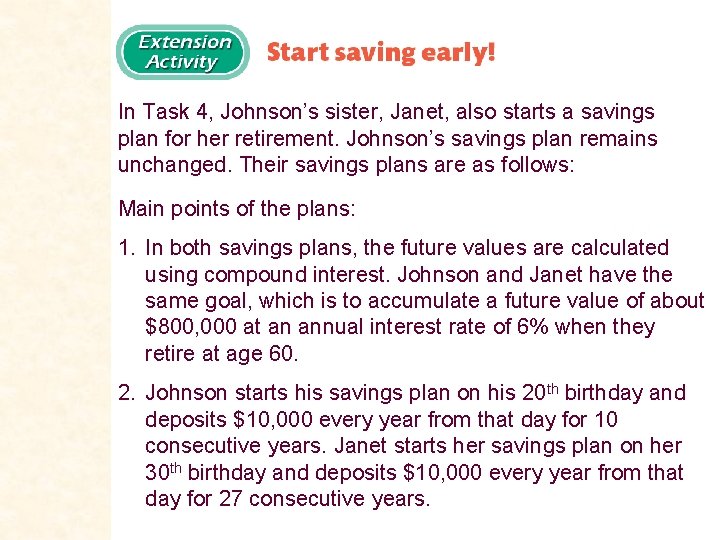
In Task 4, Johnson’s sister, Janet, also starts a savings plan for her retirement. Johnson’s savings plan remains unchanged. Their savings plans are as follows: Main points of the plans: 1. In both savings plans, the future values are calculated using compound interest. Johnson and Janet have the same goal, which is to accumulate a future value of about $800, 000 at an annual interest rate of 6% when they retire at age 60. 2. Johnson starts his savings plan on his 20 th birthday and deposits $10, 000 every year from that day for 10 consecutive years. Janet starts her savings plan on her 30 th birthday and deposits $10, 000 every year from that day for 27 consecutive years.
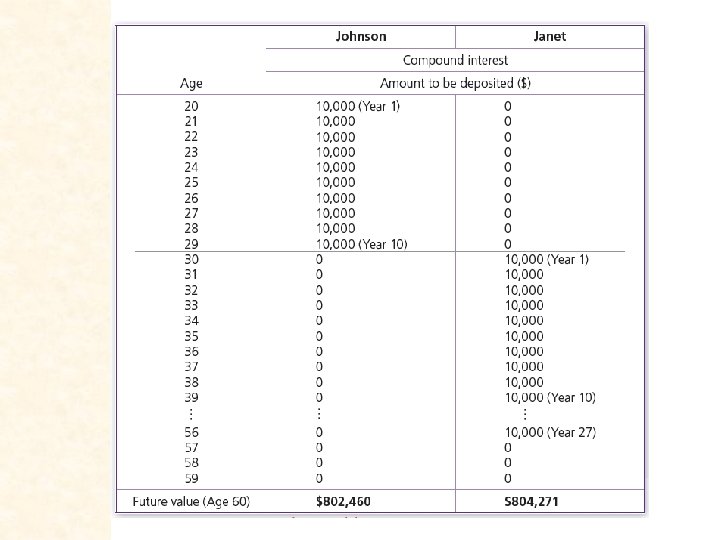
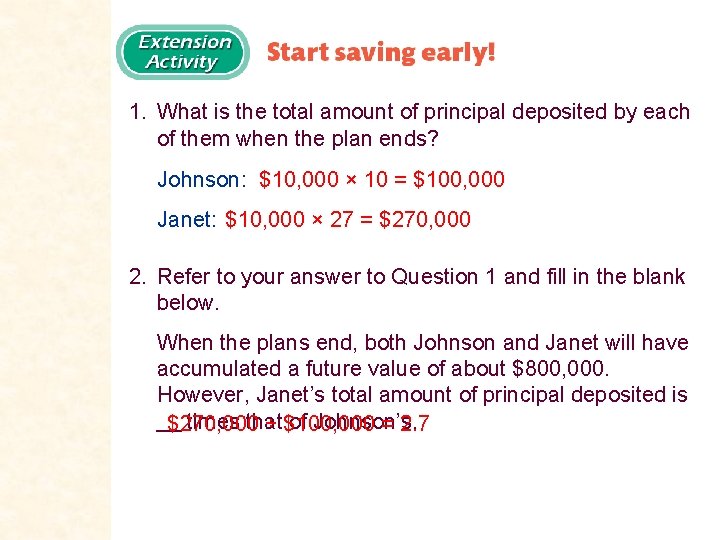
1. What is the total amount of principal deposited by each of them when the plan ends? Johnson: $10, 000 × 10 = $100, 000 Janet: $10, 000 × 27 = $270, 000 2. Refer to your answer to Question 1 and fill in the blank below. When the plans end, both Johnson and Janet will have accumulated a future value of about $800, 000. However, Janet’s total amount of principal deposited is times that of Johnson’s. $270, 000 ÷ $100, 000 = 2. 7
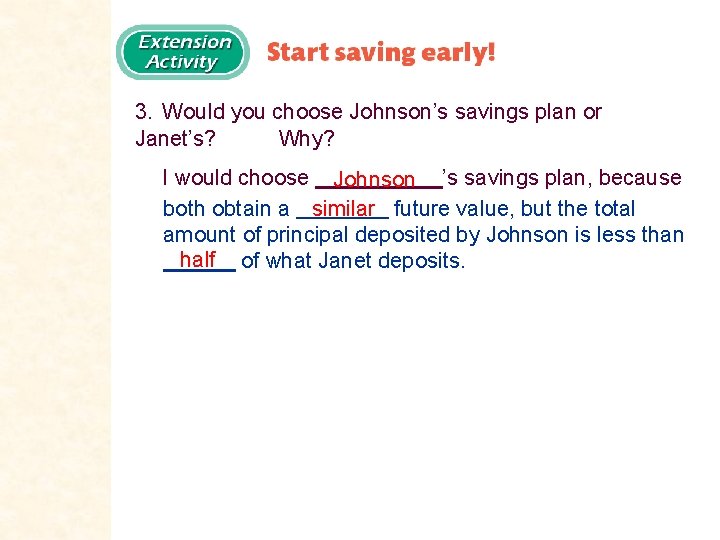
3. Would you choose Johnson’s savings plan or Janet’s? Why? I would choose Johnson ’s savings plan, because both obtain a similar future value, but the total amount of principal deposited by Johnson is less than half of what Janet deposits.
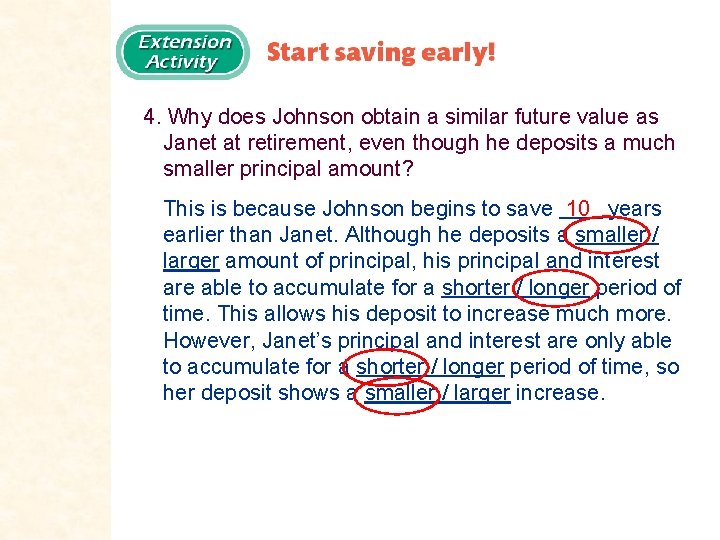
4. Why does Johnson obtain a similar future value as Janet at retirement, even though he deposits a much smaller principal amount? This is because Johnson begins to save 10 years earlier than Janet. Although he deposits a smaller / larger amount of principal, his principal and interest are able to accumulate for a shorter / longer period of time. This allows his deposit to increase much more. However, Janet’s principal and interest are only able to accumulate for a shorter / longer period of time, so her deposit shows a smaller / larger increase.
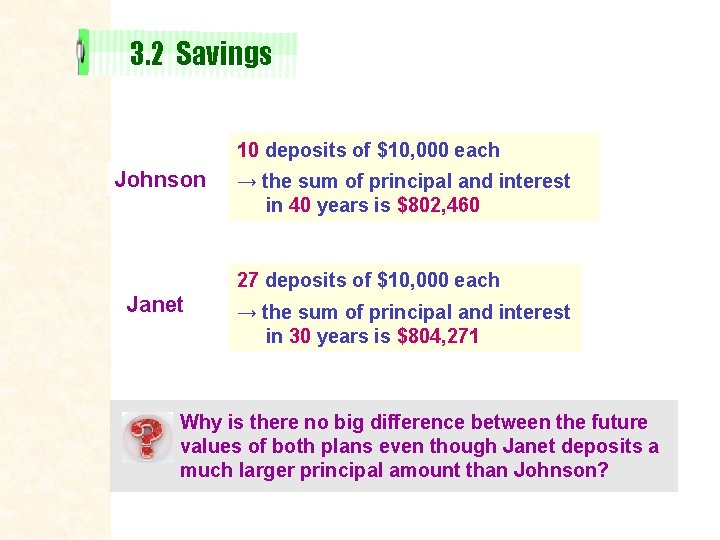
3. 2 Savings 10 deposits of $10, 000 each Johnson → the sum of principal and interest in 40 years is $802, 460 27 deposits of $10, 000 each Janet → the sum of principal and interest in 30 years is $804, 271 Why is there no big difference between the future values of both plans even though Janet deposits a much larger principal amount than Johnson?
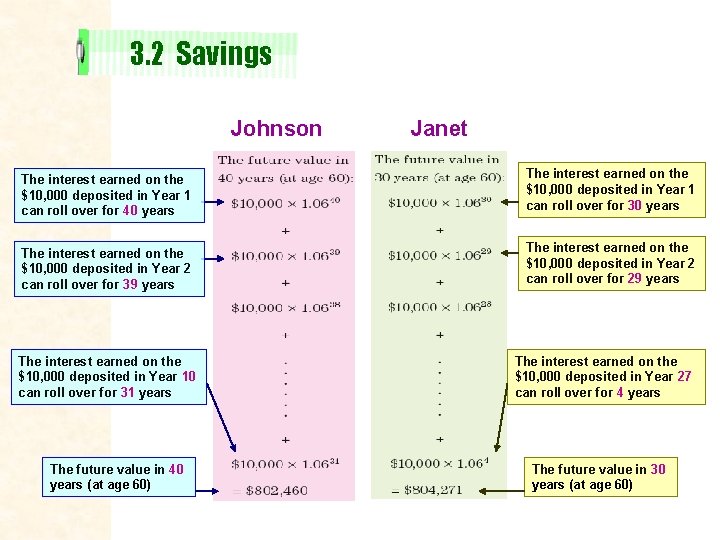
3. 2 Savings Johnson Janet The interest earned on the $10, 000 deposited in Year 1 can roll over for 40 years The interest earned on the $10, 000 deposited in Year 1 can roll over for 30 years The interest earned on the $10, 000 deposited in Year 2 can roll over for 39 years The interest earned on the $10, 000 deposited in Year 2 can roll over for 29 years The interest earned on the $10, 000 deposited in Year 10 can roll over for 31 years The future value in 40 years (at age 60) The interest earned on the $10, 000 deposited in Year 27 can roll over for 4 years The future value in 30 years (at age 60)
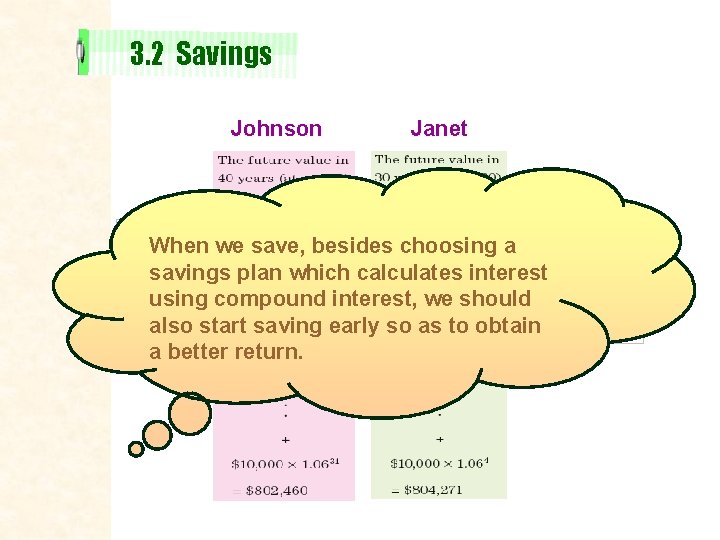
3. 2 Savings Johnson Janet Under thewe compound interestchoosing effect, as along as we When save, besides start saving plan earlier / latercalculates and allow interest the principal and savings which interest accumulateinterest, over a longer / shorter period usingtocompound we should also start saving so as to obtain of time, we can obtainearly a lower / higher future value a better return.
- Slides: 44