
Unit 2 The Origins of Banking Skills focus

Unit 2 The Origins of Banking
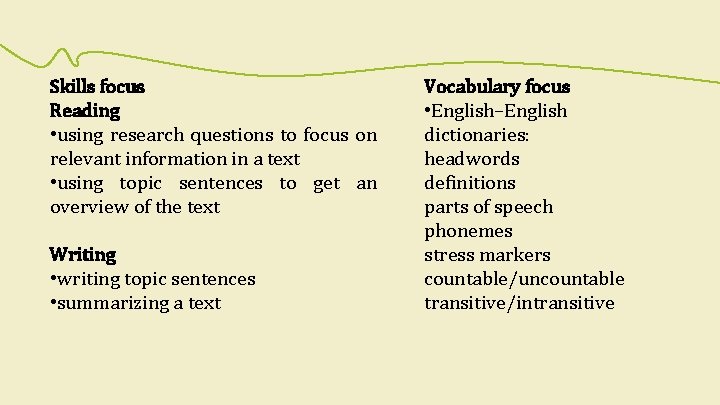
Skills focus Reading • using research questions to focus on relevant information in a text • using topic sentences to get an overview of the text Writing • writing topic sentences • summarizing a text Vocabulary focus • English–English dictionaries: headwords definitions parts of speech phonemes stress markers countable/uncountable transitive/intransitive
2. 1 Vocabulary 2. 2 Reading 2. 3 Extending skills 2. 4 Extending skills
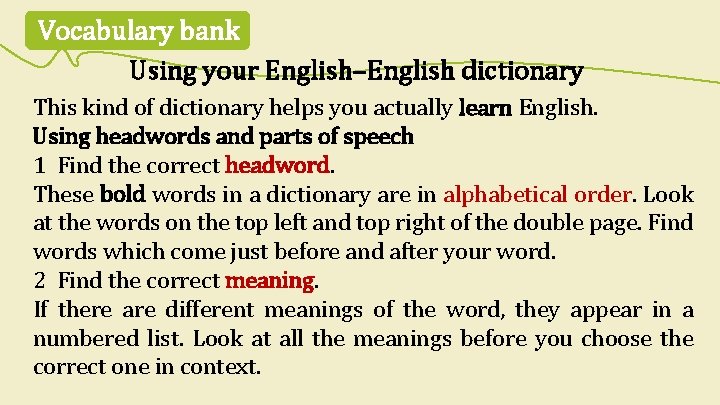
Vocabulary bank Using your English–English dictionary This kind of dictionary helps you actually learn English. Using headwords and parts of speech 1 Find the correct headword. These bold words in a dictionary are in alphabetical order. Look at the words on the top left and top right of the double page. Find words which come just before and after your word. 2 Find the correct meaning. If there are different meanings of the word, they appear in a numbered list. Look at all the meanings before you choose the correct one in context.
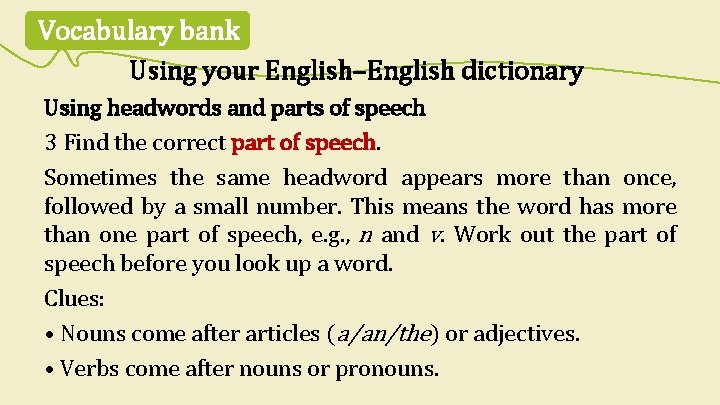
Vocabulary bank Using your English–English dictionary Using headwords and parts of speech 3 Find the correct part of speech. Sometimes the same headword appears more than once, followed by a small number. This means the word has more than one part of speech, e. g. , n and v. Work out the part of speech before you look up a word. Clues: • Nouns come after articles (a/an/the) or adjectives. • Verbs come after nouns or pronouns.
2. 1 Vocabulary A How can an English–English dictionary help you understand produce spoken and written English? The following information is useful for spoken English: lstress lpronunciation of individual phonemes – particularly when a phoneme has multiple pronunciations The following information is useful for written English: linformation about the type of word – C/U; T/I lthe spelling lexamples of the word in use to memorize lsome synonyms for lexical cohesion
2. 1 Vocabulary B Study the dictionary extract in your textbook. 1 Why are the two words (top left and top right) important? They tell you the first and last words on the pages to help you locate the word you want. 2 How many parts of speech does the word bankrupt have? Two: noun and adjective. 3 What do the superscript numbers mean after the word bank? That there are two entries giving different meanings of the word bank: the first entry gives the meaning related to finance, and the second entry gives the meaning related to geography.
2. 1 Vocabulary B Study the dictionary extract in your textbook. 4 What do the numbers 1– 4 mean in the definitions for the word bank? It has four meanings related to finance. 5 Say the word account. Where is the stress? On the second syllable. 6 Where is the stress in bank account? Main stress is on the first word, bank; secondary stress in ac′count. 7 What is the pronunciation of a in each bold word in this extract? Four pronunciations: /æ/, /a: /, /ei/, /ə/.
2. 1 Vocabulary B Study the dictionary extract in your textbook. 8 What is the pronunciation of c in each bold word in this extract? Two pronunciations: /k/, /s/. 9 What part of speech is bankable? Adjective. 10 Are both of these correct? He is a bankrupt/He is bankrupt. Yes, because bankrupt can be a noun or an adjective. 11 Can we say I banked today? Why (not)? No, because bank is either transitive – you must say what you banked – or, when intransitive, must be followed by with.
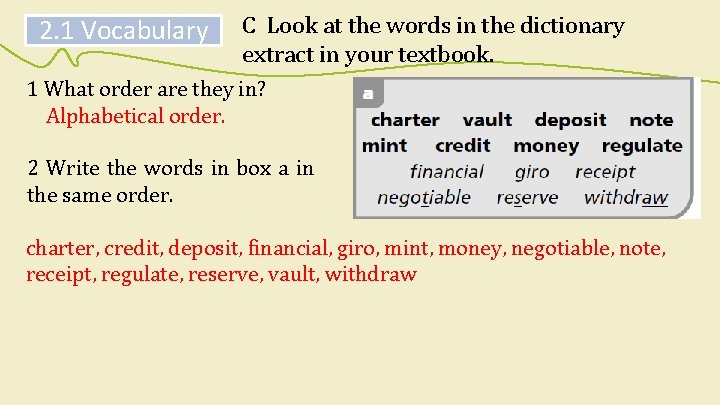
2. 1 Vocabulary C Look at the words in the dictionary extract in your textbook. 1 What order are they in? Alphabetical order. 2 Write the words in box a in the same order. charter, credit, deposit, financial, giro, mint, money, negotiable, note, receipt, regulate, reserve, vault, withdraw
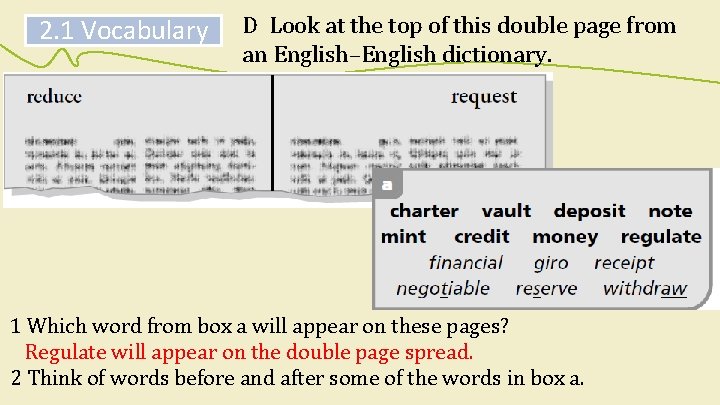
2. 1 Vocabulary D Look at the top of this double page from an English–English dictionary. 1 Which word from box a will appear on these pages? Regulate will appear on the double page spread. 2 Think of words before and after some of the words in box a.
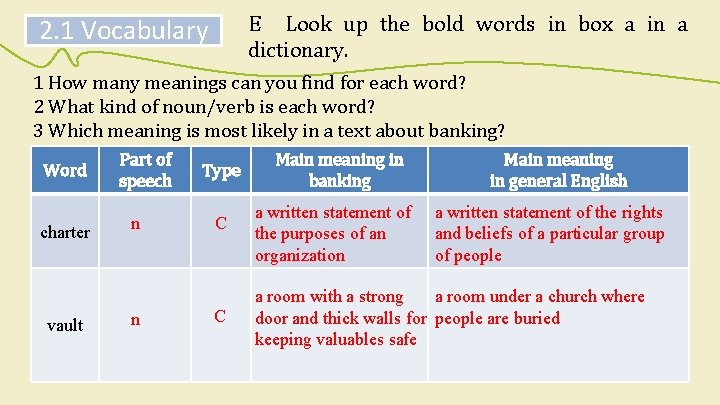
2. 1 Vocabulary E Look up the bold words in box a in a dictionary. 1 How many meanings can you find for each word? 2 What kind of noun/verb is each word? 3 Which meaning is most likely in a text about banking? Word charter vault Part of speech n n Type C C Main meaning in banking a written statement of the purposes of an organization Main meaning in general English a written statement of the rights and beliefs of a particular group of people a room with a strong a room under a church where door and thick walls for people are buried keeping valuables safe
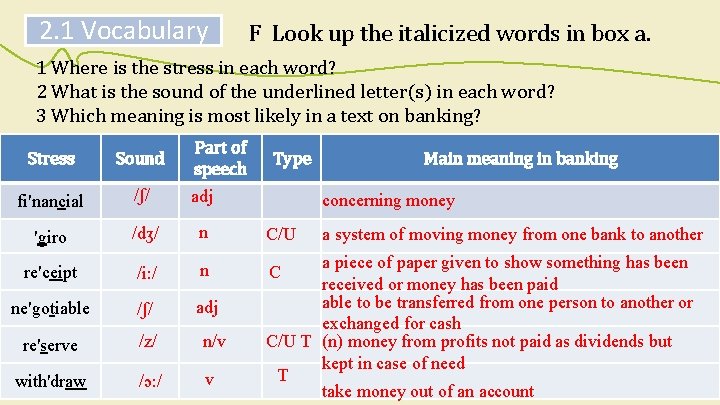
2. 1 Vocabulary F Look up the italicized words in box a. 1 Where is the stress in each word? 2 What is the sound of the underlined letter(s) in each word? 3 Which meaning is most likely in a text on banking? Part of speech Stress Sound Type Main meaning in banking fi'nancial /ʃ/ adj 'giro /dʒ/ n C/U re'ceipt /i: / n ne'gotiable /ʃ/ adj re'serve /z/ n/v with'draw /ɔ: / v a piece of paper given to show something has been received or money has been paid able to be transferred from one person to another or exchanged for cash C/U T (n) money from profits not paid as dividends but kept in case of need T take money out of an account concerning money C a system of moving money from one bank to another
2. 1 Vocabulary G Test each other on the words from Exercises E and F. Give the dictionary definition of one of the words. Can your partner guess which word you are defining?
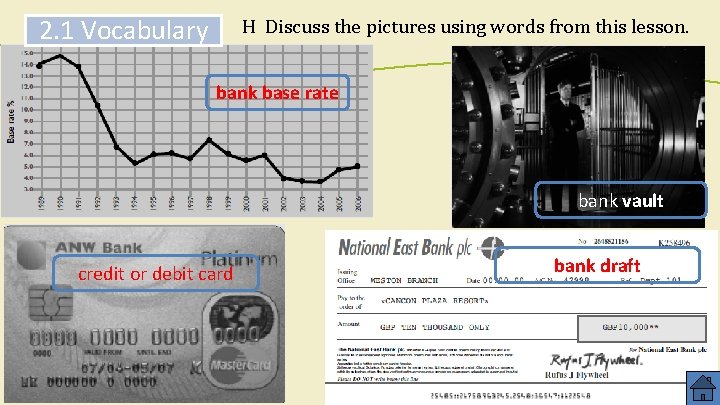
2. 1 Vocabulary H Discuss the pictures using words from this lesson. bank base rate bank vault credit or debit card bank draft
2. 2 Reading A What was the first significant innovation in the history of banking? If you don’t know, guess! How about: Ømoney-changing services Øa system of credit
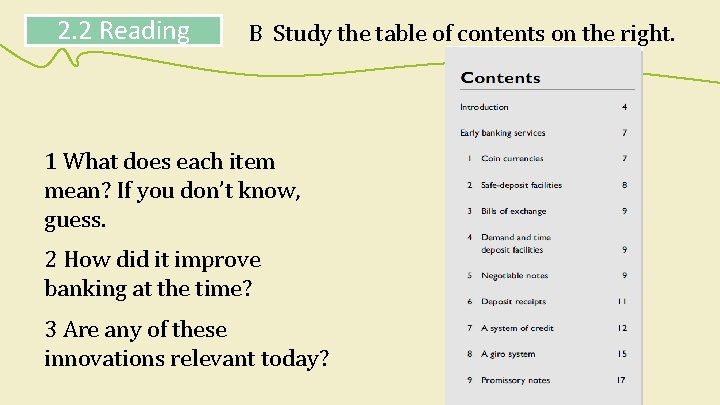
2. 2 Reading B Study the table of contents on the right. 1 What does each item mean? If you don’t know, guess. 2 How did it improve banking at the time? 3 Are any of these innovations relevant today?
2. 2 Reading C You are going to read a text. What should you do before you read a text in detail? See Skills bank.
Skills bank Doing reading research Before you start reading … l. Think of research questions. In other words, ask yourself: What must I find out from my research? l. Look at headings, sub-headings, illustrations, etc. Look for patterns or variations in presentation, e. g. , a series of dates; words in bold or italic script. Think: What information do they give me? l. Decide how to record information from your reading. Choose one or more methods of note-taking. See Unit 1 Skills bank.
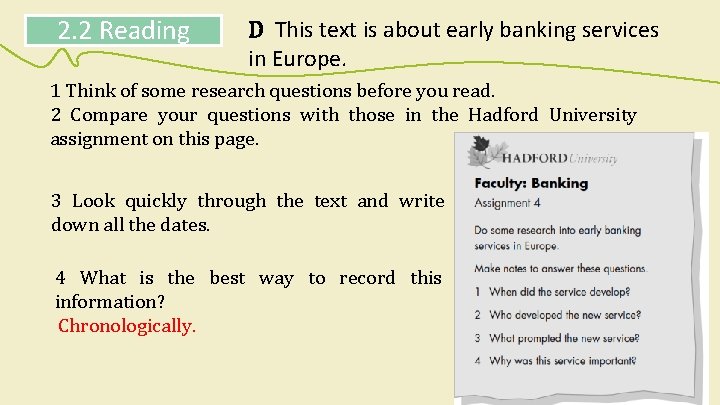
2. 2 Reading D This text is about early banking services in Europe. 1 Think of some research questions before you read. 2 Compare your questions with those in the Hadford University assignment on this page. 3 Look quickly through the text and write down all the dates. 4 What is the best way to record this information? Chronologically.
2. 2 Reading E Study these topic sentences from the text and answer the questions below. 1 What are the banking services mentioned in this text? Safe-deposit vaults, coin currency, minting, receipts against gold. 2 Where do you expect to find the answer to each question in the Hadford University assignment? Write 1, 2 or 3 next to the sentence. The first safe-deposit vaults were operated by royal palaces and temples. 2 The ancient Greeks developed money in the form of silver and bronze coins. 2 During the Middle Ages, European monarchs controlled the production, or minting, of coins. 1, 2 By the 17 th century, goldsmiths were issuing additional receipts against the gold to borrowers. 1, 2 The 1882 Bills of Exchange Act defined banking as trading in money by investing, lending or exchanging it.
2. 2 Reading F Read the text on the opposite page and check your ideas. See Skills bank.
Skills bank Doing reading research While you are reading … l. Highlight the topic sentences. Which paragraph(s) will probably give me the answer to my research questions? l. Think: l. Read these paragraphs first. l. Make notes. After reading … l. Think: l. If Did the text answer all my research questions? the answer is no, look at other paragraphs to see if the information is there.
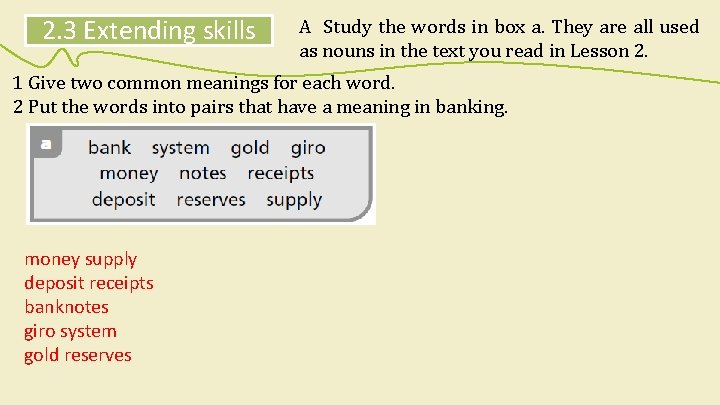
2. 3 Extending skills A Study the words in box a. They are all used as nouns in the text you read in Lesson 2. 1 Give two common meanings for each word. 2 Put the words into pairs that have a meaning in banking. money supply deposit receipts banknotes giro system gold reserves
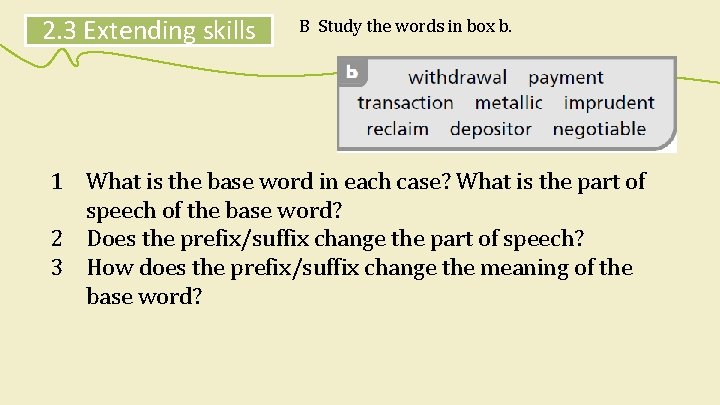
2. 3 Extending skills B Study the words in box b. 1 What is the base word in each case? What is the part of speech of the base word? 2 Does the prefix/suffix change the part of speech? 3 How does the prefix/suffix change the meaning of the base word?
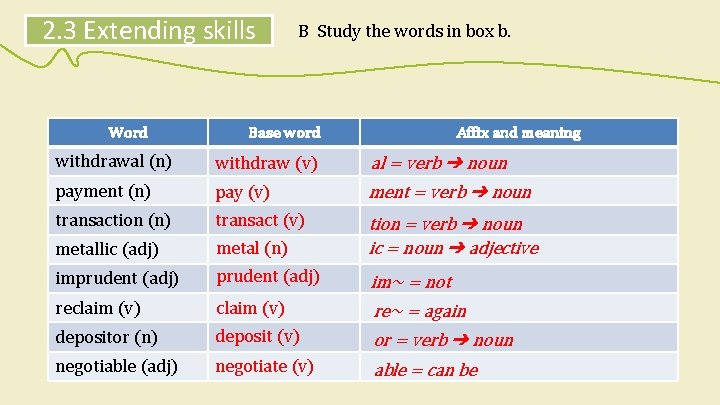
2. 3 Extending skills Word B Study the words in box b. Base word Affix and meaning withdrawal (n) withdraw (v) al = verb ➔ noun payment (n) pay (v) ment = verb ➔ noun transaction (n) transact (v) metallic (adj) metal (n) tion = verb ➔ noun ic = noun ➔ adjective imprudent (adj) reclaim (v) im~ = not re~ = again depositor (n) deposit (v) or = verb ➔ noun negotiable (adj) negotiate (v) able = can be
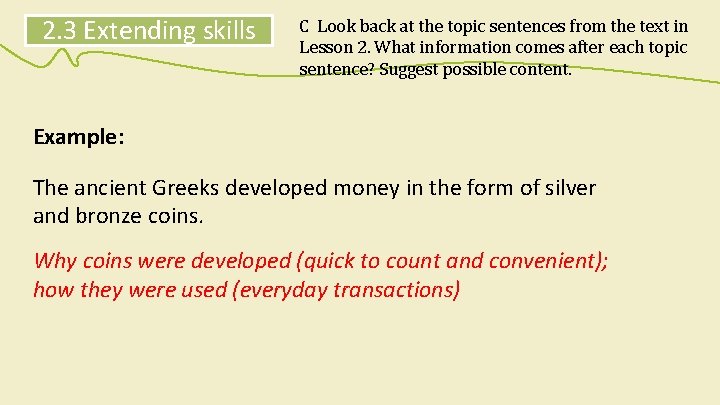
2. 3 Extending skills C Look back at the topic sentences from the text in Lesson 2. What information comes after each topic sentence? Suggest possible content. Example: The ancient Greeks developed money in the form of silver and bronze coins. Why coins were developed (quick to count and convenient); how they were used (everyday transactions)
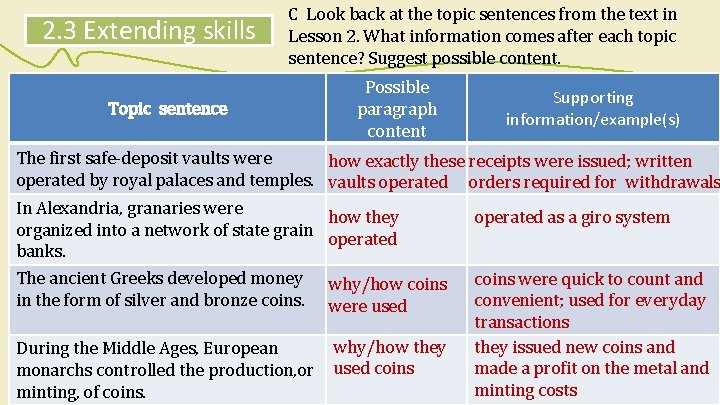
2. 3 Extending skills C Look back at the topic sentences from the text in Lesson 2. What information comes after each topic sentence? Suggest possible content. Topic sentence Possible paragraph content Supporting information/example(s) The first safe-deposit vaults were how exactly these receipts were issued; written operated by royal palaces and temples. vaults operated orders required for withdrawals In Alexandria, granaries were how they operated as a giro system organized into a network of state grain operated banks. The ancient Greeks developed money in the form of silver and bronze coins. why/how coins were used During the Middle Ages, European monarchs controlled the production, or minting, of coins. why/how they used coins were quick to count and convenient; used for everyday transactions they issued new coins and made a profit on the metal and minting costs
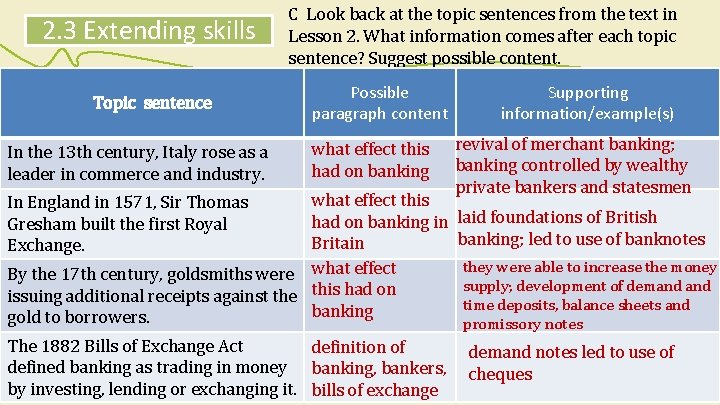
2. 3 Extending skills Topic sentence In the 13 th century, Italy rose as a leader in commerce and industry. C Look back at the topic sentences from the text in Lesson 2. What information comes after each topic sentence? Suggest possible content. Possible paragraph content what effect this had on banking in Britain By the 17 th century, goldsmiths were what effect issuing additional receipts against the this had on banking gold to borrowers. In England in 1571, Sir Thomas Gresham built the first Royal Exchange. The 1882 Bills of Exchange Act definition of defined banking as trading in money banking, bankers, by investing, lending or exchanging it. bills of exchange Supporting information/example(s) revival of merchant banking; banking controlled by wealthy private bankers and statesmen laid foundations of British banking; led to use of banknotes they were able to increase the money supply; development of demand time deposits, balance sheets and promissory notes demand notes led to use of cheques
2. 3 Extending skills See Skills bank. D Write a summary of the text from Lesson 2. Paraphrase the topic sentences. Add extra information and examples.
Skills bank Using topic sentences to summarise The topic sentences of a text normally make a good basis for a summary. Follow this procedure: l. Locate the topic sentences. l. Paraphrase them – in other words, rewrite them in your own words so that the meaning is the same. Do not simply copy them. (This is a form of plagiarism. ) l. Add supporting information – once again, in your own words. l. Check your summary. Check that the ideas flow logically. Check spelling and grammar. If your summary is short, it may be just one paragraph. Divide a longer summary into paragraphs.
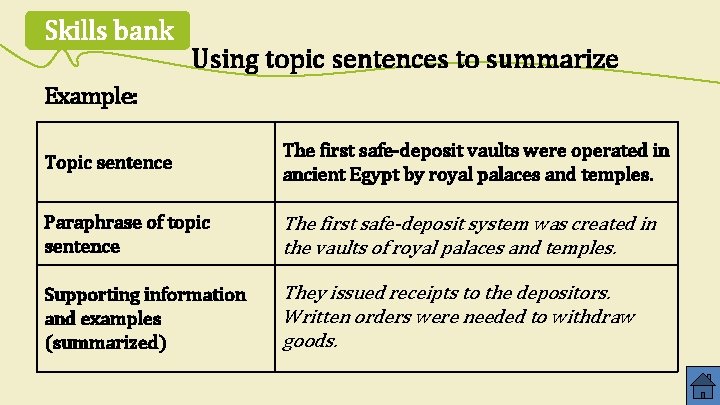
Skills bank Using topic sentences to summarize Example: Topic sentence The first safe-deposit vaults were operated in ancient Egypt by royal palaces and temples. Paraphrase of topic sentence The first safe-deposit system was created in the vaults of royal palaces and temples. Supporting information and examples (summarized) They issued receipts to the depositors. Written orders were needed to withdraw goods.
2. 4 Extending skills A Can you remember all the early European banking innovations from Lesson 2? Possible answers: ücoin currencies üsafe-deposit facilities übills of exchange üdemand time deposit facilities ünegotiable notes üdeposit receipts üa system of credit üa giro system üpromissory notes
2. 4 Extending skills B The lecturer has asked you to research early American banking. 1 Think of good research questions before you read the text. 2 Look quickly at the text on the opposite page. What is the best way to record information in this case while you are reading? Timeline/chronological notes.
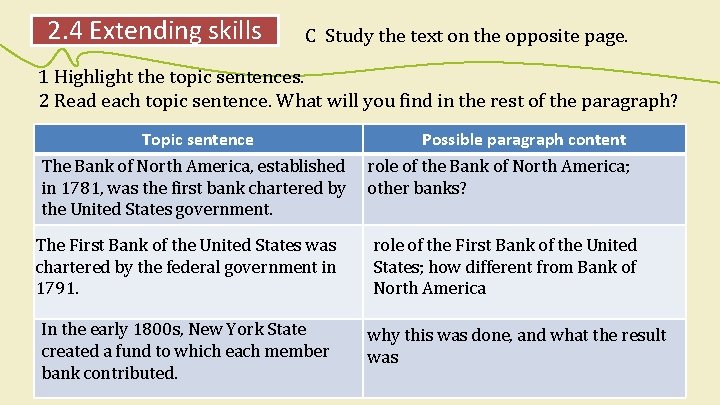
2. 4 Extending skills C Study the text on the opposite page. 1 Highlight the topic sentences. 2 Read each topic sentence. What will you find in the rest of the paragraph? Topic sentence The Bank of North America, established in 1781, was the first bank chartered by the United States government. The First Bank of the United States was chartered by the federal government in 1791. In the early 1800 s, New York State created a fund to which each member bank contributed. Possible paragraph content role of the Bank of North America; other banks? role of the First Bank of the United States; how different from Bank of North America why this was done, and what the result was
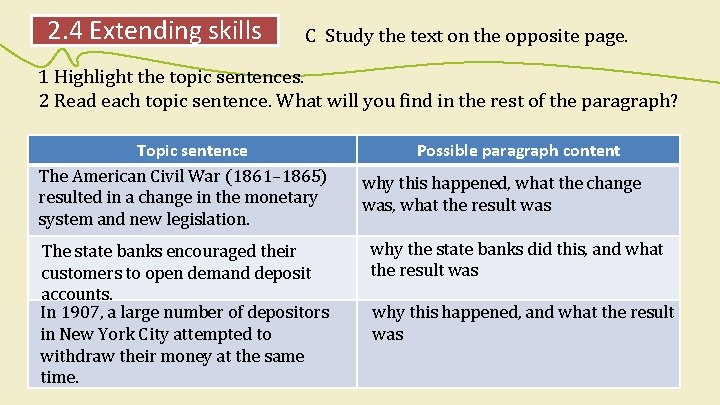
2. 4 Extending skills C Study the text on the opposite page. 1 Highlight the topic sentences. 2 Read each topic sentence. What will you find in the rest of the paragraph? Topic sentence The American Civil War (1861– 1865) resulted in a change in the monetary system and new legislation. The state banks encouraged their customers to open demand deposit accounts. In 1907, a large number of depositors in New York City attempted to withdraw their money at the same time. Possible paragraph content why this happened, what the change was, what the result was why the state banks did this, and what the result was why this happened, and what the result was
2. 4 Extending skills C Study the text on the opposite page. 3 Which paragraph(s) will probably answer each research question? Read those paragraphs and make notes. 4 Have you got all the information you need? If not, read other paragraphs.
2. 4 Extending skills D Use the Internet to research one of the early banking services from the list in Lesson 2. Use the same research questions as in Lesson 2. 1 Make notes. 2 Write a series of topic sentences which summarize your findings. 3 Report back to the other students. Read out each topic sentence, then add extra details.
Tips for Reference 2. 1 Vocabulary部分,教师讲解Vocabulary bank内容,并以小组课堂讨论 形式,讨论练习A、B、E、F、H;课后学生完成练习C、D、G。 2. 2 Reading部分,让学生课后查阅资料,完成练习A、B;教师课堂讲解 Skills bank中的“Doing reading research”技能,深度阅读文章“BANKING from the Egyptians to the Victorians”,并按次序完成练习C、D、E、F。 2. 3 Extending skills部分,学生课前完成练习A、B;课堂教师讲解练习C; 教师讲解Skills bank中的“Using topic sentences to summarize”技能,并 完成练习D。 2. 4 Extending skills部分,深度阅读文章“The History of American Banks”, 完成练习A、B、C、D。

- Slides: 40