
UNIT 2 The nutrition function PLANT NUTRITION PROCESSES


- Slides: 8
UNIT 2 The nutrition function PLANT NUTRITION PROCESSES Natural Science 2. Secondary Education
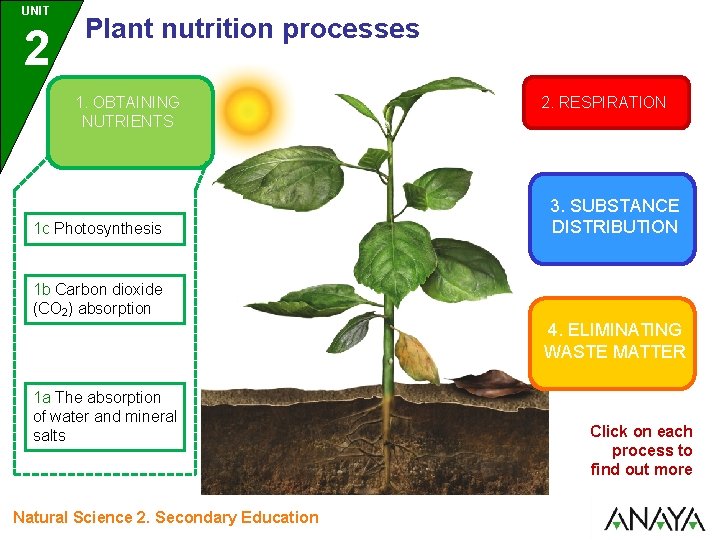
UNIT 2 Plant nutrition processes 1. OBTAINING NUTRIENTS 1 c Photosynthesis 2. RESPIRATION 3. SUBSTANCE DISTRIBUTION 1 b Carbon dioxide (CO 2) absorption 4. ELIMINATING WASTE MATTER 1 a The absorption of water and mineral salts Natural Science 2. Secondary Education Click on each process to find out more
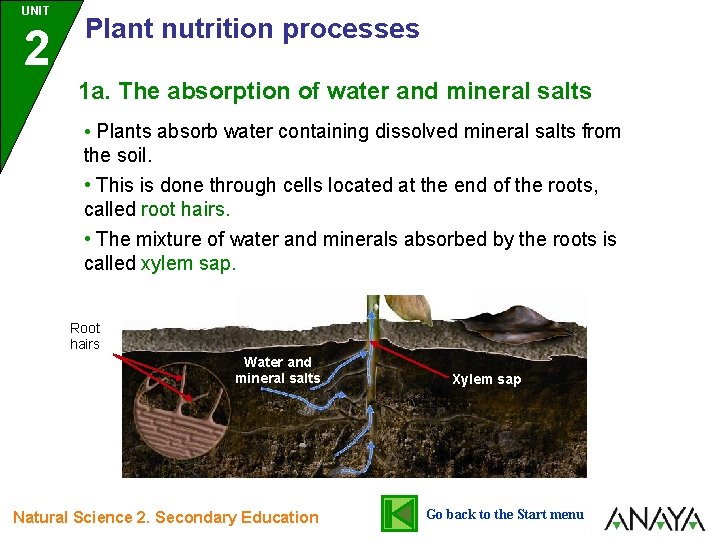
UNIT 2 Plant nutrition processes 1 a. The absorption of water and mineral salts • Plants absorb water containing dissolved mineral salts from the soil. • This is done through cells located at the end of the roots, called root hairs. • The mixture of water and minerals absorbed by the roots is called xylem sap. Root hairs Water and mineral salts Natural Science 2. Secondary Education Xylem sap Go back to the Start menu
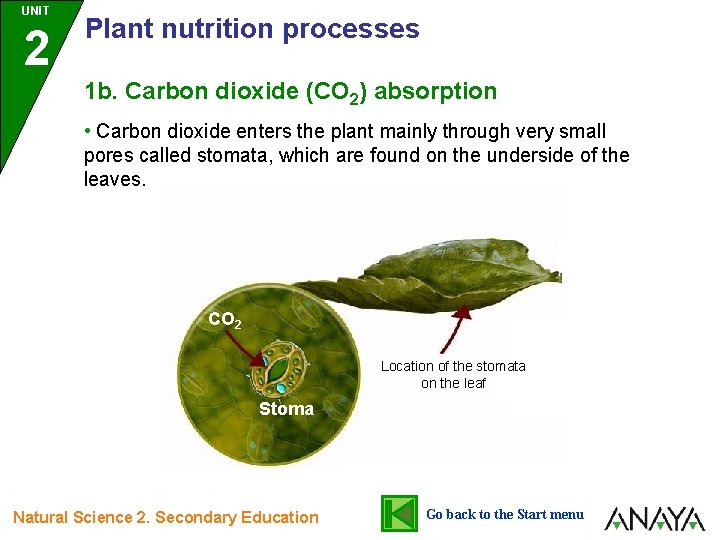
UNIT 2 Plant nutrition processes 1 b. Carbon dioxide (CO 2) absorption • Carbon dioxide enters the plant mainly through very small pores called stomata, which are found on the underside of the leaves. CO 2 Location of the stomata on the leaf Stoma Natural Science 2. Secondary Education Go back to the Start menu
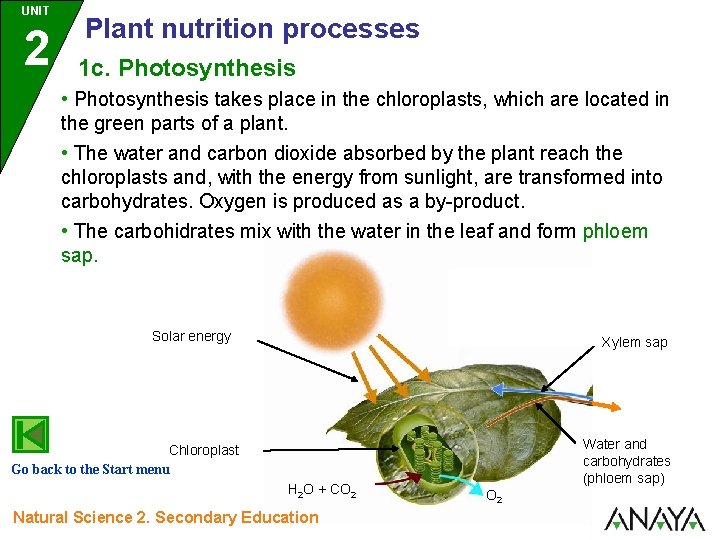
UNIT 2 Plant nutrition processes 1 c. Photosynthesis • Photosynthesis takes place in the chloroplasts, which are located in the green parts of a plant. • The water and carbon dioxide absorbed by the plant reach the chloroplasts and, with the energy from sunlight, are transformed into carbohydrates. Oxygen is produced as a by-product. • The carbohidrates mix with the water in the leaf and form phloem sap. Solar energy Xylem sap Water and carbohydrates (phloem sap) Chloroplast Go back to the Start menu H 2 O + CO 2 Natural Science 2. Secondary Education O 2
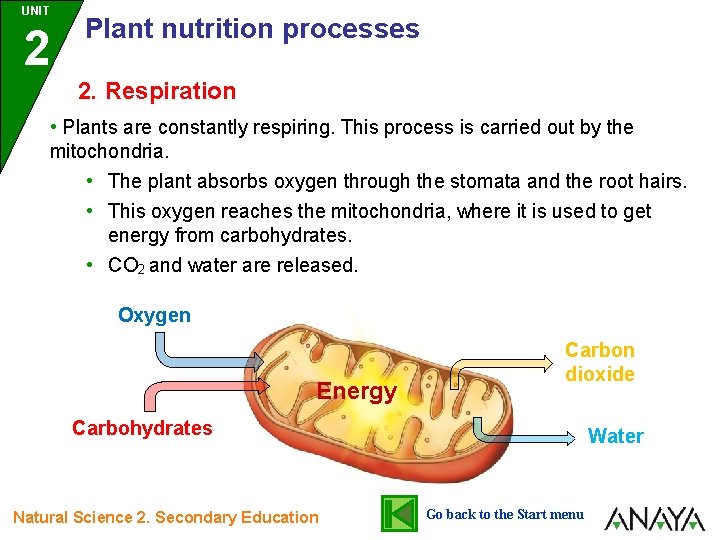
UNIT 2 Plant nutrition processes 2. Respiration • Plants are constantly respiring. This process is carried out by the mitochondria. • The plant absorbs oxygen through the stomata and the root hairs. • This oxygen reaches the mitochondria, where it is used to get energy from carbohydrates. • CO 2 and water are released. Oxygen Energy Carbon dioxide Carbohydrates Natural Science 2. Secondary Education Water Go back to the Start menu
UNIT 2 Plant nutrition processes 3. Substance distribution • Substances in the plant are transported through tube-shaped vessels which run along the stem, the branches and the leaf veins. Xylem sap Phloem sap • Some vessels take the xylem sap from the roots to the green parts of the plant. • Others distribute the phloem sap throughout the plant. Natural Science 2. Secondary Education Go back to the Start menu
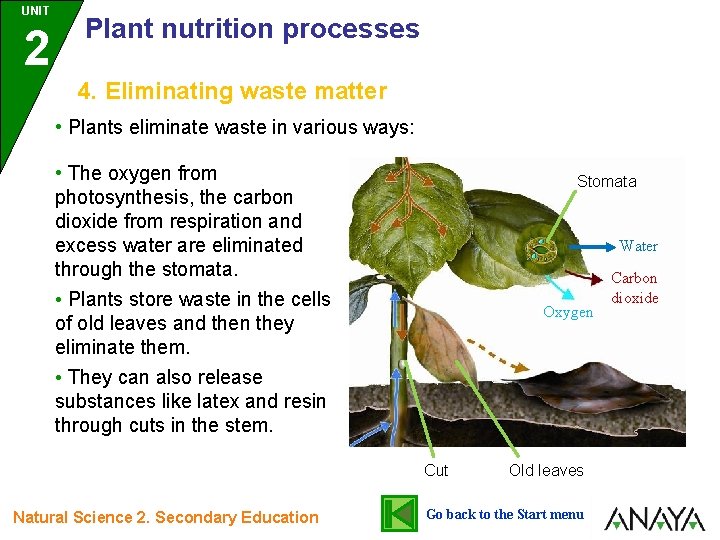
UNIT 2 Plant nutrition processes 4. Eliminating waste matter • Plants eliminate waste in various ways: • The oxygen from photosynthesis, the carbon dioxide from respiration and excess water are eliminated through the stomata. • Plants store waste in the cells of old leaves and then they eliminate them. • They can also release substances like latex and resin through cuts in the stem. Stomata Water Oxygen Cut Natural Science 2. Secondary Education Old leaves Go back to the Start menu Carbon dioxide