
Unit 2 the lifespan Infancy and childhood Adolescence









- Slides: 60
Unit 2: the lifespan Infancy and childhood Adolescence Adulthood and old age
Why is this important? Each of us born into a world in which we must adapt. From childhood to adolescence to adulthood to old age.
In this unit you will learn about; Developmental Psychology: ◦ The specialized study of how an individual’s physical, social, emotional, moral, and intellectual development occurs in a sequential interrelated stages throughout the life cycle. ◦ Developmental Psychology = study of changes that occur as an individual matures.
In what ways do we develop? Physical Perceptual Language Cognitive Emotional Social Moral Sexual Identity
Infancy and Childhood
Physical, Perceptual, and Language Development. Main Idea: ◦ Infants are born equipped to experience the world. As infants grow physically they also develop cognitive skills, perceptions, and language. Vocabulary: ◦ Developmental Psychology ◦ Grasping Reflex ◦ Rooting Reflex ◦ Maturation ◦ Telegraphic Speech Objectives: ◦ Describe the physical and perceptual development of newborns and children. ◦ Discuss the development of language.
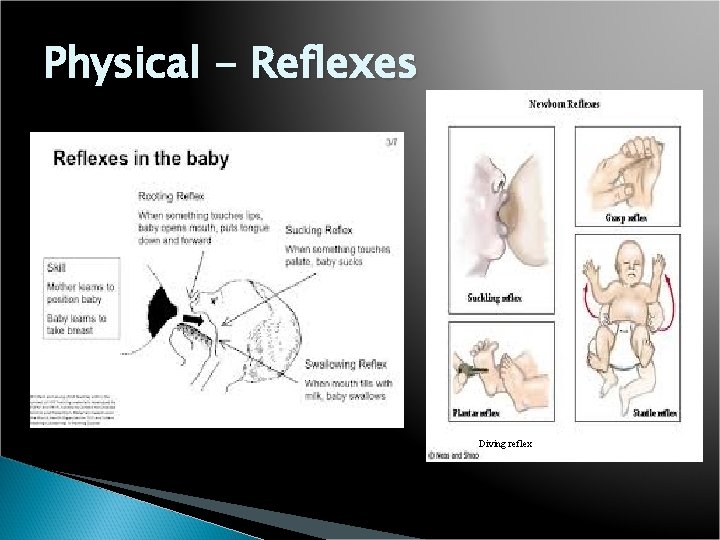
Physical Development The newborn is capable of certain inherited, automatic, coordinated movement patters, called reflexes, that can be triggered by the right stimulus. Grasping Reflex: an infant’s clinging response to a touch on the palm of his or her hand.
Rooting Reflex: an infant’s response in turning toward the source of touching that occurs anywhere around his or her mouth. ◦ Ex. Mothers breast on infants cheek guides mouth towards nipple ◦ The sucking that follows contact with the nipple is one of the infant’s most complex reflexes. Infant is able to suck, breath air, and swallow milk twice a second without getting confused.
Physical - Reflexes Diving reflex
• Infants on average weigh 7. 3 pounds at birth • Some infants can weigh up to 20 or 25 pounds by the end of the first year. • At birth, 95% of infants are between 5. 5 and 10 pounds and are 18 to 22 inches in length. • In the space of two years, the grasping, rooting, searching infant will develop into a child who can walk, talk, and feel himself. This transformation is the result of both maturation and learning.
Physical Maturation: The internally programmed growth of a child. - Maturation is as important as learning or experience, especially in the first years. Learning: is a relatively permanent change in behavior that occurs as a result of experience. Handout: Figure 3. 2/ Maturation
Perceptual How do we know what infants perceive?
Perceptual Development Besides grasping and sucking, newborns look at their bodies and at their surroundings. Newborns have mature perception skills.
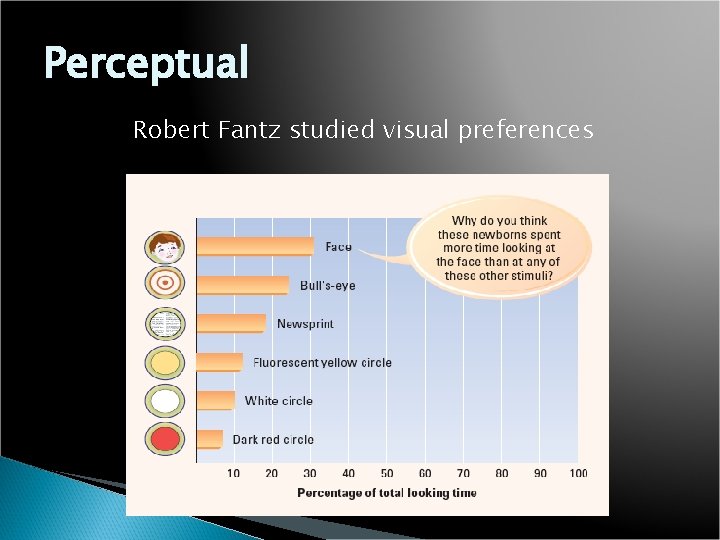
Perceptual Robert Fantz studied visual preferences
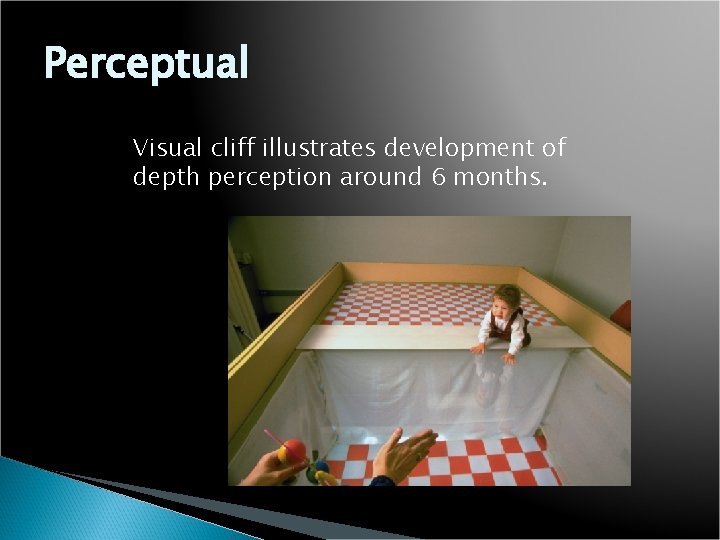
Perceptual Visual cliff illustrates development of depth perception around 6 months.
Language Development • Language and thought are closely intertwined. • Both abilities involve using symbols. • A child begins to think, to represent things to himself, before he is able to speak. • The acquisition of language, however, propels the child into further intellectual development. • �We have learned a lot about the acquisition of language from animals.
Can animals use language? • Vocabulary vs grammar (chimps can learn signs: Washoe learned 160 by age 5, but no grammar) • Chimps use words as symbols but do not apply grammatical rules. • The ability to arrange symbols in new combinations to produce new meanings is especially well developed in the human brain. • The rules for such organization of symbols are called grammar.
How Children Acquire Language? Handout: Figure 3. 6 The flowering of Language
Language Telegraphic Speech: The kind of verbal utterances in which words are left out, but the meaning is usually clear. • Example: • “Where my apple? ”, “Daddy fall down”.
Language • Babies who learn sign language communicate earlier • Is there a Critical Period for language acquisition? Consider the case of “Genie”. (view “Wild Child”)
Section Quiz 3 -1
Cognitive and Emotional Development Main Idea: ◦ As the thought processes of children develop, they begin to think, communicate and relate with others, and solve problems. Vocabulary: ◦ Schema ◦ Assimilation ◦ Accommodation ◦ Object Permanence ◦ Representational Thought ◦ Conservation ◦ Egocentric ◦ Imprinting ◦ Critical Period ◦ ◦ Objectives: - Summarize the cognitive –development theory. - Discuss how children develop.
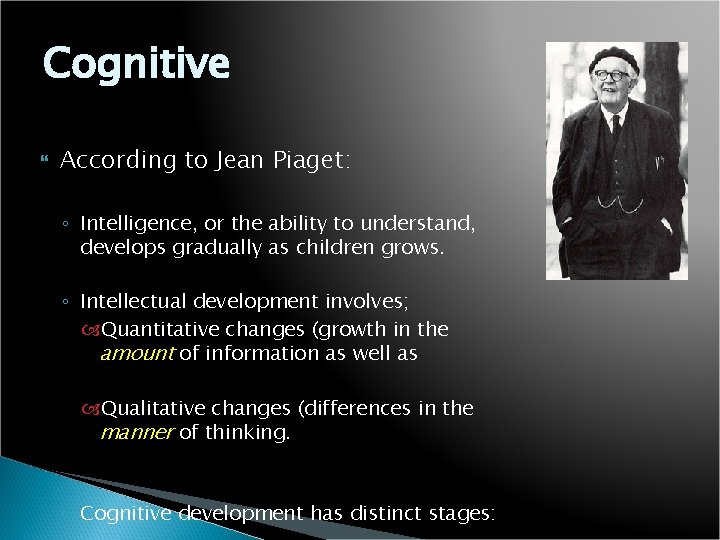
Cognitive According to Jean Piaget: ◦ Intelligence, or the ability to understand, develops gradually as children grows. ◦ Intellectual development involves; Quantitative changes (growth in the amount of information as well as Qualitative changes (differences in the manner of thinking. ◦ Cognitive development has distinct stages:
How Knowing Changes Schema: a conceptual framework a person uses to make sense of the world. Assimilation: the processes of fitting objects and experiences into one’s schema. Accommodation: the adjustment of one’s schema to include newly observed events and experiences. http: //www. youtube. com/watch? v= xl 46 c 6 S 6 p. I 0 Funny american
Object Permanence: a child’s realization that an object exists even when he or she cannot see or touch it. (Fig. 3. 7) Representational Thought: the intellectual ability of a child to picture something in his or her mind. Conservation: the principle that a given quantity does not change when its appearance is changed. (Fig. 3. 8) Egocentric: a young child’s inability to understand another person’s perspective.
http: //www. youtube. com/watch? v= Yt. LEWVu 815 o&list=PLZuo 2 y. Gm Ewq-Aud. V 0 y. EJDY 2 F 6 Nh. FJ 3 Tvs Complete Graphic Organizer 3
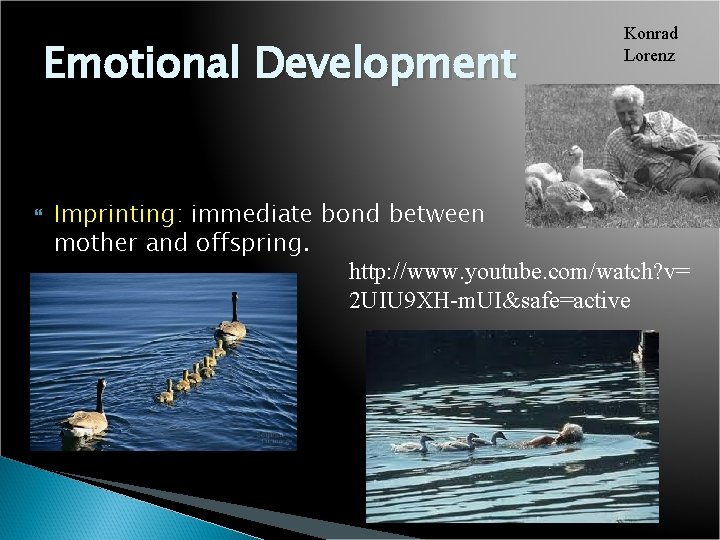
Emotional Development Konrad Lorenz Imprinting: immediate bond between mother and offspring. http: //www. youtube. com/watch? v= 2 UIU 9 XH-m. UI&safe=active
Critical Period: a specific time in development when certain skills or abilities are most easily learned. Ex. The goslings are especially sensitive just after birth, and whatever they learn during this critical period, about 13 to 16 hours after birth, makes a deep impression that resists change. If a gosling has imprinted on a human being instead of a goose, it will correct its imprinted response when later exposed to its actual mother. Thus, imprinting is important for survival purposes.
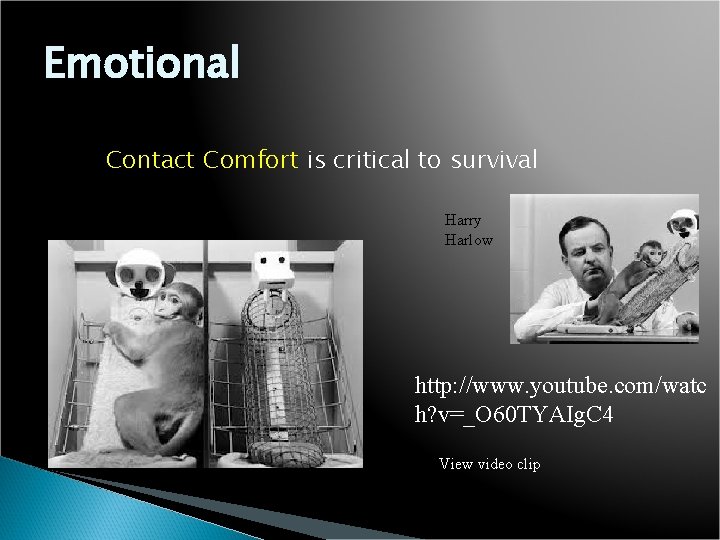
Emotional Contact Comfort is critical to survival Harry Harlow http: //www. youtube. com/watc h? v=_O 60 TYAIg. C 4 View video clip
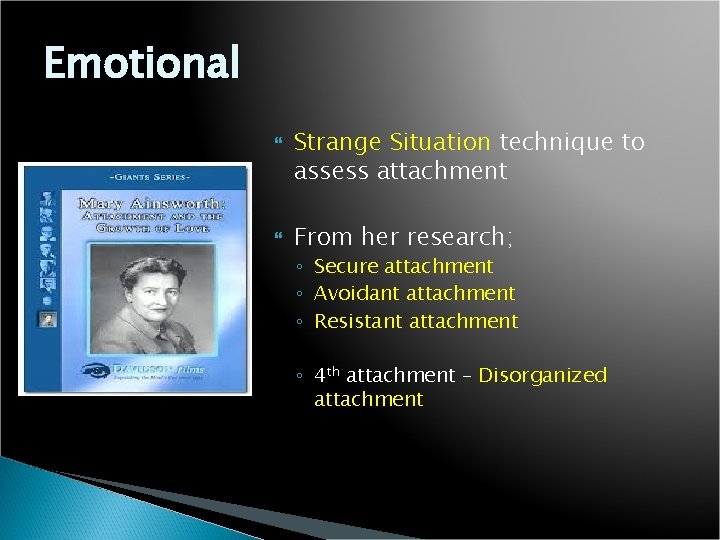
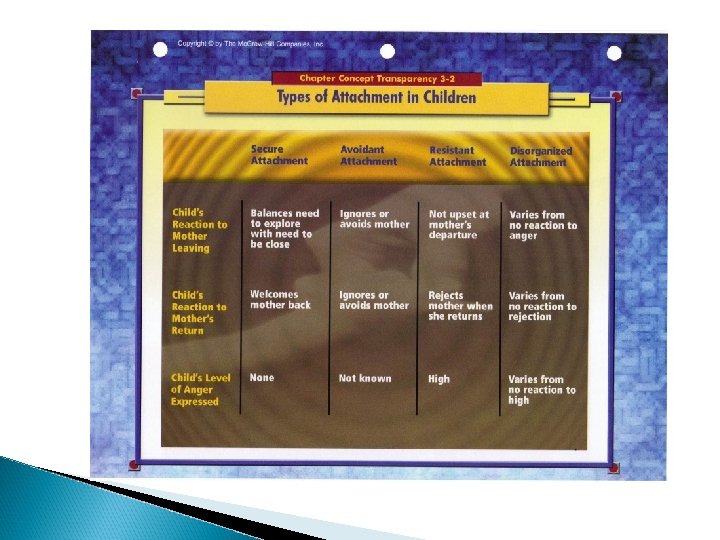
Emotional Strange Situation technique to assess attachment From her research; ◦ Secure attachment ◦ Avoidant attachment ◦ Resistant attachment ◦ 4 th attachment – Disorganized attachment
Section Quiz 3 -2
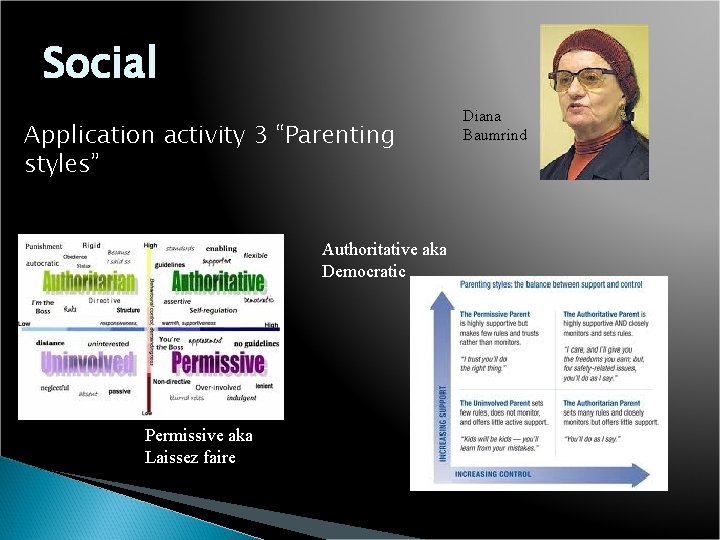
Social Application activity 3 “Parenting styles” Authoritative aka Democratic Permissive aka Laissez faire Diana Baumrind
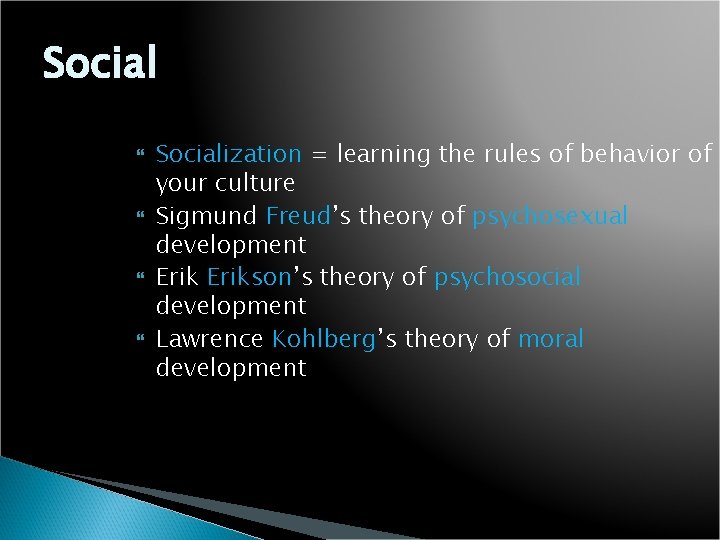
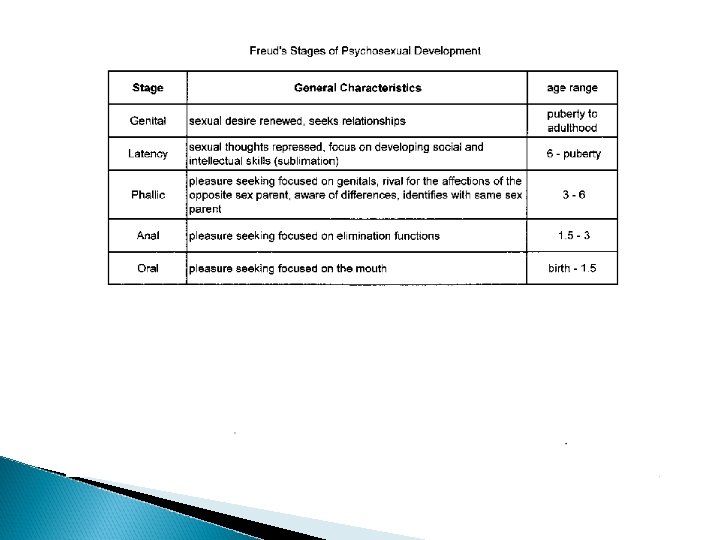
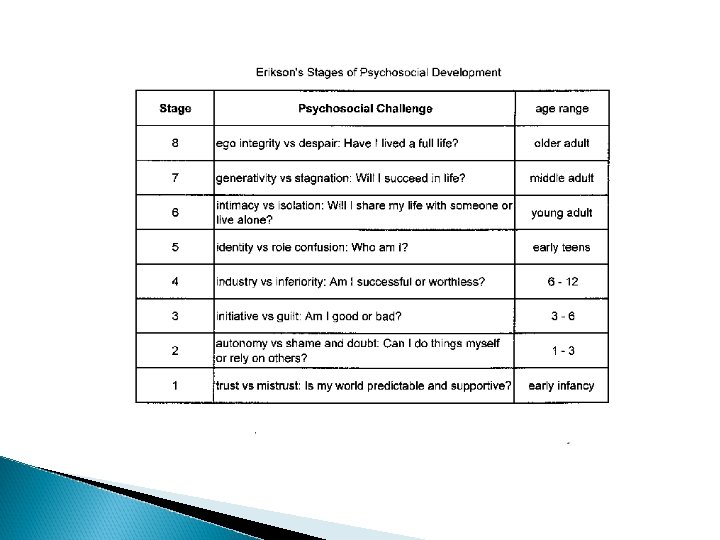
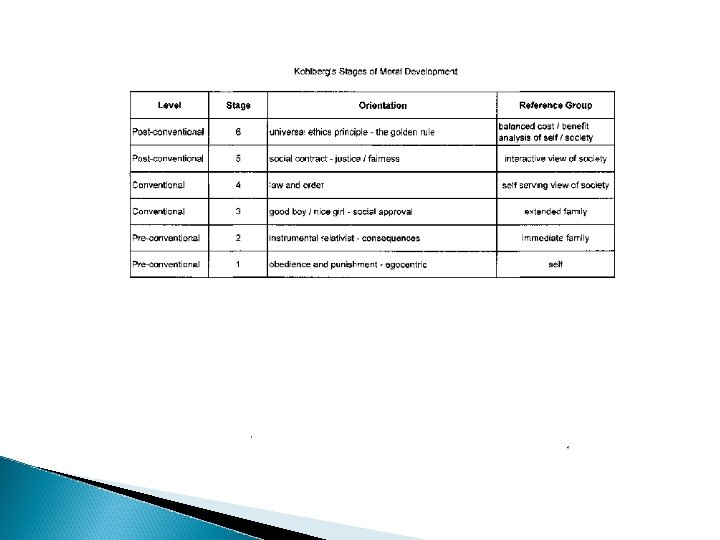
Social Socialization = learning the rules of behavior of your culture Sigmund Freud’s theory of psychosexual development Erikson’s theory of psychosocial development Lawrence Kohlberg’s theory of moral development
Social Albert Bandura’s social learning theory ◦ View video: Bobo doll experiment
Section Quiz 3 -3
Adolescence
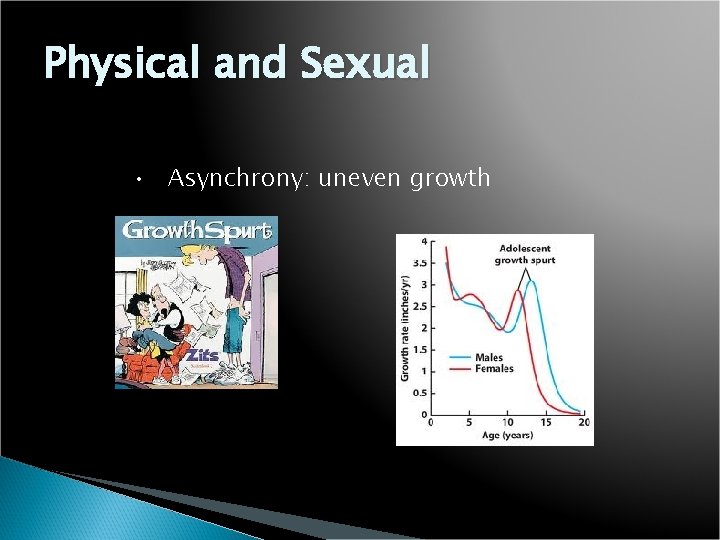
Physical and Sexual • Asynchrony: uneven growth
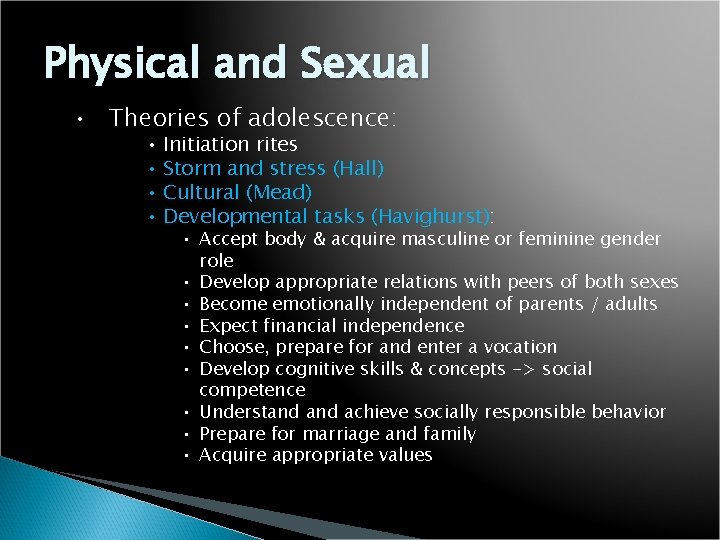
Physical and Sexual • Theories of adolescence: • Initiation rites • Storm and stress (Hall) • Cultural (Mead) • Developmental tasks (Havighurst): • Accept body & acquire masculine or feminine gender role • Develop appropriate relations with peers of both sexes • Become emotionally independent of parents / adults • Expect financial independence • Choose, prepare for and enter a vocation • Develop cognitive skills & concepts -> social competence • Understand achieve socially responsible behavior • Prepare for marriage and family • Acquire appropriate values
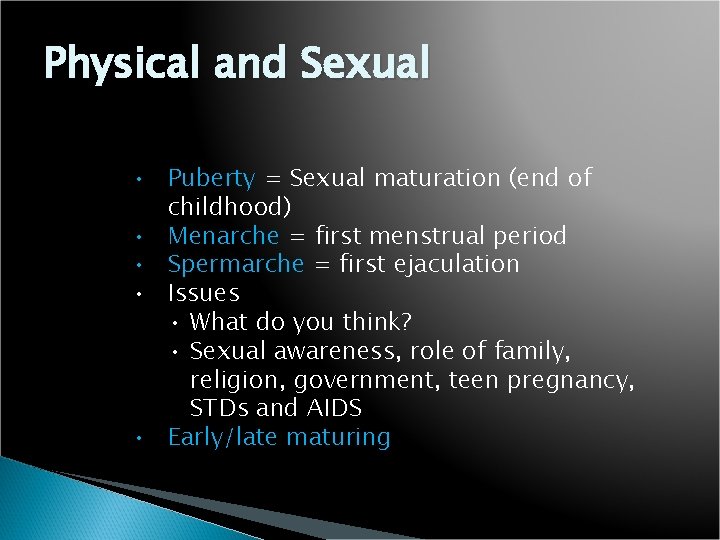
Physical and Sexual • Puberty = Sexual maturation (end of childhood) • Menarche = first menstrual period • Spermarche = first ejaculation • Issues • What do you think? • Sexual awareness, role of family, religion, government, teen pregnancy, STDs and AIDS • Early/late maturing
Section Quiz 4 -1
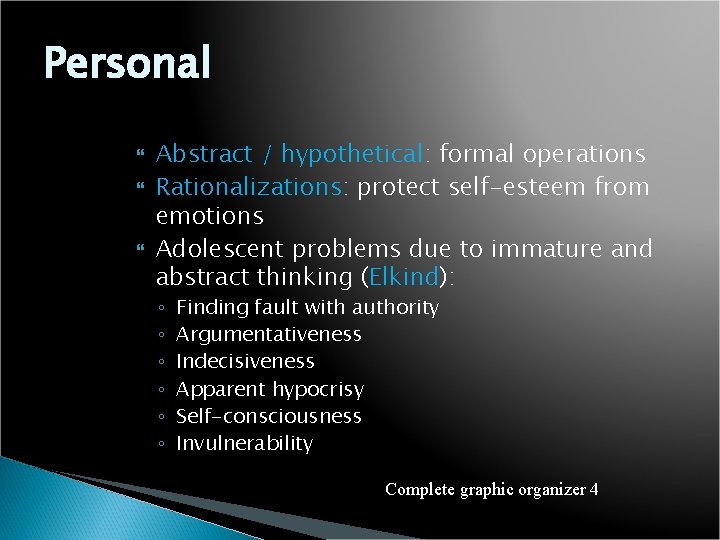
Personal Abstract / hypothetical: formal operations Rationalizations: protect self-esteem from emotions Adolescent problems due to immature and abstract thinking (Elkind): ◦ ◦ ◦ Finding fault with authority Argumentativeness Indecisiveness Apparent hypocrisy Self-consciousness Invulnerability Complete graphic organizer 4
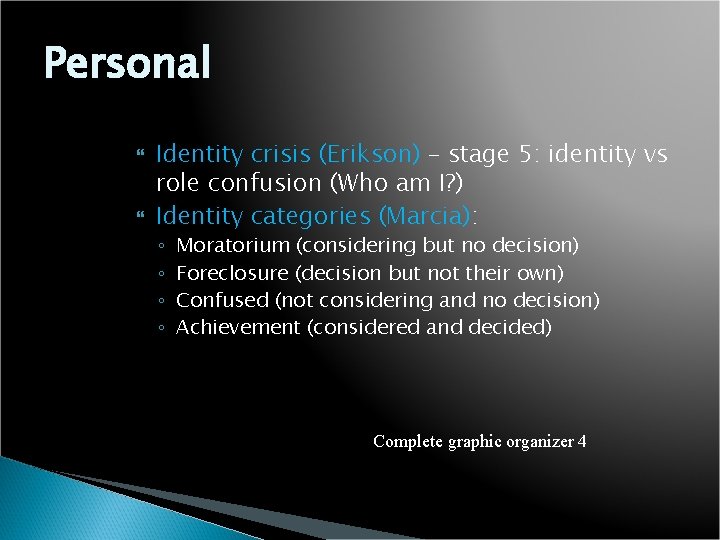
Personal Identity crisis (Erikson) – stage 5: identity vs role confusion (Who am I? ) Identity categories (Marcia): ◦ ◦ Moratorium (considering but no decision) Foreclosure (decision but not their own) Confused (not considering and no decision) Achievement (considered and decided) Complete graphic organizer 4
Section Quiz 4 -2
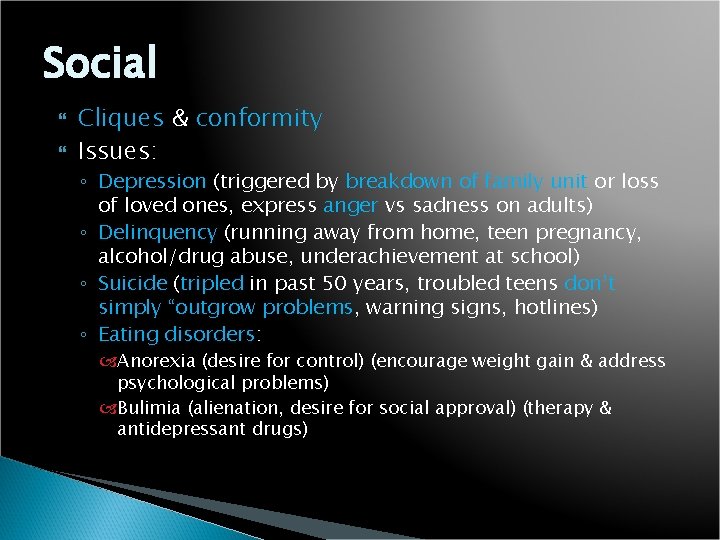
Social Cliques & conformity Issues: ◦ Depression (triggered by breakdown of family unit or loss of loved ones, express anger vs sadness on adults) ◦ Delinquency (running away from home, teen pregnancy, alcohol/drug abuse, underachievement at school) ◦ Suicide (tripled in past 50 years, troubled teens don’t simply “outgrow problems, warning signs, hotlines) ◦ Eating disorders: Anorexia (desire for control) (encourage weight gain & address psychological problems) Bulimia (alienation, desire for social approval) (therapy & antidepressant drugs)
Section Quiz 4 -3
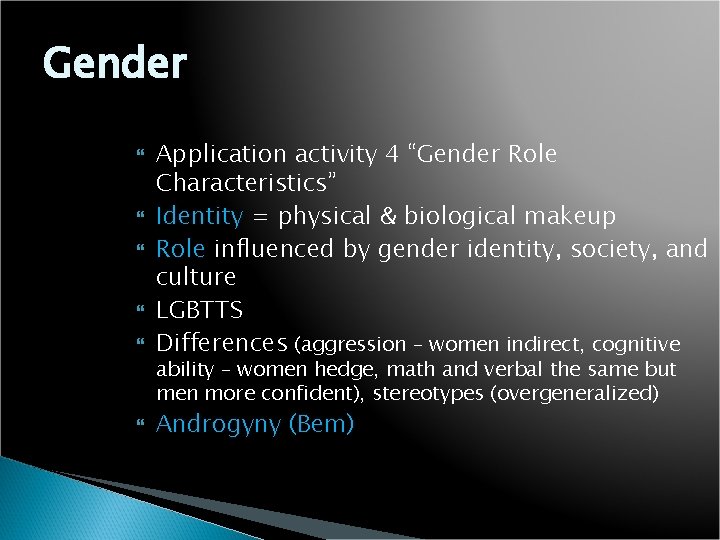
Gender Application activity 4 “Gender Role Characteristics” Identity = physical & biological makeup Role influenced by gender identity, society, and culture LGBTTS Differences (aggression – women indirect, cognitive Androgyny (Bem) ability – women hedge, math and verbal the same but men more confident), stereotypes (overgeneralized)
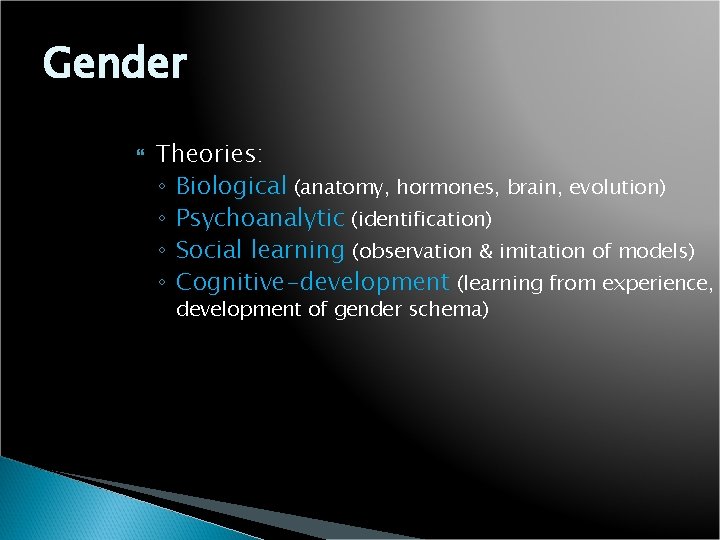
Gender Theories: ◦ Biological (anatomy, hormones, brain, evolution) ◦ Psychoanalytic (identification) ◦ Social learning (observation & imitation of models) ◦ Cognitive-development (learning from experience, development of gender schema)
Section Quiz 4 -4
Adulthood and Old Age
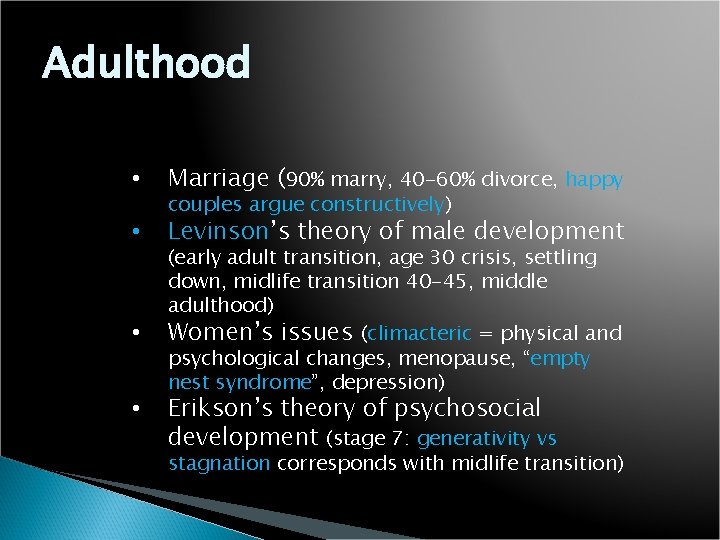
Adulthood • Marriage (90% marry, 40 -60% divorce, happy • Levinson’s theory of male development • • couples argue constructively) (early adult transition, age 30 crisis, settling down, midlife transition 40 -45, middle adulthood) Women’s issues (climacteric = physical and psychological changes, menopause, “empty nest syndrome”, depression) Erikson’s theory of psychosocial development (stage 7: generativity vs stagnation corresponds with midlife transition)
Section Quiz 5 -1
Old Age • • Ageism: prejudice / discrimination against elderly (Application activity 5) Good health in youth -> old age Masters & Johnson (ok to keep having sex) Chronic diseases of elderly: heart disease, hypertension, diabetes, arthritis Complete Graphic Organizer 5
Old Age • Decremental model of aging: progressive • • Decline in nervous system responsible Intelligence: • Crystalized: use accumulated knowledge • Fluid: solve problems and generate new ideas Senile dementia (memory loss, • • physical and mental decline inevitable forgetfulness, disorientation, altered personality, impaired attention) Alzheimer’s disease (most common dementia, neurological disease, destroys ability to think, remember, relate to others, care for self) Complete Graphic Organizer 5
Section Quiz 5 -2
Dying and Death • • • Thanatology = study of dying and death Kubler-Ross’s Stages of psychological acceptance of death and dying: (denial, anger, bargaining, depression, acceptance) Dying with dignity: • Hospice = facility to care for special needs • Assisted suicide (controversial)
Section Quiz 5 -3