
Unit 2 present simple The present simple Lets

- Slides: 10
Unit 2 – present simple
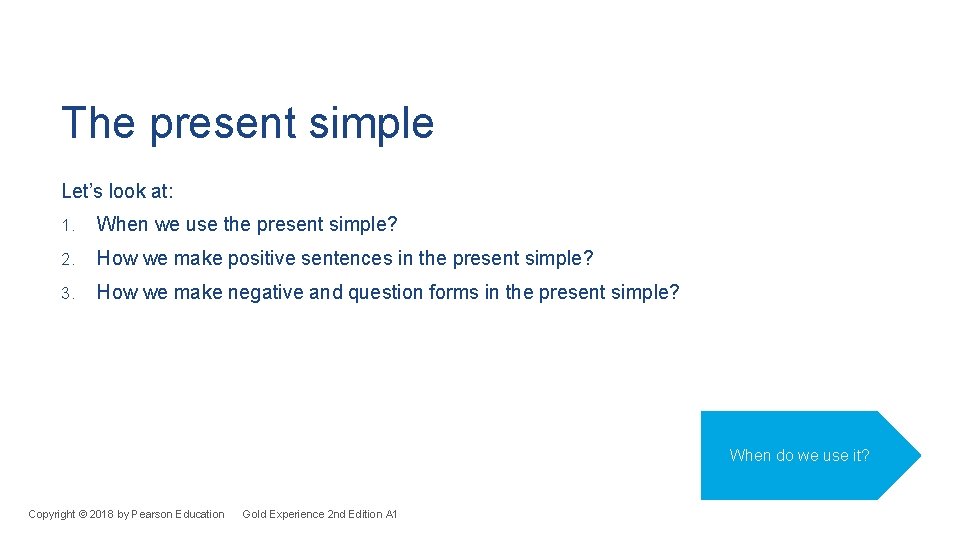
The present simple Let’s look at: 1. When we use the present simple? 2. How we make positive sentences in the present simple? 3. How we make negative and question forms in the present simple? When do we use it? Copyright © 2018 by Pearson Education Gold Experience 2 nd Edition A 1
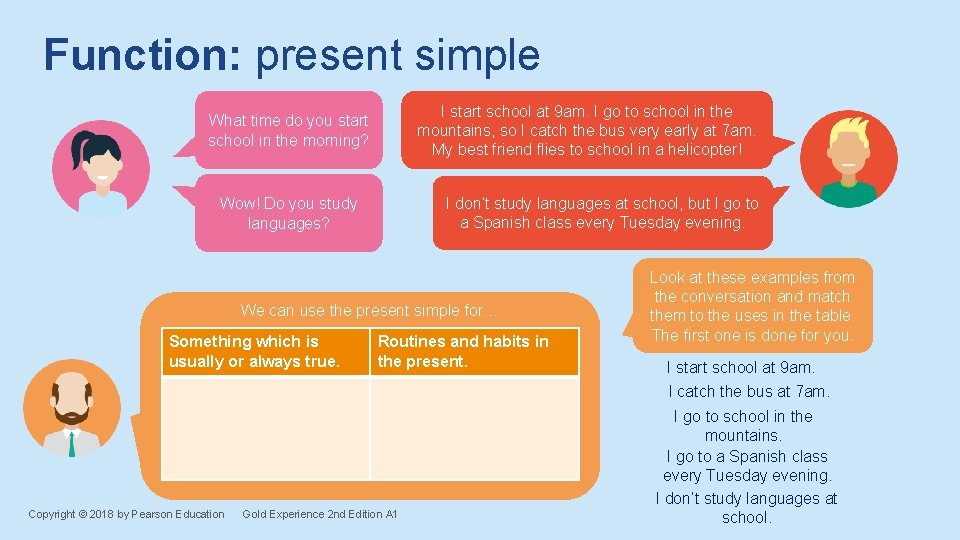
Function: present simple I start school at 9 am. I go to school in the mountains, so I catch the bus very early at 7 am. My best friend flies to school in a helicopter! What time do you start school in the morning? I don’t study languages at school, but I go to a Spanish class every Tuesday evening. Wow! Do you study languages? We can use the present simple for… Something which is usually or always true. Copyright © 2018 by Pearson Education Routines and habits in the present. Gold Experience 2 nd Edition A 1 Look at these examples from the conversation and match them to the uses in the table. The first one is done for you. I start school at 9 am. I catch the bus at 7 am. I go to school in the mountains. I go to a Spanish class every Tuesday evening. I don’t study languages at school.
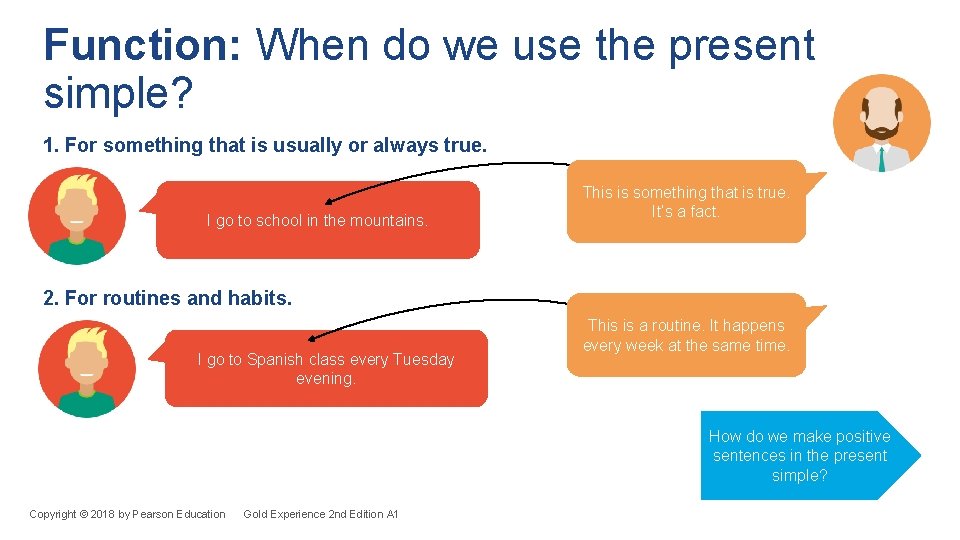
Function: When do we use the present simple? 1. For something that is usually or always true. I go to school in the mountains. This is something that is true. It’s a fact. 2. For routines and habits. I go to Spanish class every Tuesday evening. This is a routine. It happens every week at the same time. How do we make positive sentences in the present simple? Copyright © 2018 by Pearson Education Gold Experience 2 nd Edition A 1
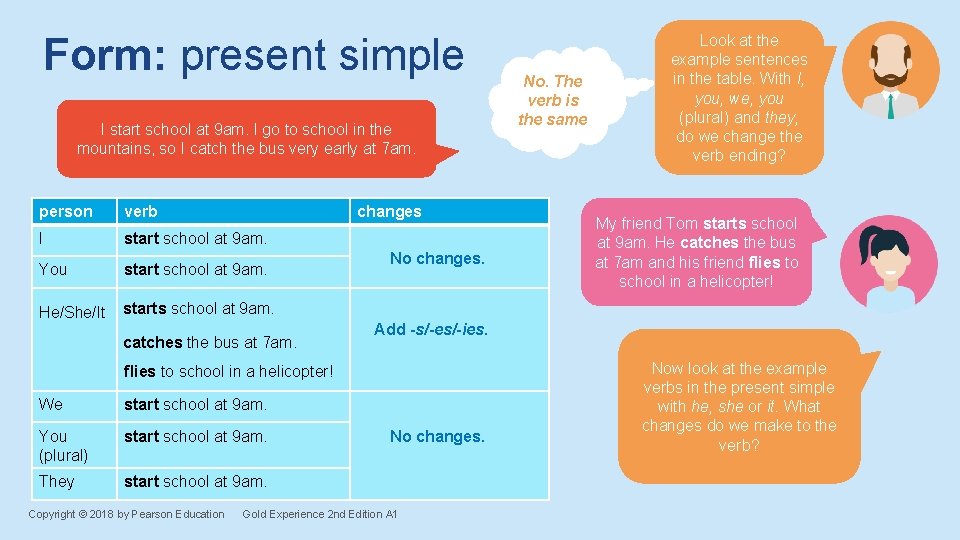
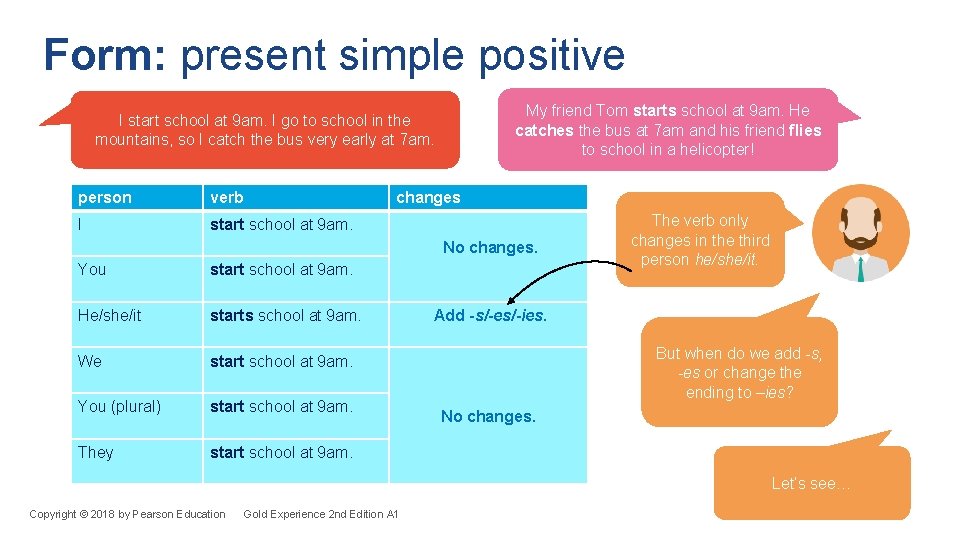
Form: present simple I start school at 9 am. I go to school in the mountains, so I catch the bus very early at 7 am. person verb changes I start school at 9 am. You start school at 9 am. He/She/It starts school at 9 am. catches the bus at 7 am. No changes. start school at 9 am. You (plural) start school at 9 am. They start school at 9 am. Copyright © 2018 by Pearson Education My friend Tom starts school at 9 am. He catches the bus at 7 am and his friend flies to school in a helicopter! Add -s/-es/-ies. flies to school in a helicopter! We No. The verb is the same Look at the example sentences in the table. With I, you, we, you (plural) and they, do we change the verb ending? No changes. Gold Experience 2 nd Edition A 1 Now look at the example verbs in the present simple with he, she or it. What changes do we make to the verb?
Form: present simple positive My friend Tom starts school at 9 am. He catches the bus at 7 am and his friend flies to school in a helicopter! I start school at 9 am. I go to school in the mountains, so I catch the bus very early at 7 am. person verb changes I start school at 9 am. No changes. You start school at 9 am. He/she/it starts school at 9 am. We start school at 9 am. You (plural) start school at 9 am. They start school at 9 am. The verb only changes in the third person he/she/it. Add -s/-es/-ies. But when do we add -s, -es or change the ending to –ies? No changes. Let’s see… Copyright © 2018 by Pearson Education Gold Experience 2 nd Edition A 1
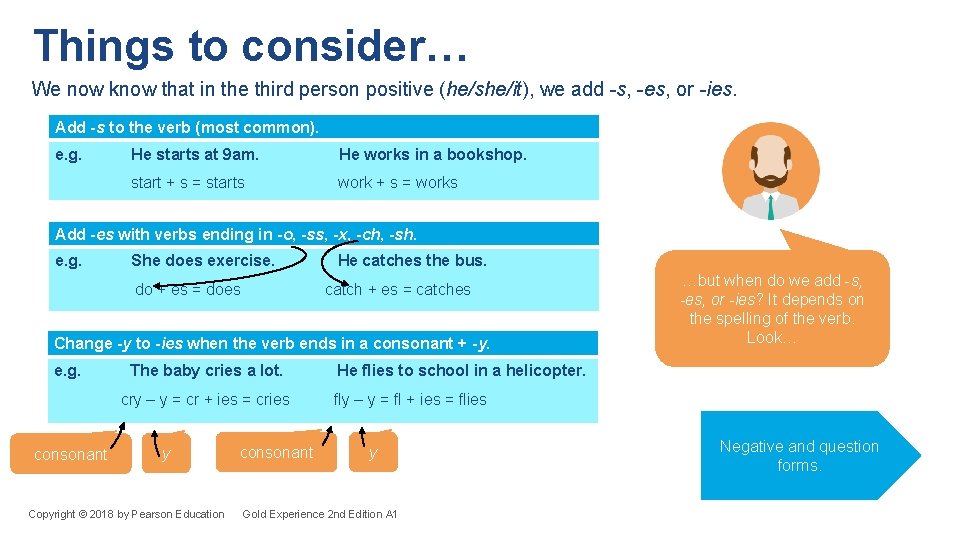
Things to consider… We now know that in the third person positive (he/she/it), we add -s, -es, or -ies. Add -s to the verb (most common). e. g. He starts at 9 am. He works in a bookshop. start + s = starts work + s = works Add -es with verbs ending in -o, -ss, -x, -ch, -sh. e. g. She does exercise. do + es = does He catches the bus. catch + es = catches Change -y to -ies when the verb ends in a consonant + -y. e. g. The baby cries a lot. cry – y = cr + ies = cries consonant y Copyright © 2018 by Pearson Education consonant …but when do we add -s, -es, or -ies? It depends on the spelling of the verb. Look… He flies to school in a helicopter. fly – y = fl + ies = flies y Gold Experience 2 nd Edition A 1 Negative and question forms.
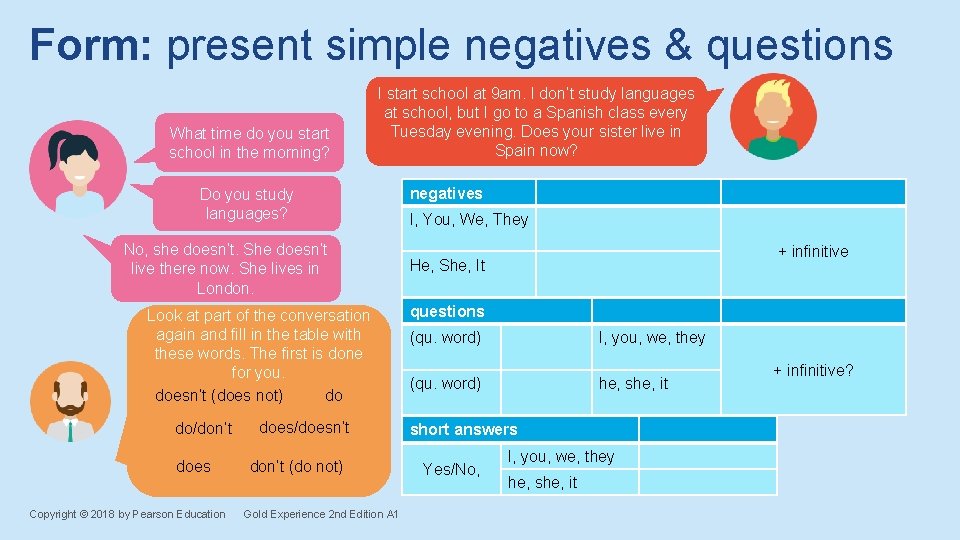
Form: present simple negatives & questions What time do you start school in the morning? I start school at 9 am. I don’t study languages at school, but I go to a Spanish class every Tuesday evening. Does your sister live in Spain now? Do you study languages? No, she doesn’t. She doesn’t live there now. She lives in London. Look at part of the conversation again and fill in the table with these words. The first is done for you. doesn’t (does not) do do/don’t does Copyright © 2018 by Pearson Education does/doesn’t don’t (do not) Gold Experience 2 nd Edition A 1 negatives I, You, We, They + infinitive He, She, It questions (qu. word) I, you, we, they (qu. word) he, she, it short answers Yes/No, I, you, we, they he, she, it + infinitive?
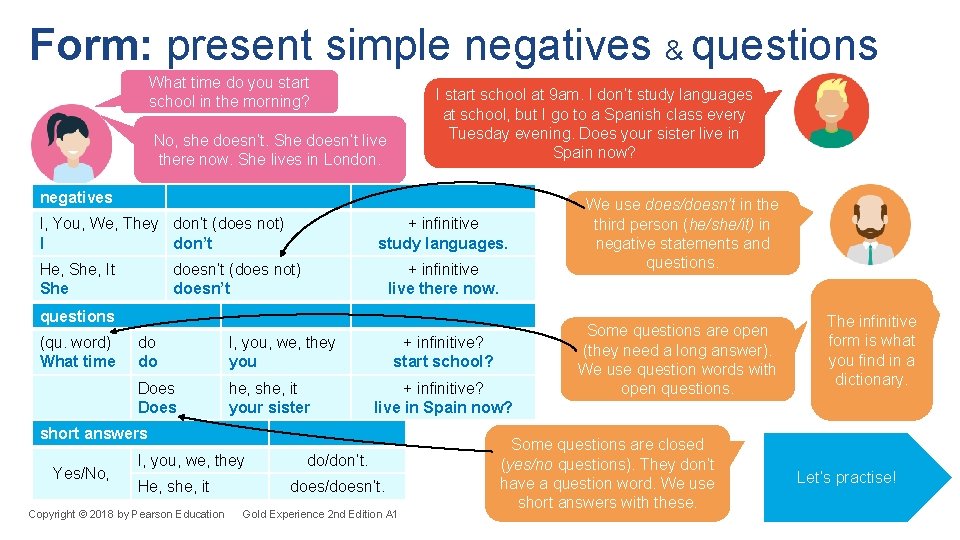
Form: present simple negatives & questions What time do you start school in the morning? I start school at 9 am. I don’t study languages at school, but I go to a Spanish class every Tuesday evening. Does your sister live in Spain now? No, she doesn’t. She doesn’t live there now. She lives in London. negatives I, You, We, They don’t (does not) I don’t He, She, It She + infinitive study languages. doesn’t (does not) doesn’t + infinitive live there now. questions (qu. word) What time do do I, you, we, they you Does he, she, it your sister + infinitive? start school? + infinitive? live in Spain now? short answers Yes/No, I, you, we, they He, she, it Copyright © 2018 by Pearson Education do/don’t. does/doesn’t. Gold Experience 2 nd Edition A 1 We use does/doesn’t in the third person (he/she/it) in negative statements and questions. Some questions are open (they need a long answer). We use question words with open questions. Some questions are closed (yes/no questions). They don’t have a question word. We use short answers with these. The infinitive form is what you find in a dictionary. Let’s practise!
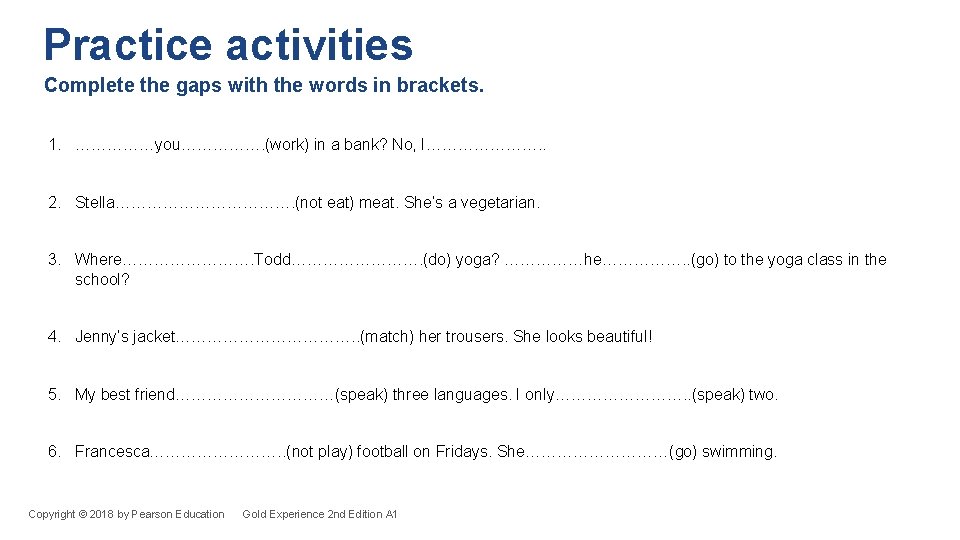
Practice activities Complete the gaps with the words in brackets. 1. ……………you……………. (work) in a bank? No, I…………………. . 2. Stella………………. (not eat) meat. She’s a vegetarian. 3. Where…………. Todd…………. (do) yoga? ……………he……………. . (go) to the yoga class in the school? 4. Jenny’s jacket………………. . (match) her trousers. She looks beautiful! 5. My best friend……………(speak) three languages. I only…………. . (speak) two. 6. Francesca…………. . (not play) football on Fridays. She……………(go) swimming. Copyright © 2018 by Pearson Education Gold Experience 2 nd Edition A 1