
UNIT 2 POLITICAL IDEOLOGIES LESSON 4 BASIC TENETS
UNIT 2: POLITICAL IDEOLOGIES LESSON 4: BASIC TENETS OF SOCIALISM

SOCIALISM • Socialism is a political and economic theory of social organization that advocates that the means of production, distribution, and exchange should be owned or regulated by the community as a whole.

HISTORY OF SOCIALISM • Socialism arose as a response to the Industrial Revolution, which was the emergence of technologies such as the steam engine and mass production. The Industrial Revolution started in England in the last years of the eighteenth century and had spread too much of Europe and America by the end of the nineteenth century. It caused major upheavals: In a very short time, many people were forced to abandon agricultural ways of life for the modern mechanized world of factories.
SOCIALIST-THINKERS • Early versions of socialism were put forward in Europe in the first part of the nineteenth century (these versions are often dubbed “utopian socialism”), but truly influential socialist theories did not emerge until industrialization expanded in the mid-nineteenth century. • Karl Marx is the best-known theorist of socialism. Along with Friedrich Engels, Marx wrote The Communist Manifesto (1848) as a call to revolution. • Other prominent socialist-thinkers included Karl Kautsky, Vladimir Lenin, and Antonio Gramsci.

EARLY SOCIALIST PIONEERS • Robert Owen (1870 -1924 • Karl Marx (1818 -1883) • Friedrich Engels (1818 -1883) • Vladimir Lenin (1870 -1924)
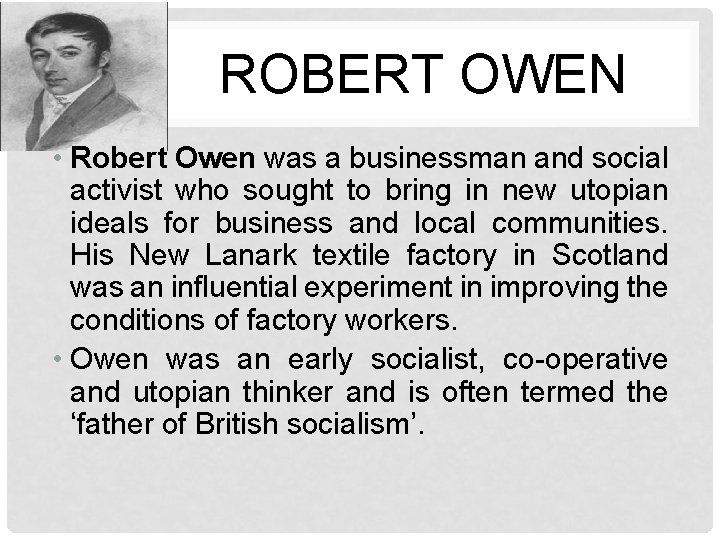
ROBERT OWEN • Robert Owen was a businessman and social activist who sought to bring in new utopian ideals for business and local communities. His New Lanark textile factory in Scotland was an influential experiment in improving the conditions of factory workers. • Owen was an early socialist, co-operative and utopian thinker and is often termed the ‘father of British socialism’.
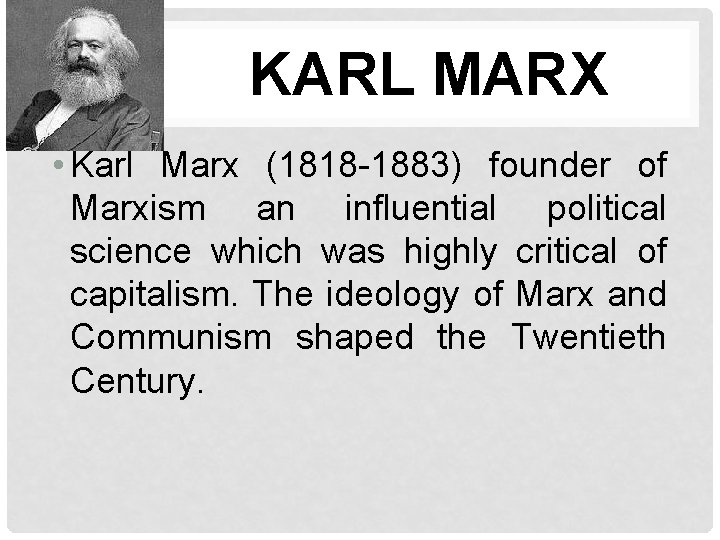
KARL MARX • Karl Marx (1818 -1883) founder of Marxism an influential political science which was highly critical of capitalism. The ideology of Marx and Communism shaped the Twentieth Century.
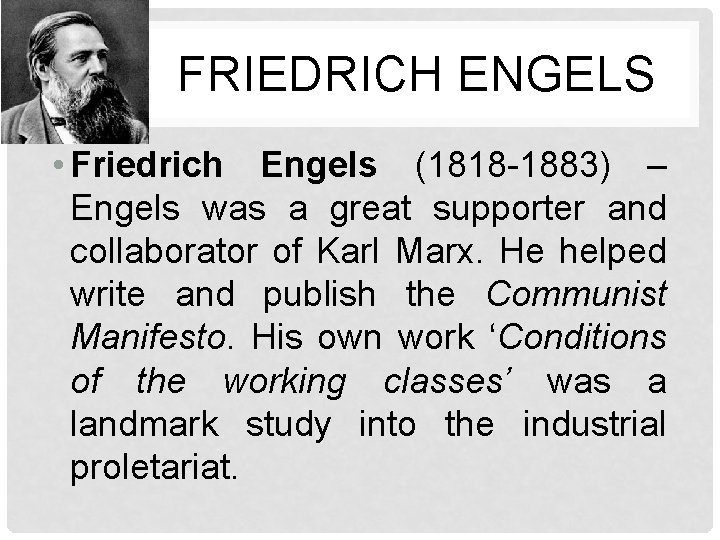
FRIEDRICH ENGELS • Friedrich Engels (1818 -1883) – Engels was a great supporter and collaborator of Karl Marx. He helped write and publish the Communist Manifesto. His own work ‘Conditions of the working classes’ was a landmark study into the industrial proletariat.
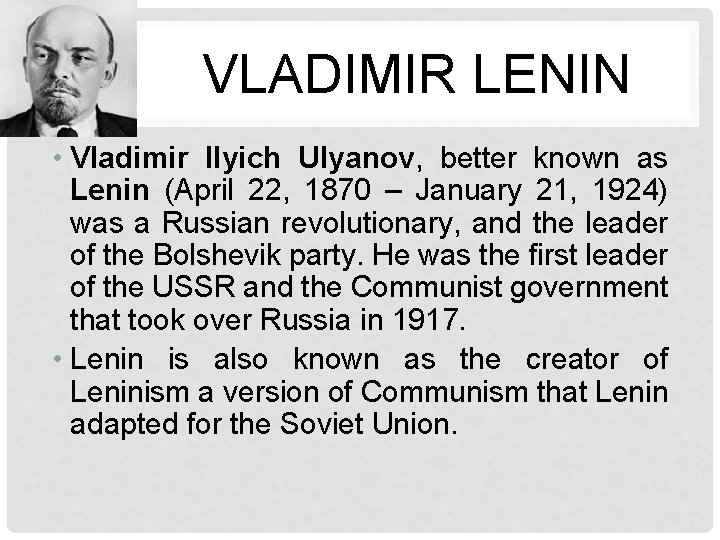
VLADIMIR LENIN • Vladimir Ilyich Ulyanov, better known as Lenin (April 22, 1870 – January 21, 1924) was a Russian revolutionary, and the leader of the Bolshevik party. He was the first leader of the USSR and the Communist government that took over Russia in 1917. • Lenin is also known as the creator of Leninism a version of Communism that Lenin adapted for the Soviet Union.
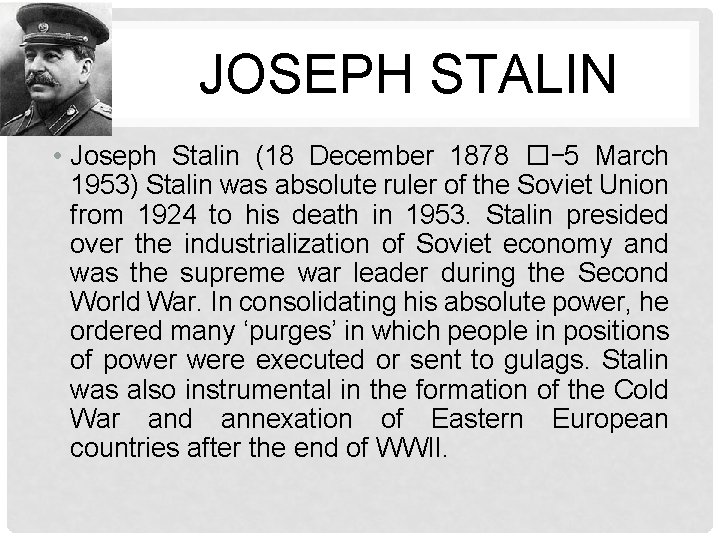
JOSEPH STALIN • Joseph Stalin (18 December 1878 �-5 March 1953) Stalin was absolute ruler of the Soviet Union from 1924 to his death in 1953. Stalin presided over the industrialization of Soviet economy and was the supreme war leader during the Second World War. In consolidating his absolute power, he ordered many ‘purges’ in which people in positions of power were executed or sent to gulags. Stalin was also instrumental in the formation of the Cold War and annexation of Eastern European countries after the end of WWII.
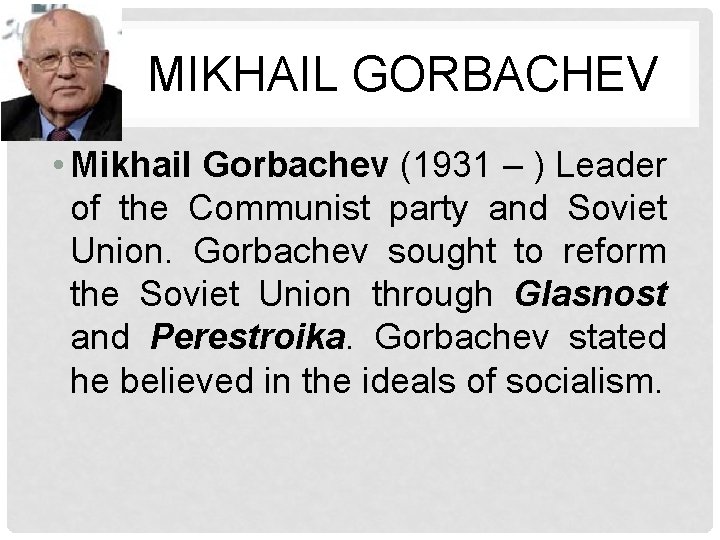
MIKHAIL GORBACHEV • Mikhail Gorbachev (1931 – ) Leader of the Communist party and Soviet Union. Gorbachev sought to reform the Soviet Union through Glasnost and Perestroika. Gorbachev stated he believed in the ideals of socialism.
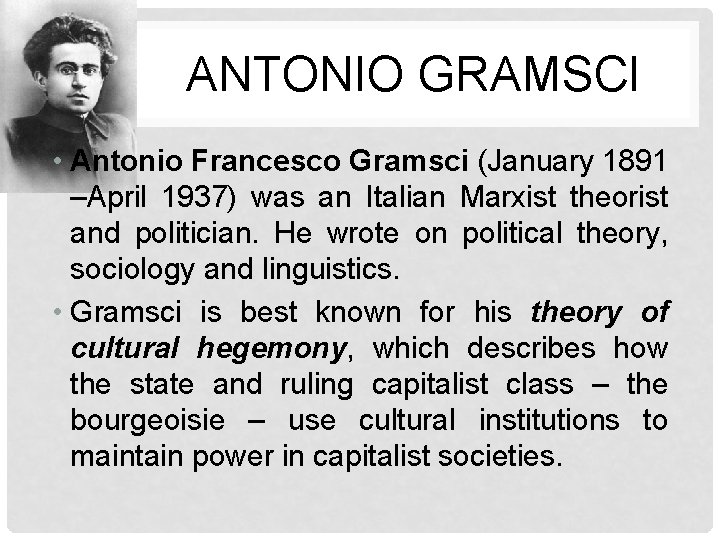
ANTONIO GRAMSCI • Antonio Francesco Gramsci (January 1891 –April 1937) was an Italian Marxist theorist and politician. He wrote on political theory, sociology and linguistics. • Gramsci is best known for his theory of cultural hegemony, which describes how the state and ruling capitalist class – the bourgeoisie – use cultural institutions to maintain power in capitalist societies.
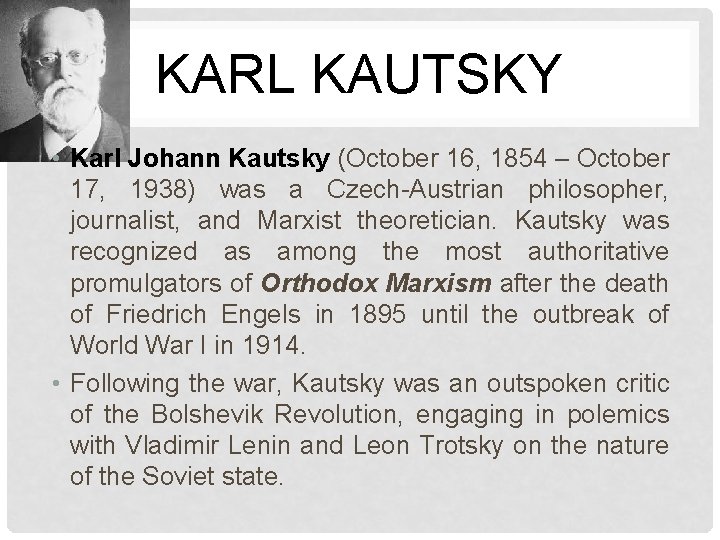
KARL KAUTSKY • Karl Johann Kautsky (October 16, 1854 – October 17, 1938) was a Czech-Austrian philosopher, journalist, and Marxist theoretician. Kautsky was recognized as among the most authoritative promulgators of Orthodox Marxism after the death of Friedrich Engels in 1895 until the outbreak of World War I in 1914. • Following the war, Kautsky was an outspoken critic of the Bolshevik Revolution, engaging in polemics with Vladimir Lenin and Leon Trotsky on the nature of the Soviet state.
SOCIALISM EMPHASIZES • Collectivism - Human beings are social by nature, and society should respect this. Individualism is poisonous; • Public ownership - Society, not individuals, should own the property; • Central economic planning - The government plans the economy; there is no free market; • Economic equality - All citizens have roughly the same level of prosperity.
CLASS WARFARE According to socialists, liberalism fails to live up to its promises of freedom and equality. Socialists blame the free market for liberalism’s failings. Under a capitalist system, money and means of production are the measures of power. The haves (the bourgeoisie, in Marx’s terms) and the have-nots (whom Marx calls the proletariat) are locked into a fight that Marx called class warfare. Because they control the money and means of production, the bourgeoisie have the power and thus are winning the fight. The rich use the government to further their control and to increase their power over the lower, poorer classes, so people are neither free nor equal.
THE EVOLUTION OF SOCIALISM Socialism evolved in a variety of ways. Communism and democratic socialism are the two most prominent evolutions of socialism. Communism: An authoritarian and revolutionary approach to achieving socialism. As an ideology, communism emphasizes a classless society in which all members jointly share the means and output of production. The regimes of the Soviet Union and communist China embody this ideology.
DEMOCRATIC SOCIALISM • Democratic socialism: A peaceful and democratic approach to achieving socialism. As an ideology, democratic socialism also emphasizes a classless society in which all members jointly share the means and output of production. But unlike communism, democratic socialism attempts to achieve its goals peacefully via the democratic processes. • Democratic socialists reject the need for immediate transition to socialism in favor of a gradualist approach, achieved by working within a democratic government. Economic inequalities should be remedied through a welfare state, a system that provides aid to the poor and help to the unemployed.
DEMOCRATIC SOCIALISM TODAY • Democratic socialism has been quite successful in Western Europe and Scandinavia. Many governments there have extensive welfare systems that have remained largely intact even when democratic socialists are voted out of office. • Democratic socialist parties exist in many democracies around the world. Germany’s Social Democratic Party and Britain’s Labor Party are contemporary examples of successful political parties heavily influenced by democratic socialism.
COMMUNISM In political and social sciences, communism is the philosophical, social, political, and economic ideology and movement whose ultimate goal is the establishment of the communist society, which is a socioeconomic order structured upon the common ownership of the means of production and the absence of social classes, money, and the state.
COMMUNISM Communism includes a variety of schools of thought, which broadly include Marxism, anarchism (anarchist communism), and the political ideologies grouped around both. All these share the analysis that the current order of society stems from its economic system, capitalism, that in this system, there are two major social classes: the working class—who must work to survive, and who make up the majority within society
COMMUNISM …and the capitalist class—a minority who derives profit from employing the working class, through private ownership of the means of production, and that conflict between these two classes will trigger a revolution. The primary element which will enable this transformation, according to this analysis, is the social ownership of the means of production.
ACTIVITY 1 • DIFFERENTIATE SOCIALISM FROM COMMUNISM Political Ideology Definition Characteristic Features
- Slides: 23