
Unit 2 Part1 Sorting Part2 Complexity Part3 Advance
![Heap sort: Insert algorithm Algorithm insert(a, n, item) { i = n; a[i] =](https://slidetodoc.com/presentation_image_h2/fe928aadd8da119a1490a5fbf959b841/image-12.jpg "Heap sort: Insert algorithm Algorithm insert(a, n, item) { i = n; a[i] =")
![Heap sort: Adjust algorithm Algorithm adjust(a, i, n) { item=a[i] j=2 i while (j<=](https://slidetodoc.com/presentation_image_h2/fe928aadd8da119a1490a5fbf959b841/image-14.jpg "Heap sort: Adjust algorithm Algorithm adjust(a, i, n) { item=a[i] j=2 i while (j<=")
- Slides: 15
Unit – 2 Part-1 : Sorting Part-2 : Complexity Part-3 : Advance Data Structures Unit Outcomes: Ability to understand mathematical formulation, complexity analysis and methodologies to solve recurrence relations for algorithms. Ability to apply algorithm design principles to derive solutions for real life problems and comment on complexity of solution.
UNIT-2: (i) Sorting
Sorting Insertion sort and its analysis Selection sort and its analysis Heap sort and its analysis Sorting: Arranging elements in ascending or descending order.
Insertion Sort Principle: Select an element from given array and place it proper position by scanning and comparing all the elements present before the selected element. Sorting process is expands at each stage. This method does not require all elements to be referred at one stage. For an array of size “n”, maximum “n-1” comparisons are required.
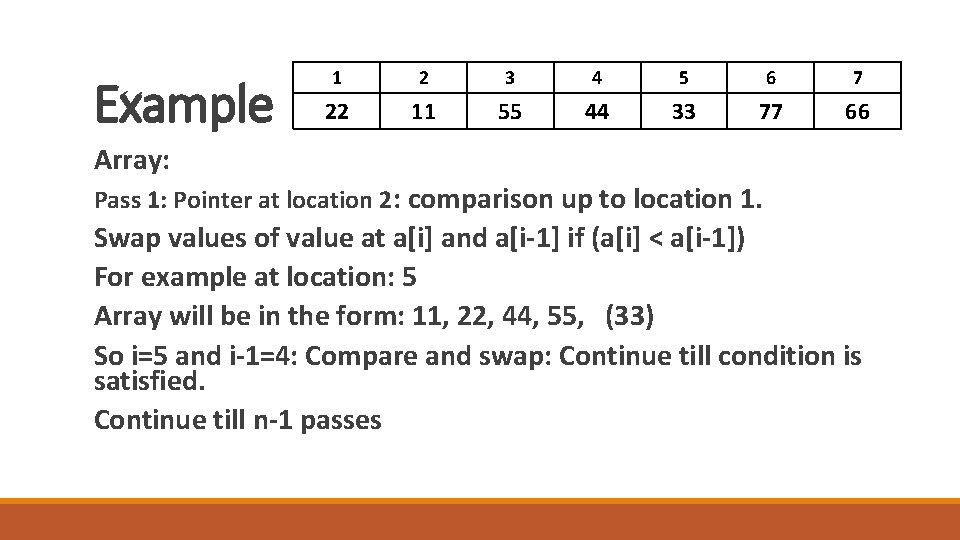
Example 1 2 3 4 5 6 7 22 11 55 44 33 77 66 Array: Pass 1: Pointer at location 2: comparison up to location 1. Swap values of value at a[i] and a[i-1] if (a[i] < a[i-1]) For example at location: 5 Array will be in the form: 11, 22, 44, 55, (33) So i=5 and i-1=4: Compare and swap: Continue till condition is satisfied. Continue till n-1 passes
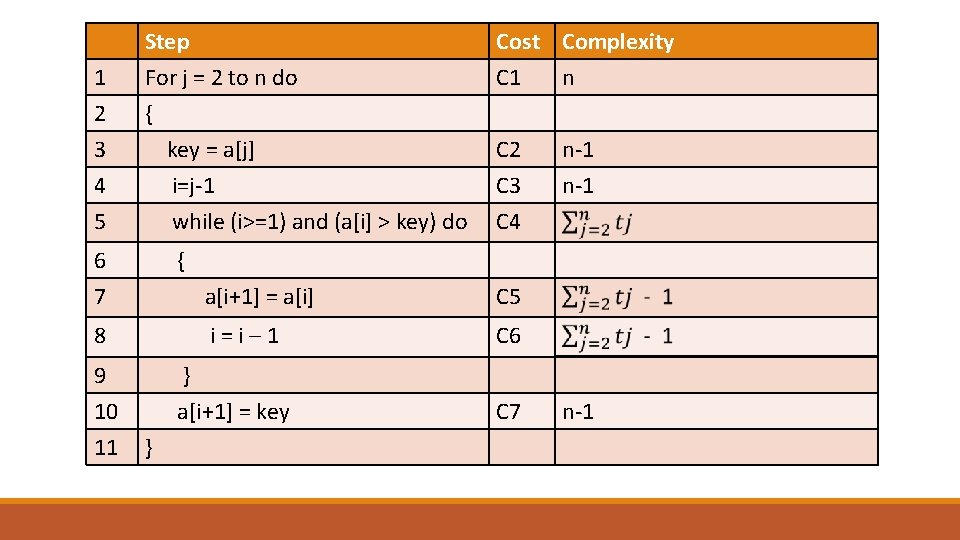
1 2 3 Step For j = 2 to n do Cost Complexity C 1 n { key = a[j] C 2 n-1 4 5 i=j-1 while (i>=1) and (a[i] > key) do C 3 C 4 n-1 6 7 { 8 9 10 11 a[i+1] = a[i] C 5 i=i– 1 C 6 } a[i+1] = key } C 7 n-1
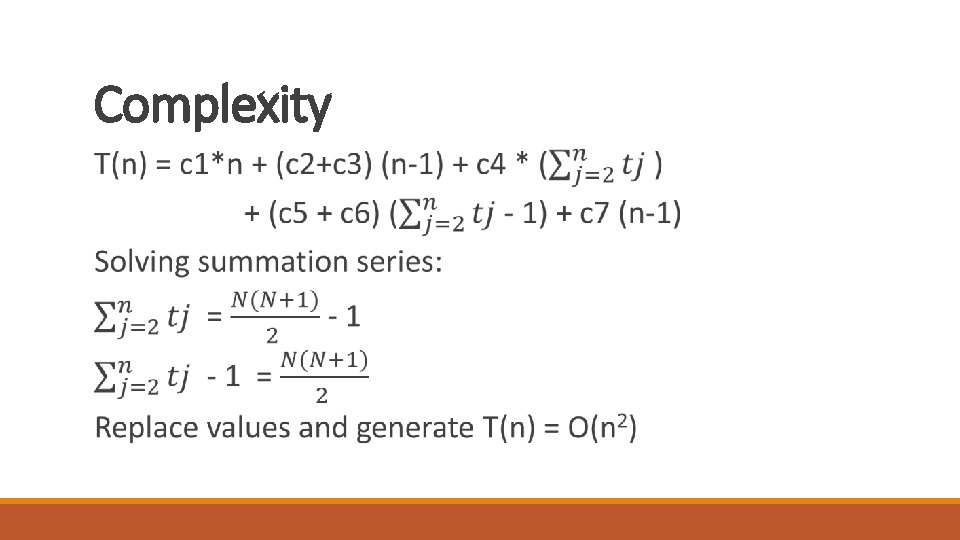
Complexity
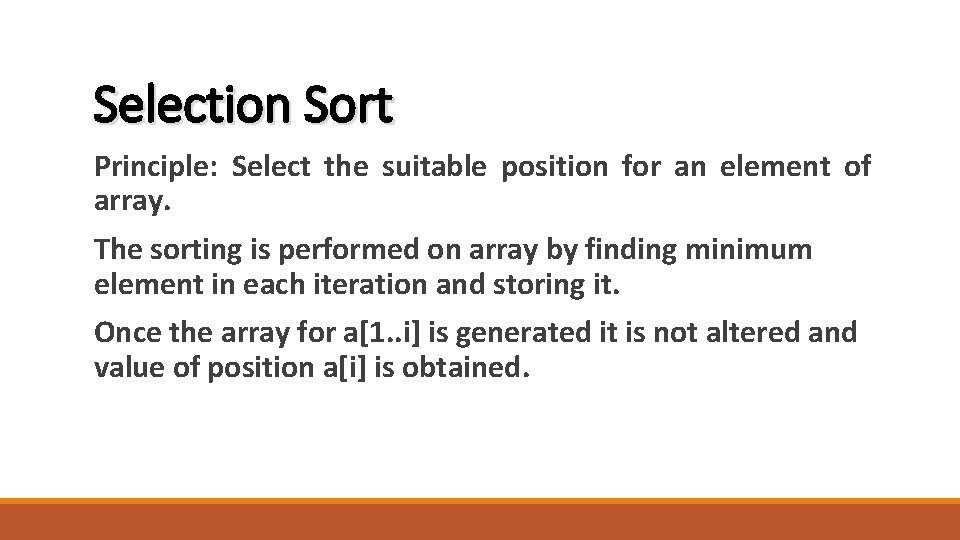
Selection Sort Principle: Select the suitable position for an element of array. The sorting is performed on array by finding minimum element in each iteration and storing it. Once the array for a[1. . i] is generated it is not altered and value of position a[i] is obtained.
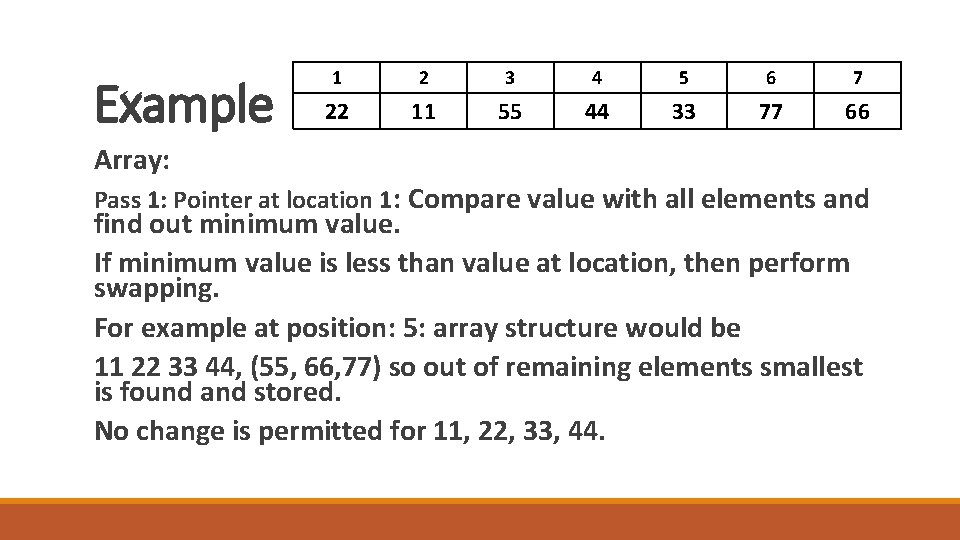
Example 1 2 3 4 5 6 7 22 11 55 44 33 77 66 Array: Pass 1: Pointer at location 1: Compare value with all elements and find out minimum value. If minimum value is less than value at location, then perform swapping. For example at position: 5: array structure would be 11 22 33 44, (55, 66, 77) so out of remaining elements smallest is found and stored. No change is permitted for 11, 22, 33, 44.
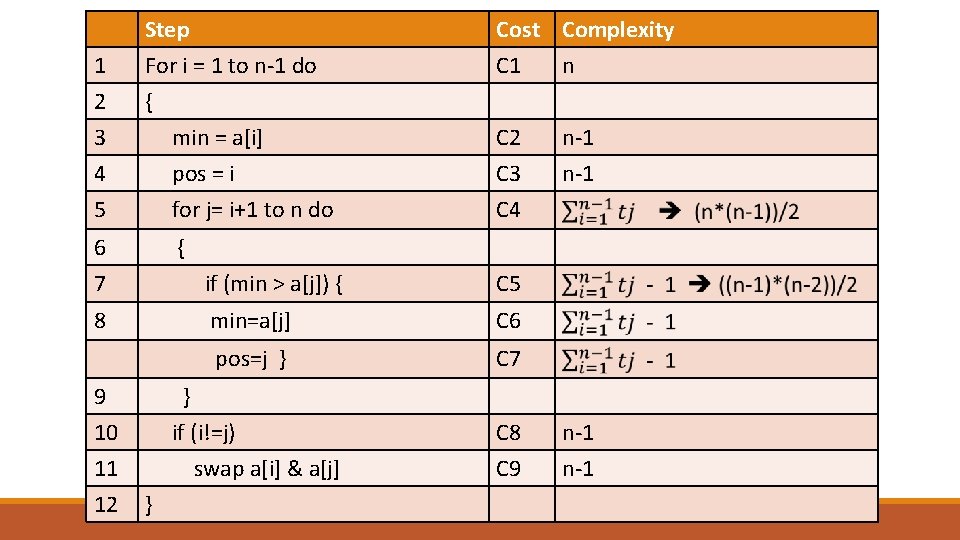
1 2 3 Step For i = 1 to n-1 do { min = a[i] 4 5 pos = i for j= i+1 to n do 6 7 { 8 9 10 11 12 } Cost Complexity C 1 n C 2 n-1 C 3 C 4 n-1 if (min > a[j]) { C 5 min=a[j] C 6 pos=j } C 7 } if (i!=j) swap a[i] & a[j] C 8 C 9 n-1
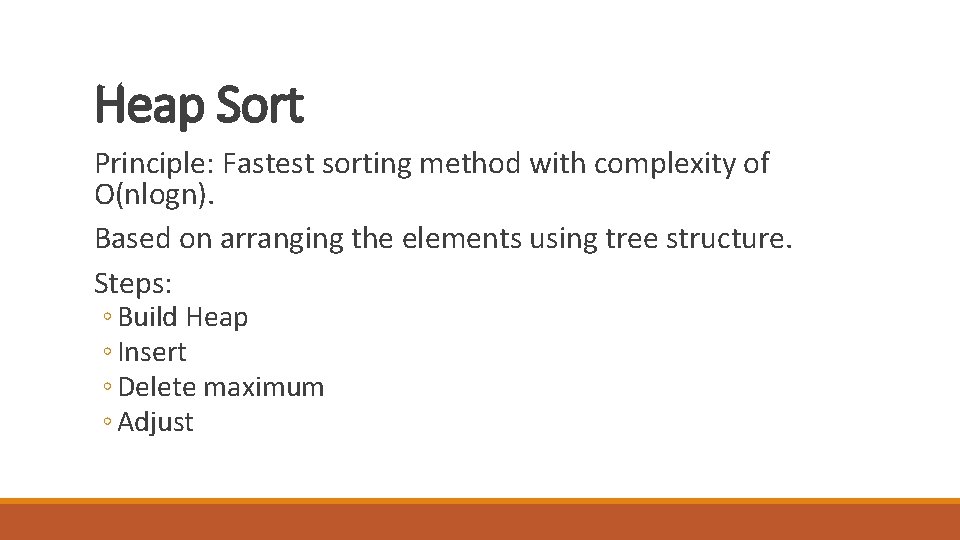
Heap Sort Principle: Fastest sorting method with complexity of O(nlogn). Based on arranging the elements using tree structure. Steps: ◦ Build Heap ◦ Insert ◦ Delete maximum ◦ Adjust
Heap sort: Insert algorithm Algorithm insert(a, n, item) { i = n; a[i] = item; while (i>1) and (a[i/2] < item) do { a[i] = a[i/2] i = i/2 } a[i] = item } // lb
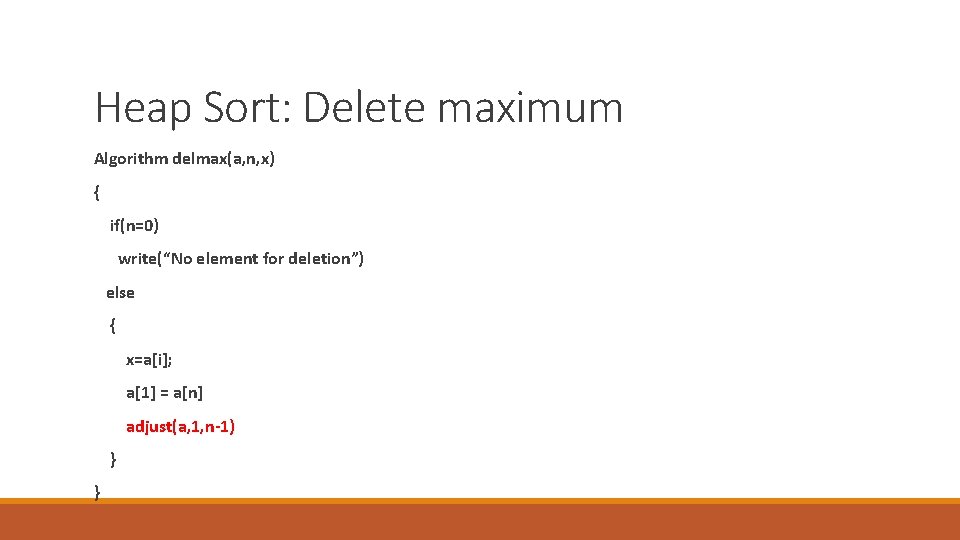
Heap Sort: Delete maximum Algorithm delmax(a, n, x) { if(n=0) write(“No element for deletion”) else { x=a[i]; a[1] = a[n] adjust(a, 1, n-1) } }
Heap sort: Adjust algorithm Algorithm adjust(a, i, n) { item=a[i] j=2 i while (j<= n) do { if(a[j] < a[j+1]) j=j+1; if(item >=a[j]) break; a[j/2] = a[j] j=2 j } a[j/2] = item; } //lb //LB