
Unit 2 Part 2 TaskBased Language Teaching I
Unit 2 Part 2 Task-Based Language Teaching 任务型语言教学
I. Revision 1) What are the differences between the traditional foreign language teaching and language use in real life? 2) What is the ultimate goal of foreign language learning? 3) How can we bridge the big gap between these two?
II. Task-based Language Teaching Besides CLT, there has been another language teaching approach which has become more and more popular from late 1980 s, that is, Taskbased Language Teaching (TBLT).
• “TBLT” is a further development of CLT. It shares the same beliefs, as language should be learned as close as possible to how it is used in real life. • “TBLT” has stressed the importance to combine form-focused teaching with communication focused teaching.

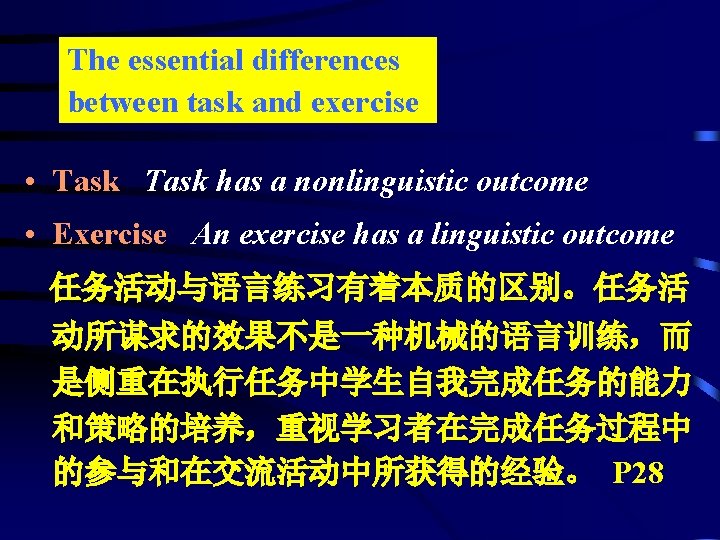
2. 1 What is a task? P 27 A task is a piece of work undertaken for oneself or for others, freely or for some reward. It is meant what people do in everyday life, at work, at play, and in between. (Long 1985: 89) 任务是人们在日常生活中所从事的有目的的活 动。
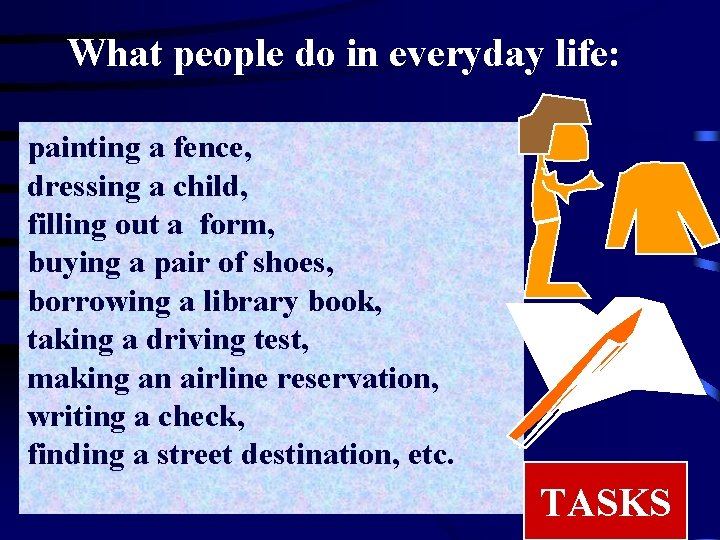
What people do in everyday life: painting a fence, dressing a child, filling out a form, buying a pair of shoes, borrowing a library book, taking a driving test, making an airline reservation, writing a check, finding a street destination, etc. TASKS

• A task is an activity or action which is carried out as the result of processing or understanding language ( i. e. as a response). (Richards, Platt and Weber 1986: 289) 任务=人们在学习、理解、体会语言之后 所开展的活动。
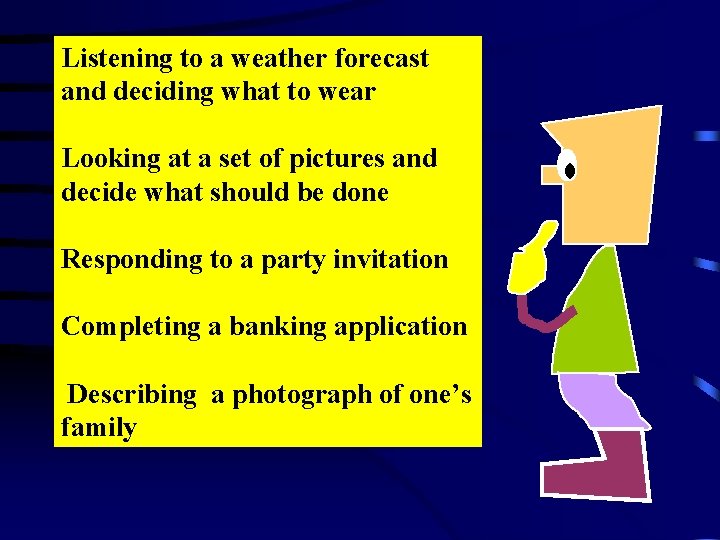
Listening to a weather forecast and deciding what to wear Looking at a set of pictures and decide what should be done Responding to a party invitation Completing a banking application Describing a photograph of one’s family
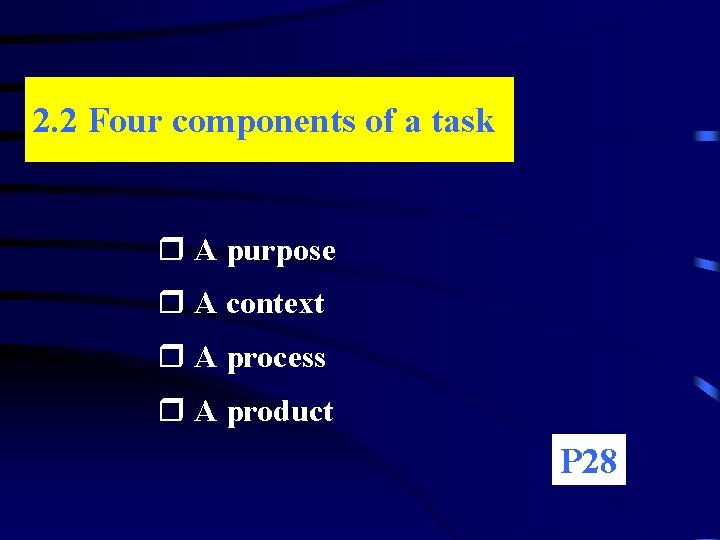
2. 2 Four components of a task r A purpose r A context r A process r A product P 28
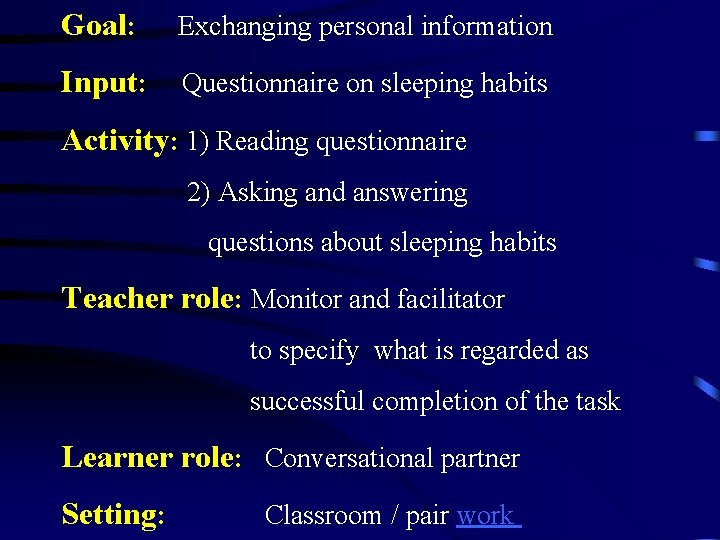
Goal: Exchanging personal information Input: Questionnaire on sleeping habits Activity: 1) Reading questionnaire 2) Asking and answering questions about sleeping habits Teacher role: Monitor and facilitator to specify what is regarded as successful completion of the task Learner role: Conversational partner Setting: Classroom / pair work

2. 3 What are not tasks? • Tasks do not include activities which involve language used for practice or display, such as • ‘ Describe the picture using the words and phrases from the list below’ or ‘ Ask your partner if he likes the food listed here using the forms Do you like…? Yes, I do/ No, I don’t. where there is no outcome or purpose other than practice of prespecified language.
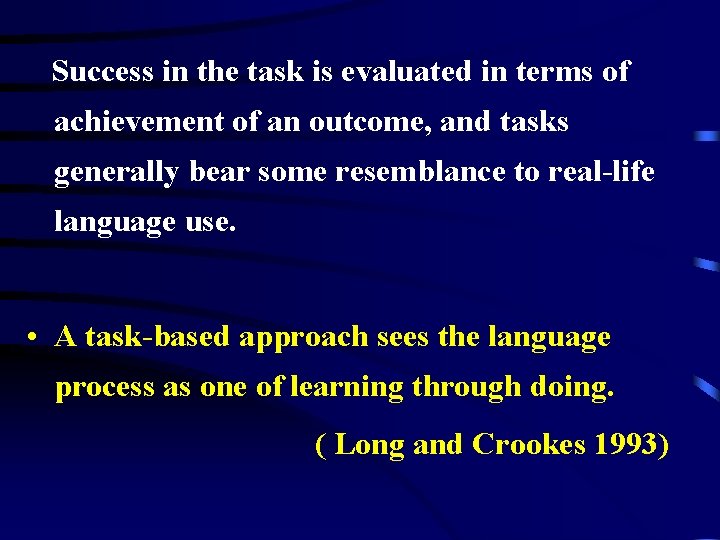
Success in the task is evaluated in terms of achievement of an outcome, and tasks generally bear some resemblance to real-life language use. • A task-based approach sees the language process as one of learning through doing. ( Long and Crookes 1993)

Practice Turn your books to Page 29 and do Task No. 10.
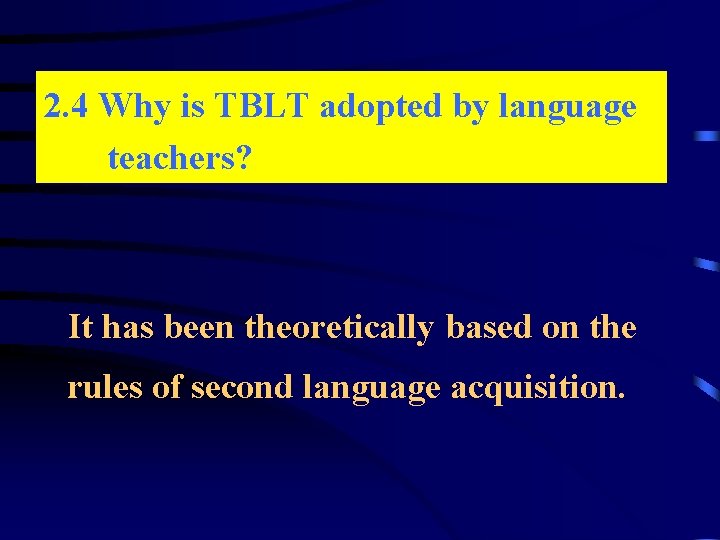
2. 4 Why is TBLT adopted by language teachers? It has been theoretically based on the rules of second language acquisition.

1) Knowledge of grammatical rules was no guarantee of being able to use those rules for communication. Learners who were able to identify instances of rule violation, and who could even state the rule, frequently violated the rules when using language for communication. David Nunan (1999) 语法知识的记忆不能保证语言使用的正确。
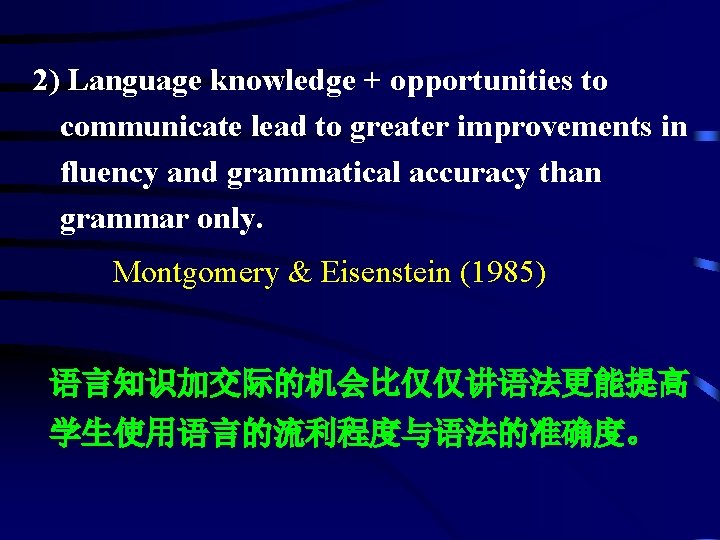
2) Language knowledge + opportunities to communicate lead to greater improvements in fluency and grammatical accuracy than grammar only. Montgomery & Eisenstein (1985) 语言知识加交际的机会比仅仅讲语法更能提高 学生使用语言的流利程度与语法的准确度。

3) Learner participation in class is related significantly to improvements in language proficiency. Lim (1992) 学习者积极主动的参与与语言熟练程度的提 高关系极大。
4) Classrooms that were basically “communicative” for explicit grammatical instruction, were superior to both traditional classrooms that focused heavily on grammar, and to immersion programs that eschewed explicit grammatical instruction. 基本上以“交际”为导向的课堂教学,但同时也 有明确的语法讲解,要比只注重语法教学或回 避语法讲解的沉浸式教学都更好。
5) Language is acquired as learners actively engaged in attempting to communicate in the target language. Acquisition will be maximized when learners engage in tasks that “push” them to the limits of their current competence. 当学习者积极地参与用目的语进行交际的尝试 时,语言也被掌握了。当学习者所进行的任务 使他们当前的语言能力发挥至极点时,习得也 扩展到最佳程度。
2. 5 Features of TBLT 1. An emphasis on learning to communicate through interaction in the target language. 强调通过用目标语交流来学会交际 2. The introduction of authentic texts into the learning situation. 将真实的语言材料引入学习的环境
3. Provision of opportunities for learners to focus, not only on language itself, but also on the learning process. 关注语言的本身,也关注学习的过程 4. An enhancement of the learners’ own personal experiences as important contributing elements to classroom learning. 学习者的个人经历对语言学习具有重要意义
5. An attempt to link classroom language learning with language activation outside the classroom. 试图把课内的语言学习与社会的语言活动结 合起来。 ( Nunan 1991)
2. 6 Three Pedagogical Goals for Task-based Approaches Accuracy 准确程度 • Accuracy concerns how well language is produced in relation to the target language.

Complexity 综合程度 Complexity concerns how far learners rely on prefabricated phrases and established routines, and how far they need to expand their language resources to meet the communicative challenge.
Fluency 流利程度 • Fluency concerns the learner’s capacity to produce language in real time without undue pausing or hesitation. (Skehan 1994)

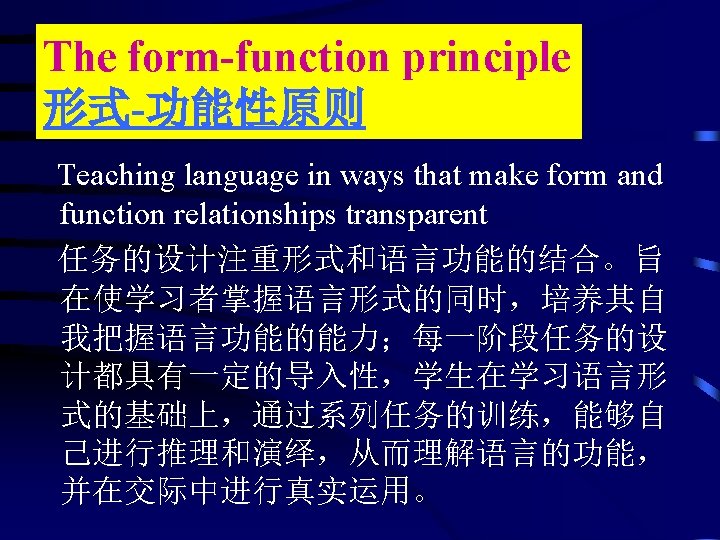
2. 7 Principles to Design • The authenticity principle • The form-function principle • The task dependency principle • Learning by doing
The authenticity principle 言语、情境真实性原则 • The linguistic data that learners work with are authentic. • The relationship between linguistic form and communicative function are clear to the learner. 任务的设计要提供给学习者明确、真实的语言 信息。学习者应该清楚语言形式和语言功能之 间的关系。使学习者在一种自然、真实或模拟 真实的情境中体会语言、掌握语言的应用。
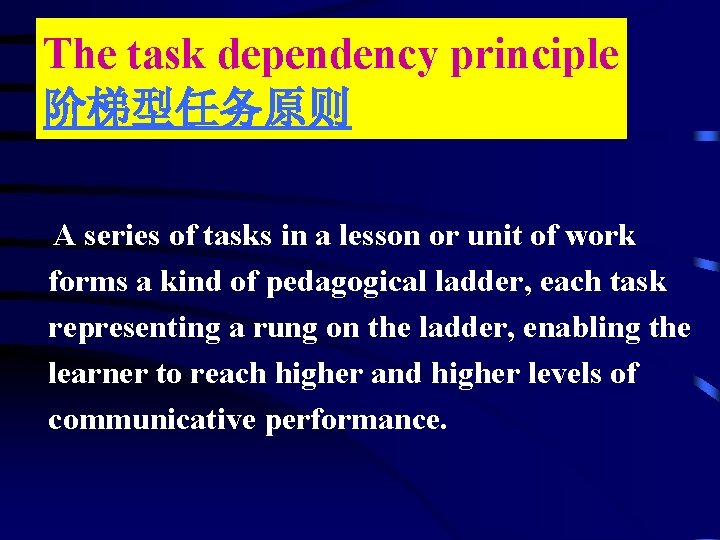
The task dependency principle 阶梯型任务原则 A series of tasks in a lesson or unit of work forms a kind of pedagogical ladder, each task representing a rung on the ladder, enabling the learner to reach higher and higher levels of communicative performance.

Learning by doing 做中学原则 Learning by doing motivates students to fulfill their potential. Learners master the language by using it communicatively in the classroom, although they still have to learn grammar and memorize vocabulary.

2. 8 Activity types • Information-gap activity • Reasoning-gap activity (deciding what to do after listening or reading, working out a plan, a timetable or something else ) • Opinion-gap activity (story completion, social issue discussion, etc)

Homework • What are the limitations of CLT and TBLT under the Chinese foreign language teaching setting?
Reference books p 魏永红. 任务型外语教学研究—认知心理学视角. 上海: 华东师范大学出版社, 2004. p Skehan, P. 1996. Second language acquisition research and task-based instruction, in Willis, J. & Willis, D. Challenge and Change in Language Teaching. UK: Macmillan Publishers Limited. p Willis, J. 1996. A flexible frramework for task-based learning, in Willis, J. & Willis, D. Challenge and Change in Language Teaching. UK: Macmillan Publishers Limited.

- Slides: 35