
Unit 2 Operating Systems and Execution Environment Operating

- Slides: 36
Unit - 2 Operating Systems and Execution Environment
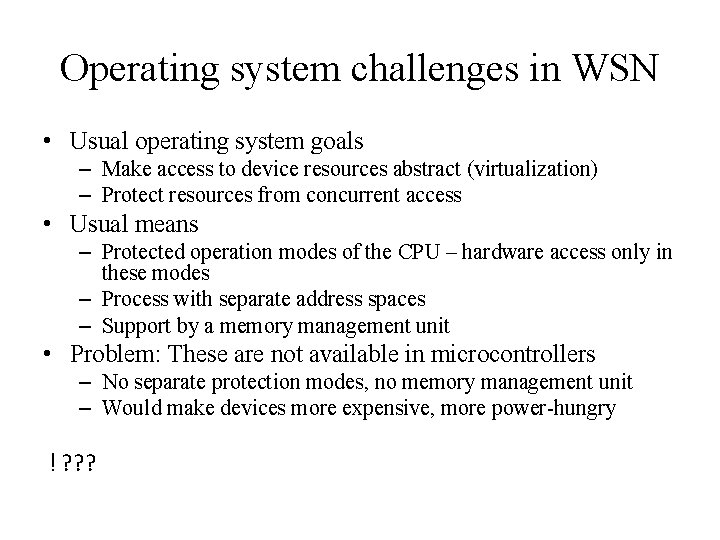
Operating system challenges in WSN • Usual operating system goals – Make access to device resources abstract (virtualization) – Protect resources from concurrent access • Usual means – Protected operation modes of the CPU – hardware access only in these modes – Process with separate address spaces – Support by a memory management unit • Problem: These are not available in microcontrollers – No separate protection modes, no memory management unit – Would make devices more expensive, more power-hungry ! ? ? ?
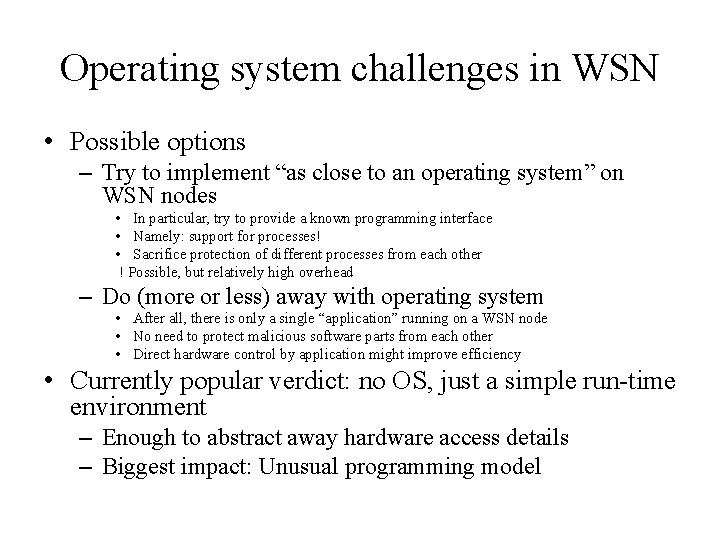
Operating system challenges in WSN • Possible options – Try to implement “as close to an operating system” on WSN nodes • In particular, try to provide a known programming interface • Namely: support for processes! • Sacrifice protection of different processes from each other ! Possible, but relatively high overhead – Do (more or less) away with operating system • After all, there is only a single “application” running on a WSN node • No need to protect malicious software parts from each other • Direct hardware control by application might improve efficiency • Currently popular verdict: no OS, just a simple run-time environment – Enough to abstract away hardware access details – Biggest impact: Unusual programming model
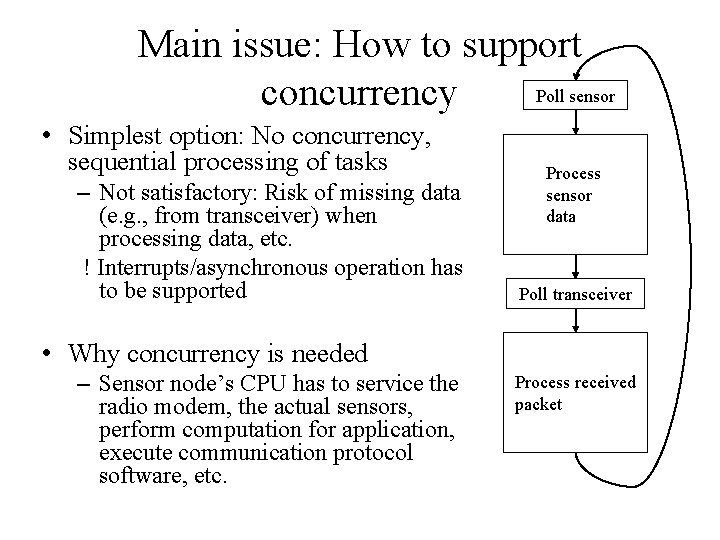
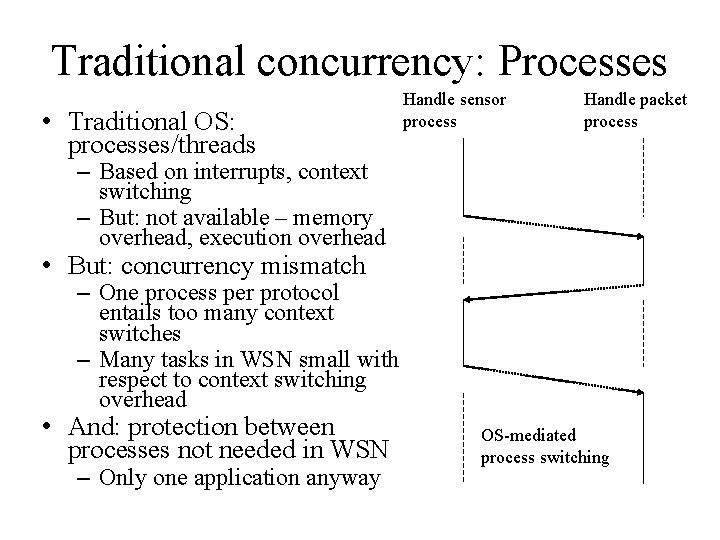
Main issue: How to support Poll sensor concurrency • Simplest option: No concurrency, sequential processing of tasks – Not satisfactory: Risk of missing data (e. g. , from transceiver) when processing data, etc. ! Interrupts/asynchronous operation has to be supported Process sensor data Poll transceiver • Why concurrency is needed – Sensor node’s CPU has to service the radio modem, the actual sensors, perform computation for application, execute communication protocol software, etc. Process received packet
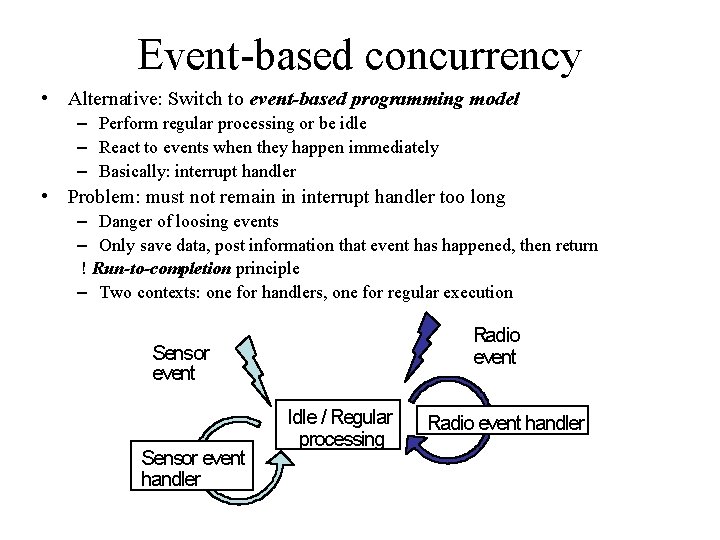
Traditional concurrency: Processes • Traditional OS: processes/threads Handle sensor process Handle packet process – Based on interrupts, context switching – But: not available – memory overhead, execution overhead • But: concurrency mismatch – One process per protocol entails too many context switches – Many tasks in WSN small with respect to context switching overhead • And: protection between processes not needed in WSN – Only one application anyway OS-mediated process switching
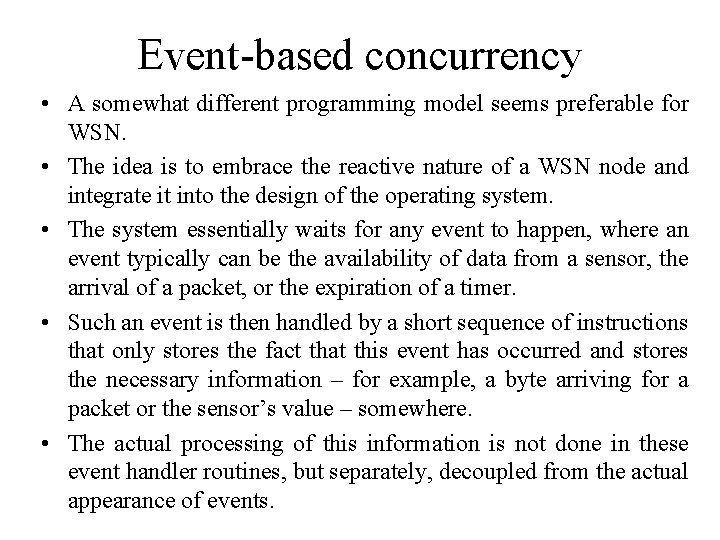
Event-based concurrency • Alternative: Switch to event-based programming model – Perform regular processing or be idle – React to events when they happen immediately – Basically: interrupt handler • Problem: must not remain in interrupt handler too long – Danger of loosing events – Only save data, post information that event has happened, then return ! Run-to-completion principle – Two contexts: one for handlers, one for regular execution Radio event Sensor event handler Idle / Regular processing Radio event handler
Event-based concurrency • A somewhat different programming model seems preferable for WSN. • The idea is to embrace the reactive nature of a WSN node and integrate it into the design of the operating system. • The system essentially waits for any event to happen, where an event typically can be the availability of data from a sensor, the arrival of a packet, or the expiration of a timer. • Such an event is then handled by a short sequence of instructions that only stores the fact that this event has occurred and stores the necessary information – for example, a byte arriving for a packet or the sensor’s value – somewhere. • The actual processing of this information is not done in these event handler routines, but separately, decoupled from the actual appearance of events.
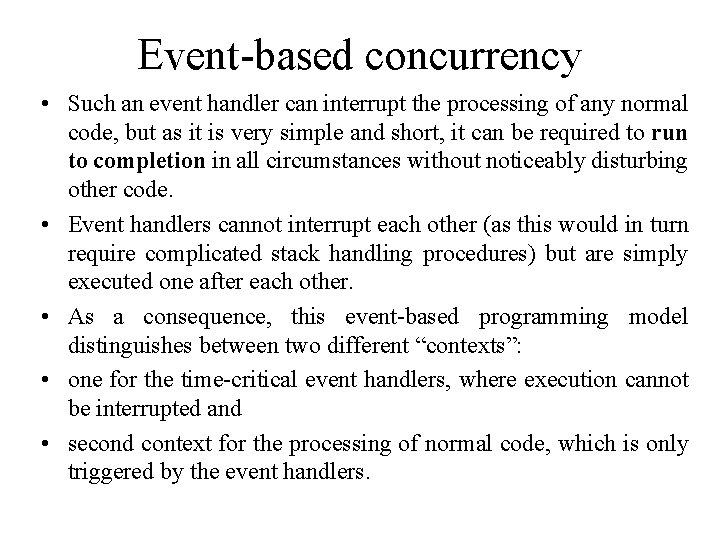
Event-based concurrency • Such an event handler can interrupt the processing of any normal code, but as it is very simple and short, it can be required to run to completion in all circumstances without noticeably disturbing other code. • Event handlers cannot interrupt each other (as this would in turn require complicated stack handling procedures) but are simply executed one after each other. • As a consequence, this event-based programming model distinguishes between two different “contexts”: • one for the time-critical event handlers, where execution cannot be interrupted and • second context for the processing of normal code, which is only triggered by the event handlers.
Event-based concurrency • This event-based programming model is slightly different to what most programmers are used to. • It is actually comparable, on some levels, to communicating, extended finite state machines, which are used in protocol design formalisms as well as in some parallel programming paradigms. • It does offer considerable advantages. • The performance of a process-based an event-based programming model is compared on the same hardware and found that performance improved by a factor of 8, • instruction/data memory requirements were reduced by factors of 2 and 30, respectively, • and power consumption was reduced by a factor of 12.
Interfaces to the operating system • In addition to the programming model, it is also necessary to specify some interfaces to how internal state of the system can be inquired and perhaps set. • As the clear distinction between protocol stack and application programs vanishes somewhat in WSNs, such an interface should be accessible from protocol implementations and it should allow these implementations to access each other. • This interface is also closely tied with the structure of protocol stacks. • Such an Application Programming Interface (API) comprises, in general, • a functional interface, • object abstractions, • and detailed behavioral semantics.
Interfaces to the operating system • Abstractions are wireless links, nodes, and so on. • Possible functions include state inquiry and manipulation, sending and transmitting of data, access to hardware (sensors, actuators, transceivers), and setting of policies, for example, with respect to energy/quality trade-offs. • While such a general API would be extremely useful, there is currently no clear standard – or even an in-depth discussion – arising from the literature. • Some first steps in this direction are more concerned with the networking architecture, not so much with accessing functionality on a single node. • Until this changes, de facto standards will continue to be used and are likely to serve reasonably well.
Structure of operating system and protocol stack • The traditional approach to communication protocol structuring is to use layering: • Individual protocols are stacked on top of each other, each layer only using functions of the layer directly below. • This layered approach has great benefits in keeping the entire protocol stack manageable, in containing complexity, and in promoting modularity and reuse. • For the purposes of a WSN, however, it is not clear whether such a strictly layered approach will suffice. • As an example, consider the use of information about the strength of the signal received from a communication partner.
Structure of operating system and protocol stack • This physical layer information can be used to assist in networking protocols to decide about routing changes (a signal becomes weaker if a node moves away and should perhaps no longer be used as a next hop), to compute location information by estimating distance from the signal strength, or to assist link layer protocols in channel-adaptive or hybrid FEC/ARQ schemes. • Hence, one single source of information can be used to the advantage of many other protocols not directly associated with the source of this information. • Such cross-layer information exchange is but one way to loosen the strict confinements of the layered approach.
Structure of operating system and protocol stack • Even in traditional network scenarios, • efficiency considerations , • the need to support wired networking protocols in wireless systems, • the need to migrate functionality into the backbone despite the prescriptions of Internet’s end-to-end model , • or the desire to support handover mechanisms by physical layer information in cellular networks, • all have created a considerable pressure for a flexible, manageable, and efficient way of structuring and implementing communication protocols.
Structure of operating system and protocol stack • When departing from the layered architecture, the prevalent trend is to use a component model. • Relatively large, monolithic layers are broken up into small, selfcontained “components”, “building blocks”, or “modules” (the terminology varies). • These components only fulfill one well-defined function each – for example, computation of a Cyclic Redundancy Check (CRC) – and interact with each other over clear interfaces. • The main difference compared to the layered architecture is that these interactions are not confined to immediate neighbors in an up/down relationship, but can be with any other component.
Structure of operating system and protocol stack • This component model not only solves some of the structuring problems for protocol stacks, it also fits naturally with an eventbased approach to programming wireless sensor nodes. • Wrapping of hardware, communication primitives, in-network processing functionalities all can be conveniently designed and implemented as components. • One popular example for an operating system following this approach is Tiny. OS. • It uses the notion of explicit wiring of components to allow event exchange to take place between them.
Dynamic energy and power management • Switching individual components into various sleep states or reducing their performance by scaling down frequency and supply voltage and selecting particular modulation and codings were the prominent examples for improving energy efficiency. • To control these possibilities, decisions have to be made by the operating system, by the protocol stack, or potentially by an application when to switch into one of these states. • Dynamic Power Management (DPM) on a system level is the problem at hand. • One of the complicating factors to DPM is the energy and time required for the transition of a component between any two states. • If these factors were negligible, clearly it would be optimal to always & immediately go into the mode with the lowest power consumption possible. • As this is not the case, more advanced algorithms are required, taking into account these costs, the rate of updating power management decisions, the probability distribution of time until future events, and properties of the used algorithms.
Probabilistic state transition policies • Sinha and Chandrakasan consider the problem of policies that regulate the transition between various sleep states. • They start out by considering sensors randomly distributed over a fixed area and assume that events arrive with certain temporal distributions (Poisson process) and spatial distributions. • This allows them to compute probabilities for the time to the next event, once an event has been processed (even for moving events). • They use this probability to select the deepest sleep state out of several possible ones. • In addition, they take into account the possibility of missing events when the sensor as such is also shut down in sleep mode. • This can be acceptable for some applications, and Sinha and Chandrakasan give some probabilistic rules on how to decide whether to go into such a deep sleep mode.
Controlling dynamic voltage scaling • To turn the possibilities of DVS into a technical solution also requires some further considerations. • For example, it is the rare exception that there is only a single task to be run in an operating system; • hence, a clever scheduler is required to decide which clock rate to use in each situation to meet all deadlines. • This can require feedback from applications and has been mostly studied in “traditional” applications. • Another approach incorporates dynamic voltage scaling control into the kernel of the operating system and achieves energy efficiency improvements in mixed workloads without modifications to user programs. • Many other papers have considered DVS-based power management in various circumstances, often in the context of hard real-time systems. • Applying these results to the specific settings of a WSN is, however, still a research task as WSNs usually do not operate under similarly strict timing constraints, nor are the application profiles comparable.
Trading off fidelity against energy consumption • Most of the just described work on controlling DVS assumes hard deadlines for each task (the task has to be completed by a given time, otherwise its results are useless). • In WSNs, such an assumption is often not appropriate. • Rather, there are often tasks that can be computed with a higher or lower level of accuracy. • The fidelity achieved by such tasks is a candidate for trading it off against other resources. • When time is considered, the concept of “imprecise computation” results. • In a WSN, the natural trade-off is against energy required to compute a task. • Essentially, the question arises again how best to invest a given amount of energy available for a given task.
Trading off fidelity against energy consumption • Some approaches to exploit such trade-offs have been described in the literature, for example, • Sinha et al. discuss the energy-quality trade-off for algorithm design, especially for signal processing purposes. • The idea is to transform an algorithm such that it quickly approximates the final result and keeps computing as long as energy is available, producing incremental refinements (being a direct counterpart to imprecise computation , where computation can continue as long as time is available).
Case study embedded OS: Tiny. OS & nes. C • The use of an event-based programming model as the only feasible way to support the concurrency required for sensor node software while staying within the confined resources and running on top of the simple hardware provided by these nodes. • The open question is how to harness the power of this programming model without getting lost in the complexity of many individual state machines sending each other events. • In addition, modularity should be supported to easily exchange one state machine against another. • The operating system Tiny. OS , along with the programming language nes. C, addresses these challenges.
Case study embedded OS: Tiny. OS & nes. C • Tiny. OS supports modularity and event-based programming by the concept of components. • A component contains semantically related functionality, for example, for handling a radio interface or for computing routes. • Such a component comprises the required state information in a frame, the program code for normal tasks, and handlers for events and commands. • Both events and commands are exchanged between different components.
Case study embedded OS: Tiny. OS & nes. C • Components are arranged hierarchically, from low-level components close to the hardware to high-level components making up the actual application. • Events originate in the hardware and pass upward from lowlevel to high-level components; • commands, on the other hand, are passed from high-level to low-level components.
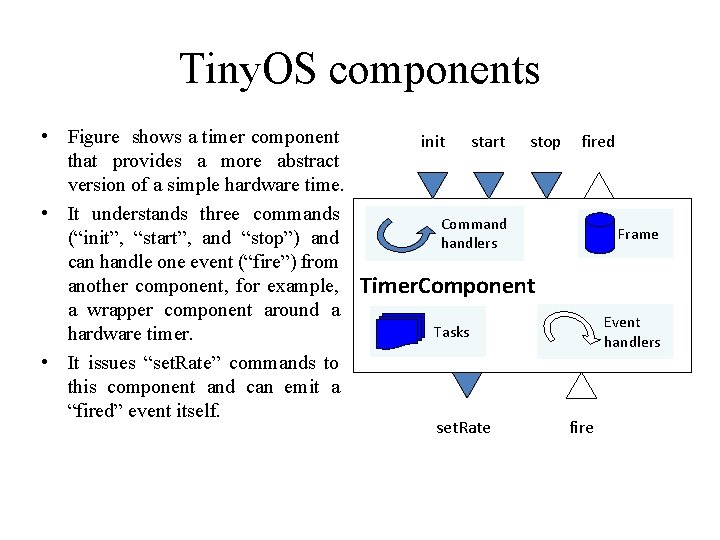
Tiny. OS components • Figure shows a timer component init start stop fired that provides a more abstract version of a simple hardware time. • It understands three commands Command Frame (“init”, “start”, and “stop”) and handlers can handle one event (“fire”) from another component, for example, Timer. Component a wrapper component around a Event Tasks hardware timer. handlers • It issues “set. Rate” commands to this component and can emit a “fired” event itself. set. Rate fire
Case study embedded OS: Tiny. OS & nes. C • The important thing to note is that, in staying with the eventbased paradigm, both command event handlers must run to conclusion; they are only supposed to perform very simple triggering duties. • In particular, commands must not block or wait for an indeterminate amount of time; they are simply a request upon which some task of the hierarchically lower component has to act. • Similarly, an event handler only leaves information in its component’s frame and arranges for a task to be executed later; it can also send commands to other components or directly report an event further up.
Case study embedded OS: Tiny. OS & nes. C • The actual computational work is done in the tasks. • In Tiny. OS, they also have to run to completion, but can be interrupted by handlers. • The advantage is twofold: there is no need for stack management and tasks are atomic with respect to each other. • Still, by virtue of being triggered by handlers, tasks are seemingly concurrent to each other. • The arbitration between tasks – multiple can be triggered by several events and are ready to execute – is done by a simple, power-aware First In First Out (FIFO) scheduler, which shuts the node down when there is no task executing or waiting.
Case study embedded OS: Tiny. OS & nes. C • With handlers and tasks all required to run to completion, it is not clear how a component could obtain feedback from another component about a command that it has invoked there. • for example, how could an Automatic Repeat Request (ARQ) protocol learn from the MAC protocol whether a packet had been sent successfully or not? • The idea is to split invoking such a request and the information about answers into two phases: The first phase is the sending of the command, • the second is an explicit information about the outcome of the operation, delivered by a separate event.
Case study embedded OS: Tiny. OS & nes. C • This split-phase programming approach requires for each command a matching event but enables concurrency under the constraints of run-to-completion semantics – if no confirmation for a command is required, no completion event is necessary. • Having commands and events as the only way of interaction between components (the frames of components are private data structures), and especially when using split-phase programming, a large number of commands and events add up in even a modestly large program. • Hence, an abstraction is necessary to organize them.
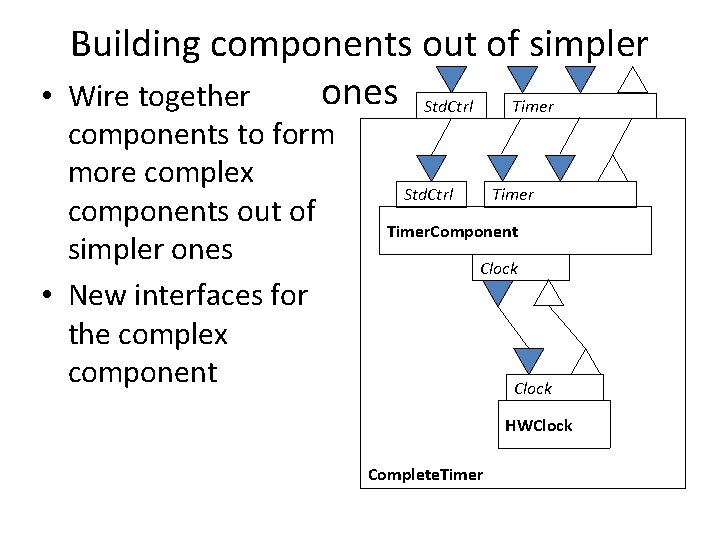
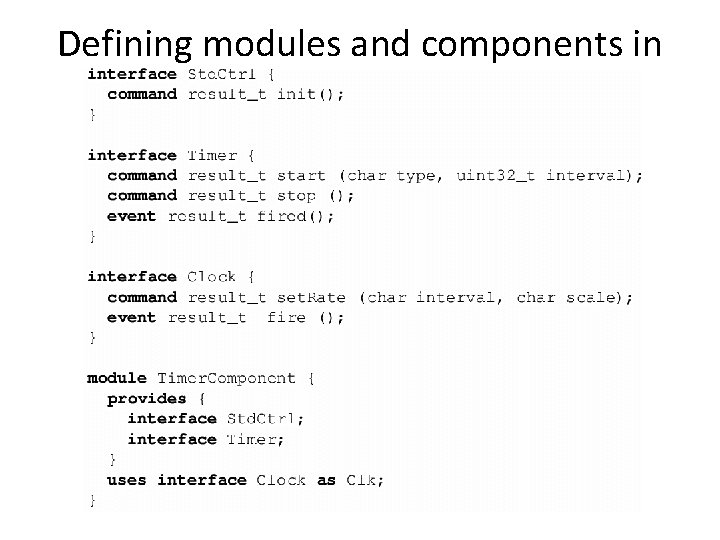
Case study embedded OS: Tiny. OS & nes. C • As a matter of fact, the set of commands that a component understands and the set of events that a component may emit are its interface to the components of a hierarchically higher layer. • A component can invoke certain commands at its lower component and receive certain events from it. • Therefore, structuring commands and events that belong together forms an interface between two components. • The nes. C language formalizes this intuition by allowing a programmer to define interface types that define commands and events that belong together. • This allows to easily express split-phase programming style by putting commands and their corresponding completion events into the same interface. • Components then provide certain interfaces to their users and in turn use other interfaces from underlying components.
Handlers versus tasks • Command handlers and events must run to completion – Must not wait an indeterminate amount of time – Only a request to perform some action • Tasks, on the other hand, can perform arbitrary, long computation – Also have to be run to completion since no noncooperative multi-tasking is implemented – But can be interrupted by handlers ! No need for stack management, tasks are atomic with respect to each other
Split-phase programming • Handler/task characteristics and separation has consequences on programming model – How to implement a blocking call to another component? – Example: Order another component to send a packet – Blocking function calls are not an option ! Split-phase programming – First phase: Issue the command to another component • Receiving command handler will only receive the command, post it to a task for actual execution and returns immediately • Returning from a command invocation does not mean that the command has been executed! – Second phase: Invoked component notifies invoker by event that command has been executed – Consequences e. g. for buffer handling • Buffers can only be freed when completion event is received
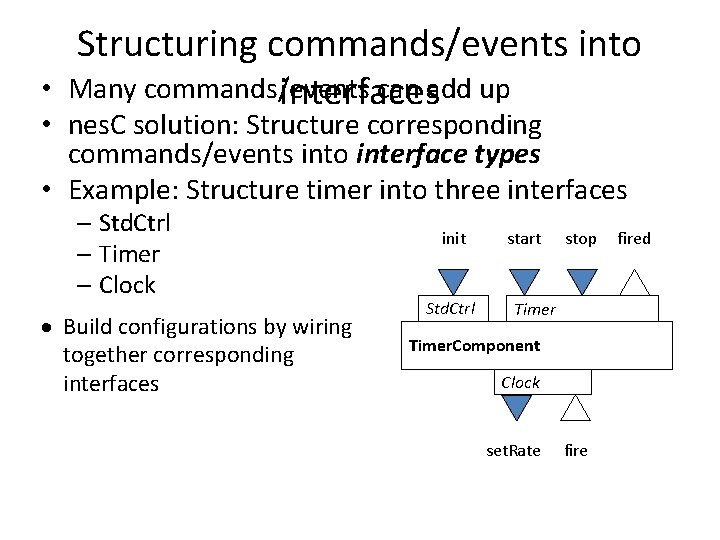
Structuring commands/events into Many commands/events can add up interfaces • • nes. C solution: Structure corresponding commands/events into interface types • Example: Structure timer into three interfaces – Std. Ctrl – Timer – Clock · Build configurations by wiring together corresponding interfaces init Std. Ctrl start stop Timer. Component Clock set. Rate fired
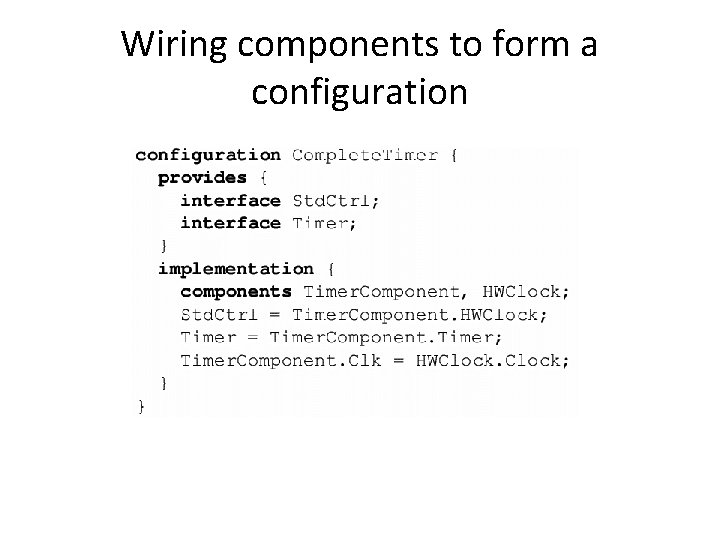
Building components out of simpler ones Std. Ctrl Timer • Wire together components to form more complex components out of simpler ones • New interfaces for the complex component Std. Ctrl Timer. Component Clock HWClock Complete. Timer
Defining modules and components in nes. C
Wiring components to form a configuration