
Unit 2 Notes Part B Ecology Terrestrial Ecosystems

Unit 2 Notes (Part B) Ecology

• Terrestrial Ecosystems: each is defined by a unique set of abiotic factors and has a characteristic ecological community.
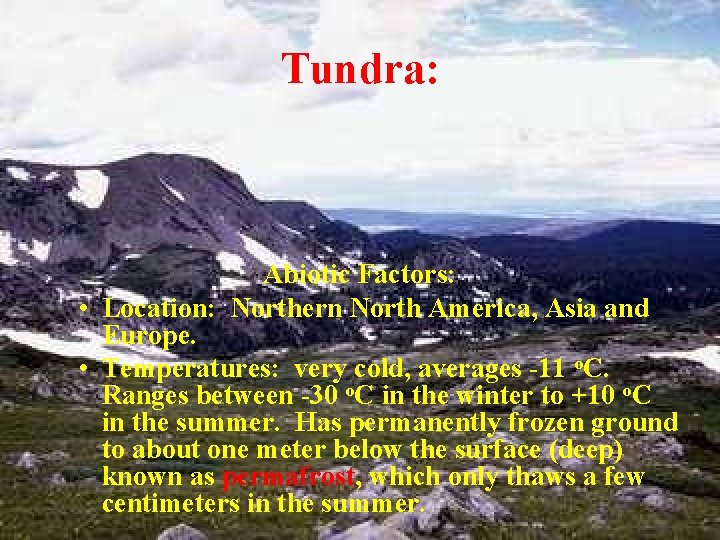
Tundra: Abiotic Factors: • Location: Northern North America, Asia and Europe. • Temperatures: very cold, averages -11 o. C. Ranges between -30 o. C in the winter to +10 o. C in the summer. Has permanently frozen ground to about one meter below the surface (deep) known as permafrost, which only thaws a few centimeters in the summer.
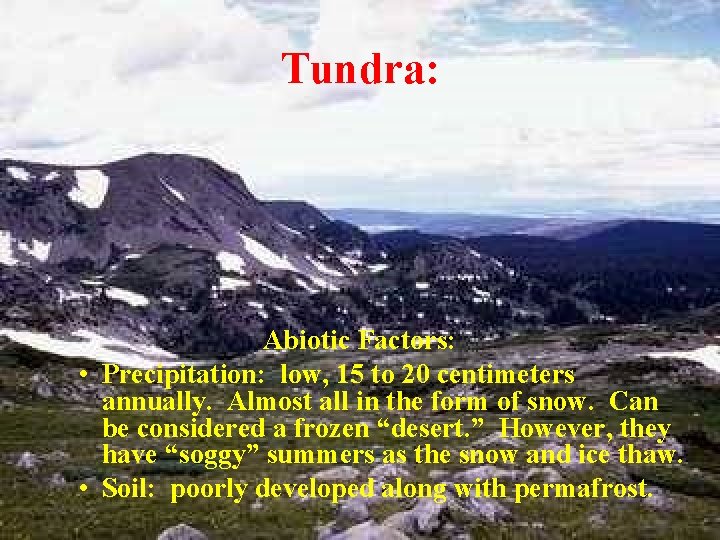
Tundra: Abiotic Factors: • Precipitation: low, 15 to 20 centimeters annually. Almost all in the form of snow. Can be considered a frozen “desert. ” However, they have “soggy” summers as the snow and ice thaw. • Soil: poorly developed along with permafrost.
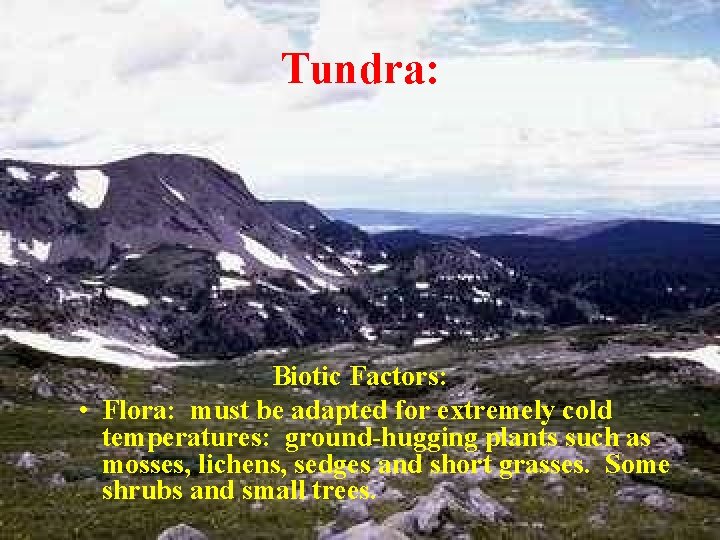
Tundra: Biotic Factors: • Flora: must be adapted for extremely cold temperatures: ground-hugging plants such as mosses, lichens, sedges and short grasses. Some shrubs and small trees.
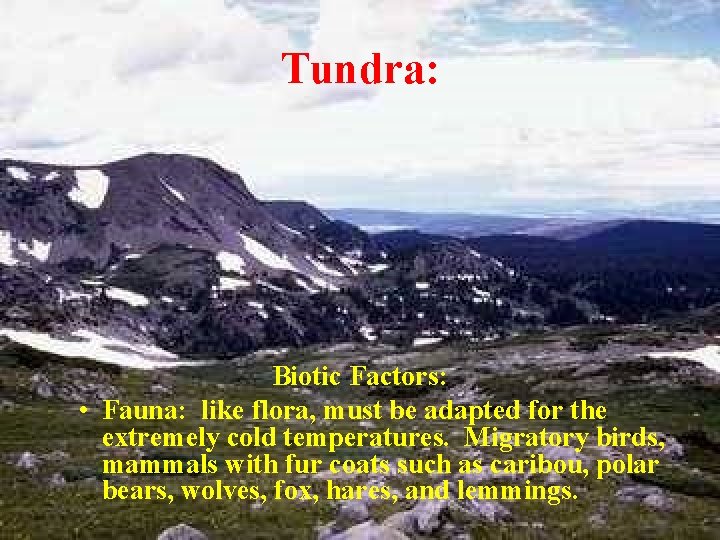
Tundra: Biotic Factors: • Fauna: like flora, must be adapted for the extremely cold temperatures. Migratory birds, mammals with fur coats such as caribou, polar bears, wolves, fox, hares, and lemmings.
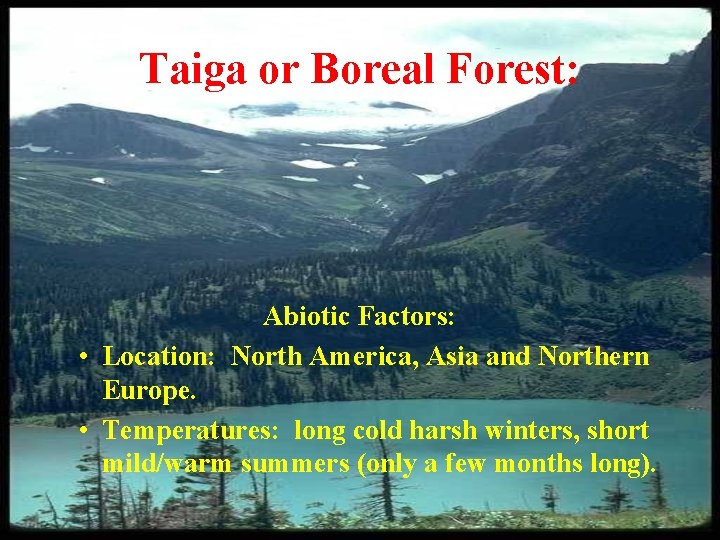
Taiga or Boreal Forest: Abiotic Factors: • Location: North America, Asia and Northern Europe. • Temperatures: long cold harsh winters, short mild/warm summers (only a few months long).
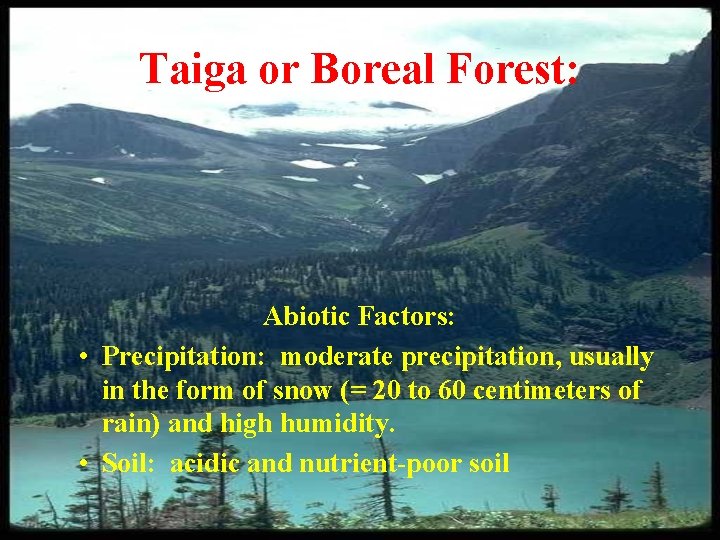
Taiga or Boreal Forest: Abiotic Factors: • Precipitation: moderate precipitation, usually in the form of snow (= 20 to 60 centimeters of rain) and high humidity. • Soil: acidic and nutrient-poor soil
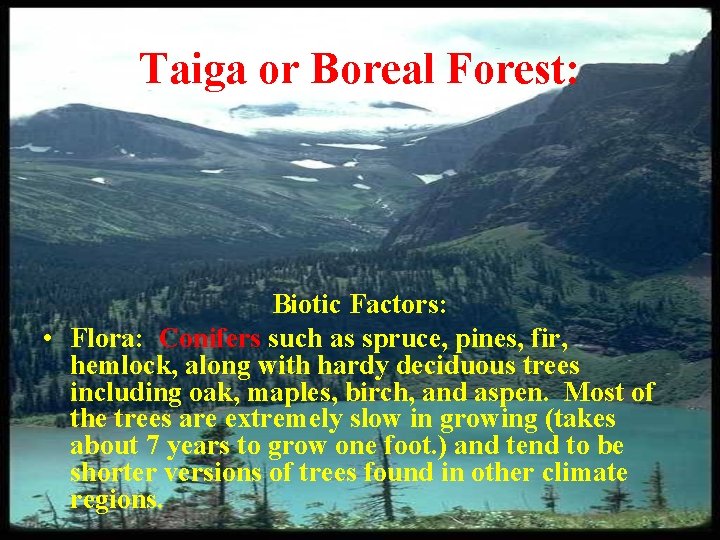
Taiga or Boreal Forest: Biotic Factors: • Flora: Conifers such as spruce, pines, fir, hemlock, along with hardy deciduous trees including oak, maples, birch, and aspen. Most of the trees are extremely slow in growing (takes about 7 years to grow one foot. ) and tend to be shorter versions of trees found in other climate regions.
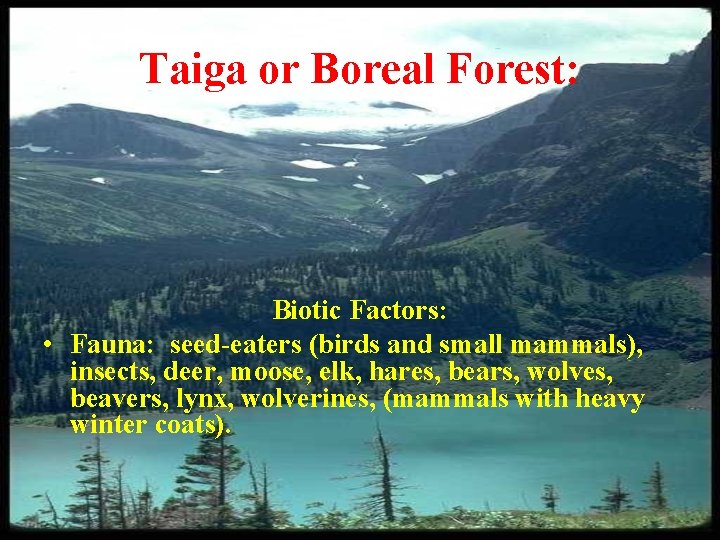
Taiga or Boreal Forest: Biotic Factors: • Fauna: seed-eaters (birds and small mammals), insects, deer, moose, elk, hares, bears, wolves, beavers, lynx, wolverines, (mammals with heavy winter coats).
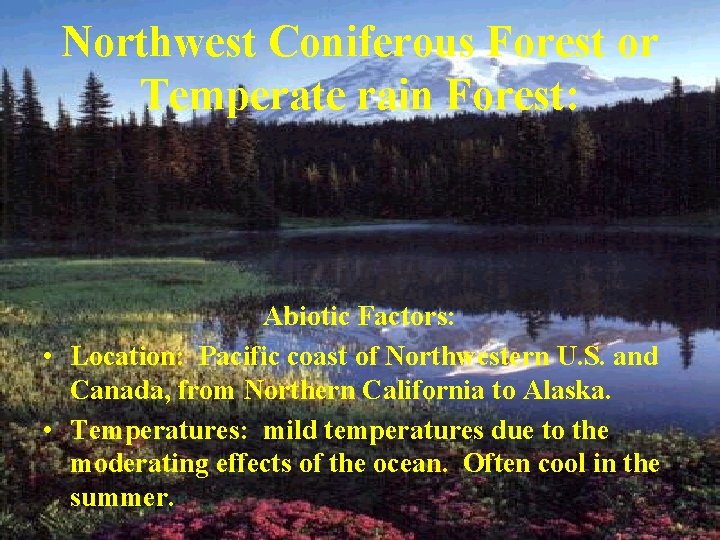
Northwest Coniferous Forest or Temperate rain Forest: Abiotic Factors: • Location: Pacific coast of Northwestern U. S. and Canada, from Northern California to Alaska. • Temperatures: mild temperatures due to the moderating effects of the ocean. Often cool in the summer.
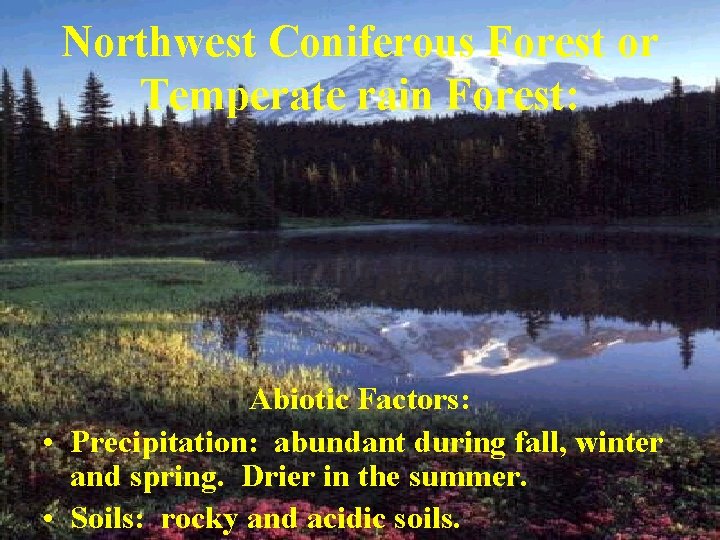
Northwest Coniferous Forest or Temperate rain Forest: Abiotic Factors: • Precipitation: abundant during fall, winter and spring. Drier in the summer. • Soils: rocky and acidic soils.
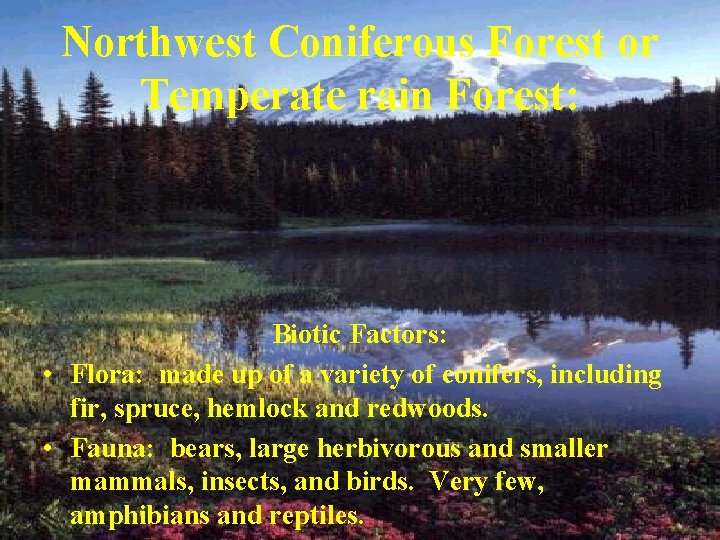
Northwest Coniferous Forest or Temperate rain Forest: Biotic Factors: • Flora: made up of a variety of conifers, including fir, spruce, hemlock and redwoods. • Fauna: bears, large herbivorous and smaller mammals, insects, and birds. Very few, amphibians and reptiles.
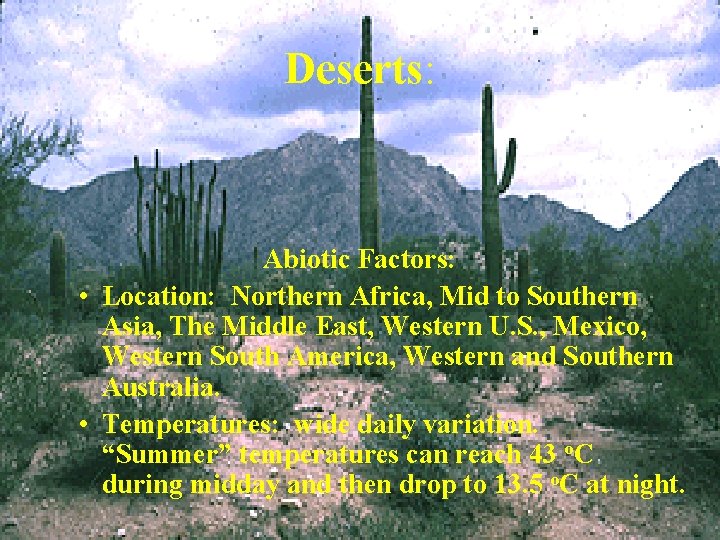
Deserts: Abiotic Factors: • Location: Northern Africa, Mid to Southern Asia, The Middle East, Western U. S. , Mexico, Western South America, Western and Southern Australia. • Temperatures: wide daily variation. “Summer” temperatures can reach 43 o. C during midday and then drop to 13. 5 o. C at night.
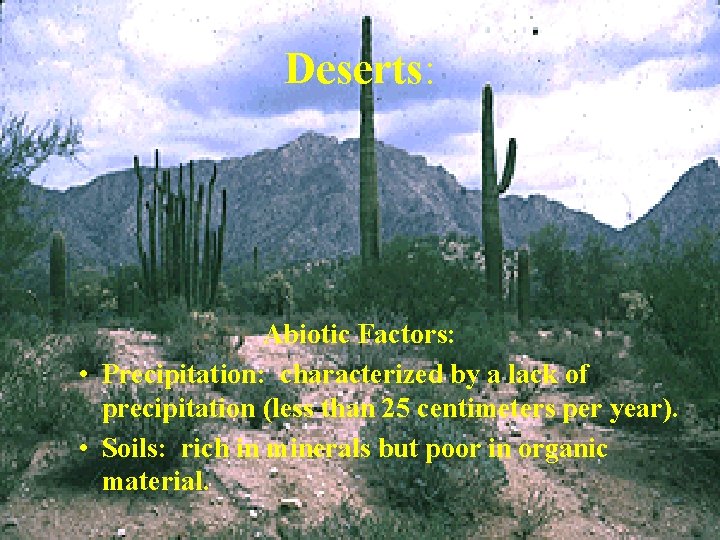
Deserts: Abiotic Factors: • Precipitation: characterized by a lack of precipitation (less than 25 centimeters per year). • Soils: rich in minerals but poor in organic material.
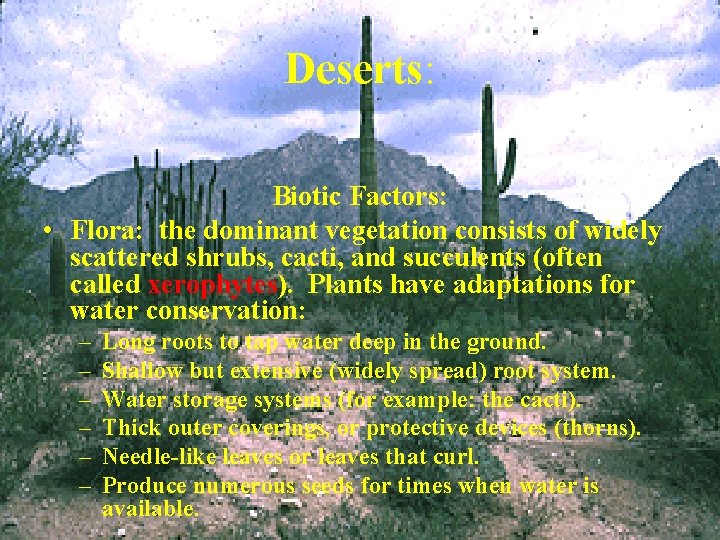
Deserts: Biotic Factors: • Flora: the dominant vegetation consists of widely scattered shrubs, cacti, and succulents (often called xerophytes). Plants have adaptations for water conservation: – – – Long roots to tap water deep in the ground. Shallow but extensive (widely spread) root system. Water storage systems (for example: the cacti). Thick outer coverings, or protective devices (thorns). Needle-like leaves or leaves that curl. Produce numerous seeds for times when water is available.
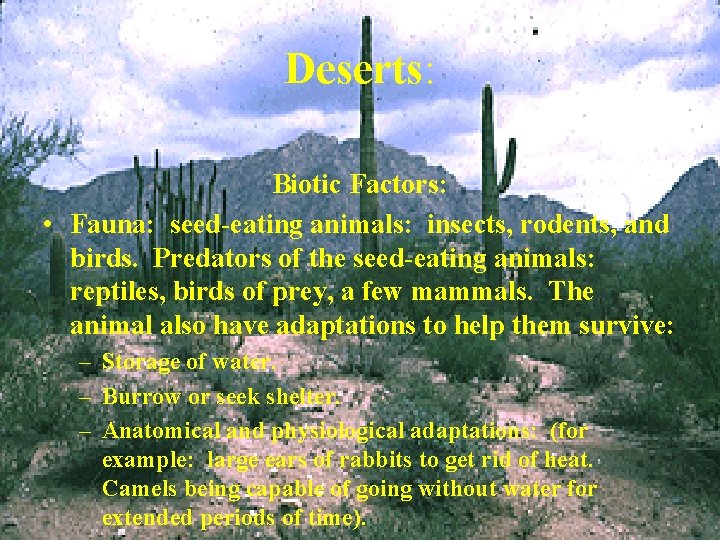
Deserts: Biotic Factors: • Fauna: seed-eating animals: insects, rodents, and birds. Predators of the seed-eating animals: reptiles, birds of prey, a few mammals. The animal also have adaptations to help them survive: – Storage of water. – Burrow or seek shelter. – Anatomical and physiological adaptations: (for example: large ears of rabbits to get rid of heat. Camels being capable of going without water for extended periods of time).
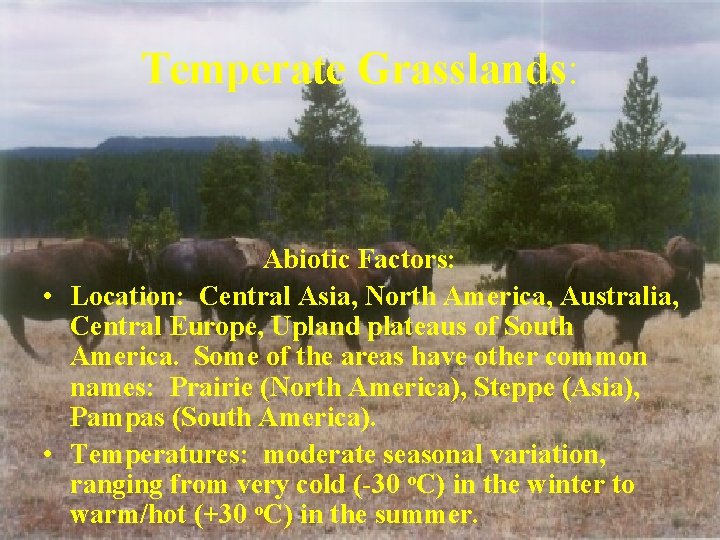
Temperate Grasslands: Abiotic Factors: • Location: Central Asia, North America, Australia, Central Europe, Upland plateaus of South America. Some of the areas have other common names: Prairie (North America), Steppe (Asia), Pampas (South America). • Temperatures: moderate seasonal variation, ranging from very cold (-30 o. C) in the winter to warm/hot (+30 o. C) in the summer.
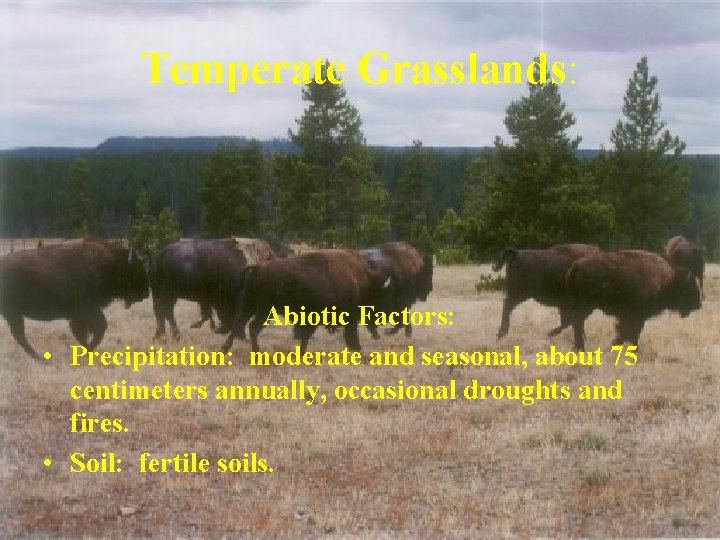
Temperate Grasslands: Abiotic Factors: • Precipitation: moderate and seasonal, about 75 centimeters annually, occasional droughts and fires. • Soil: fertile soils.
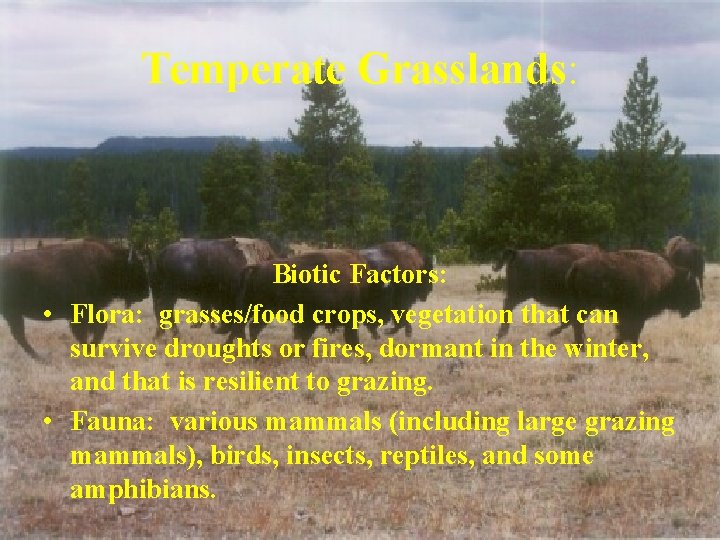
Temperate Grasslands: Biotic Factors: • Flora: grasses/food crops, vegetation that can survive droughts or fires, dormant in the winter, and that is resilient to grazing. • Fauna: various mammals (including large grazing mammals), birds, insects, reptiles, and some amphibians.
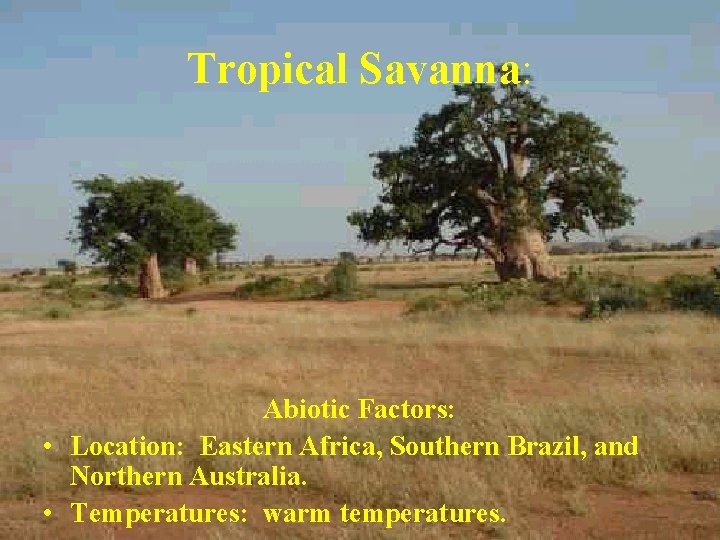
Tropical Savanna: Abiotic Factors: • Location: Eastern Africa, Southern Brazil, and Northern Australia. • Temperatures: warm temperatures.
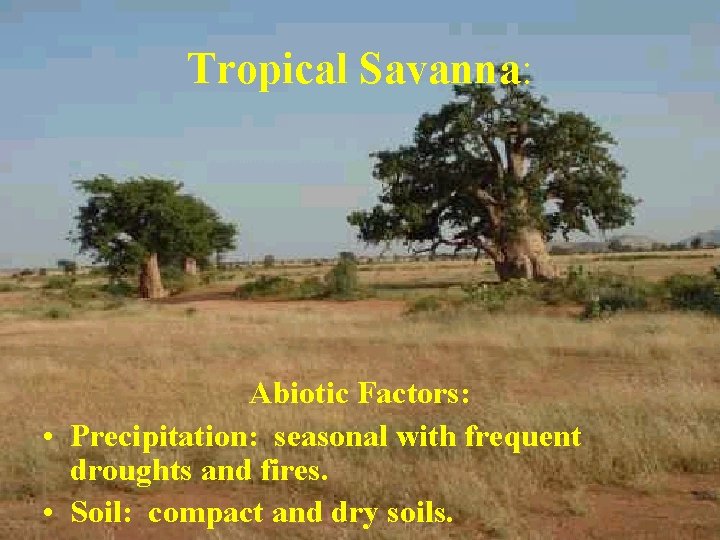
Tropical Savanna: Abiotic Factors: • Precipitation: seasonal with frequent droughts and fires. • Soil: compact and dry soils.
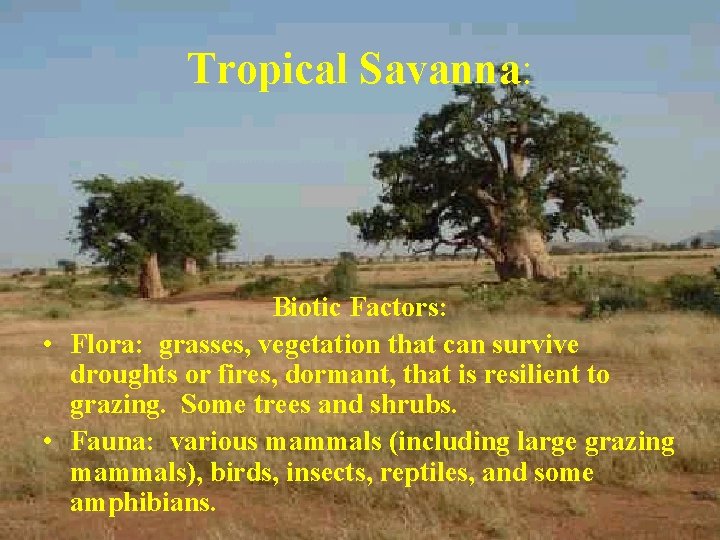
Tropical Savanna: Biotic Factors: • Flora: grasses, vegetation that can survive droughts or fires, dormant, that is resilient to grazing. Some trees and shrubs. • Fauna: various mammals (including large grazing mammals), birds, insects, reptiles, and some amphibians.
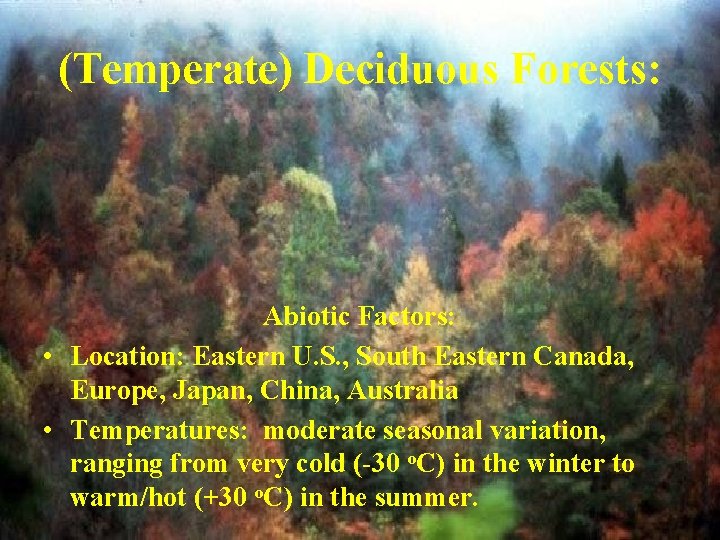
(Temperate) Deciduous Forests: Abiotic Factors: • Location: Eastern U. S. , South Eastern Canada, Europe, Japan, China, Australia • Temperatures: moderate seasonal variation, ranging from very cold (-30 o. C) in the winter to warm/hot (+30 o. C) in the summer.
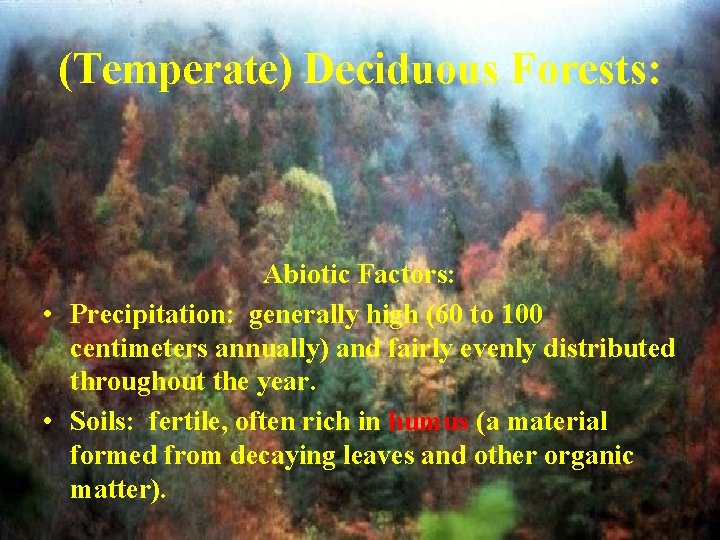
(Temperate) Deciduous Forests: Abiotic Factors: • Precipitation: generally high (60 to 100 centimeters annually) and fairly evenly distributed throughout the year. • Soils: fertile, often rich in humus (a material formed from decaying leaves and other organic matter).
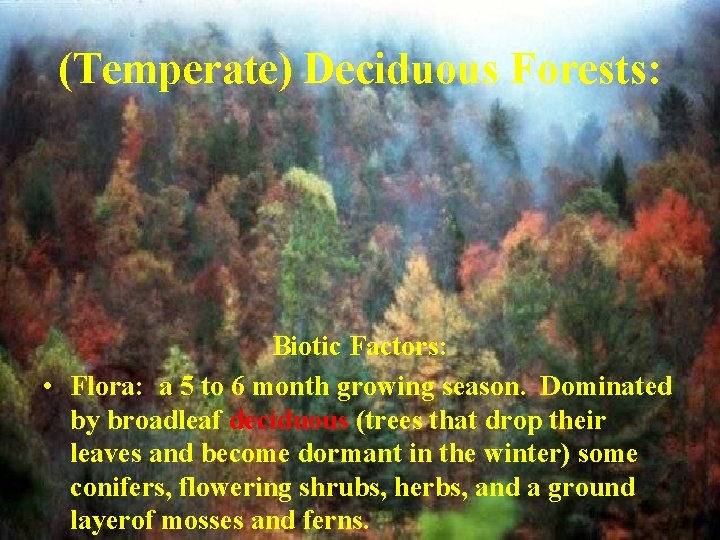
(Temperate) Deciduous Forests: Biotic Factors: • Flora: a 5 to 6 month growing season. Dominated by broadleaf deciduous (trees that drop their leaves and become dormant in the winter) some conifers, flowering shrubs, herbs, and a ground layerof mosses and ferns.
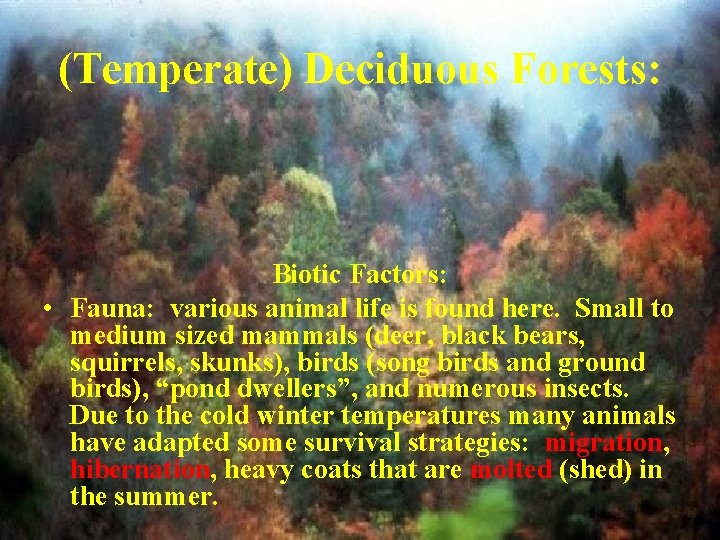
(Temperate) Deciduous Forests: Biotic Factors: • Fauna: various animal life is found here. Small to medium sized mammals (deer, black bears, squirrels, skunks), birds (song birds and ground birds), “pond dwellers”, and numerous insects. Due to the cold winter temperatures many animals have adapted some survival strategies: migration, hibernation, heavy coats that are molted (shed) in the summer.
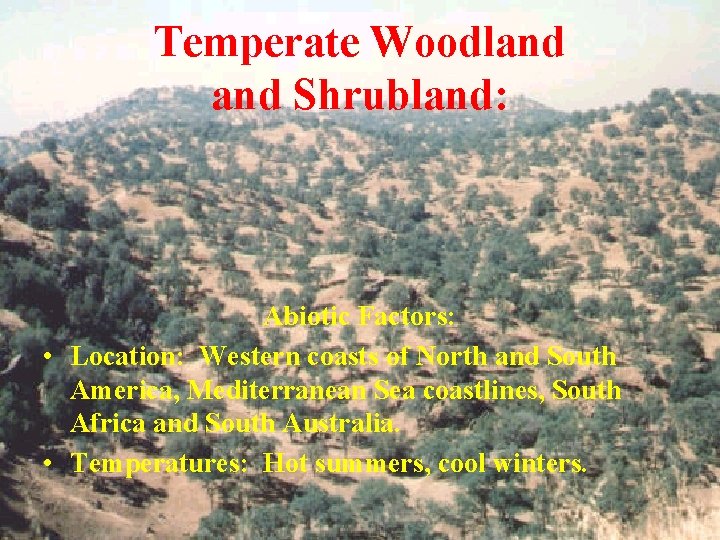
Temperate Woodland Shrubland: Abiotic Factors: • Location: Western coasts of North and South America, Mediterranean Sea coastlines, South Africa and South Australia. • Temperatures: Hot summers, cool winters.
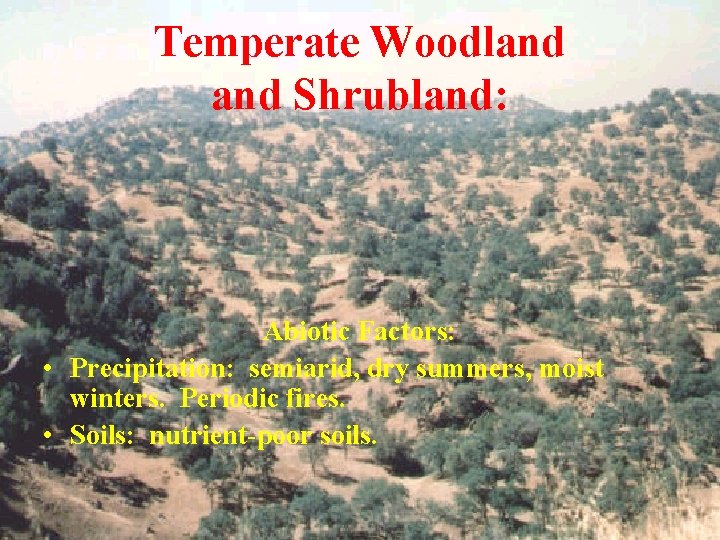
Temperate Woodland Shrubland: Abiotic Factors: • Precipitation: semiarid, dry summers, moist winters. Periodic fires. • Soils: nutrient-poor soils.
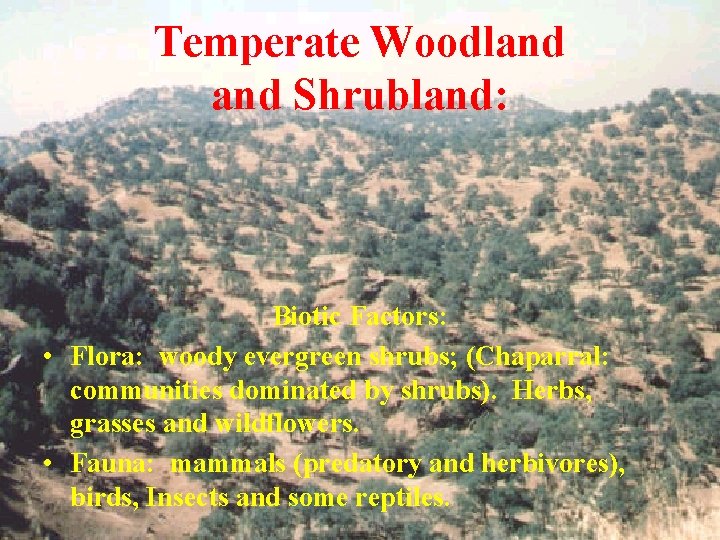
Temperate Woodland Shrubland: Biotic Factors: • Flora: woody evergreen shrubs; (Chaparral: communities dominated by shrubs). Herbs, grasses and wildflowers. • Fauna: mammals (predatory and herbivores), birds, Insects and some reptiles.
Tropical Rain Forest: Abiotic Factors: • Location: South and Central America, Southeast Asia, Southern India, Northeastern Australia. • Temperatures: almost no seasonal variation, the temperatures stay around 25 to 30 o. C year round.
Tropical Rain Forest: Abiotic Factors: • Precipitation: extremely high, between 200 to 400 centimeters annually, sometimes more than 500 centimeters. • Soils: thin and very nutrient poor. Nutrients are quickly taken up by vegetation.
Tropical Rain Forest: Biotic Factors: • Flora: enormous variety. Some plants must live on others in order to get sunlight. These are called epiphytes. • Up to 4 Layers of Vegetation: Ground Layer: “jungle” - very thick, almost impassable vegetation, Understory: short trees, Canopy: tall trees that capture most of the sunlight, and Emergent Trees: occasional trees that rise above the canopy.
Tropical Rain Forest: Biotic Factors: • Fauna: widest variety of species in the world. Many species are arboreal (live in the trees). Mammals: large cats, monkeys, bats, etc. . Birds, Reptiles, Insects, Amphibians (70% of all amphibian species are found here).
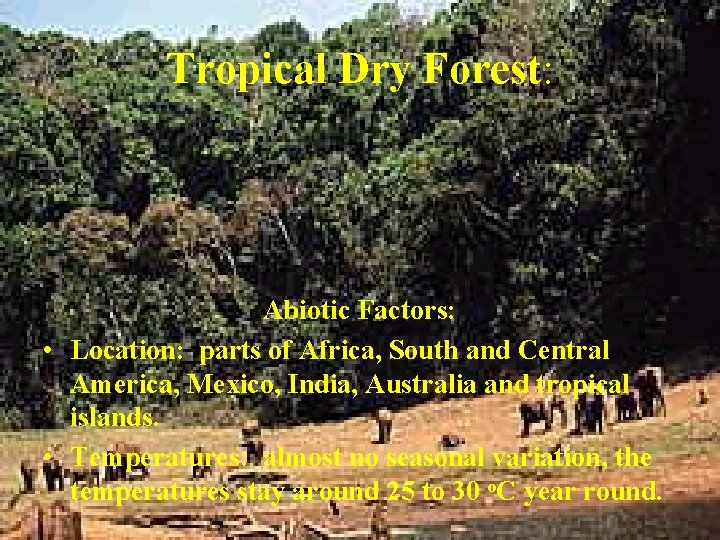
Tropical Dry Forest: Abiotic Factors: • Location: parts of Africa, South and Central America, Mexico, India, Australia and tropical islands. • Temperatures: almost no seasonal variation, the temperatures stay around 25 to 30 o. C year round.
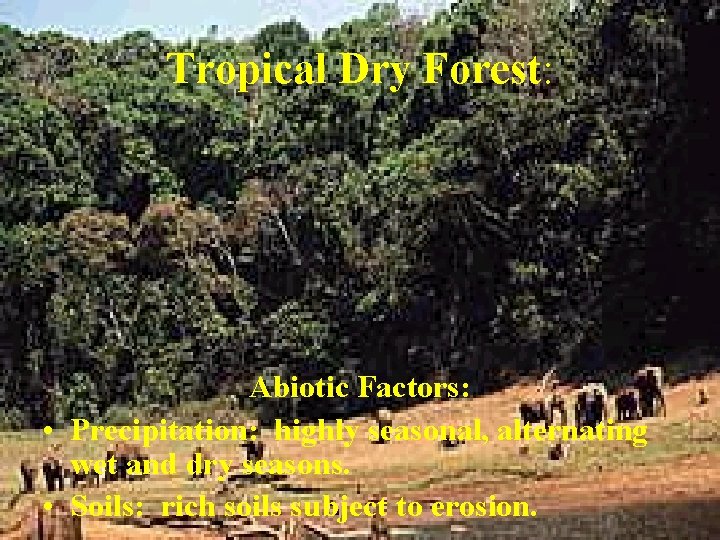
Tropical Dry Forest: Abiotic Factors: • Precipitation: highly seasonal, alternating wet and dry seasons. • Soils: rich soils subject to erosion.
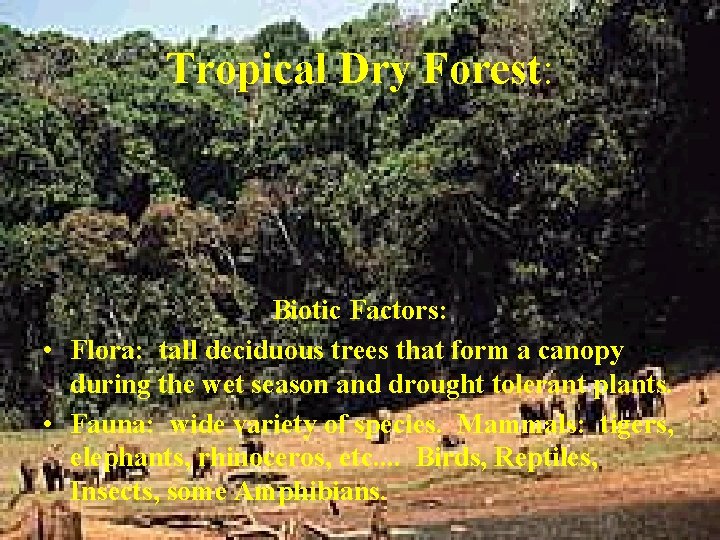
Tropical Dry Forest: Biotic Factors: • Flora: tall deciduous trees that form a canopy during the wet season and drought tolerant plants. • Fauna: wide variety of species. Mammals: tigers, elephants, rhinoceros, etc. . Birds, Reptiles, Insects, some Amphibians.
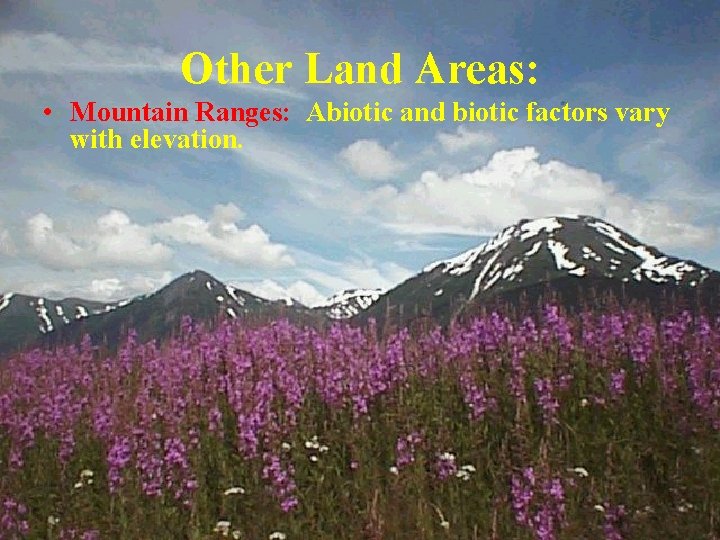
Other Land Areas: • Mountain Ranges: Abiotic and biotic factors vary with elevation.
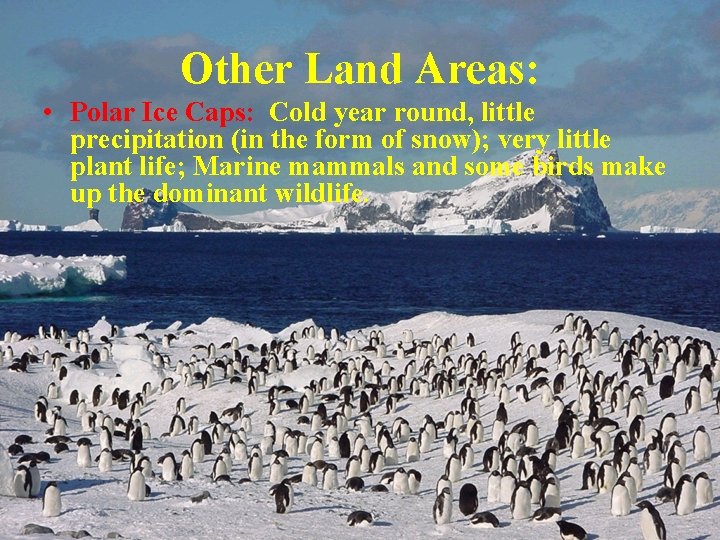
Other Land Areas: • Polar Ice Caps: Cold year round, little precipitation (in the form of snow); very little plant life; Marine mammals and some birds make up the dominant wildlife.
- Slides: 39