
Unit 2 MICROECONOMICS Microeconomics is the area of





- Slides: 134
Unit 2 MICROECONOMICS
Microeconomics: is the area of economics that deals with behavior and decision making by small units, such as individuals and businesses. Examples include looking at individual businesses, a particular industry or how prices are established.
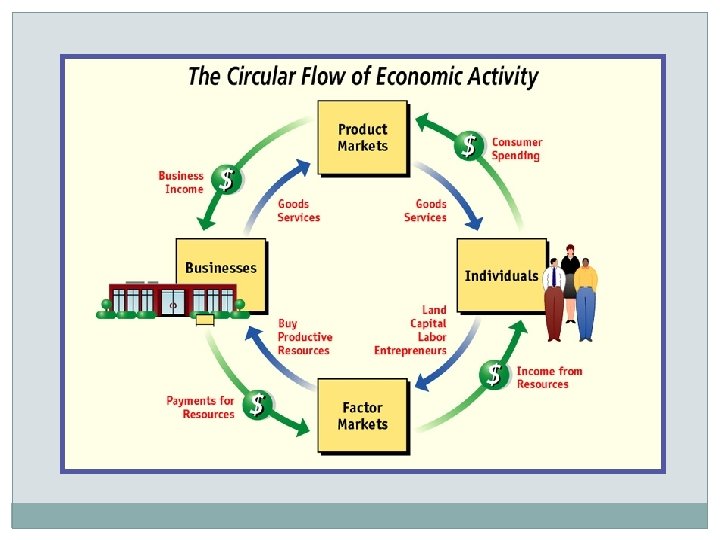
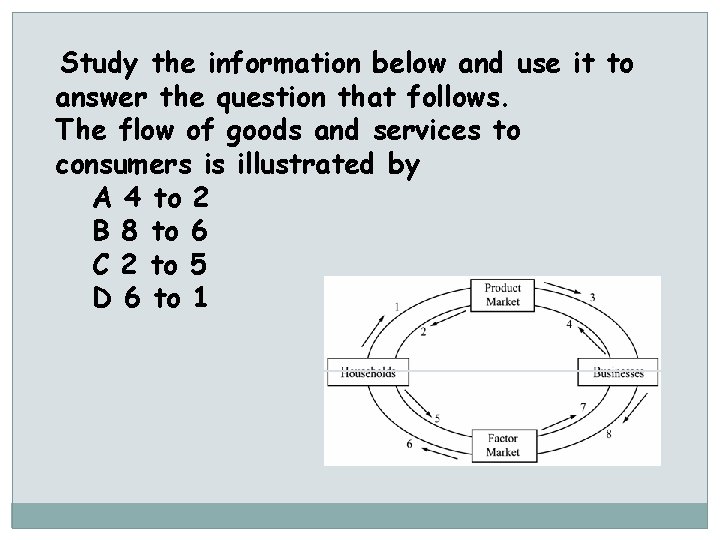
Circular Flow Model: a model that illustrates the flow of economic activity (buying & selling) between households and firms.
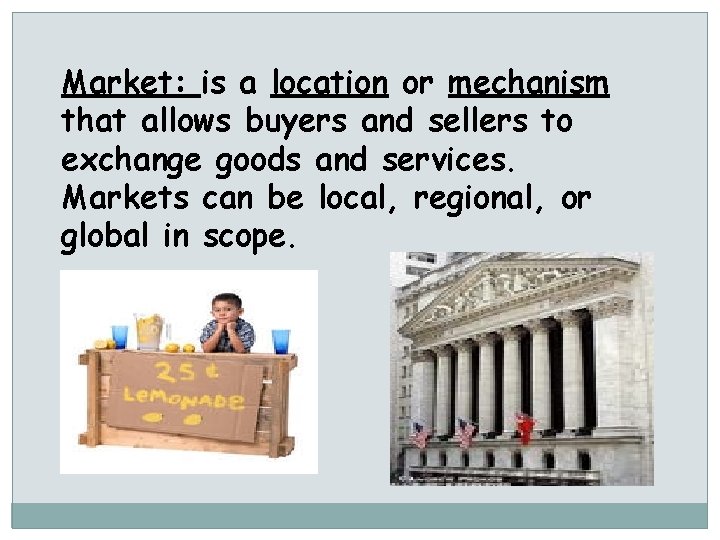
Market: is a location or mechanism that allows buyers and sellers to exchange goods and services. Markets can be local, regional, or global in scope.
Product Market: a market where goods and services are bought and sold. Firms supply/sell goods and services to consumers/households, while households demand/buy goods and services from businesses.
Resource/Factor Market: A market where resources are bought and sold. Households supply/sell resources and businesses demand/buy resources from the households.
When households sell resources they receive income in return. q. Land– rental income q. Labor– wages or salary income q. Capital– interest income q. Entrepreneur– profit income
Study the information below and use it to answer the question that follows. The flow of goods and services to consumers is illustrated by A 4 to 2 B 8 to 6 C 2 to 5 D 6 to 1
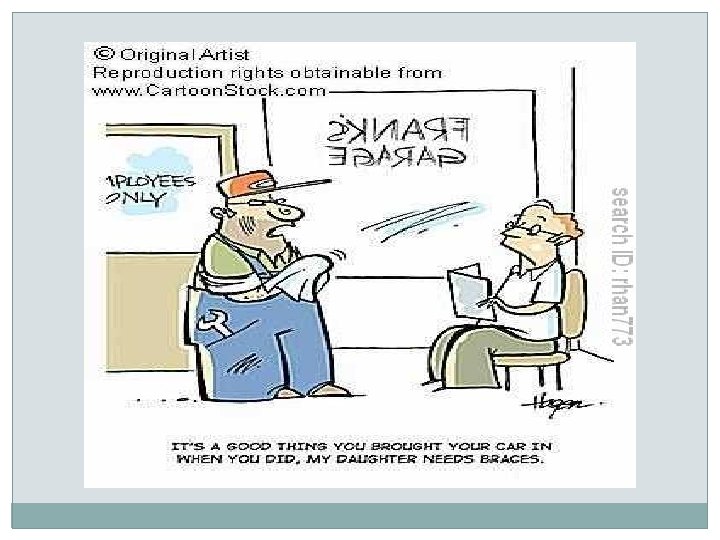
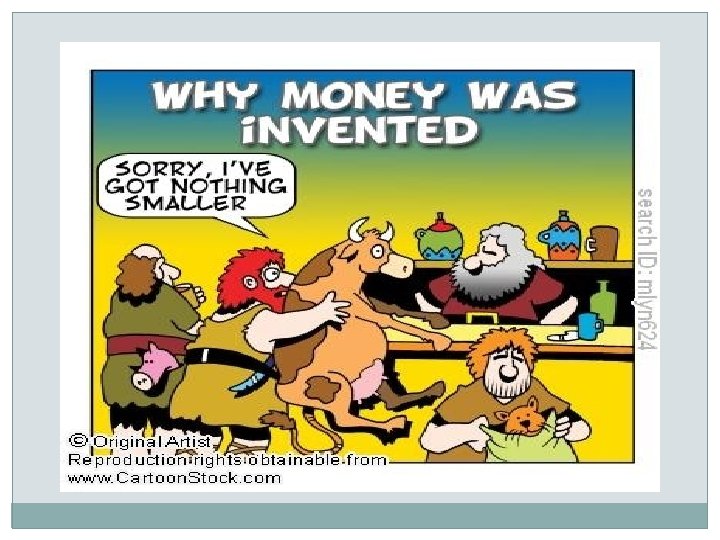
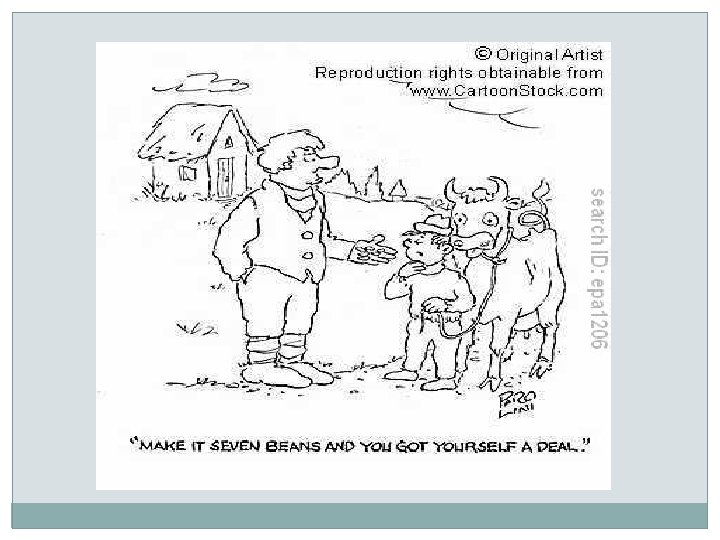
All the buying and selling that take place in the circular flow model requires money to help facilitate exchange. Barter: a moneyless economy that relies on trading goods for services. This is not very efficient.
There are 3 main functions of money. 1. Medium of exchange: something accepted by all parties as payment for goods and services. This is the most basic function, it must be accepted. 2. Measure of Value: a common denominator that can be used to express worth in terms that most people can understand. 3. Store of Value: allows purchasing power to be saved until needed in the future.
On the island of Yap, large circular stones are used for money. The main reason why this type of money serves its function as a medium of exchange is because it is A very portable B highly divisible C accepted as payment D prized in foreign transactions
Commodity Money: money that has an alternative use as an economic good, or commodity.
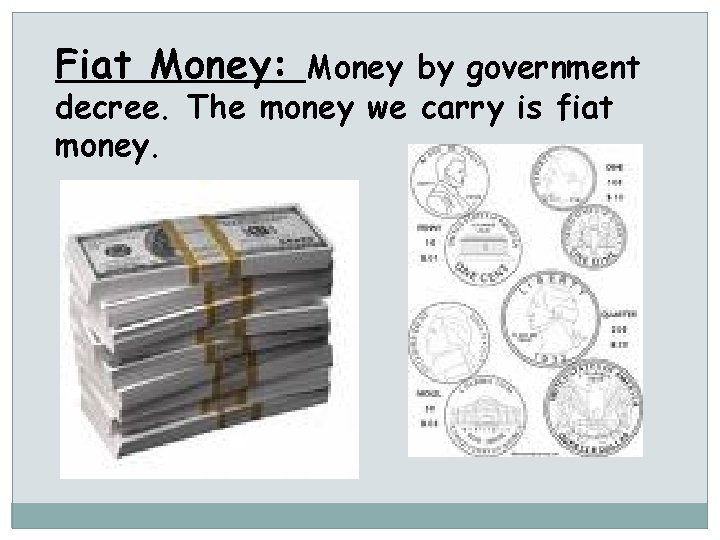
Fiat Money: Money by government decree. The money we carry is fiat money.
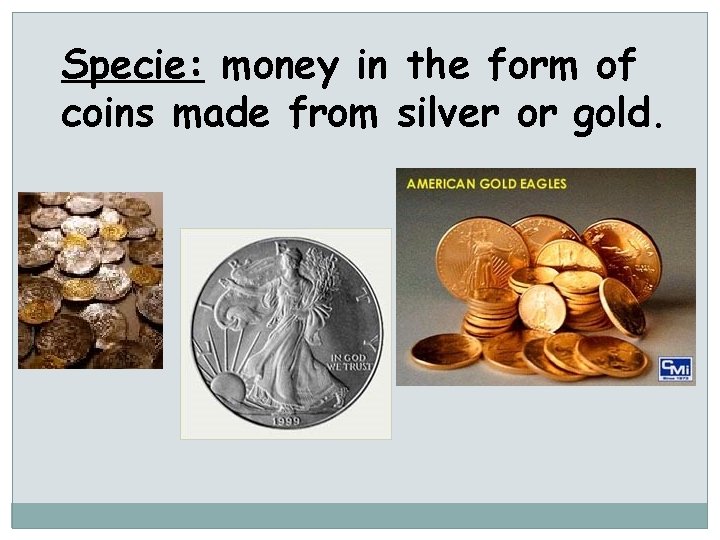
Specie: money in the form of coins made from silver or gold.
Characteristics of Money 1. Portable 2. Durable 3. Divisible 4. Limited in Supply
Demand: is the desire and ability of consumers to buy a good or service. Desire without ability does not constitute demand.
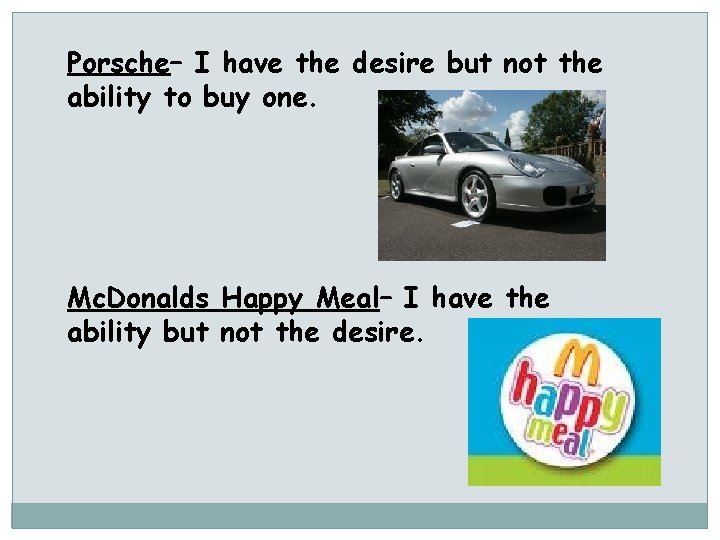
Porsche– I have the desire but not the ability to buy one. Mc. Donalds Happy Meal– I have the ability but not the desire.
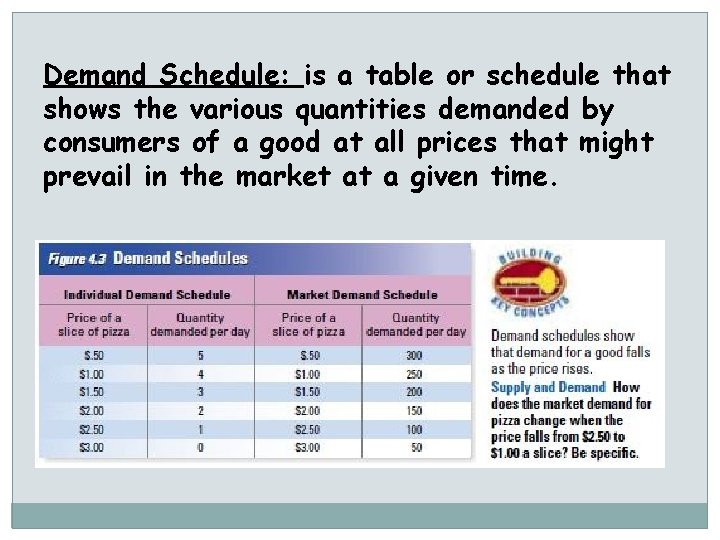
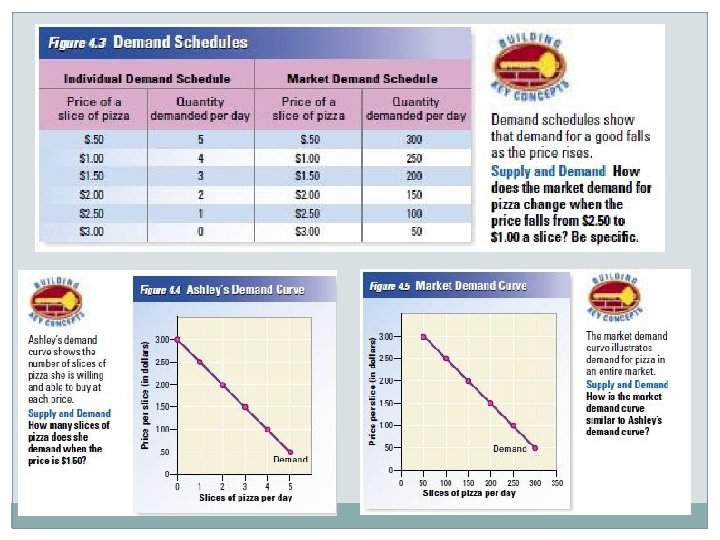
Demand Schedule: is a table or schedule that shows the various quantities demanded by consumers of a good at all prices that might prevail in the market at a given time.
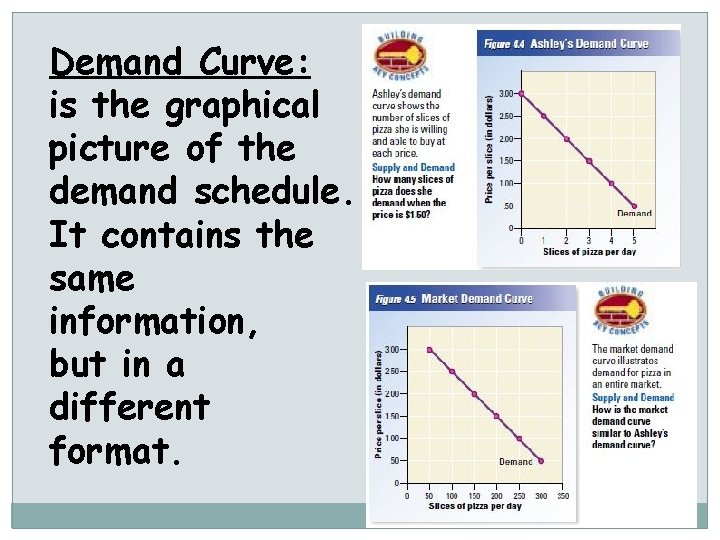
Demand Curve: is the graphical picture of the demand schedule. It contains the same information, but in a different format.
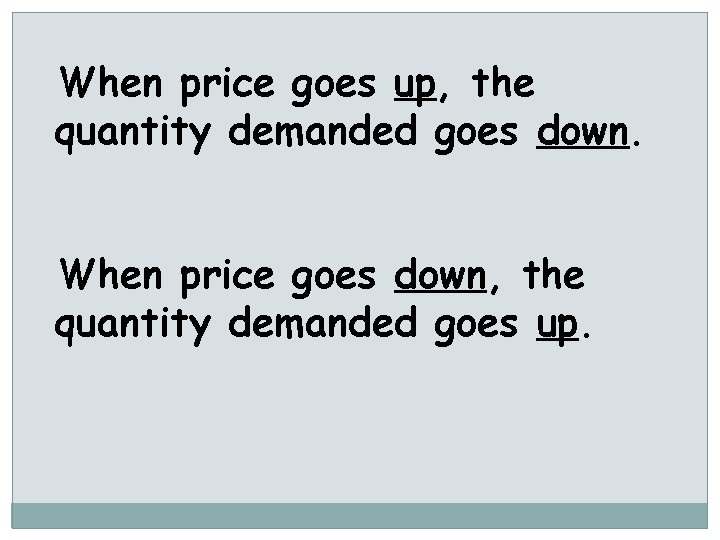
Law of Demand: states that the quantity demanded of a good or service varies inversely with its price. Inversely means opposite.
When price goes up, the quantity demanded goes down. When price goes down, the quantity demanded goes up.
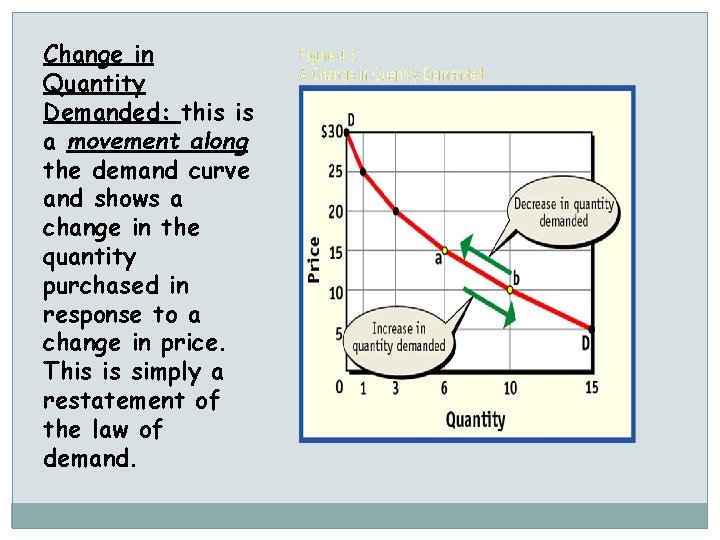
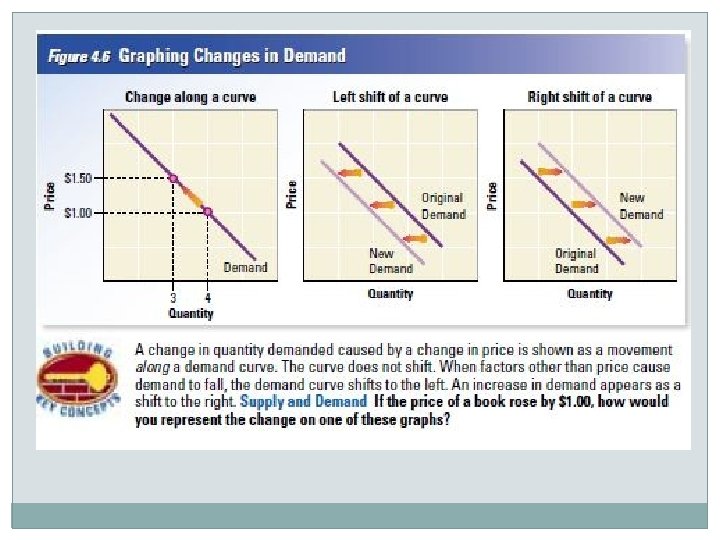
Change in Quantity Demanded: this is a movement along the demand curve and shows a change in the quantity purchased in response to a change in price. This is simply a restatement of the law of demand.
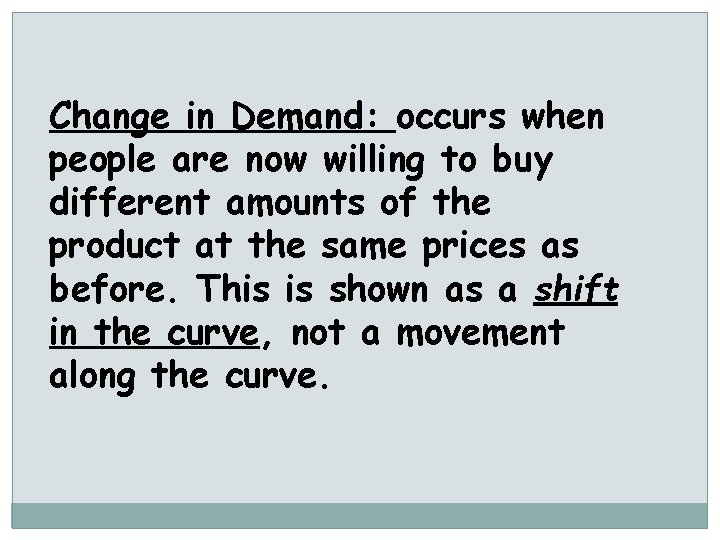
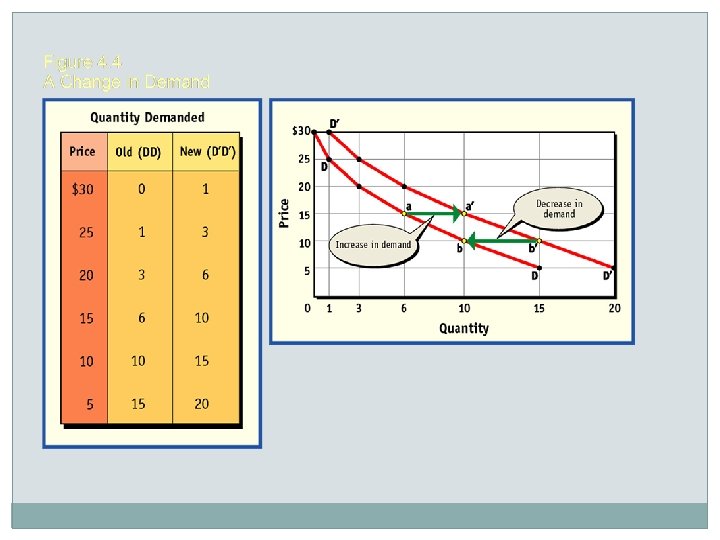
Change in Demand: occurs when people are now willing to buy different amounts of the product at the same prices as before. This is shown as a shift in the curve, not a movement along the curve.
Demand Review Video http: //www. econedlink. org/interactives/Econ. Ed. Linkinteractive-tool-player. php? iid=210
Increase in demand– rightward shift Decrease in demand– leftward shift
There are 6 factors that can shift the demand curve to the right or left. These factors have nothing to do with the price of the product. They include:
1. Consumer Income: An increase in income allows consumers to buy more of most goods and services, so the curve shifts right. A decrease in income would cause a decrease in demand therefore a leftward shift of the curve.
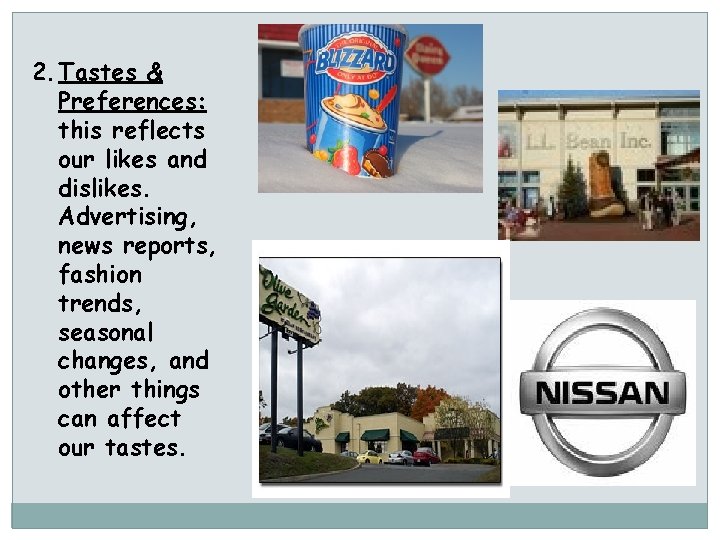
2. Tastes & Preferences: this reflects our likes and dislikes. Advertising, news reports, fashion trends, seasonal changes, and other things can affect our tastes.
Example of a Fad http: //abcnews. go. com/Nightline/video/ silly-bandz-latest-fad-11686769
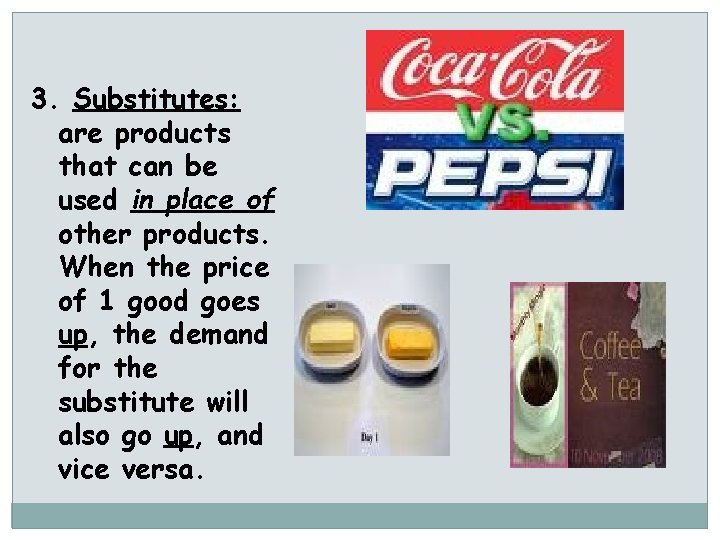
3. Substitutes: are products that can be used in place of other products. When the price of 1 good goes up, the demand for the substitute will also go up, and vice versa.
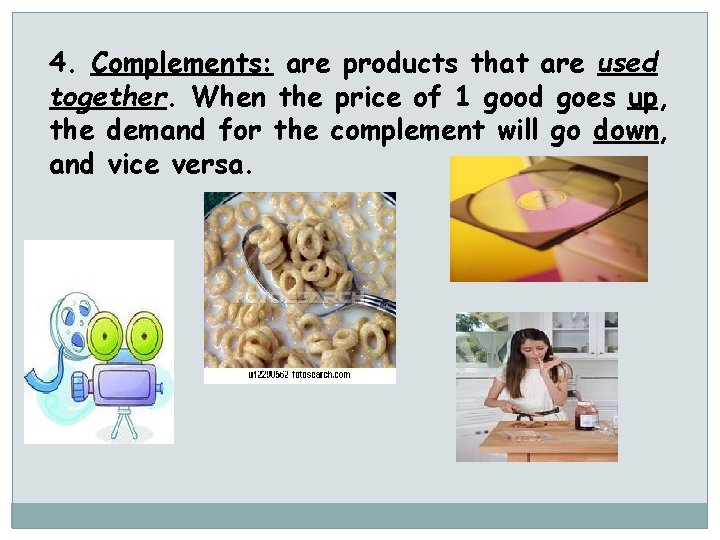
4. Complements: are products that are used together. When the price of 1 good goes up, the demand for the complement will go down, and vice versa.
5. Change in Expectations: demand may change because of the expectation of some future event. If I expect prices to rise in a few weeks, I might buy more now. If I think I might lose my job soon, I’ll begin to spend less now.
6. Number of Buyers: more buyers in the market will lead to an increase in demand. Fewer buyers will lead to a decrease in demand. Some things that might affect number of buyers are: Ø Ø Population changes Immigration trends Medical advancements Trade Agreements like NAFTA
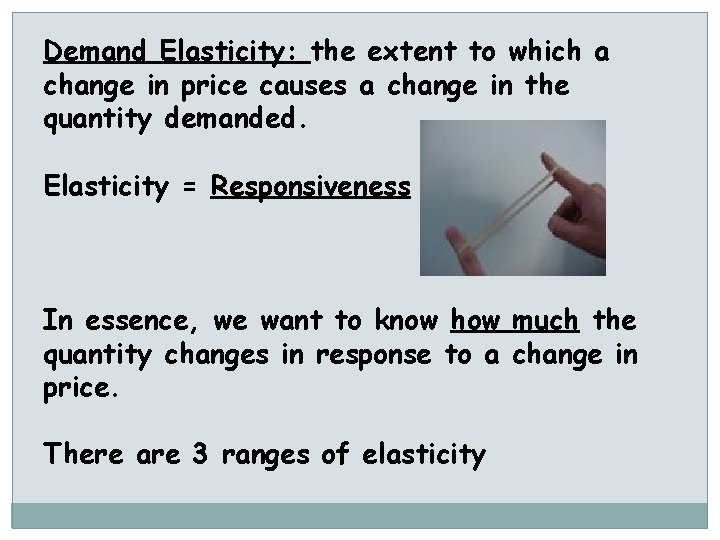
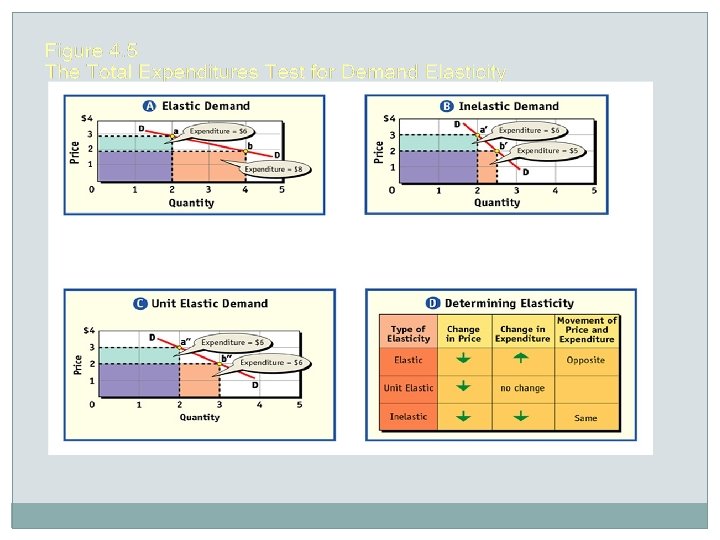
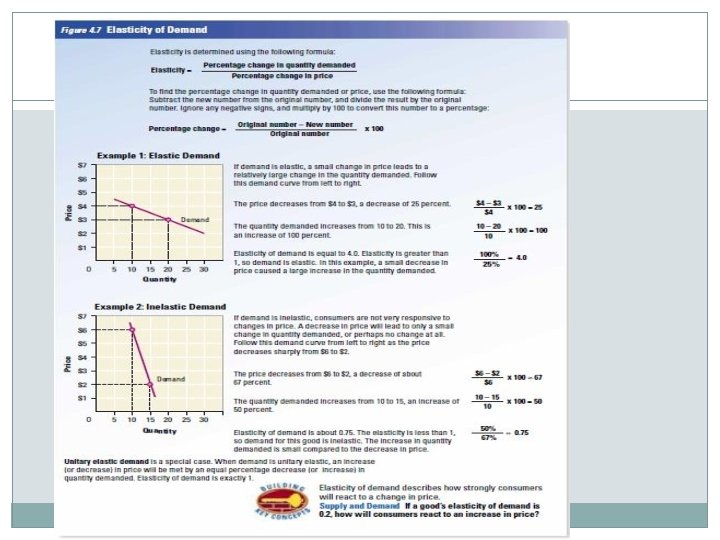
Demand Elasticity: the extent to which a change in price causes a change in the quantity demanded. Elasticity = Responsiveness In essence, we want to know how much the quantity changes in response to a change in price. There are 3 ranges of elasticity
1. Elastic Demand: when a given change in price causes a relatively larger change in the quantity demanded. Here consumers are very sensitive to a price change.
2. Inelastic Demand: when a given change in price causes a relatively smaller change in the quantity demanded. Notice consumers aren’t as sensitive to the price change now.
3. Unit Elastic Demand: when a given change in price causes a proportional change in the quantity demanded. Now the quantity demanded changes in proportion to the price change.
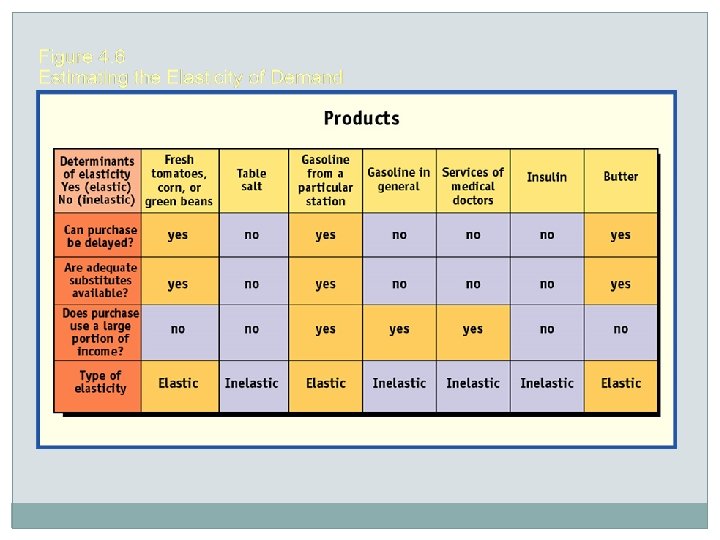
Determinants of Demand Elasticity These are 3 general questions to ask yourself.
1. Can the purchase be delayed? yes- elastic no- inelastic Fresh vegetables or Insulin
2. Are adequate substitutes available? yes– elastic no- inelastic Gasoline or Butter
3. Does the purchase use a large portion of income? yes– elastic no- inelastic New car or Plastic bags
DEMAND ELASTICITY REVIEW http: //www. econedlink. org/interactives/Econ. Ed. Link-interactive-toolplayer. php? iid=211&full
The other side of demand is supply. This represents producers or firms that use resources to make goods and services. Producers attempt to maximize profits by selling what consumers want and by producing as efficiently as possible.
Supply: the amount of a product that firms are willing and able to offer for sale at all possible prices that might prevail in the market.
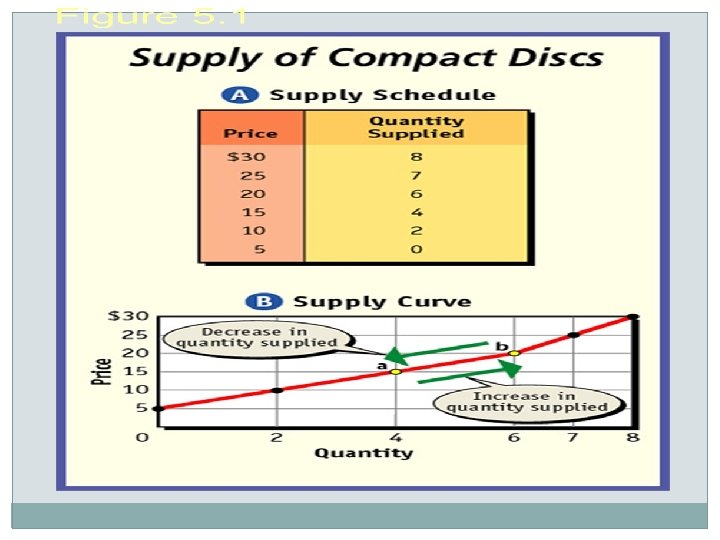
Supply Schedule: a table or schedule that shows the various quantities supplied of a product at all prices that might prevail in the market at a given time. Supply Curve: The graphical representation of the supply schedule. The supply schedule and curve contain the same information but in a different format.
Law of Supply: states that the price and the quantity supplied are directly related to each other. Direct means both variables move together, in the same direction.
As price increases, so does the quantity supplied. As price decreases, so does the quantity supplied.
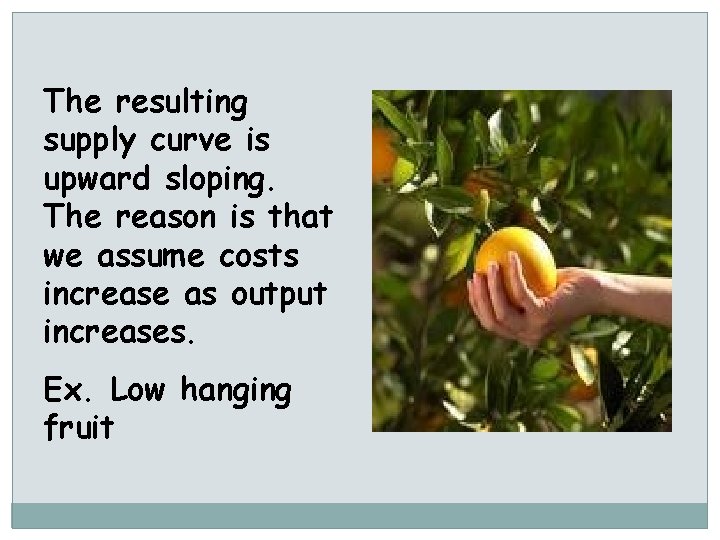
The resulting supply curve is upward sloping. The reason is that we assume costs increase as output increases. Ex. Low hanging fruit
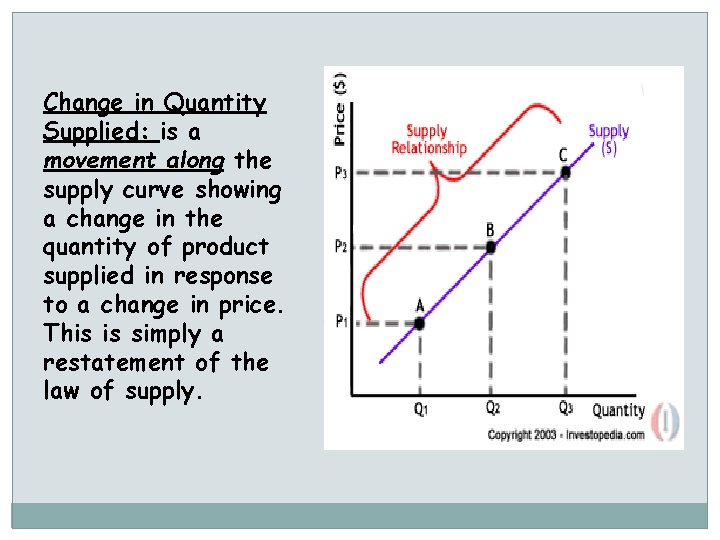
Change in Quantity Supplied: is a movement along the supply curve showing a change in the quantity of product supplied in response to a change in price. This is simply a restatement of the law of supply.
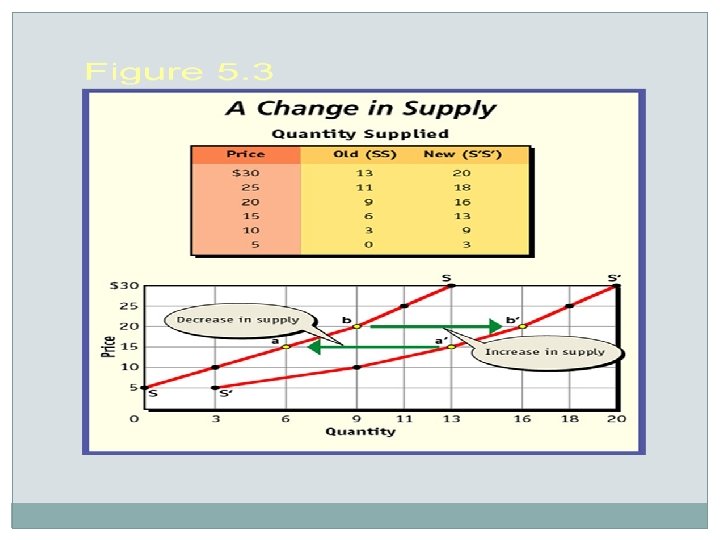
Change in Supply: when firms are now willing to offer different amounts of the product for sale at the same prices as before. This is shown as a shift in the curve, not a movement along the curve.
Increase in supply– rightward shift Decrease in supply– leftward shift
There are 7 factors that can shift the supply curve to the right or left. These factors have nothing to do with the price of the product. The one thing they have in common is they affect the firm’s costs which in turn affect profits.
Total revenue – Total cost = Profits TR > TC = Profit TR < TC = Loss Therefore anything that lowers costs relative to revenue will increase profits. Anything that raises costs relative to revenue will reduce profits.
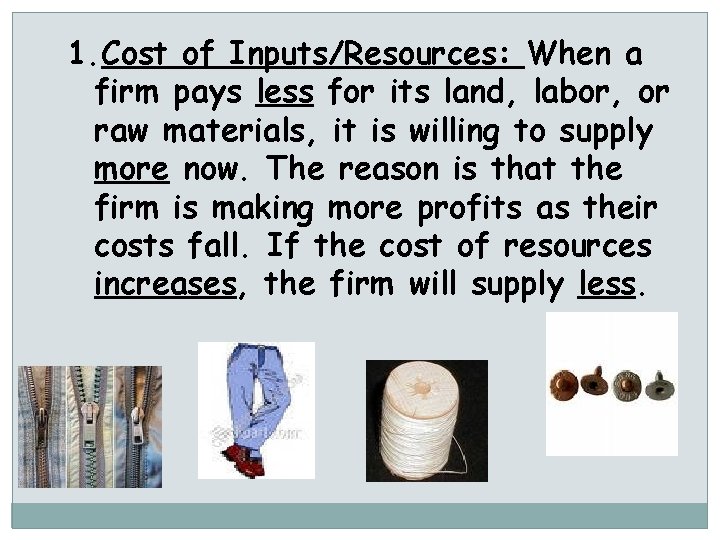
1. Cost of Inputs/Resources: When a firm pays less for its land, labor, or raw materials, it is willing to supply more now. The reason is that the firm is making more profits as their costs fall. If the cost of resources increases, the firm will supply less.
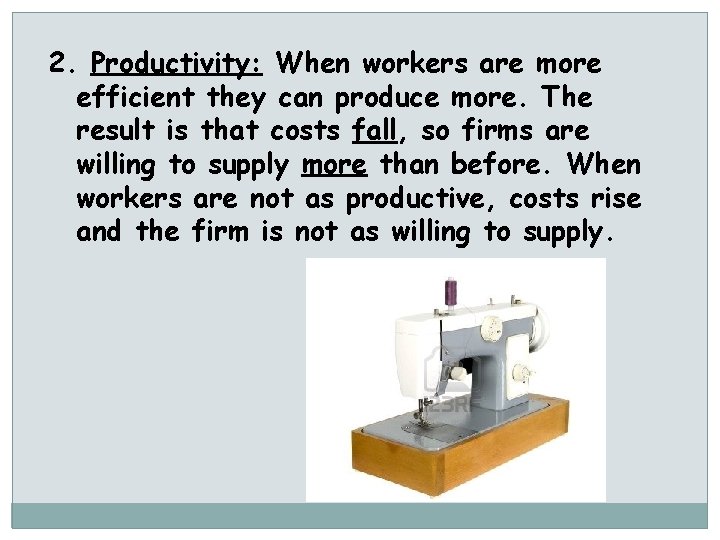
2. Productivity: When workers are more efficient they can produce more. The result is that costs fall, so firms are willing to supply more than before. When workers are not as productive, costs rise and the firm is not as willing to supply.
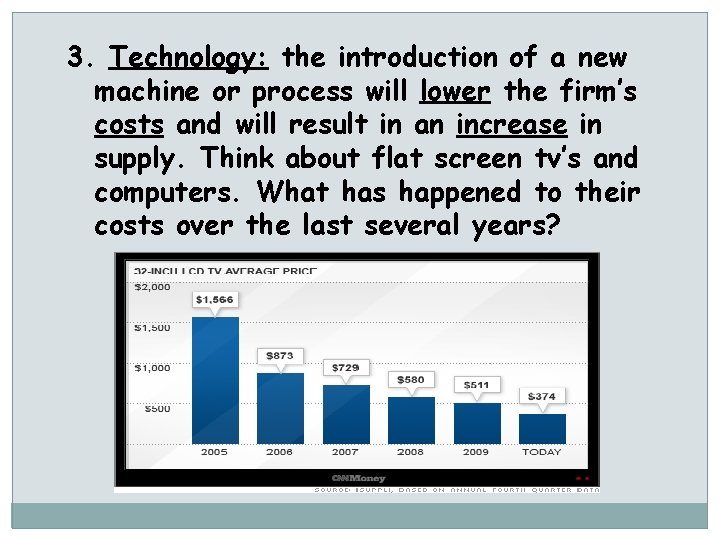
3. Technology: the introduction of a new machine or process will lower the firm’s costs and will result in an increase in supply. Think about flat screen tv’s and computers. What has happened to their costs over the last several years?
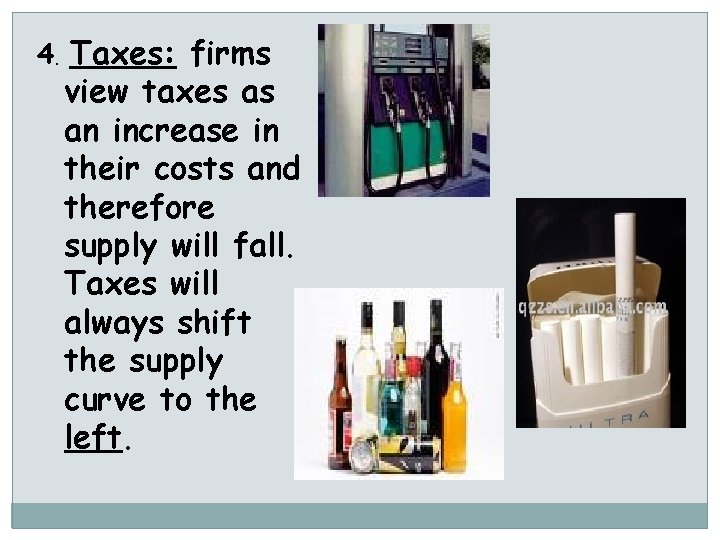
4. Taxes: firms view taxes as an increase in their costs and therefore supply will fall. Taxes will always shift the supply curve to the left.
5. Subsidies: are the opposite of a tax. In this case the government gives money to firms to encourage or protect a certain type of economic activity. Subsidies lower costs and increase supply.
6. Government Regulations: when the government regulates a firm’s product, costs rise and supply falls. Ask yourself how much more expensive it is to comply with federal standards on exhaust emissions on cars. More regulation means less supply. Less regulation means more supply. 7. Number of Sellers: more firm’s leads to more supply, fewer firms leads to less supply.
Supply Elasticity is the same concept as demand elasticity. 1. Elastic Supply: when a given change in price causes a relatively larger change in quantity supplied. 2. Inelastic Supply: when a given change in price causes a relatively smaller change in quantity supplied. 3. Unit Elastic Supply: when a given change in price causes a proportional change in quantity supplied.
Price: is the monetary value of a product or service and is established by supply and demand.
Prices act as signals that help us make our economic decisions. Prices communicate information and provide incentives to buyers and sellers.
For example: High Price– firms want to produce more but consumers want to buy less. Low Price– firms want to produce less but consumers want to buy more.
How would society allocate goods /services and resources without a system of prices? One possible method could be rationing.
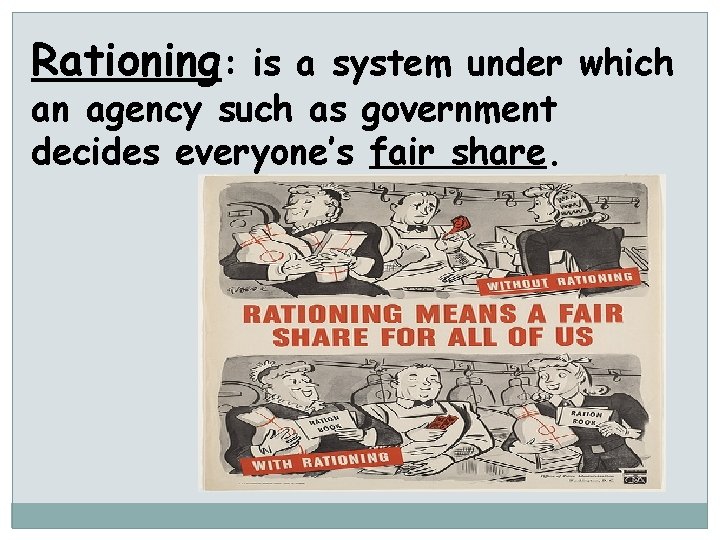
Rationing: is a system under which an agency such as government decides everyone’s fair share.
3 problems of rationing include: §Fairness §Administrative costs §Diminished incentives
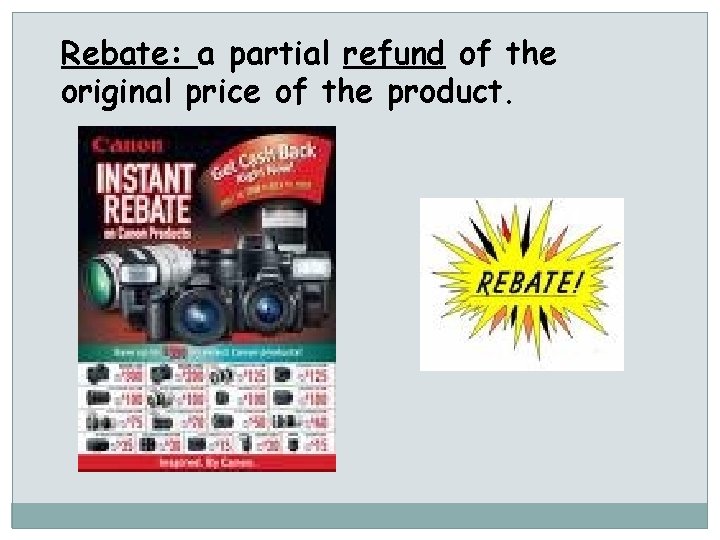
Rebate: a partial refund of the original price of the product.
We now want to bring supply and demand together to determine how prices are established in a market economy. It is a process of trial and error.
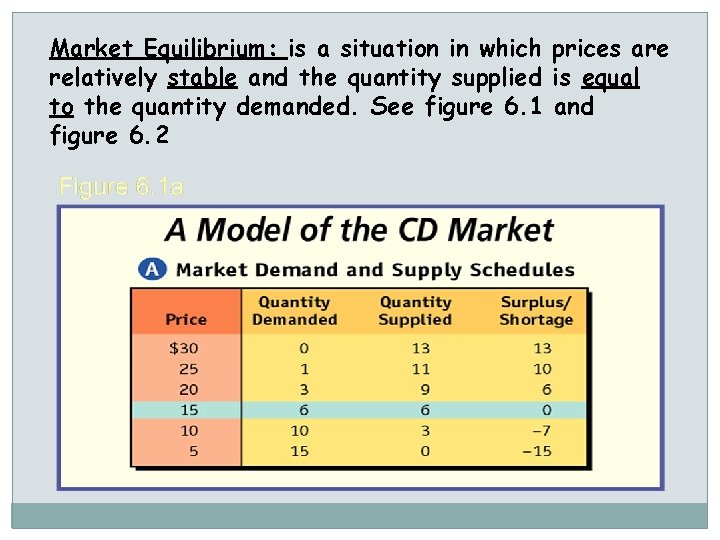
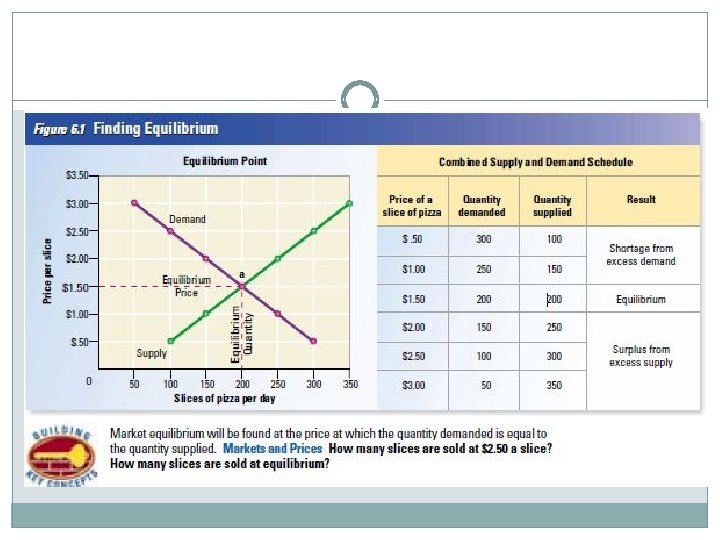
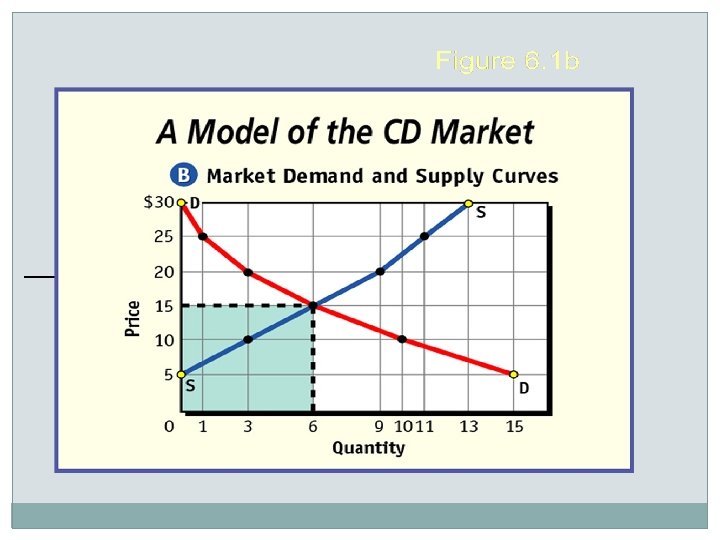
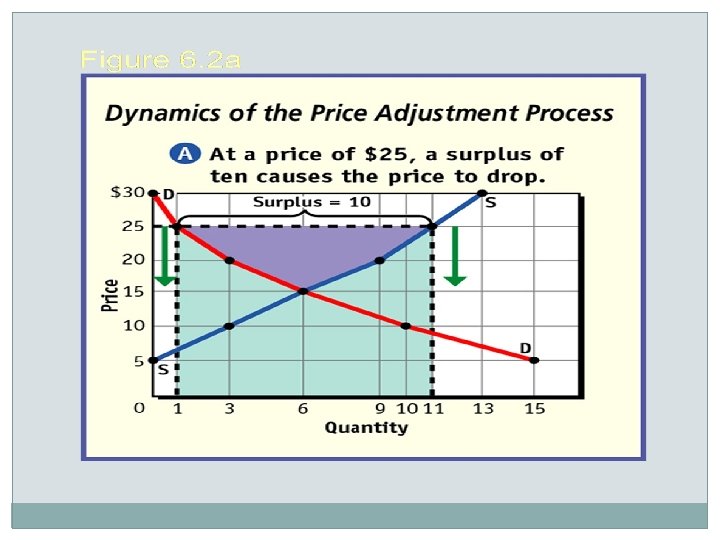
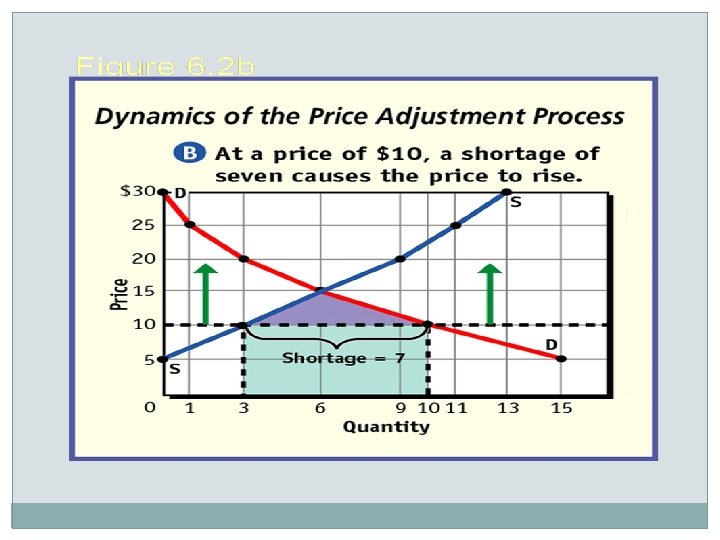
Market Equilibrium: is a situation in which prices are relatively stable and the quantity supplied is equal to the quantity demanded. See figure 6. 1 and figure 6. 2
Surplus: when the quantity supplied is greater than the quantity demanded at a given price. The result of the surplus is that price will fall. (Qs>Qd)
Shortage: when the quantity demanded is greater than the quantity supplied at a given price. The result of the shortage is that price will rise. (Qd>Qs)
Equilibrium price will do what? A. clear the market B. result in a surplus C. result in a shortage D. will always be found for every product produced
Sometimes society may have to sacrifice some efficiency and freedom in order to achieve greater equity and security. Think back to the economic and social goals in unit 1.
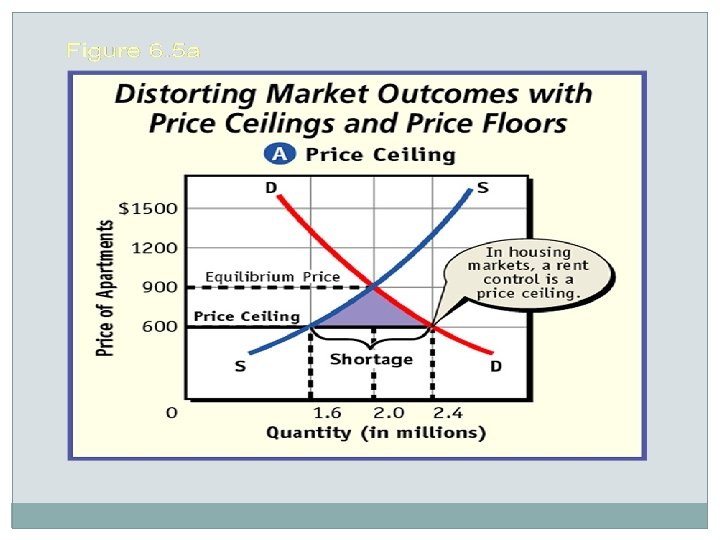
One common way to achieve more equity or security for certain groups of people is for the government to set prices at the socially desirable level. When this happens, prices are not allowed to adjust to reach equilibrium and some efficiency is sacrificed.
Price Ceiling: the maximum legal price that can be charged for a product. Ex. Rent control on apartments
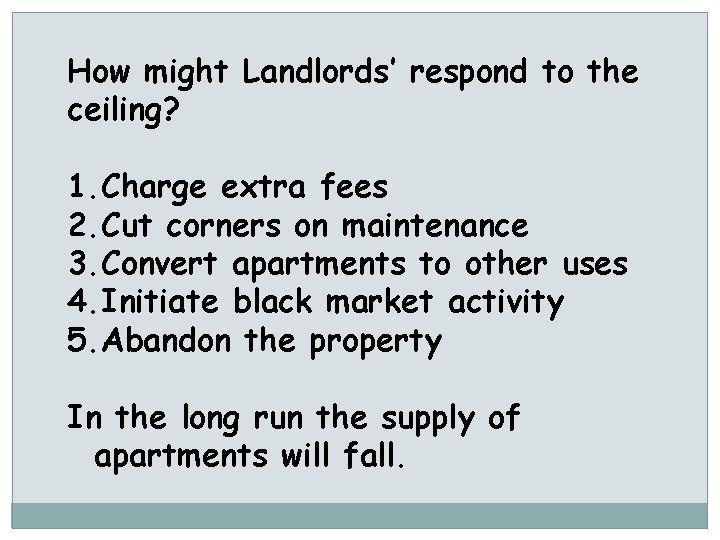
How might Landlords’ respond to the ceiling? 1. Charge extra fees 2. Cut corners on maintenance 3. Convert apartments to other uses 4. Initiate black market activity 5. Abandon the property In the long run the supply of apartments will fall.
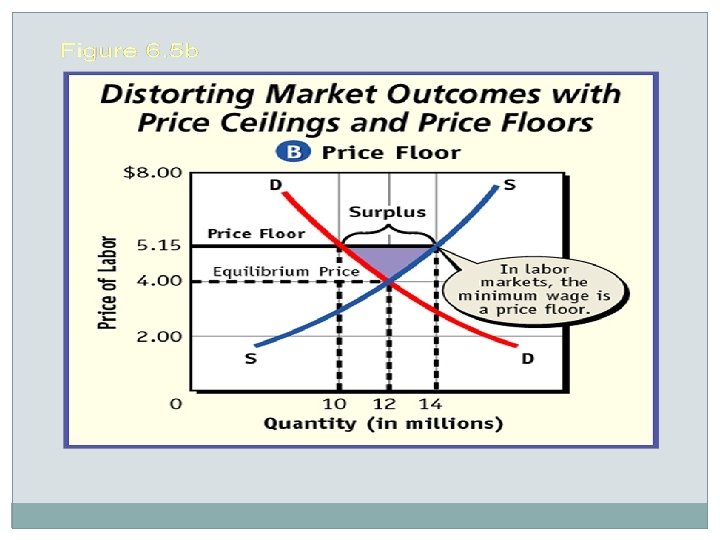
Price Floor: the lowest legal price that can be charged for a product. Ex. Minimum wage Farm products
What happens when wages are set above the equilibrium level by law? A. firms employ more workers than they would at the equilibrium wage B. firms employ fewer workers than they would at the equilibrium wage C. firms tend to try to break the law and hire people at the equilibrium level D. firms hire more workers but for fewer hours than they would at the equilibrium wage
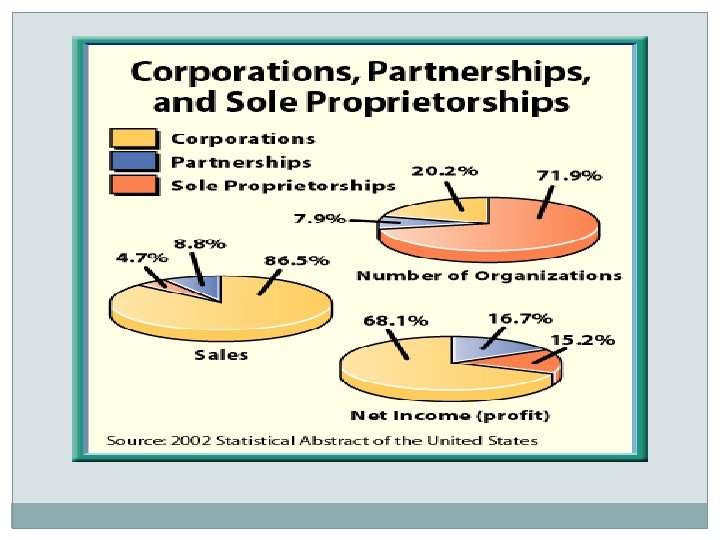
Legal Forms of Business - shows the 3 main ways businesses are set up. Let’s look at 3 pie charts to see some interesting facts about businesses. 1. Sales 2. Net income 3. # of firms
1. Sole Proprietorship: A business owned and operated by 1 person. It is the most common form of business numerically.
2. Partnership: a business jointly owned by 2 or more people. 2 Types include § General Partnership § Limited Partnership
General– all partners are responsible for the management and financial obligations of the business. Limited– at least 1 partner is not active in the daily operation of the business although they may have contributed funds to finance the operation.
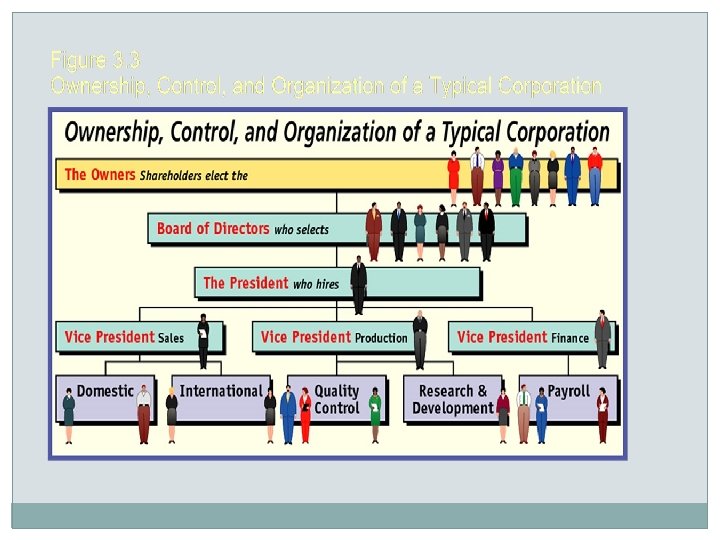
3. Corporation: is recognized by law as a separate legal entity having all the rights of an individual.
Important aspects of corporations include: Charter: a government document giving permission to create a corporation. • Corporation’s name • Its purpose • Number of shares to be issued • Names of parties who started it
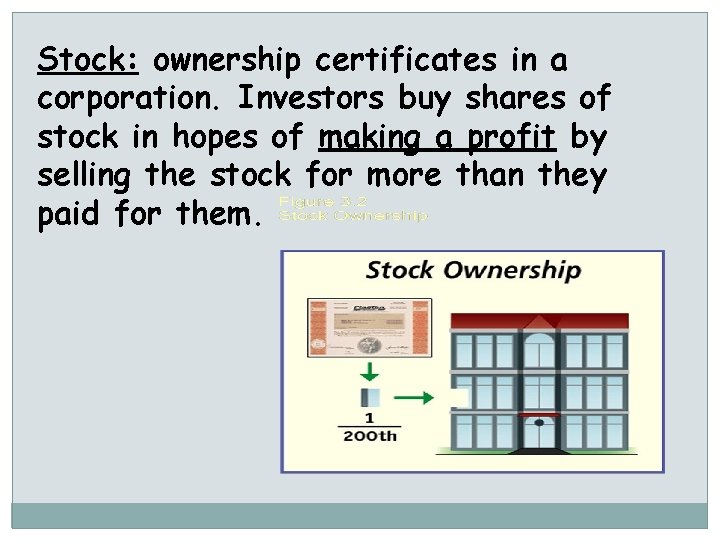
Stock: ownership certificates in a corporation. Investors buy shares of stock in hopes of making a profit by selling the stock for more than they paid for them.
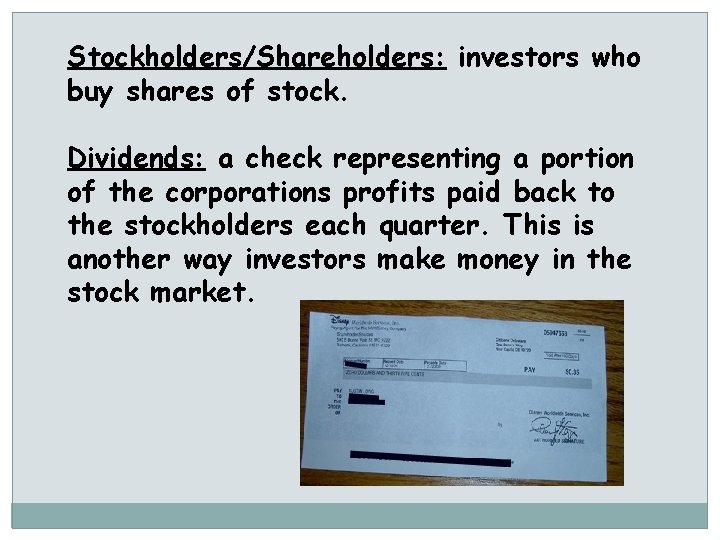
Stockholders/Shareholders: investors who buy shares of stock. Dividends: a check representing a portion of the corporations profits paid back to the stockholders each quarter. This is another way investors make money in the stock market.
Profit Motive: this is the driving force that encourages people and organizations to improve their material well-being. Entrepreneurs start businesses to make the greatest amount of profit possible. Total revenue >Total cost – profits Total revenue < Total cost– losses Total revenue = Total costs-- breakeven
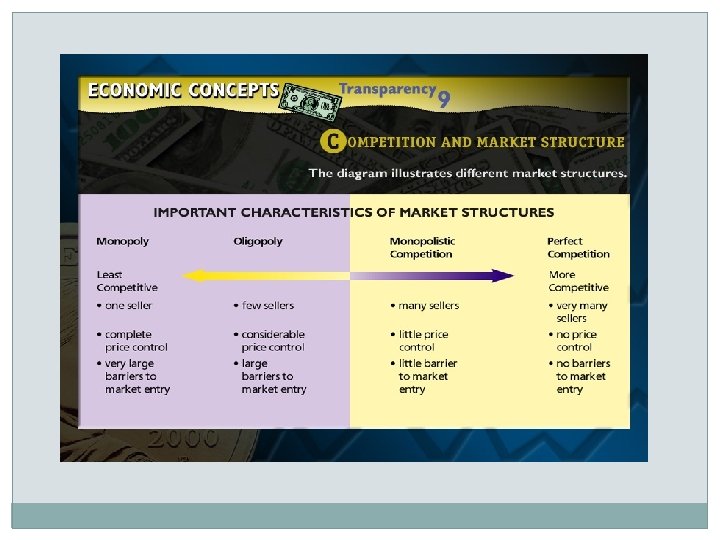
Market Structure: represents the nature and degree of competition among firms operating in the same industry. An industry represents all firms in the same market like airlines or cars.
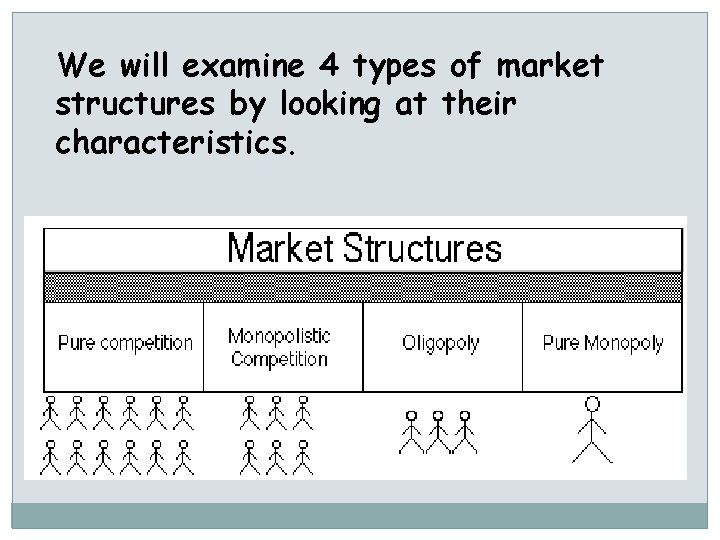
We will examine 4 types of market structures by looking at their characteristics.
1. Perfect Competition o Large numbers of buyers and sellers, 100’s to 1000’s. o Have no control over price. o Buyers and sellers deal in an identical product. o Buyers and sellers are free to enter or leave the market when they choose. o Do not need to advertise. The best examples include certain types of farming.
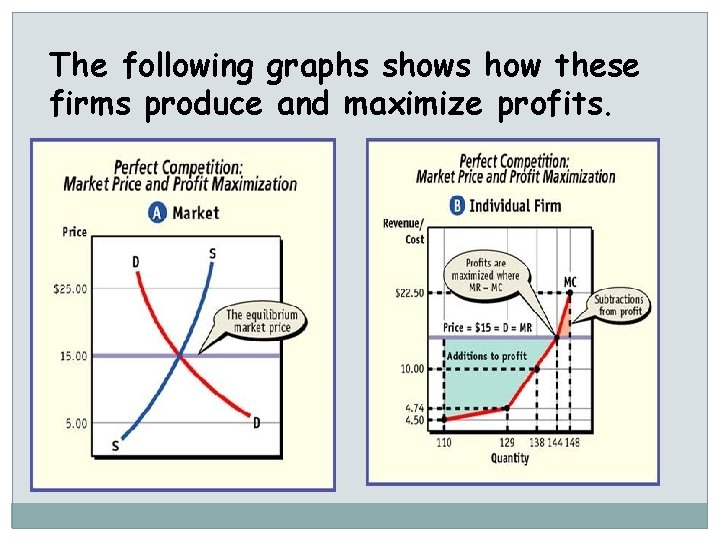
The following graphs shows how these firms produce and maximize profits.
2. Monopolistic Competition • Large number of buyers and sellers, 20 to 70. • Have a little bit of control over price. • Buyers and sellers deal in a differentiated product. • Buyers and sellers are free to enter or leave the market. • There is a lot of advertising by firms. Examples include gas stations and drycleaners.
Product Differentiation: the real or imagined differences between competing products in the same industry. Examples include: • Store location • Store design • Manner of payment • Delivery options • Packaging • Service • Store merchandising
Non-price competition: the use of advertising, promotions or giveaways to convince buyers that their product is better than another brand.
3. Oligopoly • Few firms, 3 to 12. • Some control over price with • The product can be identical differentiated. • It is very difficult for firms this market. • There is a lot of advertising collusion. or to enter by firms. Examples include airlines, automobiles and steel.
Interdependent behavior: whenever one firm acts, it must consider how the other firms will respond. Ex. Raise price– ignore Lower price– lower
Collusion: a formal agreement to set prices or behave in a cooperative manner to increase profits. A good example is OPEC. This behavior is illegal in the U. S. Price-fixing: agreeing to charge the same or similar price for a product.
4. Monopoly • A single firm, 1. • Almost complete control over price. • The product is unique with no close substitutes. • It is almost impossible to enter this market. • No advertising is needed unless it is for public relations reasons. Best example would be the local power company or water company.
Types of monopolies Natural Monopoly: when the costs of production are minimized by having a single firm produce the good. This is called economies of scale.
Geographic Monopoly: a single firm by virtue of its location such as a country store.
Technological Monopoly: a monopoly based on the ownership or control of a manufacturing method, process, or other scientific advance such as a patent or copyright.
Government Monopoly: a monopoly that the government owns and runs like the postal service, the city water company, or the TVA.
http: //www. econedlink. org/interactives/ Econ. Ed. Link-interactive-toolplayer. php? iid=208
Sometimes markets fail because of inadequate competition, inadequate information, resource immobility, externalities and public goods. We will focus on 2 types of market failures.
1. Externalities: a cost or benefit that accrues to a 3 rd party not involved in the transaction.
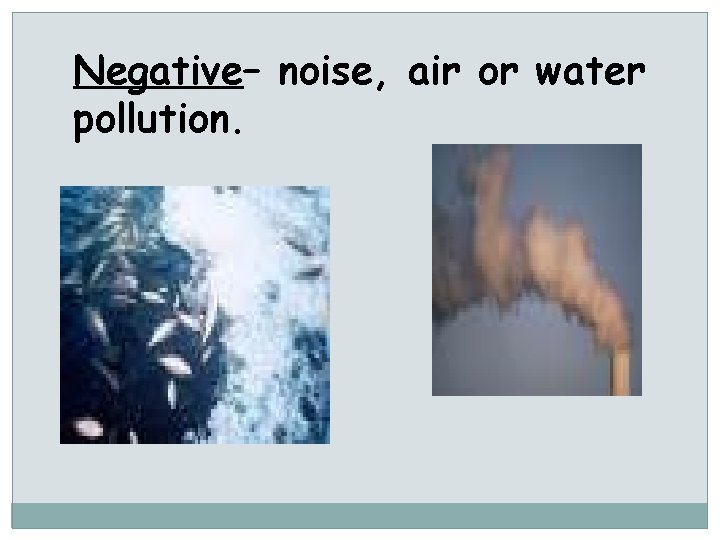
Negative– noise, air or water pollution.
Positive– education or immunizations
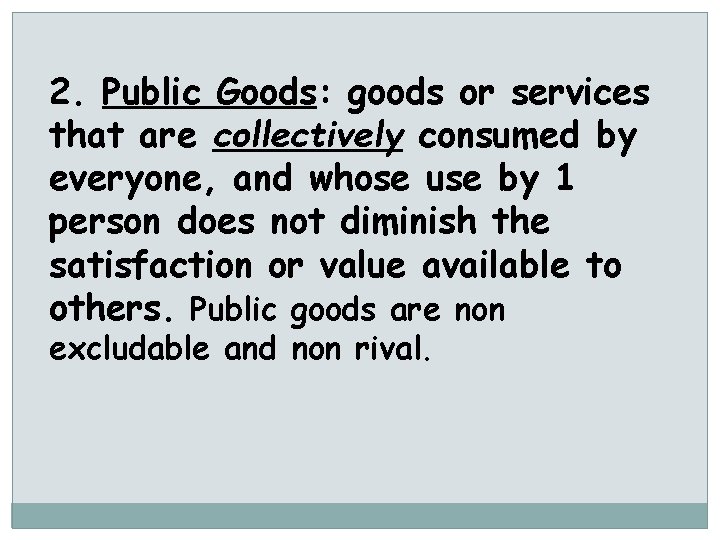
2. Public Goods: goods or services that are collectively consumed by everyone, and whose use by 1 person does not diminish the satisfaction or value available to others. Public goods are non excludable and non rival.
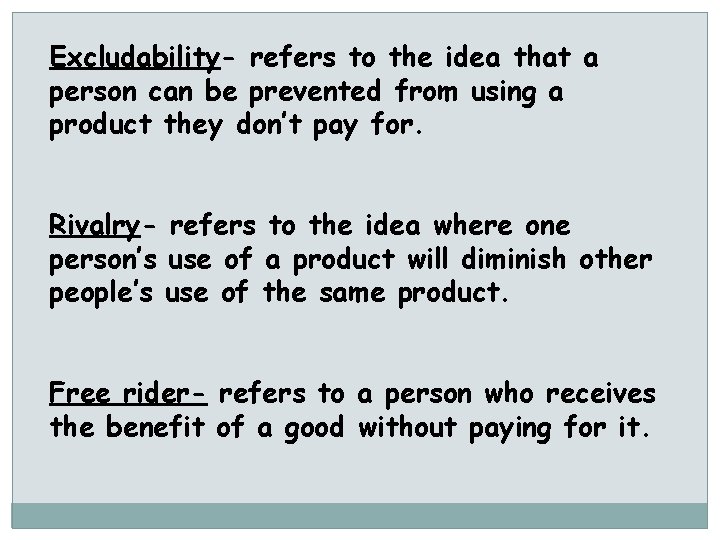
Excludability- refers to the idea that a person can be prevented from using a product they don’t pay for. Rivalry- refers to the idea where one person’s use of a product will diminish other people’s use of the same product. Free rider- refers to a person who receives the benefit of a good without paying for it.
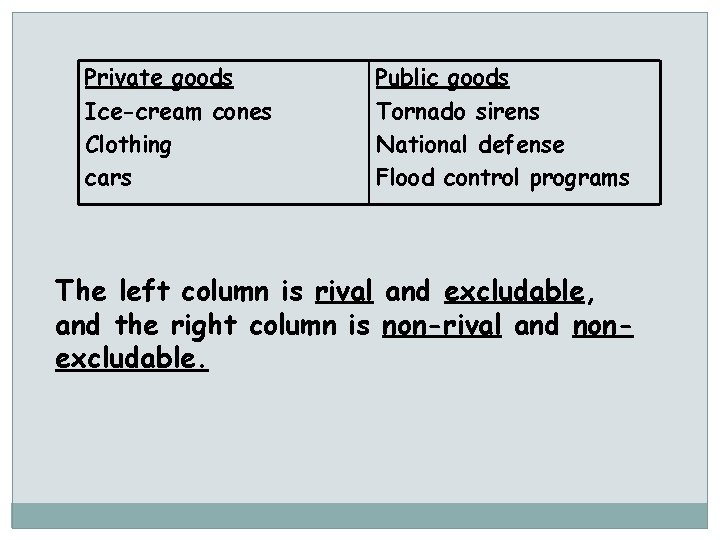
Private goods Ice-cream cones Clothing cars Public goods Tornado sirens National defense Flood control programs The left column is rival and excludable, and the right column is non-rival and nonexcludable.
http: //www. econedlink. org/interactives/ Econ. Ed. Link-interactive-toolplayer. php? iid=215
In the U. S. , how are public goods paid for? A. Private firms collect fees from their employees. B. Non-profit organizations collect charitable donations from people. C. The government collects tax revenues from individuals and firms. D. Corporations make profits from selling goods and services.