
Unit 2 Metabolism and Survival 1 Metabolic pathways
Unit 2: Metabolism and Survival 1. Metabolic pathways and their control 25/10/2021 Metabolism and Survival
You should already know that: • The cell membrane consists of phospholipids and proteins and is selectively permeable • Enzymes speed up cellular reactions and are unchanged in the process 25/10/2021 Metabolism and Survival
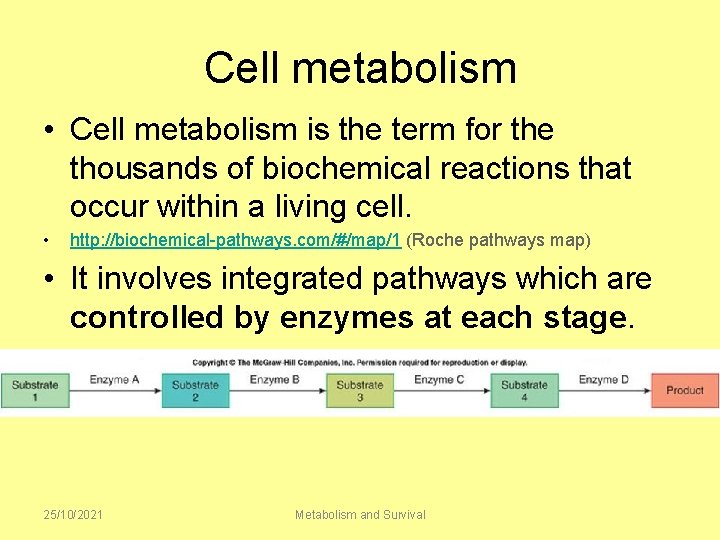
Cell metabolism • Cell metabolism is the term for the thousands of biochemical reactions that occur within a living cell. • http: //biochemical-pathways. com/#/map/1 (Roche pathways map) • It involves integrated pathways which are controlled by enzymes at each stage. 25/10/2021 Metabolism and Survival
What do these pathways do? • Break down large molecules (macromolecules) and • Build up large molecules from smaller molecules 25/10/2021 Metabolism and Survival
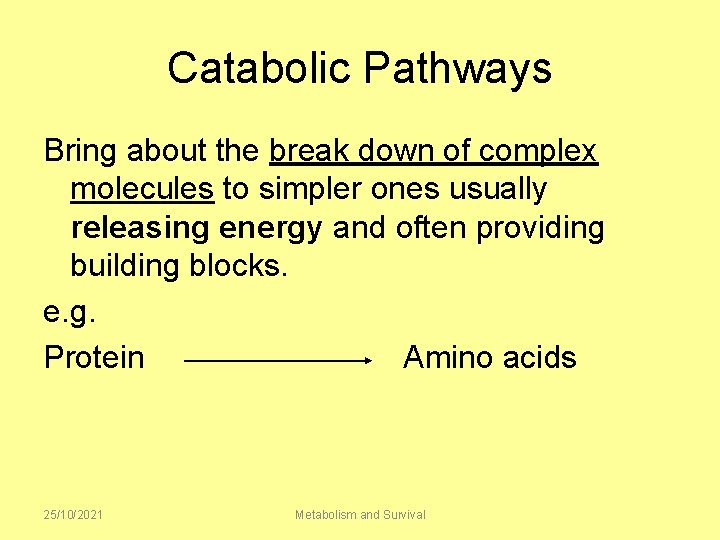
Catabolic Pathways Bring about the break down of complex molecules to simpler ones usually releasing energy and often providing building blocks. e. g. Protein Amino acids 25/10/2021 Metabolism and Survival
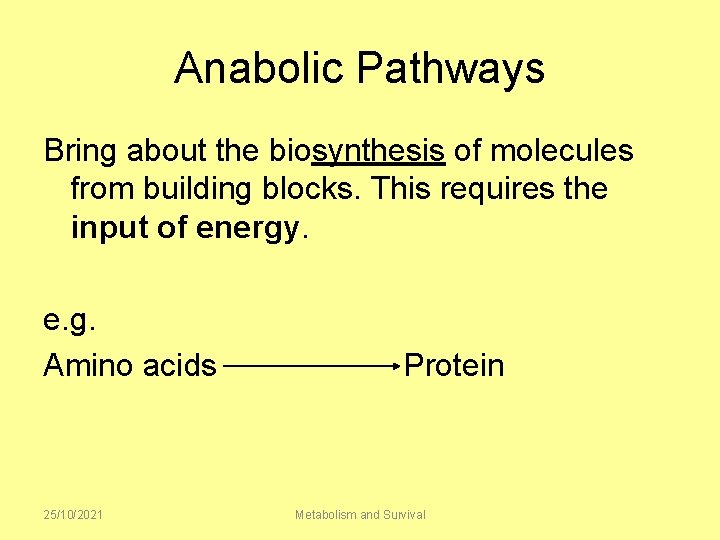
Anabolic Pathways Bring about the biosynthesis of molecules from building blocks. This requires the input of energy. e. g. Amino acids 25/10/2021 Protein Metabolism and Survival
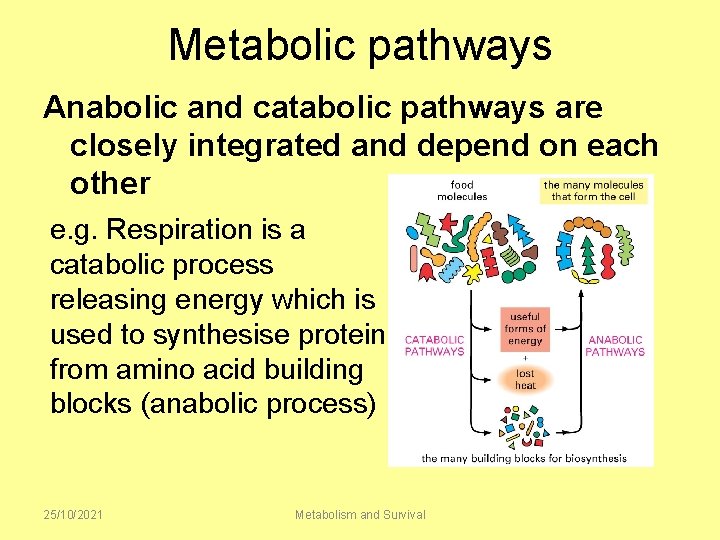
Metabolic pathways Anabolic and catabolic pathways are closely integrated and depend on each other e. g. Respiration is a catabolic process releasing energy which is used to synthesise protein from amino acid building blocks (anabolic process) 25/10/2021 Metabolism and Survival
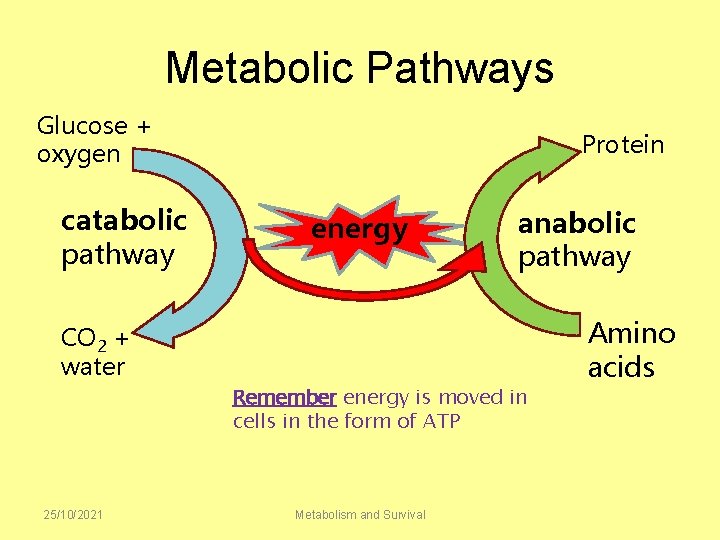
Metabolic Pathways Glucose + oxygen catabolic pathway Protein energy anabolic pathway CO 2 + water Remember energy is moved in cells in the form of ATP 25/10/2021 Metabolism and Survival Amino acids
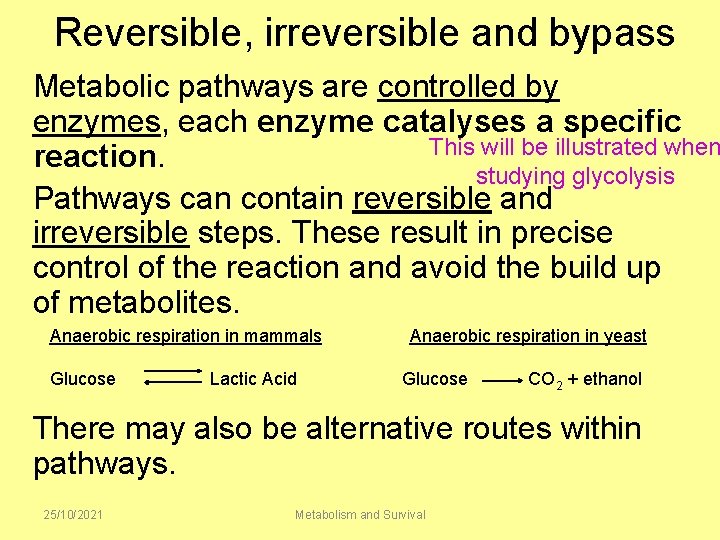
Reversible, irreversible and bypass Metabolic pathways are controlled by enzymes, each enzyme catalyses a specific This will be illustrated when reaction. studying glycolysis Pathways can contain reversible and irreversible steps. These result in precise control of the reaction and avoid the build up of metabolites. Anaerobic respiration in mammals Glucose Lactic Acid Anaerobic respiration in yeast Glucose CO 2 + ethanol There may also be alternative routes within pathways. 25/10/2021 Metabolism and Survival
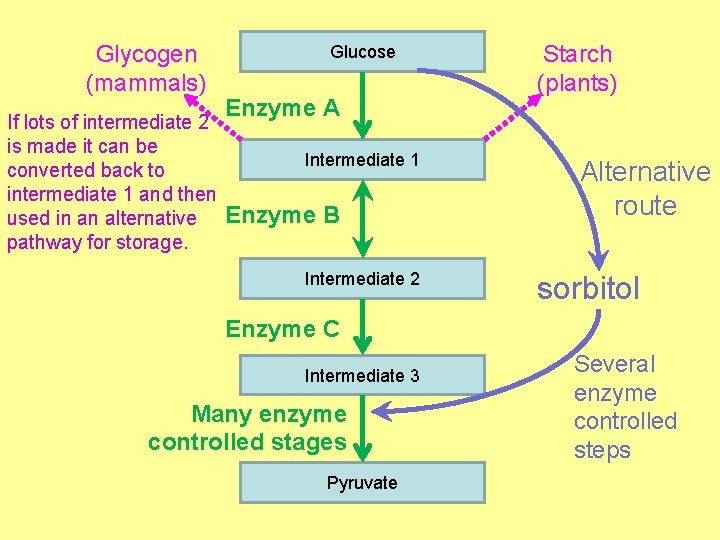
Glycogen (mammals) If lots of intermediate 2 is made it can be converted back to intermediate 1 and then used in an alternative pathway for storage. Glucose Enzyme A Intermediate 1 Enzyme B Intermediate 2 Starch (plants) Alternative route sorbitol Enzyme C Intermediate 3 Many enzyme controlled stages Pyruvate Several enzyme controlled steps
• Answer TYK Q 1 pg 120 • Answer AYK Q 1 pg 29 25/10/2021 Metabolism and Survival
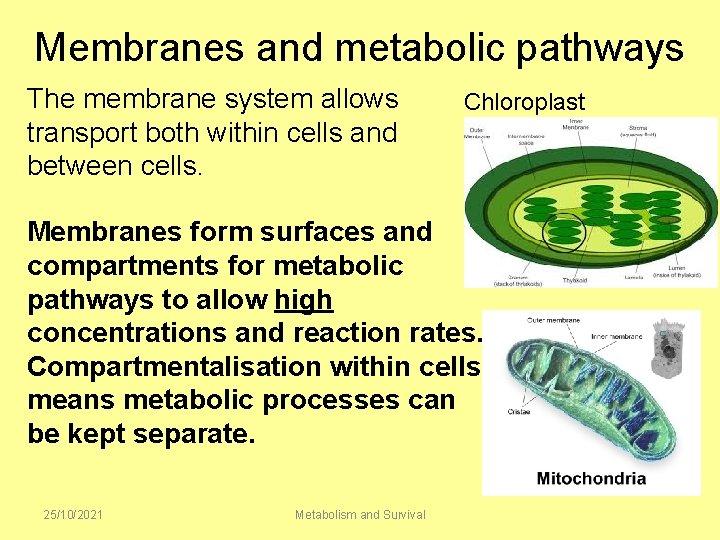
Membranes and metabolic pathways The membrane system allows transport both within cells and between cells. Chloroplast Membranes form surfaces and compartments for metabolic pathways to allow high concentrations and reaction rates. Compartmentalisation within cells means metabolic processes can be kept separate. 25/10/2021 Metabolism and Survival
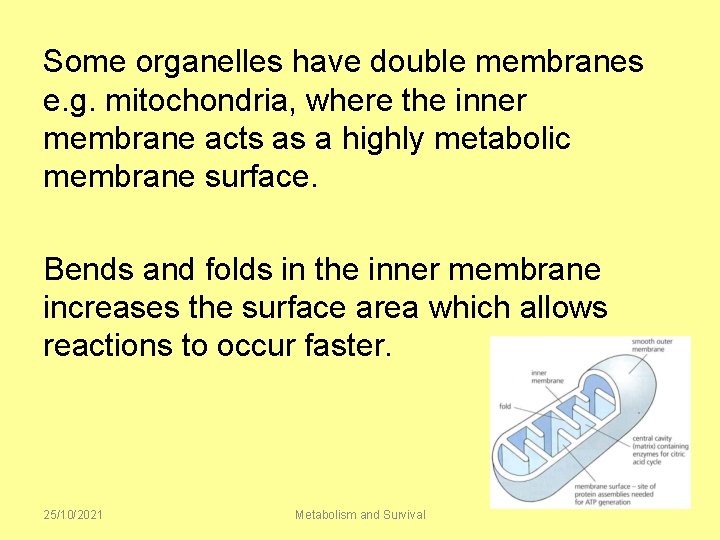
Some organelles have double membranes e. g. mitochondria, where the inner membrane acts as a highly metabolic membrane surface. Bends and folds in the inner membrane increases the surface area which allows reactions to occur faster. 25/10/2021 Metabolism and Survival
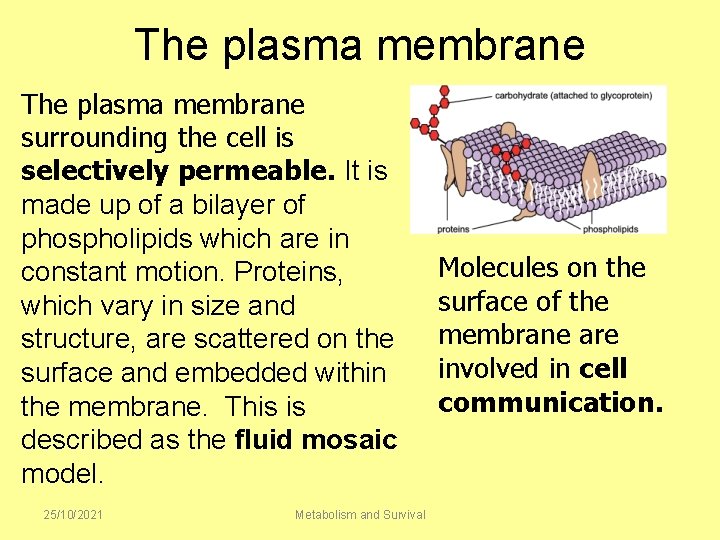
The plasma membrane surrounding the cell is selectively permeable. It is made up of a bilayer of phospholipids which are in constant motion. Proteins, which vary in size and structure, are scattered on the surface and embedded within the membrane. This is described as the fluid mosaic model. 25/10/2021 Metabolism and Survival Molecules on the surface of the membrane are involved in cell communication.
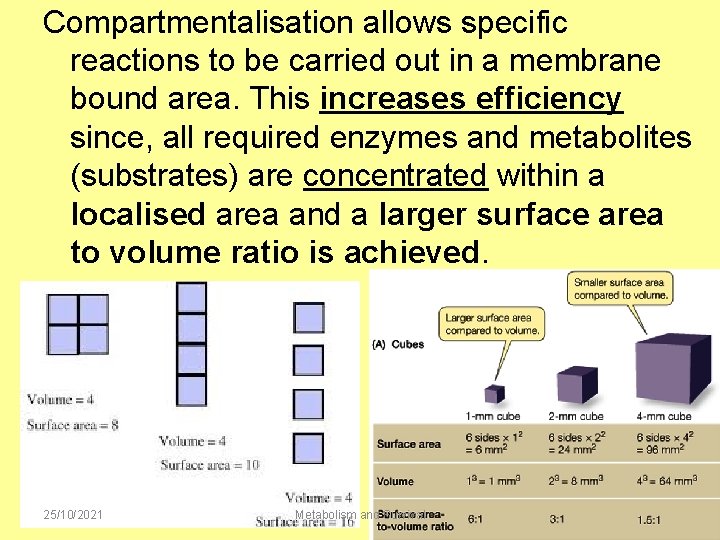
Compartmentalisation allows specific reactions to be carried out in a membrane bound area. This increases efficiency since, all required enzymes and metabolites (substrates) are concentrated within a localised area and a larger surface area to volume ratio is achieved. 25/10/2021 Metabolism and Survival
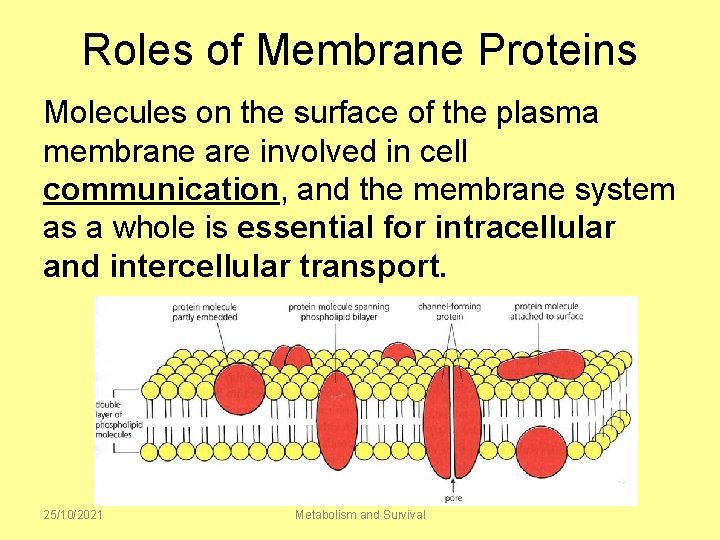
Roles of Membrane Proteins Molecules on the surface of the plasma membrane are involved in cell communication, and the membrane system as a whole is essential for intracellular and intercellular transport. 25/10/2021 Metabolism and Survival
Roles of Membrane Proteins Transport 1. What is the definition of diffusion? 2. Do molecules move down or against the concentration gradient? 3. Does diffusion require ATP? 4. What size of molecules can freely diffuse across the cell membrane? 25/10/2021 Metabolism and Survival
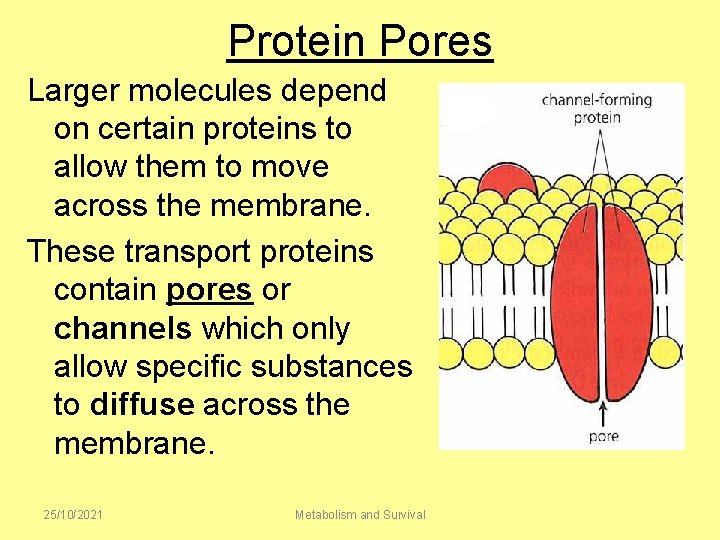
Protein Pores Larger molecules depend on certain proteins to allow them to move across the membrane. These transport proteins contain pores or channels which only allow specific substances to diffuse across the membrane. 25/10/2021 Metabolism and Survival
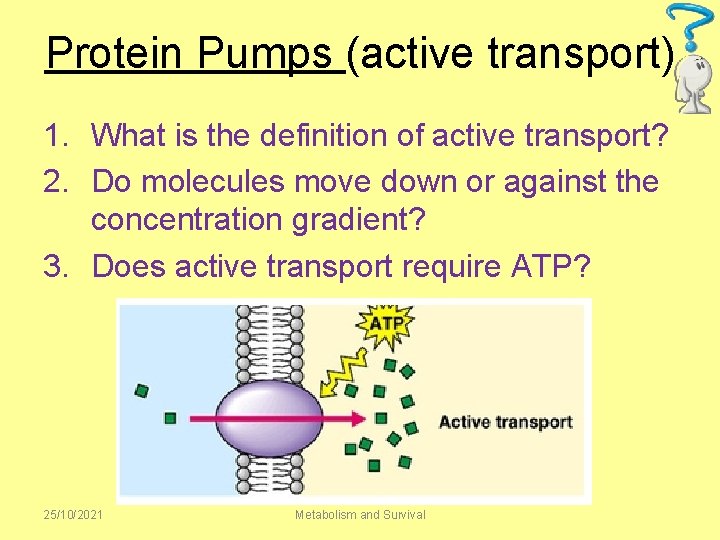
Protein Pumps (active transport) 1. What is the definition of active transport? 2. Do molecules move down or against the concentration gradient? 3. Does active transport require ATP? 25/10/2021 Metabolism and Survival
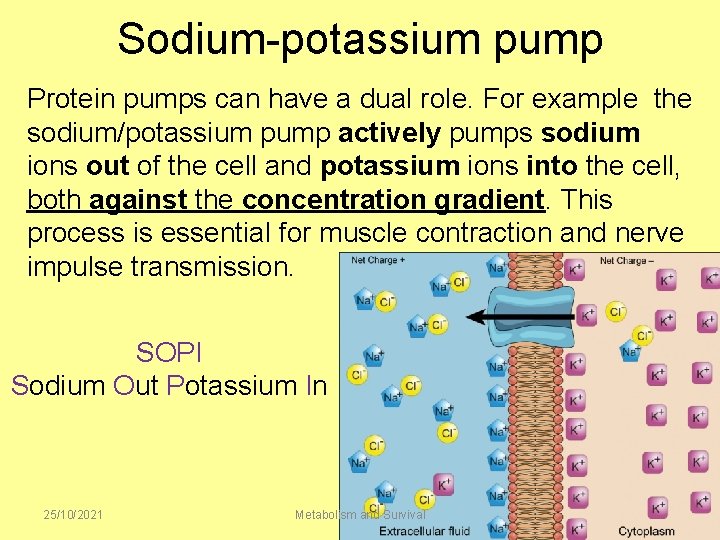
Sodium-potassium pump Protein pumps can have a dual role. For example the sodium/potassium pump actively pumps sodium ions out of the cell and potassium ions into the cell, both against the concentration gradient. This process is essential for muscle contraction and nerve impulse transmission. SOPI Sodium Out Potassium In 25/10/2021 Metabolism and Survival
What factors affect how quickly the pump can operate? Clue 1 ……… The pump needs ATP Clue 2 ……… ATP is made during respiration Clue 3 ……… Respiration needs glucose and oxygen (if it’s aerobic) Clue 4 ……… Respiration rate is controlled by enzymes Clue 5 ……… Enzymes work best at an optimum temperature Temperature and availability of oxygen & glucose affect the rate of respiration and therefore the rate of active transport 25/10/2021 Metabolism and Survival
Enzymes in the Membrane Some proteins in the membrane are enzymes which catalyse steps within cellular metabolic processes e. g. ATP synthase which is embedded in the membrane of mitochondria and chloroplasts. 25/10/2021 Metabolism and Survival
• Answer Q 2 & 3 pg. 120 TYK • Answer Q 2 (not c) & 3 pg. 29 -30 AYK • Complete end of topic test 1 from the questions booklet 25/10/2021 Metabolism and Survival
Extended Response Write notes on the following: a) Metabolic pathways b) The functions of membranes 4 5 Total = 9 25/10/2021 Metabolism and Survival
Key area 1 b – Control of Metabolic Pathways 25/10/2021 Metabolism and Survival
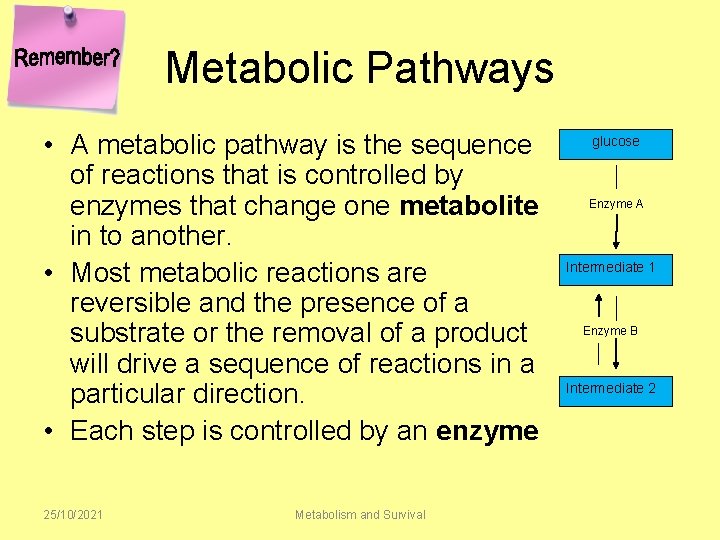
Metabolic Pathways • A metabolic pathway is the sequence of reactions that is controlled by enzymes that change one metabolite in to another. • Most metabolic reactions are reversible and the presence of a substrate or the removal of a product will drive a sequence of reactions in a particular direction. • Each step is controlled by an enzyme 25/10/2021 Metabolism and Survival glucose Enzyme A Intermediate 1 Enzyme B Intermediate 2
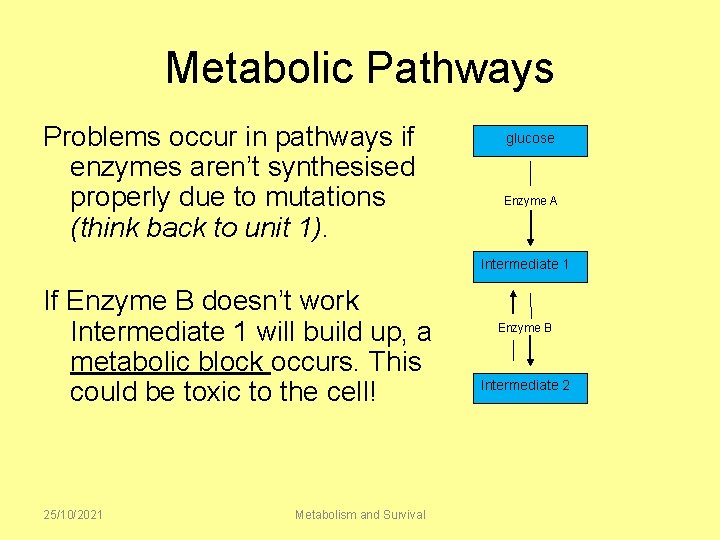
Metabolic Pathways Problems occur in pathways if enzymes aren’t synthesised properly due to mutations (think back to unit 1). glucose Enzyme A Intermediate 1 If Enzyme B doesn’t work Intermediate 1 will build up, a metabolic block occurs. This could be toxic to the cell! 25/10/2021 Metabolism and Survival Enzyme B Intermediate 2
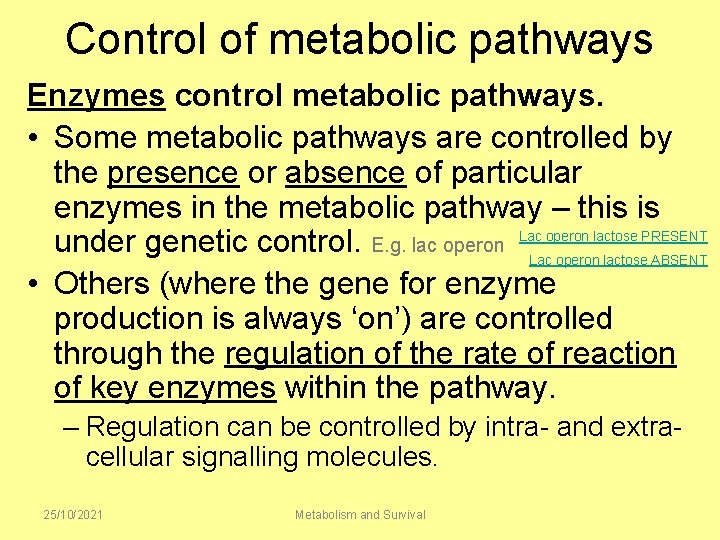
Control of metabolic pathways Enzymes control metabolic pathways. • Some metabolic pathways are controlled by the presence or absence of particular enzymes in the metabolic pathway – this is lactose PRESENT under genetic control. E. g. lac operon Lacoperon lactose ABSENT • Others (where the gene for enzyme production is always ‘on’) are controlled through the regulation of the rate of reaction of key enzymes within the pathway. – Regulation can be controlled by intra- and extracellular signalling molecules. 25/10/2021 Metabolism and Survival
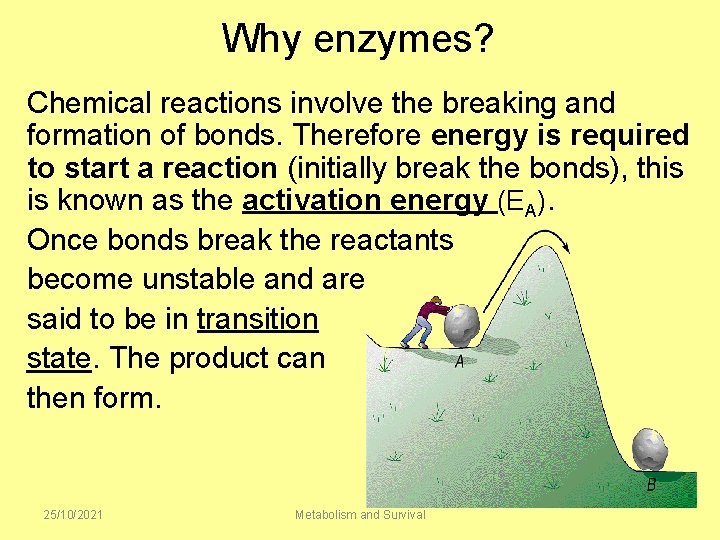
Why enzymes? Chemical reactions involve the breaking and formation of bonds. Therefore energy is required to start a reaction (initially break the bonds), this is known as the activation energy (EA). Once bonds break the reactants become unstable and are said to be in transition state. The product can then form. 25/10/2021 Metabolism and Survival
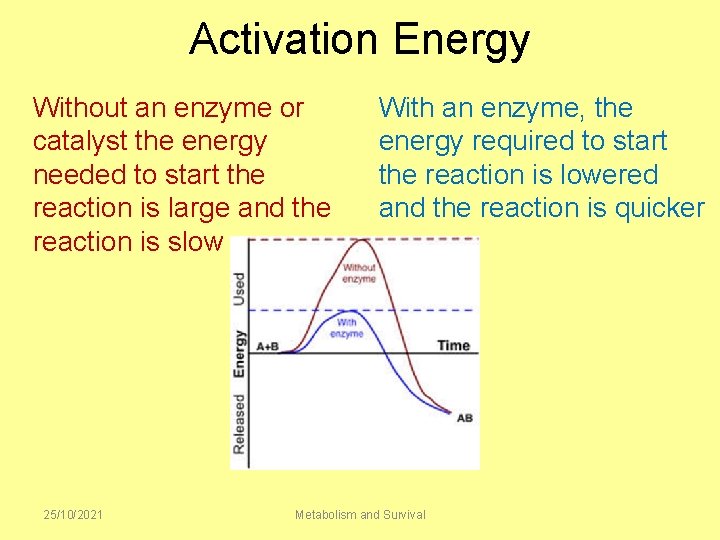
Activation Energy Without an enzyme or catalyst the energy needed to start the reaction is large and the reaction is slow 25/10/2021 With an enzyme, the energy required to start the reaction is lowered and the reaction is quicker Metabolism and Survival
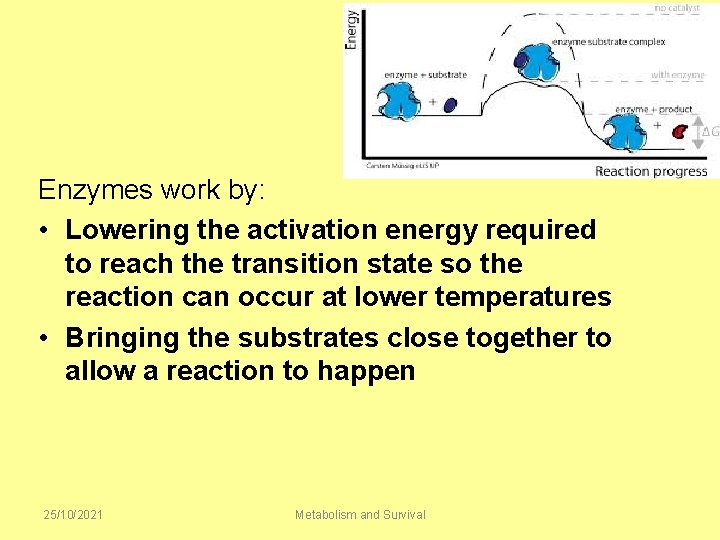
Enzymes work by: • Lowering the activation energy required to reach the transition state so the reaction can occur at lower temperatures • Bringing the substrates close together to allow a reaction to happen 25/10/2021 Metabolism and Survival
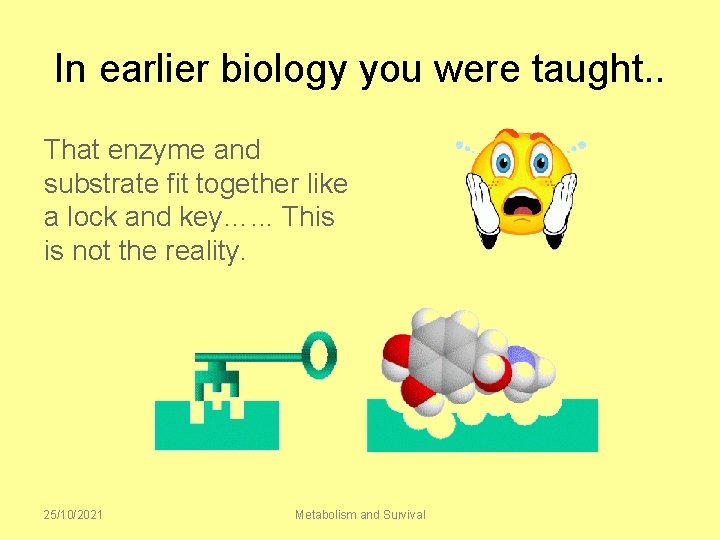
In earlier biology you were taught. . That enzyme and substrate fit together like a lock and key…. . . This is not the reality. 25/10/2021 Metabolism and Survival
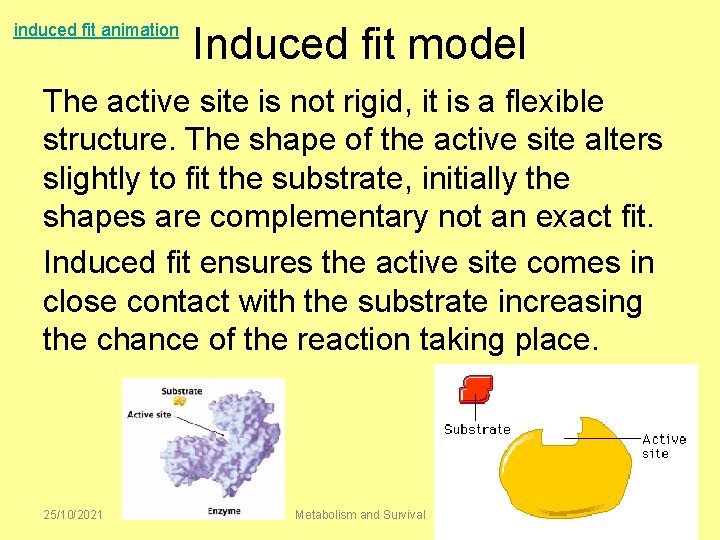
induced fit animation Induced fit model The active site is not rigid, it is a flexible structure. The shape of the active site alters slightly to fit the substrate, initially the shapes are complementary not an exact fit. Induced fit ensures the active site comes in close contact with the substrate increasing the chance of the reaction taking place. 25/10/2021 Metabolism and Survival
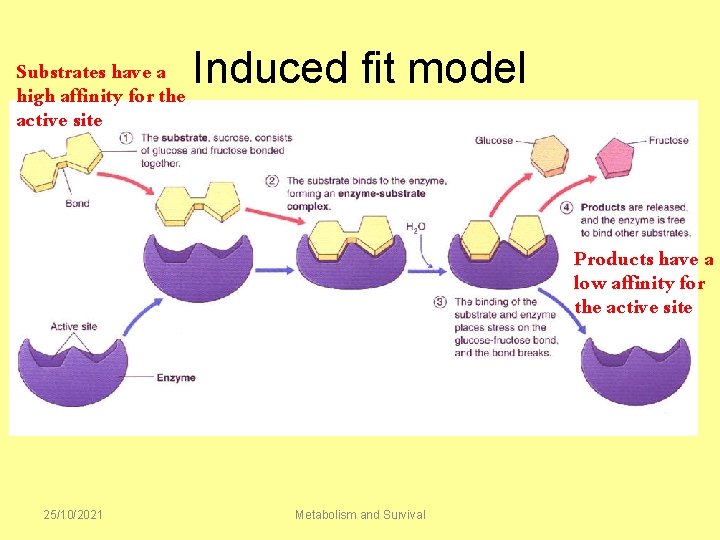
Substrates have a high affinity for the active site Induced fit model Products have a low affinity for the active site 25/10/2021 Metabolism and Survival
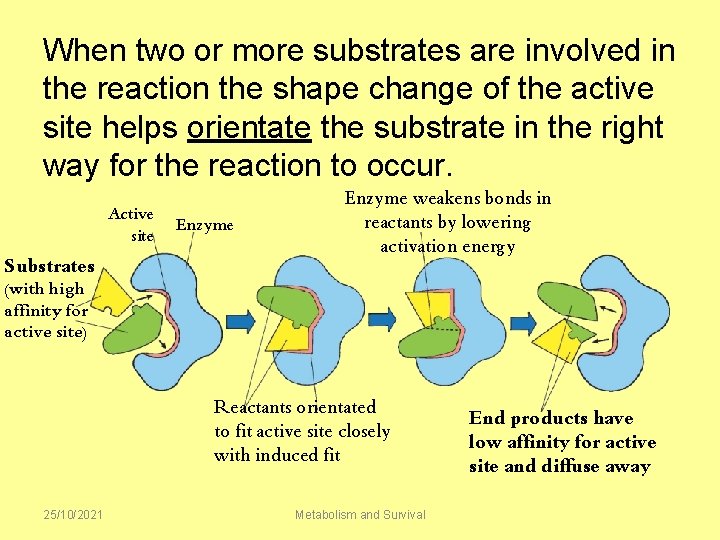
When two or more substrates are involved in the reaction the shape change of the active site helps orientate the substrate in the right way for the reaction to occur. Active site Substrates Enzyme weakens bonds in reactants by lowering activation energy (with high affinity for active site) Reactants orientated to fit active site closely with induced fit 25/10/2021 Metabolism and Survival End products have low affinity for active site and diffuse away
• Answer TYK Q 1 & 2 pg. 126 • Answer AYK Q 4 pg. 30 -31 25/10/2021 Metabolism and Survival
Factors Affecting Enzyme Action • What factors affect the rate of enzyme reactions? 25/10/2021 Metabolism and Survival
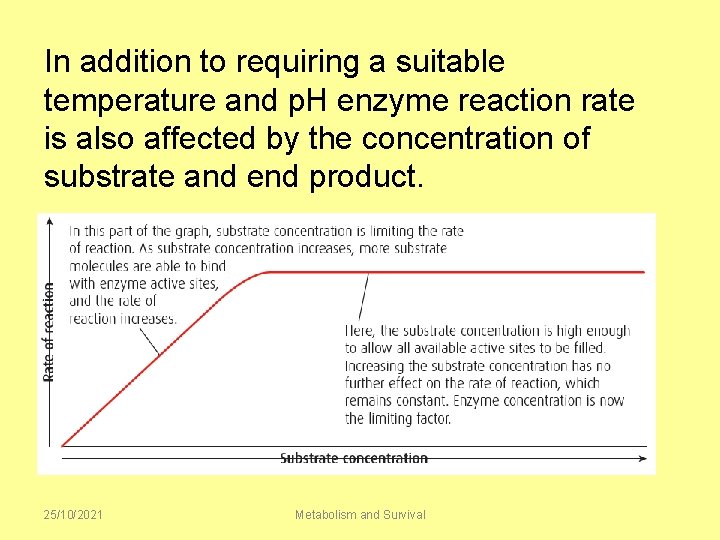
In addition to requiring a suitable temperature and p. H enzyme reaction rate is also affected by the concentration of substrate and end product. 25/10/2021 Metabolism and Survival
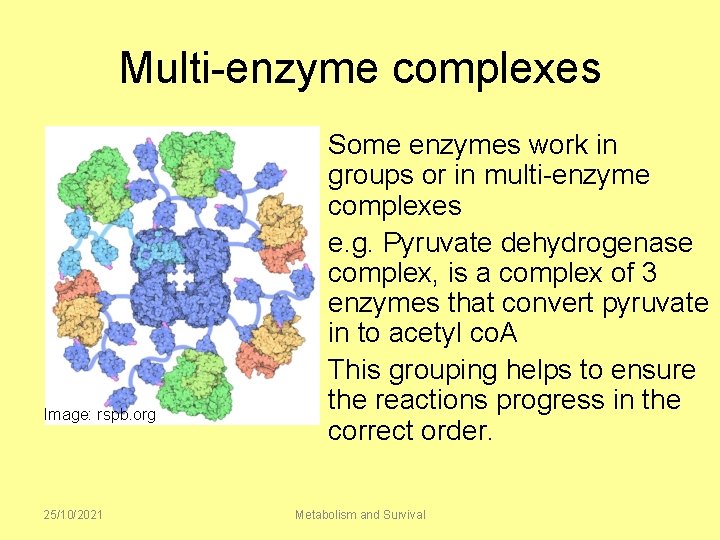
Multi-enzyme complexes Image: rspb. org 25/10/2021 Some enzymes work in groups or in multi-enzyme complexes e. g. Pyruvate dehydrogenase complex, is a complex of 3 enzymes that convert pyruvate in to acetyl co. A This grouping helps to ensure the reactions progress in the correct order. Metabolism and Survival
Regulating Enzyme activity A cell must control enzyme activity. It does this by: • Controlling the number of enzyme molecules in cell • Keeping reactions (and enzymes) in compartments e. g. mitochondria or lysosome • Changing enzyme shape (most effective) 25/10/2021 Metabolism and Survival
Enzyme Inhibitors Some enzymes are always present due to constant expression. This means they need to be controlled through the regulation of their rates of reaction. Regulation can be brought about due to other molecules binding to the enzyme. Enzyme inhibitors reduce the rate of an enzyme catalysed reaction by interfering with the enzyme in some way. This effect may be permanent or temporary. 25/10/2021 Metabolism and Survival
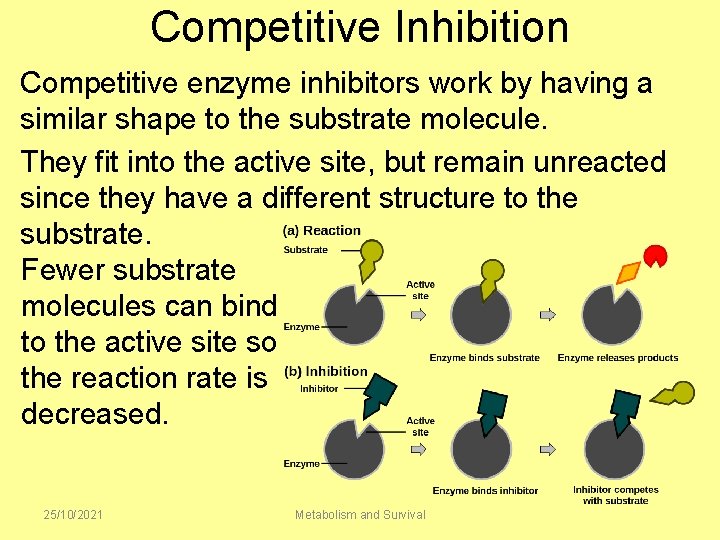
Competitive Inhibition Competitive enzyme inhibitors work by having a similar shape to the substrate molecule. They fit into the active site, but remain unreacted since they have a different structure to the substrate. Fewer substrate molecules can bind to the active site so the reaction rate is decreased. 25/10/2021 Metabolism and Survival
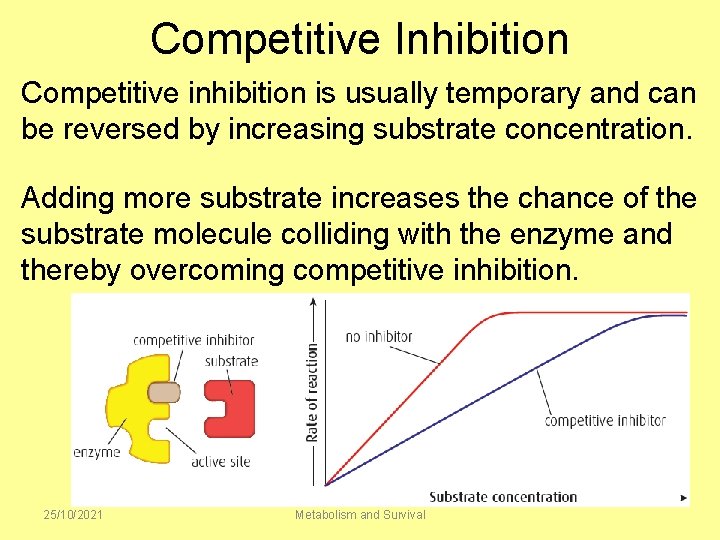
Competitive Inhibition Competitive inhibition is usually temporary and can be reversed by increasing substrate concentration. Adding more substrate increases the chance of the substrate molecule colliding with the enzyme and thereby overcoming competitive inhibition. 25/10/2021 Metabolism and Survival
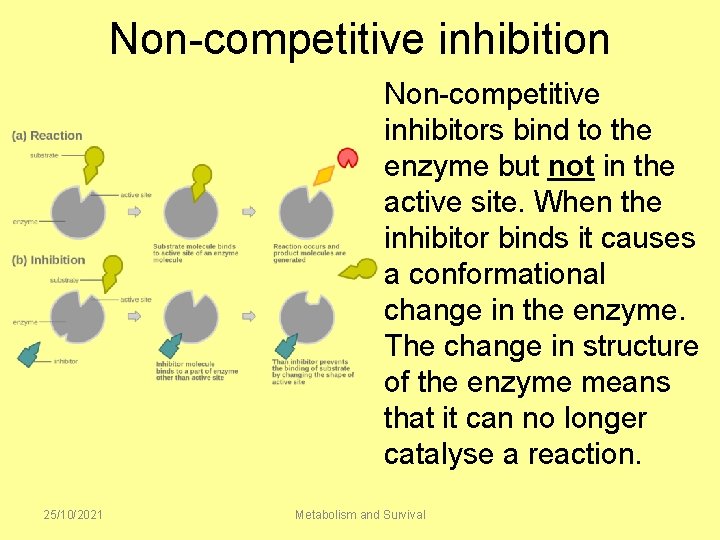
Non-competitive inhibition Non-competitive inhibitors bind to the enzyme but not in the active site. When the inhibitor binds it causes a conformational change in the enzyme. The change in structure of the enzyme means that it can no longer catalyse a reaction. 25/10/2021 Metabolism and Survival

Non-Competitive inhibition Non-competitive inhibition may or may not be reversible. Since non-competitive inhibitors do not compete with substrate molecules, increasing substrate concentration has no effect on the rate of reaction. 25/10/2021 Metabolism and Survival

Feedback Inhibition The activity of some enzymes, particularly those involved in metabolic pathways, can be selfregulating. Most often the product itself acts as an inhibitor, therefore this type of inhibition is also known as end-product inhibition. The end-product binds to an allosteric site of the enzyme at the beginning of the pathway altering the shape of the active site. This prevents the binding of substrate molecule. 25/10/2021 Metabolism and Survival
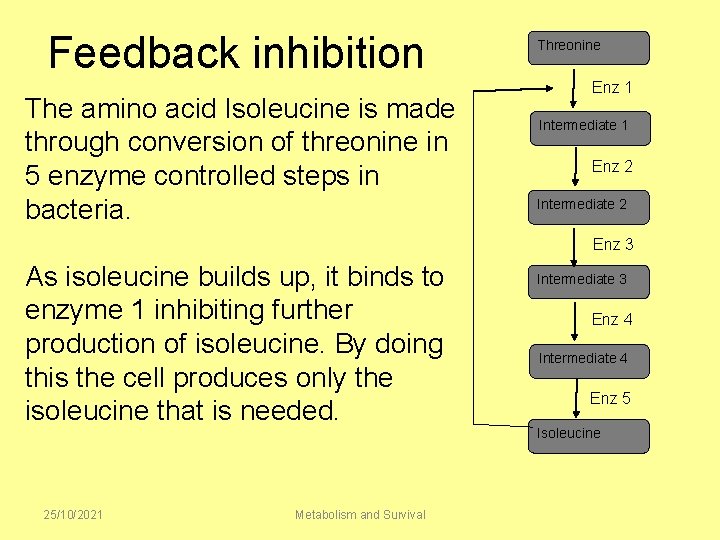
Feedback inhibition The amino acid Isoleucine is made through conversion of threonine in 5 enzyme controlled steps in bacteria. Threonine Enz 1 Intermediate 1 Enz 2 Intermediate 2 Enz 3 As isoleucine builds up, it binds to enzyme 1 inhibiting further production of isoleucine. By doing this the cell produces only the isoleucine that is needed. 25/10/2021 Metabolism and Survival Intermediate 3 Enz 4 Intermediate 4 Enz 5 Isoleucine

• Answer TYK Q 3 pg. 126 and Q 1, 2 b and 3 pg. 137 • Answer end of topic 2 test pg 21 -23 of questions booklet 25/10/2021 Metabolism and Survival
- Slides: 48