
Unit 2 Medical and Applied Sciences Biochemistry Cells
Unit 2 Medical and Applied Sciences Biochemistry Cells Movement Into and Out of the Cell The Cell Cycle Cellular Metabolism Cellular Respiration
Medical and Applied Sciences • • • • Cardiology Dermatology Endocrinology Epidemiology Gastroenterology Geriatrics Gerontology Gynecology Hematology Histology Immunology Neonatology Nephrology Obstetrics • • • Oncology Ophthalmology Orthopedics Otolaryngology Pathology Pediatrics Pharmacology Podiatry Psychiatry Radiology Toxicology Urology
Biochemistry • Biological chemistry = chemistry of living organisms. • Important in: 1. Helping explain physiological processes 2. Developing new drugs and methods for treating diseases.
Cells • Adult human body consists of 50 -100 Trillion cells. • = the basic unit of the human organism. • At least 260 different varieties, yet all cells have much in common. – Differentiated – specialized characteristics. (ex) muscle cells have many mitochondria
3 Major Parts of a Cell • pg. 78 “composite cell” 1. Nucleus 2. Cytoplasm 3. Cell membrane
Organelles • • • Ribosomes Endoplasmic Reticulum Vesicles Golgi Apparatus Mitochondria (ATP) Lysosomes • • Peroxisomes Centrosomes Cilia Flagella Microfilaments Microtubules Nucleus
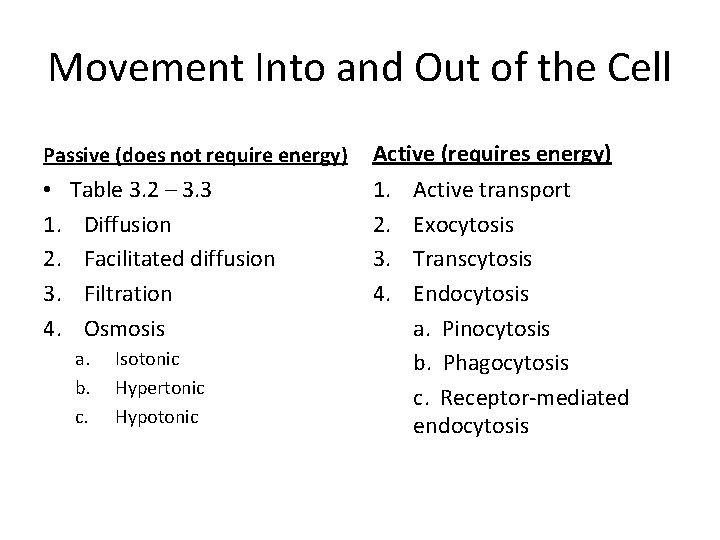
Movement Into and Out of the Cell Passive (does not require energy) • 1. 2. 3. 4. Table 3. 2 – 3. 3 Diffusion Facilitated diffusion Filtration Osmosis a. b. c. Isotonic Hypertonic Hypotonic Active (requires energy) 1. 2. 3. 4. Active transport Exocytosis Transcytosis Endocytosis a. Pinocytosis b. Phagocytosis c. Receptor-mediated endocytosis
The Cell Cycle • The series of changes that a cell undergoes, from the time it forms until it divides. 1. Interphase 2. Mitosis 3. Cytoplasmic Division (cytokinesis)
Interphase • Very active period of time • Cell grows and maintains its routine functions. Phases: a. S phase (synthesis) – DNA replication b. G 1 phase c. G 2 phase
Mitosis (table 3. 4) • 1 cell with 46 chromosomes (human) divides to become 2 cells with 46 chromosomes each. phases: a. Prophase b. Metaphase c. Anaphase d. Telophase
Cytokinesis • Begins during Anaphase • Continues through Telophase
Cellular Metabolism • Sum total of chemical rxns in the cell • Very complex and contains pathways and cycles. Anabolism – larger molecules are constructed from smaller ones, requiring energy input. Catabolism – larger molecules are broken down into smaller ones, releasing energy.
Anabolism • Provides all the materials required for cellular growth and repair. Dehydration synthesis – many simple sugars are joined to form larger molecules. (ex) pg. 115 “pre-race meal” -called dehydration due to an –OH group being removed when monosaccharides join. **this is also how fat cells are formed.
Catabolism • Hydrolysis – can decompose carbohydrates, lipids, and proteins. – A water molecule is used for each bond that is broken. – Hydrolysis of a disaccharide gives 2 monosaccharide. **hydrolysis is the reverse of dehydration synthesis.
Other Things to Note • Cellular metabolism includes hundreds of different chemical rxns, each controlled by a specific type of enzyme. Enzyme – chemical that speeds up rxns. ** sequences of enzyme-controlled rxns are called metabolic pathways. -metabolic pathways lead to synthesis or breakdown of particular biochemicals. *** 100’s of different types of enzymes are in every cell.
Cellular Respiration • Occurs in 3 distinct, yet interconnected, series of rxns. 1. Glycolysis 2. Citric Acid Cycle 3. Electron Transport Chain • • • These rxns produces/use CO 2, water, and energy. Most of the energy is lost as heat, but ½ is captured as ATP. *** Fig. 4. 9 (pg. 121), fig. 4. 11 (pg. 123)
- Slides: 16