
Unit 2 Mechanics Part 4 Impulse Momentum Table
Unit 2: Mechanics Part 4 – Impulse & Momentum
Table of Contents Impulse & Momentum Defined The Impulse-Momentum Theorem Conservation of Momentum and Energy in Collisions
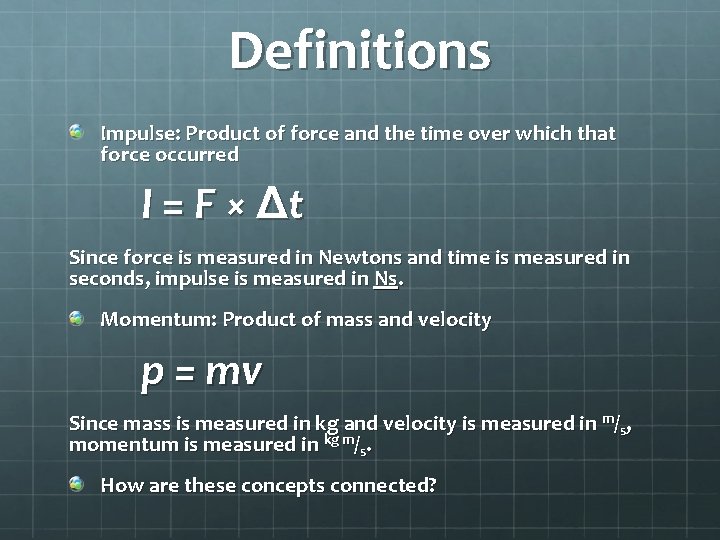
Definitions Impulse: Product of force and the time over which that force occurred I = F × Δt Since force is measured in Newtons and time is measured in seconds, impulse is measured in Ns. Momentum: Product of mass and velocity p = mv Since mass is measured in kg and velocity is measured in m/s, momentum is measured in kg m/s. How are these concepts connected?
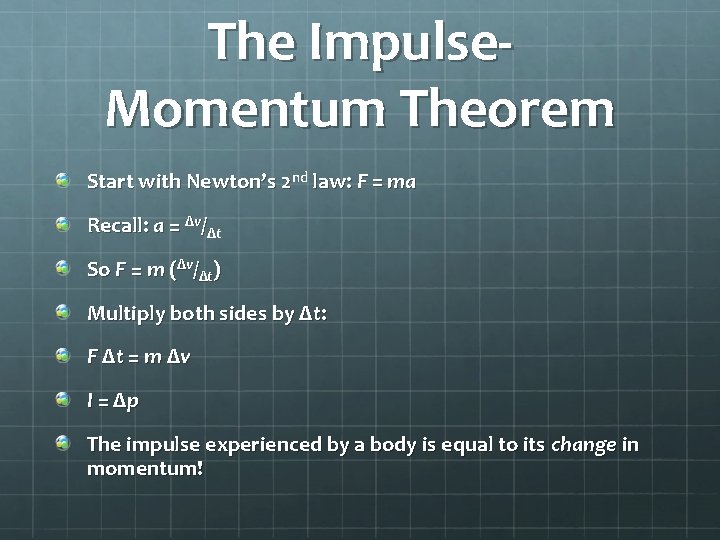
The Impulse. Momentum Theorem Start with Newton’s 2 nd law: F = ma Recall: a = Δv/Δt So F = m (Δv/Δt) Multiply both sides by Δt: F Δt = m Δv I = Δp The impulse experienced by a body is equal to its change in momentum!
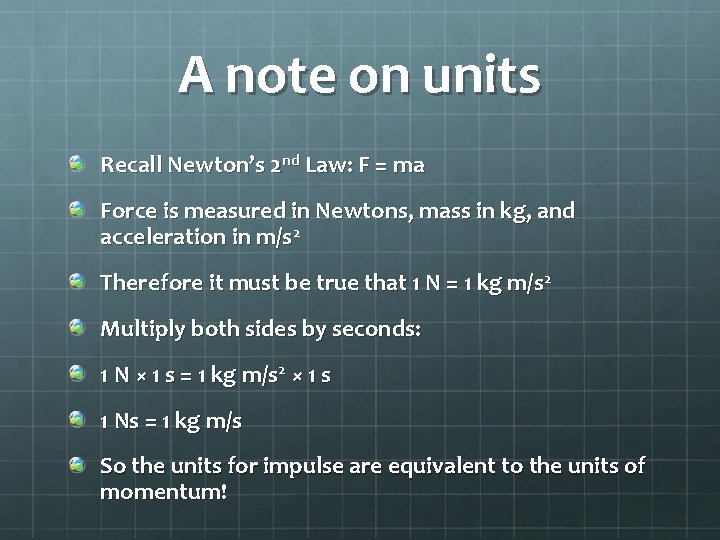
A note on units Recall Newton’s 2 nd Law: F = ma Force is measured in Newtons, mass in kg, and acceleration in m/s 2 Therefore it must be true that 1 N = 1 kg m/s 2 Multiply both sides by seconds: 1 N × 1 s = 1 kg m/s 2 × 1 s 1 Ns = 1 kg m/s So the units for impulse are equivalent to the units of momentum!
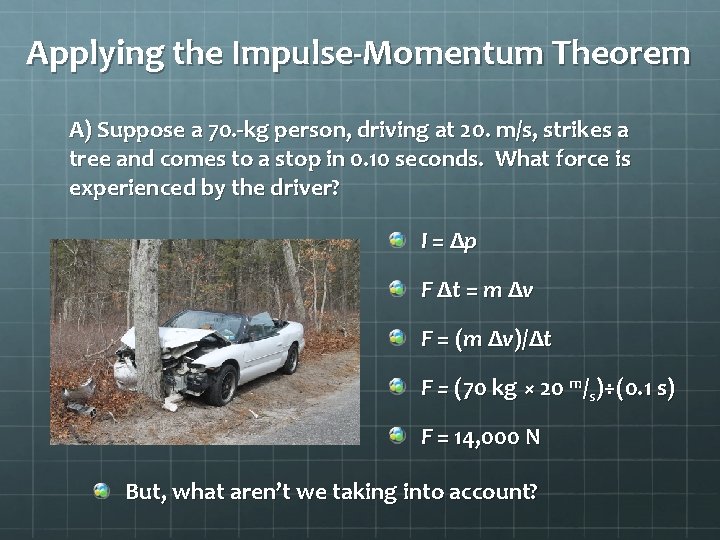
Applying the Impulse-Momentum Theorem A) Suppose a 70. -kg person, driving at 20. m/s, strikes a tree and comes to a stop in 0. 10 seconds. What force is experienced by the driver? I = Δp F Δt = m Δv F = (m Δv)/Δt F = (70 kg × 20 m/s)÷(0. 1 s) F = 14, 000 N But, what aren’t we taking into account?
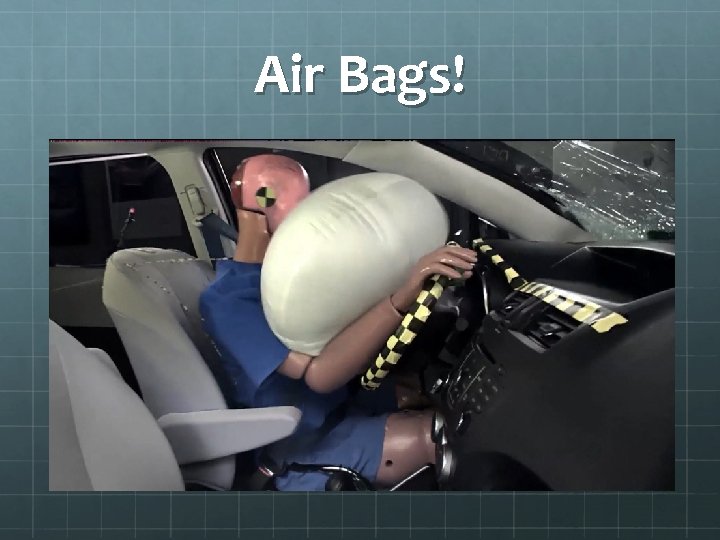
Air Bags!
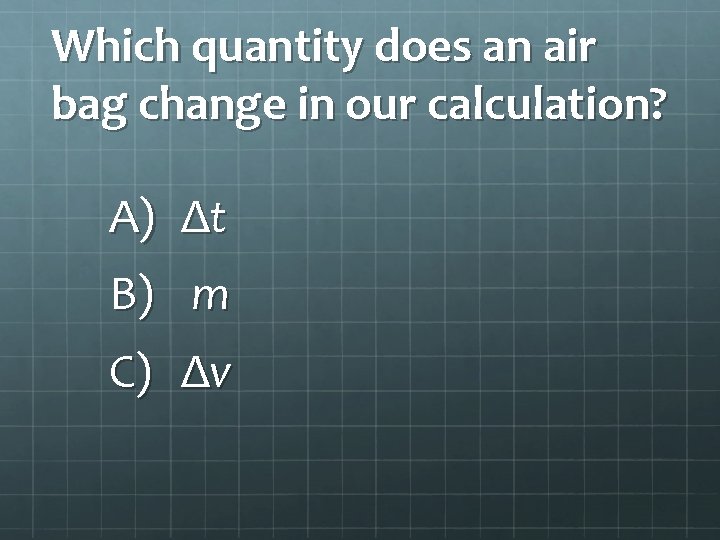
Which quantity does an air bag change in our calculation? A) Δt B) m C) Δv
Which quantity does an air bag change in our calculation? A) Δt B) m C) Δv
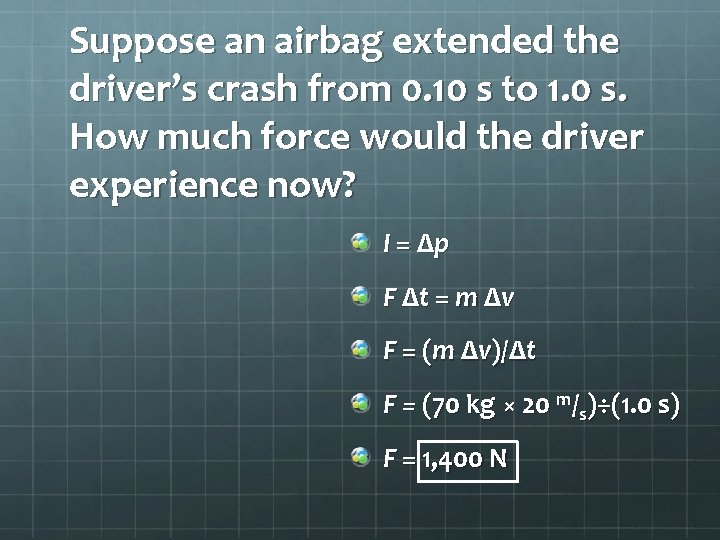
Suppose an airbag extended the driver’s crash from 0. 10 s to 1. 0 s. How much force would the driver experience now? I = Δp F Δt = m Δv F = (m Δv)/Δt F = (70 kg × 20 m/s)÷(1. 0 s) F = 1, 400 N
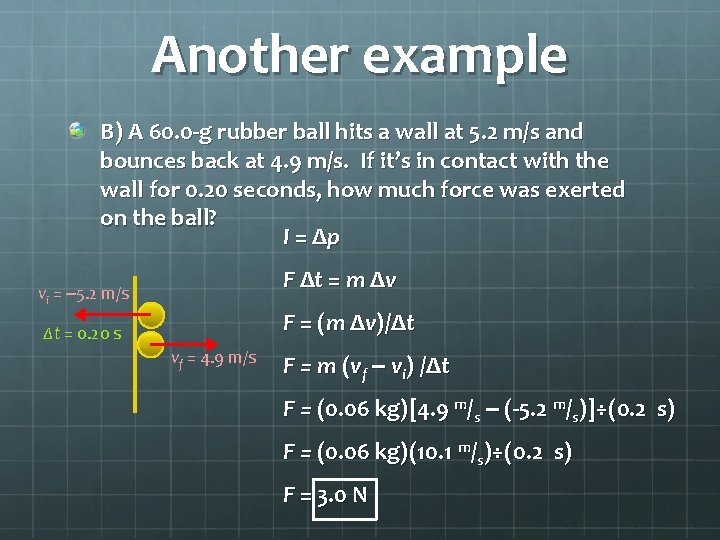
Another example B) A 60. 0 -g rubber ball hits a wall at 5. 2 m/s and bounces back at 4. 9 m/s. If it’s in contact with the wall for 0. 20 seconds, how much force was exerted on the ball? I = Δp F Δt = m Δv vi = – 5. 2 m/s F = (m Δv)/Δt Δt = 0. 20 s vf = 4. 9 m/s F = m (vf – vi) /Δt F = (0. 06 kg)[4. 9 m/s – (-5. 2 m/s)]÷(0. 2 s) F = (0. 06 kg)(10. 1 m/s)÷(0. 2 s) F = 3. 0 N
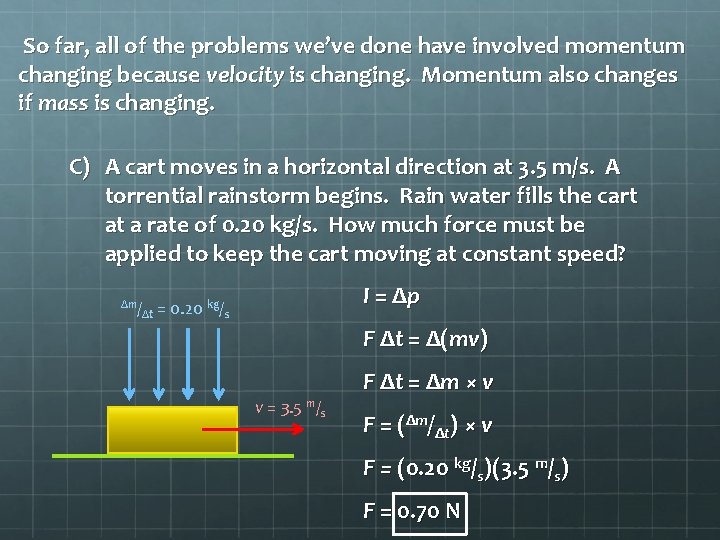
So far, all of the problems we’ve done have involved momentum changing because velocity is changing. Momentum also changes if mass is changing. C) A cart moves in a horizontal direction at 3. 5 m/s. A torrential rainstorm begins. Rain water fills the cart at a rate of 0. 20 kg/s. How much force must be applied to keep the cart moving at constant speed? Δm/ I = Δp kg Δt = 0. 20 /s F Δt = Δ(mv) v = 3. 5 m/s F Δt = Δ m × v F = ( Δ m /Δ t ) × v F = (0. 20 kg/s)(3. 5 m/s) F = 0. 70 N
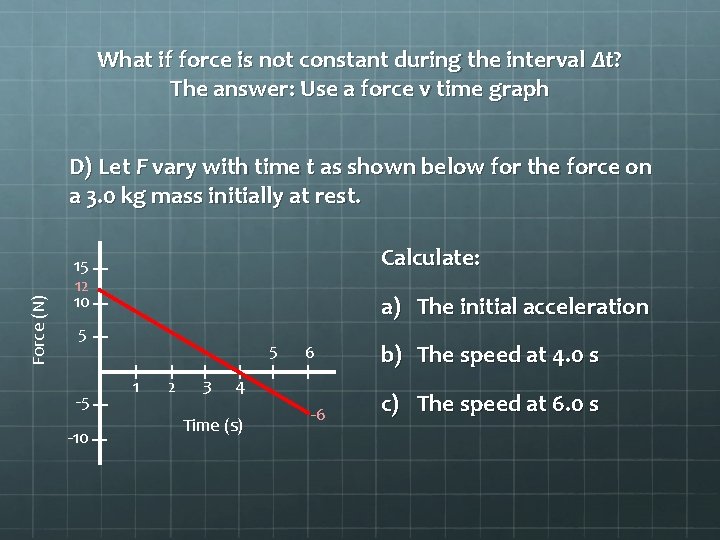
What if force is not constant during the interval Δt? The answer: Use a force v time graph Force (N) D) Let F vary with time t as shown below for the force on a 3. 0 kg mass initially at rest. Calculate: 15 12 10 a) The initial acceleration 5 -5 -10 5 1 2 3 6 4 Time (s) -6 b) The speed at 4. 0 s c) The speed at 6. 0 s
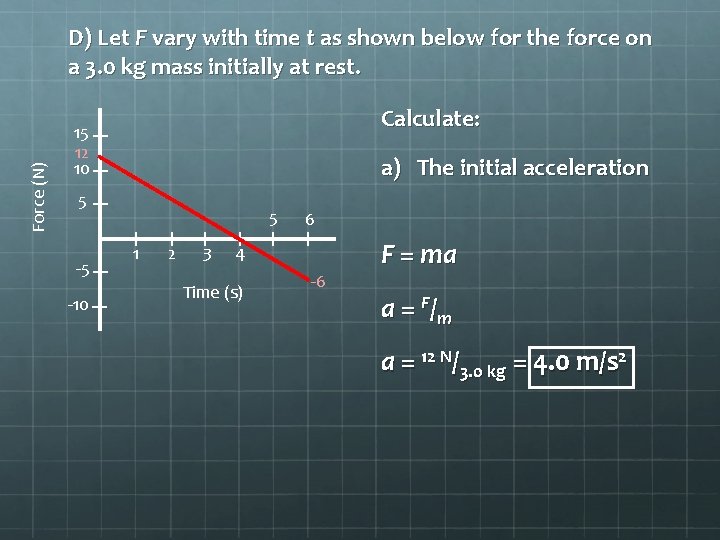
Force (N) D) Let F vary with time t as shown below for the force on a 3. 0 kg mass initially at rest. Calculate: 15 12 10 a) The initial acceleration 5 -5 -10 5 1 2 3 6 4 Time (s) -6 F = ma a = F/ m a = 12 N/3. 0 kg = 4. 0 m/s 2
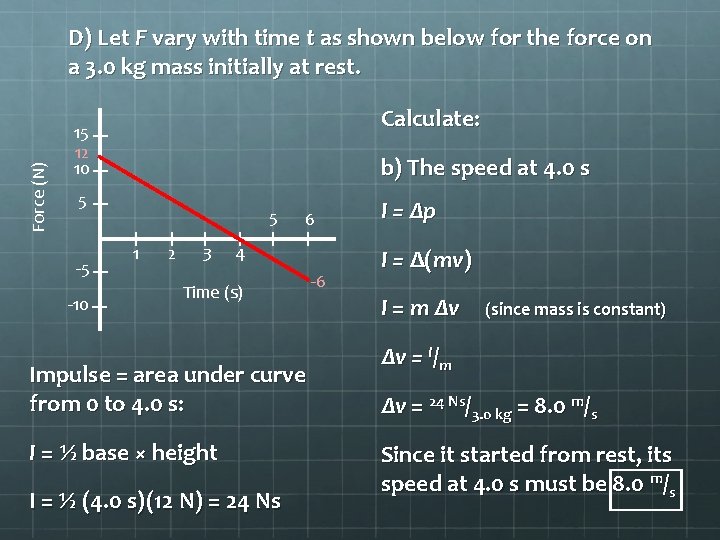
Force (N) D) Let F vary with time t as shown below for the force on a 3. 0 kg mass initially at rest. Calculate: 15 12 10 b) The speed at 4. 0 s 5 -5 -10 5 1 2 3 6 4 Time (s) Impulse = area under curve from 0 to 4. 0 s: I = ½ base × height I = ½ (4. 0 s)(12 N) = 24 Ns -6 I = Δp I = Δ(mv) I = m Δv (since mass is constant) Δv = I/m Δv = 24 Ns/3. 0 kg = 8. 0 m/s Since it started from rest, its speed at 4. 0 s must be 8. 0 m/s
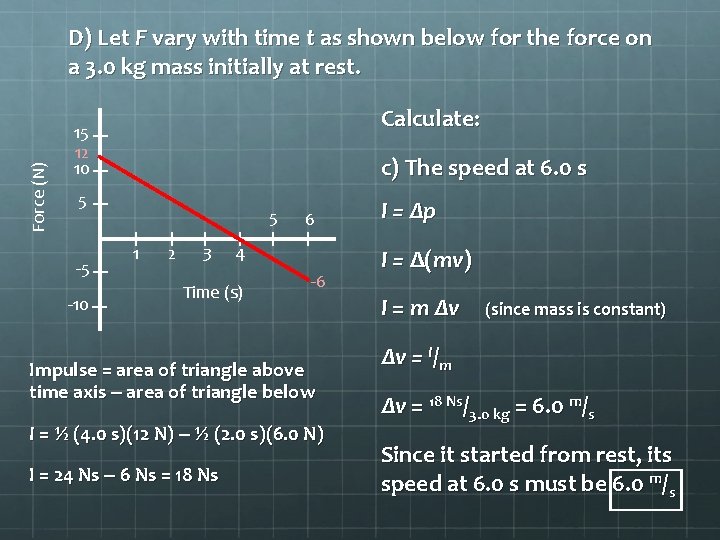
Force (N) D) Let F vary with time t as shown below for the force on a 3. 0 kg mass initially at rest. Calculate: 15 12 10 c) The speed at 6. 0 s 5 -5 -10 5 1 2 3 6 4 Time (s) -6 Impulse = area of triangle above time axis – area of triangle below I = ½ (4. 0 s)(12 N) – ½ (2. 0 s)(6. 0 N) I = 24 Ns – 6 Ns = 18 Ns I = Δp I = Δ(mv) I = m Δv (since mass is constant) Δv = I/m Δv = 18 Ns/3. 0 kg = 6. 0 m/s Since it started from rest, its speed at 6. 0 s must be 6. 0 m/s
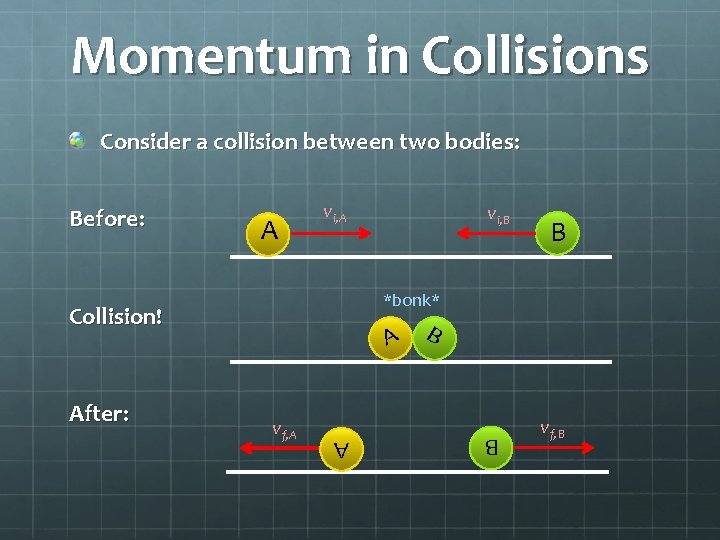
Momentum in Collisions Consider a collision between two bodies: A vi, A B *bonk* Collision! A vf, A A After: vi, B Before: vf, B
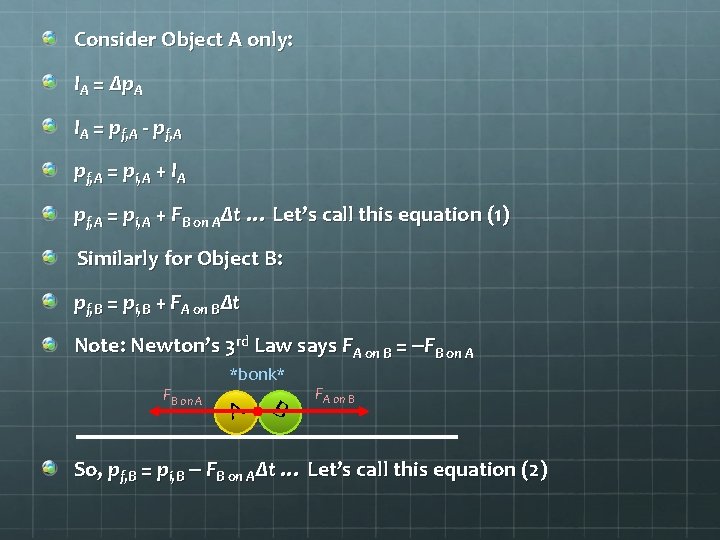
Consider Object A only: IA = Δp. A IA = pf, A - pf, A = pi, A + IA pf, A = pi, A + FB on AΔt … Let’s call this equation (1) Similarly for Object B: pf, B = pi, B + FA on BΔt Note: Newton’s 3 rd Law says FA on B = –FB on A *bonk* A B FA on B So, pf, B = pi, B – FB on AΔt … Let’s call this equation (2)
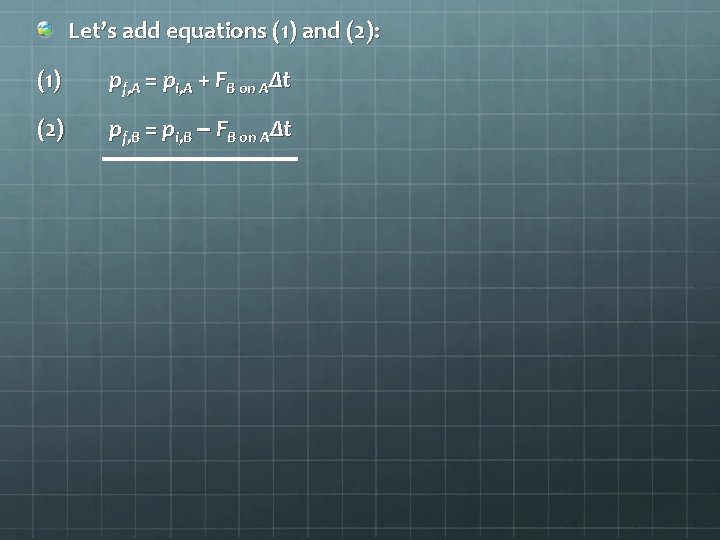
Let’s add equations (1) and (2): (1) pf, A = pi, A + FB on AΔt (2) pf, B = pi, B – FB on AΔt
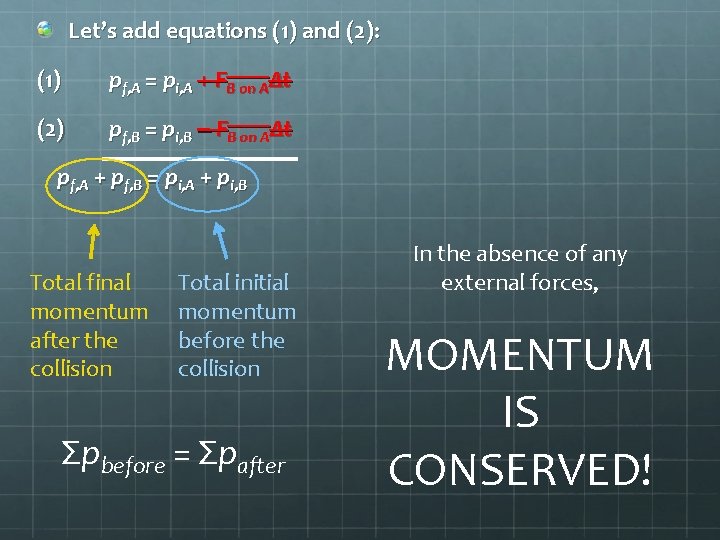
Let’s add equations (1) and (2): (1) pf, A = pi, A + FB on AΔt (2) pf, B = pi, B – FB on AΔt pf, A + pf, B = pi, A + pi, B Total final momentum after the collision Total initial momentum before the collision Σpbefore = Σpafter In the absence of any external forces, MOMENTUM IS CONSERVED!
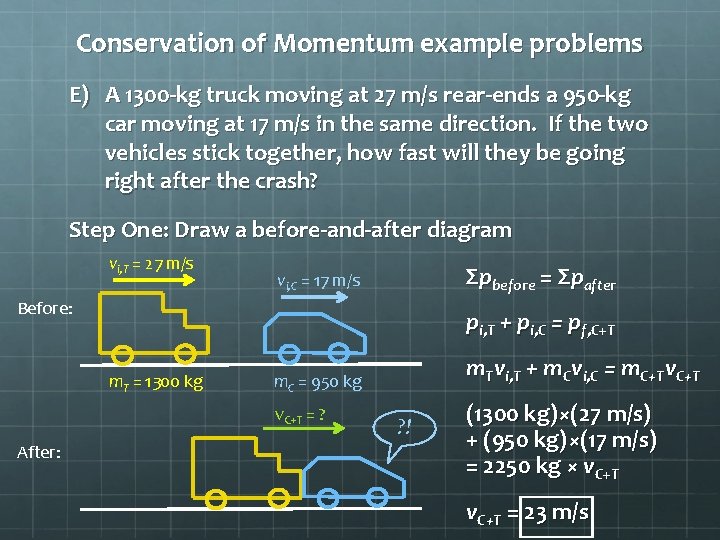
Conservation of Momentum example problems E) A 1300 -kg truck moving at 27 m/s rear-ends a 950 -kg car moving at 17 m/s in the same direction. If the two vehicles stick together, how fast will they be going right after the crash? Step One: Draw a before-and-after diagram vi, T = 27 m/s Σpbefore = Σpafter vi, C = 17 m/s Before: pi, T + pi, C = pf, C+T m. T = 1300 kg v. C+T = ? After: m. Tvi, T + m. Cvi, C = m. C+Tv. C+T m. C = 950 kg ? ! (1300 kg)×(27 m/s) + (950 kg)×(17 m/s) = 2250 kg × v. C+T = 23 m/s
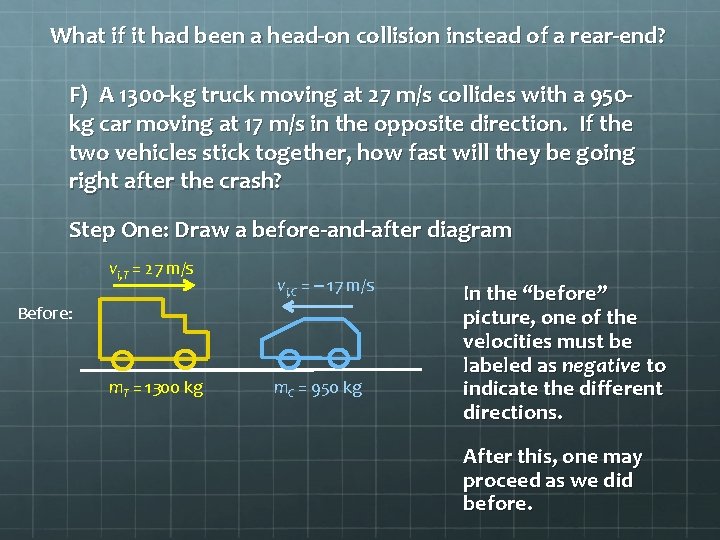
What if it had been a head-on collision instead of a rear-end? F) A 1300 -kg truck moving at 27 m/s collides with a 950 kg car moving at 17 m/s in the opposite direction. If the two vehicles stick together, how fast will they be going right after the crash? Step One: Draw a before-and-after diagram vi, T = 27 m/s vi, C = – 17 m/s Before: m. T = 1300 kg m. C = 950 kg In the “before” picture, one of the velocities must be labeled as negative to indicate the different directions. After this, one may proceed as we did before.
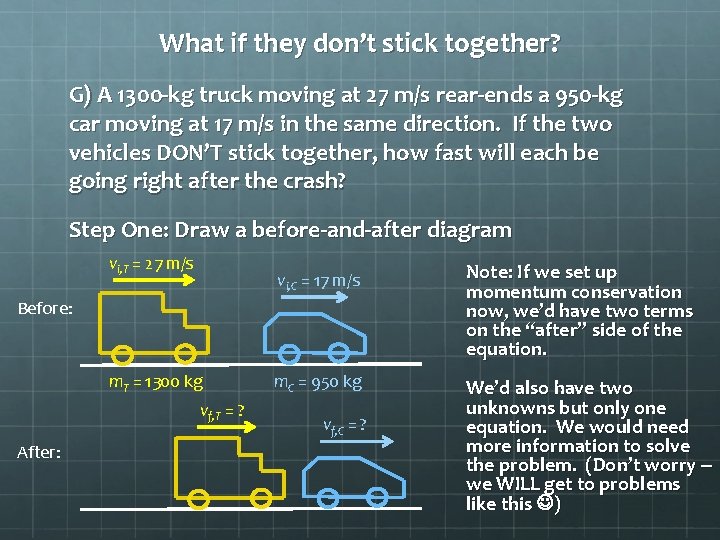
What if they don’t stick together? G) A 1300 -kg truck moving at 27 m/s rear-ends a 950 -kg car moving at 17 m/s in the same direction. If the two vehicles DON’T stick together, how fast will each be going right after the crash? Step One: Draw a before-and-after diagram vi, T = 27 m/s vi, C = 17 m/s Before: m. T = 1300 kg vf, T = ? After: m. C = 950 kg vf, C = ? Note: If we set up momentum conservation now, we’d have two terms on the “after” side of the equation. We’d also have two unknowns but only one equation. We would need more information to solve the problem. (Don’t worry – we WILL get to problems like this )
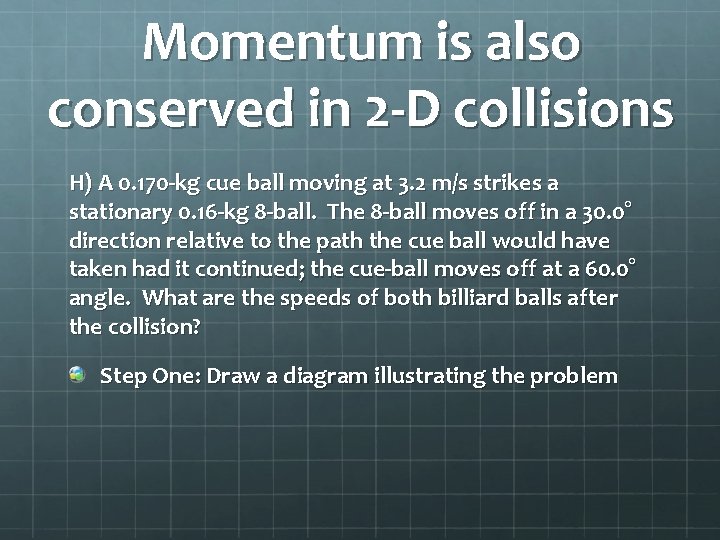
Momentum is also conserved in 2 -D collisions H) A 0. 170 -kg cue ball moving at 3. 2 m/s strikes a stationary 0. 16 -kg 8 -ball. The 8 -ball moves off in a 30. 0° direction relative to the path the cue ball would have taken had it continued; the cue-ball moves off at a 60. 0° angle. What are the speeds of both billiard balls after the collision? Step One: Draw a diagram illustrating the problem
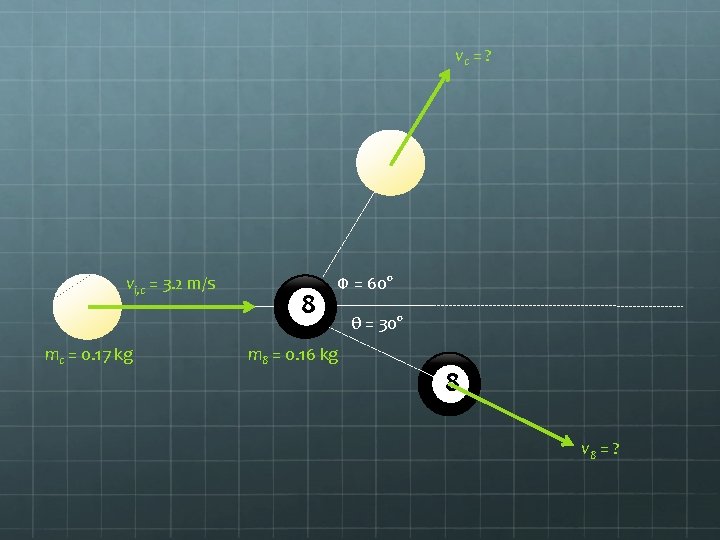
vc = ? vi, c = 3. 2 m/s mc = 0. 17 kg 8 Φ = 60° m 8 = 0. 16 kg θ = 30° 8 v 8 = ?
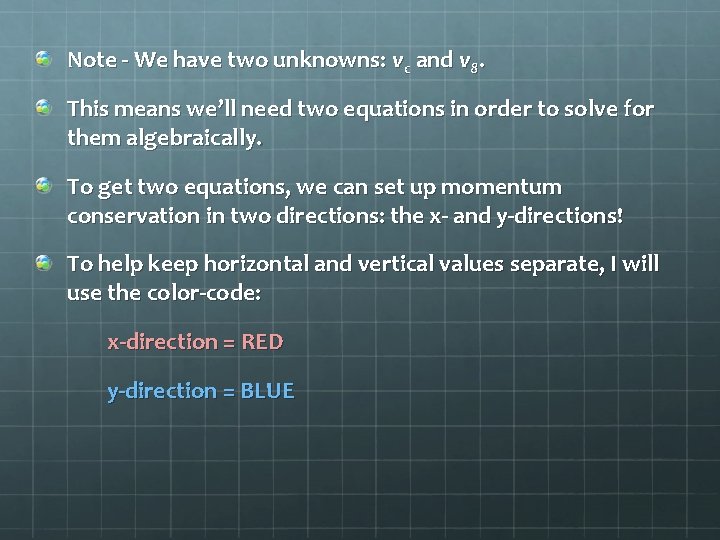
Note - We have two unknowns: vc and v 8. This means we’ll need two equations in order to solve for them algebraically. To get two equations, we can set up momentum conservation in two directions: the x- and y-directions! To help keep horizontal and vertical values separate, I will use the color-code: x-direction = RED y-direction = BLUE
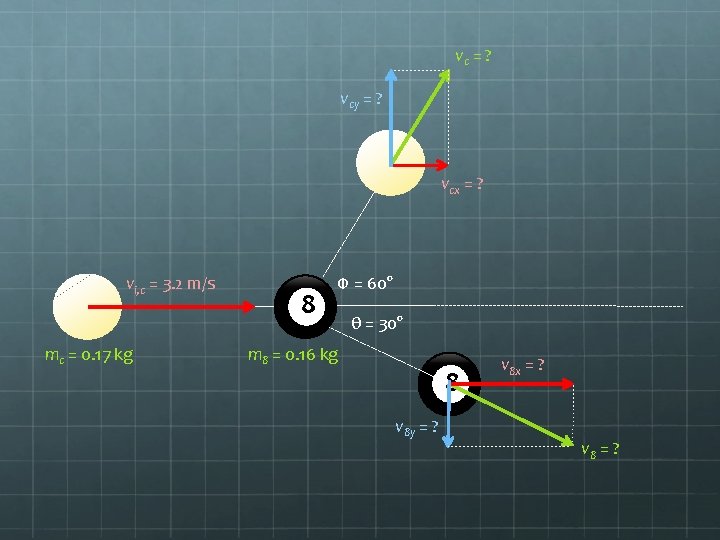
vc = ? vcy = ? vcx = ? vi, c = 3. 2 m/s mc = 0. 17 kg 8 Φ = 60° θ = 30° m 8 = 0. 16 kg 8 v 8 y = ? v 8 x = ? v 8 = ?
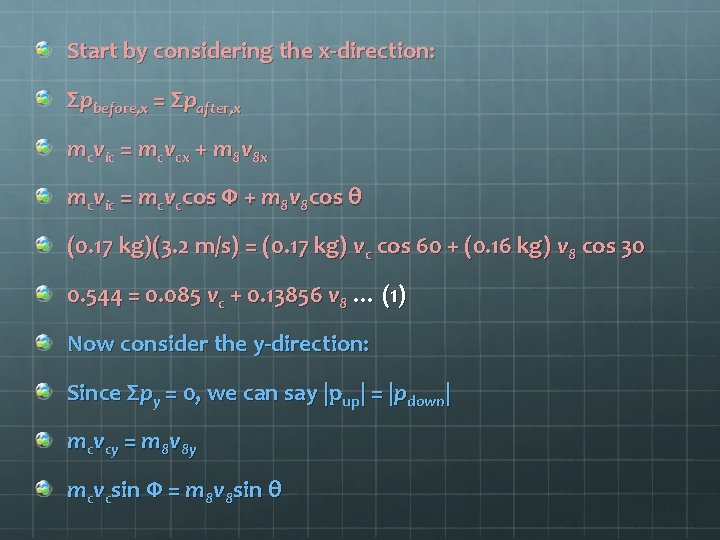
Start by considering the x-direction: Σpbefore, x = Σpafter, x mcvic = mcvcx + m 8 v 8 x mcvic = mcvccos Φ + m 8 v 8 cos θ (0. 17 kg)(3. 2 m/s) = (0. 17 kg) vc cos 60 + (0. 16 kg) v 8 cos 30 0. 544 = 0. 085 vc + 0. 13856 v 8 … (1) Now consider the y-direction: Since Σpy = 0, we can say |pup| = |pdown| mcvcy = m 8 v 8 y mcvcsin Φ = m 8 v 8 sin θ
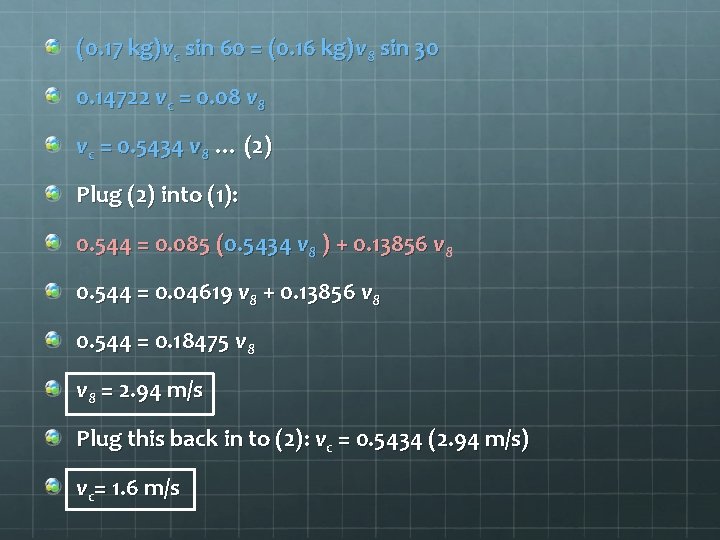
(0. 17 kg)vc sin 60 = (0. 16 kg)v 8 sin 30 0. 14722 vc = 0. 08 v 8 vc = 0. 5434 v 8 … (2) Plug (2) into (1): 0. 544 = 0. 085 (0. 5434 v 8 ) + 0. 13856 v 8 0. 544 = 0. 04619 v 8 + 0. 13856 v 8 0. 544 = 0. 18475 v 8 = 2. 94 m/s Plug this back in to (2): vc = 0. 5434 (2. 94 m/s) vc= 1. 6 m/s
Energy and Collisions Elastic Collision – collision in which NO mechanical energy is lost; a perfect bounce occurs Inelastic Collision – collision in which some mechanical energy is lost and converted to another form. It takes energy to deform something, generate heat, or make objects stick together. If any of these things occur as a result of a collision, the collision must have been inelastic.
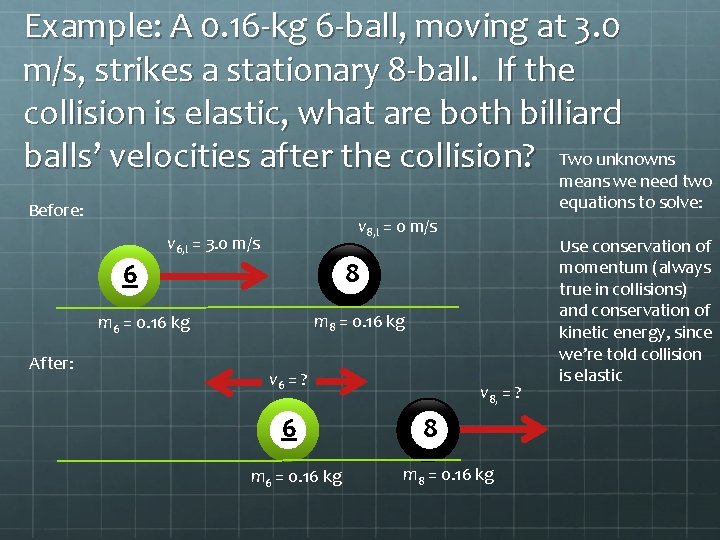
Example: A 0. 16 -kg 6 -ball, moving at 3. 0 m/s, strikes a stationary 8 -ball. If the collision is elastic, what are both billiard balls’ velocities after the collision? Two unknowns means we need two equations to solve: Before: v 8, I = 0 m/s v 6, I = 3. 0 m/s 8 6 m 8 = 0. 16 kg m 6 = 0. 16 kg After: v 6 = ? 6 m 6 = 0. 16 kg v 8, = ? 8 m 8 = 0. 16 kg Use conservation of momentum (always true in collisions) and conservation of kinetic energy, since we’re told collision is elastic
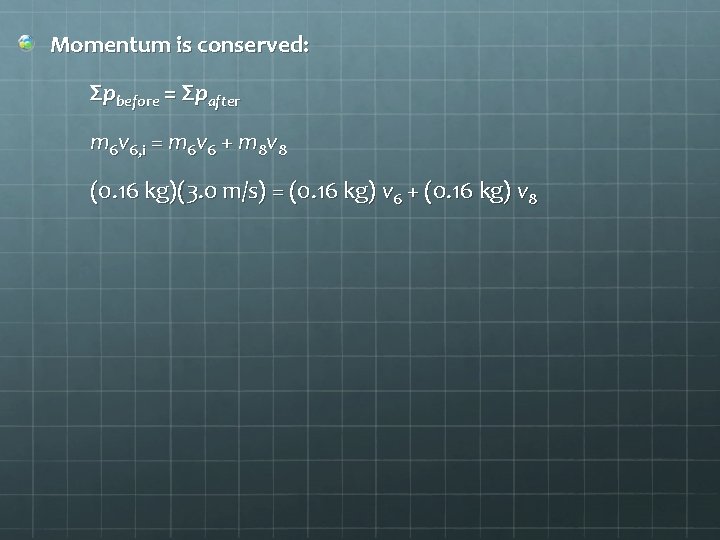
Momentum is conserved: Σpbefore = Σpafter m 6 v 6, i = m 6 v 6 + m 8 v 8 (0. 16 kg)(3. 0 m/s) = (0. 16 kg) v 6 + (0. 16 kg) v 8
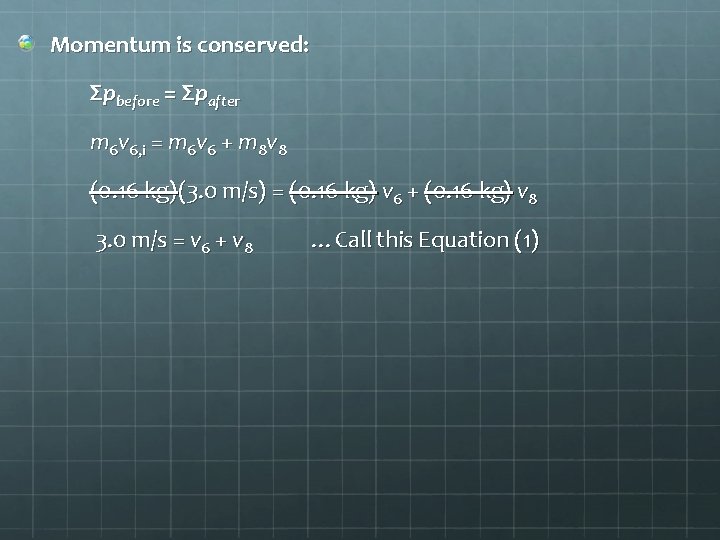
Momentum is conserved: Σpbefore = Σpafter m 6 v 6, i = m 6 v 6 + m 8 v 8 (0. 16 kg)(3. 0 m/s) = (0. 16 kg) v 6 + (0. 16 kg) v 8 3. 0 m/s = v 6 + v 8 …Call this Equation (1)
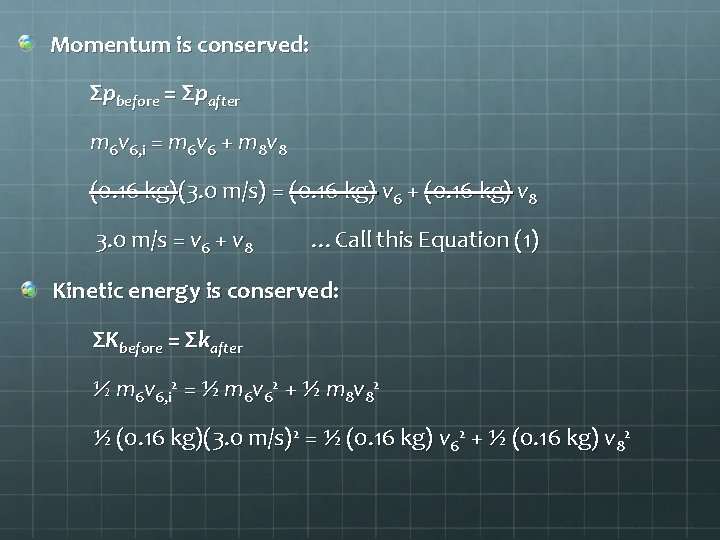
Momentum is conserved: Σpbefore = Σpafter m 6 v 6, i = m 6 v 6 + m 8 v 8 (0. 16 kg)(3. 0 m/s) = (0. 16 kg) v 6 + (0. 16 kg) v 8 3. 0 m/s = v 6 + v 8 …Call this Equation (1) Kinetic energy is conserved: ΣKbefore = Σkafter ½ m 6 v 6, i 2 = ½ m 6 v 62 + ½ m 8 v 82 ½ (0. 16 kg)(3. 0 m/s)2 = ½ (0. 16 kg) v 62 + ½ (0. 16 kg) v 82
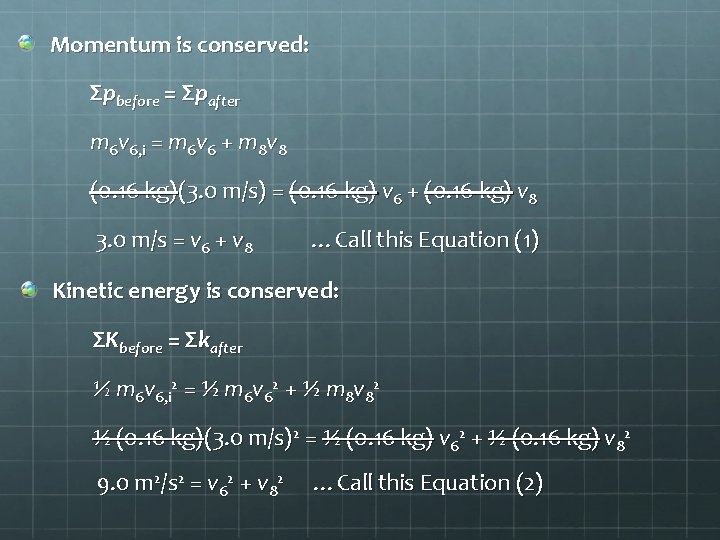
Momentum is conserved: Σpbefore = Σpafter m 6 v 6, i = m 6 v 6 + m 8 v 8 (0. 16 kg)(3. 0 m/s) = (0. 16 kg) v 6 + (0. 16 kg) v 8 3. 0 m/s = v 6 + v 8 …Call this Equation (1) Kinetic energy is conserved: ΣKbefore = Σkafter ½ m 6 v 6, i 2 = ½ m 6 v 62 + ½ m 8 v 82 ½ (0. 16 kg)(3. 0 m/s)2 = ½ (0. 16 kg) v 62 + ½ (0. 16 kg) v 82 9. 0 m 2/s 2 = v 62 + v 82 …Call this Equation (2)
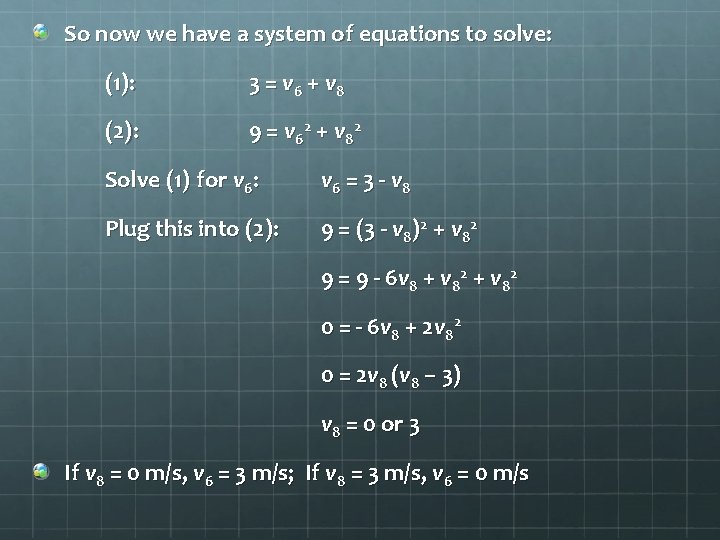
So now we have a system of equations to solve: (1): 3 = v 6 + v 8 (2): 9 = v 6 2 + v 8 2 Solve (1) for v 6: v 6 = 3 - v 8 Plug this into (2): 9 = ( 3 - v 8 ) 2 + v 8 2 9 = 9 - 6 v 8 + v 8 2 0 = - 6 v 8 + 2 v 8 2 0 = 2 v 8 (v 8 – 3) v 8 = 0 or 3 If v 8 = 0 m/s, v 6 = 3 m/s; If v 8 = 3 m/s, v 6 = 0 m/s
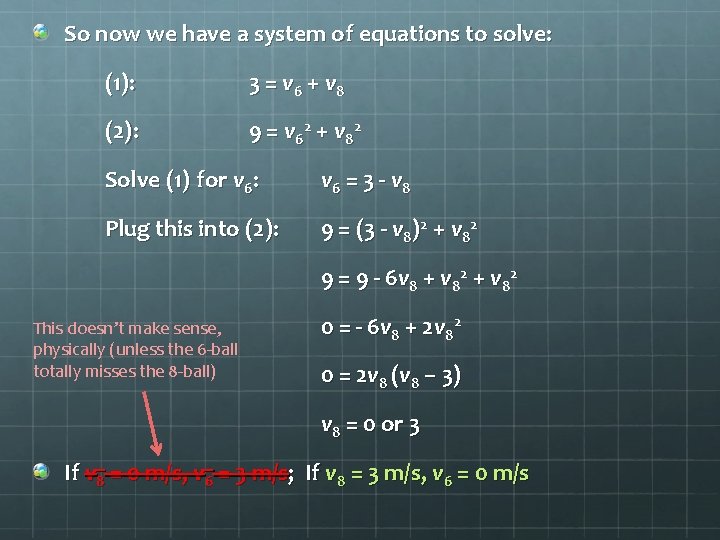
So now we have a system of equations to solve: (1): 3 = v 6 + v 8 (2): 9 = v 6 2 + v 8 2 Solve (1) for v 6: v 6 = 3 - v 8 Plug this into (2): 9 = ( 3 - v 8 ) 2 + v 8 2 9 = 9 - 6 v 8 + v 8 2 This doesn’t make sense, physically (unless the 6 -ball totally misses the 8 -ball) 0 = - 6 v 8 + 2 v 8 2 0 = 2 v 8 (v 8 – 3) v 8 = 0 or 3 If v 8 = 0 m/s, v 6 = 3 m/s; If v 8 = 3 m/s, v 6 = 0 m/s
So in an elastic collision between two objects of equal mass, all of the momentum and energy must be transferred to the struck body.

But perfect elastic collisions aren’t realistic. Let’s revisit our billiard problem…
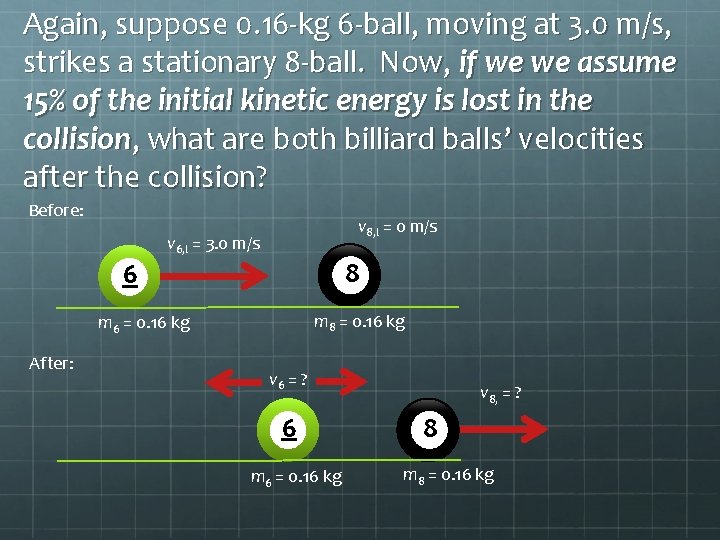
Again, suppose 0. 16 -kg 6 -ball, moving at 3. 0 m/s, strikes a stationary 8 -ball. Now, if we we assume 15% of the initial kinetic energy is lost in the collision, what are both billiard balls’ velocities after the collision? Before: v 8, I = 0 m/s v 6, I = 3. 0 m/s 8 6 m 8 = 0. 16 kg m 6 = 0. 16 kg After: v 6 = ? 6 m 6 = 0. 16 kg v 8, = ? 8 m 8 = 0. 16 kg
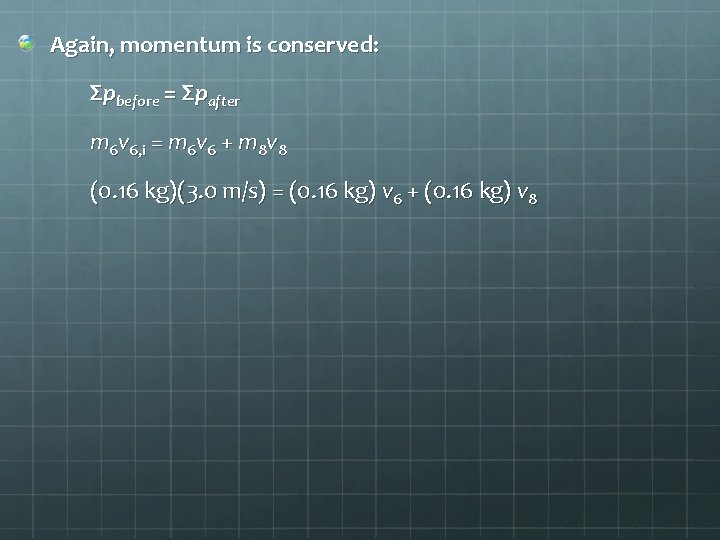
Again, momentum is conserved: Σpbefore = Σpafter m 6 v 6, i = m 6 v 6 + m 8 v 8 (0. 16 kg)(3. 0 m/s) = (0. 16 kg) v 6 + (0. 16 kg) v 8
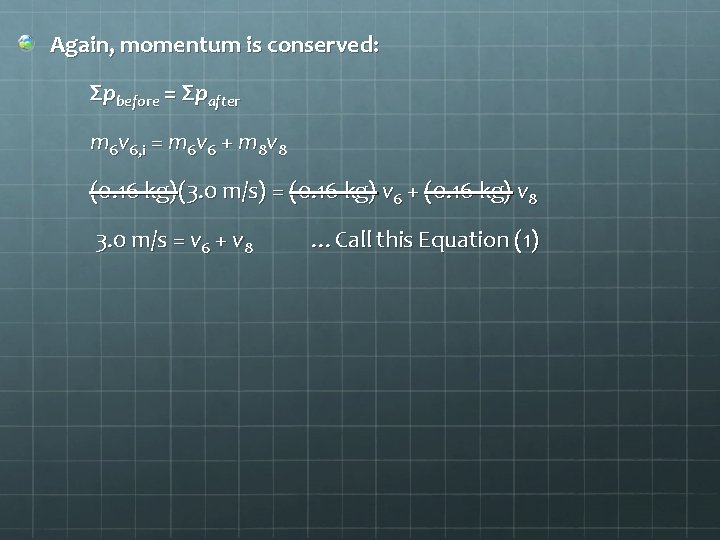
Again, momentum is conserved: Σpbefore = Σpafter m 6 v 6, i = m 6 v 6 + m 8 v 8 (0. 16 kg)(3. 0 m/s) = (0. 16 kg) v 6 + (0. 16 kg) v 8 3. 0 m/s = v 6 + v 8 …Call this Equation (1)
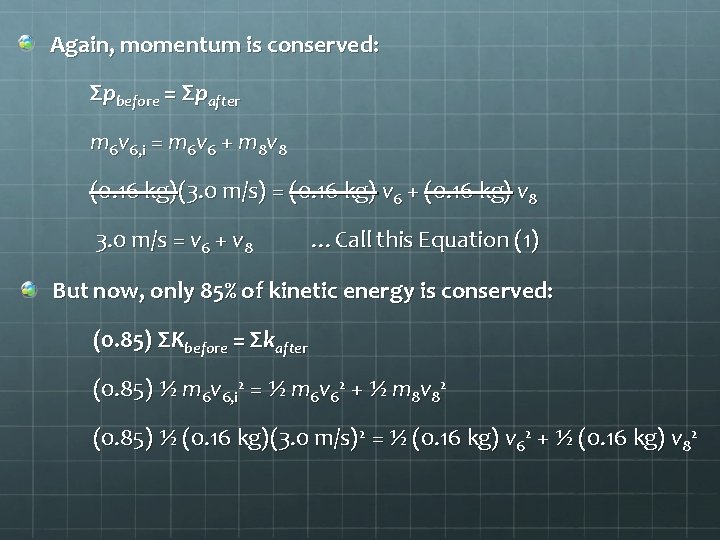
Again, momentum is conserved: Σpbefore = Σpafter m 6 v 6, i = m 6 v 6 + m 8 v 8 (0. 16 kg)(3. 0 m/s) = (0. 16 kg) v 6 + (0. 16 kg) v 8 3. 0 m/s = v 6 + v 8 …Call this Equation (1) But now, only 85% of kinetic energy is conserved: (0. 85) ΣKbefore = Σkafter (0. 85) ½ m 6 v 6, i 2 = ½ m 6 v 62 + ½ m 8 v 82 (0. 85) ½ (0. 16 kg)(3. 0 m/s)2 = ½ (0. 16 kg) v 62 + ½ (0. 16 kg) v 82
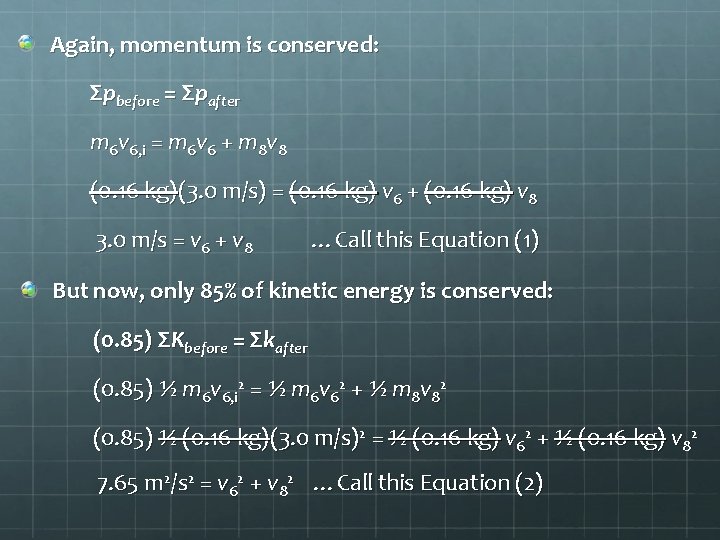
Again, momentum is conserved: Σpbefore = Σpafter m 6 v 6, i = m 6 v 6 + m 8 v 8 (0. 16 kg)(3. 0 m/s) = (0. 16 kg) v 6 + (0. 16 kg) v 8 3. 0 m/s = v 6 + v 8 …Call this Equation (1) But now, only 85% of kinetic energy is conserved: (0. 85) ΣKbefore = Σkafter (0. 85) ½ m 6 v 6, i 2 = ½ m 6 v 62 + ½ m 8 v 82 (0. 85) ½ (0. 16 kg)(3. 0 m/s)2 = ½ (0. 16 kg) v 62 + ½ (0. 16 kg) v 82 7. 65 m 2/s 2 = v 62 + v 82 …Call this Equation (2)
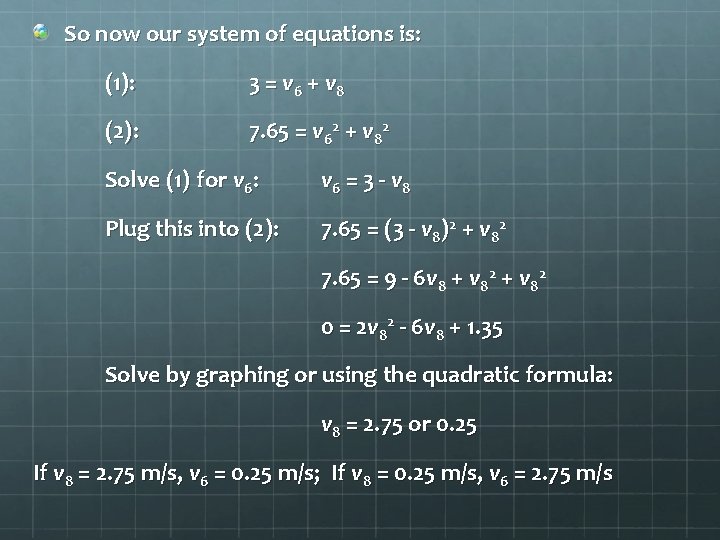
So now our system of equations is: (1): 3 = v 6 + v 8 (2): 7. 65 = v 62 + v 82 Solve (1) for v 6: v 6 = 3 - v 8 Plug this into (2): 7. 65 = (3 - v 8)2 + v 82 7. 65 = 9 - 6 v 8 + v 82 0 = 2 v 82 - 6 v 8 + 1. 35 Solve by graphing or using the quadratic formula: v 8 = 2. 75 or 0. 25 If v 8 = 2. 75 m/s, v 6 = 0. 25 m/s; If v 8 = 0. 25 m/s, v 6 = 2. 75 m/s
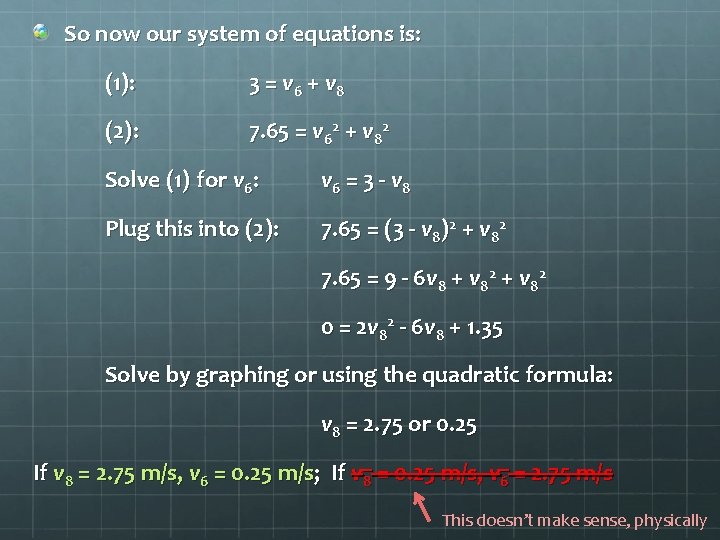
So now our system of equations is: (1): 3 = v 6 + v 8 (2): 7. 65 = v 62 + v 82 Solve (1) for v 6: v 6 = 3 - v 8 Plug this into (2): 7. 65 = (3 - v 8)2 + v 82 7. 65 = 9 - 6 v 8 + v 82 0 = 2 v 82 - 6 v 8 + 1. 35 Solve by graphing or using the quadratic formula: v 8 = 2. 75 or 0. 25 If v 8 = 2. 75 m/s, v 6 = 0. 25 m/s; If v 8 = 0. 25 m/s, v 6 = 2. 75 m/s This doesn’t make sense, physically
- Slides: 46