
Unit 2 Lesson 4 Levels of Cellular Organization
- Slides: 13
Unit 2 Lesson 4 Levels of Cellular Organization Copyright © Houghton Mifflin Harcourt Publishing Company
Unit 2 Lesson 4 Levels of Cellular Organization Florida Benchmarks • SC. 6. L. 14. 1 Describe and identify patterns in the hierarchical organization of organisms from atoms to molecules and cells to tissues to organ systems to organisms. • LA. 6. 4. 2. 2 The student will record information (e. g. , observations, notes, lists, charts, legends) related to a topic, including visual aids to organize and record information and include a list of sources used. Copyright © Houghton Mifflin Harcourt Publishing Company
Unit 2 Lesson 4 Levels of Cellular Organization Body Building How are living things organized? • An organism is a living that can carry out life processes by itself. • Unicellular organisms are single-celled and do not have levels of organization. Copyright © Houghton Mifflin Harcourt Publishing Company
Unit 2 Lesson 4 Levels of Cellular Organization Body Building How are living things organized? • Unicellular organisms need fewer resources and can live in harsh conditions. • They are very small and are easily eaten by other organisms. • If the single cell dies, the entire organism dies. Copyright © Houghton Mifflin Harcourt Publishing Company
Unit 2 Lesson 4 Levels of Cellular Organization How are living things organized? • Multicellular organisms have multiple cells that are grouped into different levels of organization. • Multicellular organisms are larger, more efficient, and have a longer life span than unicellular organisms. • Multicellular organisms need more resources than unicellular organisms. • The cells must depend on each other for the survival of the organism. Copyright © Houghton Mifflin Harcourt Publishing Company
Unit 2 Lesson 4 Levels of Cellular Organization How are living things organized? • A tissue is a group of similar cells that perform a common function. • Humans and other animals are made up of nervous, epithelial, connective, and muscle tissues. • Plants have transport, protective, and ground tissues. Copyright © Houghton Mifflin Harcourt Publishing Company
Unit 2 Lesson 4 Levels of Cellular Organization How are living things organized? • An organ is a structure made up of a collection of tissues that carry out specialized functions. • Different tissues can work together to accomplish a function, such as digesting food. • Plants have organs such as leaves, stems, and roots. Copyright © Houghton Mifflin Harcourt Publishing Company
Unit 2 Lesson 4 Levels of Cellular Organization How are living things organized? • An organ system is a group of organs that work together to perform body functions. • Each organ system in the body has a specific job to do for the organism. Copyright © Houghton Mifflin Harcourt Publishing Company
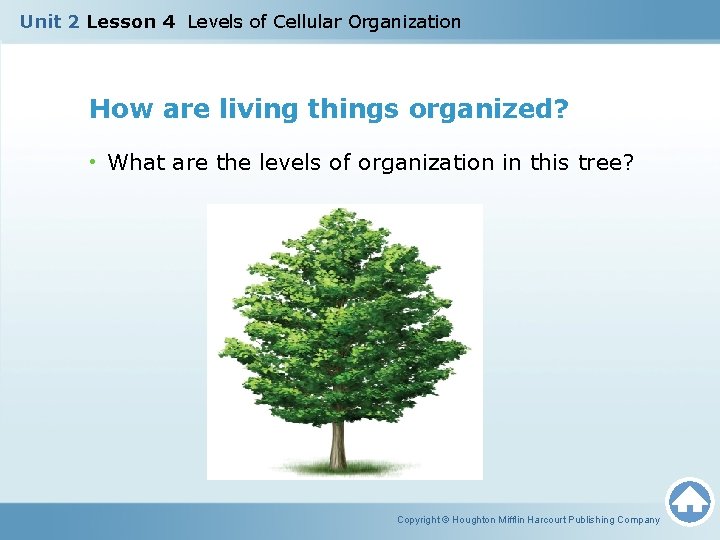
Unit 2 Lesson 4 Levels of Cellular Organization How are living things organized? • What are the levels of organization in this tree? Copyright © Houghton Mifflin Harcourt Publishing Company
Unit 2 Lesson 4 Levels of Cellular Organization What’s Your Function? How do the levels of organization work together? • Cells, tissues, organs, and organ systems make up the structure of multicellular organisms. • Structure is the arrangement of parts in an organism or object. • Function is the activity of each part in an organism. Copyright © Houghton Mifflin Harcourt Publishing Company
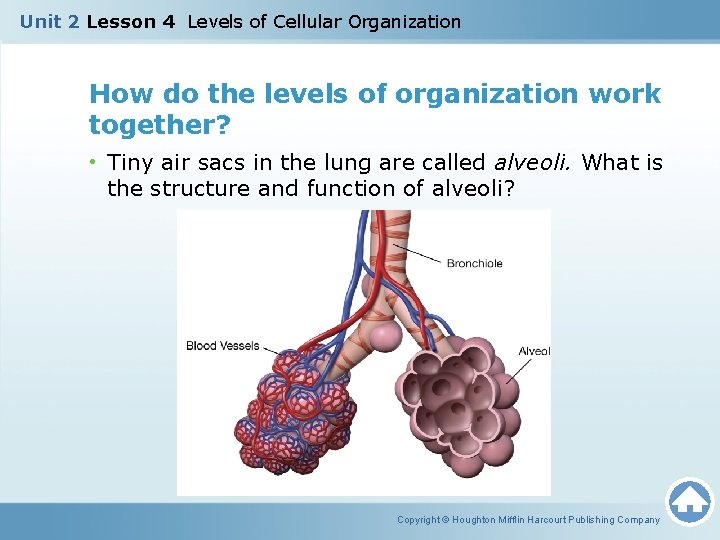
Unit 2 Lesson 4 Levels of Cellular Organization How do the levels of organization work together? • Tiny air sacs in the lung are called alveoli. What is the structure and function of alveoli? Copyright © Houghton Mifflin Harcourt Publishing Company
Unit 2 Lesson 4 Levels of Cellular Organization Odd Bodies • Different organisms develop many different kinds of body structures. • The spiny katydid has spines to protect it from being eaten. Copyright © Houghton Mifflin Harcourt Publishing Company
Unit 2 Lesson 4 Levels of Cellular Organization Odd Bodies • The longhorn cowfish has a puckered mouth to blow away sand on the shallow ocean floor to find and feed on tiny organisms. • The tarsier has huge eyes to give it better night vision for finding insects to eat. It also has long fingers to help it grasp branches. Copyright © Houghton Mifflin Harcourt Publishing Company