
Unit 2 Lesson 2 The Biomes and Organisms
Unit 2 Lesson 2 The Biomes and Organisms in the Ecosystems and Population Dynamics From Chapter 55, (Population Ecology ) of the Online Biology Textbook by Dr. M Farabee’s And From S Gibbons’ Biology 112 at Moraine Valley Community College John Levasseur Springfield Central High School
Questions to Ponder from Lesson 1 What are the levels of organization studied in biology? What are the levels of organization studied in ecology? What concept in science are we using when we divide biology or ecology into different levels of organization? What do biotic and abiotic mean? What are the differences between biology and ecology? What are the differences between the levels of organization studied in biology and in ecology? What are properties? What are emergent properties? When do emergent properties emerge? What type of ecosystem is the Serengeti Plain? Answer two questions
Questions to Answer Daily Problem Set Unit 2 - #2 1. Explain what biomes are and describe 3 examples of biomes 2. Explain why the biomes are where they are. 3. Explain the difference between habitat and niche. 4. Explain how evolution explains the varieties of organisms found in a biome and the variety of organisms between biomes. In biology, what is meant be the term population?

Biomes: Another Way to Study Ecosystems What are Biome? Biomes are the world’s distinctive types of ecosystems. Biomes are classified by the plant populations found in them. Biomes are known for unique climate and unique organisms that have evolved to better compete and survive in those climates. Examples of biomes: Tundra: Arctic Tundra Alpine Tundra Forest: Boreal forest (Taiga), Deciduous temperate forest, Tropical forest (jungle) Desert: hot dry desert, semiarid desert, cold desert. Chaparral Grassland Savanna Aquatic Freshwater Aquatic Marine (Saltwater)

Where the Biomes Are.
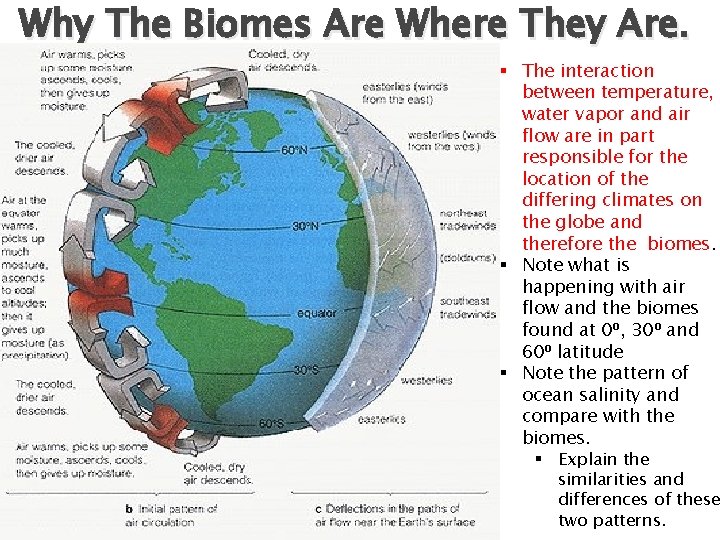
Why The Biomes Are Where They Are. § The interaction between temperature, water vapor and air flow are in part responsible for the location of the differing climates on the globe and therefore the biomes. § Note what is happening with air flow and the biomes found at 0⁰, 30⁰ and 60⁰ latitude § Note the pattern of ocean salinity and compare with the biomes. § Explain the similarities and differences of these two patterns.
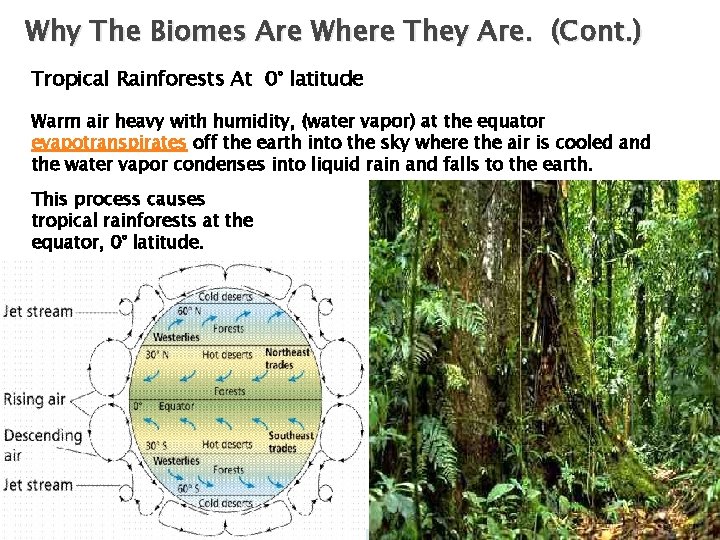
Why The Biomes Are Where They Are. (Cont. ) Tropical Rainforests At 0° latitude Warm air heavy with humidity, (water vapor) at the equator evapotranspirates off the earth into the sky where the air is cooled and the water vapor condenses into liquid rain and falls to the earth. This process causes tropical rainforests at the equator, 0° latitude.
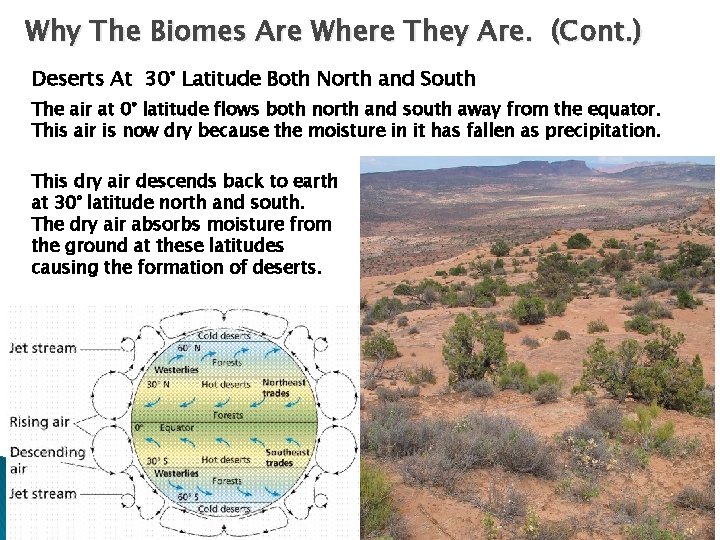
Why The Biomes Are Where They Are. (Cont. ) Deserts At 30° Latitude Both North and South The air at 0° latitude flows both north and south away from the equator. This air is now dry because the moisture in it has fallen as precipitation. This dry air descends back to earth at 30° latitude north and south. The dry air absorbs moisture from the ground at these latitudes causing the formation of deserts.

Why The Biomes Are Where They Are. (Cont. ) Temperate Forests and Grasslands Between 30° (North and South) latitude and 60° (North and South) latitude. The air flows north in the northern hemisphere and south in the southern hemisphere. As the air moves toward 60° a temperate region is made with grassland, chaparral and deciduous forests. Deciduous forest is a forest with trees that loose their leaves in autumn. Ecosystems and the biomes are effected by global weather patterns. Grassland (aka. savannah) is prairie lands like in the Midwest of America or the Serengeti.
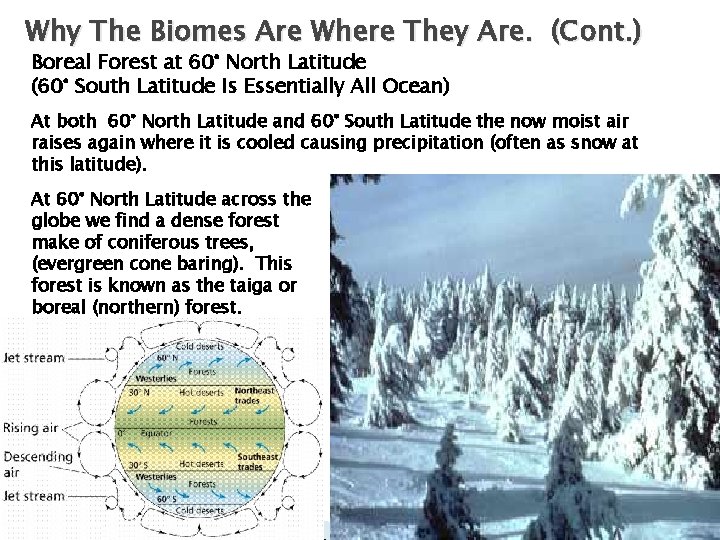
Why The Biomes Are Where They Are. (Cont. ) Boreal Forest at 60° North Latitude (60° South Latitude Is Essentially All Ocean) At both 60° North Latitude and 60° South Latitude the now moist air raises again where it is cooled causing precipitation (often as snow at this latitude). At 60° North Latitude across the globe we find a dense forest make of coniferous trees, (evergreen cone baring). This forest is known as the taiga or boreal (northern) forest.
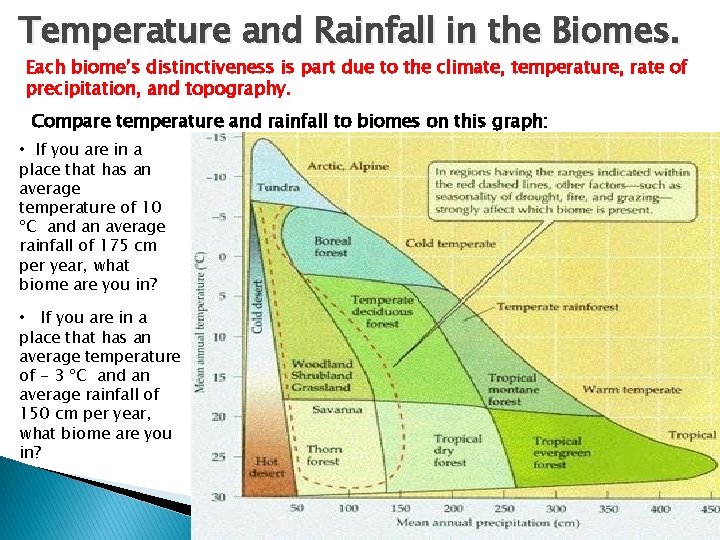
Temperature and Rainfall in the Biomes. Each biome’s distinctiveness is part due to the climate, temperature, rate of precipitation, and topography. Compare temperature and rainfall to biomes on this graph: • If you are in a place that has an average temperature of 10 ºC and an average rainfall of 175 cm per year, what biome are you in? • If you are in a place that has an average temperature of - 3 ºC and an average rainfall of 150 cm per year, what biome are you in?
Organisms in the Ecosystems: Habitat and Niche Habitat is the place where an organism lives out its life. Example: Think of the woods behind Blunt Park and SCHS. There are plants and animals that live in those woods. That stand of woods is the habitat of those plants and animals. Habitats change over time: Nature changes habitats. (Everything in nature is constantly changing; life and nature are dynamic) Humans can change habitats. Think about those woods; that habitat will change as Springfield expands. Consider how much smaller that habitat is now compared to 1638 when Springfield was incorporated as a town in Massachusetts. The impact of humans on the habitats of living organisms throughout the biosphere is tremendous. Human activity is causing a current mass extinction and global climate change.
Organisms in the Ecosystems: Habitat and Niche (Cont. ) Niche- is the role and position a species has in its environment. The special role each species occupies in nature. How a species meets its needs for nutrients and chances to reproduce. Some species increase their chances for survival by forming relationships with another species (symbiosis). So the living relationships are a strategy for survival and help to define an organism's niche. Predation, commensalism, mutualism, and parasitism are all examples of survival strategies that help form an organism’s niche. Habitat is where an organism lives Niche is how an organism lives
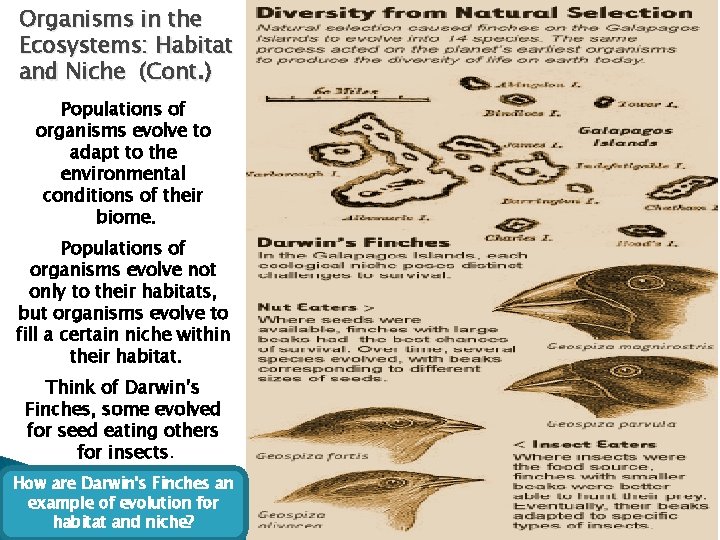
Organisms in the Ecosystems: Habitat and Niche (Cont. ) Populations of organisms evolve to adapt to the environmental conditions of their biome. Populations of organisms evolve not only to their habitats, but organisms evolve to fill a certain niche within their habitat. Think of Darwin’s Finches, some evolved for seed eating others for insects. How are Darwin's Finches an example of evolution for habitat and niche?
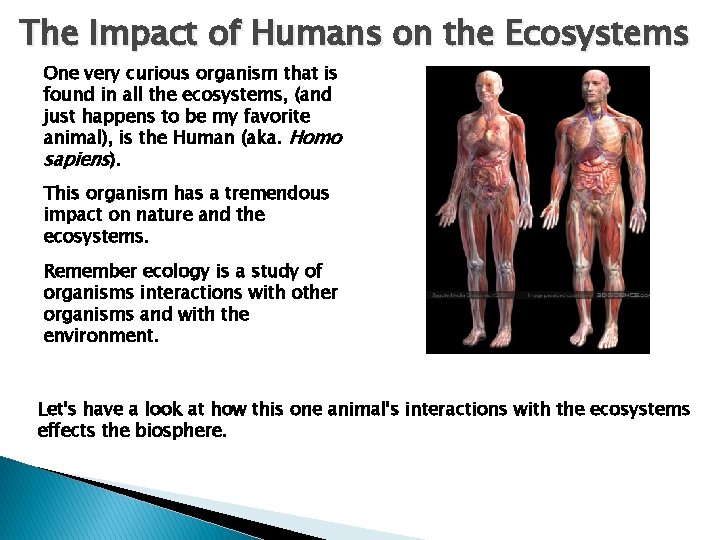
The Impact of Humans on the Ecosystems One very curious organism that is found in all the ecosystems, (and just happens to be my favorite animal), is the Human (aka. Homo sapiens). This organism has a tremendous impact on nature and the ecosystems. Remember ecology is a study of organisms interactions with other organisms and with the environment. Let's have a look at how this one animal's interactions with the ecosystems effects the biosphere.
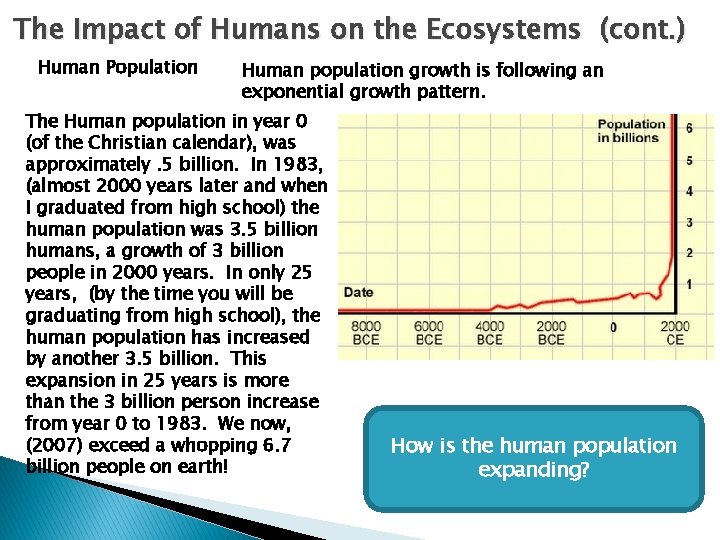
The Impact of Humans on the Ecosystems (cont. ) Human Population Human population growth is following an exponential growth pattern. The Human population in year 0 (of the Christian calendar), was approximately. 5 billion. In 1983, (almost 2000 years later and when I graduated from high school) the human population was 3. 5 billion humans, a growth of 3 billion people in 2000 years. In only 25 years, (by the time you will be graduating from high school), the human population has increased by another 3. 5 billion. This expansion in 25 years is more than the 3 billion person increase from year 0 to 1983. We now, What will happen to humans and to (2007) exceed a whopping 6. 7 Howpopulations is the human the other ofpopulation organisms billion people on earth! expanding? in our ecological communities if this human growth trend continues?
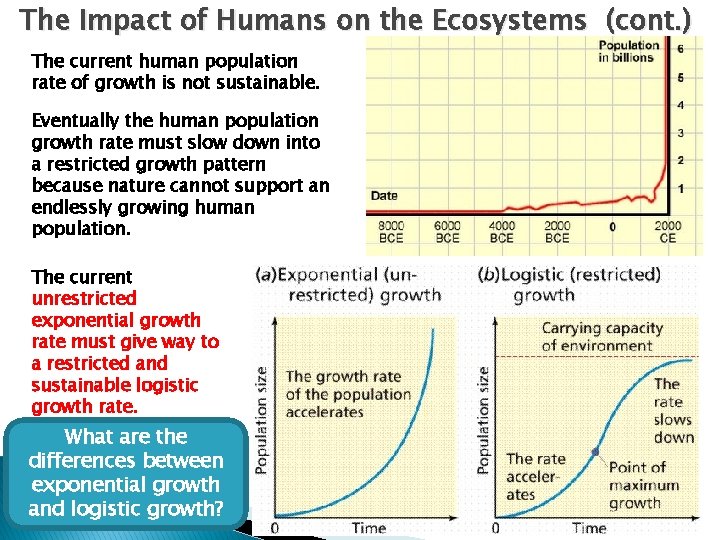
The Impact of Humans on the Ecosystems (cont. ) The current human population rate of growth is not sustainable. Eventually the human population growth rate must slow down into a restricted growth pattern because nature cannot support an endlessly growing human population. The current unrestricted exponential growth rate must give way to a restricted and sustainable logistic growth rate. What are the differences between exponential growth and logistic growth?
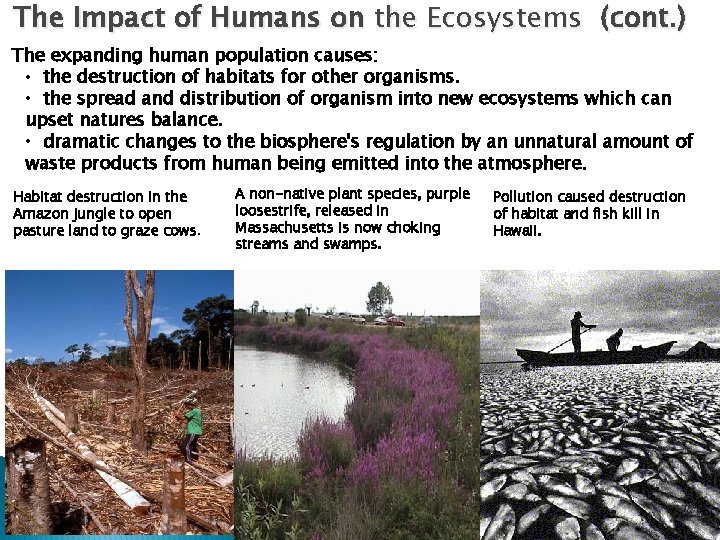
The Impact of Humans on the Ecosystems (cont. ) The expanding human population causes: • the destruction of habitats for other organisms. • the spread and distribution of organism into new ecosystems which can upset natures balance. • dramatic changes to the biosphere's regulation by an unnatural amount of waste products from human being emitted into the atmosphere. Habitat destruction in the Amazon jungle to open pasture land to graze cows. A non-native plant species, purple loosestrife, released in Massachusetts is now choking streams and swamps. Pollution caused destruction of habitat and fish kill in Hawaii.
The Impact of Humans on the Ecosystems (cont. )
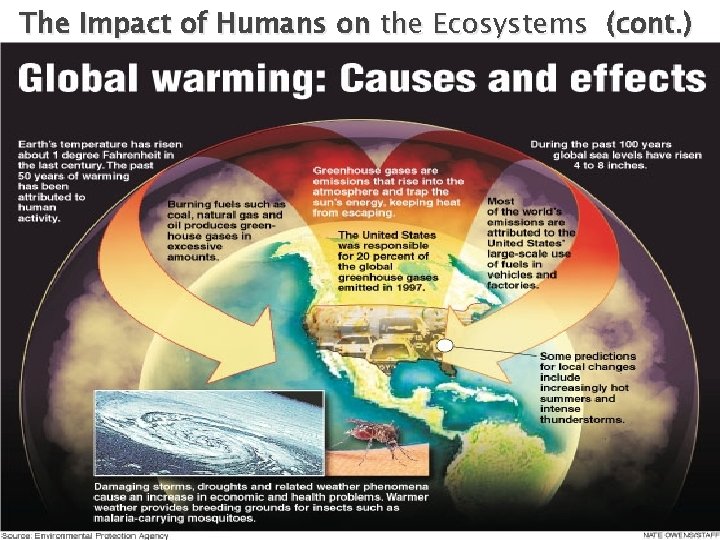
The Impact of Humans on the Ecosystems (cont. )
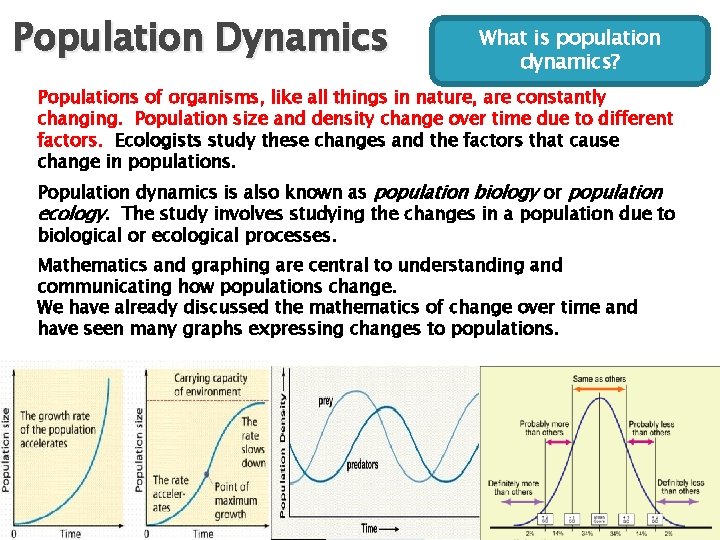
Population Dynamics What is population dynamics? Populations of organisms, like all things in nature, are constantly changing. Population size and density change over time due to different factors. Ecologists study these changes and the factors that cause change in populations. Population dynamics is also known as population biology or population ecology. The study involves studying the changes in a population due to biological or ecological processes. Mathematics and graphing are central to understanding and communicating how populations change. We have already discussed the mathematics of change over time and have seen many graphs expressing changes to populations.
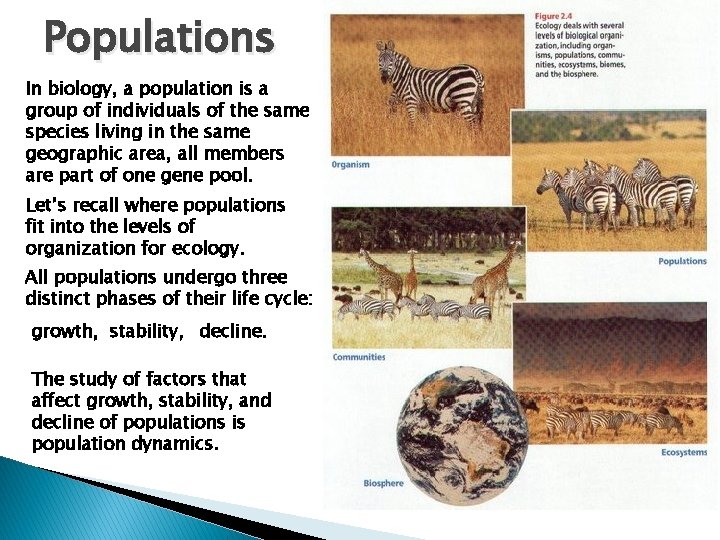
Populations In biology, a population is a group of individuals of the same species living in the same geographic area, all members are part of one gene pool. Let’s recall where populations fit into the levels of organization for ecology. All populations undergo three distinct phases of their life cycle: growth, stability, decline. The study of factors that affect growth, stability, and decline of populations is population dynamics.
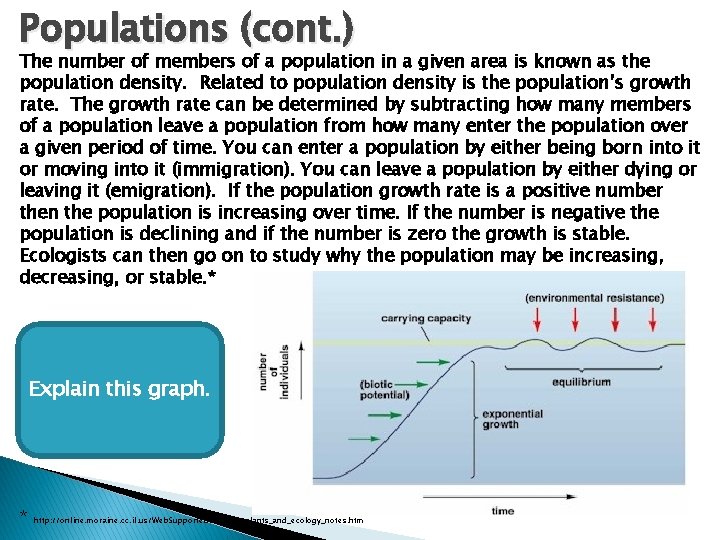
Populations (cont. ) The number of members of a population in a given area is known as the population density. Related to population density is the population’s growth rate. The growth rate can be determined by subtracting how many members of a population leave a population from how many enter the population over a given period of time. You can enter a population by either being born into it or moving into it (immigration). You can leave a population by either dying or leaving it (emigration). If the population growth rate is a positive number then the population is increasing over time. If the number is negative the population is declining and if the number is zero the growth is stable. Ecologists can then go on to study why the population may be increasing, decreasing, or stable. * Explain this graph. * http: //online. moraine. cc. il. us/Web. Supported/BIO 112/plants_and_ecology_notes. htm
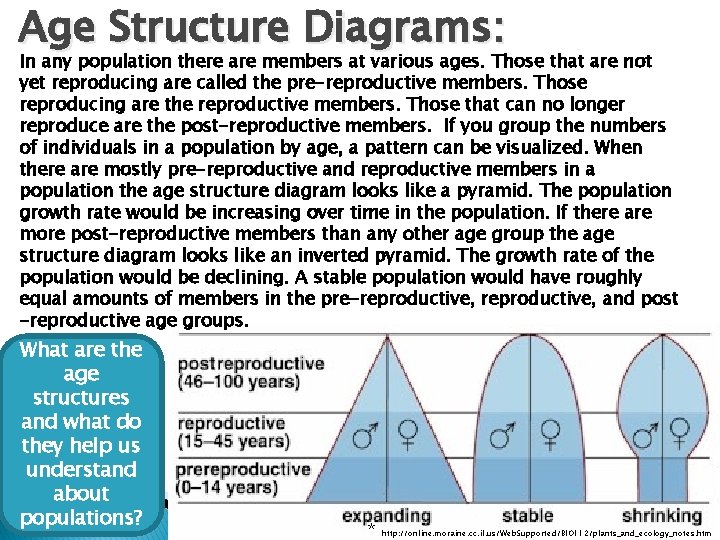
Age Structure Diagrams: In any population there are members at various ages. Those that are not yet reproducing are called the pre-reproductive members. Those reproducing are the reproductive members. Those that can no longer reproduce are the post-reproductive members. If you group the numbers of individuals in a population by age, a pattern can be visualized. When there are mostly pre-reproductive and reproductive members in a population the age structure diagram looks like a pyramid. The population growth rate would be increasing over time in the population. If there are more post-reproductive members than any other age group the age structure diagram looks like an inverted pyramid. The growth rate of the population would be declining. A stable population would have roughly equal amounts of members in the pre-reproductive, and post -reproductive age groups. What are the age structures and what do they help us understand about populations? * http: //online. moraine. cc. il. us/Web. Supported/BIO 112/plants_and_ecology_notes. htm
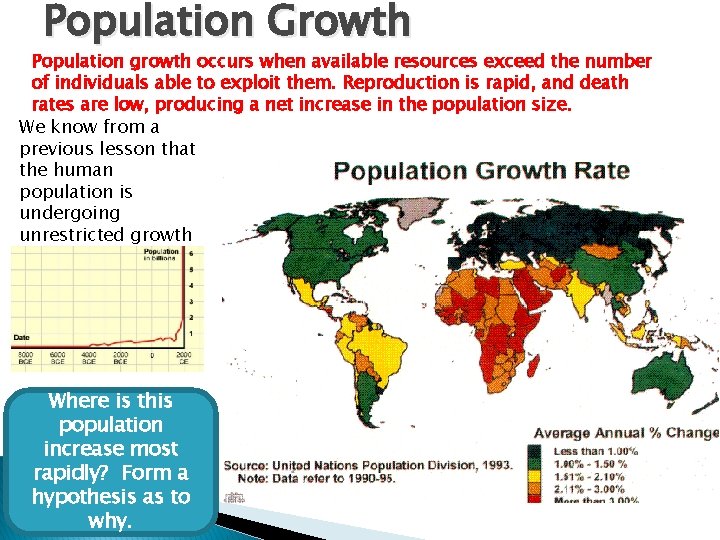
Population Growth Population growth occurs when available resources exceed the number of individuals able to exploit them. Reproduction is rapid, and death rates are low, producing a net increase in the population size. We know from a previous lesson that the human population is undergoing unrestricted growth Where is this population increase most rapidly? Form a hypothesis as to why.
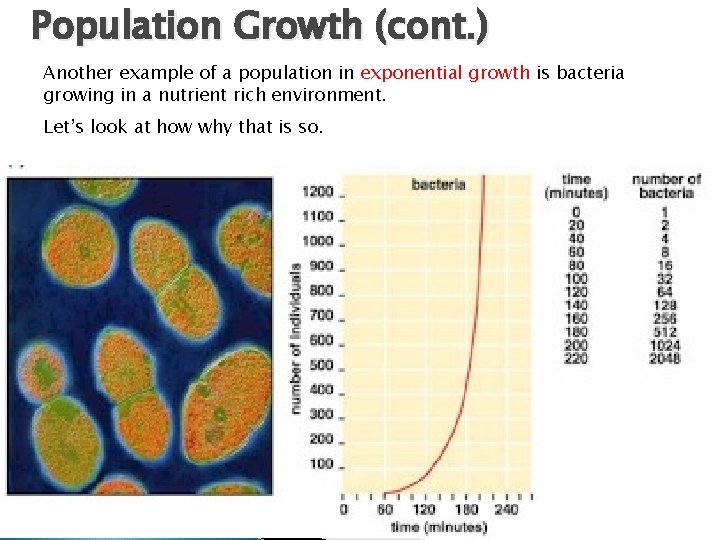
Population Growth (cont. ) Another example of a population in exponential growth is bacteria growing in a nutrient rich environment. Let’s look at how why that is so.
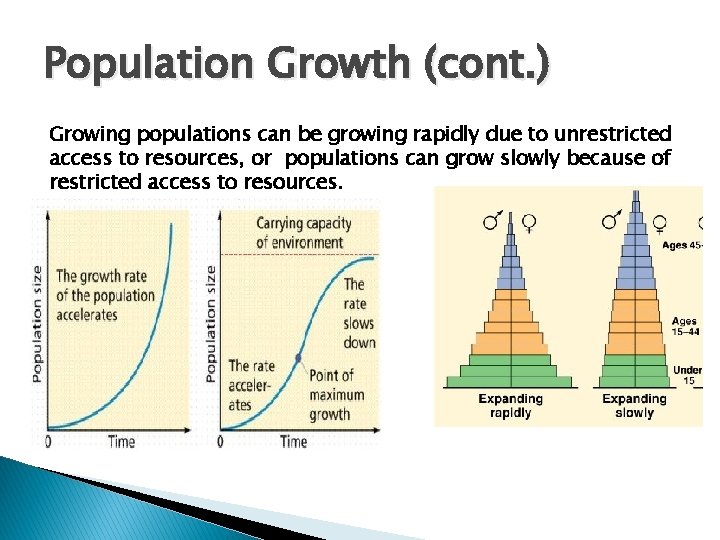
Population Growth (cont. ) Growing populations can be growing rapidly due to unrestricted access to resources, or populations can grow slowly because of restricted access to resources.
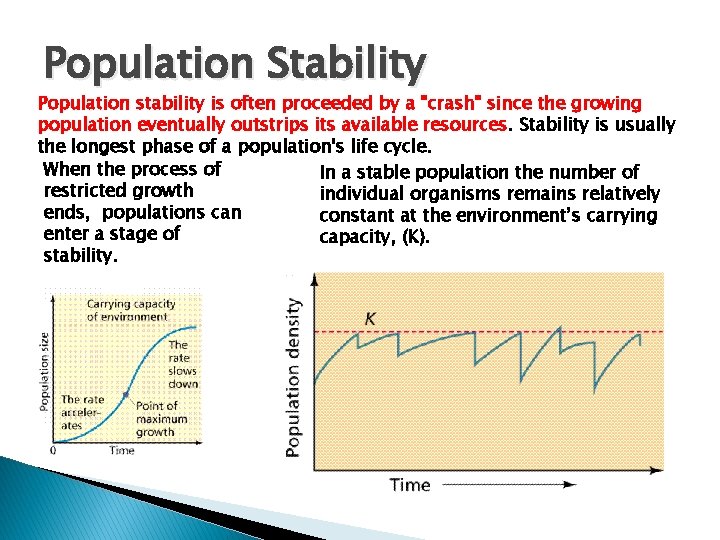
Population Stability Population stability is often proceeded by a "crash" since the growing population eventually outstrips its available resources. Stability is usually the longest phase of a population's life cycle. When the process of In a stable population the number of restricted growth individual organisms remains relatively ends, populations can constant at the environment’s carrying enter a stage of capacity, (K). stability.
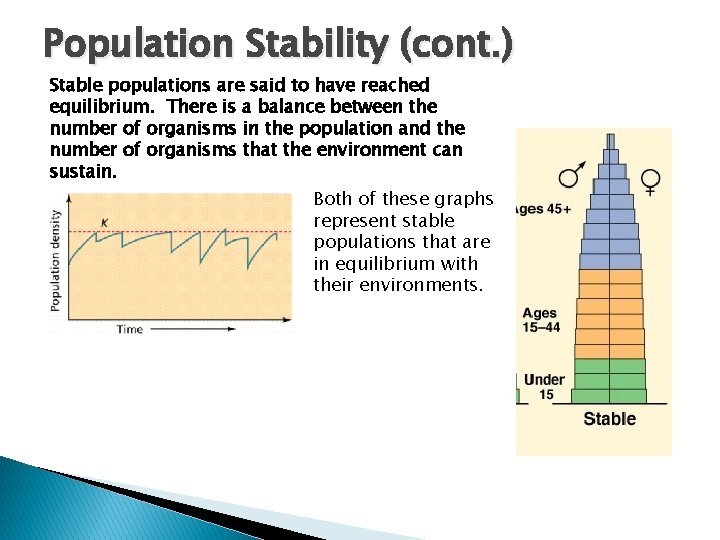
Population Stability (cont. ) Stable populations are said to have reached equilibrium. There is a balance between the number of organisms in the population and the number of organisms that the environment can sustain. Both of these graphs represent stable populations that are in equilibrium with their environments.
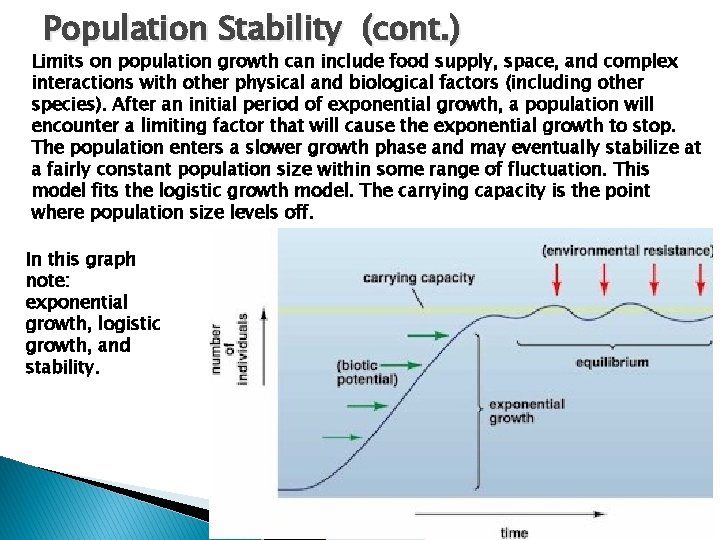
Population Stability (cont. ) Limits on population growth can include food supply, space, and complex interactions with other physical and biological factors (including other species). After an initial period of exponential growth, a population will encounter a limiting factor that will cause the exponential growth to stop. The population enters a slower growth phase and may eventually stabilize at a fairly constant population size within some range of fluctuation. This model fits the logistic growth model. The carrying capacity is the point where population size levels off. In this graph note: exponential growth, logistic growth, and stability.
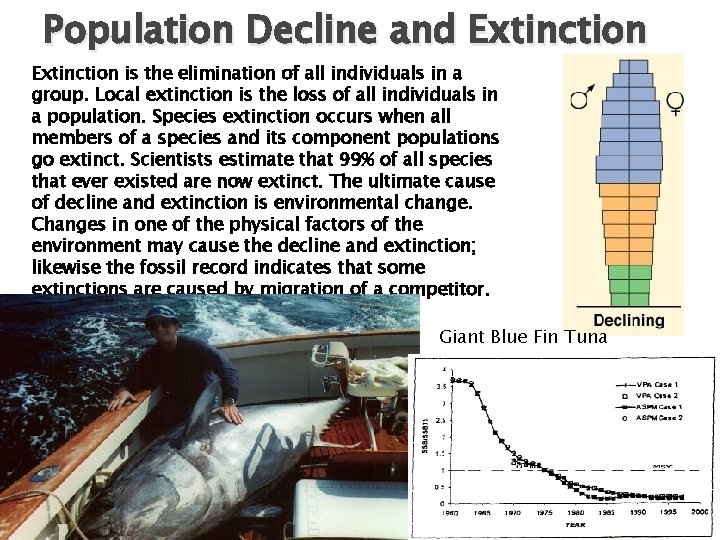
Population Decline and Extinction is the elimination of all individuals in a group. Local extinction is the loss of all individuals in a population. Species extinction occurs when all members of a species and its component populations go extinct. Scientists estimate that 99% of all species that ever existed are now extinct. The ultimate cause of decline and extinction is environmental change. Changes in one of the physical factors of the environment may cause the decline and extinction; likewise the fossil record indicates that some extinctions are caused by migration of a competitor. Giant Blue Fin Tuna
Questions to Ponder from Part 1 What are biomes? What causes the different biomes to form? How does evolution relate to the variety of organisms in each biome and in the different biomes? What is a habitat? What is a niche? What is the difference between an organism's habitat and niche? What biome would you expect to find at the equator? Why? What biome would you expect to find at 30° north and south latitude? Why? What biome would you expect to find at 60° north latitude? Why? What biome would you expect to find with high temperatures and high rainfall? What biome would you expect to find with high temperatures and low rainfall? How do humans impact the earth's ecosystems? Answer 3 questions
Questions to Ponder from Part 2 What is a population in biology? What is population dynamics? What are three phases that we can find a population in? What is exponentional growth? What is logistic growth? What restriction can there be on population growth? What are immigration and emigration? What does an age structure diagram show? ? What is carrying capacity (K)? What is extinction? How do humans impact other populations? Answer 3 questions
- Slides: 33