
UNIT 2 LEARNER NEEDS ANALYSIS Unit Objectives At
UNIT 2: LEARNER NEEDS ANALYSIS • • • Unit Objectives At the end of the unit, students are able to: describe the concept of ‘need’ in ESP; identify the different types of need; classify the various types of need with respect to ESP learners’ target, present and learning situations; • outline the various techniques of needs analysis; and • conduct small-scale needs analyses to meet the initial requirements of proposed ESP courses.
Unit 2 Sub-Topics 1. Introduction 2. Defining needs analysis 3. Approaches to needs analysis (a) Target Situation Analysis (TSA) (b) Present Situation Analysis (PSA) (c) Learning Situation Analysis (LSA)
Unit 2 Sub-Topics (cont’d…) 4. 5. 6. 7. Language audits Methods of needs analysis The timing of a needs analysis Who carries out the needs analysis / Who decides what the language needs are? 8. Translating needs analysis outcomes
Definition of ‘need’ • in education: “the gap between what is and what ought to be” • in ESP: “what the learner has to be and do in the target situation using English” • in ESP practice, definition of ‘need’ depends on the context and who is doing the analysis
Hutchinson and Waters (1987) on needs analysis in ESP : • “…if we had to state in practical terms the irreducible minimum of an ESP approach to course design, it would be needs analysis, since it is the awareness of a target situation – a definable need to communicate in English – that distinguishes the ESP learner from the learner of General English. ” (p. 54)
Needs analysis in ESP For practical purposes, it involves: • collecting and collating relevant information about a single learner’s or a set of learners’ common purpose(s) for learning English, and • interpreting the data so that choices and/or decisions can be made about defining objectives and principles for course design and materials

Concept of ‘needs’ • In general, ‘need’ = gap between what is and what ought to be • objective vs. subjective needs (Brindley, 1989) • perceived vs. felt needs (Berwick, 1989) • target needs vs. learning needs • product-oriented needs vs. processoriented needs (Brindley, 1989) • necessities, lacks and wants (Hutchinson & Waters, 1986)
General Categories of Needs A. Goal-oriented Needs (‘objective’ needs) B. Process-oriented Need (‘subjective needs) • Goal-oriented needs (narrow interpretation): elements of language, and related knowledge, skills and strategies s/he will have to use for study and/or occupational purposes
• Process-oriented needs (broad view): needs of the student qua (as) language learner i. e. skills, strategies, styles of learning, language proficiency, desires, etc. • Hutchinson 7 waters (1987): necessities, lacks and wants
NA framework in ESP Based on approaches to needs analysis: (a) Target Situation Analysis (TSA) (b) Present Situation Analysis (PSA) (c) Learning Situation Analysis (LSA
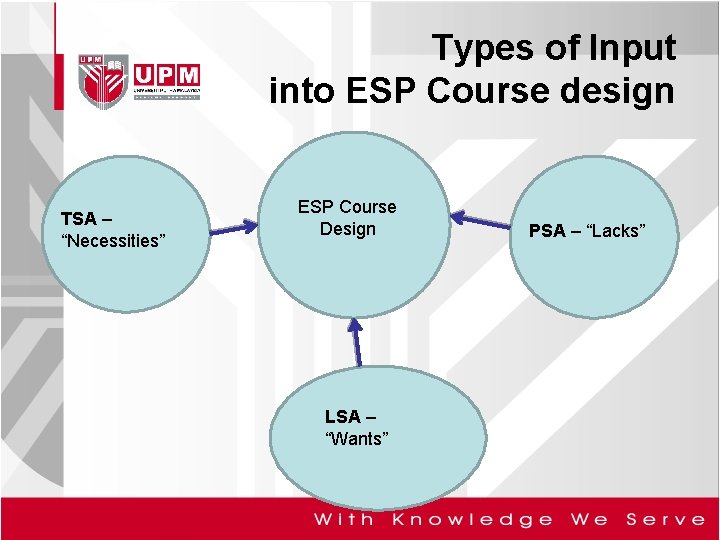
Types of Input into ESP Course design TSA – “Necessities” ESP Course Design LSA – “Wants” PSA – “Lacks”
TSA • Traditional approach for the purpose of compiling information to identify language needs and to determine objectives • “…identifying language needs consists primarily in compiling information both on the individuals or group of individuals who are to learn a language and on the use which they are expected to make of it when they have learnt it. ” (Richterich, 1983: 2)
TSA (cont’d…) • key genres (text-types) used in the target situation/context • special language elements (‘register’) • communicative purposes and functions of language • other conventions of language use in particular fields of study and work
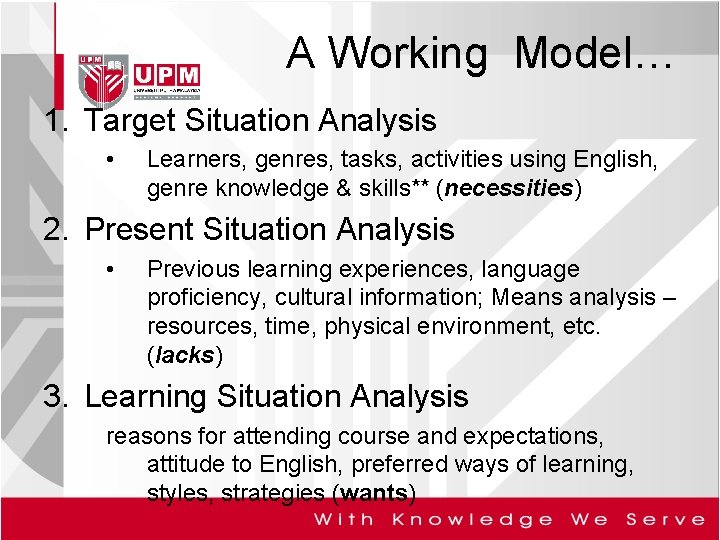
A Working Model… 1. Target Situation Analysis • Learners, genres, tasks, activities using English, genre knowledge & skills** (necessities) 2. Present Situation Analysis • Previous learning experiences, language proficiency, cultural information; Means analysis – resources, time, physical environment, etc. (lacks) 3. Learning Situation Analysis reasons for attending course and expectations, attitude to English, preferred ways of learning, styles, strategies (wants)
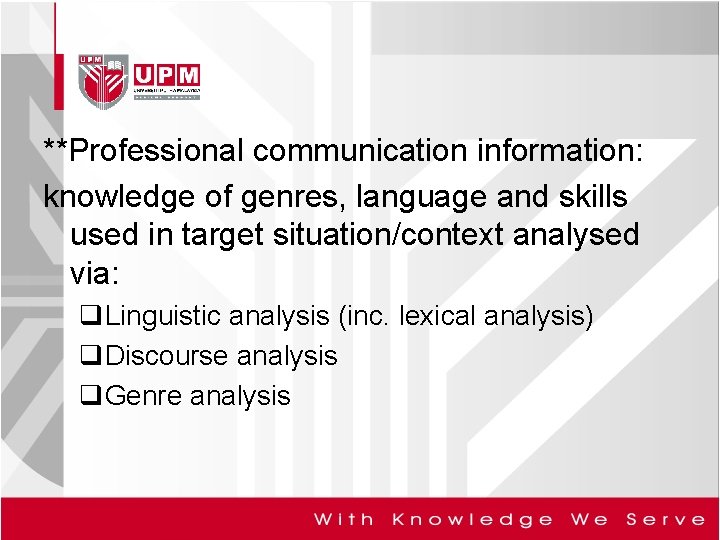
**Professional communication information: knowledge of genres, language and skills used in target situation/context analysed via: q. Linguistic analysis (inc. lexical analysis) q. Discourse analysis q. Genre analysis
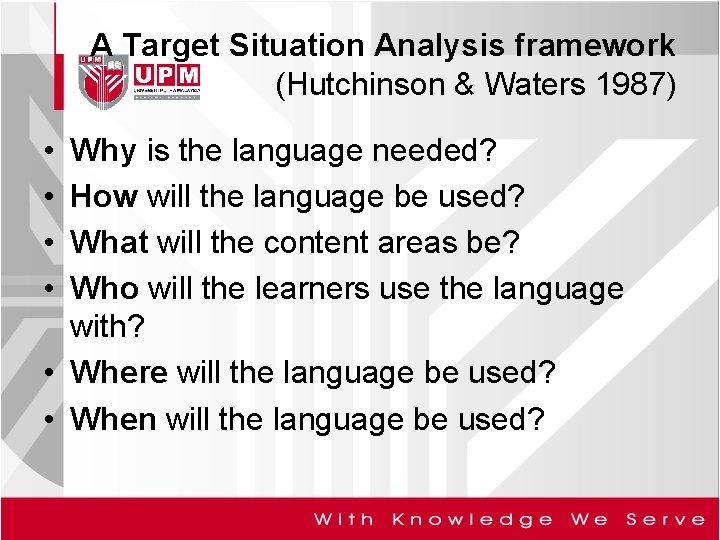
A Target Situation Analysis framework (Hutchinson & Waters 1987) • • Why is the language needed? How will the language be used? What will the content areas be? Who will the learners use the language with? • Where will the language be used? • When will the language be used?
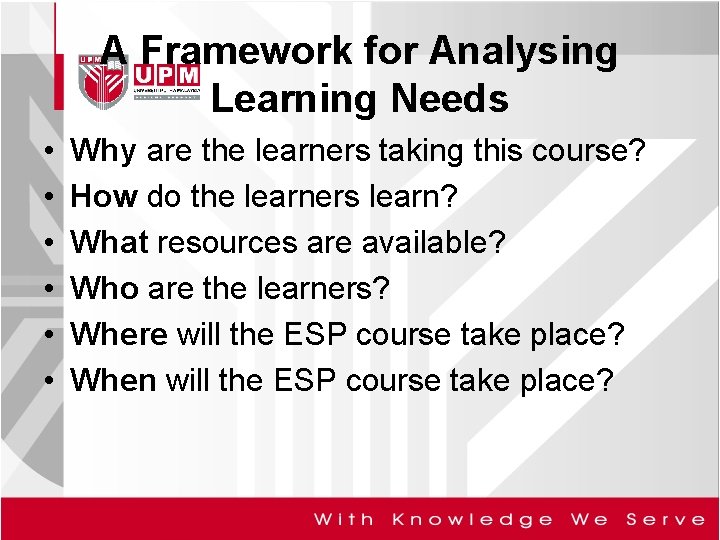
A Framework for Analysing Learning Needs • • • Why are the learners taking this course? How do the learners learn? What resources are available? Who are the learners? Where will the ESP course take place? When will the ESP course take place?
Example of a genre and its moves Research Article Abstract (adapted from Bhatia, 1993) • 1. WRITER INTRODUCES PURPOSE OF STUDY: The purpose of the study was to examine … • 2. WRITER DESCRIBES METHODOLOGY: 50 high school students in Kelantan participated in the study. They were selected from … • 3. WRITER SUMMARISES RESULTS OF STUDY: It was discovered that … • 4. WRITER PRESENTS CONCLUSIONS: High school students in Kelantan, and probably in other similar settings …
PSA • “A PSA seeks to establish what the students are like at the beginning of their language course, investigating their strengths and weakness. ” (Robinson 1991, p 9) • Assessment of learners’ strengths and weaknesses • Hutchinson & Waters (1987): ‘lacks’ • language-based gaps feed into syllabus design
LSA • pedagogical, methodological and logistical factors which will affect decisions about the design of a course • may subsequently impede or positively influence the success of a language learning programme • sub-categorised as strategy analysis and means analysis.
Materials to collect - Authentic Texts • What are authentic texts for classroom use? – narrow and defined audience – “owned” by discourse community – used by people in the learner’s target context in the course of their work • Examples: – written text types: emails, memos, reports, calls for tender, contracts, project documentation, mission statements, minutes of meetings, etc – spoken text types: interviews, meetings, phone calls, etc
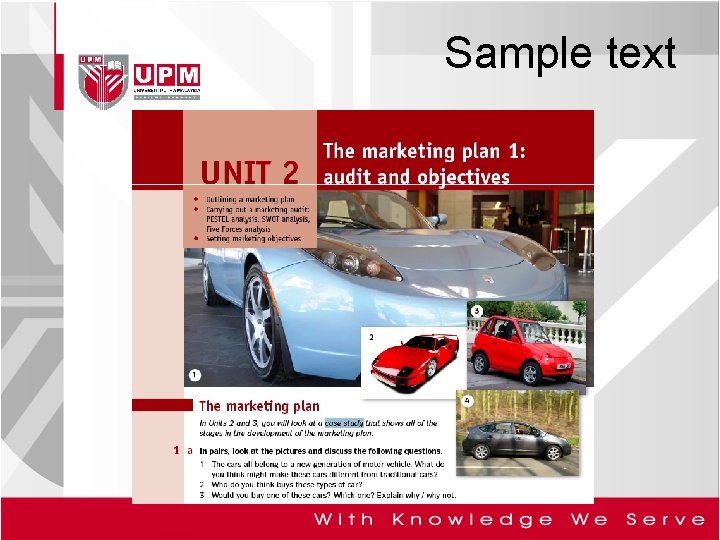
Sample text
Text Analysis • Real Content vs. Carrier Content – Carrier content: the subject of a text, what it is about – Real content: language items which the teacher determines to be present in a text and which he/she regards to be worthy of teaching
Text analysis. . . Dudley-Evans and St. John (1997): technical vocabulary: specialized and restricted meanings in certain disciplines and which may vary in meaning across disciplines semi-technical vocabulary: used in general language but has a higher frequency of occurrence/use in the specialist discourse of professional life
Task Analysis • What is the main communicative purpose of the task? • Which of the four skills does the task require? • Are there preliminary and follow-up tasks involved? • What language functions can be expected to play a role in the task? • What text types does the task involve? • Where can these texts be found?
Methods of Analysing Needs • • Tests Questionnaires Interviews /structured interviews Observation Case studies Learner diaries Previous research Participatory needs analysis (including ‘Shadowing’)
Remaining issues • The timing of a needs analysis q. Pre-course (GNP specs) q. In-course (formative assessment of LOs) q. Post-course (course evaluation) • Who carries out the needs analysis / Who decides what the language needs are? – JIJOE? (Alderson, 1996) – Home-grown expert? – Often the practitioner/instructor
Remaining issues. . . • Translating needs analysis outcomes – the GNP (Generalised Needs Profile) • Construct TSA, PSA & LSA specifications for target group of learners – Problem with heterogeneous groups – Resolve within available means/resources (Swales, 1989: ‘opportunity cost’)
Remaining issues. . . • Resolve mismatches in expectations to establish “happy mean” (Richterich, 1983) – e. g. How much ‘grammar’? How much focus on speaking skills? • Immediate needs and projected needs • A key issue: how much data to collect and analyse? – Adopt pragmatic approach/stance • Question of power: English specialist vs. Content specialist

Question of power. . .
- Slides: 30