
UNIT 2 GENETICS CHAPTER 11 INHERITANCE PATTERNS AND
- Slides: 43
UNIT 2: GENETICS CHAPTER 11: INHERITANCE PATTERNS AND HUMAN GENETICS
MUTATION
MUTATION • The DNA of chromosomes contains information that regulates inheritance patterns. • What exactly are these patterns? Why do some traits run in families, while others seem to appear out of nowhere?
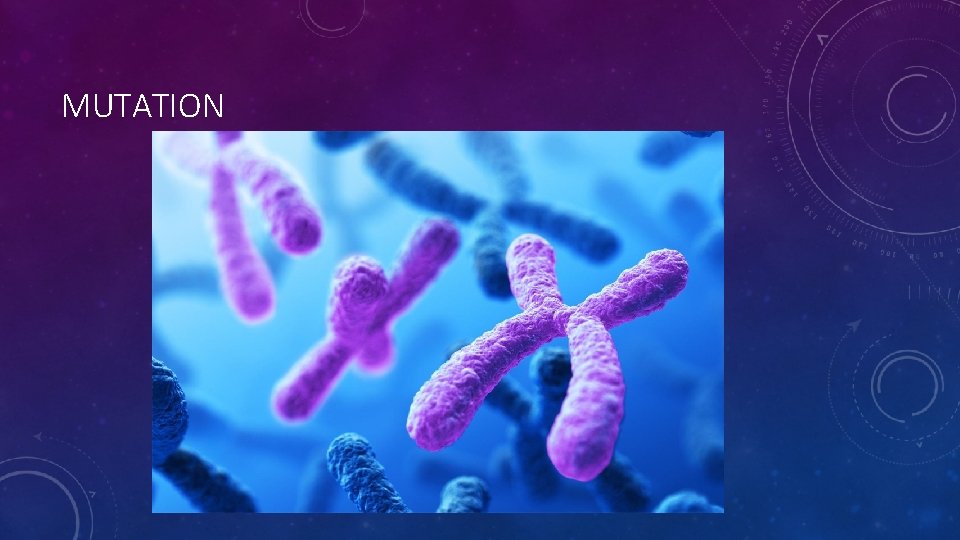
MUTATION • DNA ultimately directs the production of the proteins that affect an organism’s metabolism and development. • Any change in DNA will affect the production of proteins and in turn result in a new phenotype. • Mutation: A change in DNA. Mutations can involve entire chromosomes or specific genes. They may take place in any cell.
MUTATION • Germ Cell Mutations: Occur in sex cells, such as eggs and sperm. They do not affect the organism itself but are passed on to offspring. • Somatic Mutations: Take place in body cells. They are passed on to daughter cells through mitosis.
MUTATION • The majority of mutations are harmful. Most of these are called lethal mutations because they prevent the individual from developing much beyond the zygote stage. • Some mutations result in phenotypes that have an evolutionary advantage and are therefore beneficial. These mutations ultimately provide the variation upon which natural selection acts.
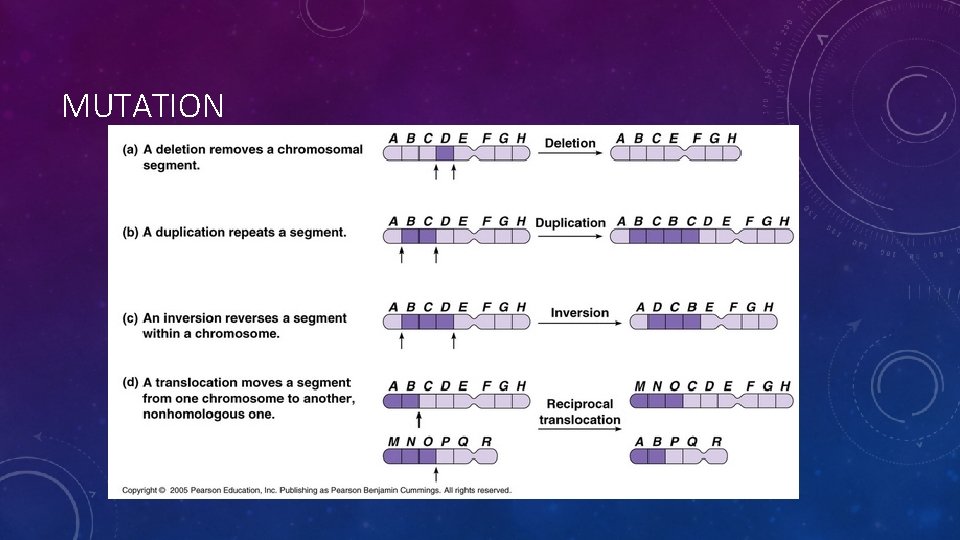
MUTATION • Chromosome mutations often occur during cell division. These mutations are either changes in the structure of a chromosome or loss of an entire chromosome. • Deletion: Occurs when a piece of a chromosome breaks off. All of the information on that piece is lost. • Inversion: Occurs when a piece breaks from a chromosome and reattaches itself to the chromosome in the reverse orientation. • Translocation: When a broken piece attaches to a nonhomologous chromosome.
MUTATION
MUTATION • Nondisjunction: Occurs when a replicated chromosome pair fails to separate during cell division. When nondisjunction occurs, one daughter cell receives an extra copy of a chromosome, and the other daughter cell lacks that chromosome entirely.
MUTATION • Gene mutations may involve a single nitrogen base within a codon or larger segments of DNA. A codon consists of three nitrogen bases that cause a specific amino acid to be inserted into a polypeptide during protein synthesis.
MUTATION • Point Mutation: The substitution, addition, or removal of a single nitrogen base. If one nitrogen base is substituted for another, the altered code may signal the insertion of a different amino acid into the protein chain. The protein will thus have a different chemical structure. • Frameshift Mutation: A type of point mutation resulting in the addition or deletion of a nitrogen base. An addition or deletion causes the genetic message to be read out of sequence. The result is usually the inability of the gene to code for the proper amino acids.
MUTATION • What causes mutations? Some mutations are chemical mishaps with no apparent external cause. As in all complex systems, sometimes by chance things go wrong. • Mutagens: Environmental factors that damage DNA. • Ames Test: A procedure to identify mutagenic substances.
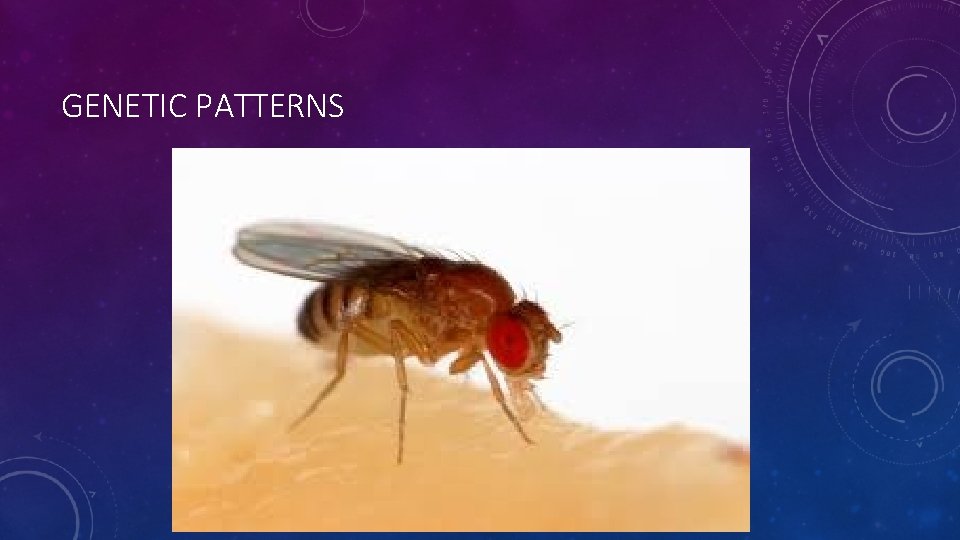
GENETIC PATTERNS • Drosophila melanogaster – The common fruit fly. Many characteristics of Drosophila make them ideal subjects.
GENETIC PATTERNS
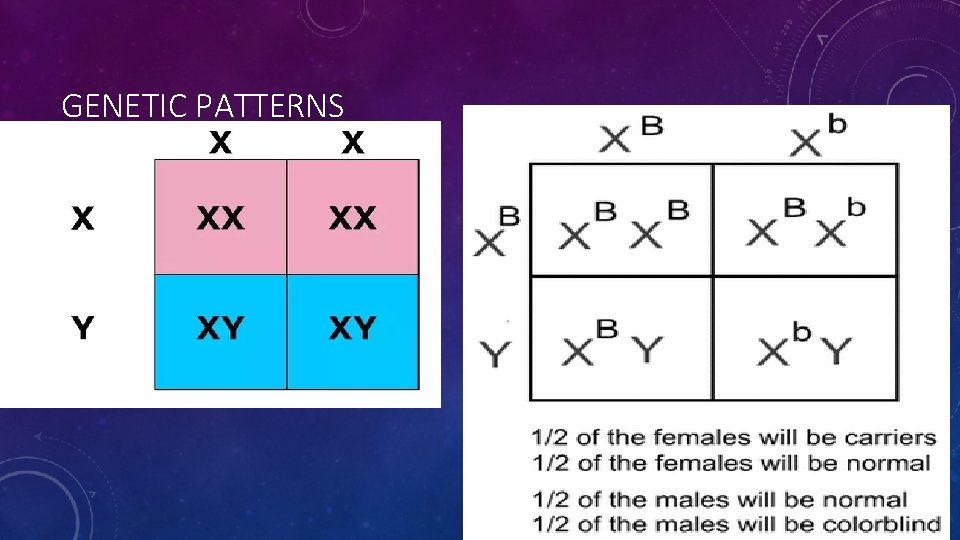
GENETIC PATTERNS • Sex Chromosomes: Chromosomes that determine an individual’s sex, the X and Y chromosomes. Female gametes each receive one X chromosome. Male gametes receive either an X or a Y chromosome. If an egg is fertilized by a sperm containing an X chromosome, the resulting zygote will be XX, and the new individual will be female. If an egg is fertilized by a sperm containing a Y chromosome, the resulting zygote will be XY, and new individual will be male. • Autosomes: The chromosomes not included in sex determination.
GENETIC PATTERNS
GENETIC PATTERNS • Sex-Linked Trait: A trait determined by alleles on the sex chromsomes. • Example: Eye color is a sex-linked trait in fruit flies carried on the X chromosome.
GENETIC PATTERNS • Genes are found on chromosomes. Since there are thousands more traits than chromosomes, each chromosome must carry many genes. • Linkage Group: The group of genes located on one chromosome. These genes are usually inherited together. • Example: Body color and wing length in the fruit fly.
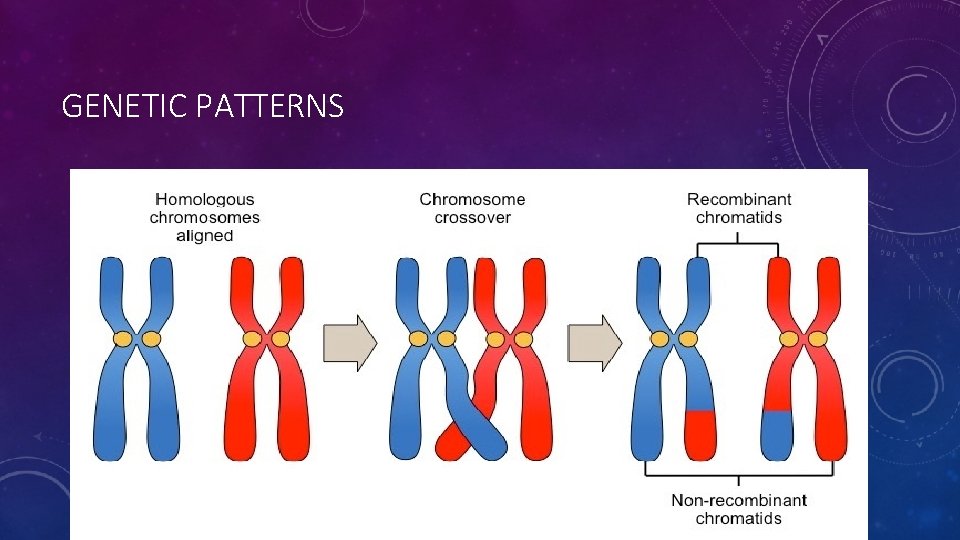
GENETIC PATTERNS • Sometimes not all the alleles in a linkage group were inherited together. Sometimes alleles change or become rearranged. • Crossing-Over: The exchange of alleles between homologous chromosomes.
GENETIC PATTERNS
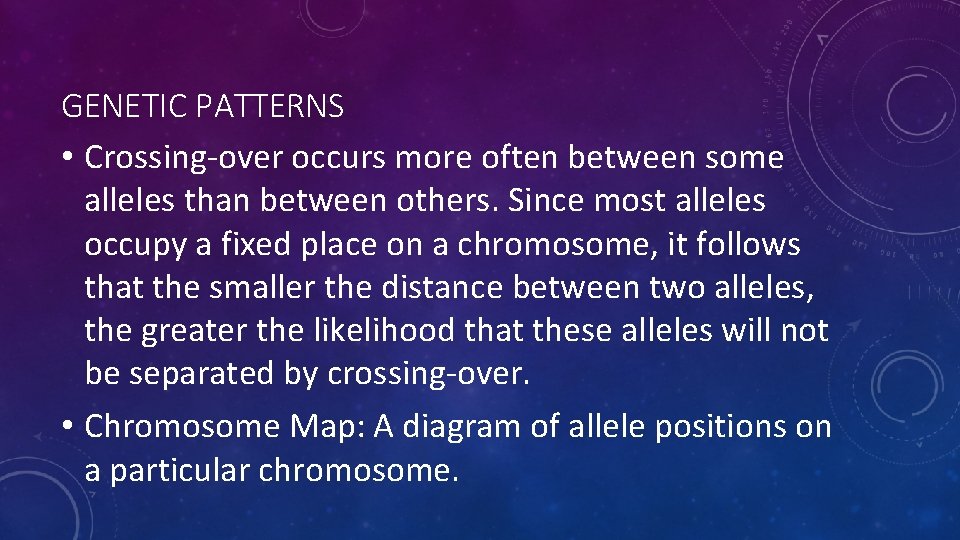
GENETIC PATTERNS • Crossing-over occurs more often between some alleles than between others. Since most alleles occupy a fixed place on a chromosome, it follows that the smaller the distance between two alleles, the greater the likelihood that these alleles will not be separated by crossing-over. • Chromosome Map: A diagram of allele positions on a particular chromosome.
HUMAN GENETICS • In this section we will study some human genetic patterns. Most of the examples are diseases or disorders, but keep in mind that the vast majority of genes control beneficial traits. • Geneticists concentrate on disease-carrying genes because they are easily traced through generations and because they are of great concern to people.
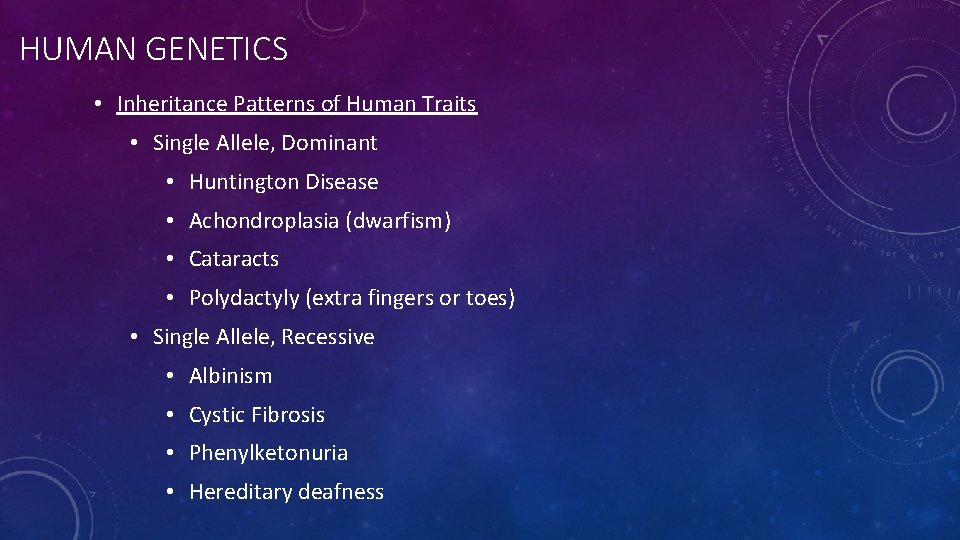
HUMAN GENETICS • Inheritance Patterns of Human Traits • Single Allele, Dominant • Huntington Disease • Achondroplasia (dwarfism) • Cataracts • Polydactyly (extra fingers or toes) • Single Allele, Recessive • Albinism • Cystic Fibrosis • Phenylketonuria • Hereditary deafness
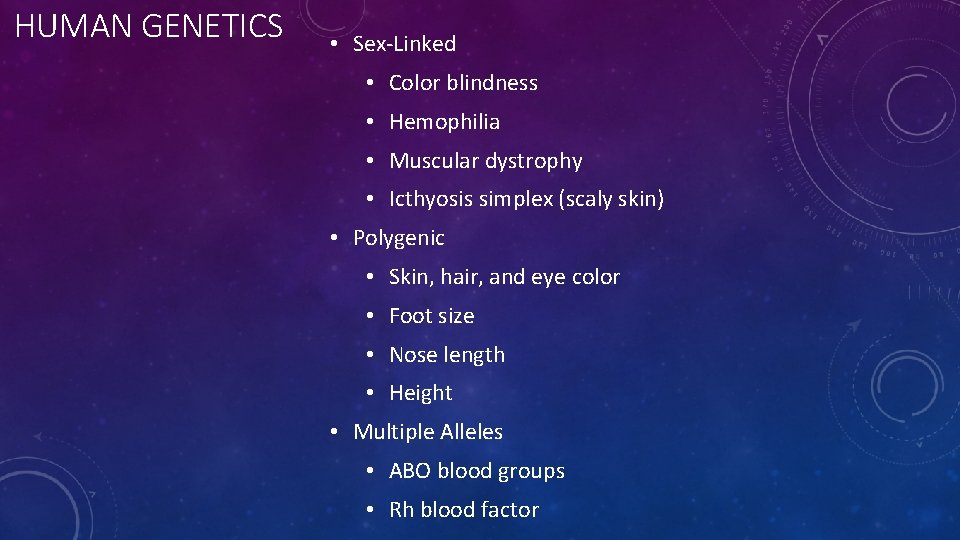
HUMAN GENETICS • Sex-Linked • Color blindness • Hemophilia • Muscular dystrophy • Icthyosis simplex (scaly skin) • Polygenic • Skin, hair, and eye color • Foot size • Nose length • Height • Multiple Alleles • ABO blood groups • Rh blood factor
HUMAN GENETICS • Why is it so much more difficult to study human genetics? • How do scientists gather evidence about human inheritance?
HUMAN GENETICS • Population Sampling: Researchers select a small number of individuals that represent the whole population. Selecting members of the sample according to carefully formulated statistical rules helps ensure that the study will yield accurate results. • Twin Studies: Identical twins are studied to distinguish between genetic and environmental influences on specific traits. Because identical twins have the same genetic inheritance, their differences may result from environmental influences such as home life or education.
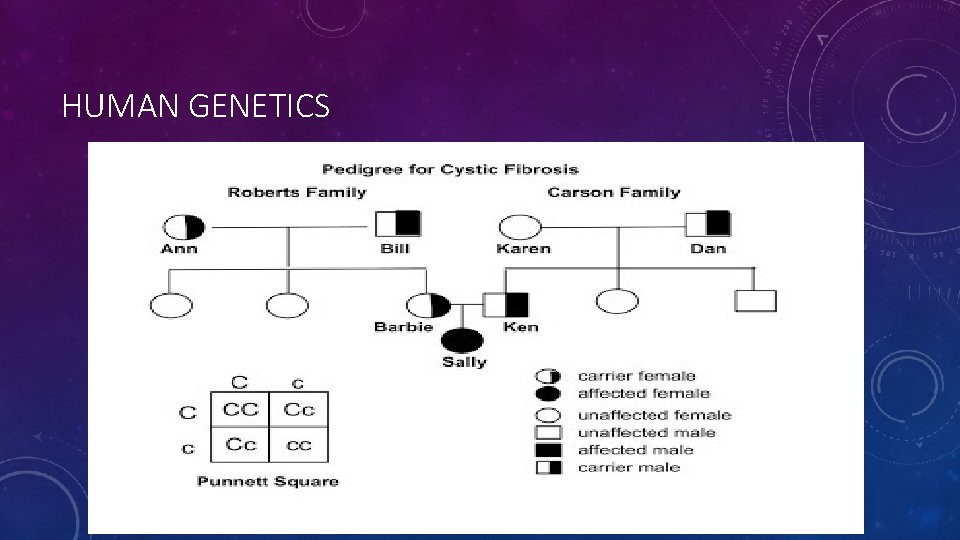
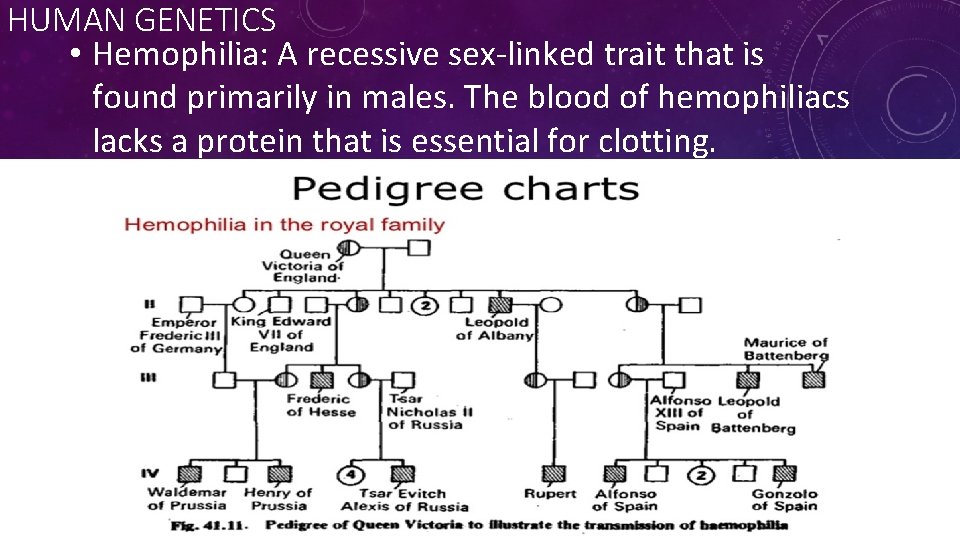
HUMAN GENETICS • Pedigree: A family record that shows how a trait is inherited over several generations. • Carrier: Someone who is heterozygous for a trait. Carriers do not have the trait themselves but may pass it on to their offspring.
HUMAN GENETICS
HUMAN GENETICS • Single-Allele Traits: Geneticists have identified about 200 human traits that are coded for by single, dominant alleles. About 250 other traits are coded for by homozygous recessive alleles. Some examples of codominance also exist. Examples of single-allele disorders include sickle-cell disease and Huntington disease.
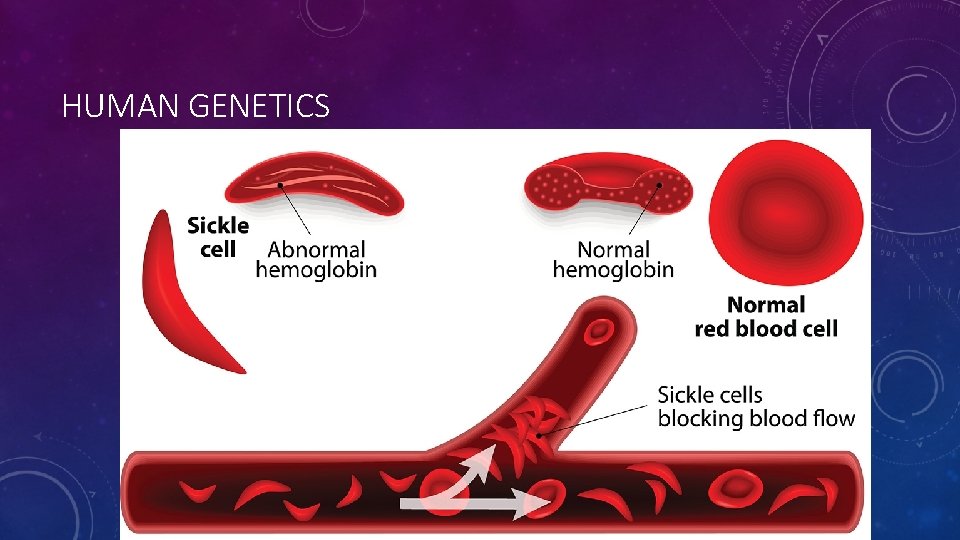
HUMAN GENETICS • Sickle-Cell Disease: Often called sickle-cell anemia, is a single-allele disorder that operates in a codominant system. The dominant allele A produces normal hemoglobin that results in round erythrocytes. The codominant allele A’ codes for abnormal hemoglobin and results in sickle-shaped erythrocytes. • AA individuals have normal hemoglobin and normal erythrocytes. Heterozygous individuals (AA’) have both normal and abnormal hemoglobin and intermediate shaped cells. A’A’ individuals only have sickle cells.
HUMAN GENETICS
HUMAN GENETICS • Huntington Disease: aka HD, a single-allele trait that is caused by a dominant allele. Because the HD allele is dominant, any person who inherits the allele will develop the disease. Unfortunately, most carriers do not know they have the disease until after they have had children. Thus the disease is unknowingly passed on from one generation to the next. • Genetic Marker: A short section of DNA that indicates the presence of an allele that codes for a trait. By conducting a simple test on sample cells, geneticists are now able to inform a person of the presence of the marker before he or she has children.
HUMAN GENETICS • Polygenic Trait: A trait that is controlled by two or more genes. For example, skin color and eye color.
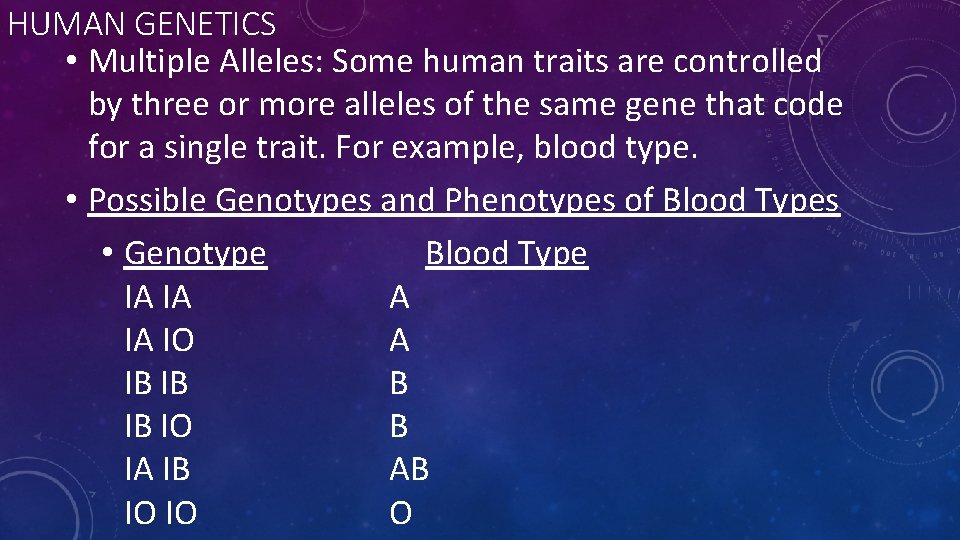
HUMAN GENETICS • Multiple Alleles: Some human traits are controlled by three or more alleles of the same gene that code for a single trait. For example, blood type. • Possible Genotypes and Phenotypes of Blood Types • Genotype Blood Type IA IA IO A IB IB IO B IA IB AB IO IO O
HUMAN GENETICS • In humans there are three alleles that code for blood type. Any individual has two of these alleles, which together make up the gene for blood type. The alleles IA and IB are codominant, and both are dominant to the IO allele. • Antigen: A substance that causes the body to produce an antibody. The kind of antigen or antigens produced by a specific combination of alleles determines the blood type. The presence of antigen A or B determines the type of blood a person can receive in a transfusion.
HUMAN GENETICS • Certain human traits are sex linked; that is, the alleles for these traits appear only on the X chromosome. Males have only one X chromosome. Since no complementary portion of the Y chromosome exists, any single recessive allele on an X chromosome will be expressed because it cannot be masked by a dominant allele. For example, color blindness and hemophilia.
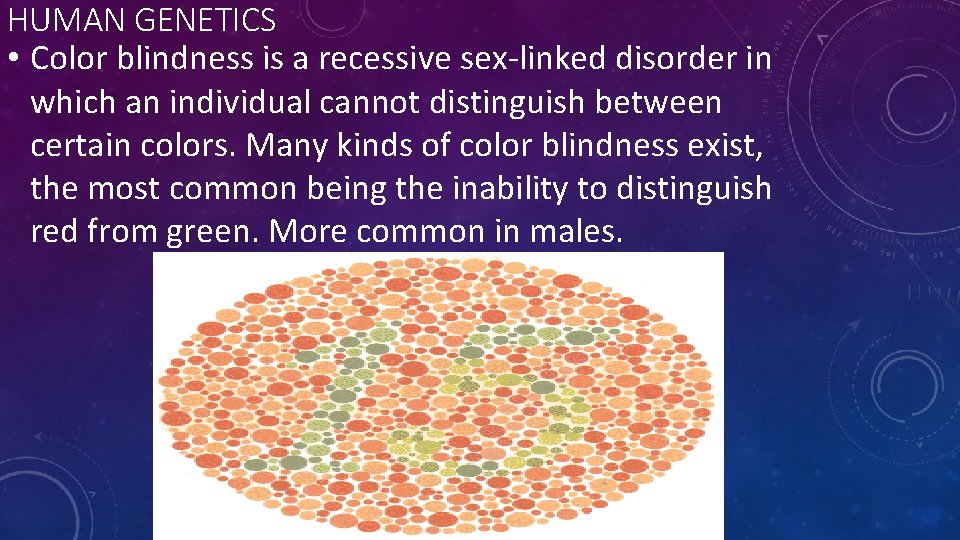
HUMAN GENETICS • Color blindness is a recessive sex-linked disorder in which an individual cannot distinguish between certain colors. Many kinds of color blindness exist, the most common being the inability to distinguish red from green. More common in males.
HUMAN GENETICS • Hemophilia: A recessive sex-linked trait that is found primarily in males. The blood of hemophiliacs lacks a protein that is essential for clotting.
HUMAN GENETICS • Sex-Influenced Traits: The presence of male or female sex hormones influences the expression of certain human traits. The alleles that code for most of these traits are on the autosomes. Males and females have the same alleles, but the trait is expressed in only one sex. • Example: Pattern baldness is a familiar sex-influenced trait. The allele for baldness, B, is dominant in males but recessive in females. A heterozygous woman (Bb) will not lose her hair, but a heterozygous man (Bb) will. These differences result from the presence of particular sex hormones.
HUMAN GENETICS • Nondisjunction is the failure of chromatids to separate during cell division. The result may be a sperm or an egg cell with either an extra or a missing chromosome. • For example, in humans, if nondisjunction occurs during sperm formation, one sperm cell may have 22 chromosomes, and another may have 24. If one of these gametes combines with a normal egg, the zygote will have either 45 or 47 chromosomes.
HUMAN GENETICS • Monosomy: A zygote with 45 chromosomes has only one of a particular chromosome. • Trisomy: A zygote with 47 chromosomes has three of a particular chromosome. • Down Syndrome: An extra chromosome 21 (trisomy 21). • Klinefelter Syndrome: Trisomic genotype XXY. • Turner Syndrome: Monosomic genotype XO.
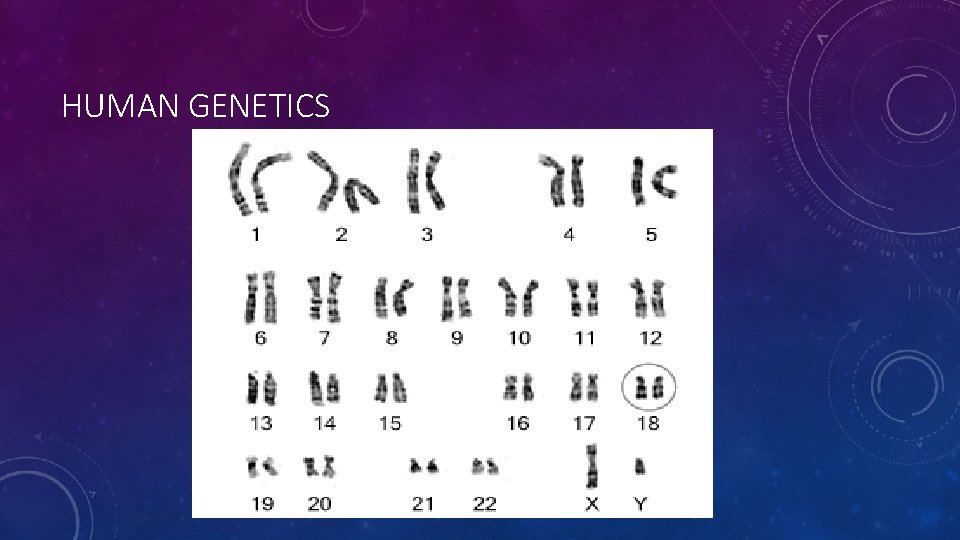
HUMAN GENETICS • Genetic Screening: An examination of a person’s genetic makeup. • Karyotype: A picture of an individual’s chromosomes. • Genetic Counseling: A type of counseling that informs a couple about problems that could affect their offspring. • Amniocentesis: A needle and syringe is used to remove a small amount of amniotic fluid from the placenta, the sac that surrounds the fetus. A karyotype is made and cells in the amniotic fluid are analyzed. • Fetoscopy: A tiny camera is inserted through a small incision in the uterus. A physician can observe the fetus’s development and take skin and blood samples for analysis. • Ultrasound: A technique in which high-frequency sound waves bounce off the fetus, forming an image. • Chorion Villi Sampling: A physician analyzes a sample of the chorion villi, which grows between the mother’s uterus and the placenta. Since the villi have the same genetic makeup as the fetus, the physician is able to detect genetic disorders.
HUMAN GENETICS