
Unit 2 Gases Chapter 5 Pressure Force exerted
- Slides: 35
Unit 2: Gases Chapter 5
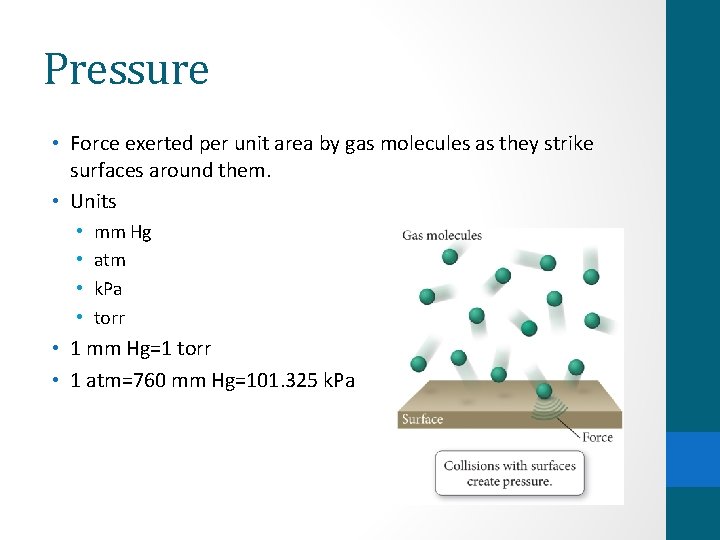
Pressure • Force exerted per unit area by gas molecules as they strike surfaces around them. • Units • • mm Hg atm k. Pa torr • 1 mm Hg=1 torr • 1 atm=760 mm Hg=101. 325 k. Pa
Practice Problem 1 • How many atmospheres are in 79 k. Pa?
SIMPLE GAS LAWS
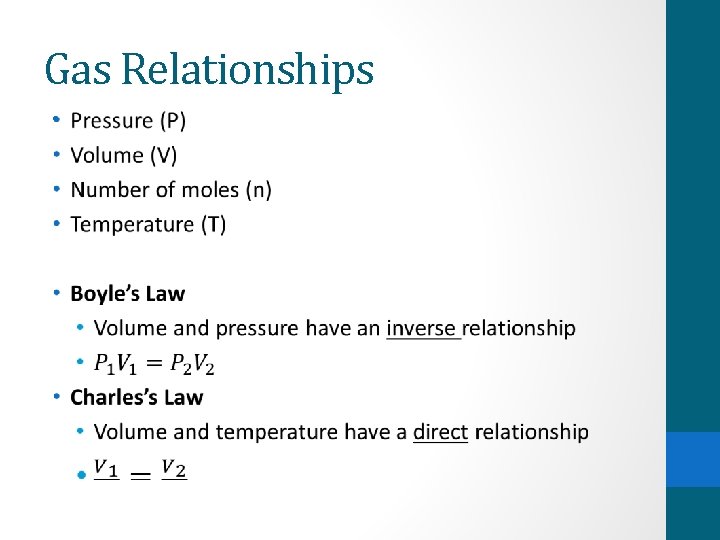
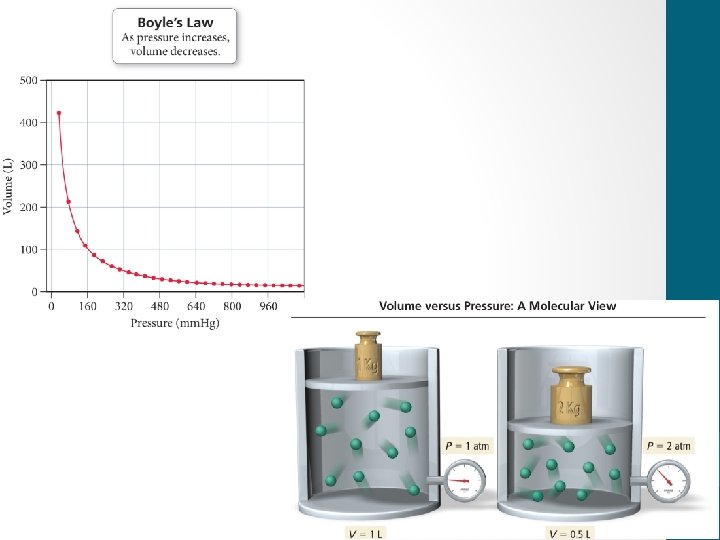
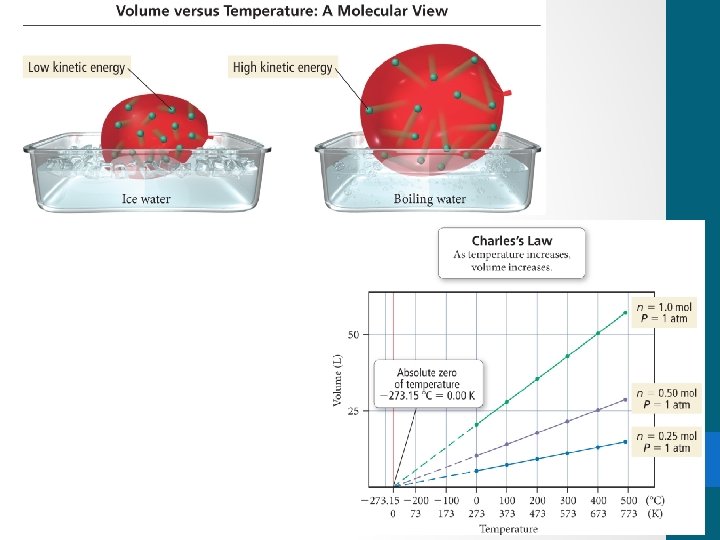
Gas Relationships •
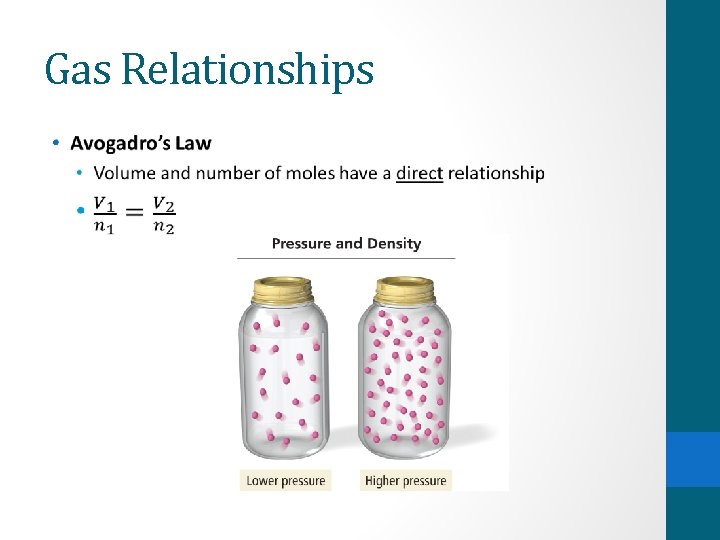
Gas Relationships •
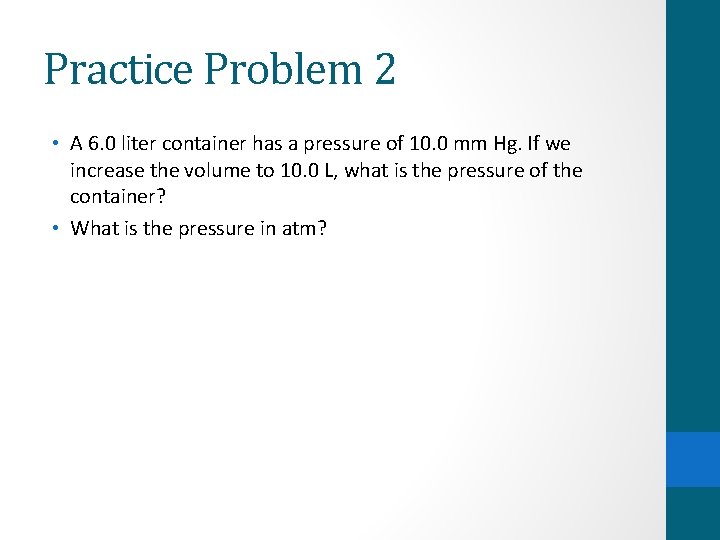
Practice Problem 2 • A 6. 0 liter container has a pressure of 10. 0 mm Hg. If we increase the volume to 10. 0 L, what is the pressure of the container? • What is the pressure in atm?
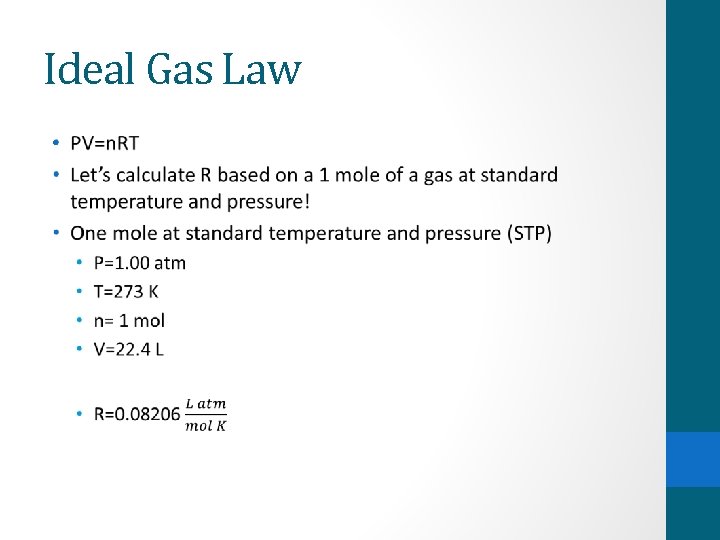
Ideal Gas Law •
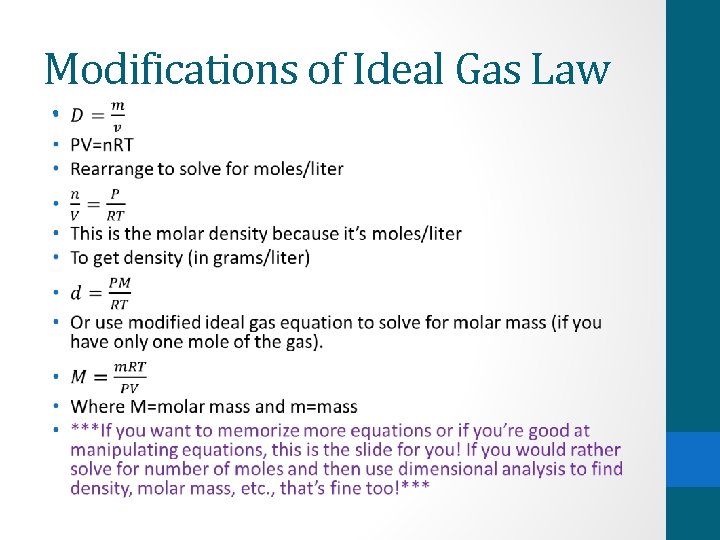
Modifications of Ideal Gas Law •
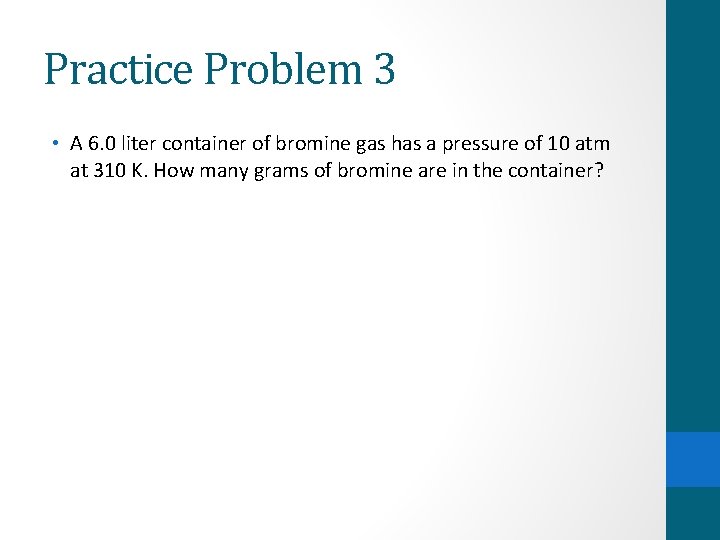
Practice Problem 3 • A 6. 0 liter container of bromine gas has a pressure of 10 atm at 310 K. How many grams of bromine are in the container?
MIXTURES OF GASES
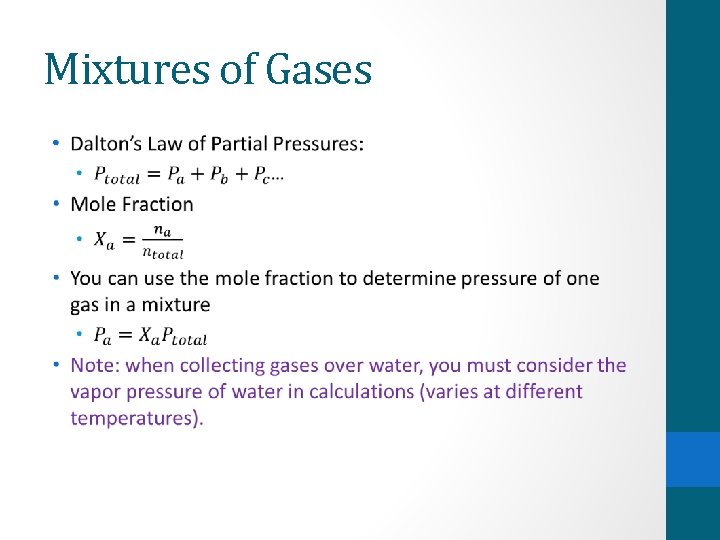
Mixtures of Gases •
Gas Stoichiometry • Same as normal stoichiometry, just use in conjunction with other gas equations. • If reaction occurs at STP, you can use the molar volume (22. 4 L) as a conversion factor.
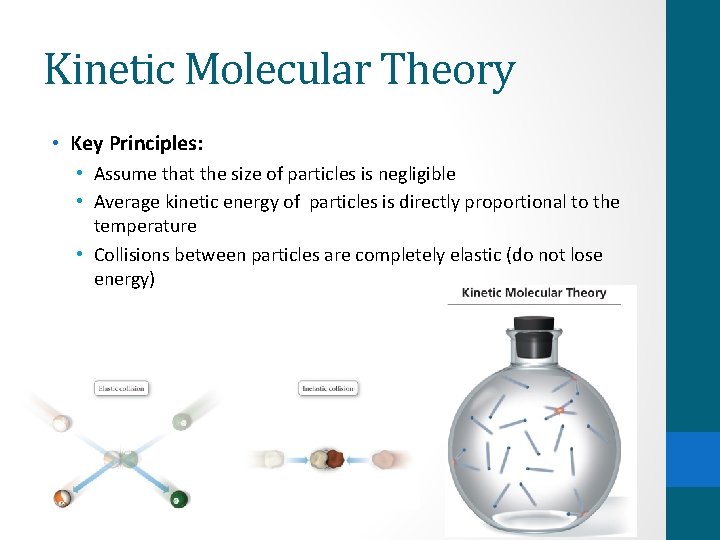
Kinetic Molecular Theory • Key Principles: • Assume that the size of particles is negligible • Average kinetic energy of particles is directly proportional to the temperature • Collisions between particles are completely elastic (do not lose energy)
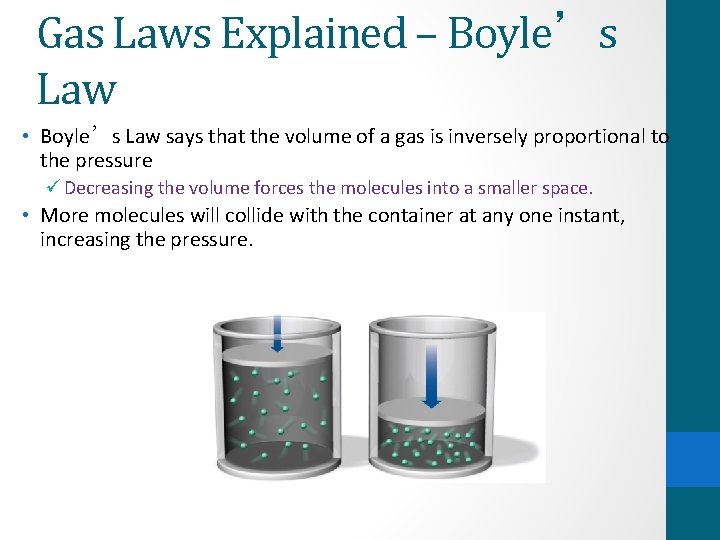
Gas Laws Explained – Boyle’s Law • Boyle’s Law says that the volume of a gas is inversely proportional to the pressure ü Decreasing the volume forces the molecules into a smaller space. • More molecules will collide with the container at any one instant, increasing the pressure.
Gas Laws Explained – Charles’s Law • Charles’s Law says that the volume of a gas is directly proportional to the absolute temperature. ü According to kinetic molecular theory, when we increase the temperature of a gas, the average speed, and thus the average kinetic energy, of the particles increases. • The greater volume spreads the collisions out over a greater surface area, so that the pressure is unchanged.
Gas Laws Explained – Avogadro’s Law • Avogadro’s Law says that the volume of a gas is directly proportional to the number of gas molecules. • Increasing the number of gas molecules causes more of them to hit the wall at the same time. • To keep the pressure constant, the volume must then increase.
Gas Laws Explained – Dalton’s Law • Dalton’s law: the total pressure of a gas mixture is the sum of the partial pressures. • According to kinetic molecular theory, the particles have negligible size and they do not interact. ü Particles of different masses have the same average kinetic energy at a given temperature. • Because the average kinetic energy is the same, the total pressure of the collisions is the same.
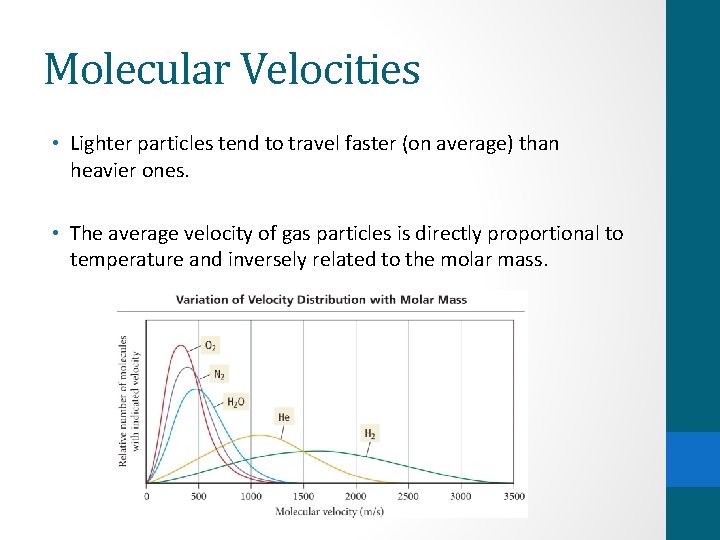
Molecular Velocities • Lighter particles tend to travel faster (on average) than heavier ones. • The average velocity of gas particles is directly proportional to temperature and inversely related to the molar mass.
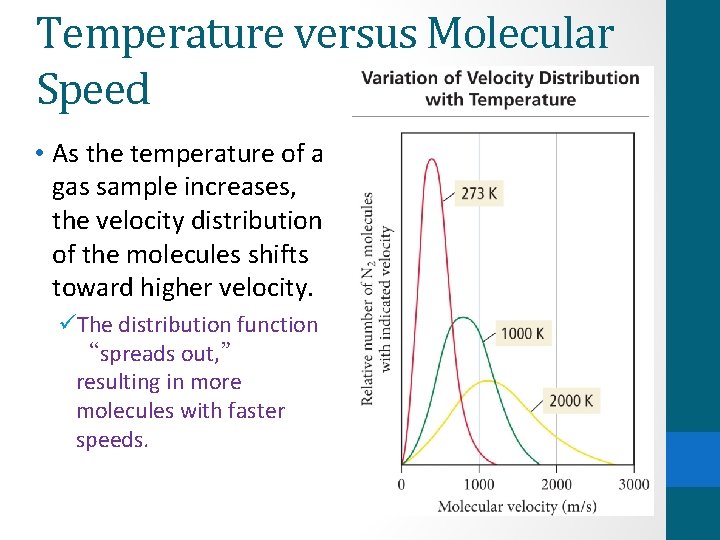
Temperature versus Molecular Speed • As the temperature of a gas sample increases, the velocity distribution of the molecules shifts toward higher velocity. üThe distribution function “spreads out, ” resulting in more molecules with faster speeds.
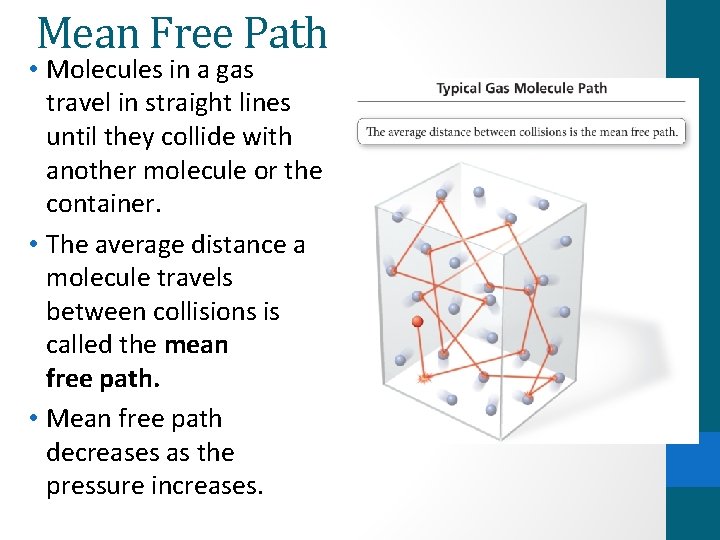
Mean Free Path • Molecules in a gas travel in straight lines until they collide with another molecule or the container. • The average distance a molecule travels between collisions is called the mean free path. • Mean free path decreases as the pressure increases.
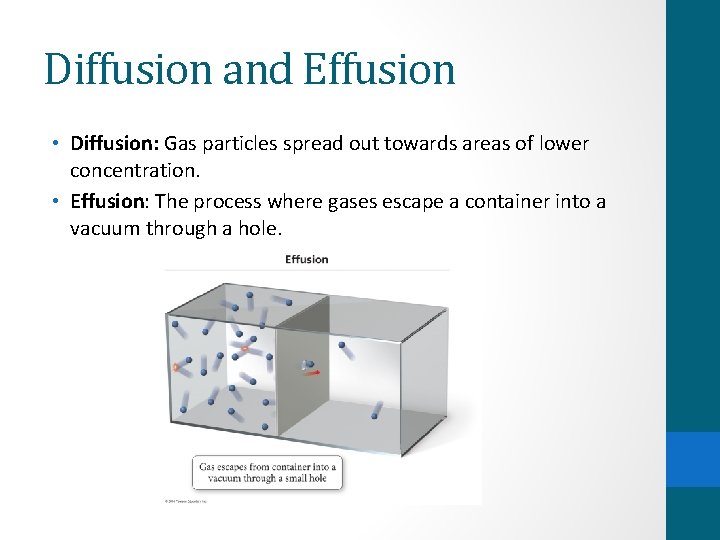
Diffusion and Effusion • Diffusion: Gas particles spread out towards areas of lower concentration. • Effusion: The process where gases escape a container into a vacuum through a hole.
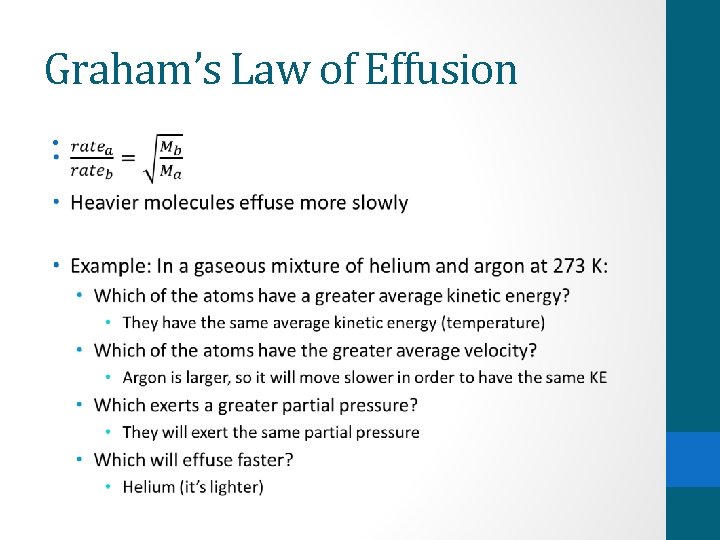
Graham’s Law of Effusion •
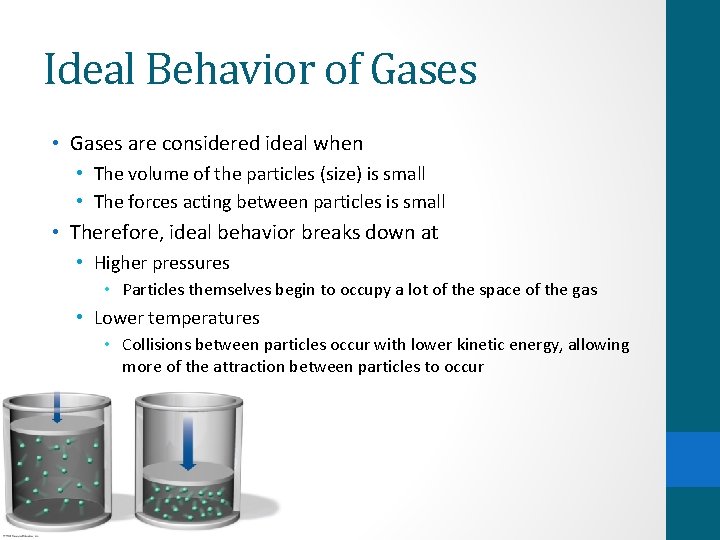
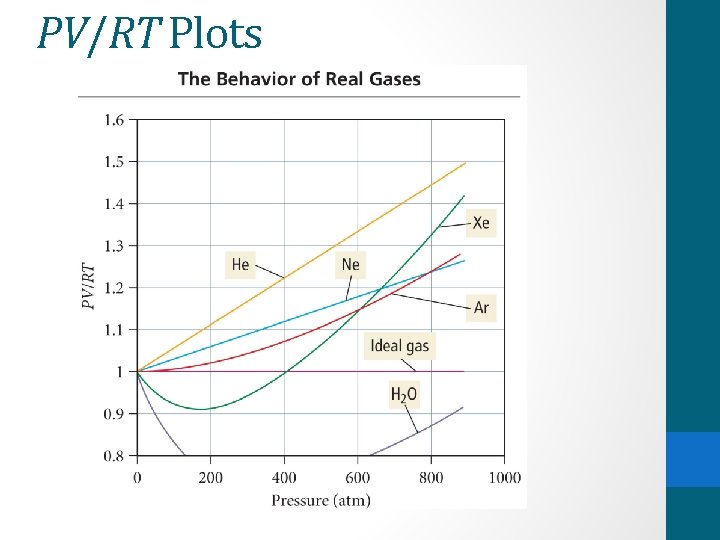
Ideal Behavior of Gases • Gases are considered ideal when • The volume of the particles (size) is small • The forces acting between particles is small • Therefore, ideal behavior breaks down at • Higher pressures • Particles themselves begin to occupy a lot of the space of the gas • Lower temperatures • Collisions between particles occur with lower kinetic energy, allowing more of the attraction between particles to occur
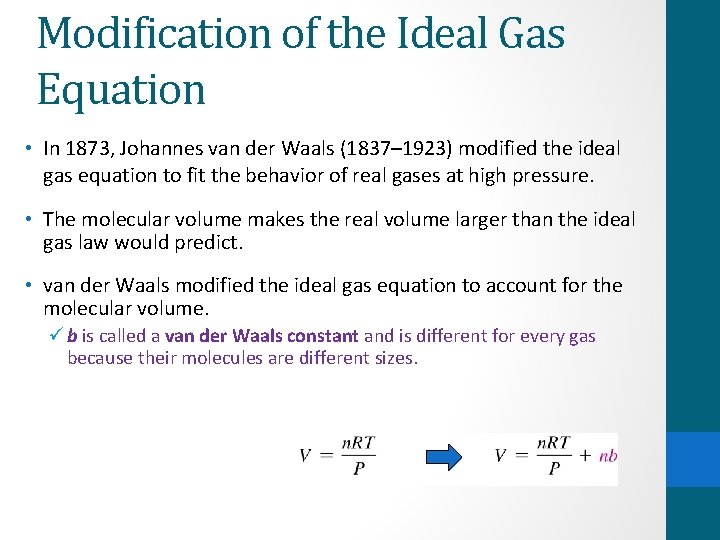
Modification of the Ideal Gas Equation • In 1873, Johannes van der Waals (1837– 1923) modified the ideal gas equation to fit the behavior of real gases at high pressure. • The molecular volume makes the real volume larger than the ideal gas law would predict. • van der Waals modified the ideal gas equation to account for the molecular volume. ü b is called a van der Waals constant and is different for every gas because their molecules are different sizes.
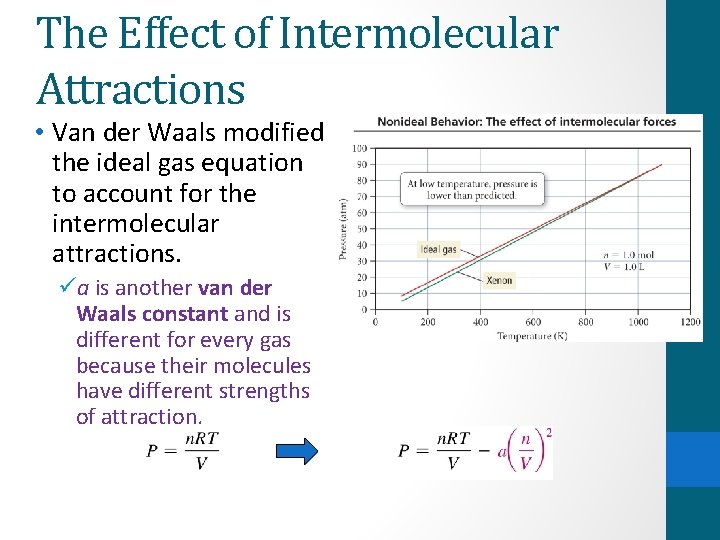
The Effect of Intermolecular Attractions • At high temperature, the pressure of the gases is nearly identical to that of an ideal gas. • But at lower temperatures, the pressure of gases is less than that of an ideal gas. ü At the lower temperatures, the gas atoms spend more time interacting with each other and less time colliding with the walls, making the actual pressure less than that predicted by the ideal gas law.
The Effect of Intermolecular Attractions • Van der Waals modified the ideal gas equation to account for the intermolecular attractions. üa is another van der Waals constant and is different for every gas because their molecules have different strengths of attraction.
PV/RT Plots
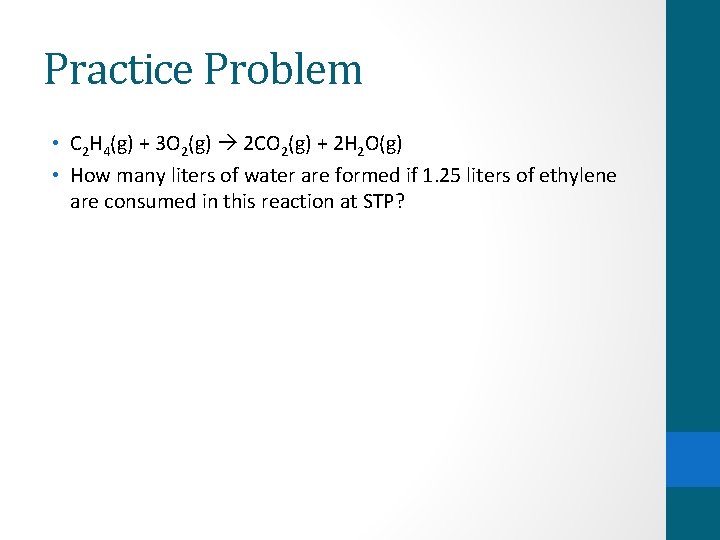
Practice Problem • C 2 H 4(g) + 3 O 2(g) 2 CO 2(g) + 2 H 2 O(g) • How many liters of water are formed if 1. 25 liters of ethylene are consumed in this reaction at STP?
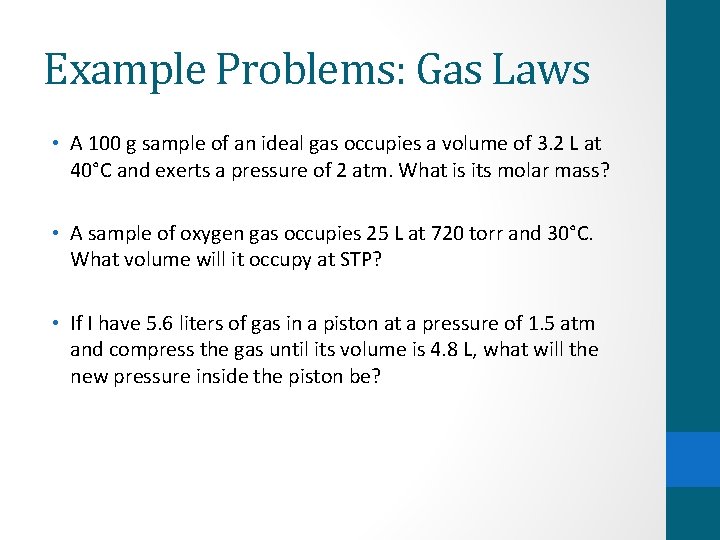
Example Problems: Gas Laws • A 100 g sample of an ideal gas occupies a volume of 3. 2 L at 40°C and exerts a pressure of 2 atm. What is its molar mass? • A sample of oxygen gas occupies 25 L at 720 torr and 30°C. What volume will it occupy at STP? • If I have 5. 6 liters of gas in a piston at a pressure of 1. 5 atm and compress the gas until its volume is 4. 8 L, what will the new pressure inside the piston be?
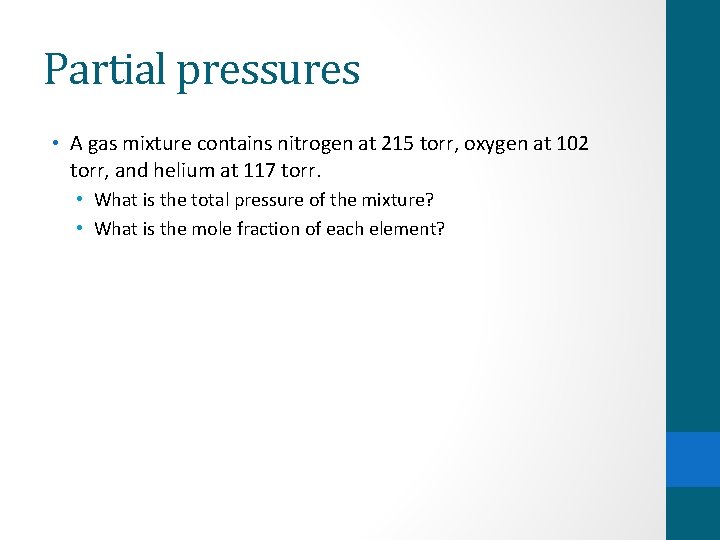
Partial pressures • A gas mixture contains nitrogen at 215 torr, oxygen at 102 torr, and helium at 117 torr. • What is the total pressure of the mixture? • What is the mole fraction of each element?
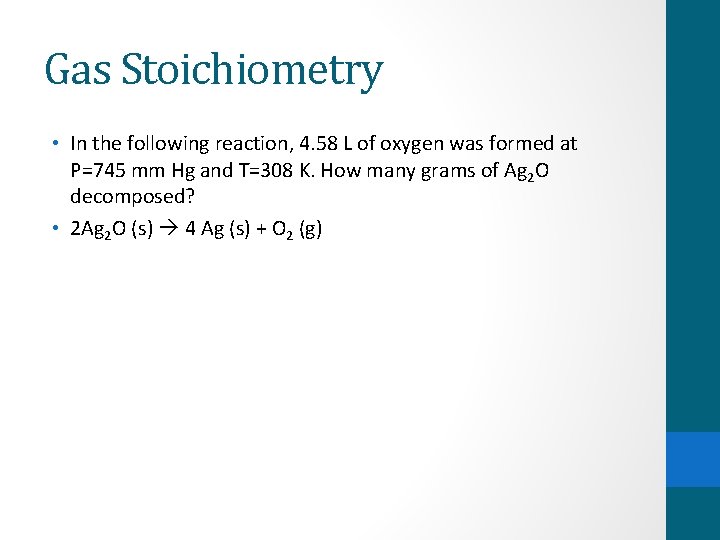
Gas Stoichiometry • In the following reaction, 4. 58 L of oxygen was formed at P=745 mm Hg and T=308 K. How many grams of Ag 2 O decomposed? • 2 Ag 2 O (s) 4 Ag (s) + O 2 (g)
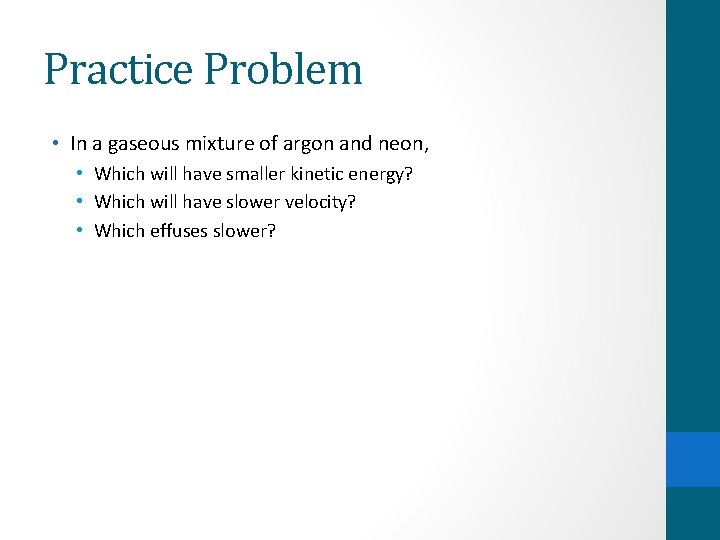
Practice Problem • In a gaseous mixture of argon and neon, • Which will have smaller kinetic energy? • Which will have slower velocity? • Which effuses slower?