
Unit 2 Fraud Background and Vocabulary motive something
Unit 2. Fraud Background and Vocabulary • motive : something (as a need or desire) that causes a person to act ex) I think he's guilty of the crime. He had the motive, the means, and the opportunity. • impersonate : to assume or act the character of ex) He was arrested for impersonating a police officer. • deception : the act of deceiving ex) She accuses the company of willful deception in its advertising.
Unit 2. Fraud Background and Vocabulary • impress : to affect especially forcibly or deeply : gain the admiration or interest of ex) Her honesty impressed us. • con : something (as a ruse) used deceptively to gain another's confidence; also : a confidence game • suspicious : tending to arouse suspicion ex) We were instructed to report any suspicious activity in the neighborhood. • fake : : made in imitation of something else with intent to deceive ex) The concert ticket is fake.
Unit 2. Fraud Reading One: Catch Me If You Can: The Frank Abagnale Story • con man: 신용사기꾼(confidence man, swindler)
Unit 2. Fraud Reading One: Catch Me If You Can: The Frank Abagnale Story • Frank William Abagnale, Jr. (born April 27, 1948) is an American security consultant best known for history as a formerconfidence trickster, cheque forger, skilled impostor, and escape artist. He became notorious in the 1960 s for successfully passing US$2. 5 million worth of meticulously forged checks across 26 countries over the course of five years, beginning when he was 16 years old. In the process, he claimed to have assumed no fewer than eight separate identities, successfully impersonated an airline pilot, a doctor, a Bureau of Prisons agent, and a lawyer. He escaped from police custody twice (once from a taxiing airliner and once from a US federal penitentiary), all before he was 21 years old.
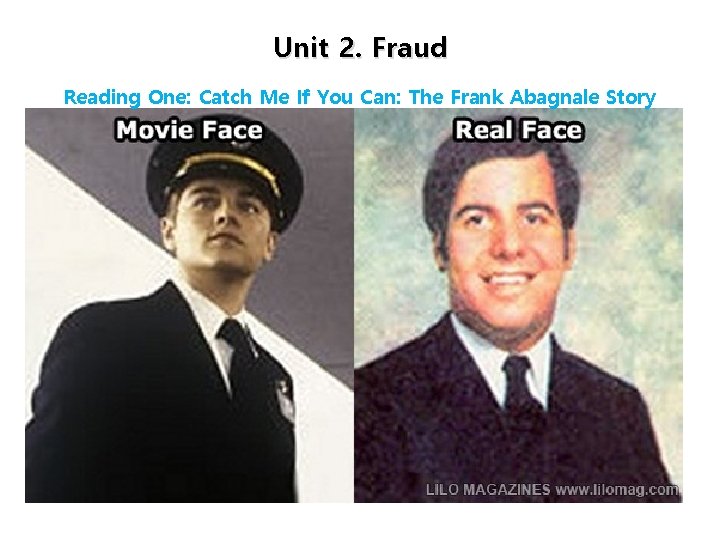
Unit 2. Fraud Reading One: Catch Me If You Can: The Frank Abagnale Story
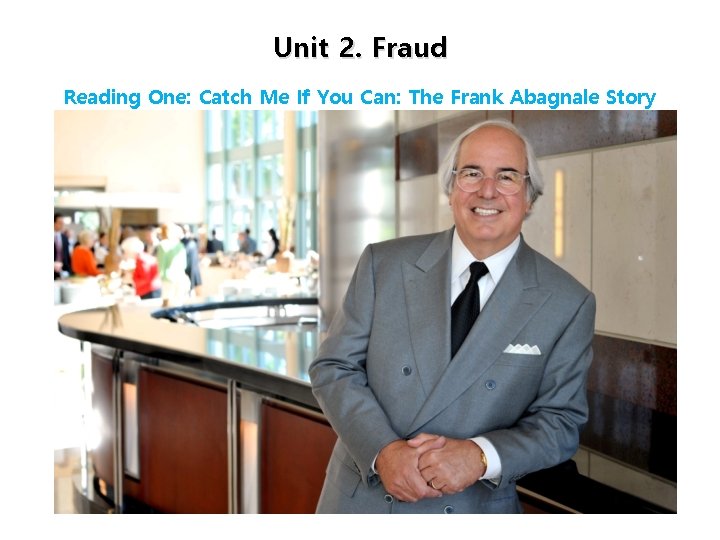
Unit 2. Fraud Reading One: Catch Me If You Can: The Frank Abagnale Story
Unit 2. Fraud Reading One: Catch Me If You Can: The Frank Abagnale Story • roles: 역할들 • cash: 현금으로 바꾸다 • false checks: 위조 수표(forged check) • motive: 동기, 행위의 원인 • [have + 목적어 + 동사원형] ex) I had my secretary typewrite the draft. 나는 비서에게 원고를 타자시켰다. ex) He had his shoes shined. 그는 구두를 닦았다. 1 st
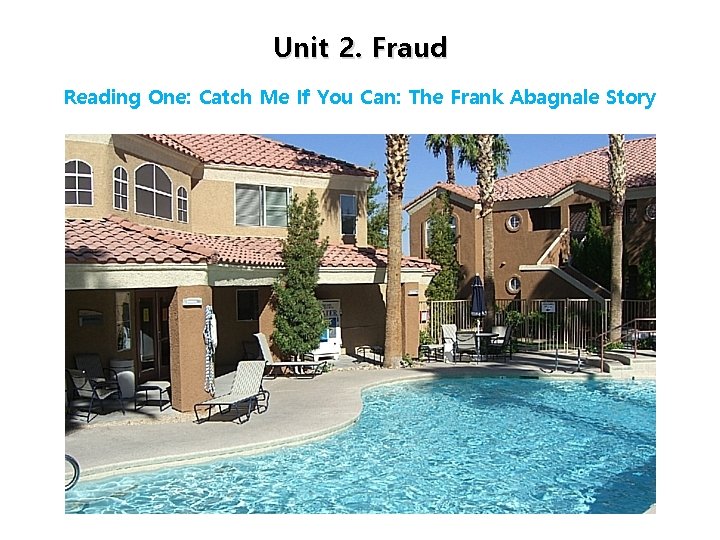
Unit 2. Fraud Reading One: Catch Me If You Can: The Frank Abagnale Story • • impersonate: ~를 사칭하다, ~인 체하다 phony: 엉터리, 엉터리의 flight attendant: 비행승무원 luxury apartment community(고급스런 공동주택 커뮤니티): area with very expensive and comfortable apartments
Unit 2. Fraud Reading One: Catch Me If You Can: The Frank Abagnale Story
Unit 2. Fraud Reading One: Catch Me If You Can: The Frank Abagnale Story • in advance: 미리 • application: 신청서 • become friends with A: A와 친구가 되다; change seats • convince: 확신시키다 • temporary supervisor: 임시 감독관 • be in charge of A: A를 맡고 있다, A 담당이다
Unit 2. Fraud Reading One: Catch Me If You Can: The Frank Abagnale Story • when faced with = when he was faced with: ① when he was faced with a life-or-death situation ~ ② being faced with a life-or-death situation ~ ③ when faced with a life-or-death situation ~
Unit 2. Fraud Reading One: Catch Me If You Can: The Frank Abagnale Story • life-or-death: 생사에 관계되는, 지극히 중요한 (life-and-death) • deception: 사기 • innocent: 천진한, 순진무구한 • Still: 그러나, 그럼에도 불구하고 • leaving = ‘quitting’ • paycheck: 급료지불수표 2 nd
Unit 2. Fraud Reading One: Catch Me If You Can: The Frank Abagnale Story • impress: ~에게 인상을 주다 • state attorney: 주(지방) 검사 • a fake transcript: 위조 성적증명서 • genuine: 진짜의 • specific: 구체적인 • suspicious: 의심스러운, A를 의심하는(~ of A) • honesty: 정직 ex)Honesty pays. (격언) 정직해서 손해 없다. 3 rd
Unit 2. Fraud Reading One: Catch Me If You Can: The Frank Abagnale Story • • • head to(for) A: A로 나아가다(향하다) , where: and there be ∼ed with A: A로 인상을 받다 false letters of recommendation: 위조 추천서 making sure to stay one chapter ahead of the students: ‘반드시 학생들보다 한 챕터 앞서 나가있으면 서’ 4 th
Unit 2. Fraud Reading One: Catch Me If You Can: The Frank Abagnale Story • authorities: 정부 당국; authority: 권위 • check fraud: 수표사기 • federal prison: 연방 교도소 5 th
Unit 2. Fraud Reading One: Catch Me If You Can: The Frank Abagnale Story • • release: 석방, 발표(발매) entry-level: 초보적인, 견습적인 background: 전력, 경력 ‘instead’가 ‘decided’와 ‘to’ 사이에 삽입되었다. offer one's services: 봉사하다 FBI Financial Crimes Unit: FBI 금융범죄 전담팀 specialize in A: A를 전문으로 다루다 6 th
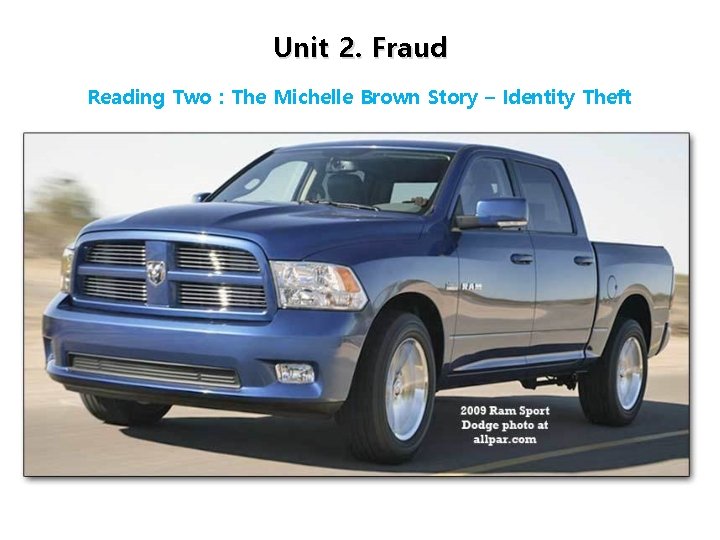
Unit 2. Fraud Reading Two : The Michelle Brown Story – Identity Theft • seemingly: 외견상으로, 겉보기에는 >> apparently • answering machine: 자동 응답기 • Dodge Ram pickup • payment past due on the loan: 대출 납입기한 이 지난 할부금
Unit 2. Fraud Reading Two : The Michelle Brown Story – Identity Theft
Unit 2. Fraud Reading Two : The Michelle Brown Story – Identity Theft • credit analyst(신용분석사): a bank employee who studies customs' bill-paying records • people found her fun to be around: ‘그녀 주위 에 있을 때 그들은 즐거움을 느꼈다. ’ • how she was too nice: ‘어찌나 그녀가 매우 멋 진지’ • Ever since ~: ~이래로 줄곧(항상) • [like + 목적어 + to 부정사] ex) 남자 아이들은 활달한게 좋다. I like boys to be lively.
Unit 2. Fraud Reading Two : The Michelle Brown Story – Identity Theft • return the call: 화답 전화를 하다 • there must have been a mistake: ‘착오가 있었 음에 틀림없다’ there is a mistake: 착오가 있다. there must be a mistake: 착오가 있음에 틀림없 다. • credit application: 신용 대출 신청서 • The phone numbers on the credit application weren't working: ‘소용이 없었다. ’ • beyond a doubt: ‘의심의 여지없이’ • stun: 깜짝 놀라게 하다; be stunned = be extremely shocked or surprised
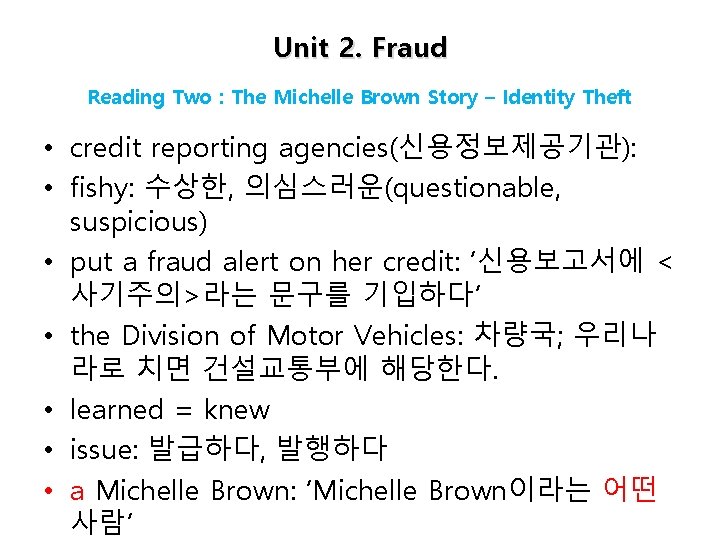
Unit 2. Fraud Reading Two : The Michelle Brown Story – Identity Theft • credit reporting agencies(신용정보제공기관): • fishy: 수상한, 의심스러운(questionable, suspicious) • put a fraud alert on her credit: ‘신용보고서에 < 사기주의>라는 문구를 기입하다’ • the Division of Motor Vehicles: 차량국; 우리나 라로 치면 건설교통부에 해당한다. • learned = knew • issue: 발급하다, 발행하다 • a Michelle Brown: ‘Michelle Brown이라는 어떤 사람’
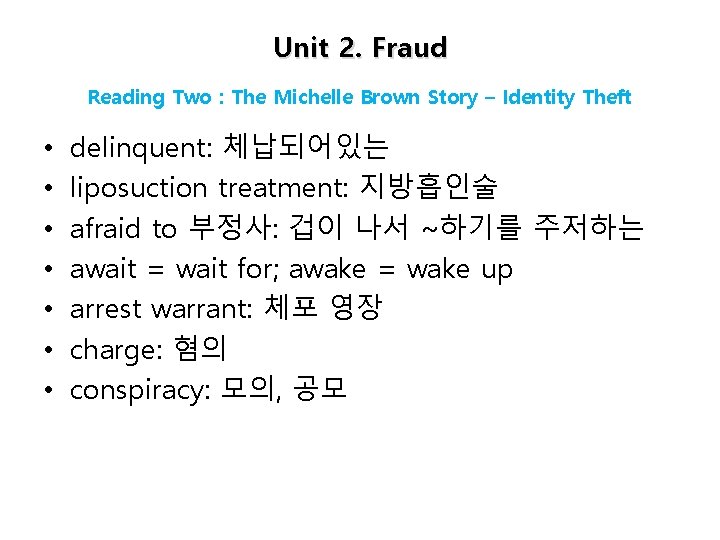
Unit 2. Fraud Reading Two : The Michelle Brown Story – Identity Theft • • delinquent: 체납되어있는 liposuction treatment: 지방흡인술 afraid to 부정사: 겁이 나서 ~하기를 주저하는 await = wait for; awake = wake up arrest warrant: 체포 영장 charge: 혐의 conspiracy: 모의, 공모
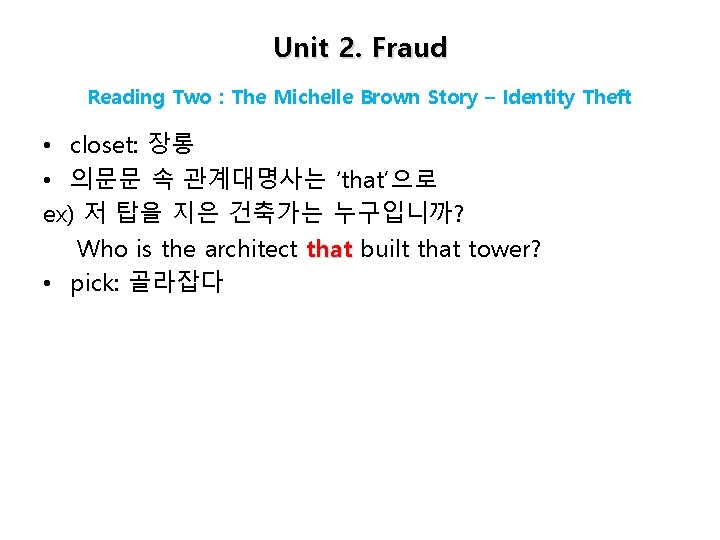
Unit 2. Fraud Reading Two : The Michelle Brown Story – Identity Theft • closet: 장롱 • 의문문 속 관계대명사는 ‘that’으로 ex) 저 탑을 지은 건축가는 누구입니까? Who is the architect that built that tower? that • pick: 골라잡다
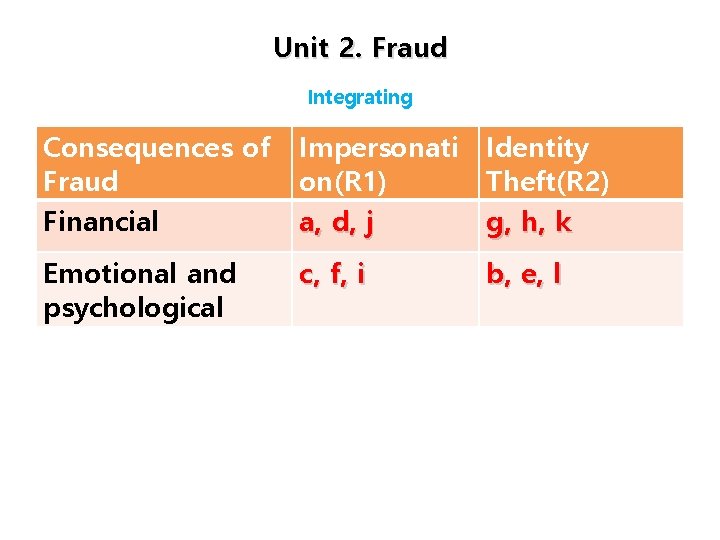
Unit 2. Fraud Integrating Consequences of Fraud Financial Impersonati Identity on(R 1) Theft(R 2) a, d, j g, h, k Emotional and psychological c, f, i b, e, l
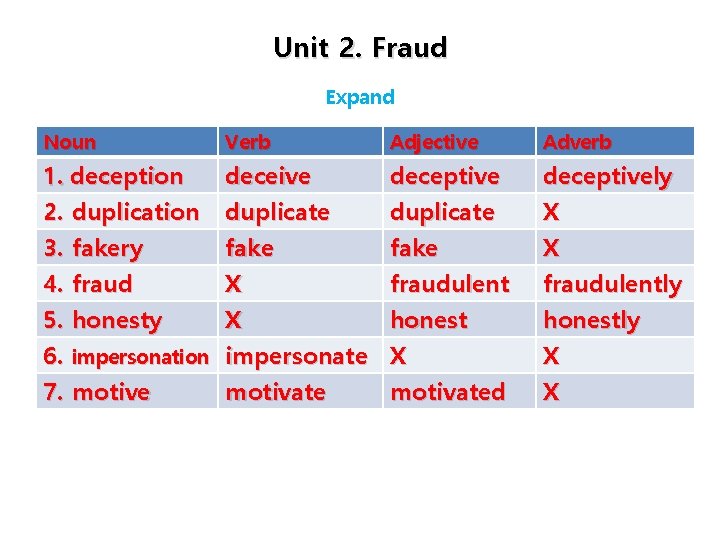
Unit 2. Fraud Expand Noun Verb Adjective Adverb 1. deception 2. duplication 3. fakery 4. fraud 5. honesty 6. impersonation 7. motive deceive duplicate fake X X deceptive duplicate fake fraudulent honest deceptively X X fraudulently honestly impersonate X motivated X X
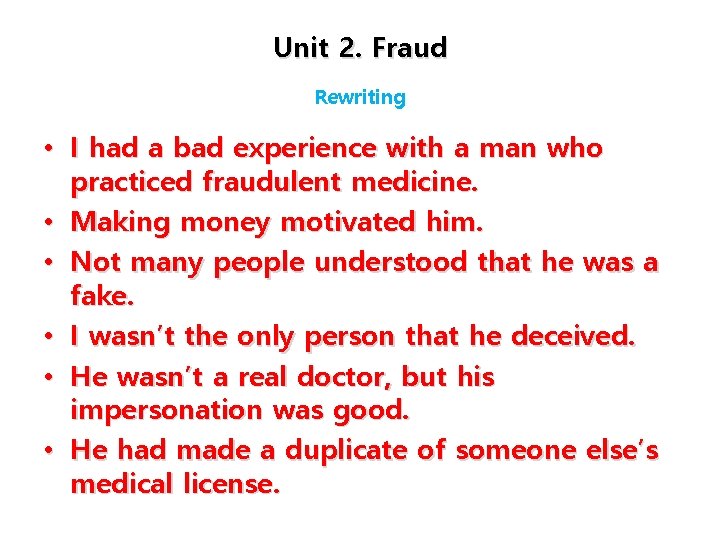
Unit 2. Fraud Rewriting • I had a bad experience with a man who practiced fraudulent medicine. • Making money motivated him. • Not many people understood that he was a fake. • I wasn’t the only person that he deceived. • He wasn’t a real doctor, but his impersonation was good. • He had made a duplicate of someone else’s medical license.
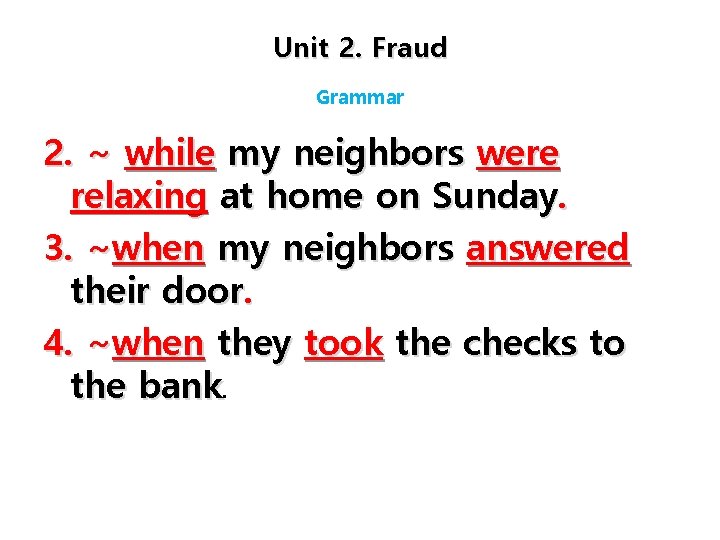
Unit 2. Fraud Grammar 2. ~ while my neighbors were relaxing at home on Sunday. 3. ~when my neighbors answered their door. 4. ~when they took the checks to the bank.
Unit 2. Fraud Grammar 3. ~while they were adding the “H” or ~while they added the “H. ” 4. ~when a bank clerk finally became suspicious of what they were doing. 5. ~, the police arrested the two men. 6. ~while I was watching the news on TV.
Unit 2. Fraud Writing • Your task : Writing a paragraph describing an experience with fraud, yours or that of someone you know.
Unit 2. Fraud Writing <Prepare to Write : Answering Questions> 1. What happened in this experience? 2. Why was this experience a fraud? 3. What were the concequences? 4. How did you or the other feel after this experience? Why?
Unit 2. Fraud Writing <Write : A Story> Describing an experience èTelling a story about something happened I. Read the paragraph and answer the questions.
Unit 2. Fraud Writing I. Read the paragraph and answer the questions.
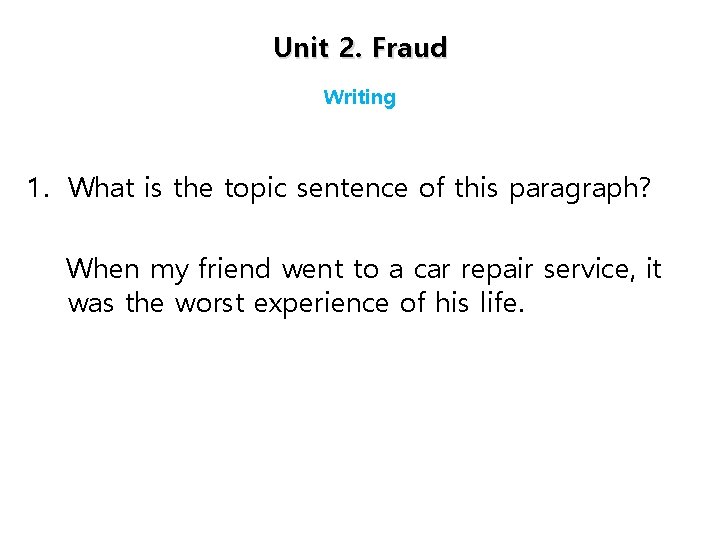
Unit 2. Fraud Writing 1. What is the topic sentence of this paragraph? When my friend went to a car repair service, it was the worst experience of his life.
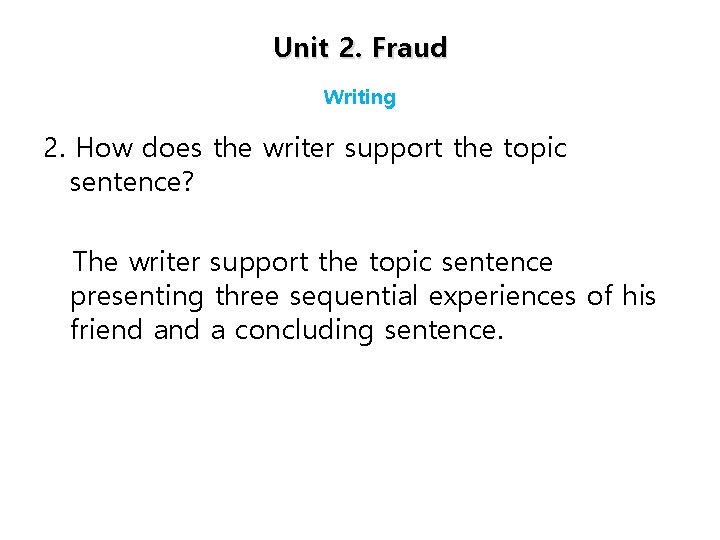
Unit 2. Fraud Writing 2. How does the writer support the topic sentence? The writer support the topic sentence presenting three sequential experiences of his friend a concluding sentence.
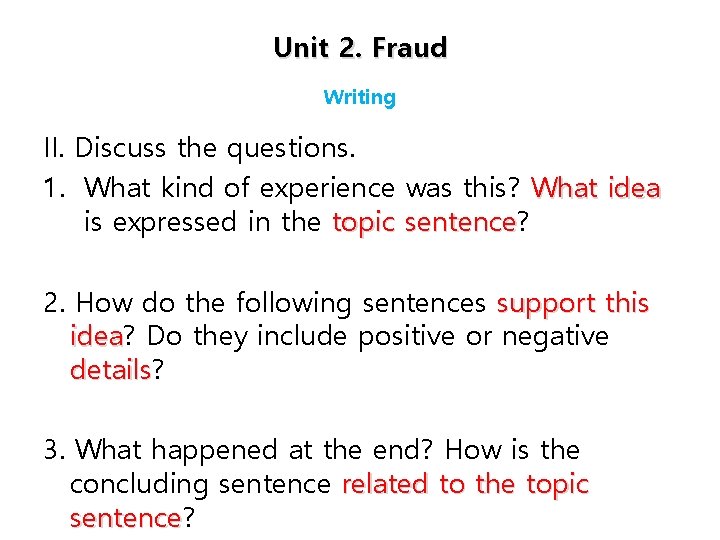
Unit 2. Fraud Writing II. Discuss the questions. 1. What kind of experience was this? What idea is expressed in the topic sentence? sentence 2. How do the following sentences support this idea? idea Do they include positive or negative details? details 3. What happened at the end? How is the concluding sentence related to the topic sentence? sentence
Unit 2. Fraud Writing Coherence!
Unit 2. Fraud Writing III. Writing the topic sentence of your paragraph èrefer to p. 33
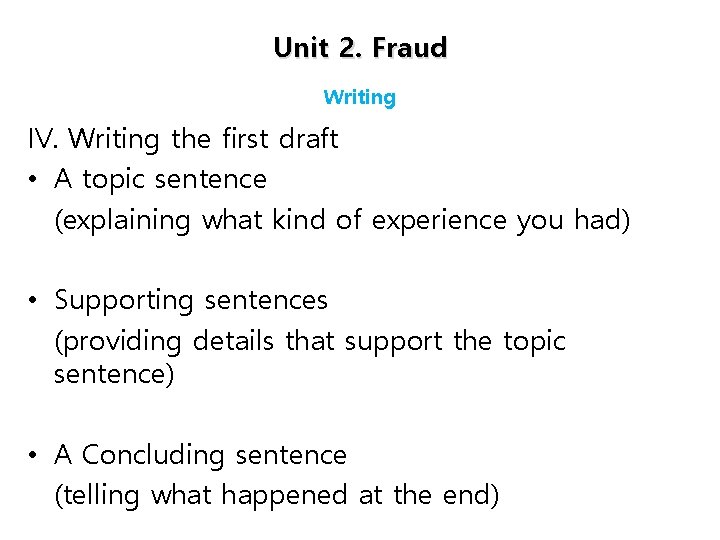
Unit 2. Fraud Writing IV. Writing the first draft • A topic sentence (explaining what kind of experience you had) • Supporting sentences (providing details that support the topic sentence) • A Concluding sentence (telling what happened at the end)
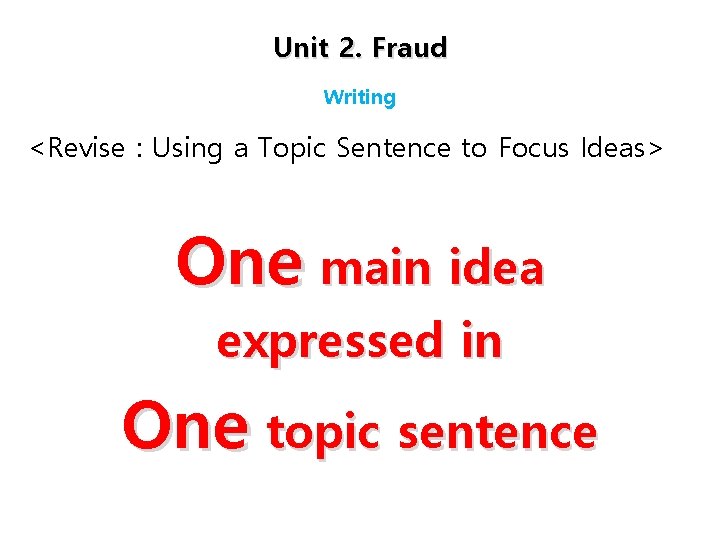
Unit 2. Fraud Writing <Revise : Using a Topic Sentence to Focus Ideas> One main idea expressed in One topic sentence
Unit 2. Fraud Writing Clarity
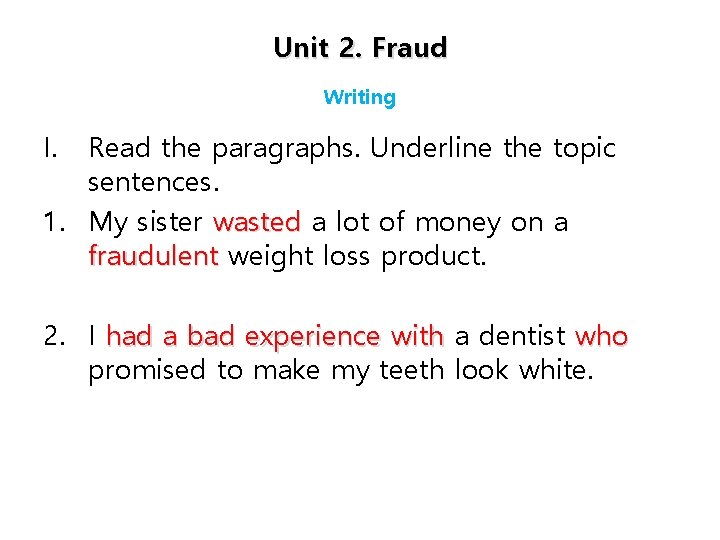
Unit 2. Fraud Writing I. Read the paragraphs. Underline the topic sentences. 1. My sister wasted a lot of money on a fraudulent weight loss product. 2. I had a bad experience with a dentist who promised to make my teeth look white.
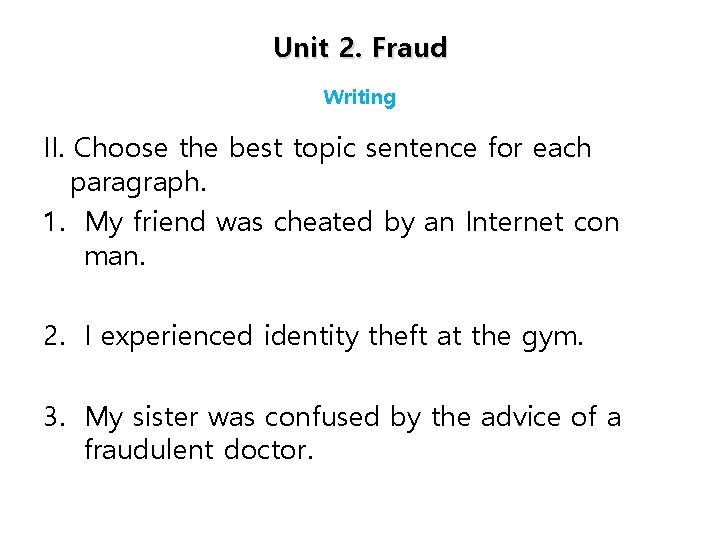
Unit 2. Fraud Writing II. Choose the best topic sentence for each paragraph. 1. My friend was cheated by an Internet con man. 2. I experienced identity theft at the gym. 3. My sister was confused by the advice of a fraudulent doctor.
Unit 2. Fraud Writing III. Rewrite the topic sentence for each paragraph. 1. 2. 3.
Unit 2. Fraud Writing <Edit : Writing the Final Draft> Coherence & Clarity
Unit 2. Fraud Writing
Unit 2. Fraud Writing
- Slides: 47