
UNIT 2 Fluid Electrolyte and AcidBase Imbalances Copyright
UNIT 2 Fluid, Electrolyte, and Acid-Base Imbalances • Copyright © 2014, 2011, 2006 by Saunders, an imprint of Elsevier, Inc. • 1
Terms � � Electrolyte vs. nonelectrolyte Anion vs. cation Electrolytes are substances that dissociate to form ions Concentration values (rather than absolute values) used to compare fluids • Copyright © 2014, 2011, 2006 by Saunders, an imprint of Elsevier, Inc. • 2
Fluid Imbalance • Copyright © 2014, 2011, 2006 by Saunders, an imprint of Elsevier, Inc. • 3
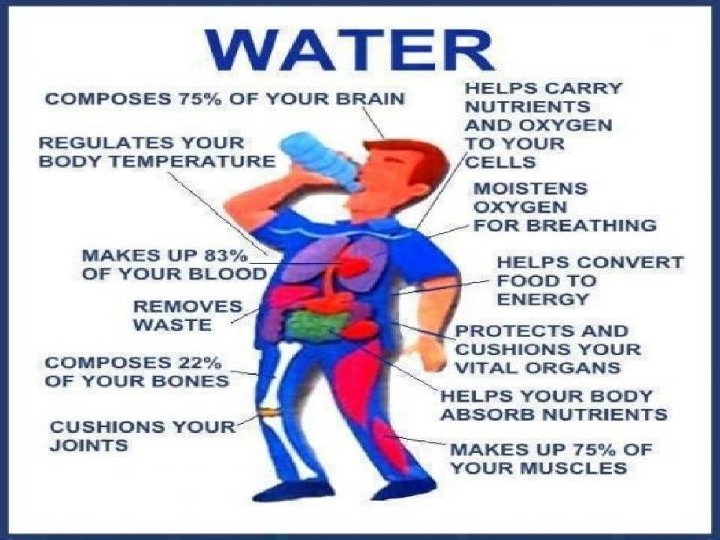
WATER • Copyright © 2014, 2011, 2006 by Saunders, an imprint of Elsevier, Inc. • 4
WATER Medium in which reactions/processes take place. � Transportation system of the body � Facilitates movement of body parts �Ex: joints, lungs, etc. � • Copyright © 2014, 2011, 2006 by Saunders, an imprint of Elsevier, Inc. • 5
Medical Significance � About 60% of an adult’s body weight is water. �About 70% of an infant’s body weight is water. �Females―higher percentage of fatty tissue, lower water content than males �Older adults and obese persons―lower proportion of water � Individuals with less fluid reserve are more likely to be adversely affected by any fluid or electrolyte imbalance. • Copyright © 2014, 2011, 2006 by Saunders, an imprint of Elsevier, Inc. • 6
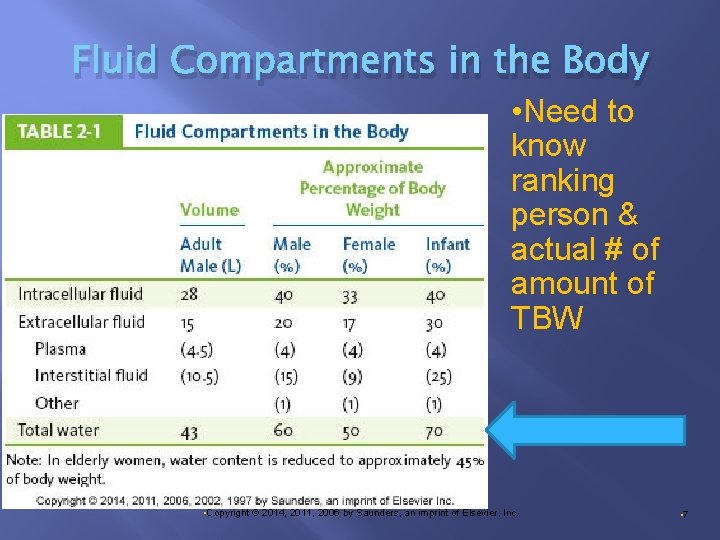
Fluid Compartments in the Body • Need to know ranking person & actual # of amount of TBW • Copyright © 2014, 2011, 2006 by Saunders, an imprint of Elsevier, Inc. • 7
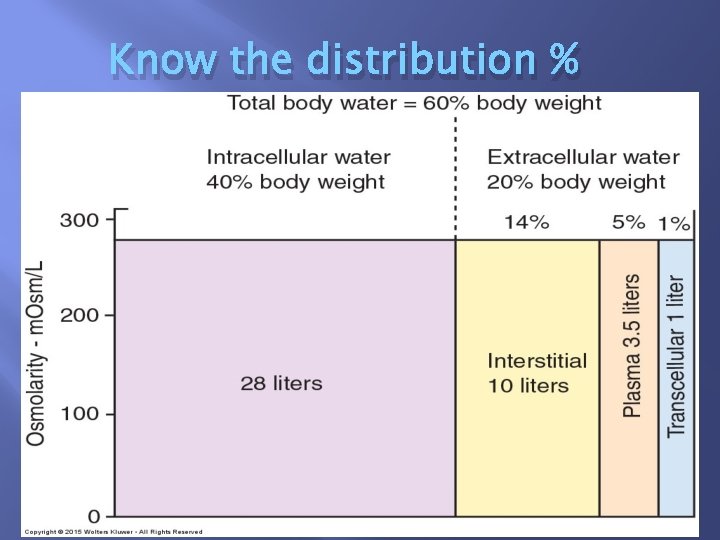
Know the distribution % • Copyright © 2014, 2011, 2006 by Saunders, an imprint of Elsevier, Inc. • 8
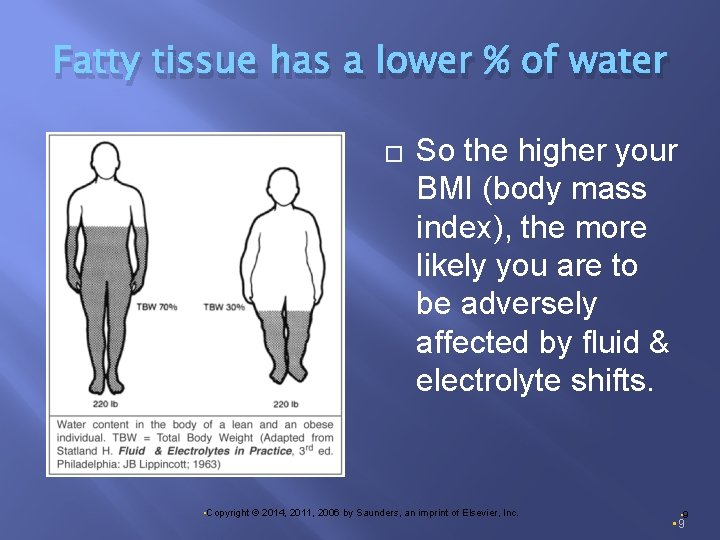
Fatty tissue has a lower % of water � So the higher your BMI (body mass index), the more likely you are to be adversely affected by fluid & electrolyte shifts. • Copyright © 2014, 2011, 2006 by Saunders, an imprint of Elsevier, Inc. • 9
Fluid Compartments in the Body The major component of the body is water in these compartments: �Intracellular fluid (ICF) compartment: fluid WITHIN cells �Extracellular fluid (ECF) compartment: fluid OUTSIDE cells � Balance of water in the compartments essential for homeostasis � • Copyright © 2014, 2011, 2006 by Saunders, an imprint of Elsevier, Inc. • 10
TBW ~ 60% of body weight � Intracellular compartment (ICF) � Fluid � inside the cells (2/3 of fluid volume) Extracellular compartment (ECF) (1/3) � Intravascular fluid (IVF) or blood (1/4) � Interstitial fluid (ISF) or intercellular fluid (3/4) � Other transcellular fluids Cerebrospinal fluid (CSF) Various secretions Lymphatic fluid Synovial & serous cavities • These fluids are usually less than 1% of the fluid • Copyright © 2014, 2011, 2006 by Saunders, an imprint of Elsevier, Inc. • 11
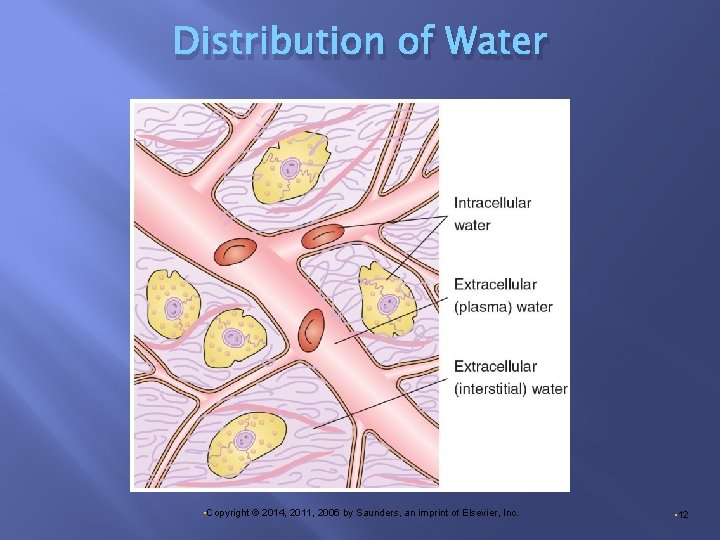
Distribution of Water • Copyright © 2014, 2011, 2006 by Saunders, an imprint of Elsevier, Inc. • 12
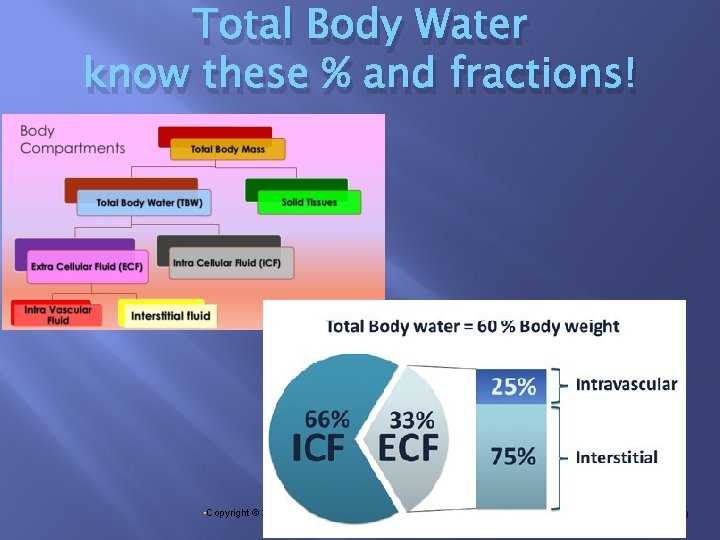
Total Body Water know these % and fractions! • Copyright © 2014, 2011, 2006 by Saunders, an imprint of Elsevier, Inc. • 13
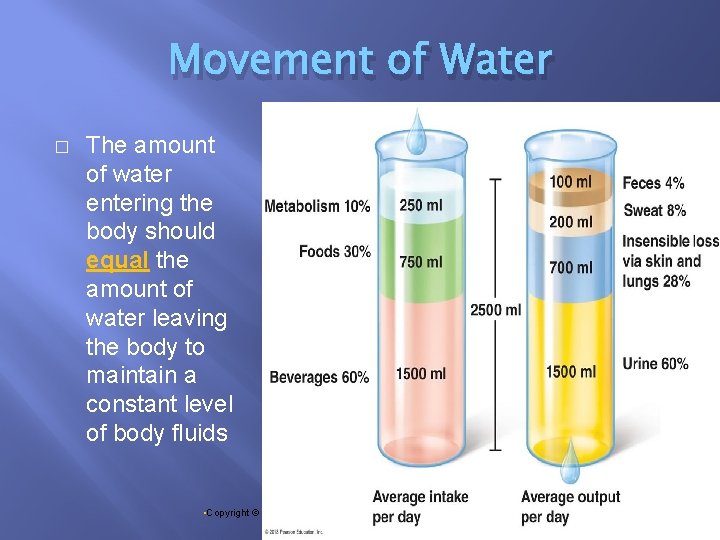
Movement of Water � The amount of water entering the body should equal the amount of water leaving the body to maintain a constant level of body fluids • Copyright © 2014, 2011, 2006 by Saunders, an imprint of Elsevier, Inc. • 14
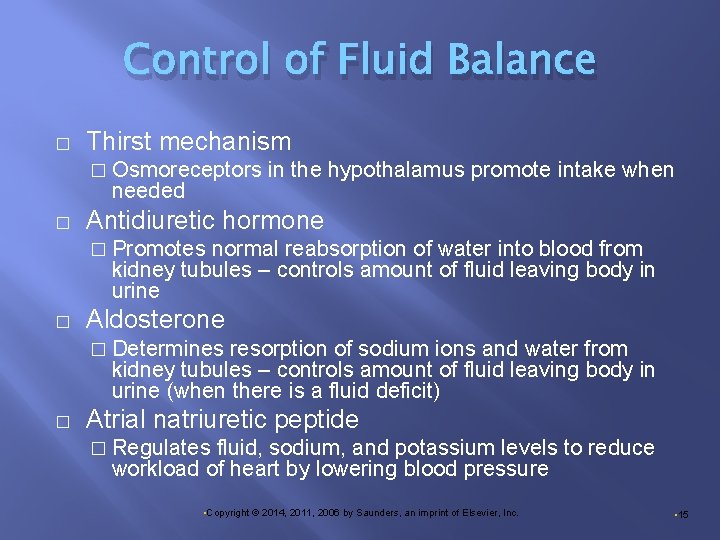
Control of Fluid Balance � Thirst mechanism � Osmoreceptors needed � in the hypothalamus promote intake when Antidiuretic hormone � Promotes normal reabsorption of water into blood from kidney tubules – controls amount of fluid leaving body in urine � Aldosterone � Determines resorption of sodium ions and water from kidney tubules – controls amount of fluid leaving body in urine (when there is a fluid deficit) � Atrial natriuretic peptide � Regulates fluid, sodium, and potassium levels to reduce workload of heart by lowering blood pressure • Copyright © 2014, 2011, 2006 by Saunders, an imprint of Elsevier, Inc. • 15
Movement of water � � The ICF and the ECF are separated by the cell membrane which maintains the appropriate concentrations of substances by active & passive processes. All water movement is passive through the process of osmosis. • Copyright © 2014, 2011, 2006 by Saunders, an imprint of Elsevier, Inc. • 16
Movement of Water � Fluid circulates throughout the body via filtration and osmosis. � Filtration: movement of water and solutes from high pressure to low pressure � Osmosis: movement of water from high concentration of water molecules to low concentration of water molecules � Water moves between IVF & ISF compartments via: � Hydrostatic pressure – tends to push water & solutes OUT of IVF into ISF � Osmotic pressure – does the opposite • Copyright © 2014, 2011, 2006 by Saunders, an imprint of Elsevier, Inc. • 17
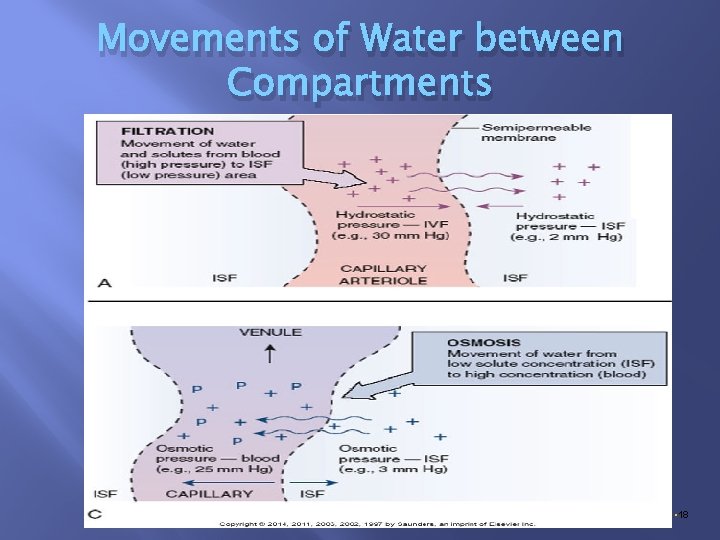
Movements of Water between Compartments • Copyright © 2014, 2011, 2006 by Saunders, an imprint of Elsevier, Inc. • 18
4 forces move H 2 O between capillaries & interstitial spaces RIGHT NOW: WRITE THESE DEFINITIONS DOWN ON FLASHCARDS! � � Capillary filtration (hydrostatic) pressure – weight of the water within the capillaries exerts a force to push water OUT of capillaries INTO interstitial space Capillary colloidal osmotic (oncotic) pressure – proteins within the capillaries exert a force to pull water INTO capillaries OUT of interstitial space Interstitial hydrostatic fluid pressure – weight of the water within the interstitial space exerts a force to push water OUT of the interstitial space INTO the capillaries Interstitial colloidal osmotic pressure – proteins within the interstitial space exert a force to pull water OUT of the capillaries INTO the interstitial space • Copyright © 2014, 2011, 2006 by Saunders, an imprint of Elsevier, Inc. • 19
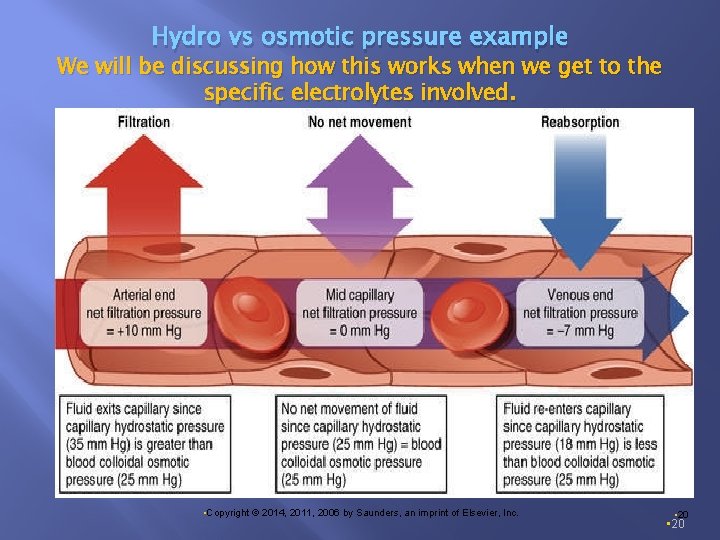
Hydro vs osmotic pressure example We will be discussing how this works when we get to the specific electrolytes involved. • Copyright © 2014, 2011, 2006 by Saunders, an imprint of Elsevier, Inc. • 20

Think About questions � In groups of 3 -4: � Complete Think About questions #1 -4 using what you have learned. � Come to a consensus in the group & write your answers on NB paper – attach to back of your notes � Be prepared to discuss your answers with the class • Copyright © 2014, 2011, 2006 by Saunders, an imprint of Elsevier, Inc. • 21
Edema Fluid Excess • Copyright © 2014, 2011, 2006 by Saunders, an imprint of Elsevier, Inc. • 22
Fluid Excess―Edema � Introduction to Edema―excessive amount of fluid in the interstitial compartment � Causes swelling or enlargement of tissue � May be localized or throughout the body � May impair tissue perfusion � May trap drugs in ISF • Copyright © 2014, 2011, 2006 by Saunders, an imprint of Elsevier, Inc. • 23
Fluid Excess � � � Excess of fluid in the EC compartment May be localized or generalized Is more severe in dependent areas � Buttocks, ankles, feet � Where force of gravity is the greatest � Prolonged edema may interfere with the following processes in the affected area: � Venous return � Arterial circulation � Cell function • Copyright © 2014, 2011, 2006 by Saunders, an imprint of Elsevier, Inc. • 24
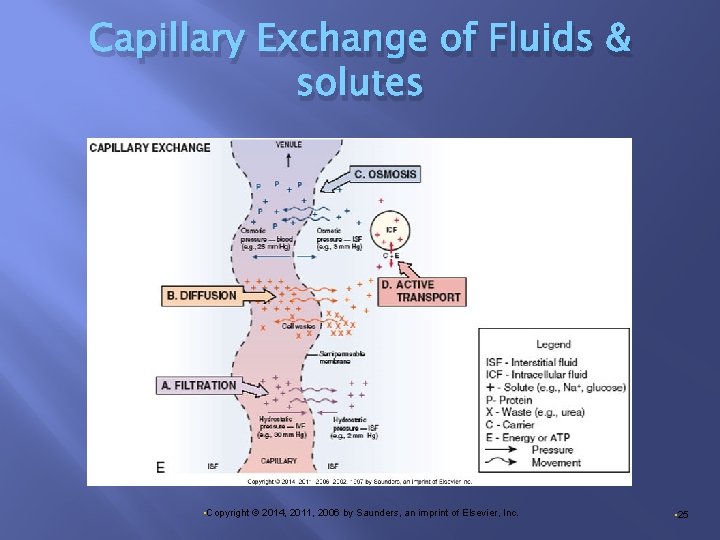
Capillary Exchange of Fluids & solutes • Copyright © 2014, 2011, 2006 by Saunders, an imprint of Elsevier, Inc. • 25
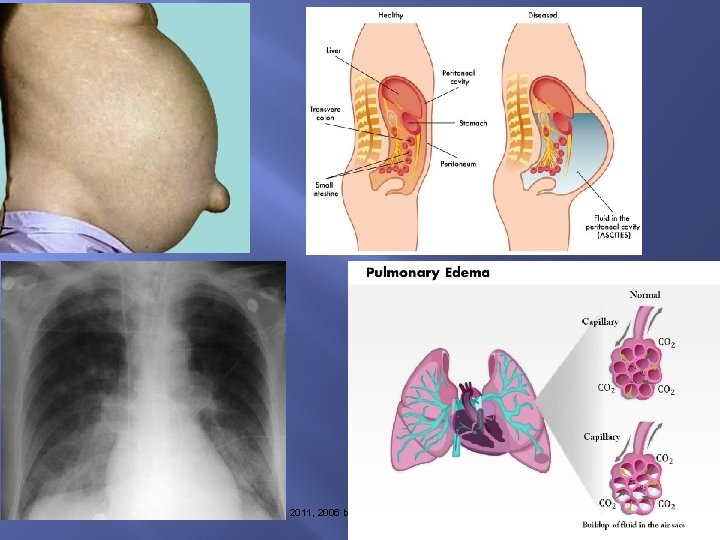
Increased capillary hydrostatic pressure � Forces increase fluid movement out of capillaries into tissue � Caused by: Hypervolemia: associated with high BP, kidney failure, pregnancy, CHF � Cause of: Pulmonary edema: fluid in the alveoli Ascites: fluid in the abdominal cavity • Copyright © 2014, 2011, 2006 by Saunders, an imprint of Elsevier, Inc. • 26
• Copyright © 2014, 2011, 2006 by Saunders, an imprint of Elsevier, Inc. • 27
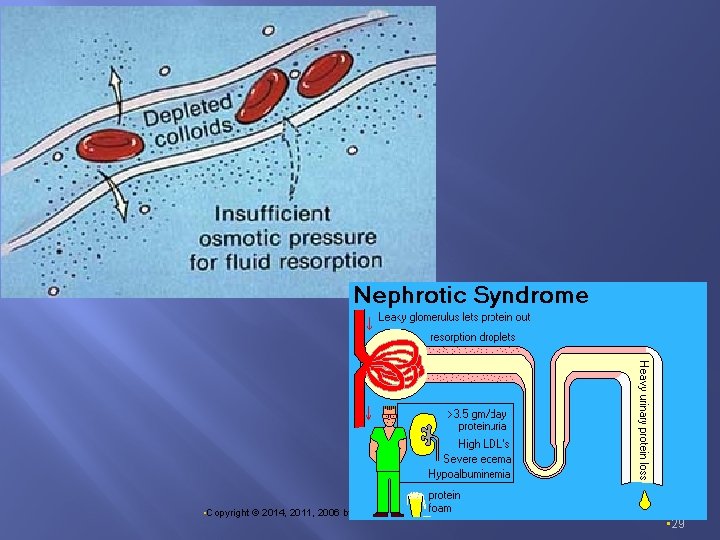
Loss of Plasma Proteins � Loss of albumin (hypoalbuminemia) – results in capillary osmotic pressure � Allows � more fluid to leave the capillaries Proteins may be lost: in urine – through CKD � Through skin – burn victims � � Synthesis of proteins impaired – through malnutrition, malabsorption, or liver disease • Copyright © 2014, 2011, 2006 by Saunders, an imprint of Elsevier, Inc. • 28
• Copyright © 2014, 2011, 2006 by Saunders, an imprint of Elsevier, Inc. • 29
Causes of Edema � Obstruction of lymphatic circulation � Causes localized edema Excessive fluid and protein not returned to general circulation � Increased capillary permeability � Usually causes localized edema May result from an inflammatory response or infection Histamines and other chemical mediators increase capillary permeability. � Can also result from some bacterial toxins or large burn wounds and result in widespread edema • Copyright © 2014, 2011, 2006 by Saunders, an imprint of Elsevier, Inc. • 30
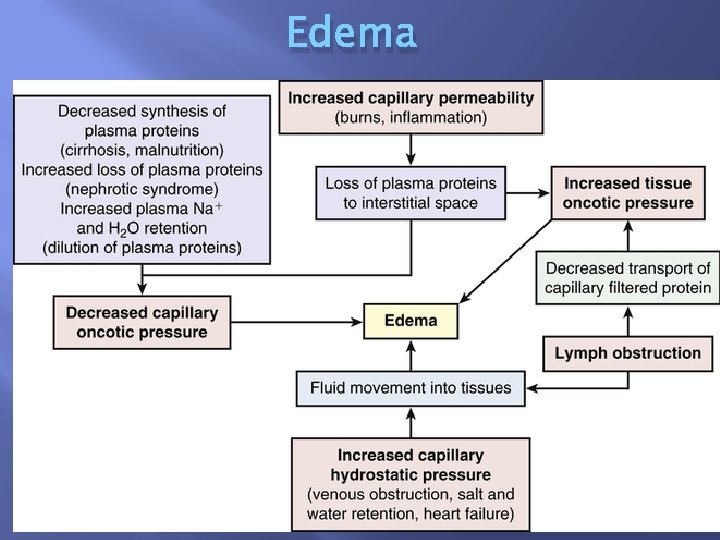
Edema • Copyright © 2014, 2011, 2006 by Saunders, an imprint of Elsevier, Inc. • 31
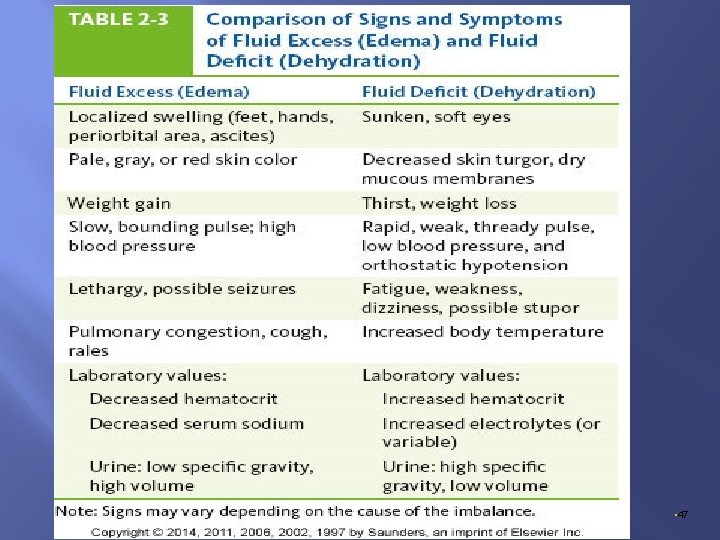
Effects of Edema � Swelling � Pale � or red in color – dependent on cause Pitting edema � Presence of excess ISF � Depression―“pit” remains when external pressure is removed � Susceptible to tissue ischemia from pressure � Increase in body weight � With generalized edema • Copyright © 2014, 2011, 2006 by Saunders, an imprint of Elsevier, Inc. • 32
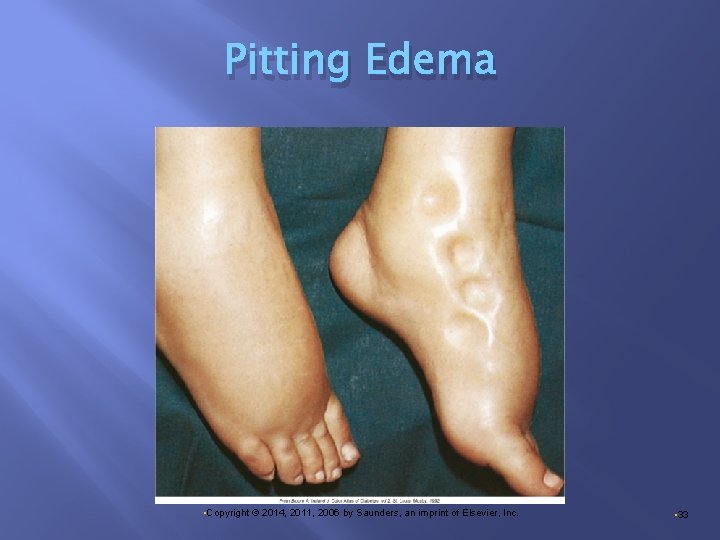
Pitting Edema • Copyright © 2014, 2011, 2006 by Saunders, an imprint of Elsevier, Inc. • 33
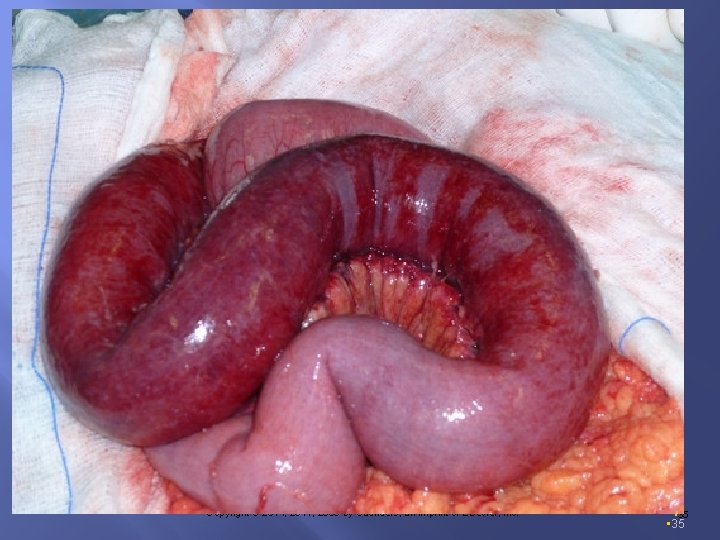
Effects of Edema (cont’d. ) � Functional impairment � Restricts range of joint movement � Intestinal wall edema may interfere with digestion & absorption of nutrients � Reduced vital capacity – lung impairment � Impaired diastole – effect on heart � Pain � Edema exerts pressure on nerves locally – may lead to permanent damage if not resolved quickly � Headache with cerebral edema – increased ICP � Stretching of organ capsules (kidney, liver) • Copyright © 2014, 2011, 2006 by Saunders, an imprint of Elsevier, Inc. • 34
• Copyright © 2014, 2011, 2006 by Saunders, an imprint of Elsevier, Inc. • 35
Effects of Edema (cont’d. ) � Impaired arterial circulation � ISF restricts arterial flow - nutrients to cells – leads to ischemia - cell function & cell mitosis � Edematous tissue � Susceptible to tissue breakdown from: Pressure Abrasion External chemicals • Copyright © 2014, 2011, 2006 by Saunders, an imprint of Elsevier, Inc. • 36
Dehydration Fluid Deficit • Copyright © 2014, 2011, 2006 by Saunders, an imprint of Elsevier, Inc. • 37
Fluid Deficit―Dehydration Insufficient body fluid �Inadequate intake �Excessive loss – more common – affect ECF first �Both � Fluid loss often measured by change in body weight � • Copyright © 2014, 2011, 2006 by Saunders, an imprint of Elsevier, Inc. • 38
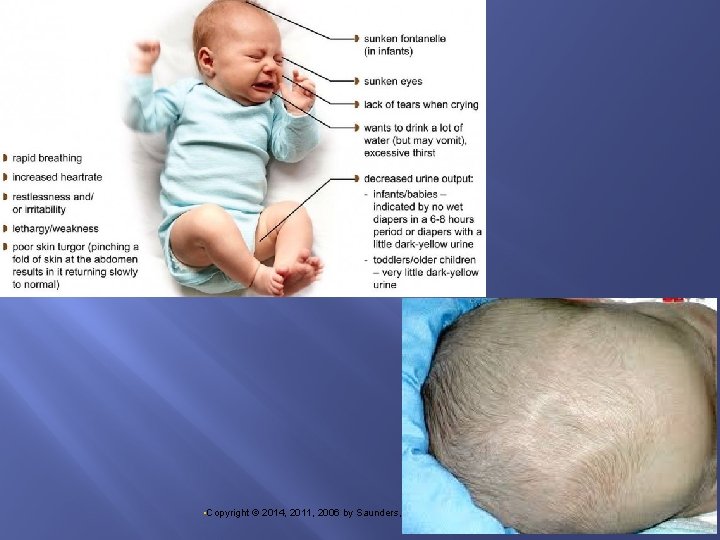
Fluid Deficit―Dehydration � Dehydration more serious in infants and older adults � Lack fluid reserve � Lack ability to conserve water quickly � Infants increased metabolic water needs � Become hypovolemic quickly – affects heart, brain, kidneys � Signs: urine output, lethargy, dry mucosa � • Copyright © 2014, 2011, 2006 by Saunders, an imprint of Elsevier, Inc. • 39
Fluid Deficit―Dehydration � � � Water loss may be accompanied by loss of electrolytes and proteins (e. g. , diarrhea). Can lead to changes in osmotic & colloidal pressures – affecting fluid shift even more Lead to �Hypotonic dehydration – loss of more electrolytes �Hypertonic dehydration – loss of more water • Copyright © 2014, 2011, 2006 by Saunders, an imprint of Elsevier, Inc. • 40
• Copyright © 2014, 2011, 2006 by Saunders, an imprint of Elsevier, Inc. • 41
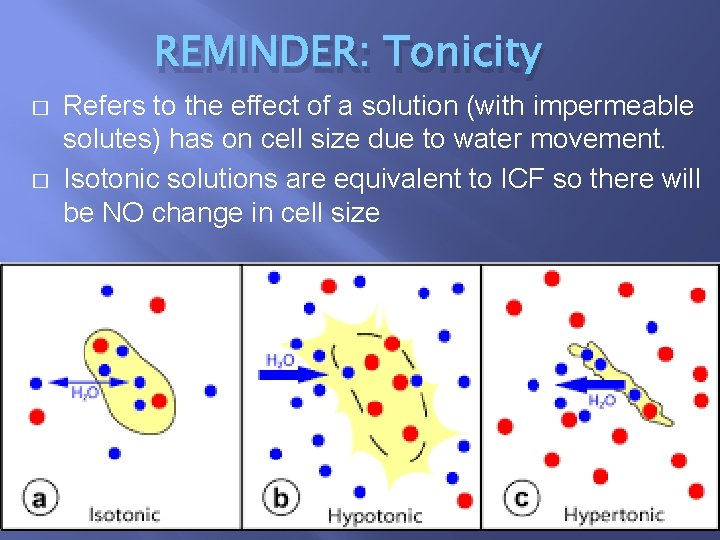
REMINDER: Tonicity � � Refers to the effect of a solution (with impermeable solutes) has on cell size due to water movement. Isotonic solutions are equivalent to ICF so there will be NO change in cell size • Copyright © 2014, 2011, 2006 by Saunders, an imprint of Elsevier, Inc. • 42
Causes of Dehydration � Vomiting and diarrhea � Loss � Excessive sweating � Loss � � of sodium and water Diabetic ketoacidosis � Loss � of electrolytes, nutrients & water of water, electrolytes, and glucose in the urine Insufficient water intake in older adults or unconscious persons Use of concentrated formula in infants • Copyright © 2014, 2011, 2006 by Saunders, an imprint of Elsevier, Inc. • 43
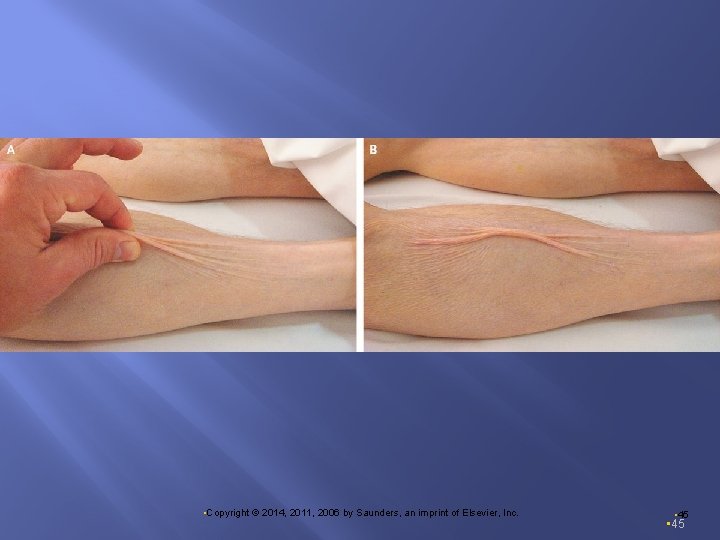
Direct Effects of Dehydration � � Dry mucous membranes in the mouth Decreased skin turgor or elasticity Lower blood pressure, weak pulse, and fatigue hematocrit - ratio of RBCs to water � � “thickens” blood – may BP Decreased mental function, confusion, loss of consciousness � brain cells function • Copyright © 2014, 2011, 2006 by Saunders, an imprint of Elsevier, Inc. • 44
• Copyright © 2014, 2011, 2006 by Saunders, an imprint of Elsevier, Inc. • 45
Putting facts together Discuss why each of the following signs & symptoms occur during edema or dehydration. • Copyright © 2014, 2011, 2006 by Saunders, an imprint of Elsevier, Inc. • 46
• Copyright © 2014, 2011, 2006 by Saunders, an imprint of Elsevier, Inc. • 47
Attempts to Compensate for Fluid Loss � � � Increasing thirst (prompted by hypothalamus) Increasing heart rate (prompted by hypovolemia) Constriction of cutaneous blood vessels � Forces � blood to vital organs Urine―low volume and high specific gravity � Producing less urine – conserve water � Concentration of urine � Due to renal vasoconstriction , increased secretion of ADH & aldosterone • Copyright © 2014, 2011, 2006 by Saunders, an imprint of Elsevier, Inc. • 48

Third Spacing • Copyright © 2014, 2011, 2006 by Saunders, an imprint of Elsevier, Inc. • 49
• Copyright © 2014, 2011, 2006 by Saunders, an imprint of Elsevier, Inc. • 50
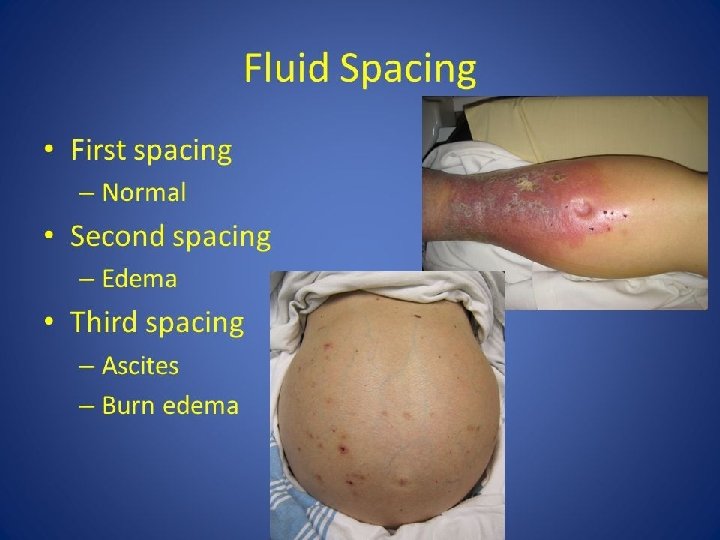
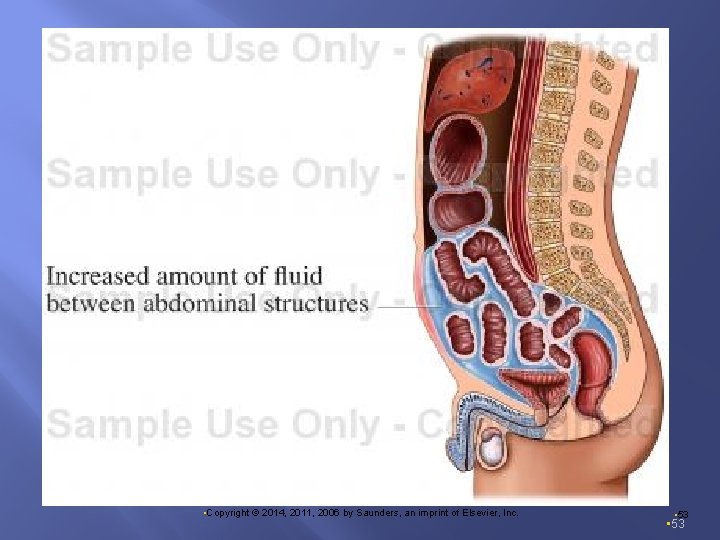
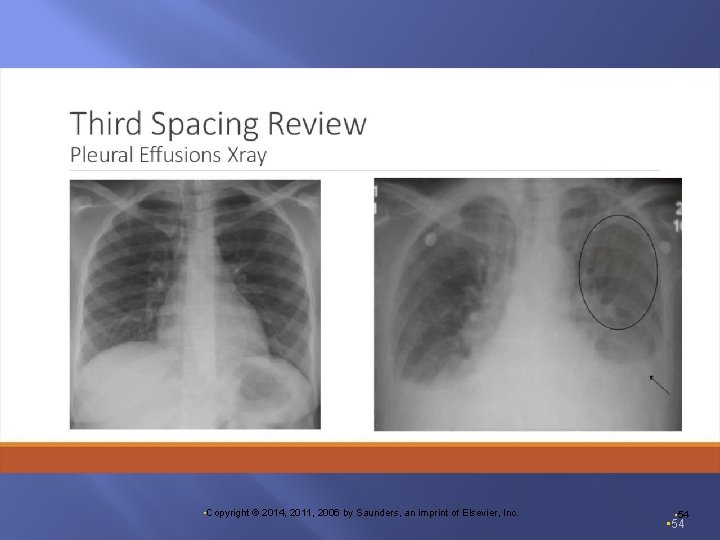
Third-Spacing of Fluid � Third Space Accumulation � Buildup of ECF in transcompartmental space � Fluid shifts out of the blood into body cavity or tissue and can no longer reenter vascular compartment. � No longer available as circulating fluid (not functional) � Results in: � Hypovolemia � ISF � Effusions: excess fluid in serous membranes • Copyright © 2014, 2011, 2006 by Saunders, an imprint of Elsevier, Inc. • 51
Third-Spacing of Fluid � Severity based on location � Brain, � larynx, lung: life threatening!! Causes: � High osmotic pressure of ISF, as in burns or peritonitis � Increased capillary permeability due to inflammation • Copyright © 2014, 2011, 2006 by Saunders, an imprint of Elsevier, Inc. • 52
• Copyright © 2014, 2011, 2006 by Saunders, an imprint of Elsevier, Inc. • 53
• Copyright © 2014, 2011, 2006 by Saunders, an imprint of Elsevier, Inc. • 54
- Slides: 54