
Unit 2 Evolution Lesson 1 Genetic Change and

- Slides: 29
Unit 2 Evolution • Lesson 1 Genetic Change and Traits
Introduction to The Characteristics Of Cells • Objective(s): 1) I can list the components of the animal and plant cell and specify their functions.
Introduction to The Characteristics Of Cells • A cell is the smallest functional and structural unit of all living organisms. • An organism is any living that carries out its own life processes. • Robert Hooke was the first to describe cells. He looked at the bark of a cork tree under a microscope.
Recall: Cell Theory • The cell theory lists three basic characteristics of all cells and organisms. • All organisms are made up of one or more cells. • The cell is the basic unit of all organisms. • All cells come from existing cells
The Cell Theory • Organisms made up of just one cell are called unicellular organisms. • The single cell must carry out all of the organism’s life functions. • Organisms made up of more than one cell are called multicellular organisms. • The cells of multicellular organisms have specialized functions.
What are the two types of cells? • Prokaryotes are single-celled organisms that do not have a nucleus or membrane-bound organelles. • Prokaryotes’ DNA is in the cytoplasm. They have organelles without cell membranes called ribosomes. • Some have hairlike structures called flagella that help them move.
What are the two types of cells? • Eukaryotes are organisms made up of cells that contain DNA in a nucleus, membrane-bound organelles, and ribosomes. • Animals, plants, protists, and fungi are eukaryotes. • Most eukaryotes are multicellular but some are unicellular.
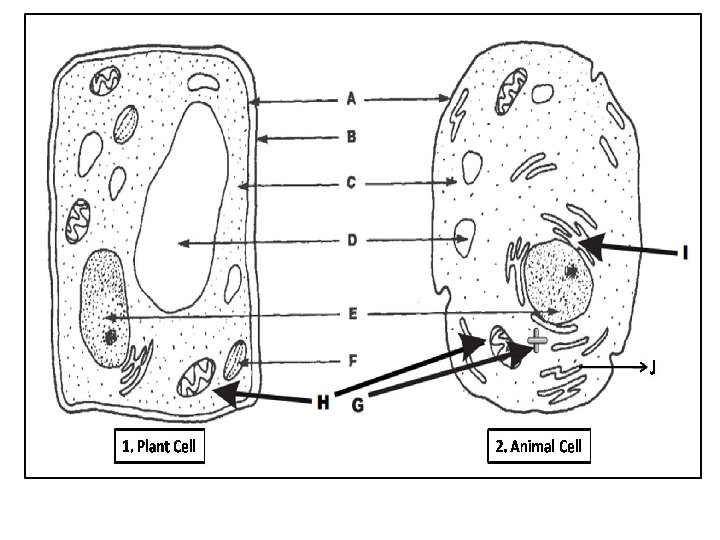
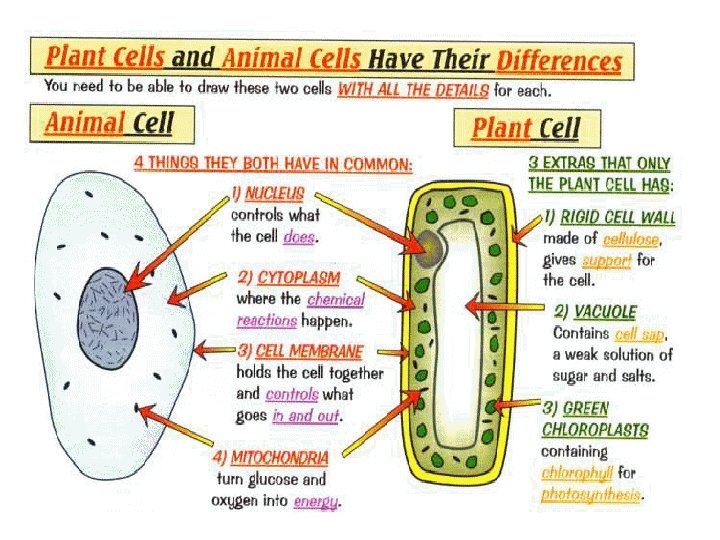
What parts do all cells have in common? • All cells have some structures in common. • A cell membrane is a protective layer that covers a cell’s surface and controls materials moving into and out of the cell. • The cytoplasm is the region inside the cell that includes the fluid and all the organelles except for the nucleus.
What parts do all cells have in common? • An organelle is a small body in the cytoplasm that is specialized to perform a specific function. • The nucleus is a membrane-bound organelle that contains DNA. • DNA, or deoxyribonucleic acid, is genetic material that provides instructions for all cell processes.
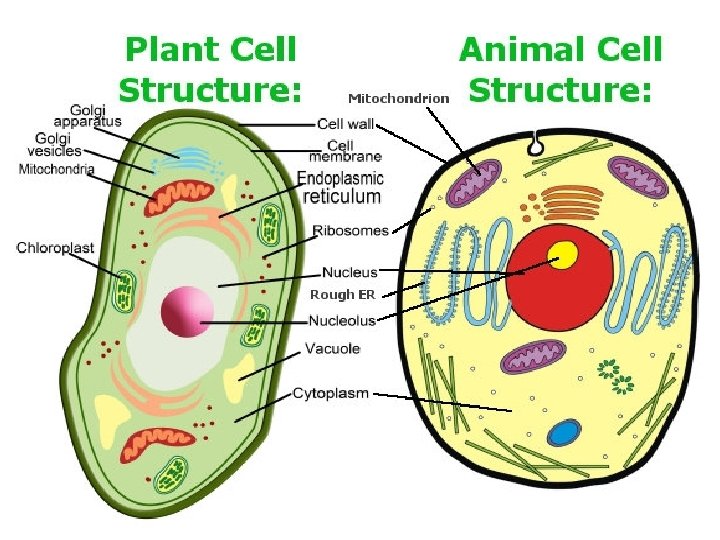
What are the characteristics of eukaryotic cells? • Eukaryotic cells differ from each other depending on their structure and function. • Structure is the arrangement of parts. Function is the activity the parts carry out. • All eukaryotic cells have a nucleus, membranebound organelles, and parts that protect and support the cell.
• The cell membrane protects the cell and regulates what enters and leaves the cell. • Throughout the cytoplasm of eukaryotic cells is a cytoskeleton, or network of protein filaments that gives shape and support to cells. • The cytoskeleton also helps in cell division and in movement. • The nucleus is an organelle that contains the cell’s genetic material or DNA. • Instructions for making proteins are stored in DNA and sent out of the nucleus through pores in the nuclear membrane.
• Cellular respiration is the process by which cells get energy by breaking down food. • Mitochondrion is an organelle where cellular respiration occurs. • Mitochondria have their own DNA and two membranes. • Ribosomes are organelles that make proteins by putting together chains of amino acids. • Ribosomes are not enclosed in a membrane. • Some ribosomes are free, and others are attached to an organelle called the endoplasmic reticulum.
• The endoplasmic reticulum, or ER, assists in the production, processing, and transport of proteins and in the production of lipids. • Rough ER has ribosomes attached to its membrane. • Smooth ER makes lipids and breaks down toxins. • The Golgi complex is a system of flattened membrane sacs. It packages and distributes materials in a cell. • Lipids and proteins from the ER are delivered to the Golgi complex to be modified for different jobs. • Vesicles of pinched-off Golgi complex membrane carry products out of the cell or to other parts of the cell.
What additional part is found in animal cells? • Lysosomes are organelles in animal cells that contain digestive enzymes. • These enzymes break down damaged organelles, waste material, and foreign invaders in the cell. • Some of these materials are collected in vacuoles. A lysosome attaches to the vacuole and releases the digestive enzymes inside.
What additional parts are found in plant cells? • In plants, the cell wall is a rigid structure that surrounds the cell membrane, providing support and protection to the cell. • Some fungi, archaea, bacteria, and protists also have cell walls. • A vacuole is a fluid-filled vesicle found in the cells of most animals, plants, and fungi. • A vacuole may contain enzymes, nutrients, water, or wastes. • Plant cells have large central vacuoles that store water and help support the cell.
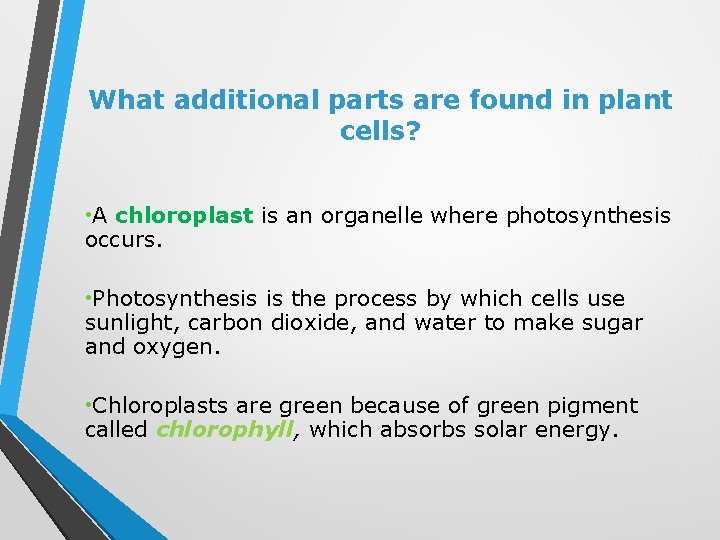
What additional parts are found in plant cells? • A chloroplast is an organelle where photosynthesis occurs. • Photosynthesis is the process by which cells use sunlight, carbon dioxide, and water to make sugar and oxygen. • Chloroplasts are green because of green pigment called chlorophyll, which absorbs solar energy.
Objective(s) 2) I can explain what DNA is and how does it work.
Task 2 a) Watch the following Stated Clearly Video-What is DNA and How Does it Work • Link: https: //youtu. be/zwibg. NGe 4 a. Y b) Take notes while watching the video.
DNA Structure and Function Cracking the Code What is DNA? • The genetic material in cells is contained in a molecule called deoxyribonucleic acid, or DNA. • Scientists describe DNA as containing a code. A code is a set of rules and symbols used to carry information. • To understand how DNA functions, you first need to learn about the structure of the DNA molecule. Copyright © Houghton Mifflin Harcourt Publishing Company
Unit 2 Lesson 6 DNA Structure and Function How was DNA discovered? • Many scientists from all over the world contributed to our understanding of DNA. • Some scientists discovered the chemicals that make up DNA, and others learned how these chemicals fit together. • Still others determined the three-dimensional structure of the DNA molecule. Copyright © Houghton Mifflin Harcourt Publishing Company
Unit 2 Lesson 6 DNA Structure and Function Unraveling DNA What does DNA look like? • Experiments and imaging techniques have helped scientists to infer the shape of DNA. • The structure of DNA is a twisted ladder shape called a double helix. Copyright © Houghton Mifflin Harcourt Publishing Company
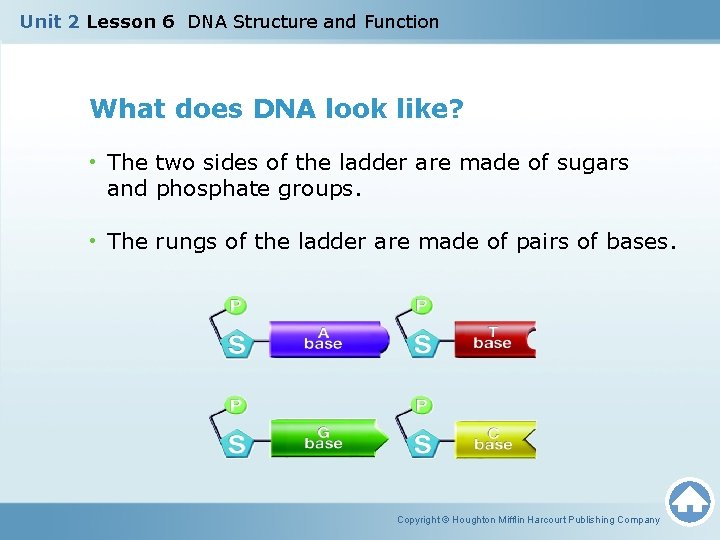
Unit 2 Lesson 6 DNA Structure and Function What does DNA look like? • The two sides of the ladder are made of sugars and phosphate groups. • The rungs of the ladder are made of pairs of bases. Copyright © Houghton Mifflin Harcourt Publishing Company
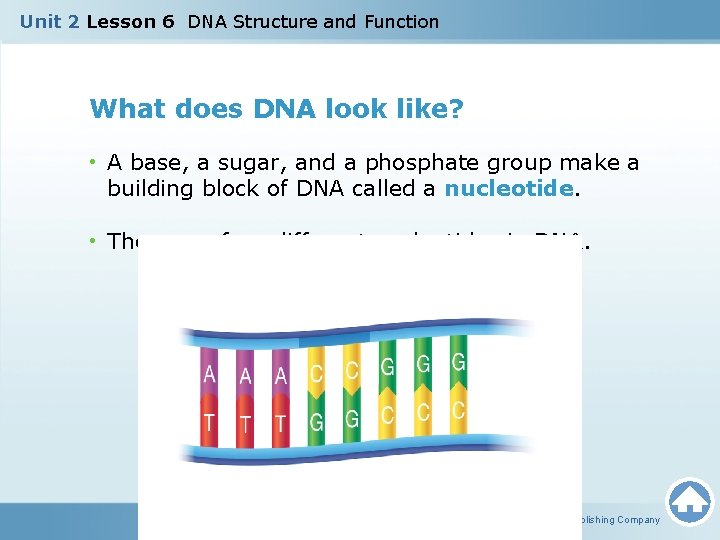
Unit 2 Lesson 6 DNA Structure and Function What does DNA look like? • A base, a sugar, and a phosphate group make a building block of DNA called a nucleotide. • There are four different nucleotides in DNA. Copyright © Houghton Mifflin Harcourt Publishing Company
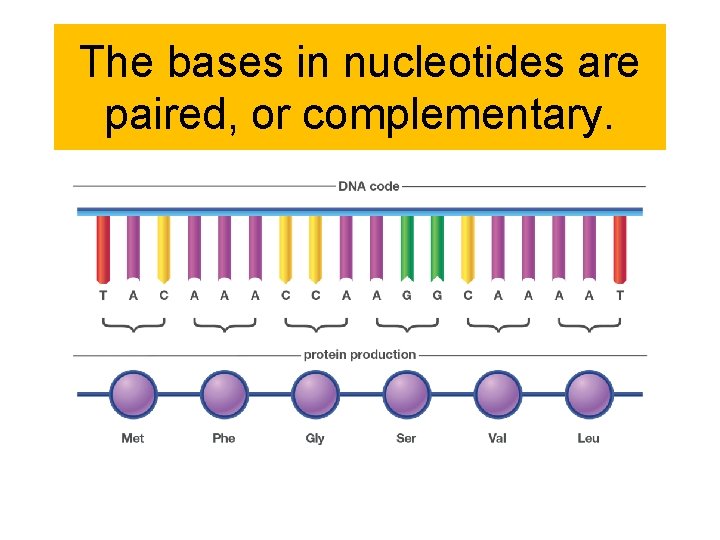
Unit 2 Lesson 6 DNA Structure and Function What does DNA look like? • The bases in nucleotides are paired, or complementary. • Adenine always pairs with thymine (A-T). • Cytosine always pairs with guanine (C-G). • The order of the nucleotides in DNA is a code that carries information. Copyright © Houghton Mifflin Harcourt Publishing Company
The bases in nucleotides are paired, or complementary.