
Unit 2 Ecology 2 2 CYCLES OF MATTER
- Slides: 13
Unit 2: Ecology 2. 2 CYCLES OF MATTER
Recycling in the Biosphere Unlike the one-way flow of energy, matter is recycled within and between ecosystems-we call these biogeochemical cycles. Matter cycles because biological systems do not use up the matter, they transform it.
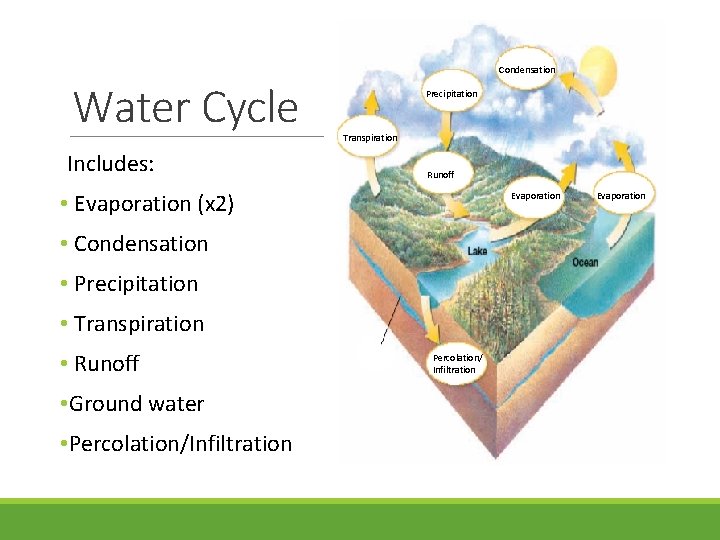
Water Cycle The Water Cycle: The continuous movement of water on, above, or below the surface of the Earth • The mass of water on Earth remains constant over time, it is just redistributed throughout different parts of Earth and its atmosphere.
Condensation Water Cycle Includes: Precipitation Transpiration Runoff • Evaporation (x 2) Evaporation • Condensation • Precipitation • Transpiration • Runoff • Ground water • Percolation/Infiltration Percolation/ Infiltration Evaporation
Nutrient Cycles • A nutrient is a chemical substance that all organisms need to sustain lifethe body’s “chemical building blocks” • Carbon, Nitrogen and Phosphorous cycles are especially important. • Note that oxygen participates in all of these cycles by combining with these elements and cycling with them.
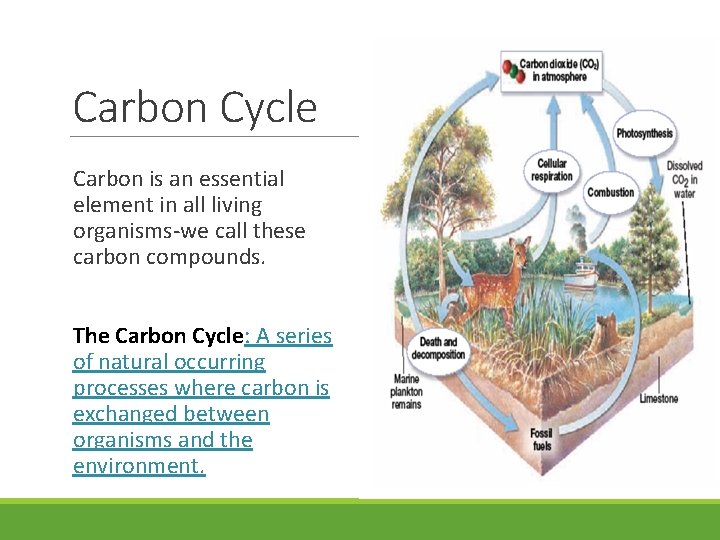
Carbon Cycle Carbon is an essential element in all living organisms-we call these carbon compounds. The Carbon Cycle: A series of natural occurring processes where carbon is exchanged between organisms and the environment.
The Carbon Cycle There are four main types of processes that move carbon through its cycle: ◦ Biological processes: photosynthesis, respiration, and decomposition take up and release carbon and oxygen ◦ Geochemical processes: erosion and volcanic activity release carbon dioxide into the atmosphere and oceans. ◦ Mixed biogeochemical processes: the burial and decomposition of dead organisms and their conversion under pressure to fossil fuels, store carbon underground. ◦ Human activities: mining, cutting and burning of forests, and burning fossil fuels release carbon dioxide into the atmosphere.
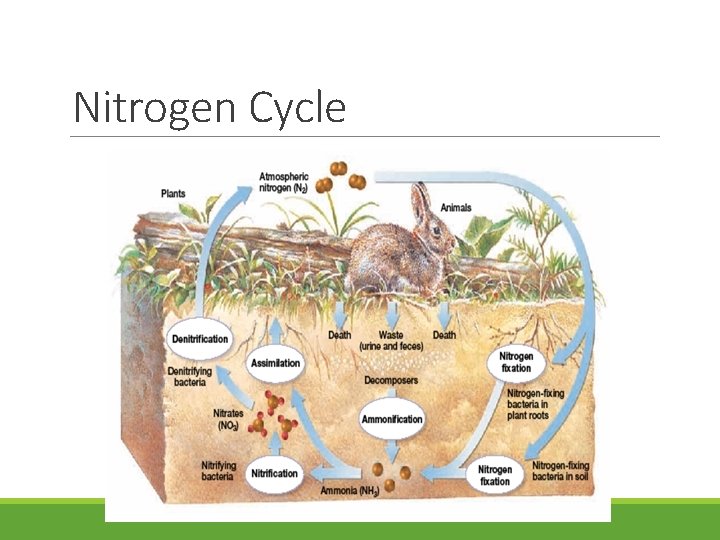
The Nitrogen Cycle All organisms require Nitrogen to make amino acids, which are used to build proteins. Forms of Nitrogen on Earth ◦ Nitrogen gas makes up 78% of Earth’s atmosphere ◦ Nitrogen containing substances (ammonia (NH 3), nitrate ions (NO 3 -), and nitrite ions (NO 2 -)) are found in waste products and are produced by dead and decaying organic matter. ◦ Nitrogen is found in large quantities in the oceans and other large bodies of water. ◦ Humans add Nitrogen through fertilizers. The Nitrogen Cycle: The series of processes by which nitrogen and its compounds are interconverted in the environment and in living organisms, including nitrogen fixation and decomposition. • Bacteria “fix” atmospheric nitrogen, making ammonia (nitrogen) available to other organisms. • This is accomplished through a symbiotic relationship between bacteria and the roots of legumes (beans)
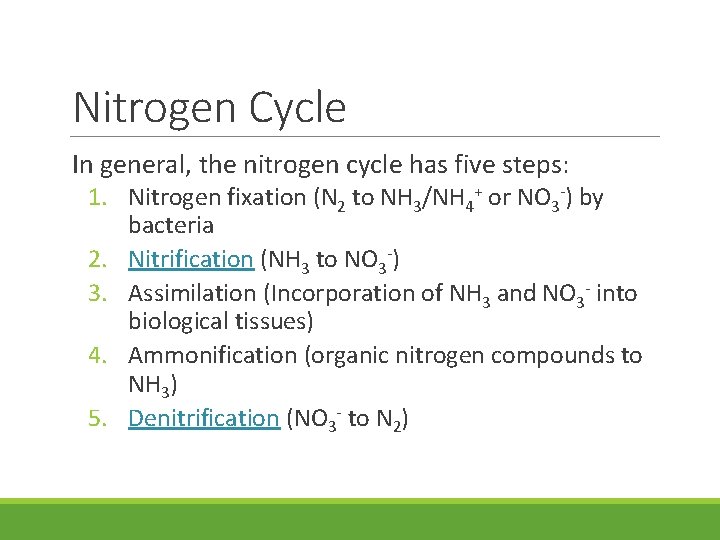
Nitrogen Cycle In general, the nitrogen cycle has five steps: 1. Nitrogen fixation (N 2 to NH 3/NH 4+ or NO 3 -) by bacteria 2. Nitrification (NH 3 to NO 3 -) 3. Assimilation (Incorporation of NH 3 and NO 3 - into biological tissues) 4. Ammonification (organic nitrogen compounds to NH 3) 5. Denitrification (NO 3 - to N 2)
Nitrogen Cycle
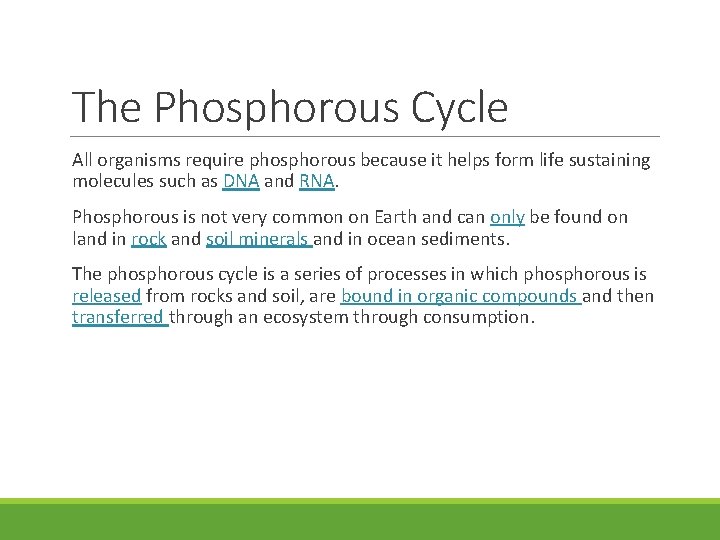
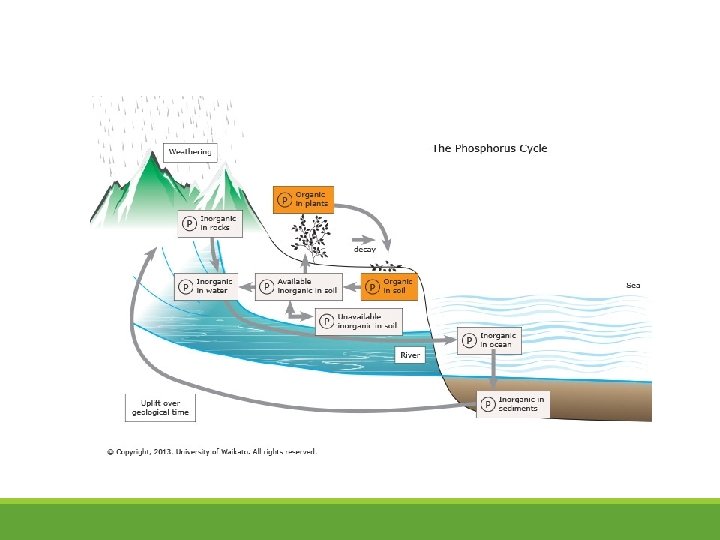
The Phosphorous Cycle All organisms require phosphorous because it helps form life sustaining molecules such as DNA and RNA. Phosphorous is not very common on Earth and can only be found on land in rock and soil minerals and in ocean sediments. The phosphorous cycle is a series of processes in which phosphorous is released from rocks and soil, are bound in organic compounds and then transferred through an ecosystem through consumption.
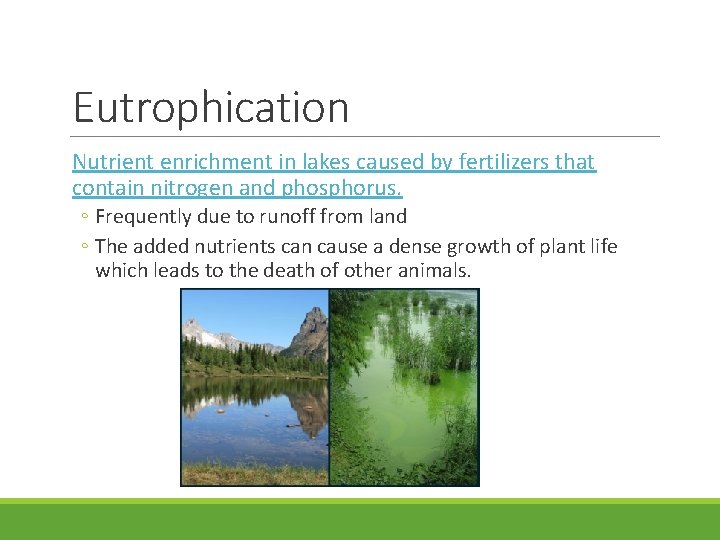
Eutrophication Nutrient enrichment in lakes caused by fertilizers that contain nitrogen and phosphorus. ◦ Frequently due to runoff from land ◦ The added nutrients can cause a dense growth of plant life which leads to the death of other animals.