
UNIT 2 CULTURE Unit Objective To define the
UNIT 2: CULTURE Unit Objective: To define the term culture, to clarify the difference between culture and society. To identify and explain the components of culture.
PEOPLE CONSTANTLY INTERCHANGE SOCIETY AND CULTURE… Are they the same?
• Society: NO! ~A group of interdependent people ~ Participate in a common culture ~ Sense of unity ~ Share material and non material products ~ Society consists of people. ~ Culture consists of the material and nonmaterial products that people create.
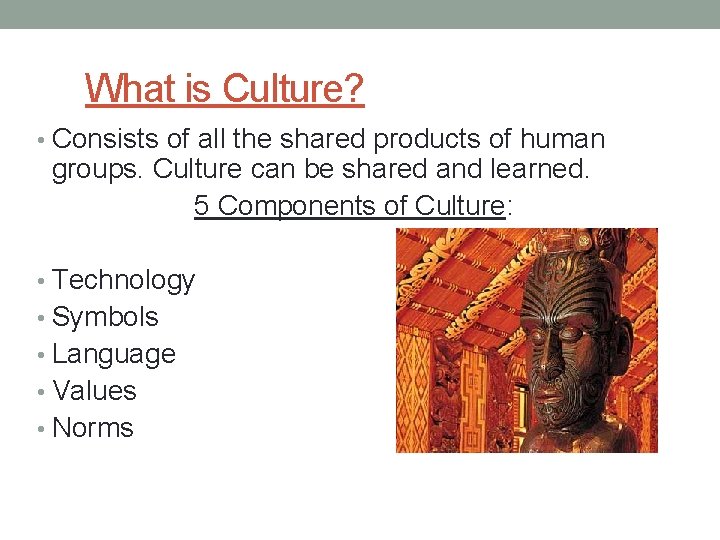
What is Culture? • Consists of all the shared products of human groups. Culture can be shared and learned. 5 Components of Culture: • Technology • Symbols • Language • Values • Norms
Material and Nonmaterial Culture • Culture can also be broken down by the following groupings: • Material Culture: Is the physical objects that people create. • Examples would be cars, books, buildings, clothing. • Nonmaterial Culture: Abstract human creations such as beliefs, ideas, language, political and economic systems.
Technology • A societies culture consists of not only physical objects but also the rules for using those physical objects. • Sociologists often refer to these rules and tools as technology. • Using items of material culture especially tools requires skills. • For example driving a car requires skills, but there are rules that govern what is acceptable when driving a car. • Sociologists would not only be interested in how the skills are developed, they would also be interested in what is acceptable behavior when using material culture.
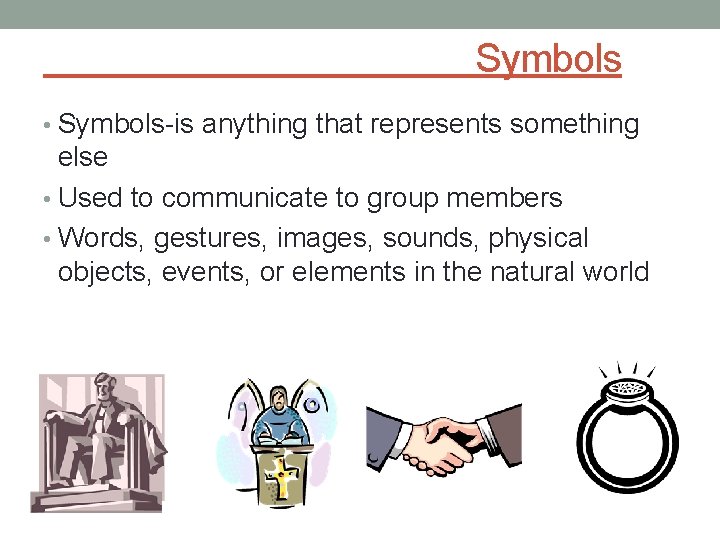
Symbols • Symbols-is anything that represents something else • Used to communicate to group members • Words, gestures, images, sounds, physical objects, events, or elements in the natural world
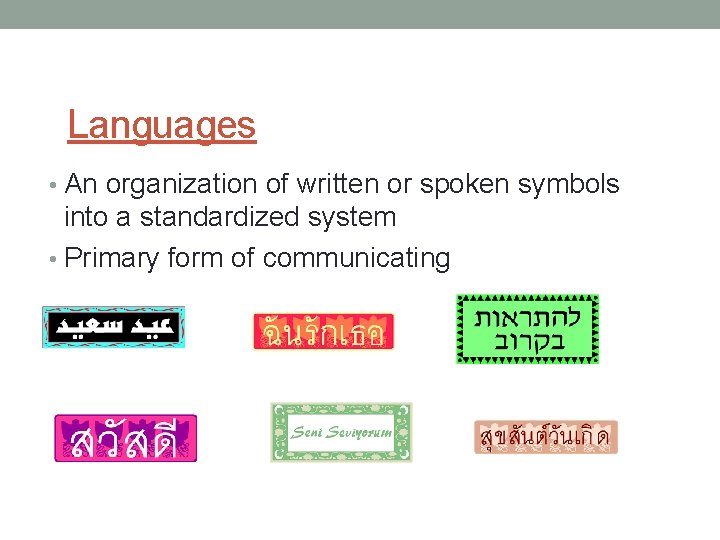
Languages • An organization of written or spoken symbols into a standardized system • Primary form of communicating
Values • Shared beliefs about what is good or bad, right or wrong, desirable or undesirable • The types of values held by a group help determine the character of its people and the kinds of material and nonmaterial culture they create.
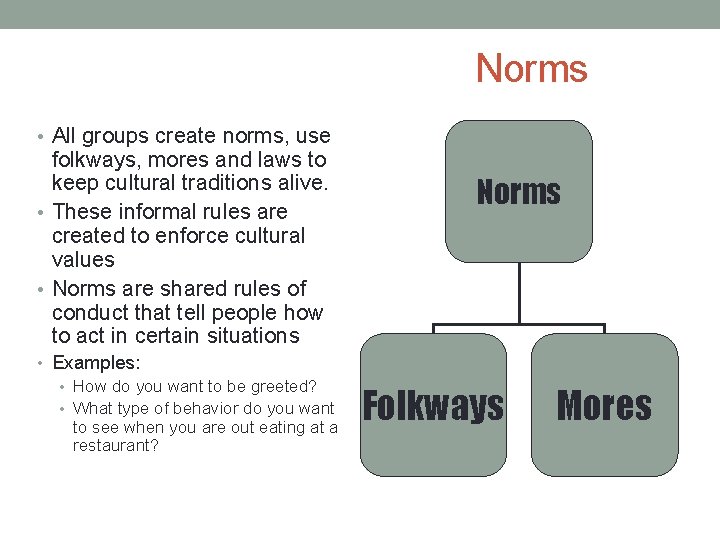
Norms • All groups create norms, use folkways, mores and laws to keep cultural traditions alive. • These informal rules are created to enforce cultural values • Norms are shared rules of conduct that tell people how to act in certain situations • Examples: • How do you want to be greeted? • What type of behavior do you want to see when you are out eating at a restaurant? Norms Folkways Mores
Mores • Mores have a greater moral significance attached to them • Violations of mores endanger a societies well-being and stability • Dishonesty • Fraud • Murder • Societies establish punishments for violating these mores LAWS.
Folkways • Folkways are norms that describe socially acceptable behavior but do not have great moral significance • Holding the door for someone • Writing thank you notes • Replying to invitations • Nonconformity is ok, because it does not endanger well- being or stability of society
How do societies enforce norms?
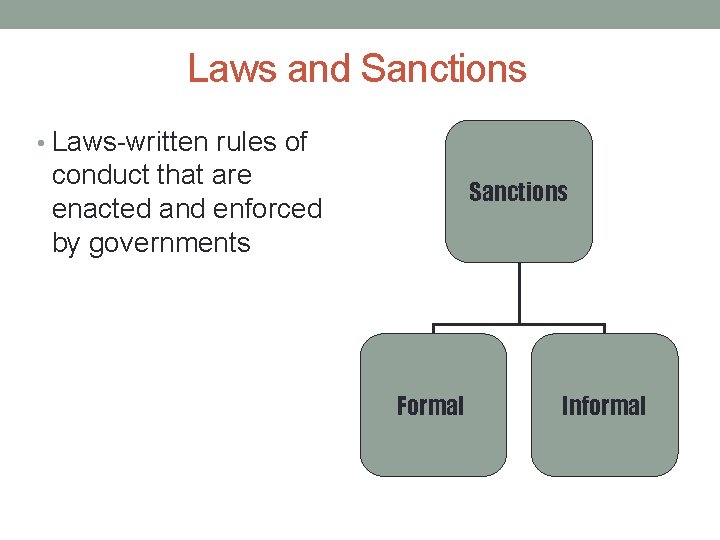
Laws and Sanctions • Laws-written rules of conduct that are enacted and enforced by governments Sanctions Formal Informal
Sanctions • Rewards or punishments in terms with norms • Positive Sanctions-Reward behavior • Negative Sanctions-Punish behavior • Informal Sanctions-given by individuals or groups • Being praised in class for doing a good job (positive) • Grounded for breaking curfew (negative) • Formal Sanctions-are given by organizations or regulatory bodies such as government, police, school • Speed tickets (negative) • MVP of the Basketball team (positive)
Cultural Traits, Complexes, and Patterns • Cultures also create cultural traits, which is an individual tool, act, or belief that is related to a particular situation or need. ( A greeting, using a tool to eat, etc. . ) • Cultural Complexes are a cluster of interrelated traits. • Culture Patterns are formed when cultural complexes are combined. • For example sports, football, basketball, baseball, soccer, swimming all combine to form American sports patterns.
Cultural Variations • Cultural variations exist not only amongst societies but also within societies. • As Americans we share common culture with all other Americans. • But within our culture there are those that share values, behaviors, and norms that are not shared by the entire population SUBCULTURE. • Most subcultures do not present a threat to society, think of ethnic neighborhoods and enclaves within American cities. • Sometimes however there are people that do reject the major values, norms and behaviors COUNTERCULTURE.
Cultural Universals • Despite the fact that cultures can be so different. • We all basically want the same thing. • These basic commonalities are called Cultural Universals. • In the 1940’s Anthropologist George Murdock created examined 100’s of different cultures in an attempt to determine what general traits are common to all cultures. • Murdock ended up creating a list of 65 cultural universals. • Examples include; cooking, music, medicine, myths, religion, sports, tool usage.
What’s Your Culture? • Download Collage Pic Collage on IPAD • Create a Collage that represents the Components of your Culture • Symbols, Values, Language and Norms • Each category must be labeled and contain a brief explanation • All images must be school appropriate • You must have a minimum of 5 images per topic • Any inappropriate images will result in no credit • Be prepared to present them to the class • 20 point quiz grade • All collages should be emailed to mcmahonc@grafton. k 12. ma. us
- Slides: 19