
UNIT 2 CONCEPTS OF SYSTEMS 2 1 Definition
- Slides: 28
UNIT 2 : CONCEPTS OF SYSTEMS 2. 1. Definition of system in an organization 2. 2. Types of systems 2. 2. 1. Deterministic probabilistic systems 2. 2. 2. Open and close systems
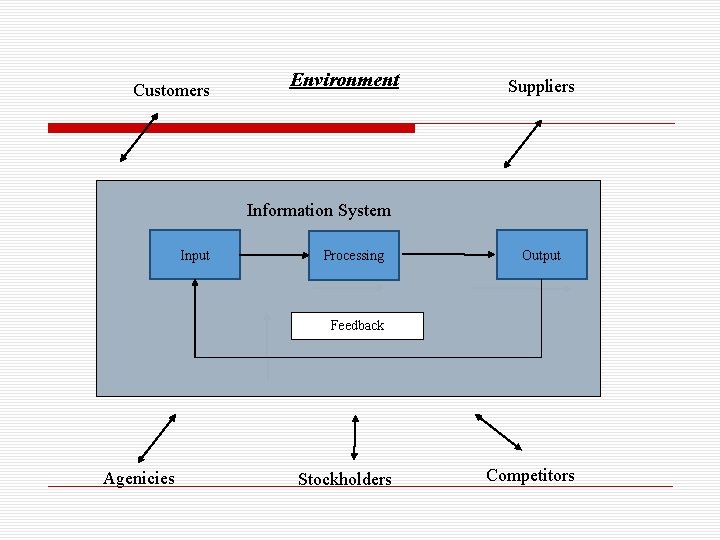
Introduction o A system is an organized collection of parts that are highly integrated in order to accomplish an overall goal. o The system has various inputs which are processed to produce certain outputs that together, accomplish the overall goal desired by the organization.
o There is ongoing feedback among these various parts to ensure they remain aligned to accomplish the overall goal of the organization. o There are several classes of systems, ranging from very simple frameworks all the way to social systems, which are the most complex. Organizations are, of course, social systems.
o Systems have inputs, processes, outputs and outcomes. o Each organization has numerous subsystems. Common examples of subsystems are departments, programs, projects, teams, processes to produce products or services, etc.
Customers Environment Suppliers Information System Input Processing Output Feedback Agenicies Stockholders Competitors
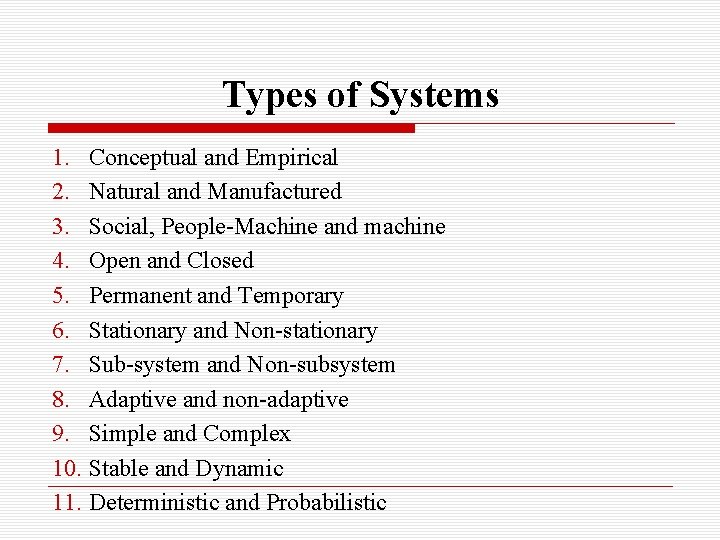
Types of Systems 1. Conceptual and Empirical 2. Natural and Manufactured 3. Social, People-Machine and machine 4. Open and Closed 5. Permanent and Temporary 6. Stationary and Non-stationary 7. Sub-system and Non-subsystem 8. Adaptive and non-adaptive 9. Simple and Complex 10. Stable and Dynamic 11. Deterministic and Probabilistic
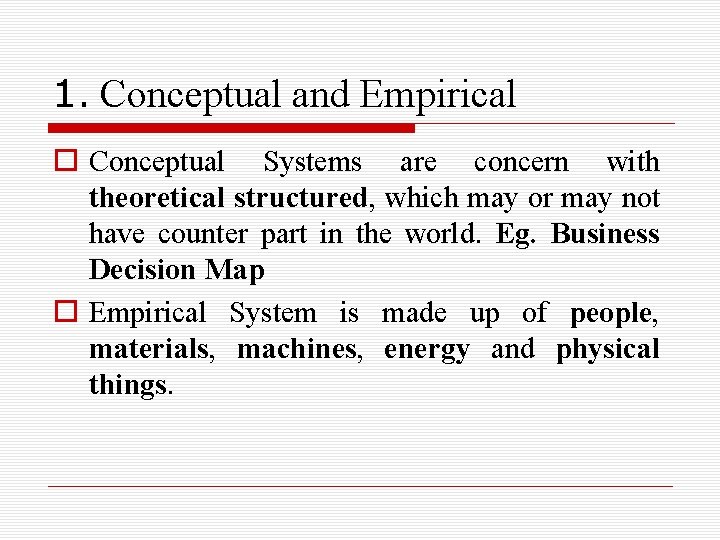
1. Conceptual and Empirical o Conceptual Systems are concern with theoretical structured, which may or may not have counter part in the world. Eg. Business Decision Map o Empirical System is made up of people, materials, machines, energy and physical things.
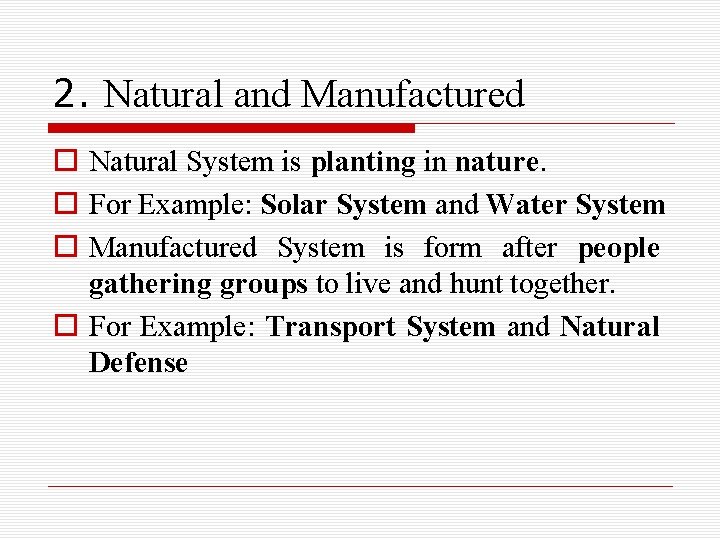
2. Natural and Manufactured o Natural System is planting in nature. o For Example: Solar System and Water System o Manufactured System is form after people gathering groups to live and hunt together. o For Example: Transport System and Natural Defense
3. Social, People-Machine and machine o System made up of people are purely social system. n For example: Political parties
4. Open and Closed o If a system is functioning in isolation from the environment, then the system does not have any exchange with the environment nor it is influenced by the environment changes such systems are CLOSED SYSTEM. n For example: Accounting System, cash, stock
o If your system is exchange from environment and is influenced by the environment then it is called OPEN SYSTEM. n For example: Marketing, Communication and forecasting
5. Permanent and Temporary o Permanent exist for a relative long period of time. o Temporary system last to specific period of time.
6. Stationary and Non-stationary o A Stationary system is one whose properties and operations either do not very in repetitive cycle. n For example: Factory, Super Market Operation o An advertising organization, Research and Development laboratory are non-stationary systems.
7. Sub-system and Non-subsystem o Each system is nested in a large system. o Super system has at lease two terms n As a opposed to subsystem n To denote any extremely large and complex system
8. Adaptive and non-adaptive o A system that reacts to its environment to such way to improve with functioning achievement of survival its called adaptive system, o Those system that do not react or adapt to the environment are called non-adaptive system.
9. Simple and Complex o Simple system have few component and the relationship or interaction between elements is an uncomplicated and straight. o Complex system has many component that are highly related and inter connected.
10. Stable and Dynamic o Stable systems undergoes very little change over time. o Dynamic systems repeatedly goes over time.
11. Deterministic and Probabilistic o A System is called deterministic when the input, process and output are known with certainty. n For example: Accounting system
Deterministic System o A system is deterministic if its outputs are certain. o This means that the relationships between its components are fully known and certain. o A deterministic system is one in which the occurrence of all events is known with certainty. o If the description of the system state at a particular point of time of its operation is given, the next state can be perfectly predicted.
o A Deterministic System has a single result or set of results given a set of input parameters. o A System is called deterministic when the input, process and output are known with certainty. n For example: Accounting system
Probabilistic System o A System is called probabilistic when the output can only be predicted in probabilistic term. n For Example: Demand forecasting system o A probabilistic system is one where the output from the system behaves probabilistically, i. e. , the output is predictable according to probability values.
o It is also known as Stochastic Model, Stochastic Process or Stochastic System. o Solved using Monte-Carlo Method. n A Computer Program uses a pseudo random number generator to provide values of the attributes of the system that vary. n The alternative to this method is to solve the problem using mathematics of probability.
Open System o Open systems are computer systems that provide some combination of interoperability, portability and open software standards. o Open systems are systems which allow users to contributes, manipulate, edit, use, reuse, mashup and in some way actually create or alter content.
o Examples of open systems include wordpress and unix, o If you modify a software it is probably an open system
o If your system is exchange from environment and is influenced by the environment then it is called OPEN SYSTEM. n For example: Marketing, Communication and forecasting
Closed System o If a system is functioning in isolation from the environment, then the system does not have any exchange with the environment nor it is influenced by the environment changes such systems are CLOSED SYSTEM. n For example: Accounting System, cash, stock
o Closed systems are systems which allow user to use content as it is, with minimal to modification to the actual system or program. o Users may email content, but the amount of what can be done is very small.
o Examples of closed systems include many library catalog software, email software such as Outlook Express